Presented By: Sridebesh Ghorui
B.Pharm, 2nd Year
Roll No.-34
Guru Nanak Institute Of Pharmaceutical Science And Technology
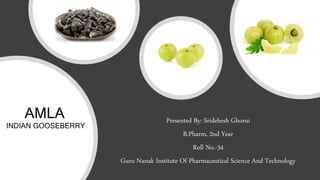
AMLA
INDIAN GOOSEBERRY
INTRODUCTION
 Name of the drug: Amla
 Synonym: Amlang
(Ar.), Amlaki (B.),
Ambala (G.), Amalica
(H.), Aunla (Or.),
Nellikai (Tm.)
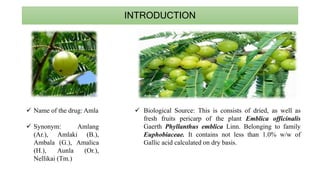
 Biological Source: This is consists of dried, as well as
fresh fruits pericarp of the plant Emblica officinalis
Gaerth Phyllanthus emblica Linn. Belonging to family
Euphobiaceae. It contains not less than 1.0% w/w of
Gallic acid calculated on dry basis.
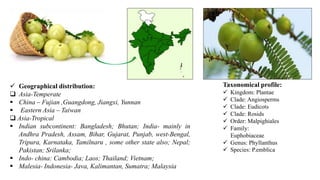
 Geographical distribution:
 Asia-Temperate
 China – Fujian ,Guangdong, Jiangxi, Yunnan
 Eastern Asia – Taiwan
 Asia-Tropical
 Indian subcontinent: Bangladesh; Bhutan; India- mainly in
Andhra Pradesh, Assam, Bihar, Gujarat, Punjab, west-Bengal,
Tripura, Karnataka, Tamilnaru , some other state also; Nepal;
Pakistan; Srilanka;
 Indo- china: Cambodia; Laos; Thailand; Vietnam;
 Malesia- Indonesia- Java, Kalimantan, Sumatra; Malaysia
Taxonomical profile:
 Kingdom: Plantae
 Clade: Angiosperms
 Clade: Eudicots
 Clade: Rosids
 Order: Malpighiales
 Family:
Euphobiaceae
 Genus: Phyllanthus
 Species: P.emblica
DESCRIPTION
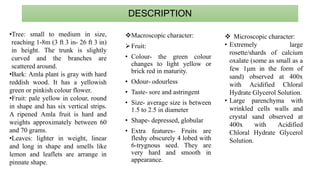
Macroscopic character:
Fruit:
• Colour- the green colour
changes to light yellow or
brick red in maturity.
• Odour- odourless
• Taste- sore and astringent
• Size- average size is between
1.5 to 2.5 in diameter
• Shape- depressed, globular
• Extra features- Fruits are
fleshy obscurely 4 lobed with
6-trygnous seed. They are
very hard and smooth in
appearance.
•Tree: small to medium in size,
reaching 1-8m (3 ft 3 in- 26 ft 3 in)
in height. The trunk is slightly
curved and the branches are
scattered around.
•Bark: Amla plant is gray with hard
reddish wood. It has a yellowish
green or pinkish colour flower.
•Fruit: pale yellow in colour, round
in shape and has six vertical strips.
A ripened Amla fruit is hard and
weights approximately between 60
and 70 grams.
•Leaves: lighter in weight, linear
and long in shape and smells like
lemon and leaflets are arrange in
pinnate shape.
 Microscopic character:
• Extremely large
rosette/shards of calcium
oxalate (some as small as a
few 1μm in the form of
sand) observed at 400x
with Acidified Chloral
Hydrate Glycerol Solution.
• Large parenchyma with
wrinkled cells walls and
crystal sand observed at
400x with Acidified
Chloral Hydrate Glycerol
Solution.
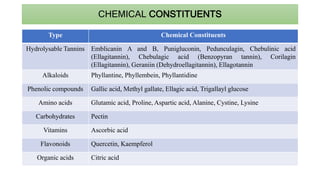
CHEMICAL CONSTITUENTS
Type Chemical Constituents
Hydrolysable Tannins Emblicanin A and B, Punigluconin, Pedunculagin, Chebulinic acid
(Ellagitannin), Chebulagic acid (Benzopyran tannin), Corilagin
(Ellagitannin), Geraniin (Dehydroellagitannin), Ellagotannin
Alkaloids Phyllantine, Phyllembein, Phyllantidine
Phenolic compounds Gallic acid, Methyl gallate, Ellagic acid, Trigallayl glucose
Amino acids Glutamic acid, Proline, Aspartic acid, Alanine, Cystine, Lysine
Carbohydrates Pectin
Vitamins Ascorbic acid
Flavonoids Quercetin, Kaempferol
Organic acids Citric acid
CHEMICAL TEST, IDENTIFICATION OF AMLA, ALLIED DRUG,
ADULTERANTS
Chemical test:
• Identification of chemical
constituents:-
• Ferric chloride test- In amla
there are present
hydrolysable tannin. When
the aqueous or alcoholic
extract of amla is treated
with ferric chloride
solution. The blue colour is
obtained.
• Adding of gelatine and
sodium chloride solution in
the aqueous extract
produced milky white
colour.
Identification of amla:
• Foreign organic matter-
not more than 3%
• Water soluble extractive-
not less than 40%
• Ethanol soluble extractive-
not less 30%
• Total ash- not more than
5%
• Acid insoluble ash- not
more than 2%
• Loss on drying- not more
than 12%. Determined on
5 gm by drying in an oven
at 105 ᵒc.
 Allied drug:
Phyllanthus emblica and
phyllanthous amarus
(bhumi amla) is use as allied
drug instead or admix with
Emblica officinalis.
 Adulterants:
Small leather pieces or fruits
pulp is drying and makes
look like drying amla they
are admix as adulterants.
Sour flavour is added in this.
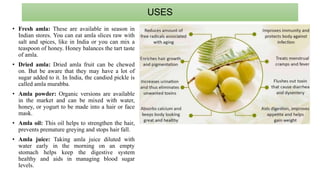
USES
• Fresh amla: These are available in season in
Indian stores. You can eat amla slices raw with
salt and spices, like in India or you can mix a
teaspoon of honey. Honey balances the tart taste
of amla.
• Dried amla: Dried amla fruit can be chewed
on. But be aware that they may have a lot of
sugar added to it. In India, the candied pickle is
called amla murabba.
• Amla powder: Organic versions are available
in the market and can be mixed with water,
honey, or yogurt to be made into a hair or face
mask.
• Amla oil: This oil helps to strengthen the hair,
prevents premature greying and stops hair fall.
• Amla juice: Taking amla juice diluted with
water early in the morning on an empty
stomach helps keep the digestive system
healthy and aids in managing blood sugar
levels.
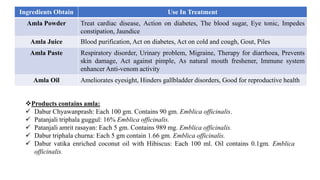
Ingredients Obtain Use In Treatment
Amla Powder Treat cardiac disease, Action on diabetes, The blood sugar, Eye tonic, Impedes
constipation, Jaundice
Amla Juice Blood purification, Act on diabetes, Act on cold and cough, Gout, Piles
Amla Paste Respiratory disorder, Urinary problem, Migraine, Therapy for diarrhoea, Prevents
skin damage, Act against pimple, As natural mouth freshener, Immune system
enhancer Anti-venom activity
Amla Oil Ameliorates eyesight, Hinders gallbladder disorders, Good for reproductive health
Products contains amla:
 Dabur Chyawanprash: Each 100 gm. Contains 90 gm. Emblica officinalis.
 Patanjali triphala guggul: 16% Emblica officinalis.
 Patanjali amrit rasayan: Each 5 gm. Contains 989 mg. Emblica officinalis.
 Dabur triphala churna: Each 5 gm contain 1.66 gm. Emblica officinalis.
 Dabur vatika enriched coconut oil with Hibiscus: Each 100 ml. Oil contains 0.1gm. Emblica
officinalis.
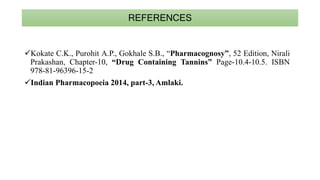
REFERENCES
Kokate C.K., Purohit A.P., Gokhale S.B., “Pharmacognosy”, 52 Edition, Nirali
Prakashan, Chapter-10, “Drug Containing Tannins” Page-10.4-10.5. ISBN
978-81-96396-15-2
Indian Pharmacopoeia 2014, part-3, Amlaki.

Amla

  • 1.
    Presented By: SridebeshGhorui B.Pharm, 2nd Year Roll No.-34 Guru Nanak Institute Of Pharmaceutical Science And Technology AMLA INDIAN GOOSEBERRY
  • 2.
    INTRODUCTION  Name ofthe drug: Amla  Synonym: Amlang (Ar.), Amlaki (B.), Ambala (G.), Amalica (H.), Aunla (Or.), Nellikai (Tm.)  Biological Source: This is consists of dried, as well as fresh fruits pericarp of the plant Emblica officinalis Gaerth Phyllanthus emblica Linn. Belonging to family Euphobiaceae. It contains not less than 1.0% w/w of Gallic acid calculated on dry basis.
  • 3.
     Geographical distribution: Asia-Temperate  China – Fujian ,Guangdong, Jiangxi, Yunnan  Eastern Asia – Taiwan  Asia-Tropical  Indian subcontinent: Bangladesh; Bhutan; India- mainly in Andhra Pradesh, Assam, Bihar, Gujarat, Punjab, west-Bengal, Tripura, Karnataka, Tamilnaru , some other state also; Nepal; Pakistan; Srilanka;  Indo- china: Cambodia; Laos; Thailand; Vietnam;  Malesia- Indonesia- Java, Kalimantan, Sumatra; Malaysia Taxonomical profile:  Kingdom: Plantae  Clade: Angiosperms  Clade: Eudicots  Clade: Rosids  Order: Malpighiales  Family: Euphobiaceae  Genus: Phyllanthus  Species: P.emblica
  • 4.
    DESCRIPTION Macroscopic character: Fruit: • Colour-the green colour changes to light yellow or brick red in maturity. • Odour- odourless • Taste- sore and astringent • Size- average size is between 1.5 to 2.5 in diameter • Shape- depressed, globular • Extra features- Fruits are fleshy obscurely 4 lobed with 6-trygnous seed. They are very hard and smooth in appearance. •Tree: small to medium in size, reaching 1-8m (3 ft 3 in- 26 ft 3 in) in height. The trunk is slightly curved and the branches are scattered around. •Bark: Amla plant is gray with hard reddish wood. It has a yellowish green or pinkish colour flower. •Fruit: pale yellow in colour, round in shape and has six vertical strips. A ripened Amla fruit is hard and weights approximately between 60 and 70 grams. •Leaves: lighter in weight, linear and long in shape and smells like lemon and leaflets are arrange in pinnate shape.  Microscopic character: • Extremely large rosette/shards of calcium oxalate (some as small as a few 1μm in the form of sand) observed at 400x with Acidified Chloral Hydrate Glycerol Solution. • Large parenchyma with wrinkled cells walls and crystal sand observed at 400x with Acidified Chloral Hydrate Glycerol Solution.
  • 5.
    CHEMICAL CONSTITUENTS Type ChemicalConstituents Hydrolysable Tannins Emblicanin A and B, Punigluconin, Pedunculagin, Chebulinic acid (Ellagitannin), Chebulagic acid (Benzopyran tannin), Corilagin (Ellagitannin), Geraniin (Dehydroellagitannin), Ellagotannin Alkaloids Phyllantine, Phyllembein, Phyllantidine Phenolic compounds Gallic acid, Methyl gallate, Ellagic acid, Trigallayl glucose Amino acids Glutamic acid, Proline, Aspartic acid, Alanine, Cystine, Lysine Carbohydrates Pectin Vitamins Ascorbic acid Flavonoids Quercetin, Kaempferol Organic acids Citric acid
  • 6.
    CHEMICAL TEST, IDENTIFICATIONOF AMLA, ALLIED DRUG, ADULTERANTS Chemical test: • Identification of chemical constituents:- • Ferric chloride test- In amla there are present hydrolysable tannin. When the aqueous or alcoholic extract of amla is treated with ferric chloride solution. The blue colour is obtained. • Adding of gelatine and sodium chloride solution in the aqueous extract produced milky white colour. Identification of amla: • Foreign organic matter- not more than 3% • Water soluble extractive- not less than 40% • Ethanol soluble extractive- not less 30% • Total ash- not more than 5% • Acid insoluble ash- not more than 2% • Loss on drying- not more than 12%. Determined on 5 gm by drying in an oven at 105 ᵒc.  Allied drug: Phyllanthus emblica and phyllanthous amarus (bhumi amla) is use as allied drug instead or admix with Emblica officinalis.  Adulterants: Small leather pieces or fruits pulp is drying and makes look like drying amla they are admix as adulterants. Sour flavour is added in this.
  • 7.
    USES • Fresh amla:These are available in season in Indian stores. You can eat amla slices raw with salt and spices, like in India or you can mix a teaspoon of honey. Honey balances the tart taste of amla. • Dried amla: Dried amla fruit can be chewed on. But be aware that they may have a lot of sugar added to it. In India, the candied pickle is called amla murabba. • Amla powder: Organic versions are available in the market and can be mixed with water, honey, or yogurt to be made into a hair or face mask. • Amla oil: This oil helps to strengthen the hair, prevents premature greying and stops hair fall. • Amla juice: Taking amla juice diluted with water early in the morning on an empty stomach helps keep the digestive system healthy and aids in managing blood sugar levels.
  • 8.
    Ingredients Obtain UseIn Treatment Amla Powder Treat cardiac disease, Action on diabetes, The blood sugar, Eye tonic, Impedes constipation, Jaundice Amla Juice Blood purification, Act on diabetes, Act on cold and cough, Gout, Piles Amla Paste Respiratory disorder, Urinary problem, Migraine, Therapy for diarrhoea, Prevents skin damage, Act against pimple, As natural mouth freshener, Immune system enhancer Anti-venom activity Amla Oil Ameliorates eyesight, Hinders gallbladder disorders, Good for reproductive health Products contains amla:  Dabur Chyawanprash: Each 100 gm. Contains 90 gm. Emblica officinalis.  Patanjali triphala guggul: 16% Emblica officinalis.  Patanjali amrit rasayan: Each 5 gm. Contains 989 mg. Emblica officinalis.  Dabur triphala churna: Each 5 gm contain 1.66 gm. Emblica officinalis.  Dabur vatika enriched coconut oil with Hibiscus: Each 100 ml. Oil contains 0.1gm. Emblica officinalis.
  • 9.
    REFERENCES Kokate C.K., PurohitA.P., Gokhale S.B., “Pharmacognosy”, 52 Edition, Nirali Prakashan, Chapter-10, “Drug Containing Tannins” Page-10.4-10.5. ISBN 978-81-96396-15-2 Indian Pharmacopoeia 2014, part-3, Amlaki.

Editor's Notes

  • #5 When conducting research, it is easy to go to one source: Wikipedia. However, you need to include a variety of sources in your research. Consider the following sources: Who can I interview to get more information on the topic? Is the topic current and will it be relevant to my audience? What articles, blogs, and magazines may have something related to my topic? Is there a YouTube video on the topic? If so, what is it about? What images can I find related to the topic?