“SULFONAMIDES”- THE ANTIMICROBIAL AGENTS
PRESENTED BY
SRIDEBESH GHORUI , SRADDHA MAJUMDER
ROLL NO.: 18601916034, 18601916035
B.PHARM, 4TH YEAR, 7TH SEMESTER, SECTION: A
GURU NANAK INSTITUTE OF PHARMACEUTICAL SCIENCE AND TECHNOLOGY
1
CONTENTS
 Introduction
 Mechanism of Action
 SAR of Sulfonamides
 Classification
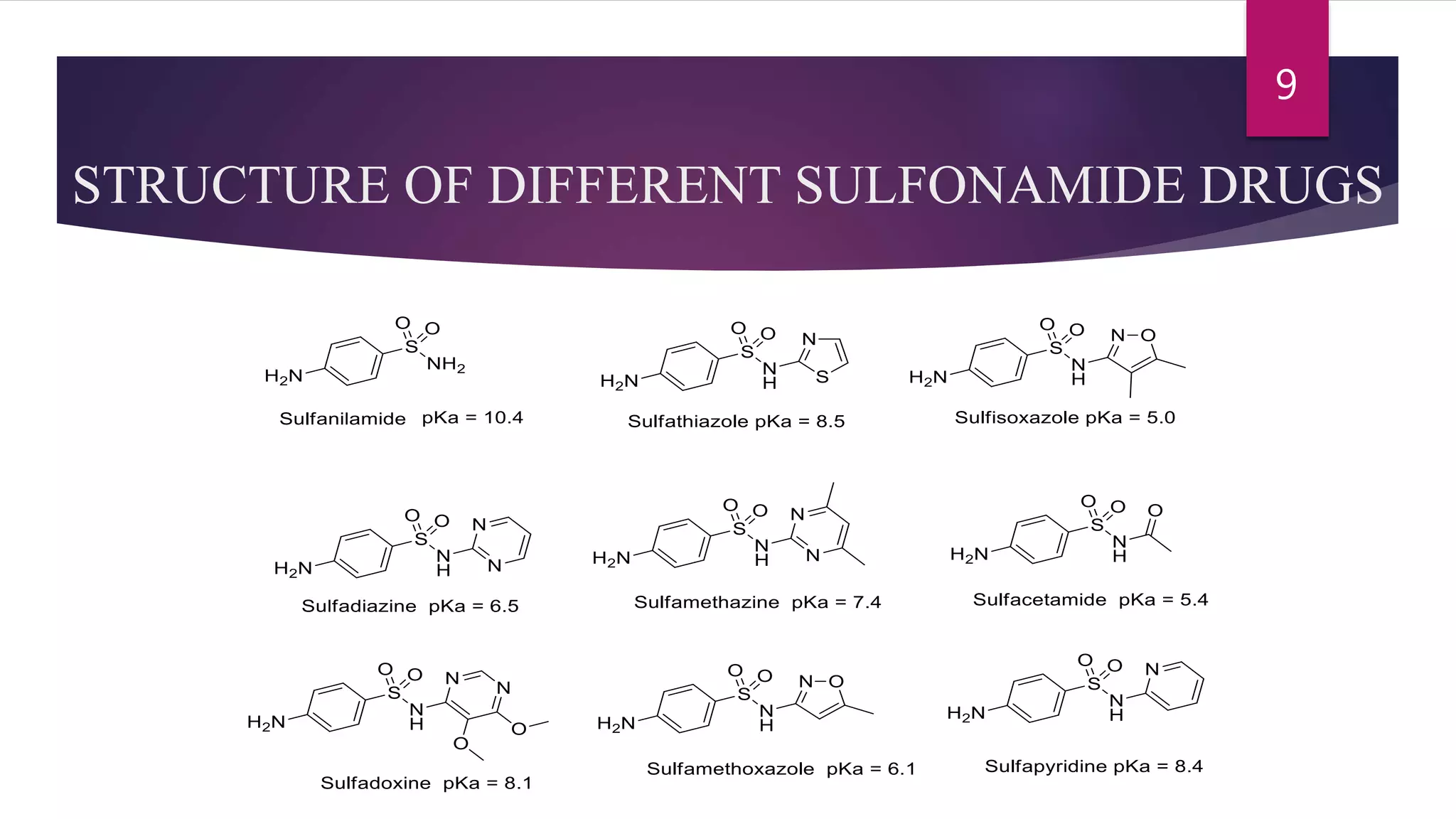
 Structure of Different Sulfonamide Drugs
 Individual Sulfonamides Uses
 Drug Interaction and Contraindication
 Adverse Effect and Side Effect
 Conclusion
 References
2
INTRODUCTION
 Sulfonamides are the first successfully synthesized antimicrobial drugs. The mechanism of sulfonamides
antimicrobial action involves competitive inhibition of folic acid synthesis which prevents the growth
and reproduction of microorganisms.
 Due to this mechanism of action, sulfonamides belong to the group of bacteriostatic agents.
 The discovery of the prontosil (Prontosil rubrum) antimicrobial effect, in the early 30s of the 20th
century represents the beginning of the chemotherapy development.
 Prontosil is an azo-dye with the sulfonamide structure. In the human body, prontosil is metabolized into
sulfanilamide under the action of cellular enzymes.
+
Prontosil sulfanilamide 1,2,4 –triaminobenzene
3
MECHANISM OF
ACTION
Sulfonamides are competitive
antagonists of p-aminobenzoic
acid (PABA), the compound
essential for the synthesis of folic
acid, and thus for the bacterial
growth and reproduction.
Sulfonamides reversibly block the
synthesis of folic acid, thus
having the bacteriostatic effect.
The basis of the inhibitory effect
is the similarity between
sulfonamide and PABA
structures.
4
SAR OF SULFONAMIDES
 General structure:
 It could be divided into 4 parts:
 Para amino group
 Aromatic ring
 Sulfonamide group
 N1-substitution
5
SAR OF SULFONAMIDES
 Para amino group:
 The para amino group is essential for the
activity and must be unsubstituted.
(exception= mafenide)
 It should be always substituted in para
position of aromatic ring other wish activity
will be loss.
 But it could be substituted with amide.
 Aromatic ring:
 It is the minimal structural requirements for
activity.
 It should be always para substituted.
 Other substitution in aromatic ring resulting
the formation of inactive compound.
6
SAR OF SULFONAMIDES
 Sulfonamide group:
 Sulfonamide group with aromatic ring is
essential for the anti bacterial activity.
 Sulphur atom is directly linked with aromatic
ring.
 Substitution of free sulfonic acid(-SO3H) for
sulfonamide group destroys activity.
 Replacement by sulfinic acid (-SO2H) and
acetylation at N4 position retains the activity.
 The active form of sulfonamides is in the
ionised form and maximum activity is observed
at pH values 6.6 to 7.4.
 N1-substitution:
 Sulfonamide nitrogen should be primary or
secondary.
 R could be substituted with hydrogen, aromatic
ring or heterocyclic ring.
 Heterocyclic ring substitution leads to highly
potent compound.
 Sulfonamides that contains single benzene ring
at N1 position are toxic.
7
CLASSIFICATION
 Sulfonamides are the first successfully synthesized selectively toxic antimicrobial drugs. Sulfonamides
with the antimicrobial activity represent a large group of drugs which can be classified in different ways:
One of the most comprehensive is the
sulfonamides classification into:
• Oral sulfonamides which can be absorbed
( Sulfamethoxazole)
• Oral sulfonamides which cannot be absorbed
(Sulfasalazine)
• Topical sulfonamides (Sodium sulfacetamide)
According to the duration of action and half-life,
absorbable oral sulfonamides can be further
divided into:
• Short-acting sulfonamides (3-8 h)
(Sulfadiazine)
• Intermediate-acting sulfonamides (8-12 h)
(Sulfamethoxazole)
• Long-acting sulfonamides (>35 h)
(Sulfadoxine)
8
STRUCTURE OF DIFFERENT SULFONAMIDE DRUGS
9
INDIVIDUAL SULFONAMIDES USES
 Eye Infection:
Sulfacetamide (10%, 20%, 30%).
 Skin Infection:
Silver sulfadiazine,
Mafenide acetate.
 GIT Infection:
Succinyl sulfathiazole,
Sulfaguanidine.
 Meningitis:
Sulfadiazine,
Sulfadimidine.
 UTI Infections:
Sulfioxazole,
Sulfamethopyrazine.
 Respiratory Tract Infection:
Sulfaphenazine,
Cotrimoxazole.
 Leprosy:
Dapsone, Solapsone
 Drugs For Bowel Disinfection:
Sulfasalazine,
Pthalylsulfathiazole.
 Malaria:
Sulfadoxine+pyrimethamine.
 Nocardiosis:
Sulfadiazine, Sulfisoxazole.
10
DRUG INTERACTION AND CONTRAINDICATION
 Drug interaction:
 Sulfonamides can increase the blood-thinning effects of warfarin ,possibly leading to abnormal
bleeding.
 All sulfonamides can crystallize in the urine when the urine is acidic. Since methenamine causes
acidic urine, it should not be used with sulfonamides.
 Increased blood levels of potassium may occur when sulfamethoxazole/trimethoprim is combined
with angiotensin converting enzyme (ACE) inhibitors.
 The increased metabolism (break-down and elimination) of cyclosporine by the liver caused by
sulfonamides. Because the kidney damage caused by unmetabolized cyclosporine.
 Contraindication:
 Pregnancy(full term)
 New born and infants( < 2 months)
 Patients on methenamine, tolbutamide and oral anti-coagulants.
11
ADVERSE EFFECT AND
SIDE EFFECT
Sulfonamides have the potential to cause a variety of
untoward reactions, including urinary tract disorders,
haemopoietic disorders, porphyria and
hypersensitivity reactions. When used in large doses,
they may cause a strong allergic reaction.
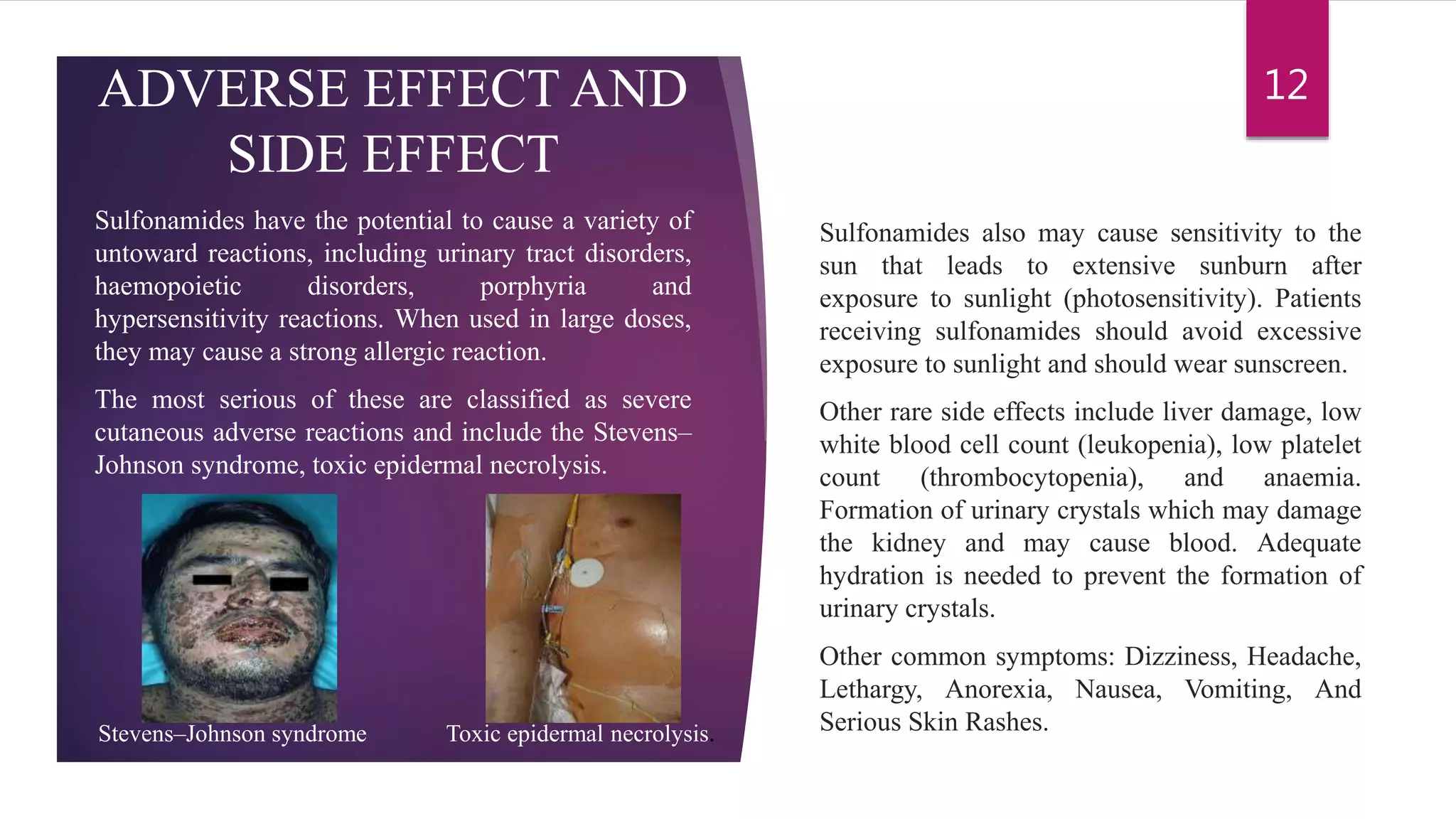
The most serious of these are classified as severe
cutaneous adverse reactions and include the Stevens–
Johnson syndrome, toxic epidermal necrolysis.
Sulfonamides also may cause sensitivity to the
sun that leads to extensive sunburn after
exposure to sunlight (photosensitivity). Patients
receiving sulfonamides should avoid excessive
exposure to sunlight and should wear sunscreen.
Other rare side effects include liver damage, low
white blood cell count (leukopenia), low platelet
count (thrombocytopenia), and anaemia.
Formation of urinary crystals which may damage
the kidney and may cause blood. Adequate
hydration is needed to prevent the formation of
urinary crystals.
Other common symptoms: Dizziness, Headache,
Lethargy, Anorexia, Nausea, Vomiting, And
Serious Skin Rashes.
12
Stevens–Johnson syndrome Toxic epidermal necrolysis.
CONCLUSION
 Sulfonamide antimicrobial drugs represent an important class of synthetic substances with different
physicochemical, pharmacokinetic and pharmacodynamic characteristics.
 Sulfonamides are used in the therapy of urogenital, gastrointestinal and respiratory tract infections, then
for the eye, skin and mucous membrane infections, as well as in the prevention and treatment of burn
infections.
 The sulfonamides application in the therapy is partially limited by the bacterial resistance .
 In order to overcome the resistance and to reduce the adverse effects, continuous efforts are made to
synthesize novel antimicrobial compounds with the sulfonamide structure and to develop novel
formulations with the existing sulfonamide substances.
 On the other side, the sulfonamides application in therapy leads to their introduction into the
environment and maintaining the resistance.
13
REFERENCES
• Katzung Betram G., Masters Susan B., Trevor Anthony J., “Basic and Clinical Pharmacology”,
Chapter- 46, Page- 834-836.
• Tripathi KD., “Essential Of Medical Pharmacology”, 7th Edition, Chapter- 50 (Sulfonamides,
Cotrimoxazole And Quinolones), Page- 704-706, ISBN: 978-93-5025-937-5.
• Lemke T.L., Zito S.W., Roche V.F., Williams D.A., “South Asian Edition Essentials of Foye’s
Principles Of Medicinal Chemistry”, Chapter-23 (Antimicrobial Agents), Page- 435-438, ISBN:
978-1-4511-9206-3.
14

Sulfonamides

  • 1.
    “SULFONAMIDES”- THE ANTIMICROBIALAGENTS PRESENTED BY SRIDEBESH GHORUI , SRADDHA MAJUMDER ROLL NO.: 18601916034, 18601916035 B.PHARM, 4TH YEAR, 7TH SEMESTER, SECTION: A GURU NANAK INSTITUTE OF PHARMACEUTICAL SCIENCE AND TECHNOLOGY 1
  • 2.
    CONTENTS  Introduction  Mechanismof Action  SAR of Sulfonamides  Classification  Structure of Different Sulfonamide Drugs  Individual Sulfonamides Uses  Drug Interaction and Contraindication  Adverse Effect and Side Effect  Conclusion  References 2
  • 3.
    INTRODUCTION  Sulfonamides arethe first successfully synthesized antimicrobial drugs. The mechanism of sulfonamides antimicrobial action involves competitive inhibition of folic acid synthesis which prevents the growth and reproduction of microorganisms.  Due to this mechanism of action, sulfonamides belong to the group of bacteriostatic agents.  The discovery of the prontosil (Prontosil rubrum) antimicrobial effect, in the early 30s of the 20th century represents the beginning of the chemotherapy development.  Prontosil is an azo-dye with the sulfonamide structure. In the human body, prontosil is metabolized into sulfanilamide under the action of cellular enzymes. + Prontosil sulfanilamide 1,2,4 –triaminobenzene 3
  • 4.
    MECHANISM OF ACTION Sulfonamides arecompetitive antagonists of p-aminobenzoic acid (PABA), the compound essential for the synthesis of folic acid, and thus for the bacterial growth and reproduction. Sulfonamides reversibly block the synthesis of folic acid, thus having the bacteriostatic effect. The basis of the inhibitory effect is the similarity between sulfonamide and PABA structures. 4
  • 5.
    SAR OF SULFONAMIDES General structure:  It could be divided into 4 parts:  Para amino group  Aromatic ring  Sulfonamide group  N1-substitution 5
  • 6.
    SAR OF SULFONAMIDES Para amino group:  The para amino group is essential for the activity and must be unsubstituted. (exception= mafenide)  It should be always substituted in para position of aromatic ring other wish activity will be loss.  But it could be substituted with amide.  Aromatic ring:  It is the minimal structural requirements for activity.  It should be always para substituted.  Other substitution in aromatic ring resulting the formation of inactive compound. 6
  • 7.
    SAR OF SULFONAMIDES Sulfonamide group:  Sulfonamide group with aromatic ring is essential for the anti bacterial activity.  Sulphur atom is directly linked with aromatic ring.  Substitution of free sulfonic acid(-SO3H) for sulfonamide group destroys activity.  Replacement by sulfinic acid (-SO2H) and acetylation at N4 position retains the activity.  The active form of sulfonamides is in the ionised form and maximum activity is observed at pH values 6.6 to 7.4.  N1-substitution:  Sulfonamide nitrogen should be primary or secondary.  R could be substituted with hydrogen, aromatic ring or heterocyclic ring.  Heterocyclic ring substitution leads to highly potent compound.  Sulfonamides that contains single benzene ring at N1 position are toxic. 7
  • 8.
    CLASSIFICATION  Sulfonamides arethe first successfully synthesized selectively toxic antimicrobial drugs. Sulfonamides with the antimicrobial activity represent a large group of drugs which can be classified in different ways: One of the most comprehensive is the sulfonamides classification into: • Oral sulfonamides which can be absorbed ( Sulfamethoxazole) • Oral sulfonamides which cannot be absorbed (Sulfasalazine) • Topical sulfonamides (Sodium sulfacetamide) According to the duration of action and half-life, absorbable oral sulfonamides can be further divided into: • Short-acting sulfonamides (3-8 h) (Sulfadiazine) • Intermediate-acting sulfonamides (8-12 h) (Sulfamethoxazole) • Long-acting sulfonamides (>35 h) (Sulfadoxine) 8
  • 9.
    STRUCTURE OF DIFFERENTSULFONAMIDE DRUGS 9
  • 10.
    INDIVIDUAL SULFONAMIDES USES Eye Infection: Sulfacetamide (10%, 20%, 30%).  Skin Infection: Silver sulfadiazine, Mafenide acetate.  GIT Infection: Succinyl sulfathiazole, Sulfaguanidine.  Meningitis: Sulfadiazine, Sulfadimidine.  UTI Infections: Sulfioxazole, Sulfamethopyrazine.  Respiratory Tract Infection: Sulfaphenazine, Cotrimoxazole.  Leprosy: Dapsone, Solapsone  Drugs For Bowel Disinfection: Sulfasalazine, Pthalylsulfathiazole.  Malaria: Sulfadoxine+pyrimethamine.  Nocardiosis: Sulfadiazine, Sulfisoxazole. 10
  • 11.
    DRUG INTERACTION ANDCONTRAINDICATION  Drug interaction:  Sulfonamides can increase the blood-thinning effects of warfarin ,possibly leading to abnormal bleeding.  All sulfonamides can crystallize in the urine when the urine is acidic. Since methenamine causes acidic urine, it should not be used with sulfonamides.  Increased blood levels of potassium may occur when sulfamethoxazole/trimethoprim is combined with angiotensin converting enzyme (ACE) inhibitors.  The increased metabolism (break-down and elimination) of cyclosporine by the liver caused by sulfonamides. Because the kidney damage caused by unmetabolized cyclosporine.  Contraindication:  Pregnancy(full term)  New born and infants( < 2 months)  Patients on methenamine, tolbutamide and oral anti-coagulants. 11
  • 12.
    ADVERSE EFFECT AND SIDEEFFECT Sulfonamides have the potential to cause a variety of untoward reactions, including urinary tract disorders, haemopoietic disorders, porphyria and hypersensitivity reactions. When used in large doses, they may cause a strong allergic reaction. The most serious of these are classified as severe cutaneous adverse reactions and include the Stevens– Johnson syndrome, toxic epidermal necrolysis. Sulfonamides also may cause sensitivity to the sun that leads to extensive sunburn after exposure to sunlight (photosensitivity). Patients receiving sulfonamides should avoid excessive exposure to sunlight and should wear sunscreen. Other rare side effects include liver damage, low white blood cell count (leukopenia), low platelet count (thrombocytopenia), and anaemia. Formation of urinary crystals which may damage the kidney and may cause blood. Adequate hydration is needed to prevent the formation of urinary crystals. Other common symptoms: Dizziness, Headache, Lethargy, Anorexia, Nausea, Vomiting, And Serious Skin Rashes. 12 Stevens–Johnson syndrome Toxic epidermal necrolysis.
  • 13.
    CONCLUSION  Sulfonamide antimicrobialdrugs represent an important class of synthetic substances with different physicochemical, pharmacokinetic and pharmacodynamic characteristics.  Sulfonamides are used in the therapy of urogenital, gastrointestinal and respiratory tract infections, then for the eye, skin and mucous membrane infections, as well as in the prevention and treatment of burn infections.  The sulfonamides application in the therapy is partially limited by the bacterial resistance .  In order to overcome the resistance and to reduce the adverse effects, continuous efforts are made to synthesize novel antimicrobial compounds with the sulfonamide structure and to develop novel formulations with the existing sulfonamide substances.  On the other side, the sulfonamides application in therapy leads to their introduction into the environment and maintaining the resistance. 13
  • 14.
    REFERENCES • Katzung BetramG., Masters Susan B., Trevor Anthony J., “Basic and Clinical Pharmacology”, Chapter- 46, Page- 834-836. • Tripathi KD., “Essential Of Medical Pharmacology”, 7th Edition, Chapter- 50 (Sulfonamides, Cotrimoxazole And Quinolones), Page- 704-706, ISBN: 978-93-5025-937-5. • Lemke T.L., Zito S.W., Roche V.F., Williams D.A., “South Asian Edition Essentials of Foye’s Principles Of Medicinal Chemistry”, Chapter-23 (Antimicrobial Agents), Page- 435-438, ISBN: 978-1-4511-9206-3. 14