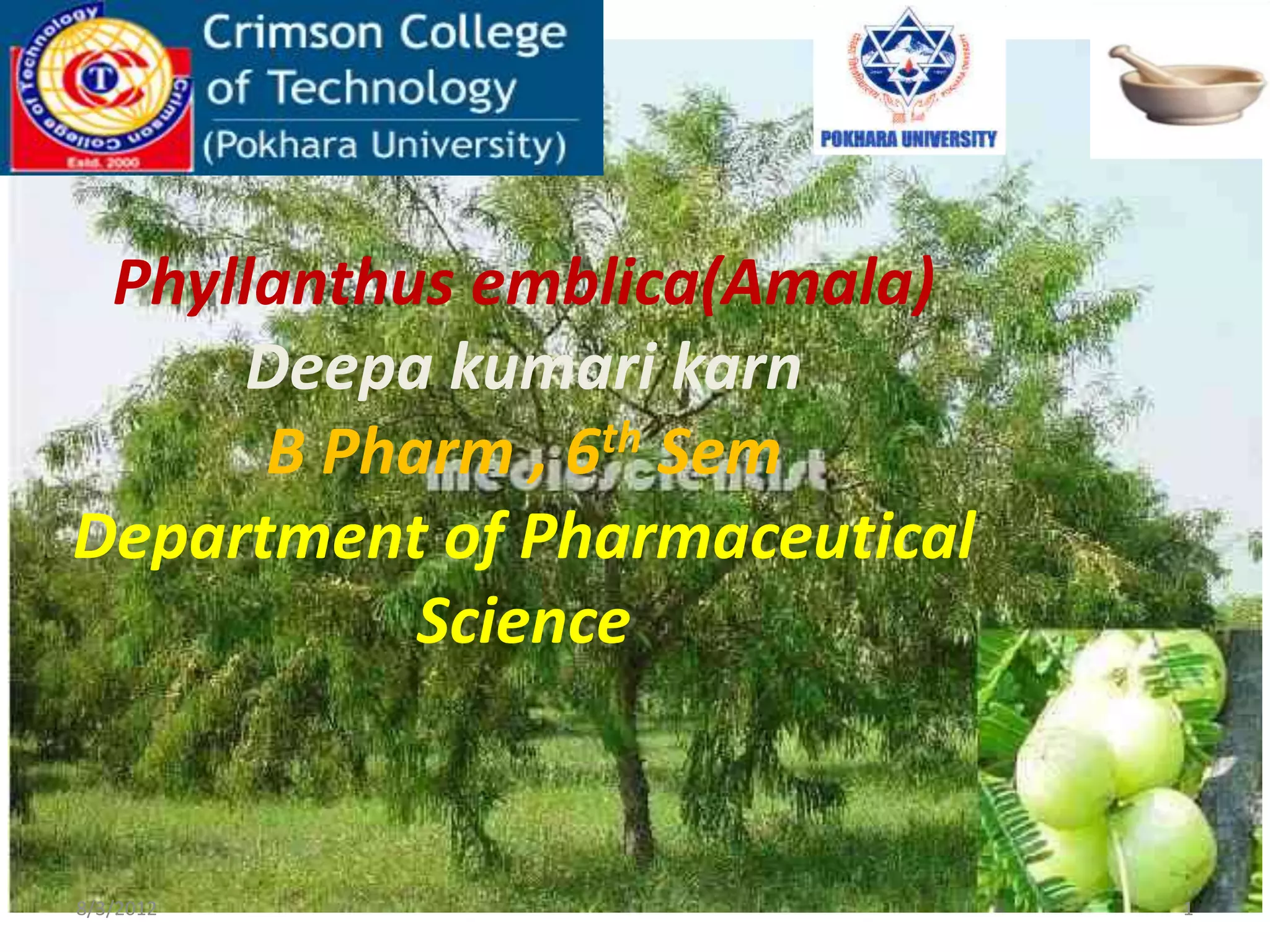
Phyllanthus emblica(Amala)
Deepa kumari karn
B Pharm , 6th Sem
Department of Pharmaceutical
Science
8/3/2012 1
Source
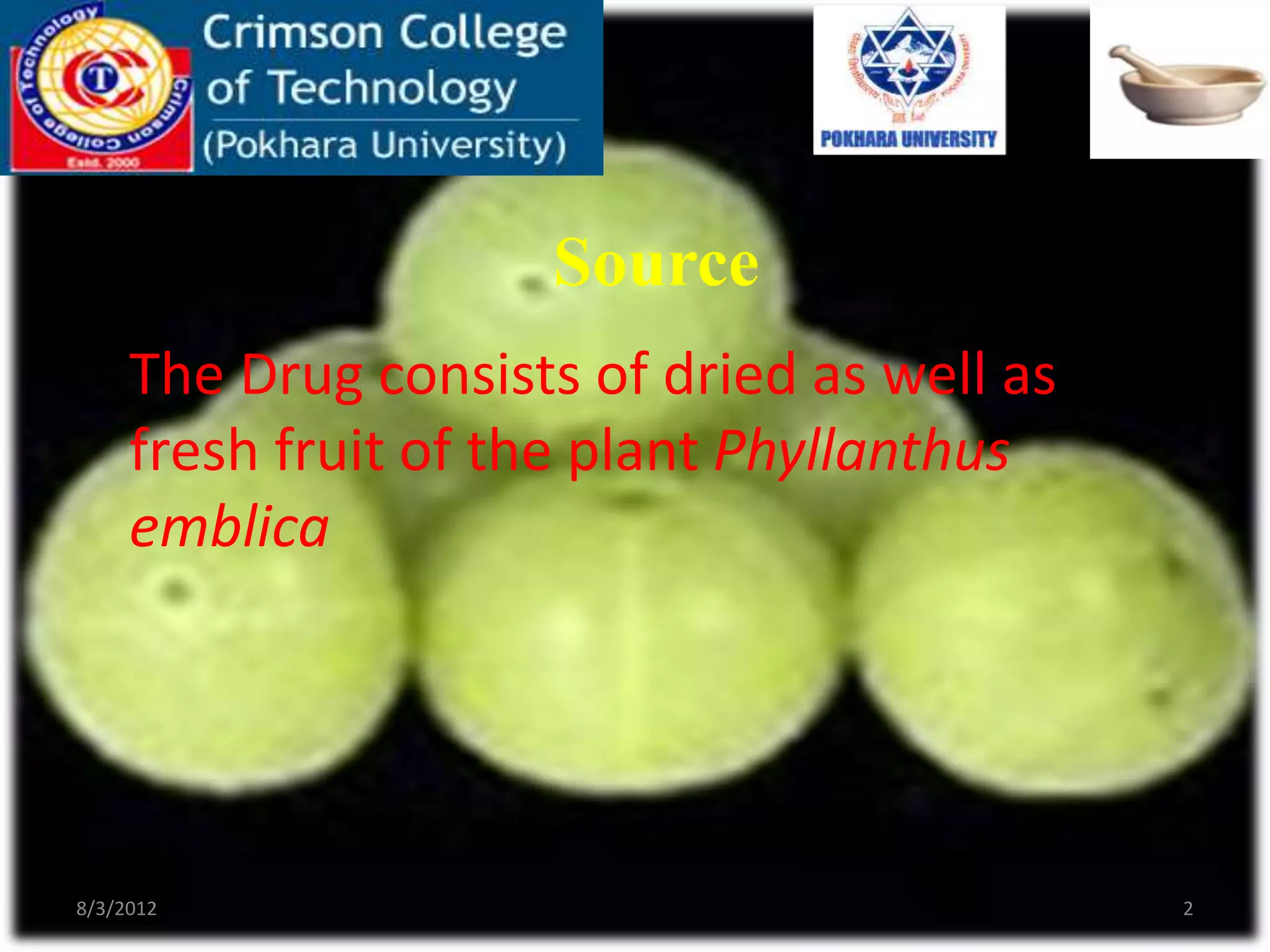
The Drug consists of dried as well as
fresh fruit of the plant Phyllanthus
emblica
8/3/2012 2
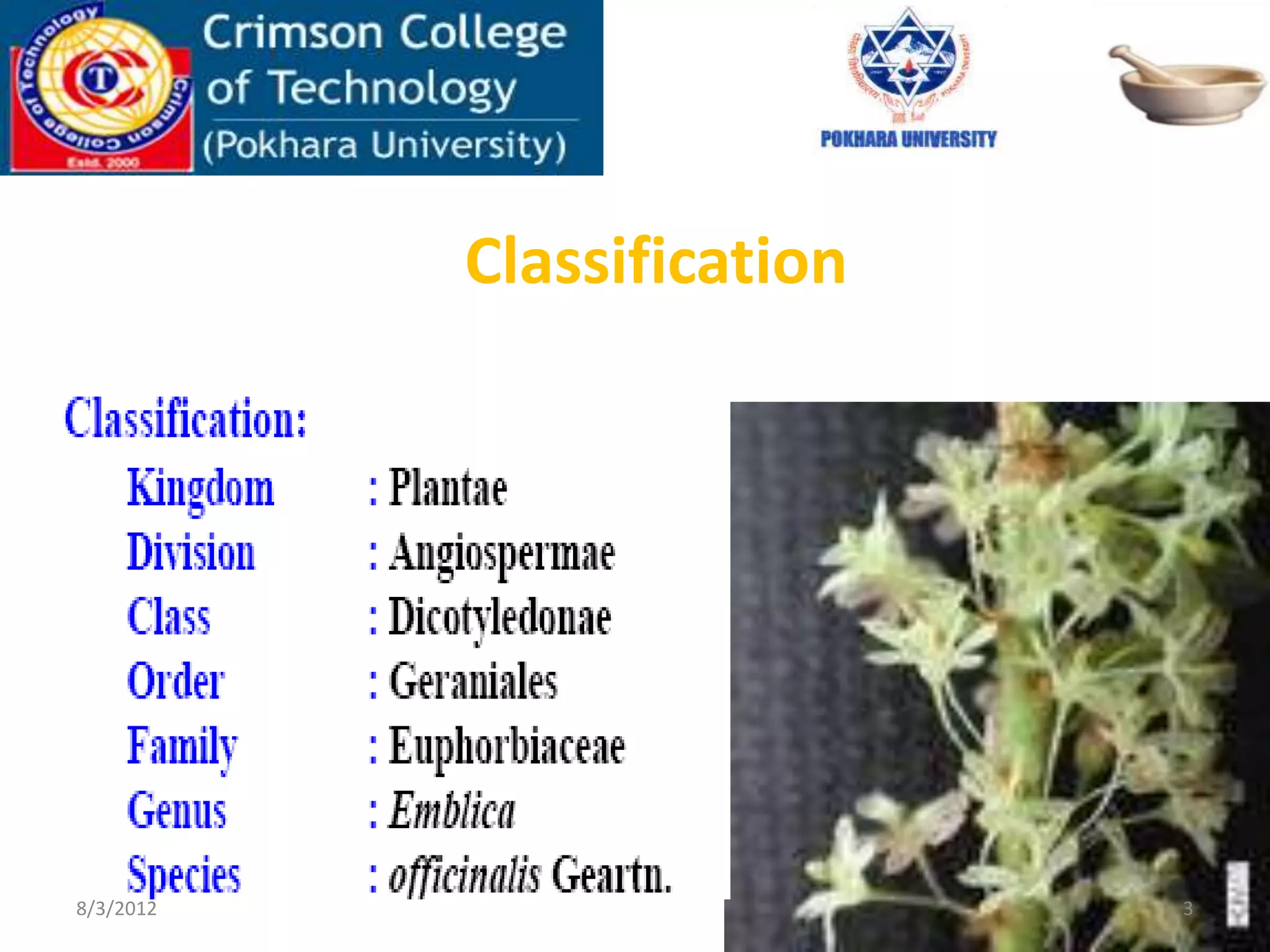
Classification
8/3/2012 3
Nomenclature
Biological name :- Phyllanthus emblica
Synonyms:- Emblica officinalis
Phyllanthus laxifolius
Local name:-
• Chepang- Tausi
• Limbu –Aagra
• Magar – aaunlesa
• Newari- amba8/3/2012 4
•Danuwar- rikhiya
•Guraung- titi
•Limbu- agara
•Magar- aaunlesa
•Tharu- aura
•Tibetan- Kyu-ru-ra
•Sanskrit- amalaki
•Rauta- aurys
•Newari- amba
•Tamang- amble
•Nepali- amala
•Hindi- amla
•English- Emblica
8/3/2012 5
Identification
Botanical identification:-
Habit and Distribution-:
• Deciduous shrub or tree up
to 10-15 m height
•Distributed throughout Nepal
to about 1600m
• Himalaya (Uttar Pradesh to
Bhutan), in all deciduous forest8/3/2012 6
Macroscopic identification-:
8/3/2012 7
Leaves-:
Simple, subsessile, closely get
along the branchlet, light
green having the appearance
of pinnate leaves
8/3/2012 8
Flower-:
• Small, yellowish, densely
clustered on the branches
• Male flowers numerous
while female flowers are
few
• Unisexual on the same
branchlet
8/3/2012 9
• Male flower are
pedicelled, 5-6 sepals,
stamen 3, filaments
united into a short
column, anther erect,
free disc absent
• Female flower has sepal
as in male, style 3,
stigma 2
8/3/2012 10
Flowering-: March to May
Fruits-:
A glabose capsule,2 cm diameter,
smooth, fleshy, with 6
longitidinal faint lines, 6 lobed,
pale yellow or greenish
8/3/2012 11
Parts used-: Root bark, leaves
and fruits
Powder analysis-: Light brown
powder with astringent and
sour taste. Soluble in water,
insoluble in most organic
solvent
8/3/2012 12
Organoleptic properties-:
8/3/2012 13
Microscopic identification
Chromosome number-: 2n=28, 98,104,198
T. S. of fruit-:
• Shows epicarp consisting of single layer
of epidermis and 2-4 layer of hypodermis
• Covered externally with a thick cuticle
and appear in surface view as polygonal
8/3/2012 14
• Hypodermal cells are tangentially
elongated, thick walled, similar in
dimension than epidermal cell
• Mesocarp forms bulk of fruit, consisting of
thin walled parenchaymatous cells with
intercellular spaces
• Pheripheral 6-9 layers smaller, ovoid or
tangentially elongated while rest are larger
in size8/3/2012 15
• Isodimetric and radially elongated,
several collateral fibrovascular bundles
scattered throughout the mesocarp
consisting of xylem and phloem
• Mesocarp contain large aggregate of
numerous irregular silica crystal
8/3/2012 16
T. S. of seed-:
• Testa consists of several layer of sclereids
• Thickened and pitted sclereids inside the
epidermal cell are partly like a
macrosclereid layer
• Partly quadratic in outline, with 2 or 3
sclereids on the top of each other
8/3/2012 17
• Endosperm is covered by 2 rows of brown
parenchymatic cell
• Has droplets of fatty oil and small cluster
crystal of calcium oxalate
8/3/2012 18
Powder microscopy-:
Fragment of parenchyma, sometime
with solitary sclereids or amorphous gray
crystalline masses
8/3/2012 19
Identification of crude drug by TLC
8/3/2012 20
8/3/2012 21
TLC for ascorbic acid
Stationary phase-: Silica gel G
Solvent system-: Ethanol-10% acetic acid
Detection-: UV-254nm(blue spots)
Ammonical Agno3(Black spot)
Rf value-: Ascorbic acid 0.5
Dehydroascorbic acid 0.73
Isoascorbic acid 0.54
8/3/2012 22
Cultivation of crude drug
Cultivation-: grown by seed germination,
also can be propagated by cutting, does
not tolerate the frost or drought
Collection-: collected on ripening of fruit,
in autumn or winter
Drying-: dried on shade, protected from
intense sunlight
8/3/2012 23
Storage-: Dry and airtight container, don’t
expose to light, active constituent get
decompose due to action of light
8/3/2012 24
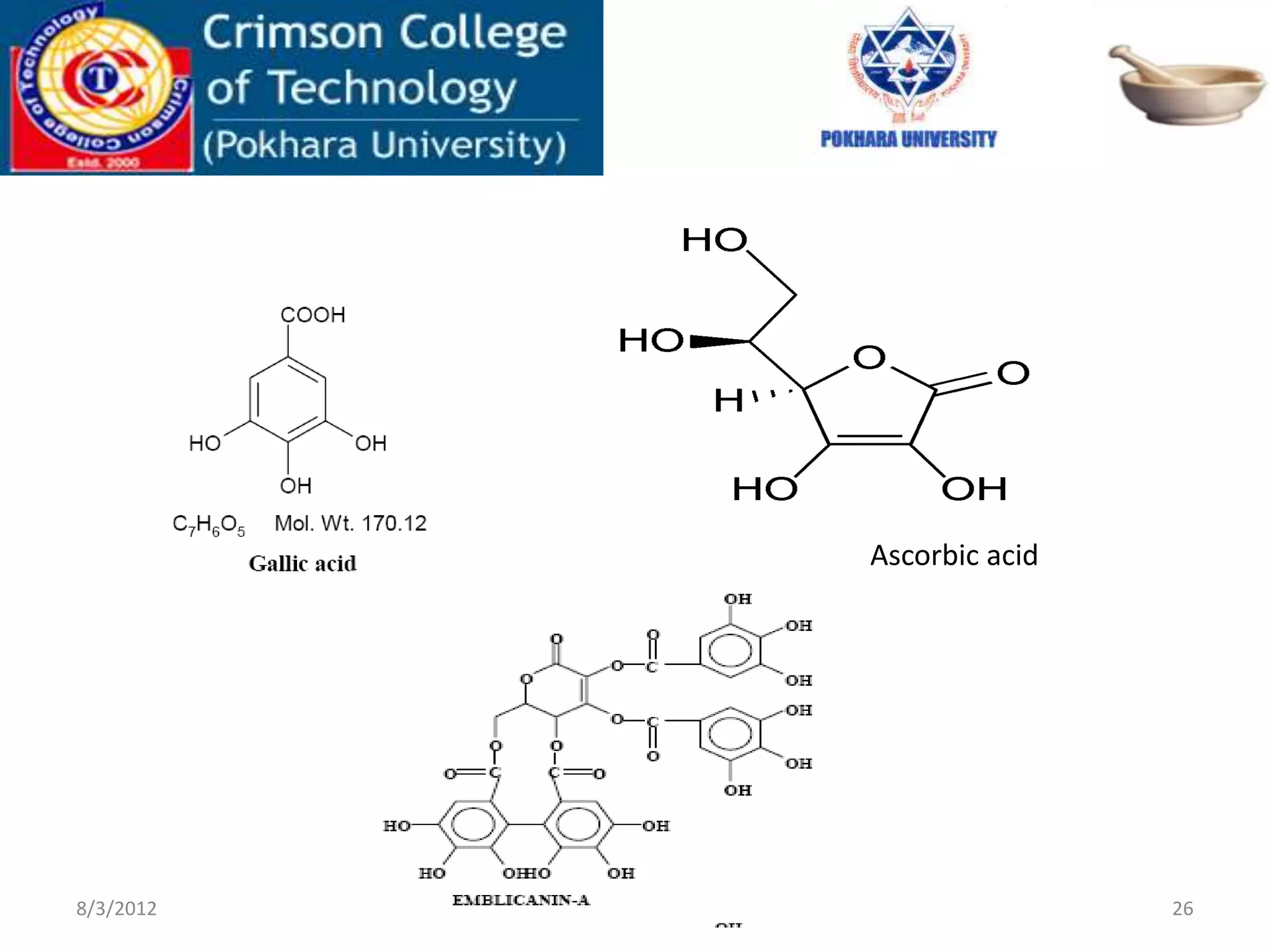
Major chemical constituent
• Ascorbic acid
• Gallic acid
• Tannins
• Beta setosterol
• Lupinoleic acid
• 1,3,6- trigalloyiglucose
• Polyphenolic
compound
8/3/2012 25
•Alkaloids phyllanthidine
and phyllantine
•Linoleic acid
•Lupeol
•Emblicanin A
8/3/2012 26
Ascorbic acid
Quality standard
8/3/2012 27
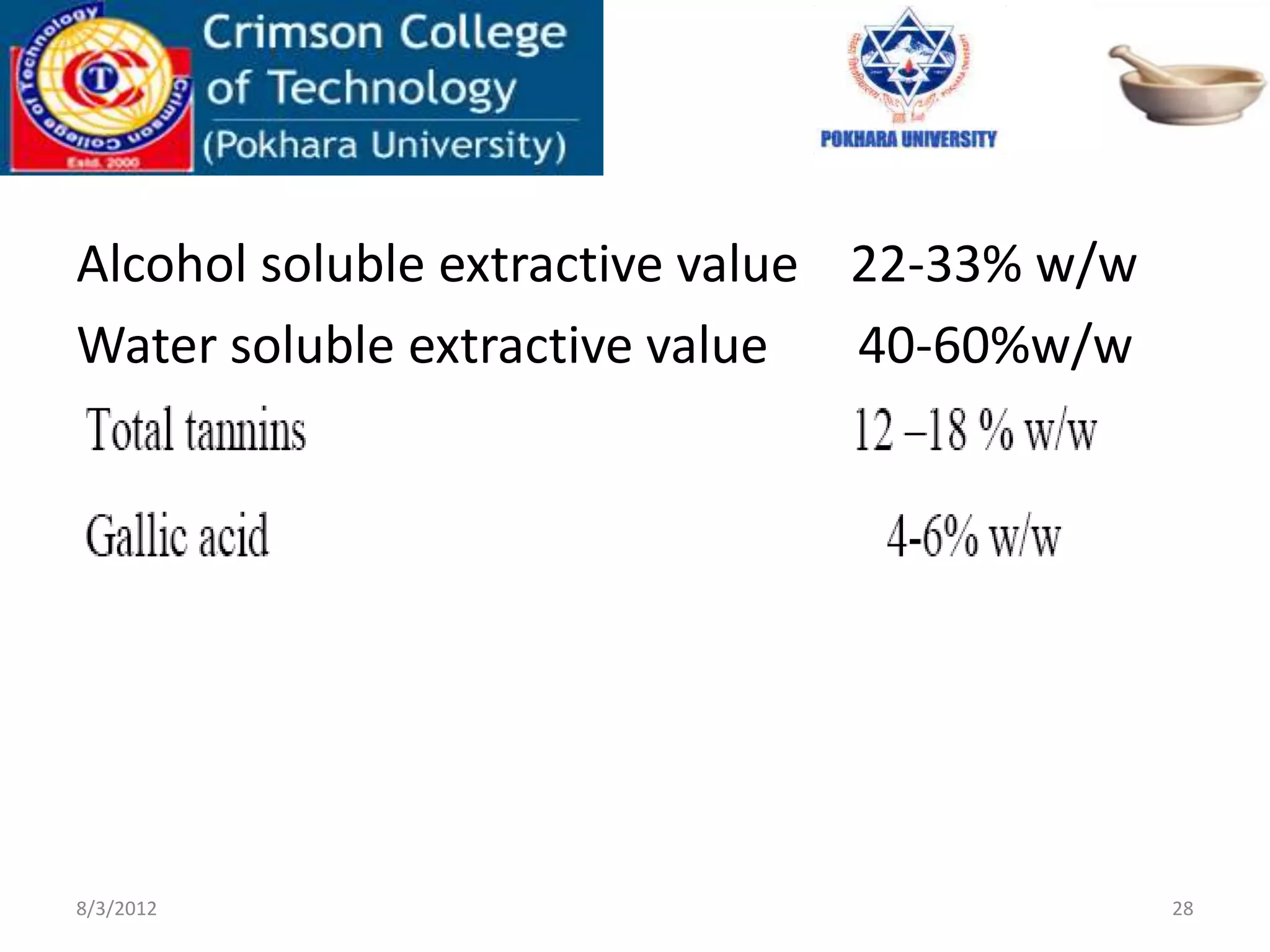
Alcohol soluble extractive value 22-33% w/w
Water soluble extractive value 40-60%w/w
8/3/2012 28
Formulation
Dosage-:
• Fresh fruits 10 to 20 g of drug
• Powdered drug 3-6 g
• Fresh juice 5-10 ml
8/3/2012 29
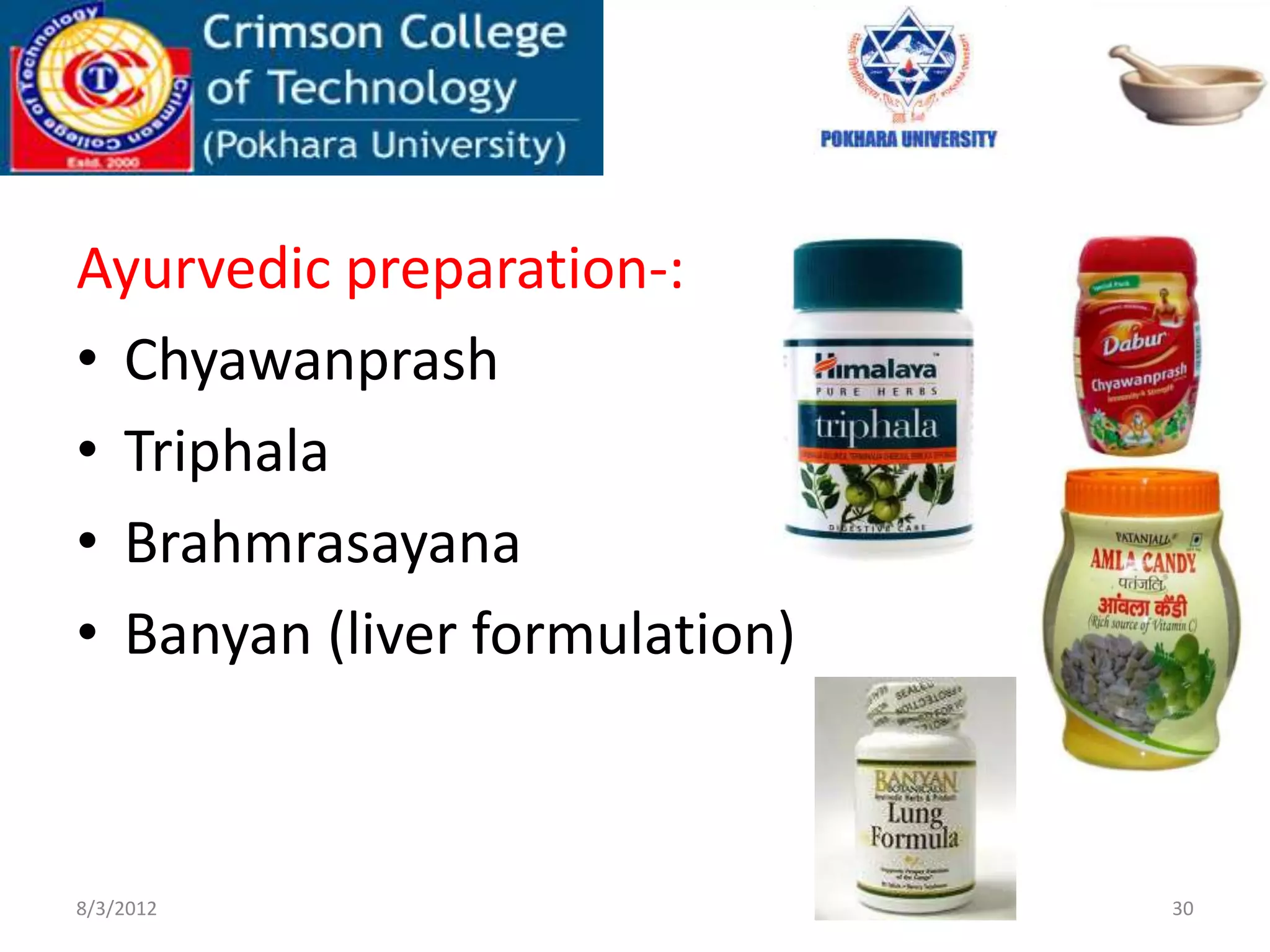
Ayurvedic preparation-:
• Chyawanprash
• Triphala
• Brahmrasayana
• Banyan (liver formulation)
8/3/2012 30
Cosmeceuticals-:
• Shampoo
• Soap
• Hair oil
• Cream
8/3/2012 31
Therapeutics
Ethnomedicinal use
• Fruits and seed of Amala is used by local
people of Doblan VDC Palpa in the treatment
of stomach disorder, hair protection purpose,
urino genital problem
• Tharu community of Jayanagar VDC of
kapilvastu use Amala in the treatment of
cough, constipation,source of vitamin C
8/3/2012 32
• Newar community of Pharping village of
Kathmandu district take fruit and seed in the
raw form for cough and cold
• The flower of amala has been used by the
Bantar ethenic group of Bhausaha, Morang
district , for blood purification and mental
disorder
8/3/2012 33
Medicinal use
• Scurvy and Toothache
• Inflammatory reaction
• Cough
• Asthma
• Bronchitis
• Diabetes
• Carminative and
digestive
• Pimples
• Digestive problem
• Mental and memory
effect
• Poor eyesight
• Hemmorage
• Peptic ulcer and
Jaundice
8/3/2012 34
Pharmacological action
• Hepatoprotective activity-: In vitro
expirement of P. emblica on paracetamol
induced hepatic damage of albino rat show
Hepatoprotective activity
• Antitumor activity-: In vitro expirement of P.
emblica on chemical induced skin
carcinogenesis of mice show anticarcinogenic
and antitumor activity
8/3/2012 35
• Antipyretic and analgesic activity-: Preliminary
phytochemical screening of extracts showed the
presence of alkaloids, tannins, phenolic
compound and amino acids which are
responsible for antipyretic and analgesic activities
• Antioxidant activity-:Amala posses long lasting
and broad spectrum antioxidant activity and
effective for relieving the oxidative stress and
improving glucose in diabetes
8/3/2012 36
• Memory enhancing activity-: Amala churna
reverses the amnesia induced by scopolamine
and diazepam
• Antimicrobial activity-: Phytochemical
screening of extract of plant Phyllanthus
emblica show antibacterial activity
8/3/2012 37
Safety measure
Toxity-:
• Sever diarrohea with losses of fluids and
electrolyte
• Electrolyte particularly potassium should be
monitored in all recepients, especially in
children and adult
8/3/2012 38
Side effect-:
• Abdominal spasms and pain, watery stools
hypokelamia, electrolyte disbalance, weakness
• Tannins precipitate proteins and may cause
bowel irritaton, liver damage, gastrointestinal
pain
• Long term use of tannins may cause
esophageal or nasal cancer
8/3/2012 39
Contraindication-:
• Not given in case of pregnancy and acute
diarrhoea
8/3/2012 40
References
• Manandhar NP (2002) Plants and people of Nepal, Timber Press,
Portland, pp 280-281.
• Malar Vidhyan .H.L and Mettilda Mary S, (2009) Hepato protective
activity of Phyllanthus emblica against Paracetamol induced
Hepatic damage in wister albino rat, African jornal of basic and
applied science,(1-2),21-25
• Natural remedies private limited, Emblica officanalis, Quality
control department,hosur road, bangalore-561-229
• Liv Xiaoli, Zhao mouming (2008), Antioxidant activity of
methanolic extract of emblica fruit (Phyllanthus emblica L) from six
region in China, Journal of Food composition and analysis 21,219-
228
8/3/2012 41
8/3/2012 42

Phyllanthus emclicus(amala)

  • 1.
    Phyllanthus emblica(Amala) Deepa kumarikarn B Pharm , 6th Sem Department of Pharmaceutical Science 8/3/2012 1
  • 2.
    Source The Drug consistsof dried as well as fresh fruit of the plant Phyllanthus emblica 8/3/2012 2
  • 3.
  • 4.
    Nomenclature Biological name :-Phyllanthus emblica Synonyms:- Emblica officinalis Phyllanthus laxifolius Local name:- • Chepang- Tausi • Limbu –Aagra • Magar – aaunlesa • Newari- amba8/3/2012 4
  • 5.
    •Danuwar- rikhiya •Guraung- titi •Limbu-agara •Magar- aaunlesa •Tharu- aura •Tibetan- Kyu-ru-ra •Sanskrit- amalaki •Rauta- aurys •Newari- amba •Tamang- amble •Nepali- amala •Hindi- amla •English- Emblica 8/3/2012 5
  • 6.
    Identification Botanical identification:- Habit andDistribution-: • Deciduous shrub or tree up to 10-15 m height •Distributed throughout Nepal to about 1600m • Himalaya (Uttar Pradesh to Bhutan), in all deciduous forest8/3/2012 6
  • 7.
  • 8.
    Leaves-: Simple, subsessile, closelyget along the branchlet, light green having the appearance of pinnate leaves 8/3/2012 8
  • 9.
    Flower-: • Small, yellowish,densely clustered on the branches • Male flowers numerous while female flowers are few • Unisexual on the same branchlet 8/3/2012 9
  • 10.
    • Male flowerare pedicelled, 5-6 sepals, stamen 3, filaments united into a short column, anther erect, free disc absent • Female flower has sepal as in male, style 3, stigma 2 8/3/2012 10
  • 11.
    Flowering-: March toMay Fruits-: A glabose capsule,2 cm diameter, smooth, fleshy, with 6 longitidinal faint lines, 6 lobed, pale yellow or greenish 8/3/2012 11
  • 12.
    Parts used-: Rootbark, leaves and fruits Powder analysis-: Light brown powder with astringent and sour taste. Soluble in water, insoluble in most organic solvent 8/3/2012 12
  • 13.
  • 14.
    Microscopic identification Chromosome number-:2n=28, 98,104,198 T. S. of fruit-: • Shows epicarp consisting of single layer of epidermis and 2-4 layer of hypodermis • Covered externally with a thick cuticle and appear in surface view as polygonal 8/3/2012 14
  • 15.
    • Hypodermal cellsare tangentially elongated, thick walled, similar in dimension than epidermal cell • Mesocarp forms bulk of fruit, consisting of thin walled parenchaymatous cells with intercellular spaces • Pheripheral 6-9 layers smaller, ovoid or tangentially elongated while rest are larger in size8/3/2012 15
  • 16.
    • Isodimetric andradially elongated, several collateral fibrovascular bundles scattered throughout the mesocarp consisting of xylem and phloem • Mesocarp contain large aggregate of numerous irregular silica crystal 8/3/2012 16
  • 17.
    T. S. ofseed-: • Testa consists of several layer of sclereids • Thickened and pitted sclereids inside the epidermal cell are partly like a macrosclereid layer • Partly quadratic in outline, with 2 or 3 sclereids on the top of each other 8/3/2012 17
  • 18.
    • Endosperm iscovered by 2 rows of brown parenchymatic cell • Has droplets of fatty oil and small cluster crystal of calcium oxalate 8/3/2012 18
  • 19.
    Powder microscopy-: Fragment ofparenchyma, sometime with solitary sclereids or amorphous gray crystalline masses 8/3/2012 19
  • 20.
    Identification of crudedrug by TLC 8/3/2012 20
  • 21.
  • 22.
    TLC for ascorbicacid Stationary phase-: Silica gel G Solvent system-: Ethanol-10% acetic acid Detection-: UV-254nm(blue spots) Ammonical Agno3(Black spot) Rf value-: Ascorbic acid 0.5 Dehydroascorbic acid 0.73 Isoascorbic acid 0.54 8/3/2012 22
  • 23.
    Cultivation of crudedrug Cultivation-: grown by seed germination, also can be propagated by cutting, does not tolerate the frost or drought Collection-: collected on ripening of fruit, in autumn or winter Drying-: dried on shade, protected from intense sunlight 8/3/2012 23
  • 24.
    Storage-: Dry andairtight container, don’t expose to light, active constituent get decompose due to action of light 8/3/2012 24
  • 25.
    Major chemical constituent •Ascorbic acid • Gallic acid • Tannins • Beta setosterol • Lupinoleic acid • 1,3,6- trigalloyiglucose • Polyphenolic compound 8/3/2012 25 •Alkaloids phyllanthidine and phyllantine •Linoleic acid •Lupeol •Emblicanin A
  • 26.
  • 27.
  • 28.
    Alcohol soluble extractivevalue 22-33% w/w Water soluble extractive value 40-60%w/w 8/3/2012 28
  • 29.
    Formulation Dosage-: • Fresh fruits10 to 20 g of drug • Powdered drug 3-6 g • Fresh juice 5-10 ml 8/3/2012 29
  • 30.
    Ayurvedic preparation-: • Chyawanprash •Triphala • Brahmrasayana • Banyan (liver formulation) 8/3/2012 30
  • 31.
    Cosmeceuticals-: • Shampoo • Soap •Hair oil • Cream 8/3/2012 31
  • 32.
    Therapeutics Ethnomedicinal use • Fruitsand seed of Amala is used by local people of Doblan VDC Palpa in the treatment of stomach disorder, hair protection purpose, urino genital problem • Tharu community of Jayanagar VDC of kapilvastu use Amala in the treatment of cough, constipation,source of vitamin C 8/3/2012 32
  • 33.
    • Newar communityof Pharping village of Kathmandu district take fruit and seed in the raw form for cough and cold • The flower of amala has been used by the Bantar ethenic group of Bhausaha, Morang district , for blood purification and mental disorder 8/3/2012 33
  • 34.
    Medicinal use • Scurvyand Toothache • Inflammatory reaction • Cough • Asthma • Bronchitis • Diabetes • Carminative and digestive • Pimples • Digestive problem • Mental and memory effect • Poor eyesight • Hemmorage • Peptic ulcer and Jaundice 8/3/2012 34
  • 35.
    Pharmacological action • Hepatoprotectiveactivity-: In vitro expirement of P. emblica on paracetamol induced hepatic damage of albino rat show Hepatoprotective activity • Antitumor activity-: In vitro expirement of P. emblica on chemical induced skin carcinogenesis of mice show anticarcinogenic and antitumor activity 8/3/2012 35
  • 36.
    • Antipyretic andanalgesic activity-: Preliminary phytochemical screening of extracts showed the presence of alkaloids, tannins, phenolic compound and amino acids which are responsible for antipyretic and analgesic activities • Antioxidant activity-:Amala posses long lasting and broad spectrum antioxidant activity and effective for relieving the oxidative stress and improving glucose in diabetes 8/3/2012 36
  • 37.
    • Memory enhancingactivity-: Amala churna reverses the amnesia induced by scopolamine and diazepam • Antimicrobial activity-: Phytochemical screening of extract of plant Phyllanthus emblica show antibacterial activity 8/3/2012 37
  • 38.
    Safety measure Toxity-: • Severdiarrohea with losses of fluids and electrolyte • Electrolyte particularly potassium should be monitored in all recepients, especially in children and adult 8/3/2012 38
  • 39.
    Side effect-: • Abdominalspasms and pain, watery stools hypokelamia, electrolyte disbalance, weakness • Tannins precipitate proteins and may cause bowel irritaton, liver damage, gastrointestinal pain • Long term use of tannins may cause esophageal or nasal cancer 8/3/2012 39
  • 40.
    Contraindication-: • Not givenin case of pregnancy and acute diarrhoea 8/3/2012 40
  • 41.
    References • Manandhar NP(2002) Plants and people of Nepal, Timber Press, Portland, pp 280-281. • Malar Vidhyan .H.L and Mettilda Mary S, (2009) Hepato protective activity of Phyllanthus emblica against Paracetamol induced Hepatic damage in wister albino rat, African jornal of basic and applied science,(1-2),21-25 • Natural remedies private limited, Emblica officanalis, Quality control department,hosur road, bangalore-561-229 • Liv Xiaoli, Zhao mouming (2008), Antioxidant activity of methanolic extract of emblica fruit (Phyllanthus emblica L) from six region in China, Journal of Food composition and analysis 21,219- 228 8/3/2012 41
  • 42.