AYURVEDIC/HERBAL
FORMULATION
Prepared By:
Pooja Khanpara
Asst. Professor
APIP, Jamnagar
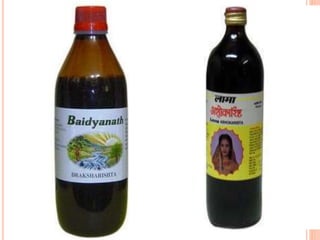
 Asava and arishtas -are liquid ayurvedic preparations or self
generated herbal fermentations.
 Asavas prepared by direct use of fresh herbal juices or
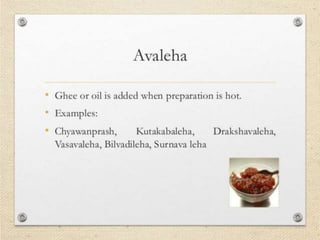
herbs soaked in water
 Arishtas are prepared with decoction of herbs in boiling water
 Both have sweet test, alcoholic smell
 Powder herbs are soak in herbal juice or decoction in
 presence of sugar or jaggaery for specific period of time.
 Fermentation is brought by addition of dhataki, dhaay ke phool
(woodfordia fruticosa) flowers.
 fermentated alcohol facilitate extraction of active constituents in
herbs and also act as preservative.
 Both asva and arishta contains up to 12 % alcohol and hence
called medicinal wines.
PREPARATION OF ASAVA
 Boil required quantity of water. Add sugar or honey or
jaggery, cooled and transferred to wooden vessel. then
add powderd drug mentioned in formula.
 Cover vessel with lid and edges are sealed with seven
consecutive layers of clay smeared cloth.
 Vessel is kept in basement for specified period of time,
after that vessel is removed ,liquid is decanted or filtered.
 Asava can be stored for any length of time in well
stoppered glass bottle.
 E,g, kumariasava, lauhasava
CHARACTERSTIC-
 Filtered final asava should not contain any particle of
sediment
 Taste should not be sour
 Should have charecterstic odour of fermented liquid
 If any growth of mould is obsereved , reject immediately
 Mix equal quantity of water and asava before use.
PREPARATION OF ARISHTA
 Prepare decoction of crude drug in potable water.
 filter it and transfer to wooden pots. Wooden pots should be
fumigated with Piply churna and also smeared with ghee
before addition of parent material or sugar. Then add sugar,
honey, jaggery to decoction.
 Now add dravas, other powder ingredients and dhataki pushpa if
mentioned.
 Close vessel with lid and seal edges with clay smeared cloth of
seven layers. place vessel in basement ( underground cellar) all
under heap of paddy to ensure constant atmospheric temperature
during fermentation.
 After specified period of 7-10 days , remove pot and decant fluid.
After 2-3 days when particle of sediment is settled down arishta
is botteled.
 Arishta can be stored for any length of time in well stopped glass
bottle.
CHARECTERSTICS-
 Filtered final arishta should not contain any particle of
sediment
 The taste should not be sour
 Should have characteristic odour of fermented liquid
 If any growth of mould is observed reject immediately
 Mix equal quantity of water and arishta before use.
DIFFERENT PARAMETERS OF
STANDARDIZATION OF ASAVA ARISHTA
 It generally involves the following parameters:
1. Orgamnoleptic Parameters
a) Colour of sample
b) Odor of sample
c) Taste of sample
d) Determination of pH of sample
2. Physical Parameters
a) Determination of foreign organic matter
b) Determination of ash value
 Total ash value
 Acid insoluble ash
 Water soluble ash
 Sulphated ash
c) Determination of extractive value
 Alcohol soluble extractive value
 Water soluble extractive value
d) Determination of moisture content
e) Determination of physical constant
 Melting point
 Boiling point
 Refractive index
 Optical rotation
f) Determination of specific gravity
g) Determination of solid content
h) Determination of alcohol content
CHEMICAL PARAMETERS
 following parameters involves in chemical evaluation like
 a) Alkaloids – Dragandroffs test
 b) Glycosides – Molish test
 c) Flavonoids – Shinoda test
 d) Phenolic – Lead acetate test
 e) Tannins – Ferric chloride test
 f) Steroids – Salkowski reaction
 g) Amino acids – Ninhydrine test
 h) Carbohydrates – Fehling’s test, Benedict test
 Toxicological parameters –
 It involves following parameters
 a)Pesticides residue
 b) Heavy metal
 c) Microbial contamination
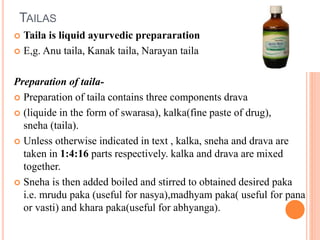
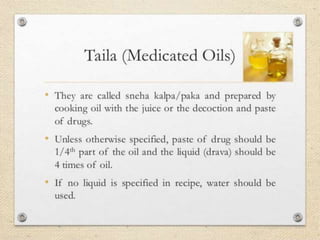
TAILAS
 Taila is liquid ayurvedic prepararation
 E,g. Anu taila, Kanak taila, Narayan taila
Preparation of taila-
 Preparation of taila contains three components drava
 (liquide in the form of swarasa), kalka(fine paste of drug),
sneha (taila).
 Unless otherwise indicated in text , kalka, sneha and drava are
taken in 1:4:16 parts respectively. kalka and drava are mixed
together.
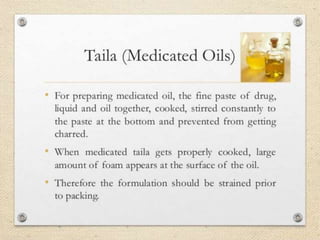
 Sneha is then added boiled and stirred to obtained desired paka
i.e. mrudu paka (useful for nasya),madhyam paka( useful for pana
or vasti) and khara paka(useful for abhyanga).
STANDERIZATION OF TAILA
 Colour
 Smell
 Appearance
 Touch Oily
 Clarity
 Specific gravity
 Acid value mg/gm
 Saponfication value
 Iodine value gm/100gm
CHARACTERISTICS
 taila will have colour , odour, consistancy of oil used.
 Taila should be preserved in bottle taila should be taken
with anupan(vehicle)
 Taila should be used within 16 months.
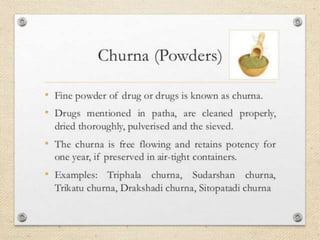
CHURNA
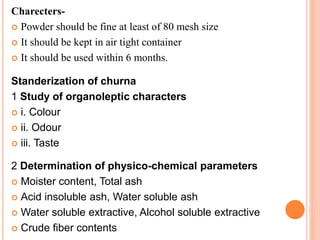
 Churna is solid ayurvedic preparation of powder of drugs with
 often taken with some anupan like milk, ghee, honey. fine the
powder the better its therapeutic effect
Preparation-
 Make powder of crud drug and sieve through cloth, or
mechanical shifter.
 If there is more than one drug each drug should be separately
powdered, sieved and weighed.
 Finally mix all the powders well together. if salt , sugar,
camphor is mentioned then it should be powdered and added
separately at end.
Charecters-
 Powder should be fine at least of 80 mesh size
 It should be kept in air tight container
 It should be used within 6 months.
Standerization of churna
1 Study of organoleptic characters
 i. Colour
 ii. Odour
 iii. Taste
2 Determination of physico-chemical parameters
 Moister content, Total ash
 Acid insoluble ash, Water soluble ash
 Water soluble extractive, Alcohol soluble extractive
 Crude fiber contents
3 Quantitative estimation of selected phyto- constituents
 Total alkaloids
4 Evaluation of Churna
 Powder fineness
 Bulk density
 Tap density
 Angle of repose
 Compressibility
 Hausner ratio
5 Determination of Ph
6 Establishing the safety pertaining to Heavy metals &
Microbial load
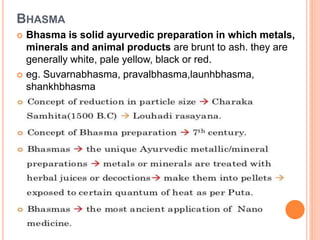
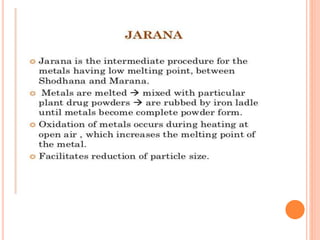
 Bhasma is solid ayurvedic preparation in which metals,
minerals and animal products are brunt to ash. they are
generally white, pale yellow, black or red.
 eg. Suvarnabhasma, pravalbhasma,launhbhasma,
shankhbhasma
BHASMA
BHASMA
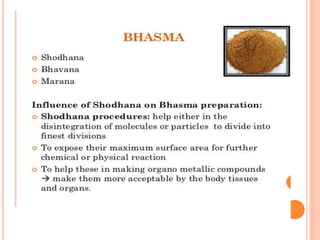
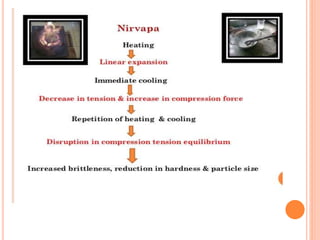
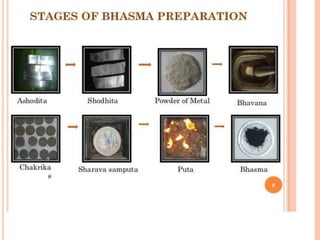
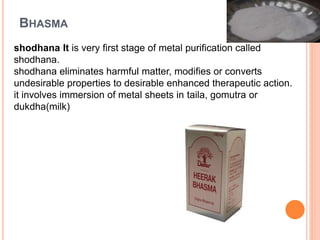
shodhana It is very first stage of metal purification called
shodhana.
shodhana eliminates harmful matter, modifies or converts
undesirable properties to desirable enhanced therapeutic action.
it involves immersion of metal sheets in taila, gomutra or
dukdha(milk)
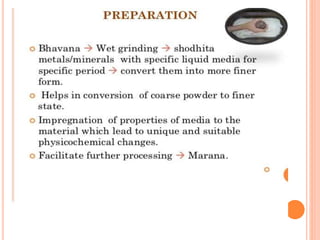
 2 maranain
 this method purified drug is put in to stone morter ( khalva) and
grounded with specified metal, mineral and animal part for
specified period of time. then small cakes are made( cakrikas)
and dried under sunlight. Dried cakes are placed in single layer
in mud tray and closed with another tray and sealed by clay
smeared with cloth of seven consecutive layers. In the ground pit
of appropriate size is dug. Half of pit is filled with dried cow
dung cakes. then above processed clay tray is placed in
 it and pit is again packed with cow dung cake. Fire is lit from all
sides and middle of pit. After specified burning , it is allowed to
cool at room temperature. Clay tray is removed and seal broken.
Contents are taken out and finely powdered. The final bhasma
should be preserved in airtight earthen container.
CHARACTERSTICS-
 Final bhasma should be free from metallic luster
 Bhasma when rubbed between fingers should be so fine so as
to get easily into lines of finger.
 In water bhasma should float on surface
STANDARDIZATION OF BHASMA
 Organoleptic characters
 Sound : The Bhasma should have imperceptible
sound
 on grinding the Bhasma between teeth.
 Colour : depends
 Touch - Soft ~ Imperceptible coarseness in the Bhasma
 Taste - should be tasteless
 Odour -should be odourless
 Physico-chemical parameters
 pH :
 Ash Value (AV):
 Acid Insoluble Ash (AIA) :
 Particle Size Distribution
 X-ray Diffraction
 Inductively Coupled Plasma – Emission
Spectroscopy
 UV-Visible Spectrophotometry
Herbal formulation  by pooja

Herbal formulation by pooja

  • 1.
  • 9.
     Asava andarishtas -are liquid ayurvedic preparations or self generated herbal fermentations.  Asavas prepared by direct use of fresh herbal juices or herbs soaked in water  Arishtas are prepared with decoction of herbs in boiling water  Both have sweet test, alcoholic smell  Powder herbs are soak in herbal juice or decoction in  presence of sugar or jaggaery for specific period of time.  Fermentation is brought by addition of dhataki, dhaay ke phool (woodfordia fruticosa) flowers.  fermentated alcohol facilitate extraction of active constituents in herbs and also act as preservative.  Both asva and arishta contains up to 12 % alcohol and hence called medicinal wines.
  • 10.
    PREPARATION OF ASAVA Boil required quantity of water. Add sugar or honey or jaggery, cooled and transferred to wooden vessel. then add powderd drug mentioned in formula.  Cover vessel with lid and edges are sealed with seven consecutive layers of clay smeared cloth.  Vessel is kept in basement for specified period of time, after that vessel is removed ,liquid is decanted or filtered.  Asava can be stored for any length of time in well stoppered glass bottle.  E,g, kumariasava, lauhasava
  • 11.
    CHARACTERSTIC-  Filtered finalasava should not contain any particle of sediment  Taste should not be sour  Should have charecterstic odour of fermented liquid  If any growth of mould is obsereved , reject immediately  Mix equal quantity of water and asava before use.
  • 12.
    PREPARATION OF ARISHTA Prepare decoction of crude drug in potable water.  filter it and transfer to wooden pots. Wooden pots should be fumigated with Piply churna and also smeared with ghee before addition of parent material or sugar. Then add sugar, honey, jaggery to decoction.  Now add dravas, other powder ingredients and dhataki pushpa if mentioned.  Close vessel with lid and seal edges with clay smeared cloth of seven layers. place vessel in basement ( underground cellar) all under heap of paddy to ensure constant atmospheric temperature during fermentation.  After specified period of 7-10 days , remove pot and decant fluid. After 2-3 days when particle of sediment is settled down arishta is botteled.  Arishta can be stored for any length of time in well stopped glass bottle.
  • 13.
    CHARECTERSTICS-  Filtered finalarishta should not contain any particle of sediment  The taste should not be sour  Should have characteristic odour of fermented liquid  If any growth of mould is observed reject immediately  Mix equal quantity of water and arishta before use.
  • 14.
    DIFFERENT PARAMETERS OF STANDARDIZATIONOF ASAVA ARISHTA  It generally involves the following parameters: 1. Orgamnoleptic Parameters a) Colour of sample b) Odor of sample c) Taste of sample d) Determination of pH of sample 2. Physical Parameters a) Determination of foreign organic matter
  • 15.
    b) Determination ofash value  Total ash value  Acid insoluble ash  Water soluble ash  Sulphated ash c) Determination of extractive value  Alcohol soluble extractive value  Water soluble extractive value d) Determination of moisture content e) Determination of physical constant  Melting point  Boiling point  Refractive index  Optical rotation
  • 16.
    f) Determination ofspecific gravity g) Determination of solid content h) Determination of alcohol content
  • 17.
    CHEMICAL PARAMETERS  followingparameters involves in chemical evaluation like  a) Alkaloids – Dragandroffs test  b) Glycosides – Molish test  c) Flavonoids – Shinoda test  d) Phenolic – Lead acetate test  e) Tannins – Ferric chloride test  f) Steroids – Salkowski reaction  g) Amino acids – Ninhydrine test  h) Carbohydrates – Fehling’s test, Benedict test
  • 18.
     Toxicological parameters–  It involves following parameters  a)Pesticides residue  b) Heavy metal  c) Microbial contamination
  • 19.
    TAILAS  Taila isliquid ayurvedic prepararation  E,g. Anu taila, Kanak taila, Narayan taila Preparation of taila-  Preparation of taila contains three components drava  (liquide in the form of swarasa), kalka(fine paste of drug), sneha (taila).  Unless otherwise indicated in text , kalka, sneha and drava are taken in 1:4:16 parts respectively. kalka and drava are mixed together.  Sneha is then added boiled and stirred to obtained desired paka i.e. mrudu paka (useful for nasya),madhyam paka( useful for pana or vasti) and khara paka(useful for abhyanga).
  • 20.
    STANDERIZATION OF TAILA Colour  Smell  Appearance  Touch Oily  Clarity  Specific gravity  Acid value mg/gm  Saponfication value  Iodine value gm/100gm
  • 21.
    CHARACTERISTICS  taila willhave colour , odour, consistancy of oil used.  Taila should be preserved in bottle taila should be taken with anupan(vehicle)  Taila should be used within 16 months.
  • 22.
    CHURNA  Churna issolid ayurvedic preparation of powder of drugs with  often taken with some anupan like milk, ghee, honey. fine the powder the better its therapeutic effect Preparation-  Make powder of crud drug and sieve through cloth, or mechanical shifter.  If there is more than one drug each drug should be separately powdered, sieved and weighed.  Finally mix all the powders well together. if salt , sugar, camphor is mentioned then it should be powdered and added separately at end.
  • 23.
    Charecters-  Powder shouldbe fine at least of 80 mesh size  It should be kept in air tight container  It should be used within 6 months. Standerization of churna 1 Study of organoleptic characters  i. Colour  ii. Odour  iii. Taste 2 Determination of physico-chemical parameters  Moister content, Total ash  Acid insoluble ash, Water soluble ash  Water soluble extractive, Alcohol soluble extractive  Crude fiber contents
  • 24.
    3 Quantitative estimationof selected phyto- constituents  Total alkaloids 4 Evaluation of Churna  Powder fineness  Bulk density  Tap density  Angle of repose  Compressibility  Hausner ratio 5 Determination of Ph 6 Establishing the safety pertaining to Heavy metals & Microbial load
  • 25.
     Bhasma issolid ayurvedic preparation in which metals, minerals and animal products are brunt to ash. they are generally white, pale yellow, black or red.  eg. Suvarnabhasma, pravalbhasma,launhbhasma, shankhbhasma BHASMA
  • 31.
    BHASMA shodhana It isvery first stage of metal purification called shodhana. shodhana eliminates harmful matter, modifies or converts undesirable properties to desirable enhanced therapeutic action. it involves immersion of metal sheets in taila, gomutra or dukdha(milk)
  • 32.
     2 maranain this method purified drug is put in to stone morter ( khalva) and grounded with specified metal, mineral and animal part for specified period of time. then small cakes are made( cakrikas) and dried under sunlight. Dried cakes are placed in single layer in mud tray and closed with another tray and sealed by clay smeared with cloth of seven consecutive layers. In the ground pit of appropriate size is dug. Half of pit is filled with dried cow dung cakes. then above processed clay tray is placed in  it and pit is again packed with cow dung cake. Fire is lit from all sides and middle of pit. After specified burning , it is allowed to cool at room temperature. Clay tray is removed and seal broken. Contents are taken out and finely powdered. The final bhasma should be preserved in airtight earthen container.
  • 33.
    CHARACTERSTICS-  Final bhasmashould be free from metallic luster  Bhasma when rubbed between fingers should be so fine so as to get easily into lines of finger.  In water bhasma should float on surface
  • 34.
    STANDARDIZATION OF BHASMA Organoleptic characters  Sound : The Bhasma should have imperceptible sound  on grinding the Bhasma between teeth.  Colour : depends  Touch - Soft ~ Imperceptible coarseness in the Bhasma  Taste - should be tasteless  Odour -should be odourless
  • 35.
     Physico-chemical parameters pH :  Ash Value (AV):  Acid Insoluble Ash (AIA) :  Particle Size Distribution  X-ray Diffraction  Inductively Coupled Plasma – Emission Spectroscopy  UV-Visible Spectrophotometry