TRADITIONALLY
FERMENTED MEDICINES:
ASAVA/ARISHTA
Mr. Suryawanshi J.S.
M.Pharm (Pharmacognosy)
Asst.Prof.& Head,Dept.of Pharmacognosy,
Satara college of Pharmacy,Degaon,Satara
 Ayurveda is a system of healing that
originated in ancient India and practiced since
thousands of years.
 In Sanskrit,
 Ayur means life or living, and
 Veda means knowledge,
 so Ayurveda has been defined as the
"knowledge of living" or the "science of
longevity.“
 Ayurvedic dosage forms are prepared from
Plants, minerals and animals, Intended for
internal or external use, for the treatment
and prevention of disease in human beings
or animals.
 Prepared exclusively in accordance with the
formulae described in the Authorative books
of Ayurvedic Systems of medicine specified in
the first schedule of the Drug and Cosmetic
act1940.
Solid Semi-solid LIQUID
 Pills Avleha Asava
 Gutika Paka Arishta
 Vatika Lepa Taila
Ghrita Arka
 Powders Bhasma, Satva,
 Churna ,Lavana, Kshara,
Liquid Dosage Forms
 Arishtas and Asavas are hydroalcoholic liquid
forms of traditional Ayurvedic system.
 They are alcoholic medicaments in which
alcohol is self generated by means of
fermentation process.
 These are the processed by soaking the drug
in powdered form OR decoction form, in a
solution of sugar or jaggery for a specific
period of time to undergo fermentation.
 Arishta or Asava treatment is suggested for a
variety of diseases and conditions.
 The difference between arishta and asava is
simple,
 Arishta is prepared from the decoction of
dried medicinal herbs,
 Asava is prepared from fresh dried herbs.
1.The main herbs mentioned in the formula.
2.The source of Carbohydrates (Sugar) is
required for fermentation.
(Canesugar/Jaggery/Honey)
3.Fermentation initiator provides inoculums
for the fermentation to start.
(The inoculum of yeasts comes from the
Woodfordia fruticosa (dhataki flowers), which
contain the wild species of yeast-Saccharomyces
spp.)
4.The flavouring agents.
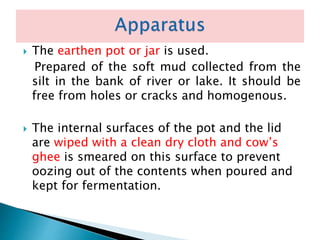
 The earthen pot or jar is used.
Prepared of the soft mud collected from the
silt in the bank of river or lake. It should be
free from holes or cracks and homogenous.
 The internal surfaces of the pot and the lid
are wiped with a clean dry cloth and cow’s
ghee is smeared on this surface to prevent
oozing out of the contents when poured and
kept for fermentation.
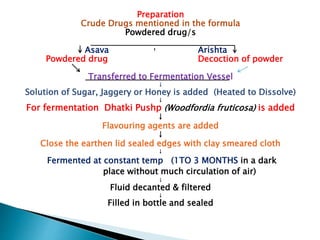
Preparation
Crude Drugs mentioned in the formula
Powdered drug/s
Asava Arishta
Powdered drug Decoction of powder
Transferred to Fermentation Vessel
↓
Solution of Sugar, Jaggery or Honey is added (Heated to Dissolve)
↓
For fermentation Dhatki Pushp (Woodfordia fruticosa) is added
↓
Flavouring agents are added
↓
Close the earthen lid sealed edges with clay smeared cloth
↓
Fermented at constant temp (1TO 3 MONTHS in a dark
place without much circulation of air)
↓
Fluid decanted & filtered
↓
Filled in bottle and sealed
 During autumn and summer seasons,
fermentation takes place in 6 days.
 In winter, it takes 10 days.
 During rainy season and spring in 8 days .
 The fermentation vessel is left undisturbed
for a month and then opened. The medicine
is filtered and taken for use.
Properties of Asava /Arishta
 Should be Clear.
 No foam should be produced.
 Should not become sour on standing.
 It has characteristic, aromatic & alcoholic odour.
 They are moderately alcoholic ( up to 12% by
volume) and mostly sweetish with slight acidity and
agreeable aroma .
Shelf Life:
 Much longer time
Storage Conditions:
 Should be stored in air tight container
 Narrow mouthed
 Store in cool place
 Away from sunlight
Saraca asoka Terminalia chebula
Phyllanthus emblica Zingiber officinale
Coscinium fenestratum
Kaempferia rotunda Jaggery
Terminalia bellirica Woodfordia fruticosa
Mangifera indica Water
Cuminum cyminum
Adhatoda vasica
Santalum album
Nigella sativa
Cyperus rotundus
Marketed Preparations:
Asavas Arishtas
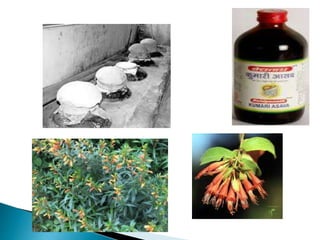
Kumariasava Dashmularishta
Madhukasava Draksharista
Punarnavasava Vidangarista
Chandanasava Asokarishta
 Description-colour, odour, taste.
 pH 3-4
 Alcohol content v/v
 Sugar content
 Acid value
 Test for Methanol & Higher alcohols
 TLC Profile/GC Profile
 Heavy Metals
1.‘Traditionally fermented biomedicines:
Asava/Arishta from Ayurveda’,S. Sekar &
S.Mariappan, Indian Journal of Traditional
knowledge,Vol 7(4),Oct.2008,548-556.
THANK YOU

Asava arishta

  • 1.
    TRADITIONALLY FERMENTED MEDICINES: ASAVA/ARISHTA Mr. SuryawanshiJ.S. M.Pharm (Pharmacognosy) Asst.Prof.& Head,Dept.of Pharmacognosy, Satara college of Pharmacy,Degaon,Satara
  • 2.
     Ayurveda isa system of healing that originated in ancient India and practiced since thousands of years.  In Sanskrit,  Ayur means life or living, and  Veda means knowledge,  so Ayurveda has been defined as the "knowledge of living" or the "science of longevity.“
  • 3.
     Ayurvedic dosageforms are prepared from Plants, minerals and animals, Intended for internal or external use, for the treatment and prevention of disease in human beings or animals.  Prepared exclusively in accordance with the formulae described in the Authorative books of Ayurvedic Systems of medicine specified in the first schedule of the Drug and Cosmetic act1940.
  • 4.
    Solid Semi-solid LIQUID Pills Avleha Asava  Gutika Paka Arishta  Vatika Lepa Taila Ghrita Arka  Powders Bhasma, Satva,  Churna ,Lavana, Kshara,
  • 5.
  • 6.
     Arishtas andAsavas are hydroalcoholic liquid forms of traditional Ayurvedic system.  They are alcoholic medicaments in which alcohol is self generated by means of fermentation process.
  • 7.
     These arethe processed by soaking the drug in powdered form OR decoction form, in a solution of sugar or jaggery for a specific period of time to undergo fermentation.  Arishta or Asava treatment is suggested for a variety of diseases and conditions.
  • 8.
     The differencebetween arishta and asava is simple,  Arishta is prepared from the decoction of dried medicinal herbs,  Asava is prepared from fresh dried herbs.
  • 9.
    1.The main herbsmentioned in the formula. 2.The source of Carbohydrates (Sugar) is required for fermentation. (Canesugar/Jaggery/Honey) 3.Fermentation initiator provides inoculums for the fermentation to start. (The inoculum of yeasts comes from the Woodfordia fruticosa (dhataki flowers), which contain the wild species of yeast-Saccharomyces spp.) 4.The flavouring agents.
  • 10.
     The earthenpot or jar is used. Prepared of the soft mud collected from the silt in the bank of river or lake. It should be free from holes or cracks and homogenous.  The internal surfaces of the pot and the lid are wiped with a clean dry cloth and cow’s ghee is smeared on this surface to prevent oozing out of the contents when poured and kept for fermentation.
  • 11.
    Preparation Crude Drugs mentionedin the formula Powdered drug/s Asava Arishta Powdered drug Decoction of powder Transferred to Fermentation Vessel ↓ Solution of Sugar, Jaggery or Honey is added (Heated to Dissolve) ↓ For fermentation Dhatki Pushp (Woodfordia fruticosa) is added ↓ Flavouring agents are added ↓ Close the earthen lid sealed edges with clay smeared cloth ↓ Fermented at constant temp (1TO 3 MONTHS in a dark place without much circulation of air) ↓ Fluid decanted & filtered ↓ Filled in bottle and sealed
  • 12.
     During autumnand summer seasons, fermentation takes place in 6 days.  In winter, it takes 10 days.  During rainy season and spring in 8 days .  The fermentation vessel is left undisturbed for a month and then opened. The medicine is filtered and taken for use.
  • 13.
    Properties of Asava/Arishta  Should be Clear.  No foam should be produced.  Should not become sour on standing.  It has characteristic, aromatic & alcoholic odour.  They are moderately alcoholic ( up to 12% by volume) and mostly sweetish with slight acidity and agreeable aroma .
  • 14.
    Shelf Life:  Muchlonger time Storage Conditions:  Should be stored in air tight container  Narrow mouthed  Store in cool place  Away from sunlight
  • 15.
    Saraca asoka Terminaliachebula Phyllanthus emblica Zingiber officinale Coscinium fenestratum Kaempferia rotunda Jaggery Terminalia bellirica Woodfordia fruticosa Mangifera indica Water Cuminum cyminum Adhatoda vasica Santalum album Nigella sativa Cyperus rotundus
  • 17.
    Marketed Preparations: Asavas Arishtas KumariasavaDashmularishta Madhukasava Draksharista Punarnavasava Vidangarista Chandanasava Asokarishta
  • 18.
     Description-colour, odour,taste.  pH 3-4  Alcohol content v/v  Sugar content  Acid value  Test for Methanol & Higher alcohols  TLC Profile/GC Profile  Heavy Metals
  • 19.
    1.‘Traditionally fermented biomedicines: Asava/Arishtafrom Ayurveda’,S. Sekar & S.Mariappan, Indian Journal of Traditional knowledge,Vol 7(4),Oct.2008,548-556.
  • 20.