WELCOME
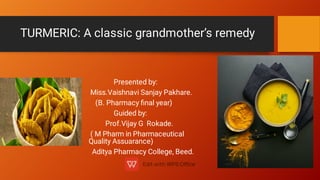
TURMERIC: A classic grandmother’s remedy
Presented by:
Miss.Vaishnavi Sanjay Pakhare.
(B. Pharmacy final year)
Guided by:
Prof.Vijay G Rokade.
( M Pharm in Pharmaceutical
Quality Assuarance)
Aditya Pharmacy College, Beed.
Contents
1.
2.
3.
4.
5.
6.
7.
8.
9.
Introduction.
Pharmacognosy.
Cultivation.
Extraction.
TLC.
Macroscopical characters.
Chemical constituents.
Chemical test.
Turmeric dosage.
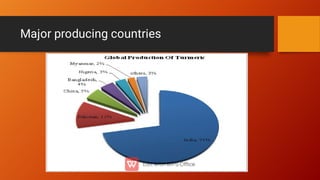
10. Major producing countries.
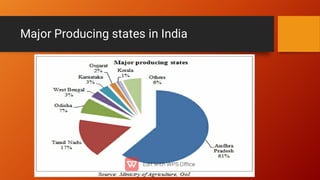
11.major producing States in
India.
12.Turmeric patent.
13.turmeric health benefits.
14. Conclusion.
15. References.
Introduction
•
•
•
•
Turmeric (nature’s precious gift) is a plant that has a very long history of
medicinal use, dating back nearly 4000 years.
In Southeast Asia, turmeric is used not only as a principal spice but also as a
component in religious ceremonies. Because of its brilliant yellow color, turmeric
is also known as “Indian saffron.”
Modern medicine has begun to recognize its importance, as indicated by the over
3000 publications dealing with turmeric that came out within the last 25 years.
Tamil Nadu, is the world’s largest producer of and the most important trading
center for turmeric. It is also known as “Yellow City,” “Turmeric City,” or “Textile
City.” Sangli, a city of Maharashtra, is second only to Erode in size and importance
as a production and trading site for turmeric.
Pharmacognosy
1.
2.
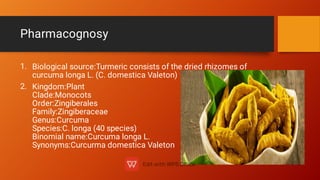
Biological source:Turmeric consists of the dried rhizomes of
curcuma longa L. (C. domestica Valeton)
Kingdom:Plant
Clade:Monocots
Order:Zingiberales
Family:Zingiberaceae
Genus:Curcuma
Species:C. longa (40 species)
Binomial name:Curcuma longa L.
Synonyms:Curcurma domestica Valeton
Cultivation
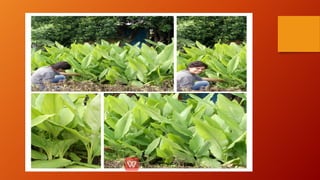
• Plant is a perennial herb; 2-3 ft high with a short stem and tufted leaves; the
rhizomes, which are short and thick, constitute the turmeric of commerce.
The crop requires a hot and moist climate, a liberal water supply and a well
drained soil. It thrives on any soil-loamy or alluvial, but the soil should be
lose and friable. The field should be well prepared by ploughing and turning
to a depth of about one ft. and liberally manure with farmyard and green
manures.
Sets or fingers of the previous crop worth one or two buds are planted 3-
inches deep at distance of 11-16 inches from April to August. The crop is
ready for harvesting in about 9-10 months when the lower leaves turns
yellow. The rhizomes are carefully dug up with hard picks, washed and
dried.
Extraction
•
•
•
•
•
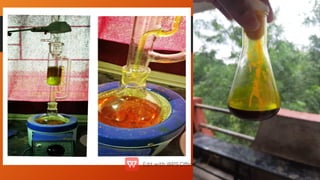
We plan to extract these curcuminoids From turmeric powder
The process involves soxhlet apparatus.it involves the solvent
extraction method
In the first step we followed the Process as Read in the literature
survey,this wasdone to ensure the familarity and also the
presence of curcuminoids
The dried turmeric was taken and powdered. 20g of this weighed
and placed in the soxhlet apparatus
200ml of acetone was heated and refluxed in the apparatus
Extraction
•
•
The process was monitored until the yellow colour Of the extraction was
faded away ( colourless)
The final extract was concentrated.
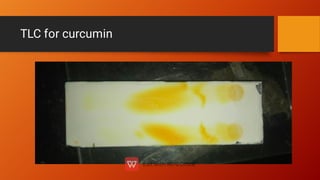
TLC for curcumin
Procedure for TLC
•
•
•
•
Stationary phase :- silica gel
Mobile phase :- chloroform:ethanol:glacial acetic acid in the ratio of
9.5:0.5:0.1
After drying the plate @105°c temperature where slurry of silica gel
is applied and Keep it in saturation chamber for 30 min
RF value= distance travelled by solute/distance travelled by solvent
=5.9/6.5 =0.90
Macroscopical character
•
•
•
•
i. Colour- Yellow to yellowish brown externally, yellow to yellow orange
internally.
ii. Form- Primary rhizomes ovate, oblongs or pyriform and are called in
commerce as bulb or round turmeric; whereas the lateral rhizomes are
more cylindrical and often short branched and they are called long turmeric.
iii. Size- the round form is about half as broad as long. The long forms are
about 4 to 7 cm long and 1 to 2 cm wide.
iv. Surface- root scars and annulations are seen.
v. Fracture- Horny.
vi. Odour- aromatic.
vii. Taste- aromatic and bitter.
Chemical constituents
1. Curcuminoids- Non-volatile colouring matter.
2. Curcumin, a diferuloylmethane; desmethoxy dicinnarmoylmethane;
bidesmethoxy curcumin.
3. Volatile oil:(a) l-cycloisoprenmyrcene,
(b) zinziberene,
(c) turmerone,
(d) a-atlantone,1. Curcuminoids- Non-volatile colouring matter.
Chemical constituent
• (e) y-atlantone,
(f) phallandrane,
(g) sabinene, cineole,
(h) borneol
(i) Curcumone.
4. Sugars- arabinose, fructose and glucose.
5. Bitter substances,
6. Fixed oil and acids
Chemical test
•
•
1. Conc. H2SO4 or a mixture of H2SO4 with alcohol (90%) imparts a
deep crimson colour to turmeric.
2. Boric acid colours to reddish brown which on addition of alkalies
becomes greenish blue.
Turmeric dosage
• 1 to 2 teaspoonfuls with lukewarm milk or honey once or twice a
day before or after meals or as prescribed by Ayurvedic doctor.
It Is 400 to 600 mg three times daily, according to the condition of
the individual. Turmeric will not give suggested therapeutic values
and dosage levels in the body as used in the normal cooking
process. If taking turmeric to manage different clinical conditions,
evidence suggests the use of 500mg of turmeric 4 times a day for
stomach problems and 500mg twice a day for managing patients
with osteoarthritis
Major producing countries
Major Producing states in India
Turmeric patent
•
•
The turmeric patent was granted in 1995 to two researchers, Soman K. Das
and Harihar Kohli of the University of Mississippi Medical Center.
India has forced the US Patent and Trademark Office (PTO) to revoke a
contentious patent it granted two years ago to researchers in the United
States on the use of powdered turmeric (Curcuma longa) for wound
healing.
The PTO withdrew the patent on 13 August after a year-long legal battle
with India's Council of Scientific and Industrial Research (CSIR), which
argued that turmeric, a native Indian plant, had been used for centuries by
its people for wound healing, and so lacked the “novelty” criterion required
for patenting.
Turmeric patent
•
•
The Indian agency hired a US patent lawyer and spent $15,000 to
fight the case, which it supported with documents ranging from
scientific publications to books on home remedies and ancient
Ayurvedic texts on Indian systems of medicine.
Indian scientists claim this is the first time that a move in the United
States to patent a traditional remedy from the developing world has
been successfully overturned. Earlier efforts by an international
coalition of environmentalists to get the US patents on products of
the neem tree cancelled ended in failure
Turmeric patent
•
•
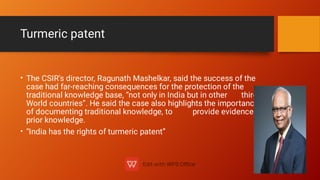
The CSIR's director, Ragunath Mashelkar, said the success of the
case had far-reaching consequences for the protection of the
traditional knowledge base, “not only in India but in other third
World countries”. He said the case also highlights the importance
of documenting traditional knowledge, to provide evidence of
prior knowledge.
“India has the rights of turmeric patent”
Health benefits of Turmeric
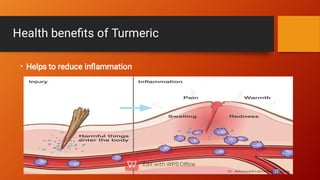
• Helps to reduce inflammation
Health benefits
• Helps to relieve arthritic pain
Health benefits
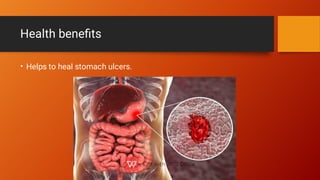
• Helps to heal stomach ulcers.
Health benefits
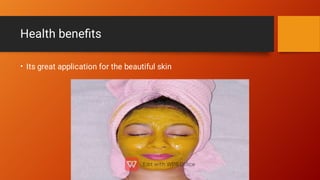
• Its great application for the beautiful skin
Helath benefits
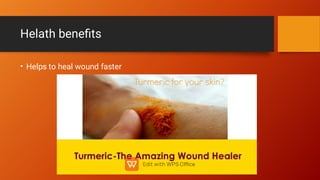
• Helps to heal wound faster
Health benefits
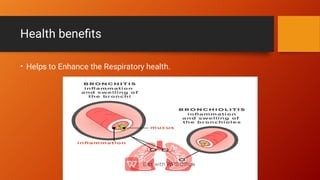
• Helps to Enhance the Respiratory health.
Health benefits
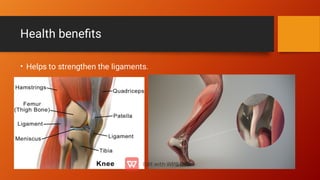
• Helps to strengthen the ligaments.
Health benefits
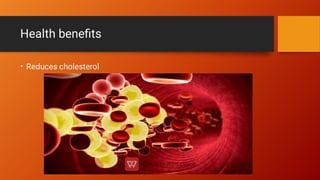
• Reduces cholesterol
Health benefits
• Improve brain functions
Health benefits
• Helps to combat depression
References:
1}Prasad S. Aggarwal BB. , Turmeric:the golden spice:from traditional medicine to modern
medicine.In :Benzie IFF, Wachtel Galor S, editors.herbal medicine biomolecular and clinical
aspects.2nd edition.Boca Raton [FL] : CRC press/Taylor & Francis; 2011.chapter 13.
2}M.Akrami , Shahab-uddini,Afzal Ahmedz, Khan Usmanghani 3, Abdul Hannan3, E. Mohiuddun4, M
Asif curcuma long and curcumin : a review article ROM.J.BIOL.-plant BIOL., volume 55,No.2,
P.65-70,Bucharest, 2010 .
3}Tuyet A Nguyen,Adman J Friedman Journal of drugs in dermatology:JDD 12, 1131-1137, 2013.
4}Fiona c rodrigues, n v anilkumar , goutam thakur europian journal of medicinal chemistry 2019.
5} Satish Sundar Dhilip Kumar , Nicolette Nadene Houreld, Heidi Abrahamse Molecules 23 , 835,
2018.
6}Rita Borik,Nagwa Fawzy, Sherifa Abu-Bakr, Magdy Aly Molecules 23 1398,2018
References
•
•
•
•
•
•
7} Sultana Parveen Pooja Ghosh Aritra Mitra Satarupa Gupta , Swagata
Dasgupta Emergent Materials, 1-12, 2019.
8}C K Kokate ,A.P. purohit,S B Gokhale,Pharmacognosy, Nirali Prakashan,54
Th Edition.
9}www.wikipedia.Com
10}www.Diabetes Selfmanagement.com/blog/turmeric-diabetes/
11}Saipriya Balasubramanian,Traditional Knowledge And Patent Issues,
Mondaq.Com, 2017
12}Dr.G. Prabhakara, Rao Bhaishajya Ratnavali Of Kaviraj Shri Govind Das
Sen, Chaukhamba Orientalia Varanasi,Planetayurveda.Com
Turmeric presentation

Turmeric presentation

  • 1.
  • 2.
    TURMERIC: A classicgrandmother’s remedy Presented by: Miss.Vaishnavi Sanjay Pakhare. (B. Pharmacy final year) Guided by: Prof.Vijay G Rokade. ( M Pharm in Pharmaceutical Quality Assuarance) Aditya Pharmacy College, Beed.
  • 3.
    Contents 1. 2. 3. 4. 5. 6. 7. 8. 9. Introduction. Pharmacognosy. Cultivation. Extraction. TLC. Macroscopical characters. Chemical constituents. Chemicaltest. Turmeric dosage. 10. Major producing countries. 11.major producing States in India. 12.Turmeric patent. 13.turmeric health benefits. 14. Conclusion. 15. References.
  • 4.
    Introduction • • • • Turmeric (nature’s preciousgift) is a plant that has a very long history of medicinal use, dating back nearly 4000 years. In Southeast Asia, turmeric is used not only as a principal spice but also as a component in religious ceremonies. Because of its brilliant yellow color, turmeric is also known as “Indian saffron.” Modern medicine has begun to recognize its importance, as indicated by the over 3000 publications dealing with turmeric that came out within the last 25 years. Tamil Nadu, is the world’s largest producer of and the most important trading center for turmeric. It is also known as “Yellow City,” “Turmeric City,” or “Textile City.” Sangli, a city of Maharashtra, is second only to Erode in size and importance as a production and trading site for turmeric.
  • 5.
    Pharmacognosy 1. 2. Biological source:Turmeric consistsof the dried rhizomes of curcuma longa L. (C. domestica Valeton) Kingdom:Plant Clade:Monocots Order:Zingiberales Family:Zingiberaceae Genus:Curcuma Species:C. longa (40 species) Binomial name:Curcuma longa L. Synonyms:Curcurma domestica Valeton
  • 6.
    Cultivation • Plant isa perennial herb; 2-3 ft high with a short stem and tufted leaves; the rhizomes, which are short and thick, constitute the turmeric of commerce. The crop requires a hot and moist climate, a liberal water supply and a well drained soil. It thrives on any soil-loamy or alluvial, but the soil should be lose and friable. The field should be well prepared by ploughing and turning to a depth of about one ft. and liberally manure with farmyard and green manures. Sets or fingers of the previous crop worth one or two buds are planted 3- inches deep at distance of 11-16 inches from April to August. The crop is ready for harvesting in about 9-10 months when the lower leaves turns yellow. The rhizomes are carefully dug up with hard picks, washed and dried.
  • 8.
    Extraction • • • • • We plan toextract these curcuminoids From turmeric powder The process involves soxhlet apparatus.it involves the solvent extraction method In the first step we followed the Process as Read in the literature survey,this wasdone to ensure the familarity and also the presence of curcuminoids The dried turmeric was taken and powdered. 20g of this weighed and placed in the soxhlet apparatus 200ml of acetone was heated and refluxed in the apparatus
  • 9.
    Extraction • • The process wasmonitored until the yellow colour Of the extraction was faded away ( colourless) The final extract was concentrated.
  • 11.
  • 12.
    Procedure for TLC • • • • Stationaryphase :- silica gel Mobile phase :- chloroform:ethanol:glacial acetic acid in the ratio of 9.5:0.5:0.1 After drying the plate @105°c temperature where slurry of silica gel is applied and Keep it in saturation chamber for 30 min RF value= distance travelled by solute/distance travelled by solvent =5.9/6.5 =0.90
  • 13.
    Macroscopical character • • • • i. Colour-Yellow to yellowish brown externally, yellow to yellow orange internally. ii. Form- Primary rhizomes ovate, oblongs or pyriform and are called in commerce as bulb or round turmeric; whereas the lateral rhizomes are more cylindrical and often short branched and they are called long turmeric. iii. Size- the round form is about half as broad as long. The long forms are about 4 to 7 cm long and 1 to 2 cm wide. iv. Surface- root scars and annulations are seen. v. Fracture- Horny. vi. Odour- aromatic. vii. Taste- aromatic and bitter.
  • 14.
    Chemical constituents 1. Curcuminoids-Non-volatile colouring matter. 2. Curcumin, a diferuloylmethane; desmethoxy dicinnarmoylmethane; bidesmethoxy curcumin. 3. Volatile oil:(a) l-cycloisoprenmyrcene, (b) zinziberene, (c) turmerone, (d) a-atlantone,1. Curcuminoids- Non-volatile colouring matter.
  • 15.
    Chemical constituent • (e)y-atlantone, (f) phallandrane, (g) sabinene, cineole, (h) borneol (i) Curcumone. 4. Sugars- arabinose, fructose and glucose. 5. Bitter substances, 6. Fixed oil and acids
  • 16.
    Chemical test • • 1. Conc.H2SO4 or a mixture of H2SO4 with alcohol (90%) imparts a deep crimson colour to turmeric. 2. Boric acid colours to reddish brown which on addition of alkalies becomes greenish blue.
  • 17.
    Turmeric dosage • 1to 2 teaspoonfuls with lukewarm milk or honey once or twice a day before or after meals or as prescribed by Ayurvedic doctor. It Is 400 to 600 mg three times daily, according to the condition of the individual. Turmeric will not give suggested therapeutic values and dosage levels in the body as used in the normal cooking process. If taking turmeric to manage different clinical conditions, evidence suggests the use of 500mg of turmeric 4 times a day for stomach problems and 500mg twice a day for managing patients with osteoarthritis
  • 18.
  • 19.
  • 20.
    Turmeric patent • • The turmericpatent was granted in 1995 to two researchers, Soman K. Das and Harihar Kohli of the University of Mississippi Medical Center. India has forced the US Patent and Trademark Office (PTO) to revoke a contentious patent it granted two years ago to researchers in the United States on the use of powdered turmeric (Curcuma longa) for wound healing. The PTO withdrew the patent on 13 August after a year-long legal battle with India's Council of Scientific and Industrial Research (CSIR), which argued that turmeric, a native Indian plant, had been used for centuries by its people for wound healing, and so lacked the “novelty” criterion required for patenting.
  • 21.
    Turmeric patent • • The Indianagency hired a US patent lawyer and spent $15,000 to fight the case, which it supported with documents ranging from scientific publications to books on home remedies and ancient Ayurvedic texts on Indian systems of medicine. Indian scientists claim this is the first time that a move in the United States to patent a traditional remedy from the developing world has been successfully overturned. Earlier efforts by an international coalition of environmentalists to get the US patents on products of the neem tree cancelled ended in failure
  • 22.
    Turmeric patent • • The CSIR'sdirector, Ragunath Mashelkar, said the success of the case had far-reaching consequences for the protection of the traditional knowledge base, “not only in India but in other third World countries”. He said the case also highlights the importance of documenting traditional knowledge, to provide evidence of prior knowledge. “India has the rights of turmeric patent”
  • 23.
    Health benefits ofTurmeric • Helps to reduce inflammation
  • 24.
    Health benefits • Helpsto relieve arthritic pain
  • 25.
    Health benefits • Helpsto heal stomach ulcers.
  • 26.
    Health benefits • Itsgreat application for the beautiful skin
  • 27.
    Helath benefits • Helpsto heal wound faster
  • 28.
    Health benefits • Helpsto Enhance the Respiratory health.
  • 29.
    Health benefits • Helpsto strengthen the ligaments.
  • 30.
  • 31.
  • 32.
    Health benefits • Helpsto combat depression
  • 33.
    References: 1}Prasad S. AggarwalBB. , Turmeric:the golden spice:from traditional medicine to modern medicine.In :Benzie IFF, Wachtel Galor S, editors.herbal medicine biomolecular and clinical aspects.2nd edition.Boca Raton [FL] : CRC press/Taylor & Francis; 2011.chapter 13. 2}M.Akrami , Shahab-uddini,Afzal Ahmedz, Khan Usmanghani 3, Abdul Hannan3, E. Mohiuddun4, M Asif curcuma long and curcumin : a review article ROM.J.BIOL.-plant BIOL., volume 55,No.2, P.65-70,Bucharest, 2010 . 3}Tuyet A Nguyen,Adman J Friedman Journal of drugs in dermatology:JDD 12, 1131-1137, 2013. 4}Fiona c rodrigues, n v anilkumar , goutam thakur europian journal of medicinal chemistry 2019. 5} Satish Sundar Dhilip Kumar , Nicolette Nadene Houreld, Heidi Abrahamse Molecules 23 , 835, 2018. 6}Rita Borik,Nagwa Fawzy, Sherifa Abu-Bakr, Magdy Aly Molecules 23 1398,2018
  • 34.
    References • • • • • • 7} Sultana ParveenPooja Ghosh Aritra Mitra Satarupa Gupta , Swagata Dasgupta Emergent Materials, 1-12, 2019. 8}C K Kokate ,A.P. purohit,S B Gokhale,Pharmacognosy, Nirali Prakashan,54 Th Edition. 9}www.wikipedia.Com 10}www.Diabetes Selfmanagement.com/blog/turmeric-diabetes/ 11}Saipriya Balasubramanian,Traditional Knowledge And Patent Issues, Mondaq.Com, 2017 12}Dr.G. Prabhakara, Rao Bhaishajya Ratnavali Of Kaviraj Shri Govind Das Sen, Chaukhamba Orientalia Varanasi,Planetayurveda.Com