CINNAMON
BP504 T: PHARMACOGNOSY AND
PHYTOCHEMISTRY II (Theory)
SONIA SINGH
ASSISTANT PROFESSOR
GLA UNIVERSITY
MATHURA
1
SONIA SINGH, ASSISTANT PROFESSOR, GLA UNIVERSITY
OBJECTIVE OF THE CLASS
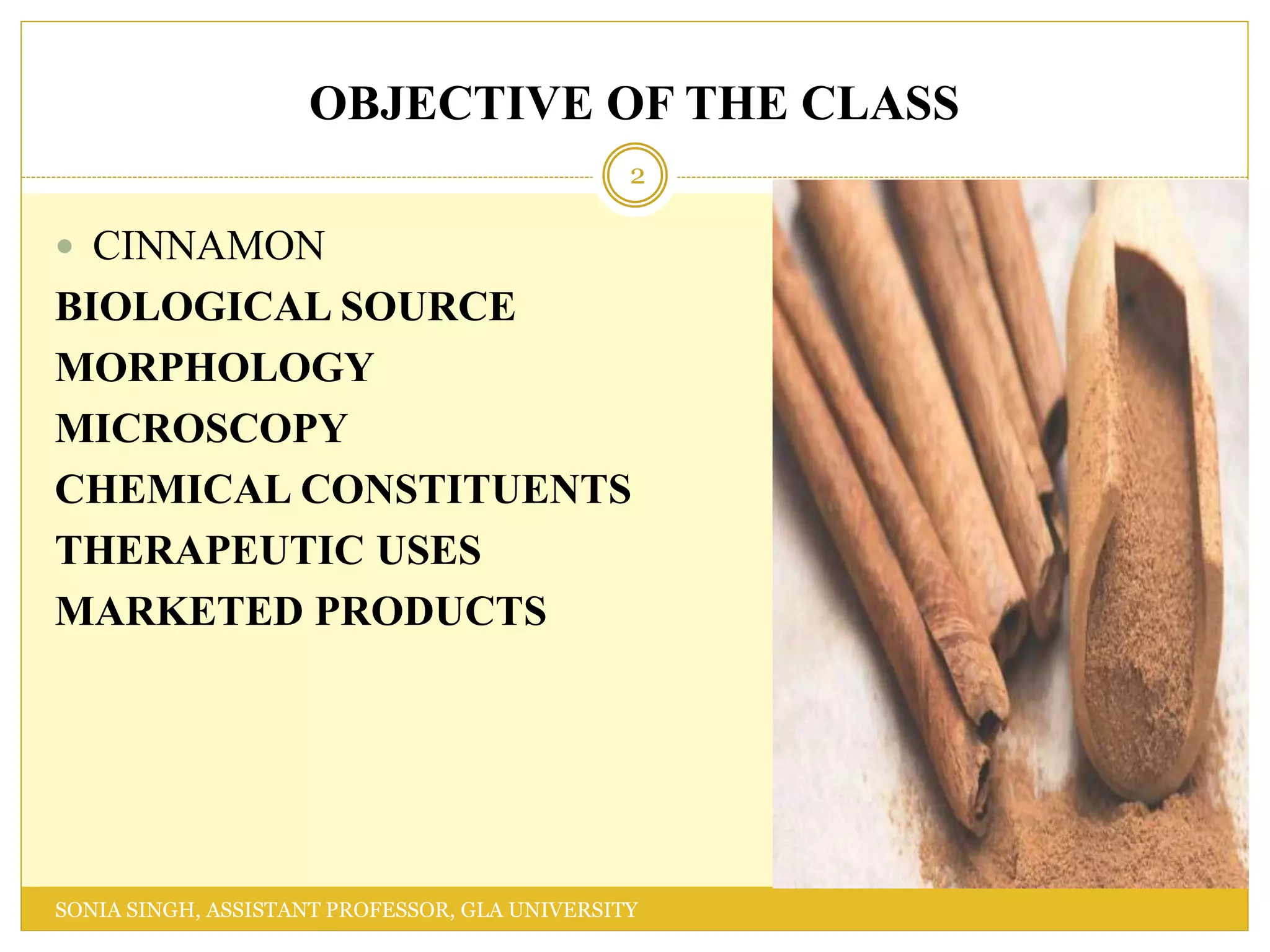
 CINNAMON
BIOLOGICAL SOURCE
MORPHOLOGY
MICROSCOPY
CHEMICAL CONSTITUENTS
THERAPEUTIC USES
MARKETED PRODUCTS
2
SONIA SINGH, ASSISTANT PROFESSOR, GLA UNIVERSITY
CINNAMON
 Synonyms:
Cinnamon bark, Kalmi-dalchini, Ceylon cinnamon
 Biological source:
It consists of the dried inner bark of the shoots of coppiced trees of
Cinnamomum zeylanicum Nees (Cinnamomum verum J. S.Presl.)
belongs to the family Lauraceae.
3
SONIA SINGH, ASSISTANT PROFESSOR, GLA UNIVERSITY
 Geographical source:
It is the evergreen tree of tropical area, is considered to be native of
Sri Lanka and Malabar Coast of India. It is also found in Jamaica
and Brazil. However, most of the world requirements are met by Sri
Lanka and hence true cinnamon is known as Sri Lanka cinnamon.
4
SONIA SINGH, ASSISTANT PROFESSOR, GLA UNIVERSITY
 Cultivation and collection:
Propagated by planting the cutting and layers.
Commercially, it is propagated by seed.
It is a crop of tropical countries. It needs sandy or siliconous soils
with an admixture of humus.
It grows favourably at 800-1000 meters .
The seeds are sown in well prepared nursery beds in June and July.
It takes approximately 20 days for germination of seeds.
Seedlings are provided with the shades and are allowed to grow for
about 10-12 months.
5
SONIA SINGH, ASSISTANT PROFESSOR, GLA UNIVERSITY
Transplantation is done in october or november or
even in rainy season.
Weeding is done periodically.
Fertilizers are applied in two equal doses.
Trees are coppiced to induce the formation of shoots.
The trees are allowed to grow unless they turn to
uniform brown by the formation of cork.
Harvesting is done in rainy season.
6
SONIA SINGH, ASSISTANT PROFESSOR, GLA UNIVERSITY
The shoots are usually cut down after the monsoons in May, but
there is a smaller harvesting in November.
At these times sap movement is considerable, and the bark readily
separates.
Special knives are used for peeling and scraping, as steel causes
discoloration. Lateral branches and leaves are cuts down the chute.
To assist removal, the bark is rubbed with the handle of the knife.
The pieces are then heaped together, and covered to conserve
moisture and heat, and thus induce slight fermentation.
7
SONIA SINGH, ASSISTANT PROFESSOR, GLA UNIVERSITY
Colour: The outer surface is dull yellowish-brown, while
the inner surface is dark yellowish-brown.
Odour: Fragrant.
Shape: Compound squill.
Size: About 1 meter in length and 1 cm in diameter. The
thickness of the bark is approximately 0.5 mm.
Taste: Aromatic and sweet followed by warm sensation.
Fracture: Splintery.
8
SONIA SINGH, ASSISTANT PROFESSOR, GLA UNIVERSITY
The outer surface of the bark is marked by wavy longitudinal
striations with small holes of scars left by the branches. The inner
surface also shows the longitudinal striations. Bark is free of cork.
9
SONIA SINGH, ASSISTANT PROFESSOR, GLA
UNIVERSITY
MACROSCOPY OF CINNAMON: LEAF AND BARK
10
SONIA SINGH, ASSISTANT PROFESSOR, GLA UNIVERSITY
MICROSCOPY OF CINNAMON
The transverse section shows the presence of three to four layers of
sclereids which are horse shoe shaped consisting of starch grains.
The pericyclic fibres (6 to 15) are present on the outer margin. It
consists of sieve tubes which are completely collapsed and are
arranged tangentially; lignified phloem fibres, arranged as tangential
rows of four to five cells; biseriate medullary rays with needle
shaped calcium oxalate crystals; longitudinally elongated idioblast
consisting of volatile oil; sub-rectangular parenchyma cells with
starch grains and calcium oxalate crystals.
11
SONIA SINGH, ASSISTANT PROFESSOR, GLA UNIVERSITY
Transverse section of Cinnamon bark
12
SONIA SINGH, ASSISTANT PROFESSOR, GLA UNIVERSITY
CHEMICAL CONSTITUENTS
 Cinnamon contains about 10% of volatile oil, tannin, mucilage,
calcium oxalate and sugar.
 Volatile oil contains 60-70% cinnamaldehyde, 5 to 10% eugenol,
benzaldehyde, cuminaldehyde, terpene hydrocarbons such as
phellandrene, cymene, caryophyllene, pinene and small quantities
of ketones and alcohols.
 1.2 % TANNINS: PHLOBATANNINS
 SWEET SUBSTANCE: MANNITOL
13
SONIA SINGH, ASSISTANT PROFESSOR, GLA UNIVERSITY
IDENTIFICATION TESTS
 A drop of volatile oil is dissolved in 5 ml of alcohol and to it a
drop of ferric chloride is added, A pale green colour is produced.
Cinnamic aldehyde gives brown colour with ferric chloride,
whereas eugenol gives blue colour.
 The alcoholic extract is treated with phenylhydrazine
hydrochloride, it produces red colour due to the formation of
phenylhydrazone of cinnamic aldehyde.
14
SONIA SINGH, ASSISTANT PROFESSOR, GLA UNIVERSITY
THERAPEUTIC USES
 An alterative, aromatic, carminative, flavouring agent, analgesic,
antiseptic, antirheumatic, antispasmodic,
 Demulcent, digestive, expectorant, stomachic, diaphoretic,
antibacterial, antifungal, etc.
 It stops vomiting, relieves flatulence and is given with chalk and
as astringents for diarrhoea and haemorrhage of the womb.
 It is also used in the treatment of bronchitis, colds, palpitations,
nausea, congestion, and liver problems.
15
SONIA SINGH, ASSISTANT PROFESSOR, GLA UNIVERSITY
MARKETED PRODUCTS
 It is one of the ingredients of the preparations known as
Rumalaya gel, Koflet lozenges, Chyavanprash (Himalaya Drug
Company), Garbhapal ras, Sutsekhar ras (Dabur), and Sage
Staminex capsules (Sage Herbals).
16
SONIA SINGH, ASSISTANT PROFESSOR, GLA
UNIVERSITY
17SONIA SINGH, ASSISTANT PROFESSOR, GLA UNIVERSITY

Cinnamon

  • 1.
    CINNAMON BP504 T: PHARMACOGNOSYAND PHYTOCHEMISTRY II (Theory) SONIA SINGH ASSISTANT PROFESSOR GLA UNIVERSITY MATHURA 1 SONIA SINGH, ASSISTANT PROFESSOR, GLA UNIVERSITY
  • 2.
    OBJECTIVE OF THECLASS  CINNAMON BIOLOGICAL SOURCE MORPHOLOGY MICROSCOPY CHEMICAL CONSTITUENTS THERAPEUTIC USES MARKETED PRODUCTS 2 SONIA SINGH, ASSISTANT PROFESSOR, GLA UNIVERSITY
  • 3.
    CINNAMON  Synonyms: Cinnamon bark,Kalmi-dalchini, Ceylon cinnamon  Biological source: It consists of the dried inner bark of the shoots of coppiced trees of Cinnamomum zeylanicum Nees (Cinnamomum verum J. S.Presl.) belongs to the family Lauraceae. 3 SONIA SINGH, ASSISTANT PROFESSOR, GLA UNIVERSITY
  • 4.
     Geographical source: Itis the evergreen tree of tropical area, is considered to be native of Sri Lanka and Malabar Coast of India. It is also found in Jamaica and Brazil. However, most of the world requirements are met by Sri Lanka and hence true cinnamon is known as Sri Lanka cinnamon. 4 SONIA SINGH, ASSISTANT PROFESSOR, GLA UNIVERSITY
  • 5.
     Cultivation andcollection: Propagated by planting the cutting and layers. Commercially, it is propagated by seed. It is a crop of tropical countries. It needs sandy or siliconous soils with an admixture of humus. It grows favourably at 800-1000 meters . The seeds are sown in well prepared nursery beds in June and July. It takes approximately 20 days for germination of seeds. Seedlings are provided with the shades and are allowed to grow for about 10-12 months. 5 SONIA SINGH, ASSISTANT PROFESSOR, GLA UNIVERSITY
  • 6.
    Transplantation is donein october or november or even in rainy season. Weeding is done periodically. Fertilizers are applied in two equal doses. Trees are coppiced to induce the formation of shoots. The trees are allowed to grow unless they turn to uniform brown by the formation of cork. Harvesting is done in rainy season. 6 SONIA SINGH, ASSISTANT PROFESSOR, GLA UNIVERSITY
  • 7.
    The shoots areusually cut down after the monsoons in May, but there is a smaller harvesting in November. At these times sap movement is considerable, and the bark readily separates. Special knives are used for peeling and scraping, as steel causes discoloration. Lateral branches and leaves are cuts down the chute. To assist removal, the bark is rubbed with the handle of the knife. The pieces are then heaped together, and covered to conserve moisture and heat, and thus induce slight fermentation. 7 SONIA SINGH, ASSISTANT PROFESSOR, GLA UNIVERSITY
  • 8.
    Colour: The outersurface is dull yellowish-brown, while the inner surface is dark yellowish-brown. Odour: Fragrant. Shape: Compound squill. Size: About 1 meter in length and 1 cm in diameter. The thickness of the bark is approximately 0.5 mm. Taste: Aromatic and sweet followed by warm sensation. Fracture: Splintery. 8 SONIA SINGH, ASSISTANT PROFESSOR, GLA UNIVERSITY
  • 9.
    The outer surfaceof the bark is marked by wavy longitudinal striations with small holes of scars left by the branches. The inner surface also shows the longitudinal striations. Bark is free of cork. 9 SONIA SINGH, ASSISTANT PROFESSOR, GLA UNIVERSITY
  • 10.
    MACROSCOPY OF CINNAMON:LEAF AND BARK 10 SONIA SINGH, ASSISTANT PROFESSOR, GLA UNIVERSITY
  • 11.
    MICROSCOPY OF CINNAMON Thetransverse section shows the presence of three to four layers of sclereids which are horse shoe shaped consisting of starch grains. The pericyclic fibres (6 to 15) are present on the outer margin. It consists of sieve tubes which are completely collapsed and are arranged tangentially; lignified phloem fibres, arranged as tangential rows of four to five cells; biseriate medullary rays with needle shaped calcium oxalate crystals; longitudinally elongated idioblast consisting of volatile oil; sub-rectangular parenchyma cells with starch grains and calcium oxalate crystals. 11 SONIA SINGH, ASSISTANT PROFESSOR, GLA UNIVERSITY
  • 12.
    Transverse section ofCinnamon bark 12 SONIA SINGH, ASSISTANT PROFESSOR, GLA UNIVERSITY
  • 13.
    CHEMICAL CONSTITUENTS  Cinnamoncontains about 10% of volatile oil, tannin, mucilage, calcium oxalate and sugar.  Volatile oil contains 60-70% cinnamaldehyde, 5 to 10% eugenol, benzaldehyde, cuminaldehyde, terpene hydrocarbons such as phellandrene, cymene, caryophyllene, pinene and small quantities of ketones and alcohols.  1.2 % TANNINS: PHLOBATANNINS  SWEET SUBSTANCE: MANNITOL 13 SONIA SINGH, ASSISTANT PROFESSOR, GLA UNIVERSITY
  • 14.
    IDENTIFICATION TESTS  Adrop of volatile oil is dissolved in 5 ml of alcohol and to it a drop of ferric chloride is added, A pale green colour is produced. Cinnamic aldehyde gives brown colour with ferric chloride, whereas eugenol gives blue colour.  The alcoholic extract is treated with phenylhydrazine hydrochloride, it produces red colour due to the formation of phenylhydrazone of cinnamic aldehyde. 14 SONIA SINGH, ASSISTANT PROFESSOR, GLA UNIVERSITY
  • 15.
    THERAPEUTIC USES  Analterative, aromatic, carminative, flavouring agent, analgesic, antiseptic, antirheumatic, antispasmodic,  Demulcent, digestive, expectorant, stomachic, diaphoretic, antibacterial, antifungal, etc.  It stops vomiting, relieves flatulence and is given with chalk and as astringents for diarrhoea and haemorrhage of the womb.  It is also used in the treatment of bronchitis, colds, palpitations, nausea, congestion, and liver problems. 15 SONIA SINGH, ASSISTANT PROFESSOR, GLA UNIVERSITY
  • 16.
    MARKETED PRODUCTS  Itis one of the ingredients of the preparations known as Rumalaya gel, Koflet lozenges, Chyavanprash (Himalaya Drug Company), Garbhapal ras, Sutsekhar ras (Dabur), and Sage Staminex capsules (Sage Herbals). 16 SONIA SINGH, ASSISTANT PROFESSOR, GLA UNIVERSITY
  • 17.
    17SONIA SINGH, ASSISTANTPROFESSOR, GLA UNIVERSITY