ASSIGNMENT ON
AZADIRACHTA INDICA
(NEEM)
SUBMITTED TO: SUBMITTED BY:
RAFI-UL HAQUE
IMRAN SAIFI
SIR
INTRODUCTION
BIOLOGICAL SOURCE
MACROSCOPIC PROPERTIES
CHEMICAL CONSTITUTION
USES
HERBAL PRODUCTS
REFERENCES
Neem or Margosa is a botanical cousin of Mahogany. It belongs to the family
Meliaceae. The latinized name of Neem Azadirachta Indica - is derived
from the Persian.
• Azad = Free,
• dirakht = Tree,
• i - Hind = of Indian Origin
which literally means: “The Free Tree of India”
Or “Noble Tree”
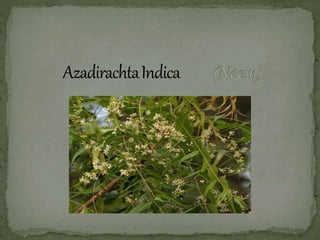
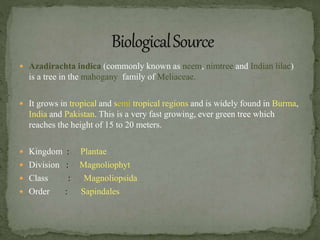
 Azadirachta indica (commonly known as neem, nimtree and Indian lilac)
is a tree in the mahogany family of Meliaceae.
 It grows in tropical and semi tropical regions and is widely found in Burma,
India and Pakistan. This is a very fast growing, ever green tree which
reaches the height of 15 to 20 meters.
 Kingdom : Plantae
 Division : Magnoliophyt
 Class : Magnoliopsida
 Order : Sapindales
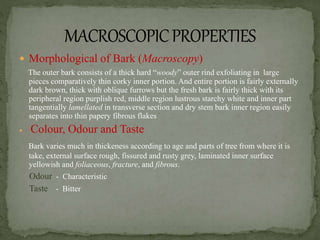
 Morphological of Bark (Macroscopy)
The outer bark consists of a thick hard “woody” outer rind exfoliating in large
pieces comparatively thin corky inner portion. And entire portion is fairly externally
dark brown, thick with oblique furrows but the fresh bark is fairly thick with its
peripheral region purplish red, middle region lustrous starchy white and inner part
tangentially lamellated in transverse section and dry stem bark inner region easily
separates into thin papery fibrous flakes
 Colour, Odour and Taste
Bark varies much in thickeness according to age and parts of tree from where it is
take, external surface rough, fissured and rusty grey, laminated inner surface
yellowish and foliaceous, fracture, and fibrous.
Odour - Characteristic
Taste - Bitter
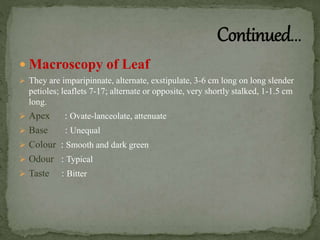
 Macroscopy of Leaf
 They are imparipinnate, alternate, exstipulate, 3-6 cm long on long slender
petioles; leaflets 7-17; alternate or opposite, very shortly stalked, 1-1.5 cm
long.
 Apex : Ovate-lanceolate, attenuate
 Base : Unequal
 Colour : Smooth and dark green
 Odour : Typical
 Taste : Bitter
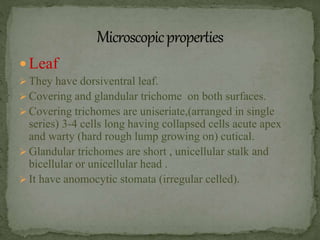
 Leaf
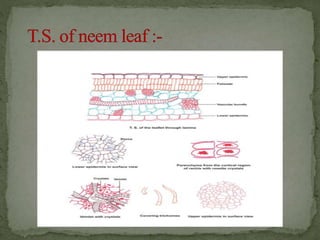
 They have dorsiventral leaf.
 Covering and glandular trichome on both surfaces.
 Covering trichomes are uniseriate,(arranged in single
series) 3-4 cells long having collapsed cells acute apex
and warty (hard rough lump growing on) cutical.
 Glandular trichomes are short , unicellular stalk and
bicellular or unicellular head .
 It have anomocytic stomata (irregular celled).
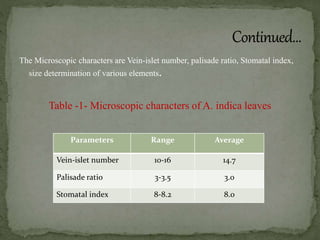
The Microscopic characters are Vein-islet number, palisade ratio, Stomatal index,
size determination of various elements.
Table -1- Microscopic characters of A. indica leaves
Parameters Range Average
Vein-islet number 10-16 14.7
Palisade ratio 3-3.5 3.0
Stomatal index 8-8.2 8.0
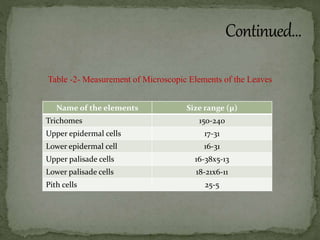
Table -2- Measurement of Microscopic Elements of the Leaves
Name of the elements Size range (µ)
Trichomes 150-240
Upper epidermal cells 17-31
Lower epidermal cell 16-31
Upper palisade cells 16-38x5-13
Lower palisade cells 18-21x6-11
Pith cells 25-5
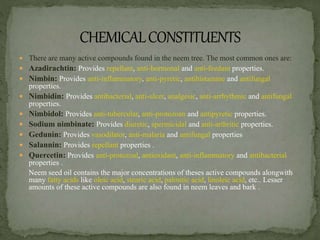
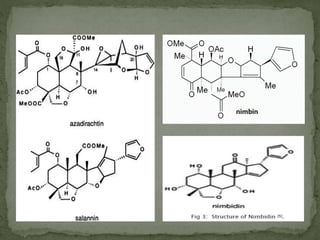
 There are many active compounds found in the neem tree. The most common ones are:
 Azadirachtin: Provides repellant, anti-hormonal and anti-feedant properties.
 Nimbin: Provides anti-inflammatory, anti-pyretic, antihistamine and antifungal
properties.
 Nimbidin: Provides antibacterial, anti-ulcer, analgesic, anti-arrhythmic and antifungal
properties.
 Nimbidol: Provides anti-tubercular, anti-protozoan and antipyretic properties.
 Sodium nimbinate: Provides diuretic, spermicidal and anti-arthritic properties.
 Gedunin: Provides vasodilator, anti-malaria and antifungal properties
 Salannin: Provides repellant properties .
 Quercetin: Provides anti-protozoal, antioxidant, anti-inflammatory and antibacterial
properties .
Neem seed oil contains the major concentrations of theses active compounds alongwith
many fatty acids like oleic acid, stearic acid, palmitic acid, linoleic acid, etc.. Lesser
amounts of these active compounds are also found in neem leaves and bark .
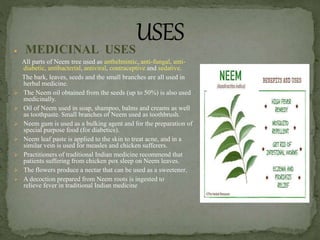
 MEDICINAL USES
All parts of Neem tree used as anthelmintic, anti-fungal, anti-
diabetic, antibacterial, antiviral, contraceptive and sedative.
The bark, leaves, seeds and the small branches are all used in
herbal medicine.
 The Neem oil obtained from the seeds (up to 50%) is also used
medicinally.
 Oil of Neem used in soap, shampoo, balms and creams as well
as toothpaste. Small branches of Neem used as toothbrush.
 Neem gum is used as a bulking agent and for the preparation of
special purpose food (for diabetics).
 Neem leaf paste is applied to the skin to treat acne, and in a
similar vein is used for measles and chicken sufferers.
 Practitioners of traditional Indian medicine recommend that
patients suffering from chicken pox sleep on Neem leaves.
 The flowers produce a nectar that can be used as a sweetener.
 A decoction prepared from Neem roots is ingested to
relieve fever in traditional Indian medicine
ThankyouforwatchingmyPowerPointPresentation.Ihopeyouarenowa littlebitmoreinformed
abouttheAzadirachtaIndica(NEEM),andif not,youcanvisitthesesitesat thebottom.
wikipedia.com
google.com
Pharmatips.in
Herbpathy.com
pubmed

Azadirachta indica (neem)

  • 1.
    ASSIGNMENT ON AZADIRACHTA INDICA (NEEM) SUBMITTEDTO: SUBMITTED BY: RAFI-UL HAQUE IMRAN SAIFI SIR
  • 3.
    INTRODUCTION BIOLOGICAL SOURCE MACROSCOPIC PROPERTIES CHEMICALCONSTITUTION USES HERBAL PRODUCTS REFERENCES
  • 4.
    Neem or Margosais a botanical cousin of Mahogany. It belongs to the family Meliaceae. The latinized name of Neem Azadirachta Indica - is derived from the Persian. • Azad = Free, • dirakht = Tree, • i - Hind = of Indian Origin which literally means: “The Free Tree of India” Or “Noble Tree”
  • 5.
     Azadirachta indica(commonly known as neem, nimtree and Indian lilac) is a tree in the mahogany family of Meliaceae.  It grows in tropical and semi tropical regions and is widely found in Burma, India and Pakistan. This is a very fast growing, ever green tree which reaches the height of 15 to 20 meters.  Kingdom : Plantae  Division : Magnoliophyt  Class : Magnoliopsida  Order : Sapindales
  • 6.
     Morphological ofBark (Macroscopy) The outer bark consists of a thick hard “woody” outer rind exfoliating in large pieces comparatively thin corky inner portion. And entire portion is fairly externally dark brown, thick with oblique furrows but the fresh bark is fairly thick with its peripheral region purplish red, middle region lustrous starchy white and inner part tangentially lamellated in transverse section and dry stem bark inner region easily separates into thin papery fibrous flakes  Colour, Odour and Taste Bark varies much in thickeness according to age and parts of tree from where it is take, external surface rough, fissured and rusty grey, laminated inner surface yellowish and foliaceous, fracture, and fibrous. Odour - Characteristic Taste - Bitter
  • 7.
     Macroscopy ofLeaf  They are imparipinnate, alternate, exstipulate, 3-6 cm long on long slender petioles; leaflets 7-17; alternate or opposite, very shortly stalked, 1-1.5 cm long.  Apex : Ovate-lanceolate, attenuate  Base : Unequal  Colour : Smooth and dark green  Odour : Typical  Taste : Bitter
  • 8.
     Leaf  Theyhave dorsiventral leaf.  Covering and glandular trichome on both surfaces.  Covering trichomes are uniseriate,(arranged in single series) 3-4 cells long having collapsed cells acute apex and warty (hard rough lump growing on) cutical.  Glandular trichomes are short , unicellular stalk and bicellular or unicellular head .  It have anomocytic stomata (irregular celled).
  • 9.
    The Microscopic charactersare Vein-islet number, palisade ratio, Stomatal index, size determination of various elements. Table -1- Microscopic characters of A. indica leaves Parameters Range Average Vein-islet number 10-16 14.7 Palisade ratio 3-3.5 3.0 Stomatal index 8-8.2 8.0
  • 10.
    Table -2- Measurementof Microscopic Elements of the Leaves Name of the elements Size range (µ) Trichomes 150-240 Upper epidermal cells 17-31 Lower epidermal cell 16-31 Upper palisade cells 16-38x5-13 Lower palisade cells 18-21x6-11 Pith cells 25-5
  • 12.
     There aremany active compounds found in the neem tree. The most common ones are:  Azadirachtin: Provides repellant, anti-hormonal and anti-feedant properties.  Nimbin: Provides anti-inflammatory, anti-pyretic, antihistamine and antifungal properties.  Nimbidin: Provides antibacterial, anti-ulcer, analgesic, anti-arrhythmic and antifungal properties.  Nimbidol: Provides anti-tubercular, anti-protozoan and antipyretic properties.  Sodium nimbinate: Provides diuretic, spermicidal and anti-arthritic properties.  Gedunin: Provides vasodilator, anti-malaria and antifungal properties  Salannin: Provides repellant properties .  Quercetin: Provides anti-protozoal, antioxidant, anti-inflammatory and antibacterial properties . Neem seed oil contains the major concentrations of theses active compounds alongwith many fatty acids like oleic acid, stearic acid, palmitic acid, linoleic acid, etc.. Lesser amounts of these active compounds are also found in neem leaves and bark .
  • 14.
     MEDICINAL USES Allparts of Neem tree used as anthelmintic, anti-fungal, anti- diabetic, antibacterial, antiviral, contraceptive and sedative. The bark, leaves, seeds and the small branches are all used in herbal medicine.  The Neem oil obtained from the seeds (up to 50%) is also used medicinally.  Oil of Neem used in soap, shampoo, balms and creams as well as toothpaste. Small branches of Neem used as toothbrush.  Neem gum is used as a bulking agent and for the preparation of special purpose food (for diabetics).  Neem leaf paste is applied to the skin to treat acne, and in a similar vein is used for measles and chicken sufferers.  Practitioners of traditional Indian medicine recommend that patients suffering from chicken pox sleep on Neem leaves.  The flowers produce a nectar that can be used as a sweetener.  A decoction prepared from Neem roots is ingested to relieve fever in traditional Indian medicine
  • 16.