Medicinal Usage of Phyllanthus emblica
Dr.V.Vijaya
Assistant Professor of Botany
E.M.G. Yadava Women’s College
Madurai -14
Tamil nadu.
veluvijaya@gmail.com
&
Ms. B.Muthu
III B.Sc. Zoology, 18ZOO19
E.M.G. Yadava Women’s College
Madurai -14
Tamil nadu.
CLASSIFICATION
Kingdom : Plantae
Division : Magnoliophyta
Class : Magnoliopsida
Order : Euphorbiales
Family : Euphorbiaceae
Genus : Phyllanthus L.
Species : Phyllanthus emblica L.
Diagnostic Keys
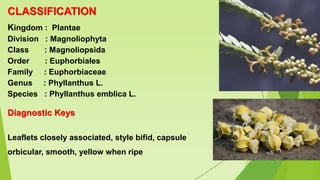
Leaflets closely associated, style bifid, capsule
orbicular, smooth, yellow when ripe
INTRODUCTION
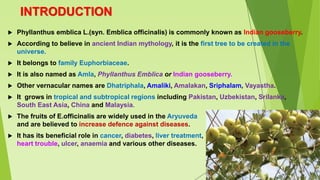
 Phyllanthus emblica L.(syn. Emblica officinalis) is commonly known as Indian gooseberry.
 According to believe in ancient Indian mythology, it is the first tree to be created in the
universe.
 It belongs to family Euphorbiaceae.
 It is also named as Amla, Phyllanthus Emblica or Indian gooseberry.
 Other vernacular names are Dhatriphala, Amaliki, Amalakan, Sriphalam, Vayastha.
 It grows in tropical and subtropical regions including Pakistan, Uzbekistan, Srilanka,
South East Asia, China and Malaysia.
 The fruits of E.officinalis are widely used in the Aryuveda
and are believed to increase defence against diseases.
 It has its beneficial role in cancer, diabetes, liver treatment,
heart trouble, ulcer, anaemia and various other diseases.
Morphology:
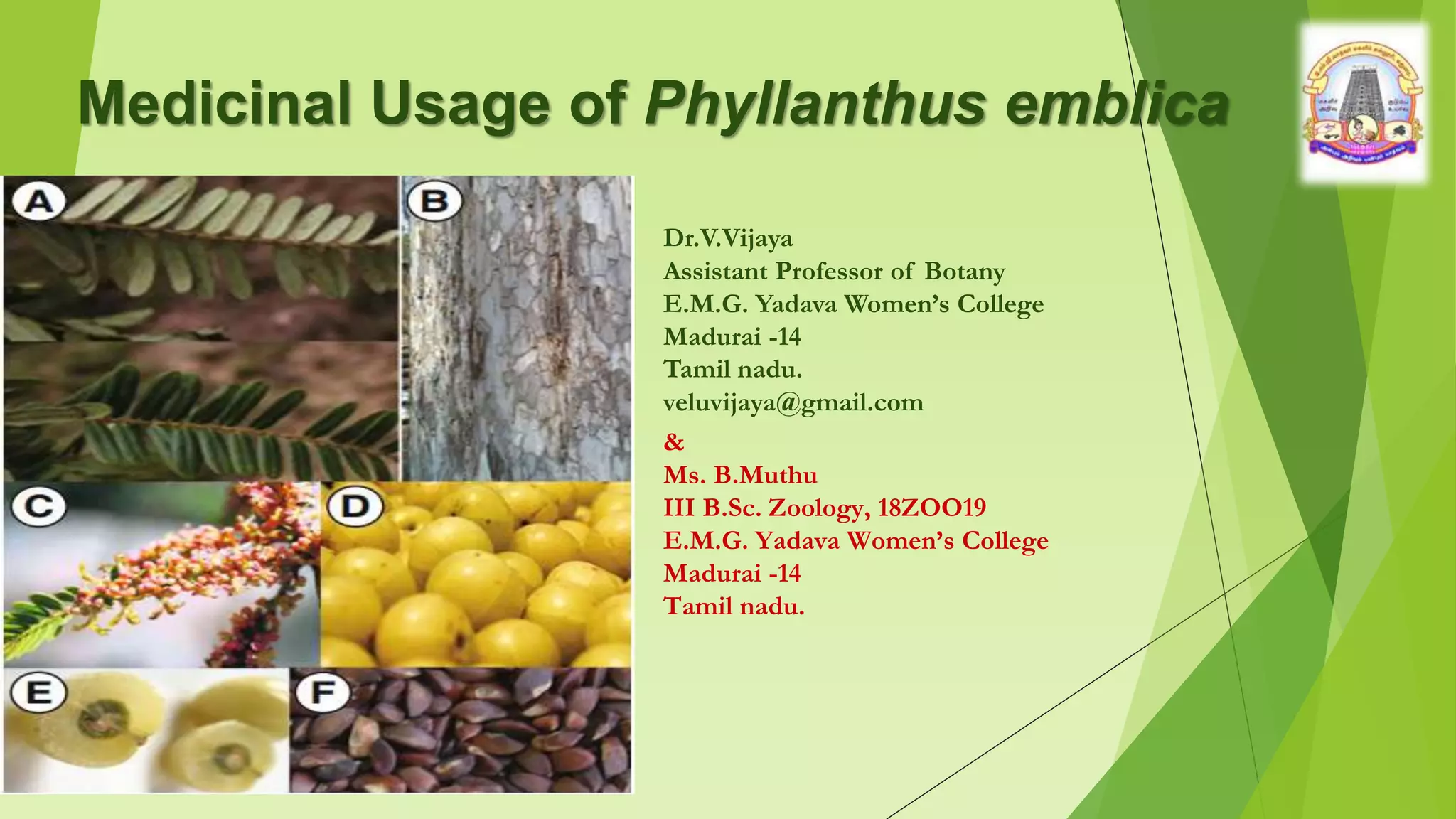
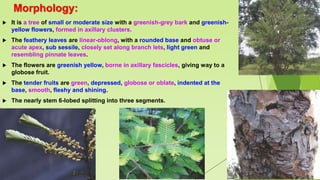
 It is a tree of small or moderate size with a greenish-grey bark and greenish-
yellow flowers, formed in axillary clusters.
 The feathery leaves are linear-oblong, with a rounded base and obtuse or
acute apex, sub sessile, closely set along branch lets, light green and
resembling pinnate leaves.
 The flowers are greenish yellow, borne in axillary fascicles, giving way to a
globose fruit.
 The tender fruits are green, depressed, globose or oblate, indented at the
base, smooth, fleshy and shining.
 The nearly stem 6-lobed splitting into three segments.
Morphology:
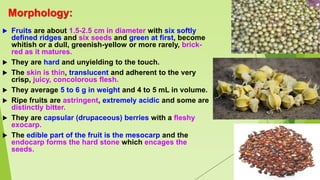
 Fruits are about 1.5-2.5 cm in diameter with six softly
defined ridges and six seeds and green at first, become
whitish or a dull, greenish-yellow or more rarely, brick-
red as it matures.
 They are hard and unyielding to the touch.
 The skin is thin, translucent and adherent to the very
crisp, juicy, concolorous flesh.
 They average 5 to 6 g in weight and 4 to 5 mL in volume.
 Ripe fruits are astringent, extremely acidic and some are
distinctly bitter.
 They are capsular (drupaceous) berries with a fleshy
exocarp.
 The edible part of the fruit is the mesocarp and the
endocarp forms the hard stone which encages the
seeds.
Ethnobotanical uses:
 Emblica Officinalis has been used as a valuable ingredient of various
medicines in India and Middle East from time immemorial.
 The green fruits are made into pickles and preserves to stimulate the appetite.
 Medical studies conducted on Amla fruit suggest that it has antiviral
properties [Udupa] and also functions as an antibacterial and anti-fungal
agent.
 The use of amla as an antioxidant has been examined by a number of authors
[Bhattacharya; Chaudhuri].
 Experiments conducted at the Niwa Institute of Immunology in Japan have
shown Amla to be a potent scavenger of free radicals.
 The studies showed that Amla preparations contained high levels of the free-
radical scavenger, superoxide dimutase (SOD), in the experimental subjects
[Treadway]Amla is believed to increase ojas, and is considered to be one of
the strongest rejuvenative herbs in Ayurvedic medicine.
 It is the primary ingredient used in one of the renowned Ayurvedic herbal
formulae, called Chayavanprasha which has great respect as a tonic.
Ethnobotanical uses:
 The preparation is named after Chayavan who was sitting in the forest when the
Emperor’s daughter who was playing while blindfolded in the forest fell over him.
 Not knowing he was a stranger, she ran her fingers through his hair and decorated
him with a garland of flowers, which must have been quite an accomplishment while
wearing a blindfold!
 Needless to say, her father found out and insisted that the wise old sage marry his
daughter (as a woman was only allowed to be touched by one man in her lifetime).
 The old sage created chayavanprasha and lived on it for 2 months, during which time
he regained youthfulness and sexual vitality [Watson].
 Beside amla, chayavanprasha contains around 30 to 50 other herbs depending on
where it is prepared.
 The pericarp of the fruit is often used in decoctions along with other ingredients and
also applied externally on boils with cow ghee to promote suppuration [Jayaweera].
 Photo aging of the skin is a complex biologic process affecting various layers of the
skin with major changes seen in the connective tissue within the dermis.
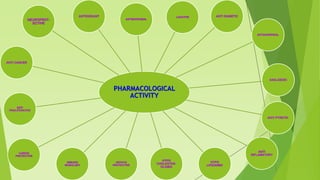
PHARMACOLOGICAL
ACTIVITY
ANTIMICROBIAL
LAXATIVE ANTI DIABETIC
ANTIDIARRHEAL
ANALGESIC
ANTI PYRETIC
ANTI
INFLAMATORY
HYPO
LIPEDEMIC
HYPO
CHOLESTER-
OLOMIC
HEPATO
PROTECTIVE
IMMUNO
MODULARY
CARDIO
PROTECTIVE
ANTI
PROLIFERATIVE
ANTI CANCER
NEUROPROT-
ECTIVE
ANTIOXIDANT
Antimicrobial Effect
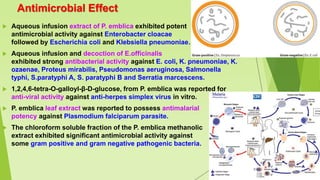
 Aqueous infusion extract of P. emblica exhibited potent
antimicrobial activity against Enterobacter cloacae
followed by Escherichia coli and Klebsiella pneumoniae.
 Aqueous infusion and decoction of E.officinalis
exhibited strong antibacterial activity against E. coli, K. pneumoniae, K.
ozaenae, Proteus mirabilis, Pseudomonas aeruginosa, Salmonella
typhi, S.paratyphi A, S. paratyphi B and Serratia marcescens.
 1,2,4,6-tetra-O-galloyl-β-D-glucose, from P. emblica was reported for
anti-viral activity against anti-herpes simplex virus in vitro.
 P. emblica leaf extract was reported to possess antimalarial
potency against Plasmodium falciparum parasite.
 The chloroform soluble fraction of the P. emblica methanolic
extract exhibited significant antimicrobial activity against
some gram positive and gram negative pathogenic bacteria.
Antioxidant Effect
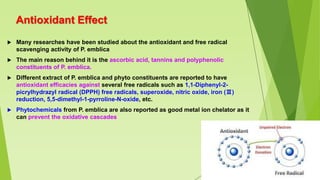
 Many researches have been studied about the antioxidant and free radical
scavenging activity of P. emblica
 The main reason behind it is the ascorbic acid, tannins and polyphenolic
constituents of P. emblica.
 Different extract of P. emblica and phyto constituents are reported to have
antioxidant efficacies against several free radicals such as 1,1-Diphenyl-2-
picrylhydrazyl radical (DPPH) free radicals, superoxide, nitric oxide, iron (Ⅲ)
reduction, 5,5-dimethyl-1-pyrroline-N-oxide, etc.
 Phytochemicals from P. emblica are also reported as good metal ion chelator as it
can prevent the oxidative cascades
Laxative Effect
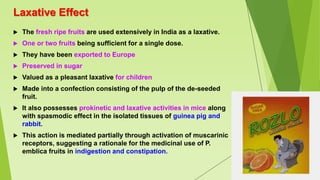
 The fresh ripe fruits are used extensively in India as a laxative.
 One or two fruits being sufficient for a single dose.
 They have been exported to Europe
 Preserved in sugar
 Valued as a pleasant laxative for children
 Made into a confection consisting of the pulp of the de-seeded
fruit.
 It also possesses prokinetic and laxative activities in mice along
with spasmodic effect in the isolated tissues of guinea pig and
rabbit.
 This action is mediated partially through activation of muscarinic
receptors, suggesting a rationale for the medicinal use of P.
emblica fruits in indigestion and constipation.
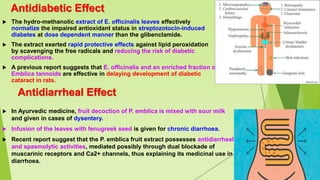
Antidiabetic Effect
 The hydro-methanolic extract of E. officinalis leaves effectively
normalize the impaired antioxidant status in streptozotocin-induced
diabetes at dose dependent manner than the glibenclamide.
 The extract exerted rapid protective effects against lipid peroxidation
by scavenging the free radicals and reducing the risk of diabetic
complications.
 A previous report suggests that E. officinalis and an enriched fraction of
Emblica tannoids are effective in delaying development of diabetic
cataract in rats.
Antidiarrheal Effect
 In Ayurvedic medicine, fruit decoction of P. emblica is mixed with sour milk
and given in cases of dysentery.
 Infusion of the leaves with fenugreek seed is given for chronic diarrhoea.
 Recent report suggest that the P. emblica fruit extract possesses antidiarrheal
and spasmolytic activities, mediated possibly through dual blockade of
muscarinic receptors and Ca2+ channels, thus explaining its medicinal use in
diarrhoea.
Analgesic and Antipyretic Effect
 Decoction of P. emblica leaves is used to treat fever and the fresh fruit is refrigerant.
 The seeds are given internally as a cooling remedy in bilious affections and nausea, and in fevers.
 A modified indigenous Siddha formulation Kalpaamruthaa, containing Semecarpus anacardium nut milk
extract, dried powder of Emblica officinalis fruit and honey is reported to have potent antinociceptive and
antipyretic activities.
 In another study, the ethanol and aqueous extracts of E. officinalis fruits at a single dose of 500 mg/kg
caused a significant lowering in rectal temperature of hyper thermic rats, comparable to that of aspirin
 Also caused an inhibition on writhing produced by acetic acid when administered intraperitoneally in mice.
Immunomodulatory Effect
 Laboratory experiment in mice showed that an aqueous P. emblica extract natural killer cell activity and
antibody-dependent cellular cytotoxicity in mice.
 Ethanol extract of P. emblica showed biphasic activity in ulcerated mice with dose-dependent healing
effect.
 It efficiently reduced pro-inflammatory cytokine, tumour necrosis factor α (TNF-α) and interleukin-1β (IL-
1β) levels and appreciably up-regulate the anti inflammatory cytokine (IL-10) concentration.
Anti-inflammatory Effect
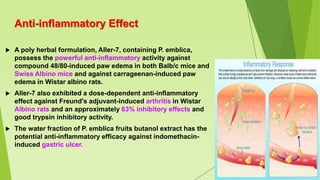
 A poly herbal formulation, Aller-7, containing P. emblica,
possess the powerful anti-inflammatory activity against
compound 48/80-induced paw edema in both Balb/c mice and
Swiss Albino mice and against carrageenan-induced paw
edema in Wistar albino rats.
 Aller-7 also exhibited a dose-dependent anti-inflammatory
effect against Freund's adjuvant-induced arthritis in Wistar
Albino rats and an approximately 63% inhibitory effects and
good trypsin inhibitory activity.
 The water fraction of P. emblica fruits butanol extract has the
potential anti-inflammatory efficacy against indomethacin-
induced gastric ulcer.
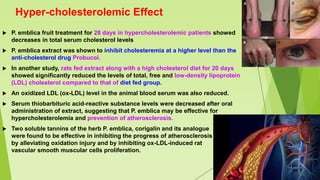
Hyper-cholesterolemic Effect
 P. emblica fruit treatment for 28 days in hypercholesterolemic patients showed
decreases in total serum cholesterol levels
 P. emblica extract was shown to inhibit cholesteremia at a higher level than the
anti-cholesterol drug Probucol.
 In another study, rats fed extract along with a high cholesterol diet for 20 days
showed significantly reduced the levels of total, free and low-density lipoprotein
(LDL) cholesterol compared to that of diet fed group.
 An oxidized LDL (ox-LDL) level in the animal blood serum was also reduced.
 Serum thiobarbituric acid-reactive substance levels were decreased after oral
administration of extract, suggesting that P. emblica may be effective for
hypercholesterolemia and prevention of atherosclerosis.
 Two soluble tannins of the herb P. emblica, corigalin and its analogue
were found to be effective in inhibiting the progress of atherosclerosis
by alleviating oxidation injury and by inhibiting ox-LDL-induced rat
vascular smooth muscular cells proliferation.
Cardio protective Effect
 A study to investigate the anti-oxidant effect of bioactive tannoid principles of
E. officinalis was carried out on cardiac ischemic-reperfusion-induced
oxidative stress in rat heart.
 In this study, an emblicanin A and emblicanin B enriched fraction of fresh juice
of E. officinalis fruits was extracted with aqueous methanol fraction and used
for testing.
 The extract of E. officinalis and vitamin E (as standard oxidizing agent) were
administered orally twice daily for 14 consecutive days prior to the perfusion
experiments.
 The results demonstrated that E. officinalis significantly reversed the effects of
ischemia-reperfusion on major antioxidant enzymes such as
superoxide dismutase (SOD), catalase (CAT), glutathione
peroxidase (GPX) and lipid peroxidation (LPO) activities.
 This study supports the claim that anti-oxidants of E. officinalis
may act as cardio protective agents.
Hepatoprotective Effect
 P. emblica and its flavonoid quercetin were found to be hepatoprotective
against acetaminophen-induced liver damage in Albino rats and mice.
 The research results indicated that the possible mechanism of P. emblica for
hepatoprotective activity is in decreasing glutathione depletion and
preventing stimulation of cytochrome P450.
 Since quercetin alone was more effective than the P. emblica extract, it is
thought to be the active principle.
 Toxic effects induced by lead nitrate and aluminum sulphate were also
counteracted by the administration of P. emblica extract and ascorbic acid in
albino rats.
 It is also reported that P. emblica has strong hepatoprotective effect against
carbon tetrachloride-induced hepatic damage.
Antitussive Effect
 The antitussive activity of E. officinalis was tested in conscious cats by
mechanical stimulation of the laryngopharyngeal and tracheobronchial
mucous areas of airways.
 The ethanol extract of the fruits of E. officinalis seems to have a good
ability to inhibit mechanically-provoked cough, but only at higher doses
(200 mg/kg body weight) suggesting the presence of antitussive activity
of E. officinalis in conscious cats, which is dose-dependent but higher
than the antitussive activity of the commonly used non-narcotic
antitussive drug, dropropizine.
 It is supposed that the antitussive activity of the dry extract of E.
officinalis is due not only to antiphlogistic, anti spasmolytic and
antioxidant efficacy effects, but also due to its effect on mucus
secretion in the airways.
Neuroprotective Effect
 Pre-treatment with hydro alcoholic extract of E. officinalis fruit (500 and 700 mg/kg) significantly
(P<0.001) increased the latency of seizures as compared with the vehicle-treated group.
 It also significantly prevented the increase in thiobarbituric acid-reactive substances levels and
ameliorated the fall in glutathione.
 Furthermore, E. officinalis dose dependently attenuated the kainic acid-induced increase in the TNF-
α level in the brain and significantly improved the cognitive deficit, as evidenced by increased
latency in passive avoidance task.
Other Effects
 Beside above discussed therapeutic potentials, P. emblica is also reported to have
chondroprotective effects in osteoarthritis by significantly inhibiting the activities of hyaluronidase
and collagenase type 2 enzymes.
 In Ayurveda, P. emblica is believed to enhances food absorption and regulates the elimination,
balances the acidity of the stomach, fortifies the liver, nourishes the brain and mental functioning,
supports the heart and strengthens the lungs, enhances the fertility, promotes the urination,
moisturizes the skin, promotes the hair growth and prevent hair greying, cools the body and flushes
out the toxins, enhances vitality and immunity, strengthens the eyes, improves muscle tone, etc.
 Many of these therapeutic potentials of P. emblica described in Ayurveda are yet to be explored
scientifically.
GOOSEBERRY RECEIPES
Conclusions
 P. emblica is one of the most used among Ayurvedic medicinal plants due to its diverse
pharmacological properties to treat several human ailments.
 However, its most extraordinary features are its anti-inflammatory and ant oxidative
properties.
 The traditional use of P. emblica enforces its effects on almost all of the human ailments,
but very few of them have been validated through clinical research and still the vast
majority of these traditional uses are yet to be proved through the systematic researches.
 P. emblica can act as the diverse subject for the research and development of alternative
and complementary medicine in future research.
 On the basis of its traditional uses, various potential remedies can be discovered through
the fruit of this plant, which suggest that it acts as the natural source for the future drug
development.
 Therefore, vigorous scientific studies should be carried out to explore the therapeutic
wonder of this key Ayurvedic medicine.
REFERENCE
 https://www.researchgate.net/publication/269396332_Phytochemistry_ph
armacology_and_medicinal_properties_of_Phyllanthus_emblica_Linn
 https://www.pharmatutor.org/articles/emblica-officinalis-
review#:~:text=Morphology%3A,green%20and%20resembling%20pinnate%2
0leaves.
 https://indiabiodiversity.org/species/show/31625
THANK YOU

Medicinal Usage of Phyllanthus emblica. Dr.V.Vijaya, Assistant Professor of Botany, E.M.G. Yadava Women's College

  • 1.
    Medicinal Usage ofPhyllanthus emblica Dr.V.Vijaya Assistant Professor of Botany E.M.G. Yadava Women’s College Madurai -14 Tamil nadu. veluvijaya@gmail.com & Ms. B.Muthu III B.Sc. Zoology, 18ZOO19 E.M.G. Yadava Women’s College Madurai -14 Tamil nadu.
  • 2.
    CLASSIFICATION Kingdom : Plantae Division: Magnoliophyta Class : Magnoliopsida Order : Euphorbiales Family : Euphorbiaceae Genus : Phyllanthus L. Species : Phyllanthus emblica L. Diagnostic Keys Leaflets closely associated, style bifid, capsule orbicular, smooth, yellow when ripe
  • 3.
    INTRODUCTION  Phyllanthus emblicaL.(syn. Emblica officinalis) is commonly known as Indian gooseberry.  According to believe in ancient Indian mythology, it is the first tree to be created in the universe.  It belongs to family Euphorbiaceae.  It is also named as Amla, Phyllanthus Emblica or Indian gooseberry.  Other vernacular names are Dhatriphala, Amaliki, Amalakan, Sriphalam, Vayastha.  It grows in tropical and subtropical regions including Pakistan, Uzbekistan, Srilanka, South East Asia, China and Malaysia.  The fruits of E.officinalis are widely used in the Aryuveda and are believed to increase defence against diseases.  It has its beneficial role in cancer, diabetes, liver treatment, heart trouble, ulcer, anaemia and various other diseases.
  • 4.
    Morphology:  It isa tree of small or moderate size with a greenish-grey bark and greenish- yellow flowers, formed in axillary clusters.  The feathery leaves are linear-oblong, with a rounded base and obtuse or acute apex, sub sessile, closely set along branch lets, light green and resembling pinnate leaves.  The flowers are greenish yellow, borne in axillary fascicles, giving way to a globose fruit.  The tender fruits are green, depressed, globose or oblate, indented at the base, smooth, fleshy and shining.  The nearly stem 6-lobed splitting into three segments.
  • 5.
    Morphology:  Fruits areabout 1.5-2.5 cm in diameter with six softly defined ridges and six seeds and green at first, become whitish or a dull, greenish-yellow or more rarely, brick- red as it matures.  They are hard and unyielding to the touch.  The skin is thin, translucent and adherent to the very crisp, juicy, concolorous flesh.  They average 5 to 6 g in weight and 4 to 5 mL in volume.  Ripe fruits are astringent, extremely acidic and some are distinctly bitter.  They are capsular (drupaceous) berries with a fleshy exocarp.  The edible part of the fruit is the mesocarp and the endocarp forms the hard stone which encages the seeds.
  • 6.
    Ethnobotanical uses:  EmblicaOfficinalis has been used as a valuable ingredient of various medicines in India and Middle East from time immemorial.  The green fruits are made into pickles and preserves to stimulate the appetite.  Medical studies conducted on Amla fruit suggest that it has antiviral properties [Udupa] and also functions as an antibacterial and anti-fungal agent.  The use of amla as an antioxidant has been examined by a number of authors [Bhattacharya; Chaudhuri].  Experiments conducted at the Niwa Institute of Immunology in Japan have shown Amla to be a potent scavenger of free radicals.  The studies showed that Amla preparations contained high levels of the free- radical scavenger, superoxide dimutase (SOD), in the experimental subjects [Treadway]Amla is believed to increase ojas, and is considered to be one of the strongest rejuvenative herbs in Ayurvedic medicine.  It is the primary ingredient used in one of the renowned Ayurvedic herbal formulae, called Chayavanprasha which has great respect as a tonic.
  • 7.
    Ethnobotanical uses:  Thepreparation is named after Chayavan who was sitting in the forest when the Emperor’s daughter who was playing while blindfolded in the forest fell over him.  Not knowing he was a stranger, she ran her fingers through his hair and decorated him with a garland of flowers, which must have been quite an accomplishment while wearing a blindfold!  Needless to say, her father found out and insisted that the wise old sage marry his daughter (as a woman was only allowed to be touched by one man in her lifetime).  The old sage created chayavanprasha and lived on it for 2 months, during which time he regained youthfulness and sexual vitality [Watson].  Beside amla, chayavanprasha contains around 30 to 50 other herbs depending on where it is prepared.  The pericarp of the fruit is often used in decoctions along with other ingredients and also applied externally on boils with cow ghee to promote suppuration [Jayaweera].  Photo aging of the skin is a complex biologic process affecting various layers of the skin with major changes seen in the connective tissue within the dermis.
  • 8.
    PHARMACOLOGICAL ACTIVITY ANTIMICROBIAL LAXATIVE ANTI DIABETIC ANTIDIARRHEAL ANALGESIC ANTIPYRETIC ANTI INFLAMATORY HYPO LIPEDEMIC HYPO CHOLESTER- OLOMIC HEPATO PROTECTIVE IMMUNO MODULARY CARDIO PROTECTIVE ANTI PROLIFERATIVE ANTI CANCER NEUROPROT- ECTIVE ANTIOXIDANT
  • 9.
    Antimicrobial Effect  Aqueousinfusion extract of P. emblica exhibited potent antimicrobial activity against Enterobacter cloacae followed by Escherichia coli and Klebsiella pneumoniae.  Aqueous infusion and decoction of E.officinalis exhibited strong antibacterial activity against E. coli, K. pneumoniae, K. ozaenae, Proteus mirabilis, Pseudomonas aeruginosa, Salmonella typhi, S.paratyphi A, S. paratyphi B and Serratia marcescens.  1,2,4,6-tetra-O-galloyl-β-D-glucose, from P. emblica was reported for anti-viral activity against anti-herpes simplex virus in vitro.  P. emblica leaf extract was reported to possess antimalarial potency against Plasmodium falciparum parasite.  The chloroform soluble fraction of the P. emblica methanolic extract exhibited significant antimicrobial activity against some gram positive and gram negative pathogenic bacteria.
  • 10.
    Antioxidant Effect  Manyresearches have been studied about the antioxidant and free radical scavenging activity of P. emblica  The main reason behind it is the ascorbic acid, tannins and polyphenolic constituents of P. emblica.  Different extract of P. emblica and phyto constituents are reported to have antioxidant efficacies against several free radicals such as 1,1-Diphenyl-2- picrylhydrazyl radical (DPPH) free radicals, superoxide, nitric oxide, iron (Ⅲ) reduction, 5,5-dimethyl-1-pyrroline-N-oxide, etc.  Phytochemicals from P. emblica are also reported as good metal ion chelator as it can prevent the oxidative cascades
  • 11.
    Laxative Effect  Thefresh ripe fruits are used extensively in India as a laxative.  One or two fruits being sufficient for a single dose.  They have been exported to Europe  Preserved in sugar  Valued as a pleasant laxative for children  Made into a confection consisting of the pulp of the de-seeded fruit.  It also possesses prokinetic and laxative activities in mice along with spasmodic effect in the isolated tissues of guinea pig and rabbit.  This action is mediated partially through activation of muscarinic receptors, suggesting a rationale for the medicinal use of P. emblica fruits in indigestion and constipation.
  • 12.
    Antidiabetic Effect  Thehydro-methanolic extract of E. officinalis leaves effectively normalize the impaired antioxidant status in streptozotocin-induced diabetes at dose dependent manner than the glibenclamide.  The extract exerted rapid protective effects against lipid peroxidation by scavenging the free radicals and reducing the risk of diabetic complications.  A previous report suggests that E. officinalis and an enriched fraction of Emblica tannoids are effective in delaying development of diabetic cataract in rats. Antidiarrheal Effect  In Ayurvedic medicine, fruit decoction of P. emblica is mixed with sour milk and given in cases of dysentery.  Infusion of the leaves with fenugreek seed is given for chronic diarrhoea.  Recent report suggest that the P. emblica fruit extract possesses antidiarrheal and spasmolytic activities, mediated possibly through dual blockade of muscarinic receptors and Ca2+ channels, thus explaining its medicinal use in diarrhoea.
  • 13.
    Analgesic and AntipyreticEffect  Decoction of P. emblica leaves is used to treat fever and the fresh fruit is refrigerant.  The seeds are given internally as a cooling remedy in bilious affections and nausea, and in fevers.  A modified indigenous Siddha formulation Kalpaamruthaa, containing Semecarpus anacardium nut milk extract, dried powder of Emblica officinalis fruit and honey is reported to have potent antinociceptive and antipyretic activities.  In another study, the ethanol and aqueous extracts of E. officinalis fruits at a single dose of 500 mg/kg caused a significant lowering in rectal temperature of hyper thermic rats, comparable to that of aspirin  Also caused an inhibition on writhing produced by acetic acid when administered intraperitoneally in mice. Immunomodulatory Effect  Laboratory experiment in mice showed that an aqueous P. emblica extract natural killer cell activity and antibody-dependent cellular cytotoxicity in mice.  Ethanol extract of P. emblica showed biphasic activity in ulcerated mice with dose-dependent healing effect.  It efficiently reduced pro-inflammatory cytokine, tumour necrosis factor α (TNF-α) and interleukin-1β (IL- 1β) levels and appreciably up-regulate the anti inflammatory cytokine (IL-10) concentration.
  • 14.
    Anti-inflammatory Effect  Apoly herbal formulation, Aller-7, containing P. emblica, possess the powerful anti-inflammatory activity against compound 48/80-induced paw edema in both Balb/c mice and Swiss Albino mice and against carrageenan-induced paw edema in Wistar albino rats.  Aller-7 also exhibited a dose-dependent anti-inflammatory effect against Freund's adjuvant-induced arthritis in Wistar Albino rats and an approximately 63% inhibitory effects and good trypsin inhibitory activity.  The water fraction of P. emblica fruits butanol extract has the potential anti-inflammatory efficacy against indomethacin- induced gastric ulcer.
  • 15.
    Hyper-cholesterolemic Effect  P.emblica fruit treatment for 28 days in hypercholesterolemic patients showed decreases in total serum cholesterol levels  P. emblica extract was shown to inhibit cholesteremia at a higher level than the anti-cholesterol drug Probucol.  In another study, rats fed extract along with a high cholesterol diet for 20 days showed significantly reduced the levels of total, free and low-density lipoprotein (LDL) cholesterol compared to that of diet fed group.  An oxidized LDL (ox-LDL) level in the animal blood serum was also reduced.  Serum thiobarbituric acid-reactive substance levels were decreased after oral administration of extract, suggesting that P. emblica may be effective for hypercholesterolemia and prevention of atherosclerosis.  Two soluble tannins of the herb P. emblica, corigalin and its analogue were found to be effective in inhibiting the progress of atherosclerosis by alleviating oxidation injury and by inhibiting ox-LDL-induced rat vascular smooth muscular cells proliferation.
  • 16.
    Cardio protective Effect A study to investigate the anti-oxidant effect of bioactive tannoid principles of E. officinalis was carried out on cardiac ischemic-reperfusion-induced oxidative stress in rat heart.  In this study, an emblicanin A and emblicanin B enriched fraction of fresh juice of E. officinalis fruits was extracted with aqueous methanol fraction and used for testing.  The extract of E. officinalis and vitamin E (as standard oxidizing agent) were administered orally twice daily for 14 consecutive days prior to the perfusion experiments.  The results demonstrated that E. officinalis significantly reversed the effects of ischemia-reperfusion on major antioxidant enzymes such as superoxide dismutase (SOD), catalase (CAT), glutathione peroxidase (GPX) and lipid peroxidation (LPO) activities.  This study supports the claim that anti-oxidants of E. officinalis may act as cardio protective agents.
  • 17.
    Hepatoprotective Effect  P.emblica and its flavonoid quercetin were found to be hepatoprotective against acetaminophen-induced liver damage in Albino rats and mice.  The research results indicated that the possible mechanism of P. emblica for hepatoprotective activity is in decreasing glutathione depletion and preventing stimulation of cytochrome P450.  Since quercetin alone was more effective than the P. emblica extract, it is thought to be the active principle.  Toxic effects induced by lead nitrate and aluminum sulphate were also counteracted by the administration of P. emblica extract and ascorbic acid in albino rats.  It is also reported that P. emblica has strong hepatoprotective effect against carbon tetrachloride-induced hepatic damage.
  • 18.
    Antitussive Effect  Theantitussive activity of E. officinalis was tested in conscious cats by mechanical stimulation of the laryngopharyngeal and tracheobronchial mucous areas of airways.  The ethanol extract of the fruits of E. officinalis seems to have a good ability to inhibit mechanically-provoked cough, but only at higher doses (200 mg/kg body weight) suggesting the presence of antitussive activity of E. officinalis in conscious cats, which is dose-dependent but higher than the antitussive activity of the commonly used non-narcotic antitussive drug, dropropizine.  It is supposed that the antitussive activity of the dry extract of E. officinalis is due not only to antiphlogistic, anti spasmolytic and antioxidant efficacy effects, but also due to its effect on mucus secretion in the airways.
  • 19.
    Neuroprotective Effect  Pre-treatmentwith hydro alcoholic extract of E. officinalis fruit (500 and 700 mg/kg) significantly (P<0.001) increased the latency of seizures as compared with the vehicle-treated group.  It also significantly prevented the increase in thiobarbituric acid-reactive substances levels and ameliorated the fall in glutathione.  Furthermore, E. officinalis dose dependently attenuated the kainic acid-induced increase in the TNF- α level in the brain and significantly improved the cognitive deficit, as evidenced by increased latency in passive avoidance task. Other Effects  Beside above discussed therapeutic potentials, P. emblica is also reported to have chondroprotective effects in osteoarthritis by significantly inhibiting the activities of hyaluronidase and collagenase type 2 enzymes.  In Ayurveda, P. emblica is believed to enhances food absorption and regulates the elimination, balances the acidity of the stomach, fortifies the liver, nourishes the brain and mental functioning, supports the heart and strengthens the lungs, enhances the fertility, promotes the urination, moisturizes the skin, promotes the hair growth and prevent hair greying, cools the body and flushes out the toxins, enhances vitality and immunity, strengthens the eyes, improves muscle tone, etc.  Many of these therapeutic potentials of P. emblica described in Ayurveda are yet to be explored scientifically.
  • 20.
  • 21.
    Conclusions  P. emblicais one of the most used among Ayurvedic medicinal plants due to its diverse pharmacological properties to treat several human ailments.  However, its most extraordinary features are its anti-inflammatory and ant oxidative properties.  The traditional use of P. emblica enforces its effects on almost all of the human ailments, but very few of them have been validated through clinical research and still the vast majority of these traditional uses are yet to be proved through the systematic researches.  P. emblica can act as the diverse subject for the research and development of alternative and complementary medicine in future research.  On the basis of its traditional uses, various potential remedies can be discovered through the fruit of this plant, which suggest that it acts as the natural source for the future drug development.  Therefore, vigorous scientific studies should be carried out to explore the therapeutic wonder of this key Ayurvedic medicine.
  • 22.
  • 23.