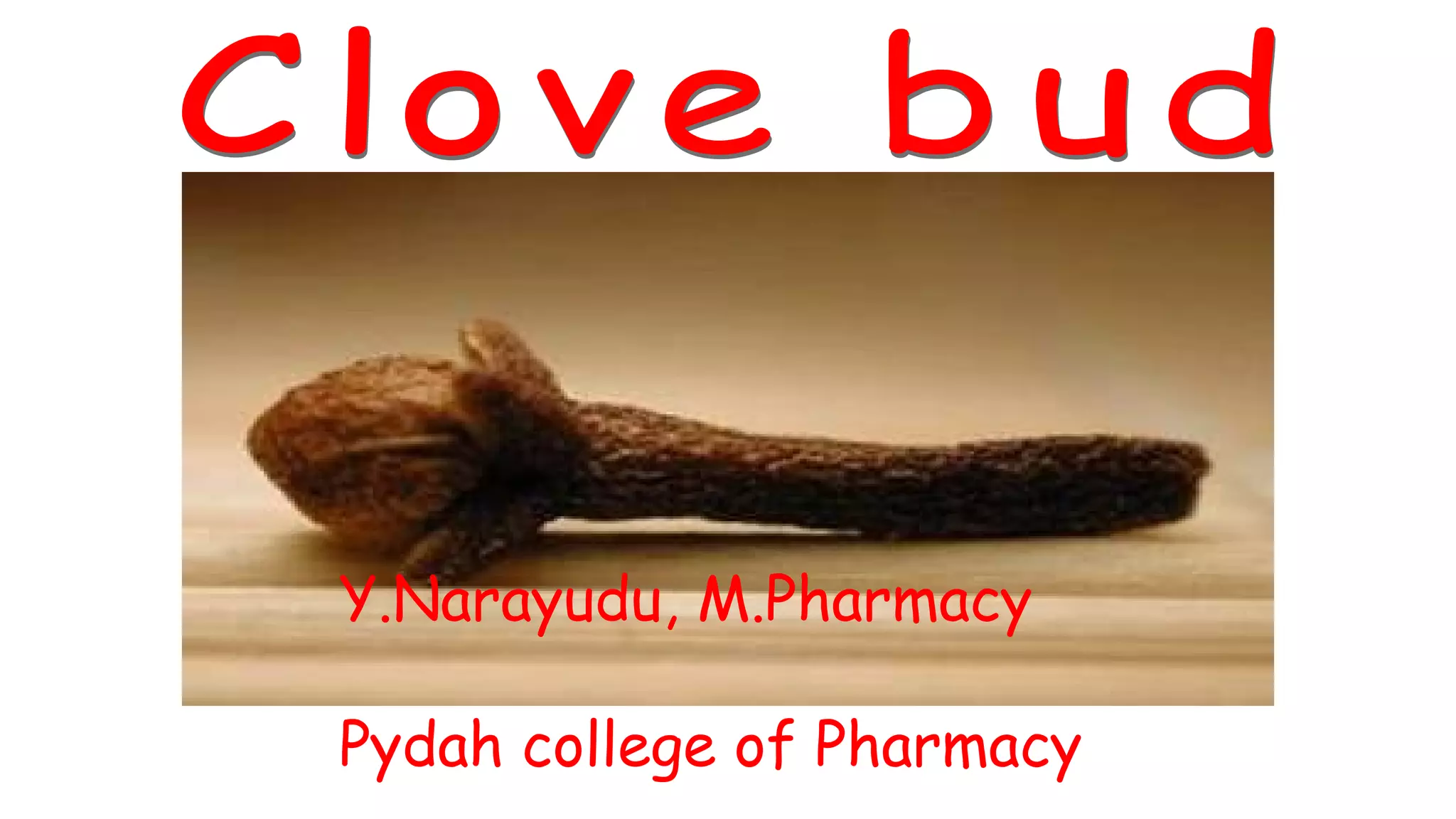
Y.Narayudu, M.Pharmacy
Pydah college of Pharmacy
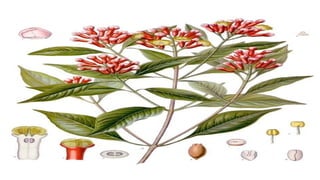
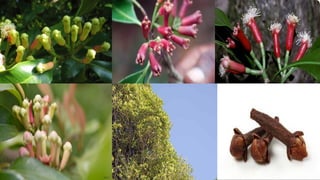
Synonyms: Caryophyllum, clove flower, clove
buds, Lavang
Biological Source: Dried flower buds of
Eugenia caryophyllus
Family: Myrtaceae
Should Contain NLT 15% v/w of clove oil
Geographical source:
•Indigenous to Amboyna & molucca islands
•Cultivated Zanzibar, pemba, penang,
Madagascar, caribean islands, srilanka, india.
• In India, hilly areas of Tamil Nadu, Kerala and
Karnataka.
Cultivation & collection:
Climate and Soil:
•Grows well in rich loamy soils of the humid tropics and can be grown
successfully in the red soils of Kerala, Tamil Nadu and Karnataka.
• A cooler climate with well distributed rainfall is ideal for flowering
•The site selected for its cultivation needs Good drainage since the crop
cannot withstand water logged conditions.
•It grow well in the areas receiving an annual rainfall of 150-300 mm
•and it can be grown at an altitude of 1500m above the sea level.
Planting Materials:
•The seeds should be collected from fully ripe fruits for raising seedlings
•Fruits for seed cultivation, known popularly as "mother of clove" are
allowed to ripe on the tree and drop down naturally, Such fruits are
collected and sown directly in the nursery (or) soaked in water overnight
and the pericarp removed before sowing.
•Second method of sowing gives excellent results
•Only fully developed and uniform sized seeds which show signs of
germination by the presence of pink radilce ,are used for sowing.
Nursery Raising:
•Nursery beds of 15-20cm height,1 mt width and convenient length are to be
prepared for sowing seeds
•The beds should be made of loose soil-sand mixture over which a layer of
sand may be spread
•Seeds are sown at 2-3 cm spacing and depth of 2cm
•The seed beds have to be protected from direct sunlight .
•The germination commences in about 10-15 days and may last for about 40
days.
• The germinated seeds are then transplanted in polybags containing a
mixture of ,soil, sand and well decomposed cowdung.
• Sometimes these seedlings are again transplanted after 1 year to a large
polythene bags. These seedlings are ready for transplanting after 18-24
months old.
• Indian conditions it is best suitable for mixed cropping in older coconut or
arec
• The seedlings are transplanted in the main field during the beginning of the
rainy season, in June-July.
Manuring and Fertilizer application:
•Cattle manure or compost @ 50 kg and bone meal or fish meal @ 2-5 kg
bearing tree per year can be applied.
•Organic manures can be applied as a single dose at the beginning of the
rainy season in the trenches dug around the trees.
•The recommended fertilizer dose for inorganic fertilizer is @40Gram
urea,110gram super phosphate, and 80gram Murate of potash in the initial
stage
•Fertilizers are given in 2 doses: may/june & october
Harvesting and Processing:
•Clove tree starts flowering from the fourth year of its planting in fertile soils
and good management conditions.
•But the full bearing stage is reached by about the 15th year only.
•The flowering season varies from September-October in the plains to
December-January at high altitudes.
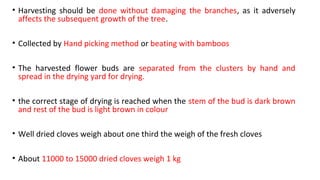
•The unopened buds are harvested when they are plump and rounded and
before they turn pink.
•At this stage ,they are less than 2 cm long.
•The opened flowers are not valued as spice.
• Harvesting should be done without damaging the branches, as it adversely
affects the subsequent growth of the tree.
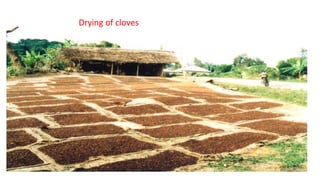
• Collected by Hand picking method or beating with bamboos
• The harvested flower buds are separated from the clusters by hand and
spread in the drying yard for drying.
• the correct stage of drying is reached when the stem of the bud is dark brown
and rest of the bud is light brown in colour
• Well dried cloves weigh about one third the weigh of the fresh cloves
• About 11000 to 15000 dried cloves weigh 1 kg
Drying of cloves
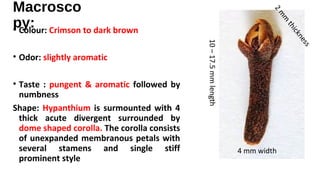
Macrosco
py:• Colour: Crimson to dark brown
• Odor: slightly aromatic
• Taste : pungent & aromatic followed by
numbness
Shape: Hypanthium is surmounted with 4
thick acute divergent surrounded by
dome shaped corolla. The corolla consists
of unexpanded membranous petals with
several stamens and single stiff
prominent style
10–17.5mmlength
4 mm width
2m
m
thickness
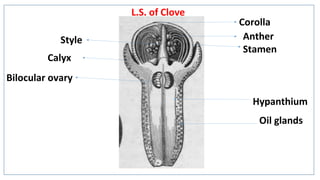
Corolla
Stamen
Style
Calyx
Anther
Bilocular ovary
Oil glands
Hypanthium
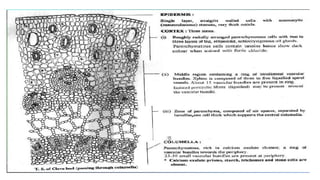
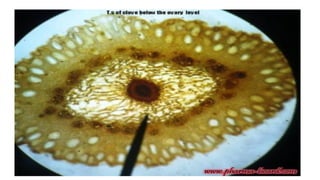
L.S. of Clove
Microscopy:
Epidermis: Straight walled cells and large anomocytic
stomata, covered with thick cuticle
Oil Glands: ovoid and schizolysigenous
Cluster crystals of calcium oxalate
Starch was absent
Chemical
constituents:1. Volatile oil (Clove oil) : 15%-20%
a- Eugenol 70%-90%
b-Vanillin
c- Caryophyllene
d-Acetyl eugenol 4%
2. Tannin : 10-13% (Gallotannic acid)
3. Resin
4. Chromone
5. Eugenin
6. Small quantities of esters, ketones, alcohols
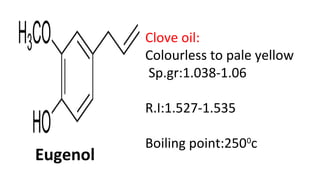
Eugenol
Clove oil:
Colourless to pale yellow
Sp.gr:1.038-1.06
R.I:1.527-1.535
Boiling point:2500
c
USES:
1. Condiment.
2. Carminative.
3. Clove oil which contain high percentage of
eugenol used commercially to produce
Vanillin .
4. Antiseptic.
5. Flavoring agent.
6. Dental uses : as filling material with ZnO
7. Local anesthetic (dental analgesic)
Adulterant
s:Clove Stalk:
•These do not often exceed 3-5 cm in length or 3 mm in thickness
•brownish, dry and woody
•In transverse section shows few oil-glands.
•when crushed, an aromatic odour and a pungent clove-like taste.
•They yield much less volatile oil than cloves (5 to 7%)
•used for adulterating powdered cloves, determined by microscopical
examination (they contain iso-diametric sclerenchymatous cells one which
do not occur in cloves) and by the amount of ash yielded by the drug,
good cloves affording not more than 7 per cent.
•Exhausted cloves: i.e. cloves which have been
deprived of their volatile oil by distillation, are
darker, yield no oil when indented with the nail
and float in water.
•Blown cloves: These are expended flowers of the
clove tree. The stamens are detached. These are
similar in colour to clove and contain less
amount of volatile oil than clove
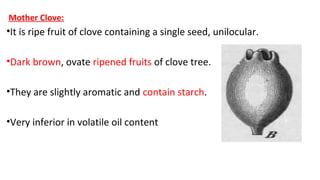
Mother Clove:
•It is ripe fruit of clove containing a single seed, unilocular.
•Dark brown, ovate ripened fruits of clove tree.
•They are slightly aromatic and contain starch.
•Very inferior in volatile oil content

Clove

  • 1.
  • 2.
    Synonyms: Caryophyllum, cloveflower, clove buds, Lavang Biological Source: Dried flower buds of Eugenia caryophyllus Family: Myrtaceae Should Contain NLT 15% v/w of clove oil
  • 3.
    Geographical source: •Indigenous toAmboyna & molucca islands •Cultivated Zanzibar, pemba, penang, Madagascar, caribean islands, srilanka, india. • In India, hilly areas of Tamil Nadu, Kerala and Karnataka.
  • 4.
    Cultivation & collection: Climateand Soil: •Grows well in rich loamy soils of the humid tropics and can be grown successfully in the red soils of Kerala, Tamil Nadu and Karnataka. • A cooler climate with well distributed rainfall is ideal for flowering •The site selected for its cultivation needs Good drainage since the crop cannot withstand water logged conditions. •It grow well in the areas receiving an annual rainfall of 150-300 mm •and it can be grown at an altitude of 1500m above the sea level.
  • 5.
    Planting Materials: •The seedsshould be collected from fully ripe fruits for raising seedlings •Fruits for seed cultivation, known popularly as "mother of clove" are allowed to ripe on the tree and drop down naturally, Such fruits are collected and sown directly in the nursery (or) soaked in water overnight and the pericarp removed before sowing. •Second method of sowing gives excellent results •Only fully developed and uniform sized seeds which show signs of germination by the presence of pink radilce ,are used for sowing.
  • 6.
    Nursery Raising: •Nursery bedsof 15-20cm height,1 mt width and convenient length are to be prepared for sowing seeds •The beds should be made of loose soil-sand mixture over which a layer of sand may be spread •Seeds are sown at 2-3 cm spacing and depth of 2cm •The seed beds have to be protected from direct sunlight . •The germination commences in about 10-15 days and may last for about 40 days.
  • 7.
    • The germinatedseeds are then transplanted in polybags containing a mixture of ,soil, sand and well decomposed cowdung. • Sometimes these seedlings are again transplanted after 1 year to a large polythene bags. These seedlings are ready for transplanting after 18-24 months old. • Indian conditions it is best suitable for mixed cropping in older coconut or arec • The seedlings are transplanted in the main field during the beginning of the rainy season, in June-July.
  • 8.
    Manuring and Fertilizerapplication: •Cattle manure or compost @ 50 kg and bone meal or fish meal @ 2-5 kg bearing tree per year can be applied. •Organic manures can be applied as a single dose at the beginning of the rainy season in the trenches dug around the trees. •The recommended fertilizer dose for inorganic fertilizer is @40Gram urea,110gram super phosphate, and 80gram Murate of potash in the initial stage •Fertilizers are given in 2 doses: may/june & october
  • 9.
    Harvesting and Processing: •Clovetree starts flowering from the fourth year of its planting in fertile soils and good management conditions. •But the full bearing stage is reached by about the 15th year only. •The flowering season varies from September-October in the plains to December-January at high altitudes. •The unopened buds are harvested when they are plump and rounded and before they turn pink. •At this stage ,they are less than 2 cm long. •The opened flowers are not valued as spice.
  • 10.
    • Harvesting shouldbe done without damaging the branches, as it adversely affects the subsequent growth of the tree. • Collected by Hand picking method or beating with bamboos • The harvested flower buds are separated from the clusters by hand and spread in the drying yard for drying. • the correct stage of drying is reached when the stem of the bud is dark brown and rest of the bud is light brown in colour • Well dried cloves weigh about one third the weigh of the fresh cloves • About 11000 to 15000 dried cloves weigh 1 kg
  • 13.
  • 14.
    Macrosco py:• Colour: Crimsonto dark brown • Odor: slightly aromatic • Taste : pungent & aromatic followed by numbness Shape: Hypanthium is surmounted with 4 thick acute divergent surrounded by dome shaped corolla. The corolla consists of unexpanded membranous petals with several stamens and single stiff prominent style 10–17.5mmlength 4 mm width 2m m thickness
  • 15.
  • 18.
    Microscopy: Epidermis: Straight walledcells and large anomocytic stomata, covered with thick cuticle Oil Glands: ovoid and schizolysigenous Cluster crystals of calcium oxalate Starch was absent
  • 19.
    Chemical constituents:1. Volatile oil(Clove oil) : 15%-20% a- Eugenol 70%-90% b-Vanillin c- Caryophyllene d-Acetyl eugenol 4% 2. Tannin : 10-13% (Gallotannic acid) 3. Resin 4. Chromone 5. Eugenin 6. Small quantities of esters, ketones, alcohols
  • 20.
    Eugenol Clove oil: Colourless topale yellow Sp.gr:1.038-1.06 R.I:1.527-1.535 Boiling point:2500 c
  • 21.
    USES: 1. Condiment. 2. Carminative. 3.Clove oil which contain high percentage of eugenol used commercially to produce Vanillin . 4. Antiseptic. 5. Flavoring agent. 6. Dental uses : as filling material with ZnO 7. Local anesthetic (dental analgesic)
  • 22.
    Adulterant s:Clove Stalk: •These donot often exceed 3-5 cm in length or 3 mm in thickness •brownish, dry and woody •In transverse section shows few oil-glands. •when crushed, an aromatic odour and a pungent clove-like taste. •They yield much less volatile oil than cloves (5 to 7%) •used for adulterating powdered cloves, determined by microscopical examination (they contain iso-diametric sclerenchymatous cells one which do not occur in cloves) and by the amount of ash yielded by the drug, good cloves affording not more than 7 per cent.
  • 23.
    •Exhausted cloves: i.e.cloves which have been deprived of their volatile oil by distillation, are darker, yield no oil when indented with the nail and float in water. •Blown cloves: These are expended flowers of the clove tree. The stamens are detached. These are similar in colour to clove and contain less amount of volatile oil than clove
  • 24.
    Mother Clove: •It isripe fruit of clove containing a single seed, unilocular. •Dark brown, ovate ripened fruits of clove tree. •They are slightly aromatic and contain starch. •Very inferior in volatile oil content