Rauwolfia
By,
Rasika Bhalke
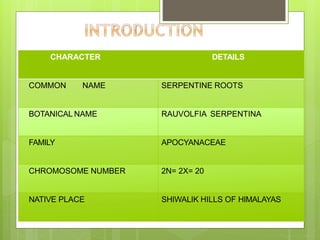
CHARACTER DETAILS
COMMON NAME SERPENTINE ROOTS
BOTANICAL NAME RAUVOLFIA SERPENTINA
FAMILY APOCYANACEAE
CHROMOSOME NUMBER 2N= 2X= 20
NATIVE PLACE SHIWALIK HILLS OF HIMALAYAS
4
Biological Sources:-
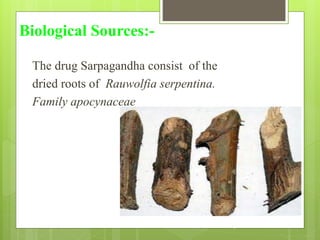
The drug Sarpagandha consist of the
dried roots of Rauwolfia serpentina.
Family apocynaceae
Description
 Sarpagandha, an evergreen plant, has been in use
since 4000 years in Indian medicine. An erect
under-shrub, it is a species of flowering plants. The
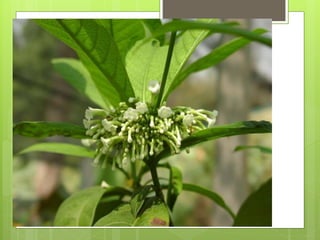
leaves are 7-10cm long, spear-shaped. The flowers
are 1 inch long, white and violet. It contains nectar
at the deep of the corolla tube. The blooming time
is in the month of August and September. The root
is branched and tuberous. It is used as a useful
herb in the Ayurveda, Unani and Homoeopathy
treatments.
6
Introduction:-
 Flowering plant in the family
Apocynaceae.
 Evergreen, glabrous, errect
and grows up to a height of 60
cm (rarely more than that).
 It consist of long irregularly
yellowish root.
7
Botanical description:-
 Macroscopic character:-
 Leaves:- Simple, opposite,
leaves are arranged in whorls of
3 to 4,to 10 cm long and 5 cm
broad.
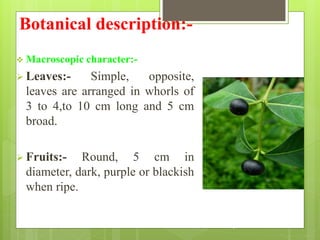
 Fruits:- Round, 5 cm in
diameter, dark, purple or blackish
when ripe.
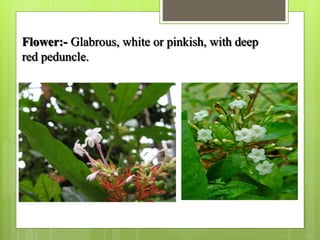
Flower:- Glabrous, white or pinkish, with deep
red peduncle.
7/1/2021 Pharmaceutical seminar 1st 9
Habit and Habitat:-
 It is an evergreen, perennial, glabrous, erect and grows up to a
height of 60 cm.
 Roots are tuberous with pale brown cork.
 Flowers are white, often has violet color.
 Fruits are purplish black in color.
 It is mostly found in the decidous forest of Nepal, India,
Pakistan and Srilanka.
 It is widely distributed from 100-900 m high from sea level of
Nepal, Burma and Bhutan.
Organoleptic properties:-
 Color:- Bary grayish yellow to brown; wood pale yellow
 Odor: Odorless
 Taste: very bitter taste
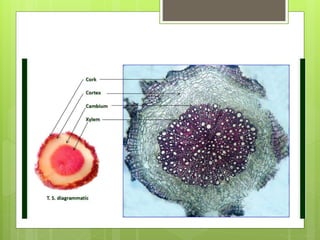
Microscopy
 CLIMATE AND SOIL: Hot and humid tropical regions
with sufficient rainfall. A range of temperature of 10-
30⁰C is found favourable for the plants. It grows from
sea level to 1300 m elevation.
 PLANTING: June and july are suitable months for
transplanting seedlings and vegetatively propagated
plants. The seedlings which are
7.5 to 12 cm high are carefully dug out from nursery
beds and planted.
 AFTER CARE: use of organic matter @ 25-30 tonnes
per hectare and two top dressing of 20 kg may be
applied of N AND 30 kg each P and K is applied
annually.
Cultivation and collection
 SEEDS: Direct sowing does not give good
results because of poor germination rate, so
the seeds are in raised beds about 5.5 kg
seeds are sufficient to plant one hectare.
 ROOT CUTTINGS: The large taproots as well
as secondary roots are employed for
preparing the cuttings 2.5-3.0 cm.
 STEM CUTTINGS: Stem cuttings of 15-20 cm
length with three internodes should be
planted in month of july- august in the
nursery and keep moist.They strike roots
within 60 days and afterwards they are
transplanted to main field.
 IRRIGATION: The transplanted seedlings
require irrigation at a regular intervals.
During hot dry season fortnightly and during
winter once a month irrigation is required.
 INTERCROPPING: Although sole cropping is
done for good root yield, intercropping with
soyabean in wet season and garlic in winter
season is recommended.
 HARVESTING: Ideal age for harvesting is 2-3
years from planting .In addition to the thick
tap root system ,fibrous secondary roots
should also be collected as the are rich in
alkaloid content.
 YIELD : From a good crop stand 2000-2500 kg
dried roots can be obtained from one
hectare.
 DRYING AND STORAGE: Roots thoroughly
dried upto 3% moisture level, the dried roots
are then broken into small pieces of 15-20
cm and packed in air tight containers for
storage in cool and dry place.
 Sarapgandha is susceptible to many diseases
especially to leaf spot, leaf blight , powder
mildews and die back diseases so 2-3
sprayings of 0.5% bordeaux mixture and
dithane Z 78 for die back required.
 Among pests caterpillars common so spraying
with dimethoate 0.03%.
Chemical Constiuents:-
The major chemical constituents are:-
 Serpentine
 Reserpine
 Ajmaline
 Ajmalicine
 Ricinnamine
 Fatty acids
 Unsaturated alcohol
 Fumaric acid
Ajmalicine:-
Molecular structure of Reserpine:-
Pharmacological action:-
Reserpine is used to treat mild to moderate
hypertension.
These are normally involved in controlling heart rate,
force of contraction and peripheral resistance.
The effects of reserpine include respiratory inhibition,
stimulation of peristalsis ,relaxation of membranes and
influence on the temperature regulating centre.
Ayurvedic Preparations:-
Sarpagandha ghanavati
Sarpagandha yoga
Sarpagandha churna
Mahesvari vati
Ethnomedical uses:-
As the antidote against the bites of
venomous reptiles, insect and animal bites.
Used in the anxiety states.
Traditionally being used in the intestinal
disorder.
Contd…..
Young shoot extract of serpentina is given
three times daily to cure pneumonia in early
stage by the people of Jhapa district.
Local people uses R.serpentina fresh leaves
juices to prevent eye inflammation.
Dosage:-
 Rauvolfia:- 100 to 150 mg (oral twice a day)
 Reserpine:- Initial dose 250 µg once a day
 Root powder:- 1-2 gm daily
 The dried roots of rauvolfia is one of the
most important crude drugs which has been
used in the indigenous system of medicine
from ancient times.
 It has been used in treatment of blood
pressure (hypertension), or as a sedative and
transqualising agent.
 A large number of alkaloids have been
isolated from the roots of this plant such as
ajmalicine, ajmaline,reserpine,serpentine.
 India exports 4 tonnes annually worth 0.43
million rupees.
Rauwolfia

Rauwolfia

  • 1.
  • 3.
    CHARACTER DETAILS COMMON NAMESERPENTINE ROOTS BOTANICAL NAME RAUVOLFIA SERPENTINA FAMILY APOCYANACEAE CHROMOSOME NUMBER 2N= 2X= 20 NATIVE PLACE SHIWALIK HILLS OF HIMALAYAS
  • 4.
    4 Biological Sources:- The drugSarpagandha consist of the dried roots of Rauwolfia serpentina. Family apocynaceae
  • 5.
    Description  Sarpagandha, anevergreen plant, has been in use since 4000 years in Indian medicine. An erect under-shrub, it is a species of flowering plants. The leaves are 7-10cm long, spear-shaped. The flowers are 1 inch long, white and violet. It contains nectar at the deep of the corolla tube. The blooming time is in the month of August and September. The root is branched and tuberous. It is used as a useful herb in the Ayurveda, Unani and Homoeopathy treatments.
  • 6.
    6 Introduction:-  Flowering plantin the family Apocynaceae.  Evergreen, glabrous, errect and grows up to a height of 60 cm (rarely more than that).  It consist of long irregularly yellowish root.
  • 7.
    7 Botanical description:-  Macroscopiccharacter:-  Leaves:- Simple, opposite, leaves are arranged in whorls of 3 to 4,to 10 cm long and 5 cm broad.  Fruits:- Round, 5 cm in diameter, dark, purple or blackish when ripe.
  • 8.
    Flower:- Glabrous, whiteor pinkish, with deep red peduncle.
  • 9.
    7/1/2021 Pharmaceutical seminar1st 9 Habit and Habitat:-  It is an evergreen, perennial, glabrous, erect and grows up to a height of 60 cm.  Roots are tuberous with pale brown cork.  Flowers are white, often has violet color.
  • 10.
     Fruits arepurplish black in color.  It is mostly found in the decidous forest of Nepal, India, Pakistan and Srilanka.  It is widely distributed from 100-900 m high from sea level of Nepal, Burma and Bhutan.
  • 11.
    Organoleptic properties:-  Color:-Bary grayish yellow to brown; wood pale yellow  Odor: Odorless  Taste: very bitter taste
  • 12.
  • 15.
     CLIMATE ANDSOIL: Hot and humid tropical regions with sufficient rainfall. A range of temperature of 10- 30⁰C is found favourable for the plants. It grows from sea level to 1300 m elevation.  PLANTING: June and july are suitable months for transplanting seedlings and vegetatively propagated plants. The seedlings which are 7.5 to 12 cm high are carefully dug out from nursery beds and planted.  AFTER CARE: use of organic matter @ 25-30 tonnes per hectare and two top dressing of 20 kg may be applied of N AND 30 kg each P and K is applied annually. Cultivation and collection
  • 16.
     SEEDS: Directsowing does not give good results because of poor germination rate, so the seeds are in raised beds about 5.5 kg seeds are sufficient to plant one hectare.  ROOT CUTTINGS: The large taproots as well as secondary roots are employed for preparing the cuttings 2.5-3.0 cm.  STEM CUTTINGS: Stem cuttings of 15-20 cm length with three internodes should be planted in month of july- august in the nursery and keep moist.They strike roots within 60 days and afterwards they are transplanted to main field.
  • 17.
     IRRIGATION: Thetransplanted seedlings require irrigation at a regular intervals. During hot dry season fortnightly and during winter once a month irrigation is required.  INTERCROPPING: Although sole cropping is done for good root yield, intercropping with soyabean in wet season and garlic in winter season is recommended.
  • 18.
     HARVESTING: Idealage for harvesting is 2-3 years from planting .In addition to the thick tap root system ,fibrous secondary roots should also be collected as the are rich in alkaloid content.  YIELD : From a good crop stand 2000-2500 kg dried roots can be obtained from one hectare.  DRYING AND STORAGE: Roots thoroughly dried upto 3% moisture level, the dried roots are then broken into small pieces of 15-20 cm and packed in air tight containers for storage in cool and dry place.
  • 19.
     Sarapgandha issusceptible to many diseases especially to leaf spot, leaf blight , powder mildews and die back diseases so 2-3 sprayings of 0.5% bordeaux mixture and dithane Z 78 for die back required.  Among pests caterpillars common so spraying with dimethoate 0.03%.
  • 20.
    Chemical Constiuents:- The majorchemical constituents are:-  Serpentine  Reserpine  Ajmaline  Ajmalicine  Ricinnamine  Fatty acids  Unsaturated alcohol  Fumaric acid
  • 24.
  • 25.
  • 26.
    Pharmacological action:- Reserpine isused to treat mild to moderate hypertension. These are normally involved in controlling heart rate, force of contraction and peripheral resistance. The effects of reserpine include respiratory inhibition, stimulation of peristalsis ,relaxation of membranes and influence on the temperature regulating centre.
  • 27.
    Ayurvedic Preparations:- Sarpagandha ghanavati Sarpagandhayoga Sarpagandha churna Mahesvari vati
  • 28.
    Ethnomedical uses:- As theantidote against the bites of venomous reptiles, insect and animal bites. Used in the anxiety states. Traditionally being used in the intestinal disorder.
  • 29.
    Contd….. Young shoot extractof serpentina is given three times daily to cure pneumonia in early stage by the people of Jhapa district. Local people uses R.serpentina fresh leaves juices to prevent eye inflammation.
  • 30.
    Dosage:-  Rauvolfia:- 100to 150 mg (oral twice a day)  Reserpine:- Initial dose 250 µg once a day  Root powder:- 1-2 gm daily
  • 31.
     The driedroots of rauvolfia is one of the most important crude drugs which has been used in the indigenous system of medicine from ancient times.  It has been used in treatment of blood pressure (hypertension), or as a sedative and transqualising agent.  A large number of alkaloids have been isolated from the roots of this plant such as ajmalicine, ajmaline,reserpine,serpentine.  India exports 4 tonnes annually worth 0.43 million rupees.