Drugs acting on Nervous
System
Aswagandha
Name : R.D.L.P.Christian
Designation : Lecturer in pharmacy
Branch : Pharmacy
Institute : GPW, Srikakulam
Year : I year
Subject : Pharmacognosy
Subject Code : PH-103
Topic : Drugs acting on Nervous System
Sub-Topic : Withania
Duration : 50 min.
Teaching Aids : PPT, Photographs
DEPARTMENT OF TECHNICAL EDUCATION
ANDHRA PRADESH
Recap
In the previous lesson we learnt about
CNS drug – ACONITE
Its Macroscopical characters
Active Constituents
Uses, etc.,
Objectives
On completion of this lesson, you would be able to
learn about
• The monograph of the CNS Drug
Aswagandha
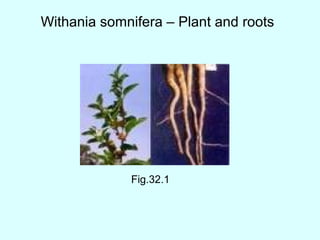
Withania somnifera – Plant and roots
Fig.32.1
Syn. : Withania root
• Biological Source :
Dried roots & stem bases of
Withania somnifera
Family : Solanaceae
• Geographical Source :
Congo, South Africa, Egypt
Jordan, Pakistan
In India it is found in M.P., U.P.,
Punjab, Gujarat and Rajasthan
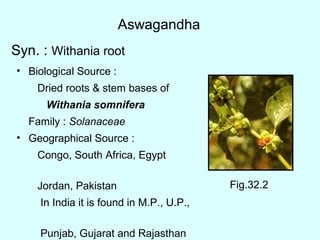
Fig.32.2
Aswagandha
Cultivation, Collection and Preparation
• Seeds are sown in June - July
• 4 - 5 Kg Seeds are required per hectare
• Plants bear fruits and flowers in January
• Harvesting lasts upto March
• In India mainly cultivated in M.P
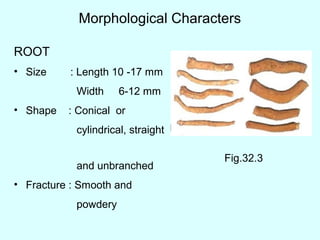
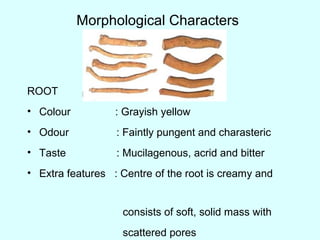
Morphological Characters
ROOT
• Size : Length 10 -17 mm
Width 6-12 mm
• Shape : Conical or
cylindrical, straight
and unbranched
• Fracture : Smooth and
powdery
Fig.32.3
Morphological Characters
ROOT
• Colour : Grayish yellow
• Odour : Faintly pungent and charasteric
• Taste : Mucilagenous, acrid and bitter
• Extra features : Centre of the root is creamy and
consists of soft, solid mass with
scattered pores
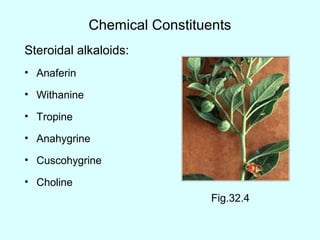
Chemical Constituents
Steroidal alkaloids:
• Anaferin
• Withanine
• Tropine
• Anahygrine
• Cuscohygrine
• Choline
Fig.32.4
Chemical Constituents
Steroidal Lactones:
• Withanolides
• Withaferine
• Withaferin A
• Withanone
Chemical Tests
1. Dil. KMnO4 + Drop of aqueous extract
Decolourisation of KMnO4 solution
2. Aqueous extract + FeCl3 (5%)
No darkening
Uses
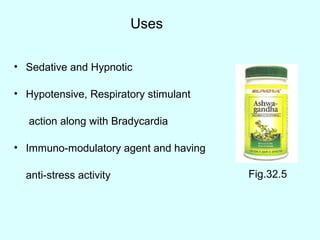
• Sedative and Hypnotic
• Hypotensive, Respiratory stimulant
action along with Bradycardia
• Immuno-modulatory agent and having
anti-stress activity Fig.32.5
Uses
• Used in the treatment of Rheumatism, Gout and Skin
diseases
• Widely used as sex-stimulant
• Strength and vigor promoting drug especially in geriatric
case
• Withaferin, a steroid lactone shows anti-tumour activity
Allied Drugs & Adulterants
• Allied drug : Withania coagulanse
• Adulterant : Wild ashwagandha
Summary
• In this class we discussed about the CNS plant drug
WITHANIA
• Withania contains Steroidal alkaloids and steroid
lactones which are having a variety of activities
Quiz
1. Withania can be used as a
a) Sedative & Hypnotic
b) Sex-stimulant
c) Immuno-modulatory agent
d) All the above
2. The plant part that is useful in Withania is
a) Leaves
b) Flowers
c) Roots
d) None of the above
Quiz
Frequently Asked Questions
1. Write the Botanical Source and Morphological
characters of Ashwagandha
2. Write the Chemical Constituents and Uses of
Ashwagandha

Aswagandha

  • 1.
    Drugs acting onNervous System Aswagandha
  • 2.
    Name : R.D.L.P.Christian Designation: Lecturer in pharmacy Branch : Pharmacy Institute : GPW, Srikakulam Year : I year Subject : Pharmacognosy Subject Code : PH-103 Topic : Drugs acting on Nervous System Sub-Topic : Withania Duration : 50 min. Teaching Aids : PPT, Photographs DEPARTMENT OF TECHNICAL EDUCATION ANDHRA PRADESH
  • 3.
    Recap In the previouslesson we learnt about CNS drug – ACONITE Its Macroscopical characters Active Constituents Uses, etc.,
  • 4.
    Objectives On completion ofthis lesson, you would be able to learn about • The monograph of the CNS Drug Aswagandha
  • 5.
    Withania somnifera –Plant and roots Fig.32.1
  • 6.
    Syn. : Withaniaroot • Biological Source : Dried roots & stem bases of Withania somnifera Family : Solanaceae • Geographical Source : Congo, South Africa, Egypt Jordan, Pakistan In India it is found in M.P., U.P., Punjab, Gujarat and Rajasthan Fig.32.2 Aswagandha
  • 7.
    Cultivation, Collection andPreparation • Seeds are sown in June - July • 4 - 5 Kg Seeds are required per hectare • Plants bear fruits and flowers in January • Harvesting lasts upto March • In India mainly cultivated in M.P
  • 8.
    Morphological Characters ROOT • Size: Length 10 -17 mm Width 6-12 mm • Shape : Conical or cylindrical, straight and unbranched • Fracture : Smooth and powdery Fig.32.3
  • 9.
    Morphological Characters ROOT • Colour: Grayish yellow • Odour : Faintly pungent and charasteric • Taste : Mucilagenous, acrid and bitter • Extra features : Centre of the root is creamy and consists of soft, solid mass with scattered pores
  • 10.
    Chemical Constituents Steroidal alkaloids: •Anaferin • Withanine • Tropine • Anahygrine • Cuscohygrine • Choline Fig.32.4
  • 11.
    Chemical Constituents Steroidal Lactones: •Withanolides • Withaferine • Withaferin A • Withanone
  • 12.
    Chemical Tests 1. Dil.KMnO4 + Drop of aqueous extract Decolourisation of KMnO4 solution 2. Aqueous extract + FeCl3 (5%) No darkening
  • 13.
    Uses • Sedative andHypnotic • Hypotensive, Respiratory stimulant action along with Bradycardia • Immuno-modulatory agent and having anti-stress activity Fig.32.5
  • 14.
    Uses • Used inthe treatment of Rheumatism, Gout and Skin diseases • Widely used as sex-stimulant • Strength and vigor promoting drug especially in geriatric case • Withaferin, a steroid lactone shows anti-tumour activity
  • 15.
    Allied Drugs &Adulterants • Allied drug : Withania coagulanse • Adulterant : Wild ashwagandha
  • 16.
    Summary • In thisclass we discussed about the CNS plant drug WITHANIA • Withania contains Steroidal alkaloids and steroid lactones which are having a variety of activities
  • 17.
    Quiz 1. Withania canbe used as a a) Sedative & Hypnotic b) Sex-stimulant c) Immuno-modulatory agent d) All the above
  • 18.
    2. The plantpart that is useful in Withania is a) Leaves b) Flowers c) Roots d) None of the above Quiz
  • 19.
    Frequently Asked Questions 1.Write the Botanical Source and Morphological characters of Ashwagandha 2. Write the Chemical Constituents and Uses of Ashwagandha