PHYLLANTHUS EMBLICA
KM SHABANAM
B.Pharm 4th Year
(Pharmacy College Azamgarh)
Under the guidance of
Dr. Anil Kumar Patel
Professor
(Pharmacy College, Azamgarh)
December
2023
(AMALA)
PHYTOMEDICINE
Phyllanthus emblica
OVERVIEWS
• Introduction
• Nomenclature
• Habitat
• Cultivation and Collection
• Chemical constituents
• Traditional uses
• Pharmacological activities
• Commercial value
• References
INTRODUCTION
 The tree is small to medium sized, reaching 8 to 18 m in height, with crooked
trunk and spreading branches.
 The leaves simple, sub-sessile and closely set along branchlets, light green,
resembling pinnate leaves.
 The fruit is nearly spherical, light greenish yellow, quite smooth and hard on
appearance.
 The flowers are greenish-yellow.
 All of the plant parts have useful pharmacological action.
 Traditionally, it was used as ayurvedic medicine which is based on a model of
bodily humours or doshas and a need to maintain the inner life force (prana )
which is believed to give rise to the fire of digestion and mental energy.
NOMENCLATURE
 Kingdom: Plantae
 Clade: Tracheophytes
 Clade: Angiosperms
 Clade: Eudicots
 Clade: Rosids
 Order: Malpighiales
 Family: Phyllanthaceae
 Genus: Phyllanthus
 Species: Phyllanthus emblica
HABITAT
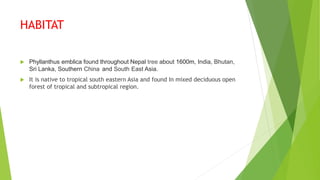
 Phyllanthus emblica found throughout Nepal tree about 1600m, India, Bhutan,
Sri Lanka, Southern China and South East Asia.
 It is native to tropical south eastern Asia and found In mixed deciduous open
forest of tropical and subtropical region.
CULTIVATION AND COLLECTION
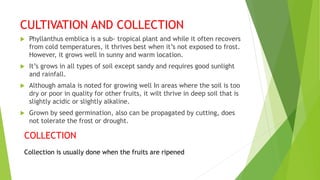
 Phyllanthus emblica is a sub- tropical plant and while it often recovers
from cold temperatures, it thrives best when it’s not exposed to frost.
However, it grows well in sunny and warm location.
 It’s grows in all types of soil except sandy and requires good sunlight
and rainfall.
 Although amala is noted for growing well In areas where the soil is too
dry or poor in quality for other fruits, it wilt thrive in deep soil that is
slightly acidic or slightly alkaline.
 Grown by seed germination, also can be propagated by cutting, does
not tolerate the frost or drought.
COLLECTION
Collection is usually done when the fruits are ripened
CHEMICAL CONSTITUENTS
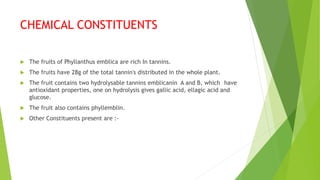
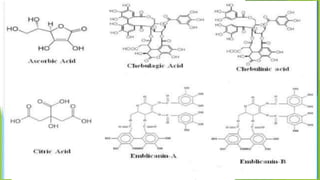
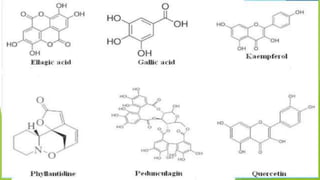
 The fruits of Phyllanthus emblica are rich In tannins.
 The fruits have 28g of the total tannin's distributed in the whole plant.
 The fruit contains two hydrolysable tannins emblicanin A and B, which have
antioxidant properties, one on hydrolysis gives gallic acid, ellagic acid and
glucose.
 The fruit also contains phyllemblin.
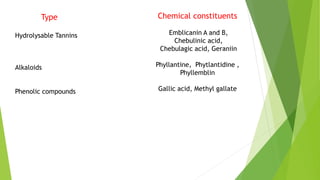
 Other Constituents present are :-
Type
Hydrolysable Tannins
Alkaloids
Phenolic compounds
Chemical constituents
Emblicanin A and B,
Chebulinic acid,
Chebulagic acid, Geraniin
Phyllantine, Phytlantidine ,
Phyllemblin
Gallic acid, Methyl gallate
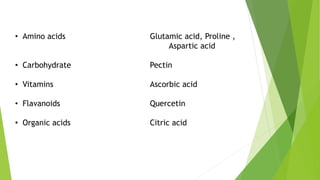
• Amino acids
• Carbohydrate
• Vitamins
• Flavanoids
• Organic acids
Glutamic acid, Proline ,
Aspartic acid
Pectin
Ascorbic acid
Quercetin
Citric acid
TRADITIONAL USE
 Ayurveda, Siddha, Unani systems of India, Tibetan, Sri Lanka and Chinese systems
of medicine utilizes Amala for a variety of ailments.
 The fruit is acidic, astringent, diuretic, laxative, stomachic, and useful for
diarrhea, dysentery, dyspepsia, menorrhagia, hemorrhage, inflammation of eye,
and troubles of the uterus.
 The juice is useful for treating burning sensations of the heart and during urinary
discharge thirst, also disease of the heart, liver complaints, and eye troubles.
 It reduces intra ocular tension in a remarkable manner when juice mixed with
honey and taken twice daily.
 A powder of the amala seed and red sandalwood is given with honey, to stop
emesis.
 Leaves are used as infusion with fenugreek seeds in chronic dysentery and as a
bitter tonic.
Pharmacological Action
1. Antioxidant and antibacterial activity :
• Methanolic extracts of dried leaves of Phyllanthus emblica was used for the
comparative study of antibacterial and antioxidant activity.
2. Radioprotective activity :
• It has been reported that mice treated with P. emblica extract before
exposure to different doses of gamma radiation can reduce the severity
of symptoms of radiation sickness and mortality.
3. Antidepressant activity :
• Extract of fruits of P. emblica in inbred adult male Swiss Albino mice weighing
25-30g. The test was carried out by forced swim test (FST) and tail suspension
test (TST). The result of this test showed the antidepressant activity of P.
emblica as comparable to the of standard antidepressant drug imipramine.
4. Antifungal activity :
• Antifungal property of P. emblica was reported against aspergillus (Satish et al.,
2007).
5. Antipyretic and analgesic properties :
• Preliminary phytochemical screening of the extracts showed the presence of
alkaloids, tannins, phenolic compounds, carbohydrates and amino acids which are
responsible for antipyretic and analgesic activities.
6. Hepato-protective activity :
• The histopathological study of liver cells of rats was examined by administering P
emblica as a preventative agent to reduce paracetamol induced hepatotoxicity
and it has been observed that fruit extract has the ability to rectify toxicity or
hepatic damage (Malar and Bai, 2009).
7.Hypo-lipidemic effect :
• Amala fruit have been reported to have significant anti-hyperlipidemic and anti-
atherogenic effect ( Santosh kumar et al.,2013).Treatment with Amala caused significant
reduction of total cholesterol (TC), Low density lipoprotein ( LDL ), triglyceride (TG),
very low density lipoprotein (VLDL) and a significant increase in high density lipoprotein
(HDL) level in patient with type Il hyperlipidemia.
8. Anti- inflammatory activity :
• Amala showed anti-inflammatory activities in carrageenan induced acute and cotton
pellet induced chronic inflammation in Sprague-Dawley rats by reducing paw volume in
acute inflammation and by decreasing cotton pellet induced granulomas tissue lipid
peroxidation, the granulomatous tissue mass, myeloperoxidase activity and plasma
extravasation in chronic inflammatory condition ( Muthuraman et al., 2011).
9. Anti-cancer activity :
• Amala exhibits its anticancer activities through inhibition of
activator protein-1 and targets transcription of viral oncogenes
responsible for development of cervical cancer thus a demonstrating
its potential efficacy for treatment of human papillomavirus-
induced cervical cancers (Mahata et al., 2013).
COMMERCIAL VALUE
 Cost of 1kg of Amla powder : Rs 750 ( In India)
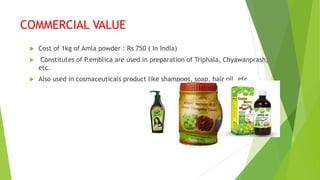
 Constitutes of P.emblica are used in preparation of Triphala, Chyawanprash,
etc.
 Also used in cosmaceuticals product like shampoos, soap, hair oil, etc.
CONCLUSION
 Plants are very important because they are the backbone of all life on
earth and an essential resource for human beings.
 They provide food ,air, habitat,medicine and help to distribute and purity
water.
 Tree produce fruits medicine which are exported in many countries thus
helping in economic growth.
 Light is required for photosynthesis cannot take place.
 For some, herbal medicine is their preferred method of treatment.
Others, herbs are used for treatment of disease and cure.
 The many part of pants are use for production of the medicine. The
active constituents of plant use for manufacturing of conventional
medicine.
REFERENCE
 https://www.researchgate.net/publication/291186546_Phytochemistry_ph
armacological_activities_and_traditional_uses_of_Emblica_officinalis_A_re
view
 https://gafacom.website/medicinal-properties-of-amla-emblica-officinalis
 Int. J. Pharm. Sci. Rev. Res., 24(2), Jan – Feb 2014; no 25, 150-159.
 Natural remedies private limited, Emblica officanalis, Quality control
department,hosur road, bangalore-561-229.
 Liv Xiaoli, Zhao mouming (2008), Antioxidant activity of methanolic
extract of emblica fruit (Phyllanthus emblica L) from six region in China,
Journal of Food composition and analysis 21,219- 228.
Phyllanthus Emblica (AMALA)..pptx

Phyllanthus Emblica (AMALA)..pptx

  • 1.
    PHYLLANTHUS EMBLICA KM SHABANAM B.Pharm4th Year (Pharmacy College Azamgarh) Under the guidance of Dr. Anil Kumar Patel Professor (Pharmacy College, Azamgarh) December 2023 (AMALA) PHYTOMEDICINE
  • 2.
    Phyllanthus emblica OVERVIEWS • Introduction •Nomenclature • Habitat • Cultivation and Collection • Chemical constituents • Traditional uses • Pharmacological activities • Commercial value • References
  • 3.
    INTRODUCTION  The treeis small to medium sized, reaching 8 to 18 m in height, with crooked trunk and spreading branches.  The leaves simple, sub-sessile and closely set along branchlets, light green, resembling pinnate leaves.  The fruit is nearly spherical, light greenish yellow, quite smooth and hard on appearance.  The flowers are greenish-yellow.  All of the plant parts have useful pharmacological action.  Traditionally, it was used as ayurvedic medicine which is based on a model of bodily humours or doshas and a need to maintain the inner life force (prana ) which is believed to give rise to the fire of digestion and mental energy.
  • 4.
    NOMENCLATURE  Kingdom: Plantae Clade: Tracheophytes  Clade: Angiosperms  Clade: Eudicots  Clade: Rosids  Order: Malpighiales  Family: Phyllanthaceae  Genus: Phyllanthus  Species: Phyllanthus emblica
  • 5.
    HABITAT  Phyllanthus emblicafound throughout Nepal tree about 1600m, India, Bhutan, Sri Lanka, Southern China and South East Asia.  It is native to tropical south eastern Asia and found In mixed deciduous open forest of tropical and subtropical region.
  • 6.
    CULTIVATION AND COLLECTION Phyllanthus emblica is a sub- tropical plant and while it often recovers from cold temperatures, it thrives best when it’s not exposed to frost. However, it grows well in sunny and warm location.  It’s grows in all types of soil except sandy and requires good sunlight and rainfall.  Although amala is noted for growing well In areas where the soil is too dry or poor in quality for other fruits, it wilt thrive in deep soil that is slightly acidic or slightly alkaline.  Grown by seed germination, also can be propagated by cutting, does not tolerate the frost or drought. COLLECTION Collection is usually done when the fruits are ripened
  • 7.
    CHEMICAL CONSTITUENTS  Thefruits of Phyllanthus emblica are rich In tannins.  The fruits have 28g of the total tannin's distributed in the whole plant.  The fruit contains two hydrolysable tannins emblicanin A and B, which have antioxidant properties, one on hydrolysis gives gallic acid, ellagic acid and glucose.  The fruit also contains phyllemblin.  Other Constituents present are :-
  • 8.
    Type Hydrolysable Tannins Alkaloids Phenolic compounds Chemicalconstituents Emblicanin A and B, Chebulinic acid, Chebulagic acid, Geraniin Phyllantine, Phytlantidine , Phyllemblin Gallic acid, Methyl gallate
  • 9.
    • Amino acids •Carbohydrate • Vitamins • Flavanoids • Organic acids Glutamic acid, Proline , Aspartic acid Pectin Ascorbic acid Quercetin Citric acid
  • 12.
    TRADITIONAL USE  Ayurveda,Siddha, Unani systems of India, Tibetan, Sri Lanka and Chinese systems of medicine utilizes Amala for a variety of ailments.  The fruit is acidic, astringent, diuretic, laxative, stomachic, and useful for diarrhea, dysentery, dyspepsia, menorrhagia, hemorrhage, inflammation of eye, and troubles of the uterus.  The juice is useful for treating burning sensations of the heart and during urinary discharge thirst, also disease of the heart, liver complaints, and eye troubles.  It reduces intra ocular tension in a remarkable manner when juice mixed with honey and taken twice daily.  A powder of the amala seed and red sandalwood is given with honey, to stop emesis.  Leaves are used as infusion with fenugreek seeds in chronic dysentery and as a bitter tonic.
  • 13.
    Pharmacological Action 1. Antioxidantand antibacterial activity : • Methanolic extracts of dried leaves of Phyllanthus emblica was used for the comparative study of antibacterial and antioxidant activity. 2. Radioprotective activity : • It has been reported that mice treated with P. emblica extract before exposure to different doses of gamma radiation can reduce the severity of symptoms of radiation sickness and mortality. 3. Antidepressant activity : • Extract of fruits of P. emblica in inbred adult male Swiss Albino mice weighing 25-30g. The test was carried out by forced swim test (FST) and tail suspension test (TST). The result of this test showed the antidepressant activity of P. emblica as comparable to the of standard antidepressant drug imipramine.
  • 14.
    4. Antifungal activity: • Antifungal property of P. emblica was reported against aspergillus (Satish et al., 2007). 5. Antipyretic and analgesic properties : • Preliminary phytochemical screening of the extracts showed the presence of alkaloids, tannins, phenolic compounds, carbohydrates and amino acids which are responsible for antipyretic and analgesic activities. 6. Hepato-protective activity : • The histopathological study of liver cells of rats was examined by administering P emblica as a preventative agent to reduce paracetamol induced hepatotoxicity and it has been observed that fruit extract has the ability to rectify toxicity or hepatic damage (Malar and Bai, 2009).
  • 15.
    7.Hypo-lipidemic effect : •Amala fruit have been reported to have significant anti-hyperlipidemic and anti- atherogenic effect ( Santosh kumar et al.,2013).Treatment with Amala caused significant reduction of total cholesterol (TC), Low density lipoprotein ( LDL ), triglyceride (TG), very low density lipoprotein (VLDL) and a significant increase in high density lipoprotein (HDL) level in patient with type Il hyperlipidemia. 8. Anti- inflammatory activity : • Amala showed anti-inflammatory activities in carrageenan induced acute and cotton pellet induced chronic inflammation in Sprague-Dawley rats by reducing paw volume in acute inflammation and by decreasing cotton pellet induced granulomas tissue lipid peroxidation, the granulomatous tissue mass, myeloperoxidase activity and plasma extravasation in chronic inflammatory condition ( Muthuraman et al., 2011).
  • 16.
    9. Anti-cancer activity: • Amala exhibits its anticancer activities through inhibition of activator protein-1 and targets transcription of viral oncogenes responsible for development of cervical cancer thus a demonstrating its potential efficacy for treatment of human papillomavirus- induced cervical cancers (Mahata et al., 2013).
  • 17.
    COMMERCIAL VALUE  Costof 1kg of Amla powder : Rs 750 ( In India)  Constitutes of P.emblica are used in preparation of Triphala, Chyawanprash, etc.  Also used in cosmaceuticals product like shampoos, soap, hair oil, etc.
  • 18.
    CONCLUSION  Plants arevery important because they are the backbone of all life on earth and an essential resource for human beings.  They provide food ,air, habitat,medicine and help to distribute and purity water.  Tree produce fruits medicine which are exported in many countries thus helping in economic growth.  Light is required for photosynthesis cannot take place.  For some, herbal medicine is their preferred method of treatment. Others, herbs are used for treatment of disease and cure.  The many part of pants are use for production of the medicine. The active constituents of plant use for manufacturing of conventional medicine.
  • 19.
    REFERENCE  https://www.researchgate.net/publication/291186546_Phytochemistry_ph armacological_activities_and_traditional_uses_of_Emblica_officinalis_A_re view  https://gafacom.website/medicinal-properties-of-amla-emblica-officinalis Int. J. Pharm. Sci. Rev. Res., 24(2), Jan – Feb 2014; no 25, 150-159.  Natural remedies private limited, Emblica officanalis, Quality control department,hosur road, bangalore-561-229.  Liv Xiaoli, Zhao mouming (2008), Antioxidant activity of methanolic extract of emblica fruit (Phyllanthus emblica L) from six region in China, Journal of Food composition and analysis 21,219- 228.