Posology
Sridebesh Ghorui
Roll No.: 18601916034
B. Pharm, 4th Year, Sec-A
Guru Nanak Institute Of Pharmaceutical Science And Technology
Introduction
• Posology: the term derived from the Greek word “Posos” means how much and “Logos”
means science.
• Posology is the branch of medical science which deals with dose or quantity of drugs which
can be administered to a patient to get the desired pharmacological action.
• The dose of a drug cannot be fixed rigidly because there are so many factor which influence
the doses.
• The official doses represent the average range of quantities suitable for the adults which
administered orally within 24 hours. When other routes of administration are followed the
relevant appropriate dose given.
• Responsibility of a pharmacist to calculate the appropriate dose each and every patients to
satisfy himself that the overdose has not be prescribed.
Factors Influencing Dose
• Age: The pharmacokinetics of many drugs changes with age . So, the age of a patients has
great significance.
• Children and old people need laser amount of drug than normal adult dose, because they
are unable to excrete drugs to that extent adults.
• Sex: Woman do not always respond to the action of drug in the same manner as it is done
in men.
• Morphine and barbiturates may produce more excitement before sedation in woman.
• During lactation antihistamines like morphine and tetracycline drugs are restricted.
Factors Influencing Dose
• Body weight: Average adult does is mentioned either in terms of mg/kg body weight or
as a single does for and adult weighing between 50- 100 kg.
• However, the dose is not applicable for children and malnourished patients.
• Route of administration: IV does is lesser than Oral dose. Because, the drugs administered
directly into the systemic circulation.
• For immediate action and special case Intravenous drugs are given.
• Time of administration: the presence of food in stomach delays the absorption of drugs,
while drugs are rapidly absorbed in empty stomach.
• The irritating drugs are better tolerated if administered after meals. E.g: Iron tablets.
Factors Influencing Dose
•Environmental factor: Daylight is stimulant, enhancing the effect of stimulating drugs.
Darkness is sedative, hypnotics are shows more effect at night.
•Emotional factor: The personality and behaviour of a physician may influence the effect of
drug especially the drug which are intended for use in psychosomatic disorder.
•Presence of disease: Drugs like barbiturates and chlorpromazine may produce unusually
prolong effect in case of liver cirrhosis patients.
•During fever a patient can tolerate high does antipyretics than a normal person.
Factors Influencing Dose
• Accumulation: The drug which are slowly excreted may built up a sufficient high
concentration in the body and produce toxic symptoms if it is repeatedly administered for a
long time.
• Additive effect: When the total pharmacological action of two or more drug administered
together is equivalent to sum of there individual pharmacological action.
• Synergism: When two or more drugs are used in the combination form, and their action is
increased.
• Antagonism: When the action of one drug is opposed by other drug on the same
physiological system is known as antagonism.
Factors Influencing Dose
• Idiosyncrasy: An extraordinary response to a drug which is different from its characteristic
pharmacological action is called idiosyncrasy.
• Tolerance: when an unusual large does of a drug is required to elicit an affect ordinarily
produced by the normal therapeutic dose of the drug the phenomenon is termed as drug
tolerance.
• Tachyphylaxis: it has been observed that when certain drugs are administrated repeatedly
at short intervals, the cell receptor get blocked and pharmacological response to that
particular drug is decreased. This phenomenon is called tachyphylaxis/ acute tolerance.
• Metabolic disorder: changes in water electrolyte balance and body temperature and other
physiological factor may modify the effect of drug.
Calculations of does
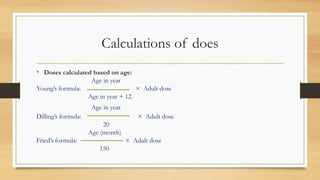
• Doses calculated based on age:
Age in year
Young’s formula: × Adult dose
Age in year + 12.
Age in year
Dilling’s formula: × Adult dose
20
Age (month)
Fried’s formula: × Adult dose
150
• Doses calculated based on body weight (Clark’s formula):
Child weight(lb)
Ă— Adult dose
150
Child weight(kg)
Ă— Adult dose
70
• Doses calculated based on surface area:
Child body surface area
× Adult dose (average adult’s body surface area= 1.73m2)
Average adults body surface area
Questionnaires
•What is posology?
•What are the different factors which influence the dose?
•Why the quantity of drug which is given by intravenous route is less than oral route.
•Write short notes on: idiosyncrasy, tolerance, tachyphylaxis, additive effect, antagonism.
•Using Young’s rule, calculate the dose for a 5 year old child if the adult dose is 340 mg.
•Using Dilling's rule, calculate the dose for a 10 year old child if the adult dose is 500 mg.
•Using Fried’s rule, calculate the dose for 5 month old child if the adult dose is 600 mg.
•Calculate the does for a child weighing 75 lbs if the adult dose is 300 mg.
•Calculate the does for a child weighing 12 kg if the adult dose is 700 mg.
•Calculate the does for a child whose body surface area is 0.43 m2 if the adult dose is 500 mg.