1. What isDNA?
• “DNA, or Deoxyribonucleic Acid, carries and
transmits hereditary materials from parents to
offsprings.”
• DNA is also known as ‘The blueprint of life’.
• About 99.9% is identical and remaining 0.1%
accounts for individual differences.
2. Where it is found?
• In all prokaryotic and eukaryotic cells.
3. Where it is located?
• Most DNA - cell Nucleus (where it is called Nuclear
DNA).
• A small amount of DNA - Mitochondria (where it is
called Mitochondrial DNA).
Introduction
3.
186
6
186
9
191
0
192
8
194
4
195
0
195
2
195
2
195
3
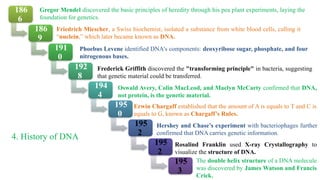
Gregor Mendel discoveredthe basic principles of heredity through his pea plant experiments, laying the
foundation for genetics.
Friedrich Miescher, a Swiss biochemist, isolated a substance from white blood cells, calling it
“nuclein,” which later became known as DNA.
Phoebus Levene identified DNA's components: deoxyribose sugar, phosphate, and four
nitrogenous bases.
Frederick Griffith discovered the "transforming principle" in bacteria, suggesting
that genetic material could be transferred.
Oswald Avery, Colin MacLeod, and Maclyn McCarty confirmed that DNA,
not protein, is the genetic material.
Erwin Chargaff established that the amount of A is equals to T and C is
equals to G, known as Chargaff’s Rules.
Hershey and Chase’s experiment with bacteriophages further
confirmed that DNA carries genetic information.
Rosalind Franklin used X-ray Crystallography to
visualize the structure of DNA.
The double helix structure of a DNA molecule
was discovered by James Watson and Francis
Crick.
4. History of DNA
4.
Structure of DNA
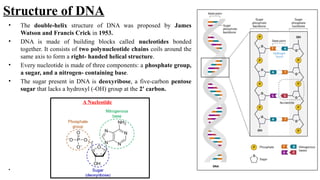
•The double-helix structure of DNA was proposed by James
Watson and Francis Crick in 1953.
• DNA is made of building blocks called nucleotides bonded
together. It consists of two polynucleotide chains coils around the
same axis to form a right- handed helical structure.
• Every nucleotide is made of three components: a phosphate group,
a sugar, and a nitrogen- containing base.
• The sugar present in DNA is deoxyribose, a five-carbon pentose
sugar that lacks a hydroxyl (-OH) group at the 2' carbon.
A Nucleotide
•
5.
• There arefour types of nitrogenous bases: Adenine (A) and
Guanine (G) (purines, with a two-ring structure); Cytosine (C)
and Thymine (T) (pyrimidines, with a single-ring structure).
• The backbone of each strand is made of alternating sugar and
phosphate groups. These are linked by phosphodiester bond,
which give structural integrity to DNA.
• Attached to the sugar molecules are nitrogenous bases, which
form the "rungs" of the DNA ladder. Nitrogenous bases and
sugar are joined by a glycosidic bond.
• The two strands are held together by hydrogen bonds between
complementary bases: A pairs with T (via two hydrogen bonds)
and G pairs with C (via three hydrogen bonds).
6.
• The twostrands run in opposite directions (antiparallel),
meaning one strand runs 5' to 3' and the other runs 3' to 5'.
5' ------------------------> 3'
3' <------------------------ 5'
• The 5' end has a phosphate group attached to the fifth carbon
atom of the sugar molecule. The 3' end has a hydroxyl group
attached to the third carbon atom of the sugar molecule. Thus
making DNA, a negatively charged biomolecule.
• The base pair are 0.34 nm (3.4 Å) apart in DNA helix. A
complete turn of helix takes 3.4 nm (34 Å), therefore in each
helical turn, 10 bases are present.
• The internal diameter of helix is 1.1 nm (11 Å) and external
diameter of helix is 2 nm (20 Å).
• The helix has two external grooves, the narrow groove is called
as minor groove (1.2 nm or 12 Å) while the wide groove is
called as major groove (2.2 nm or 22 Å). The major groove is
the site for DNA binding proteins. The minor grooves often are
the site for binding small molecules.
7.
Types of DNA
CharacteristicsA-DNA B-DNA C-DNA Z-DNA
Shape Broadest Intermediate Narrow Narrowest
Helix Sense Right-Handed Right-Handed Right-Handed Left-Handed
Rise per Base Pair
(h)
2.3 Å 3.4 Å 3.32 Å 3.8 Å
Base Pairs per Turn
of Helix (n)
11 10 9 12
Helix Pitch (h × n) 25.30 Å 34.00 Å 29.88 Å 45.60 Å
8.
Functions of DNA
1.Genetic Information Storage
• DNA stores hereditary information in the form of a genetic code (sequence of nucleotides: A, T, C, G). This
information determines an organism’s traits and biological processes.
2. DNA Replication
• DNA can self-replicate before cell division, ensuring genetic continuity across generations. The process follows
the semi-conservative model, where each new DNA molecule contains one original strand and one newly
synthesized strand.
3. Protein Synthesis
• DNA provides instructions to produce proteins through two key steps:
Transcription - DNA is converted into mRNA in the nucleus.
Translation - mRNA is read by ribosomes to assemble proteins.
4. Mutation & Evolution
• DNA can undergo mutations, leading to genetic variation.
• Beneficial mutations drive evolution, while harmful mutations can cause genetic disorders.
9.
Applications of DNA
1.Forensic Science
• DNA Fingerprinting - Identifies individuals in criminal investigations and paternity cases.
• Crime Scene Investigation - DNA from hair, blood, or saliva helps solve crimes.
• Missing Persons & Disaster Victim Identification (DVI) - DNA helps identify remains.
2. Medicine & Healthcare
• Genetic Testing - Detects inherited diseases like cystic fibrosis and sickle cell anemia.
• Gene Therapy - Replaces faulty genes to treat genetic disorders.
• Cancer Research - Identifies mutations linked to cancer for targeted therapies.
3. Environmental Science & Bioremediation
• DNA Barcoding - Identifies species for conservation efforts.
• Microbial DNAAnalysis - Helps in pollution control by detecting bio-degrading bacteria.
4. Ancestry & Evolutionary Studies
• Ancestry Testing - Determines human lineage and migration patterns.
• Evolutionary Biology - Helps study species evolution and genetic relationships.
• Ancient DNAAnalysis - Extracts DNA from fossils to study extinct species.
5. Agriculture & Animal Breeding
• Selective Breeding - Improves livestock and crop traits using genetic analysis.
• Disease-Resistant Crops - Develops plants with higher yield and disease resistance.