INCOMPLETE DOMINANCE
VS
CO-DOMINANCE
CONTENTS:
1. INTRODUCTION
2. INCOMPLETE DOMINANCE
3. EXAMPLES OF INCOMPLETE DOMINANCE
4. WHY INCOMPLETE DOMINANCE OCCUR ?
5. CO-DOMINANCE
6. EXAMPLES OF CO-DOMINANCE
7. PROBLEM OF CODOMINANCE
8. BLOOD TYPING
9. DIFFERENCE BETWEEN CO & INCOMPLETE
DOMINANCE
10. CONCLUSION
• Genes are passed parents  offspring; get
one allele from each parent
• During Meiosis, the alleles for a gene
segregate from each other.
• During Meiosis, genes independently
assort with each other.
INTRODUCTION :
Review of Mendel’s Principles
Incomplete Dominance
•Incomplete dominance is when a dominant allele,
form of a gene, does not completely mask the
effects of a recessive alleles, and the organism’s
resulting physical appearance shows a blending of
both alleles . It is also called semi dominance or
partial dominance.
Example of
Incomplete Dominance
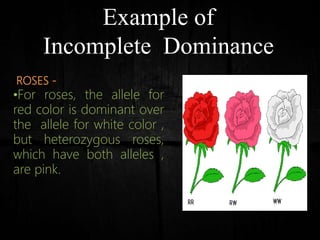
ROSES -
•For roses, the allele for
red color is dominant over
the allele for white color ,
but heterozygous roses,
which have both alleles ,
are pink.
• Snapdragons-
As an example, incomplete dominance
is seen in cross pollination
experiments between red and white
snapdragon plants. In this monohybrid
cross, the allele that produces the red
colour (R) is not completely expressed
over the allele that produces the white
colour (r). The resulting offspring are
all pink.
The genotypes are :
RED (RR) X white (rr) = Pink (Rr).
Example of
Incomplete Dominance
Then the first filial (F1) generation consisting of all pink
plants is allowed to cross
Pollinate, the resulting plants (F2 generation) consist of three
phenotypes {1/4 Red:
1/2Pink(Rr): ¼ White(rr)}.
The phenotypic ratio is 1:2:1.
•When the F1 generation is allowed to cross-pollinate with true-
breeding red plants, the
resulting F2 plants consist of red and pink phenotypes {1/2 Red
(RR) : 1/2 Pink (Rr)}.
•When the F1 generation is allowed to cross-pollinate with true
breeding white plants ,
the resulting F2 plants consist of white and pink phenotypes {1/2
White (rr) : 1/2 Pink
(Rr)}.
The phenotypic ratio is 1:1.
WHY does “Incomplete
Dominance” occur ?
• Incomplete dominance may occur because neither
of the two alleles is fully dominant over the other , or
because the dominant allele does not fully dominate
the recessive allele .
• This results in a phenotype that is different from
both the dominant and recessive alleles, and appears
to be a mixture of both.
CODOMINANCE
Some genes have alleles that are
both expressed in the heterozygote
individuals
© 2016 Paul Billiet ODWS
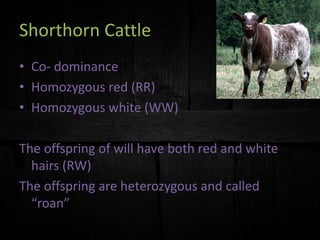
Shorthorn Cattle
• Co- dominance
• Homozygous red (RR)
• Homozygous white (WW)
The offspring of will have both red and white
hairs (RW)
The offspring are heterozygous and called
“roan”
Phenotypes Sickle cell trait x Sickle cell trait
Genotypes HbNHbS HbNHbS
Gametes HbN HbS HbN HbS
HbN HbS
HbN HbNHbN HbNHbS
HbS HbNHbS HbSHbS
Offspring Normal Sickle cell trait Sickle cell anemia
Proportions 25% 50% 25%
Unusual proportions
• In codominance, heterozygotes have their own
phenotype
• This gives rise to different proportions amongst
offspring of some genetic crosses
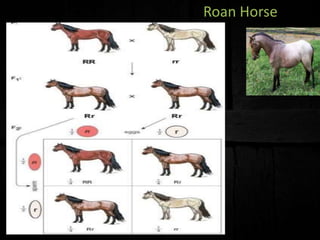
Roan Horse
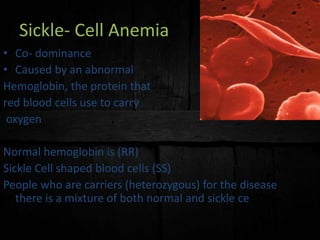
Sickle- Cell Anemia
• Co- dominance
• Caused by an abnormal
Hemoglobin, the protein that
red blood cells use to carry
oxygen
Normal hemoglobin is (RR)
Sickle Cell shaped blood cells (SS)
People who are carriers (heterozygous) for the disease
there is a mixture of both normal and sickle cell (RS)
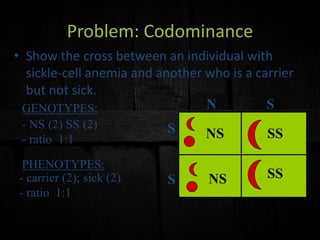
Problem: Codominance
• Show the cross between an individual with
sickle-cell anemia and another who is a carrier
but not sick.
N S
S
S
NS
NS
SS
SS
- NS (2) SS (2)
- ratio 1:1
- carrier (2); sick (2)
- ratio 1:1
GENOTYPES:
PHENOTYPES:
Blood types are A, B, O, and AB.
AB blood is a co-dominant trait.
Both the A blood and the B blood need to be dominant
in order to make a combination of co-dominant blood
types, which is AB.
 IA IA IA
iiiiiiiiiiiiiiiiiiiiiiiiiiiiiiiii

 IB IB

 IB i
IA IB IA IB
IA IB IA IB
IA IB IB i
IA i ii
i
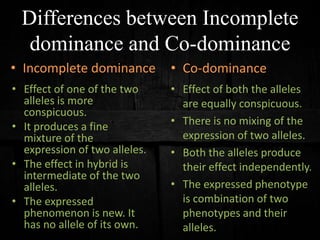
Differences between Incomplete
dominance and Co-dominance
• Incomplete dominance
• Effect of one of the two
alleles is more
conspicuous.
• It produces a fine
mixture of the
expression of two alleles.
• The effect in hybrid is
intermediate of the two
alleles.
• The expressed
phenomenon is new. It
has no allele of its own.
• Effect of both the alleles
are equally conspicuous.
• There is no mixing of the
expression of two alleles.
• Both the alleles produce
their effect independently.
• The expressed phenotype
is combination of two
phenotypes and their
alleles.
• Co-dominance
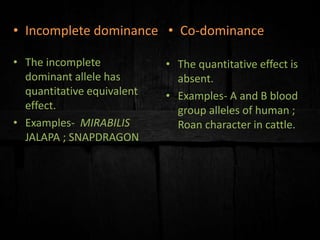
• The incomplete
dominant allele has
quantitative equivalent
effect.
• Examples- MIRABILIS
JALAPA ; SNAPDRAGON
• Incomplete dominance
• The quantitative effect is
absent.
• Examples- A and B blood
group alleles of human ;
Roan character in cattle.
• Co-dominance
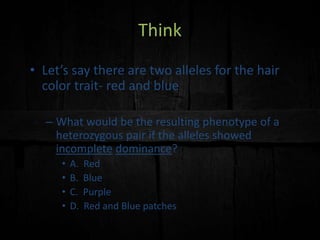
Think
• Let’s say there are two alleles for the hair
color trait- red and blue
– What would be the resulting phenotype of a
heterozygous pair if the alleles showed
incomplete dominance?
• A. Red
• B. Blue
• C. Purple
• D. Red and Blue patches
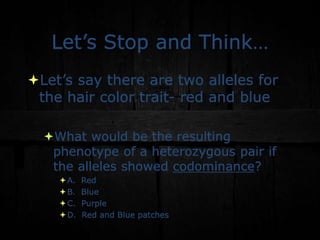
Let’s Stop and Think…
Let’s say there are two alleles for
the hair color trait- red and blue
What would be the resulting
phenotype of a heterozygous pair if
the alleles showed codominance?
A. Red
B. Blue
C. Purple
D. Red and Blue patches
Conclusion-
IN INCOMPLETE DOMINANCE IT IS
CLEAR THAT THE DOMINANT ALLELE
DOES NOT SUPRESS THE RECESSIVE
ALLELE AND THUS BLENDING OCCURS
AND AN INTERMEDIATE IS FORMED. IT
IS A NON-MENDELIAN TRAIT.
IN CODOMINANCE THE CASE IS NOT THAT
LIKE AS INCOMPLETE DOMINANCE. HERE
BLENDING DOES NOT OCCUR RATHER AN
ANOTHER PRODUCT IS FORMED WHICH IS
NEITHER RECESSIVE NOR DOMINANT AND
CONTAINS GAMETS OF BOTH DOMINANAT
AND RECESSSIVE GAMETS. AND ALL THE
PRODUCTS COME IN PROPORTION.

INCOMPLETE DOMINANCE VS CO-DOMINANCE

  • 1.
  • 2.
    CONTENTS: 1. INTRODUCTION 2. INCOMPLETEDOMINANCE 3. EXAMPLES OF INCOMPLETE DOMINANCE 4. WHY INCOMPLETE DOMINANCE OCCUR ? 5. CO-DOMINANCE 6. EXAMPLES OF CO-DOMINANCE 7. PROBLEM OF CODOMINANCE 8. BLOOD TYPING 9. DIFFERENCE BETWEEN CO & INCOMPLETE DOMINANCE 10. CONCLUSION
  • 3.
    • Genes arepassed parents  offspring; get one allele from each parent • During Meiosis, the alleles for a gene segregate from each other. • During Meiosis, genes independently assort with each other. INTRODUCTION : Review of Mendel’s Principles
  • 4.
    Incomplete Dominance •Incomplete dominanceis when a dominant allele, form of a gene, does not completely mask the effects of a recessive alleles, and the organism’s resulting physical appearance shows a blending of both alleles . It is also called semi dominance or partial dominance.
  • 5.
    Example of Incomplete Dominance ROSES- •For roses, the allele for red color is dominant over the allele for white color , but heterozygous roses, which have both alleles , are pink.
  • 6.
    • Snapdragons- As anexample, incomplete dominance is seen in cross pollination experiments between red and white snapdragon plants. In this monohybrid cross, the allele that produces the red colour (R) is not completely expressed over the allele that produces the white colour (r). The resulting offspring are all pink. The genotypes are : RED (RR) X white (rr) = Pink (Rr). Example of Incomplete Dominance
  • 7.
    Then the firstfilial (F1) generation consisting of all pink plants is allowed to cross Pollinate, the resulting plants (F2 generation) consist of three phenotypes {1/4 Red: 1/2Pink(Rr): ¼ White(rr)}. The phenotypic ratio is 1:2:1. •When the F1 generation is allowed to cross-pollinate with true- breeding red plants, the resulting F2 plants consist of red and pink phenotypes {1/2 Red (RR) : 1/2 Pink (Rr)}. •When the F1 generation is allowed to cross-pollinate with true breeding white plants , the resulting F2 plants consist of white and pink phenotypes {1/2 White (rr) : 1/2 Pink (Rr)}. The phenotypic ratio is 1:1.
  • 8.
    WHY does “Incomplete Dominance”occur ? • Incomplete dominance may occur because neither of the two alleles is fully dominant over the other , or because the dominant allele does not fully dominate the recessive allele . • This results in a phenotype that is different from both the dominant and recessive alleles, and appears to be a mixture of both.
  • 9.
    CODOMINANCE Some genes havealleles that are both expressed in the heterozygote individuals © 2016 Paul Billiet ODWS
  • 10.
    Shorthorn Cattle • Co-dominance • Homozygous red (RR) • Homozygous white (WW) The offspring of will have both red and white hairs (RW) The offspring are heterozygous and called “roan”
  • 11.
    Phenotypes Sickle celltrait x Sickle cell trait Genotypes HbNHbS HbNHbS Gametes HbN HbS HbN HbS HbN HbS HbN HbNHbN HbNHbS HbS HbNHbS HbSHbS Offspring Normal Sickle cell trait Sickle cell anemia Proportions 25% 50% 25% Unusual proportions • In codominance, heterozygotes have their own phenotype • This gives rise to different proportions amongst offspring of some genetic crosses
  • 12.
  • 13.
    Sickle- Cell Anemia •Co- dominance • Caused by an abnormal Hemoglobin, the protein that red blood cells use to carry oxygen Normal hemoglobin is (RR) Sickle Cell shaped blood cells (SS) People who are carriers (heterozygous) for the disease there is a mixture of both normal and sickle cell (RS)
  • 14.
    Problem: Codominance • Showthe cross between an individual with sickle-cell anemia and another who is a carrier but not sick. N S S S NS NS SS SS - NS (2) SS (2) - ratio 1:1 - carrier (2); sick (2) - ratio 1:1 GENOTYPES: PHENOTYPES:
  • 15.
    Blood types areA, B, O, and AB. AB blood is a co-dominant trait. Both the A blood and the B blood need to be dominant in order to make a combination of co-dominant blood types, which is AB.  IA IA IA iiiiiiiiiiiiiiiiiiiiiiiiiiiiiiiii   IB IB   IB i IA IB IA IB IA IB IA IB IA IB IB i IA i ii i
  • 16.
    Differences between Incomplete dominanceand Co-dominance • Incomplete dominance • Effect of one of the two alleles is more conspicuous. • It produces a fine mixture of the expression of two alleles. • The effect in hybrid is intermediate of the two alleles. • The expressed phenomenon is new. It has no allele of its own. • Effect of both the alleles are equally conspicuous. • There is no mixing of the expression of two alleles. • Both the alleles produce their effect independently. • The expressed phenotype is combination of two phenotypes and their alleles. • Co-dominance
  • 17.
    • The incomplete dominantallele has quantitative equivalent effect. • Examples- MIRABILIS JALAPA ; SNAPDRAGON • Incomplete dominance • The quantitative effect is absent. • Examples- A and B blood group alleles of human ; Roan character in cattle. • Co-dominance
  • 18.
    Think • Let’s saythere are two alleles for the hair color trait- red and blue – What would be the resulting phenotype of a heterozygous pair if the alleles showed incomplete dominance? • A. Red • B. Blue • C. Purple • D. Red and Blue patches
  • 19.
    Let’s Stop andThink… Let’s say there are two alleles for the hair color trait- red and blue What would be the resulting phenotype of a heterozygous pair if the alleles showed codominance? A. Red B. Blue C. Purple D. Red and Blue patches
  • 20.
    Conclusion- IN INCOMPLETE DOMINANCEIT IS CLEAR THAT THE DOMINANT ALLELE DOES NOT SUPRESS THE RECESSIVE ALLELE AND THUS BLENDING OCCURS AND AN INTERMEDIATE IS FORMED. IT IS A NON-MENDELIAN TRAIT. IN CODOMINANCE THE CASE IS NOT THAT LIKE AS INCOMPLETE DOMINANCE. HERE BLENDING DOES NOT OCCUR RATHER AN ANOTHER PRODUCT IS FORMED WHICH IS NEITHER RECESSIVE NOR DOMINANT AND CONTAINS GAMETS OF BOTH DOMINANAT AND RECESSSIVE GAMETS. AND ALL THE PRODUCTS COME IN PROPORTION.