DNA
DNA
DNA
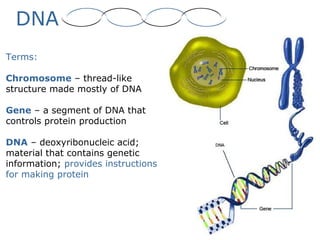
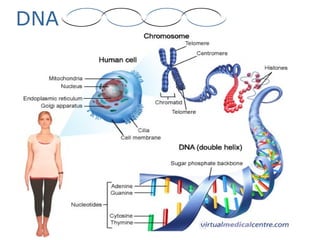
Terms:
Chromosome – thread-like
structure made mostly of DNA
Gene – a segment of DNA that
controls protein production
DNA – deoxyribonucleic acid;
material that contains genetic
information; provides instructions
for making protein
DNA
DNA
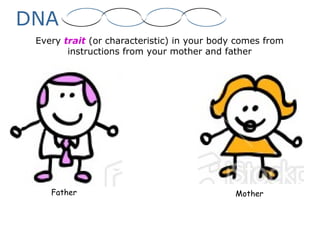
Every trait (or characteristic) in your body comes from
instructions from your mother and father
Father Mother
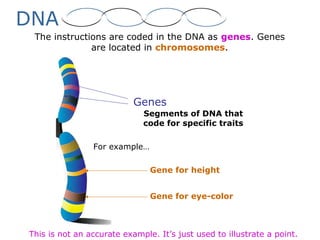
Genes
Segments of DNA that
code for specific traits
The instructions are coded in the DNA as genes. Genes
are located in chromosomes.
Gene for height
For example…
Gene for eye-color
This is not an accurate example. It’s just used to illustrate a point.
DNA
Father Mother
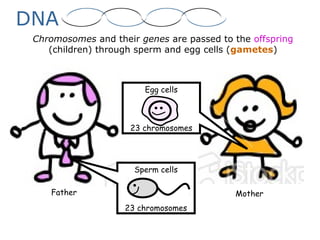
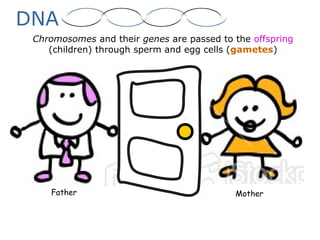
Chromosomes and their genes are passed to the offspring
(children) through sperm and egg cells (gametes)
Sperm cells
23 chromosomes
Egg cells
23 chromosomes
DNA
Father Mother
Chromosomes and their genes are passed to the offspring
(children) through sperm and egg cells (gametes)
DNA
Father Mother
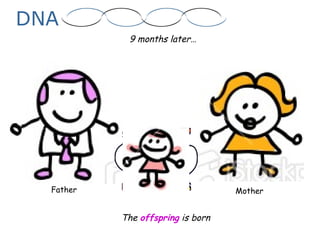
9 months later…
The offspring is born
DNA
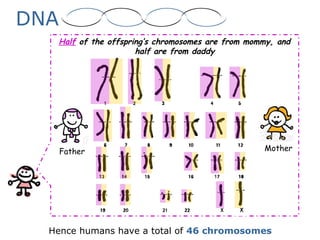
Half of the offspring’s chromosomes are from mommy, and
half are from daddy
Father Mother
DNA
Hence humans have a total of 46 chromosomes
DNA
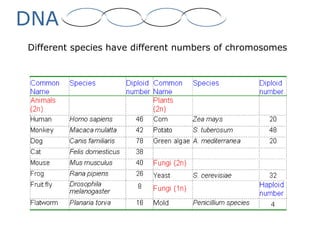
Different species have different numbers of chromosomes
DNA
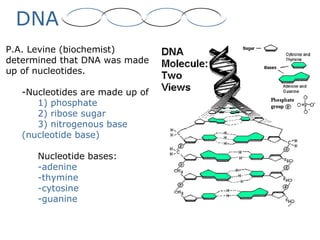
P.A. Levine (biochemist)
determined that DNA was made
up of nucleotides.
-Nucleotides are made up of
1) phosphate
2) ribose sugar
3) nitrogenous base
(nucleotide base)
Nucleotide bases:
-adenine
-thymine
-cytosine
-guanine
DNA
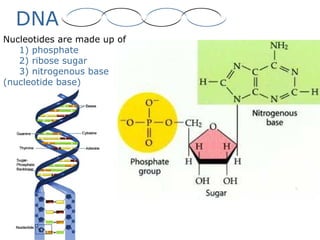
Nucleotides are made up of
1) phosphate
2) ribose sugar
3) nitrogenous base
(nucleotide base)
DNA
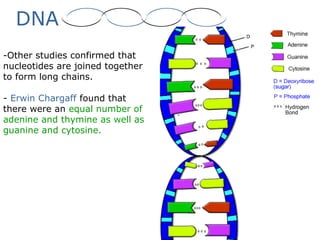
-Other studies confirmed that
nucleotides are joined together
to form long chains.
- Erwin Chargaff found that
there were an equal number of
adenine and thymine as well as
guanine and cytosine.
DNA
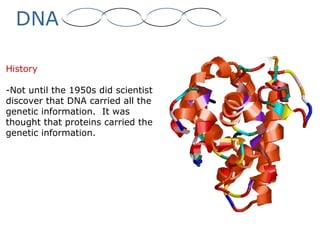
History
-Not until the 1950s did scientist
discover that DNA carried all the
genetic information. It was
thought that proteins carried the
genetic information.
DNA
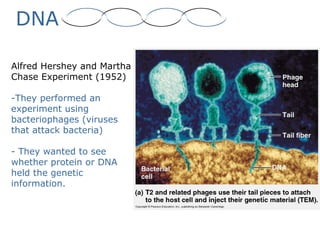
Alfred Hershey and Martha
Chase Experiment (1952)
-They performed an
experiment using
bacteriophages (viruses
that attack bacteria)
- They wanted to see
whether protein or DNA
held the genetic
information.
DNA
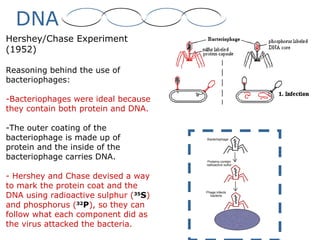
Hershey/Chase Experiment
(1952)
Reasoning behind the use of
bacteriophages:
-Bacteriophages were ideal because
they contain both protein and DNA.
-The outer coating of the
bacteriophage is made up of
protein and the inside of the
bacteriophage carries DNA.
- Hershey and Chase devised a way
to mark the protein coat and the
DNA using radioactive sulphur (35
S)
and phosphorus (32
P), so they can
follow what each component did as
the virus attacked the bacteria.
DNA
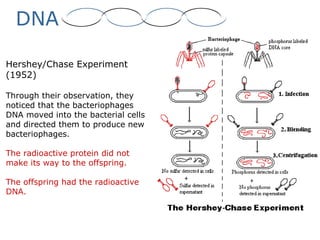
Hershey/Chase Experiment
(1952)
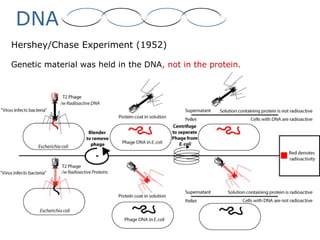
Through their observation, they
noticed that the bacteriophages
DNA moved into the bacterial cells
and directed them to produce new
bacteriophages.
The radioactive protein did not
make its way to the offspring.
The offspring had the radioactive
DNA.
DNA
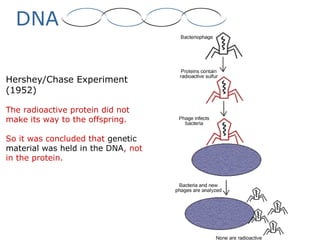
Hershey/Chase Experiment
(1952)
The radioactive protein did not
make its way to the offspring.
So it was concluded that genetic
material was held in the DNA, not
in the protein.
DNA
Hershey/Chase Experiment (1952)
Genetic material was held in the DNA, not in the protein.
DNA
Discovering the Double Helix
Information scientists knew by 1953:
-DNA is made up of nucleotides
-Nucleotides are linked together in a
string.
-In each DNA molecule there is an equal
number of adenine – thymine nucleotides
and an equal number of guanine –
cytosine nucleotides.
QUESTION:
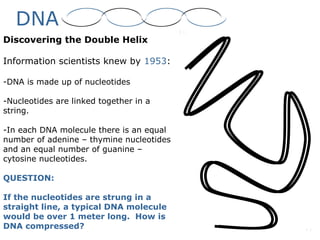
If the nucleotides are strung in a
straight line, a typical DNA molecule
would be over 1 meter long. How is
DNA compressed?
DNA
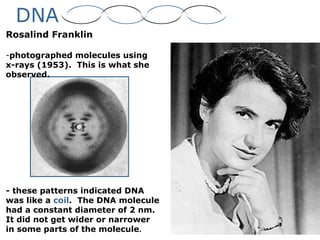
Rosalind Franklin
-photographed molecules using
x-rays (1953). This is what she
observed.
- these patterns indicated DNA
was like a coil. The DNA molecule
had a constant diameter of 2 nm.
It did not get wider or narrower
in some parts of the molecule.
DNA
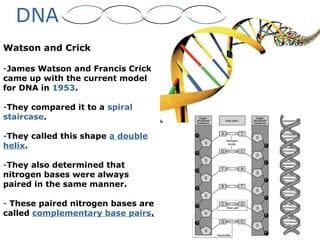
Watson and Crick
-James Watson and Francis Crick
came up with the current model
for DNA in 1953.
-They compared it to a spiral
staircase.
-They called this shape a double
helix.
-They also determined that
nitrogen bases were always
paired in the same manner.
- These paired nitrogen bases are
called complementary base pairs.
DNA
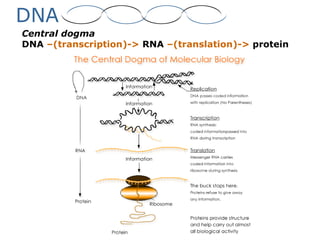
Central dogma
DNA –(transcription)-> RNA –(translation)-> protein
DNA
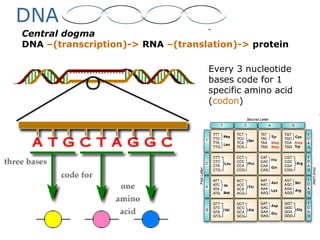
Central dogma
DNA –(transcription)-> RNA –(translation)-> protein
Every 3 nucleotide
bases code for 1
specific amino acid
(codon)
DNA
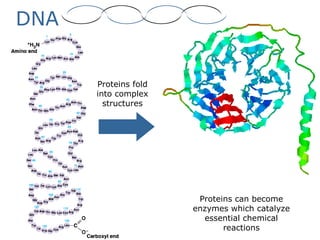
Proteins fold
into complex
structures
Proteins can become
enzymes which catalyze
essential chemical
reactions
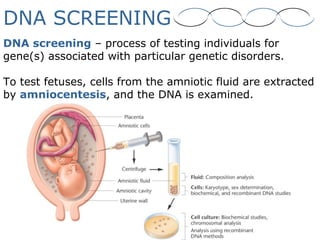
DNA SCREENING
DNA screening – process of testing individuals for
gene(s) associated with particular genetic disorders.
To test fetuses, cells from the amniotic fluid are extracted
by amniocentesis, and the DNA is examined.
Human genetic disorders
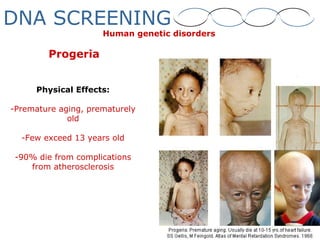
Progeria
Physical Effects:
-Premature aging, prematurely
old
-Few exceed 13 years old
-90% die from complications
from atherosclerosis
DNA SCREENING
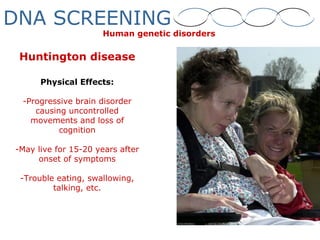
Huntington disease
Physical Effects:
-Progressive brain disorder
causing uncontrolled
movements and loss of
cognition
-May live for 15-20 years after
onset of symptoms
-Trouble eating, swallowing,
talking, etc.
Human genetic disorders
DNA SCREENING
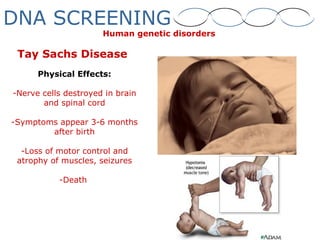
Tay Sachs Disease
Physical Effects:
-Nerve cells destroyed in brain
and spinal cord
-Symptoms appear 3-6 months
after birth
-Loss of motor control and
atrophy of muscles, seizures
-Death
Human genetic disorders
DNA SCREENING
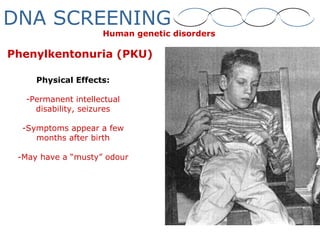
Phenylkentonuria (PKU)
Physical Effects:
-Permanent intellectual
disability, seizures
-Symptoms appear a few
months after birth
-May have a “musty” odour
Human genetic disorders
DNA SCREENING
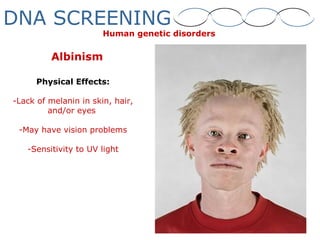
Albinism
Physical Effects:
-Lack of melanin in skin, hair,
and/or eyes
-May have vision problems
-Sensitivity to UV light
Human genetic disorders
DNA SCREENING
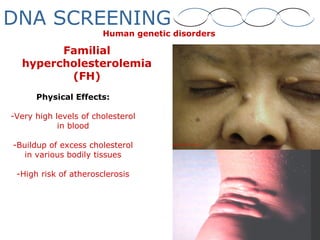
Familial
hypercholesterolemia
(FH)
Physical Effects:
-Very high levels of cholesterol
in blood
-Buildup of excess cholesterol
in various bodily tissues
-High risk of atherosclerosis
Human genetic disorders
DNA SCREENING
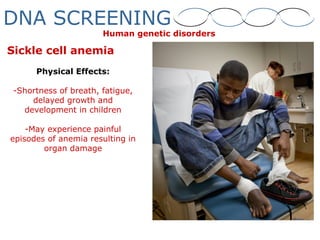
Sickle cell anemia
Physical Effects:
-Shortness of breath, fatigue,
delayed growth and
development in children
-May experience painful
episodes of anemia resulting in
organ damage
Human genetic disorders
DNA SCREENING
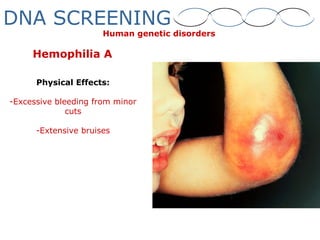
Hemophilia A
Physical Effects:
-Excessive bleeding from minor
cuts
-Extensive bruises
Human genetic disorders
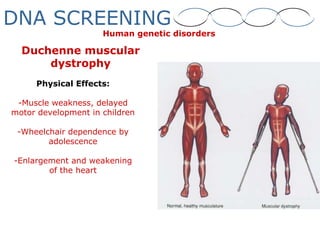
DNA SCREENING
Duchenne muscular
dystrophy
Physical Effects:
-Muscle weakness, delayed
motor development in children
-Wheelchair dependence by
adolescence
-Enlargement and weakening
of the heart
Human genetic disorders
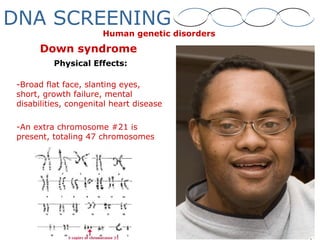
DNA SCREENING
Down syndrome
Physical Effects:
-Broad flat face, slanting eyes,
short, growth failure, mental
disabilities, congenital heart disease
-An extra chromosome #21 is
present, totaling 47 chromosomes
Human genetic disorders
DNA SCREENING
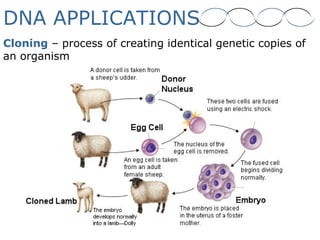
DNA APPLICATIONS
Cloning – process of creating identical genetic copies of
an organism
DNA APPLICATIONS
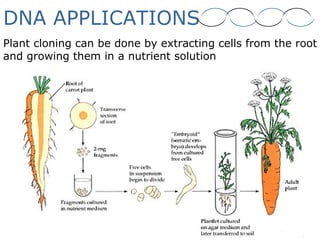
Plant cloning can be done by extracting cells from the root
and growing them in a nutrient solution
DNA APPLICATIONS
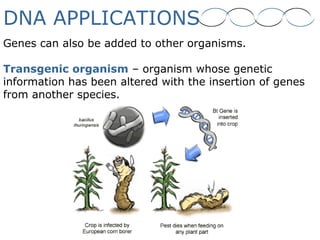
Genes can also be added to other organisms.
Transgenic organism – organism whose genetic
information has been altered with the insertion of genes
from another species.
DNA APPLICATIONS
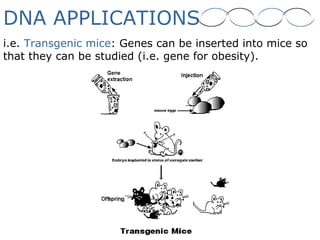
i.e. Transgenic mice: Genes can be inserted into mice so
that they can be studied (i.e. gene for obesity).
DNA APPLICATIONS
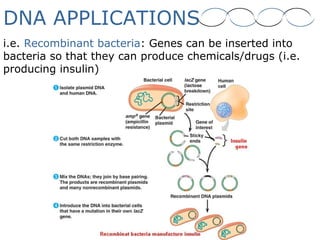
i.e. Recombinant bacteria: Genes can be inserted into
bacteria so that they can produce chemicals/drugs (i.e.
producing insulin)

02 dna

  • 1.
  • 2.
  • 3.
    DNA Terms: Chromosome – thread-like structuremade mostly of DNA Gene – a segment of DNA that controls protein production DNA – deoxyribonucleic acid; material that contains genetic information; provides instructions for making protein
  • 4.
  • 5.
    DNA Every trait (orcharacteristic) in your body comes from instructions from your mother and father Father Mother
  • 6.
    Genes Segments of DNAthat code for specific traits The instructions are coded in the DNA as genes. Genes are located in chromosomes. Gene for height For example… Gene for eye-color This is not an accurate example. It’s just used to illustrate a point. DNA
  • 7.
    Father Mother Chromosomes andtheir genes are passed to the offspring (children) through sperm and egg cells (gametes) Sperm cells 23 chromosomes Egg cells 23 chromosomes DNA
  • 8.
    Father Mother Chromosomes andtheir genes are passed to the offspring (children) through sperm and egg cells (gametes) DNA
  • 9.
    Father Mother 9 monthslater… The offspring is born DNA
  • 10.
    Half of theoffspring’s chromosomes are from mommy, and half are from daddy Father Mother DNA Hence humans have a total of 46 chromosomes
  • 11.
    DNA Different species havedifferent numbers of chromosomes
  • 12.
    DNA P.A. Levine (biochemist) determinedthat DNA was made up of nucleotides. -Nucleotides are made up of 1) phosphate 2) ribose sugar 3) nitrogenous base (nucleotide base) Nucleotide bases: -adenine -thymine -cytosine -guanine
  • 13.
    DNA Nucleotides are madeup of 1) phosphate 2) ribose sugar 3) nitrogenous base (nucleotide base)
  • 14.
    DNA -Other studies confirmedthat nucleotides are joined together to form long chains. - Erwin Chargaff found that there were an equal number of adenine and thymine as well as guanine and cytosine.
  • 15.
    DNA History -Not until the1950s did scientist discover that DNA carried all the genetic information. It was thought that proteins carried the genetic information.
  • 16.
    DNA Alfred Hershey andMartha Chase Experiment (1952) -They performed an experiment using bacteriophages (viruses that attack bacteria) - They wanted to see whether protein or DNA held the genetic information.
  • 17.
    DNA Hershey/Chase Experiment (1952) Reasoning behindthe use of bacteriophages: -Bacteriophages were ideal because they contain both protein and DNA. -The outer coating of the bacteriophage is made up of protein and the inside of the bacteriophage carries DNA. - Hershey and Chase devised a way to mark the protein coat and the DNA using radioactive sulphur (35 S) and phosphorus (32 P), so they can follow what each component did as the virus attacked the bacteria.
  • 18.
    DNA Hershey/Chase Experiment (1952) Through theirobservation, they noticed that the bacteriophages DNA moved into the bacterial cells and directed them to produce new bacteriophages. The radioactive protein did not make its way to the offspring. The offspring had the radioactive DNA.
  • 19.
    DNA Hershey/Chase Experiment (1952) The radioactiveprotein did not make its way to the offspring. So it was concluded that genetic material was held in the DNA, not in the protein.
  • 20.
    DNA Hershey/Chase Experiment (1952) Geneticmaterial was held in the DNA, not in the protein.
  • 21.
    DNA Discovering the DoubleHelix Information scientists knew by 1953: -DNA is made up of nucleotides -Nucleotides are linked together in a string. -In each DNA molecule there is an equal number of adenine – thymine nucleotides and an equal number of guanine – cytosine nucleotides. QUESTION: If the nucleotides are strung in a straight line, a typical DNA molecule would be over 1 meter long. How is DNA compressed?
  • 22.
    DNA Rosalind Franklin -photographed moleculesusing x-rays (1953). This is what she observed. - these patterns indicated DNA was like a coil. The DNA molecule had a constant diameter of 2 nm. It did not get wider or narrower in some parts of the molecule.
  • 23.
    DNA Watson and Crick -JamesWatson and Francis Crick came up with the current model for DNA in 1953. -They compared it to a spiral staircase. -They called this shape a double helix. -They also determined that nitrogen bases were always paired in the same manner. - These paired nitrogen bases are called complementary base pairs.
  • 24.
    DNA Central dogma DNA –(transcription)->RNA –(translation)-> protein
  • 25.
    DNA Central dogma DNA –(transcription)->RNA –(translation)-> protein Every 3 nucleotide bases code for 1 specific amino acid (codon)
  • 26.
    DNA Proteins fold into complex structures Proteinscan become enzymes which catalyze essential chemical reactions
  • 27.
    DNA SCREENING DNA screening– process of testing individuals for gene(s) associated with particular genetic disorders. To test fetuses, cells from the amniotic fluid are extracted by amniocentesis, and the DNA is examined.
  • 28.
    Human genetic disorders Progeria PhysicalEffects: -Premature aging, prematurely old -Few exceed 13 years old -90% die from complications from atherosclerosis DNA SCREENING
  • 29.
    Huntington disease Physical Effects: -Progressivebrain disorder causing uncontrolled movements and loss of cognition -May live for 15-20 years after onset of symptoms -Trouble eating, swallowing, talking, etc. Human genetic disorders DNA SCREENING
  • 30.
    Tay Sachs Disease PhysicalEffects: -Nerve cells destroyed in brain and spinal cord -Symptoms appear 3-6 months after birth -Loss of motor control and atrophy of muscles, seizures -Death Human genetic disorders DNA SCREENING
  • 31.
    Phenylkentonuria (PKU) Physical Effects: -Permanentintellectual disability, seizures -Symptoms appear a few months after birth -May have a “musty” odour Human genetic disorders DNA SCREENING
  • 32.
    Albinism Physical Effects: -Lack ofmelanin in skin, hair, and/or eyes -May have vision problems -Sensitivity to UV light Human genetic disorders DNA SCREENING
  • 33.
    Familial hypercholesterolemia (FH) Physical Effects: -Very highlevels of cholesterol in blood -Buildup of excess cholesterol in various bodily tissues -High risk of atherosclerosis Human genetic disorders DNA SCREENING
  • 34.
    Sickle cell anemia PhysicalEffects: -Shortness of breath, fatigue, delayed growth and development in children -May experience painful episodes of anemia resulting in organ damage Human genetic disorders DNA SCREENING
  • 35.
    Hemophilia A Physical Effects: -Excessivebleeding from minor cuts -Extensive bruises Human genetic disorders DNA SCREENING
  • 36.
    Duchenne muscular dystrophy Physical Effects: -Muscleweakness, delayed motor development in children -Wheelchair dependence by adolescence -Enlargement and weakening of the heart Human genetic disorders DNA SCREENING
  • 37.
    Down syndrome Physical Effects: -Broadflat face, slanting eyes, short, growth failure, mental disabilities, congenital heart disease -An extra chromosome #21 is present, totaling 47 chromosomes Human genetic disorders DNA SCREENING
  • 38.
    DNA APPLICATIONS Cloning –process of creating identical genetic copies of an organism
  • 39.
    DNA APPLICATIONS Plant cloningcan be done by extracting cells from the root and growing them in a nutrient solution
  • 40.
    DNA APPLICATIONS Genes canalso be added to other organisms. Transgenic organism – organism whose genetic information has been altered with the insertion of genes from another species.
  • 41.
    DNA APPLICATIONS i.e. Transgenicmice: Genes can be inserted into mice so that they can be studied (i.e. gene for obesity).
  • 42.
    DNA APPLICATIONS i.e. Recombinantbacteria: Genes can be inserted into bacteria so that they can produce chemicals/drugs (i.e. producing insulin)