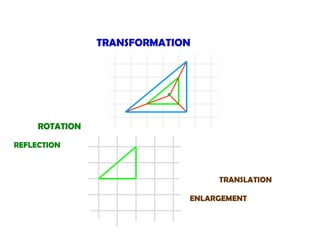
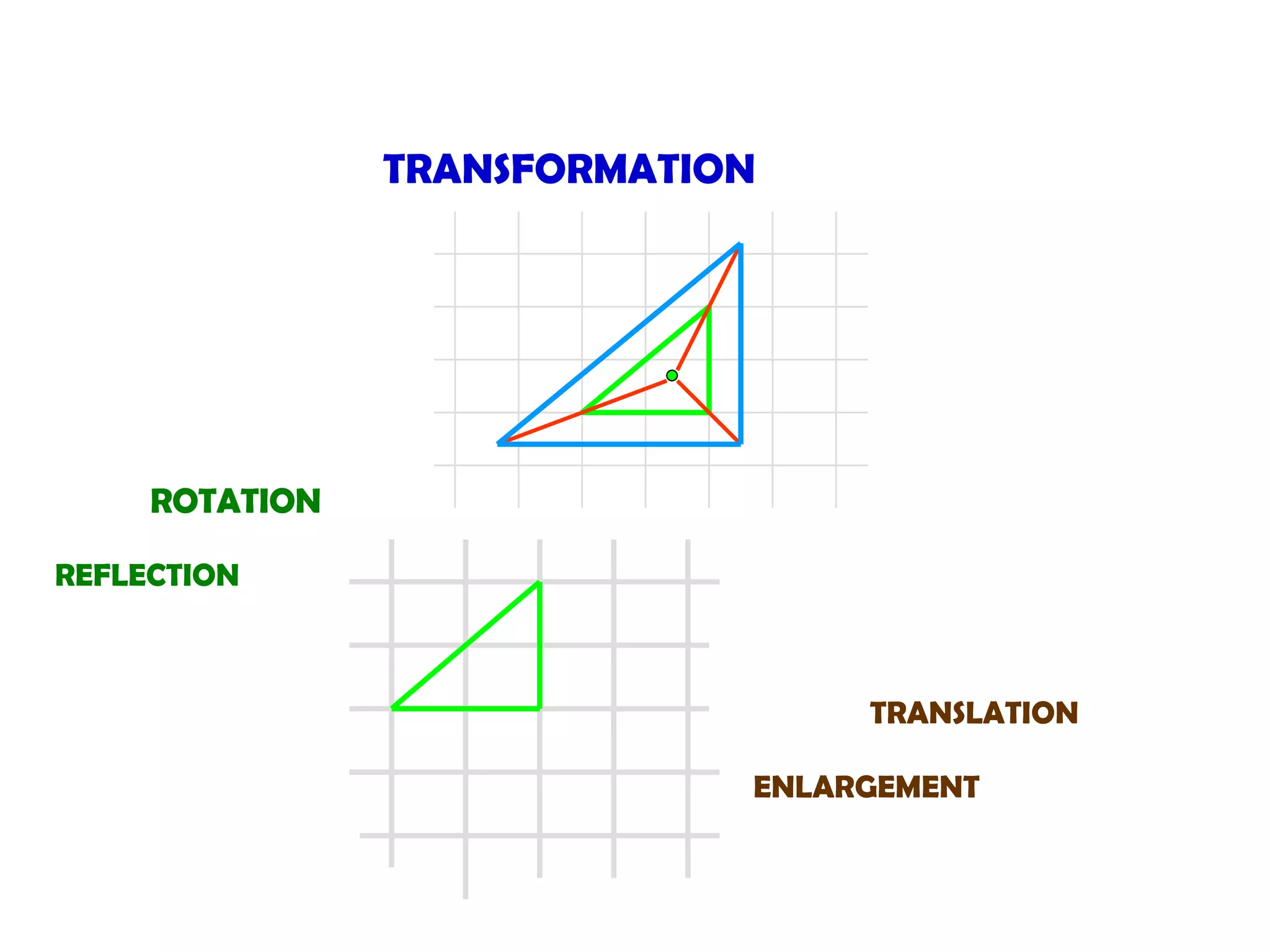
TRANSFORMATION TRANSLATION ENLARGEMENT ROTATION REFLECTION
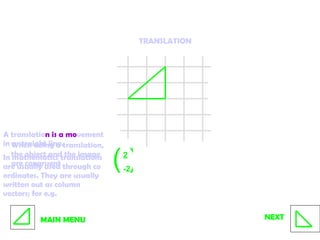
TRANSLATION A translatio n is a mo vement in a straight line.  In mathematics translations are usually used through co ordinates. They are usually written out as column vectors; for e.g.  2 -2 MAIN MENU NEXT ( ) When doing a translation, the object and the image are congruent
+ + - - THINGS TO REMEMBER ALWAYS THE FIRST # IN THE COORDINANTS IS FOR GOING HORIZNTALLY  AND THE SECOND # IS GOING VERTICALLY! PREVIOUS INVERSE MAIN MENU
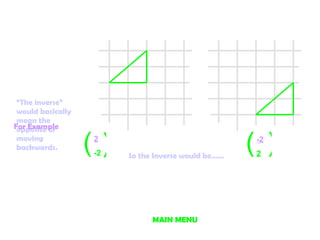
MAIN MENU โ€œ The inverseโ€ would basically mean the opposite or moving backwards.   So the Inverse would beโ€ฆโ€ฆ 2 -2 ( ) ( ) -2 2 For Example
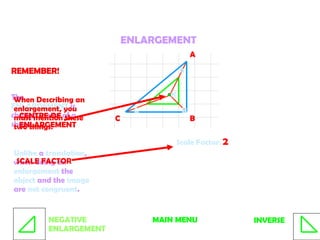
ENLARGEMENT The  ENLARGEMENT  is change in size of a shape.  Unlike  a  translation , when doing an  enlargement  the  object  and the  image  are  not congruent . A B C A B C Scale Factor:  2 K REMEMBER! When Describing an enlargement, you must mention these two things:  SCALE FACTOR CENTRE OF ENLARGEMENT MAIN MENU INVERSE NEGATIVE ENLARGEMENT
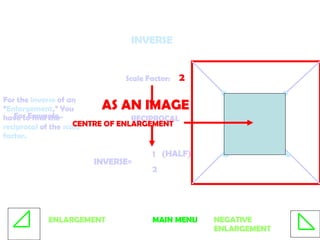
INVERSE For the  inverse  of an โ€œ Enlargement ,โ€ You have to find the  reciprocal  of the  scale factor.   For Example.. Scale Factor: RECIPROCAL 1   (HALF) 2  INVERSE= 2 AS AN IMAGE   CENTRE OF ENLARGEMENT MAIN MENU ENLARGEMENT NEGATIVE ENLARGEMENT
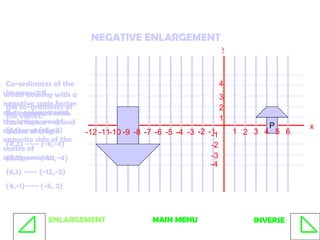
MAIN MENU INVERSE ENLARGEMENT NEGATIVE ENLARGEMENT When dealing with a negative scale factor of an enlargement, the image would appear on the opposite side of the centre of enlargement.  1 2 3 6 1 2 3 4 x y -1 -2 -3 -4 P 4 5 -1 -2 -3 -4 -5 -6 -7 -8 -9 -10 -11 -12 Enlargement with scale factor =-2 and centre of origin  Co-ordinates of the image=-2 X  the co-ordinates of the object. (3,1) ---- (-6,-2) (4,2) ---- (-8,-4) (5,2) ---- (-10,-4) (6,1) ---- (-12,-2) (4,-1)---- (-8, 2)
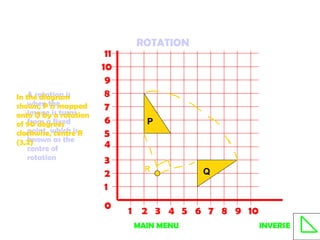
ROTATION A rotation is when the image is turns from a fixed point, which is known as the centre of rotation 0 1 2 3 4 5 6 7 8 9 10 1 2 3 4 5 6 7 8 9 10 11 In the diagram shown, P is mapped onto Q by a rotation of 90 degrees clockwise, centre R (3,2) P Q R MAIN MENU INVERSE
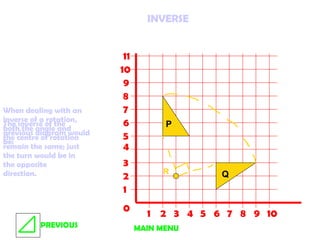
0 1 2 3 4 5 6 7 8 9 10 1 2 3 4 5 6 7 8 9 10 11 P Q R INVERSE When dealing with an inverse of a rotation, both the angle and the centre of rotation remain the same; just the turn would be in the opposite direction. The inverse of the previous diagram would be: MAIN MENU PREVIOUS
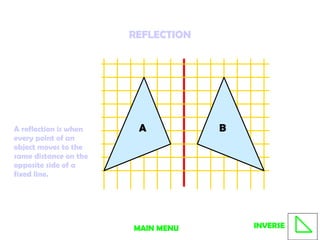
REFLECTION A reflection is when every point of an object moves to the same distance on the opposite side of a fixed line. A B MAIN MENU INVERSE
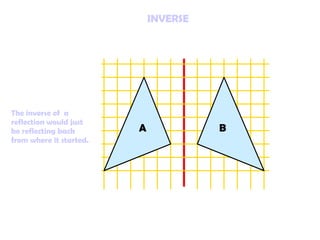
INVERSE The inverse of  a reflection would just be reflecting back from where it started.   A B
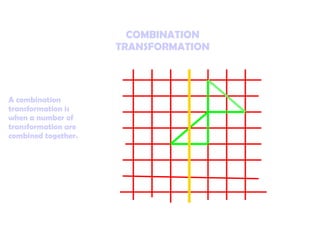
COMBINATION TRANSFORMATION A combination transformation is when a number of transformation are combined together.

All 4

  • 1.
  • 2.
    TRANSLATION A translation is a mo vement in a straight line. In mathematics translations are usually used through co ordinates. They are usually written out as column vectors; for e.g. 2 -2 MAIN MENU NEXT ( ) When doing a translation, the object and the image are congruent
  • 3.
    + + -- THINGS TO REMEMBER ALWAYS THE FIRST # IN THE COORDINANTS IS FOR GOING HORIZNTALLY AND THE SECOND # IS GOING VERTICALLY! PREVIOUS INVERSE MAIN MENU
  • 4.
    MAIN MENU โ€œThe inverseโ€ would basically mean the opposite or moving backwards. So the Inverse would beโ€ฆโ€ฆ 2 -2 ( ) ( ) -2 2 For Example
  • 5.
    ENLARGEMENT The ENLARGEMENT is change in size of a shape. Unlike a translation , when doing an enlargement the object and the image are not congruent . A B C A B C Scale Factor: 2 K REMEMBER! When Describing an enlargement, you must mention these two things: SCALE FACTOR CENTRE OF ENLARGEMENT MAIN MENU INVERSE NEGATIVE ENLARGEMENT
  • 6.
    INVERSE For the inverse of an โ€œ Enlargement ,โ€ You have to find the reciprocal of the scale factor. For Example.. Scale Factor: RECIPROCAL 1 (HALF) 2 INVERSE= 2 AS AN IMAGE CENTRE OF ENLARGEMENT MAIN MENU ENLARGEMENT NEGATIVE ENLARGEMENT
  • 7.
    MAIN MENU INVERSEENLARGEMENT NEGATIVE ENLARGEMENT When dealing with a negative scale factor of an enlargement, the image would appear on the opposite side of the centre of enlargement. 1 2 3 6 1 2 3 4 x y -1 -2 -3 -4 P 4 5 -1 -2 -3 -4 -5 -6 -7 -8 -9 -10 -11 -12 Enlargement with scale factor =-2 and centre of origin Co-ordinates of the image=-2 X the co-ordinates of the object. (3,1) ---- (-6,-2) (4,2) ---- (-8,-4) (5,2) ---- (-10,-4) (6,1) ---- (-12,-2) (4,-1)---- (-8, 2)
  • 8.
    ROTATION A rotationis when the image is turns from a fixed point, which is known as the centre of rotation 0 1 2 3 4 5 6 7 8 9 10 1 2 3 4 5 6 7 8 9 10 11 In the diagram shown, P is mapped onto Q by a rotation of 90 degrees clockwise, centre R (3,2) P Q R MAIN MENU INVERSE
  • 9.
    0 1 23 4 5 6 7 8 9 10 1 2 3 4 5 6 7 8 9 10 11 P Q R INVERSE When dealing with an inverse of a rotation, both the angle and the centre of rotation remain the same; just the turn would be in the opposite direction. The inverse of the previous diagram would be: MAIN MENU PREVIOUS
  • 10.
    REFLECTION A reflectionis when every point of an object moves to the same distance on the opposite side of a fixed line. A B MAIN MENU INVERSE
  • 11.
    INVERSE The inverseof a reflection would just be reflecting back from where it started. A B
  • 12.
    COMBINATION TRANSFORMATION Acombination transformation is when a number of transformation are combined together.