Chapter 1
computer graphics
S.G.R. Education Foundation
G H RAISONI COLLEGE OF ENGINEERING AND MANAGEMENT
AHMEDNAGAR
NAAC ACCREDITED
(APPROVED BY AICTE, NEW DELHI, RECOGNIZED BY GOVT. OF MAHARASHTRA & AFFILIATED TO SAVITRIBAI PHULE PUNE UNIVERSITY)
- Prof. Aniket V. Joshi
Asst. Professor
Mechanical Engineering Department
GHRCEM, A’Nagar.
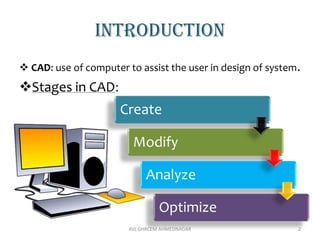
Introduction
 CAD: use of computer to assist the user in design of system.
Stages in CAD:
Create
Modify
Analyze
Optimize
2
AVJ GHRCEM AHMEDNAGAR
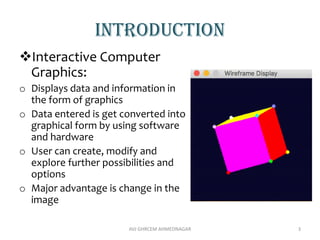
Introduction
Interactive Computer
Graphics:
o Displays data and information in
the form of graphics
o Data entered is get converted into
graphical form by using software
and hardware
o User can create, modify and
explore further possibilities and
options
o Major advantage is change in the
image
3
AVJ GHRCEM AHMEDNAGAR
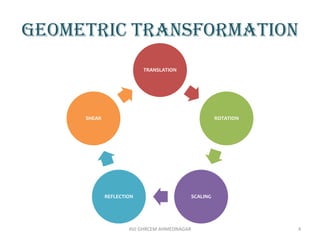
GEOMETRIC TRANSFORMATION
TRANSLATION
ROTATION
SCALING
REFLECTION
SHEAR
AVJ GHRCEM AHMEDNAGAR 4
GEOMETRIC TRANSFORMATION
 Transformations: changes performed on the original
graphic image by changing database.
 Used to alter the orientation, scale, position of the drawing
 Applications of Transformations:
a. Must be creation of model
b. To express location of objects relative to others
c. To view an object from different positions and directions
d. To perform transformations like translate/move, rotate,
scale, mirror, etc..
e. To obtain orthographic and perspective views of model
f. To create animation
AVJ GHRCEM AHMEDNAGAR 5
Formulation
• Point can be represented as P= [x,y]
• Line can be represented as L=
• L’=L [TM] where [TM]= Transformation Matrix
AVJ GHRCEM AHMEDNAGAR 6
translation
o Entity of a geometric model remains parallel to its initial
position
o Every point on geometric model moves by equal distance
T = [tx ty]
AVJ GHRCEM AHMEDNAGAR 7
A’B’C’D’ = ABCD + T
translation
 Translation can be applied to curves such as circles,
parabolas, surfaces and solids. These shapes are treated as
a geometric entity.
 Limitations for translation of circle:
a) Circle would be broken down into finite points and
transformations for each of these points would then have
to be done
b) Resulting entity would lose its identity of being a circle.
AVJ GHRCEM AHMEDNAGAR 8
rotation
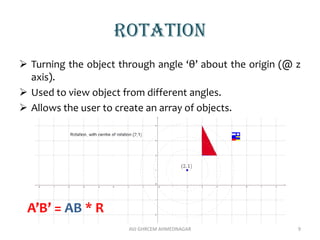
 Turning the object through angle ‘θ’ about the origin (@ z
axis).
 Used to view object from different angles.
 Allows the user to create an array of objects.
AVJ GHRCEM AHMEDNAGAR 9
A’B’ = AB * R
scaling
 Alters the size of an object.
 It can be Uniform (equal in both X and Y directions) or non-
uniform (different in X and Y directions)
P’ = P * S
[x’ y’] = [x y]
AVJ GHRCEM AHMEDNAGAR 10
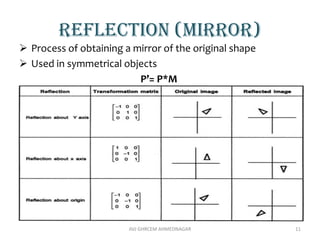
Reflection (mirror)
 Process of obtaining a mirror of the original shape
 Used in symmetrical objects
P’= P*M
AVJ GHRCEM AHMEDNAGAR 11
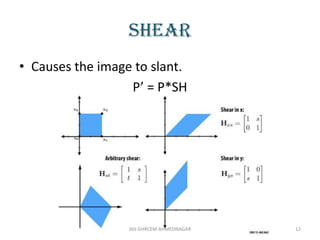
shear
• Causes the image to slant.
P’ = P*SH
AVJ GHRCEM AHMEDNAGAR 12
Homogeneous co-ordinates
 Need:
o For quick and efficient calculations, it is desirable to express
all transformations in the form of multiplications.
o To represent points at infinity and non intersection of
parallel lines.
o To represent multiple operations which include translation.
o To draw perspective views of geometrical models
AVJ GHRCEM AHMEDNAGAR 13
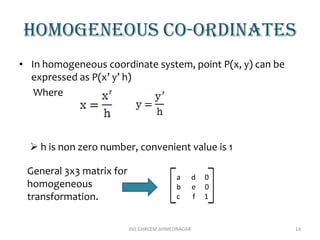
Homogeneous co-ordinates
• In homogeneous coordinate system, point P(x, y) can be
expressed as P(x’ y’ h)
Where
AVJ GHRCEM AHMEDNAGAR 14
 h is non zero number, convenient value is 1
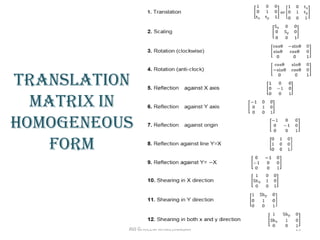
General 3x3 matrix for
homogeneous
transformation.
a d 0
b e 0
c f 1
Translation
matrix in
homogeneous
form
AVJ GHRCEM AHMEDNAGAR 15
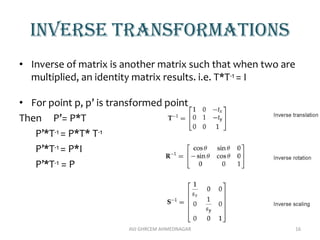
Inverse transformations
• Inverse of matrix is another matrix such that when two are
multiplied, an identity matrix results. i.e. T*T-1 = I
• For point p, p’ is transformed point
Then P’= P*T
P’*T-1 = P*T* T-1
P’*T-1 = P*I
P’*T-1 = P
AVJ GHRCEM AHMEDNAGAR 16
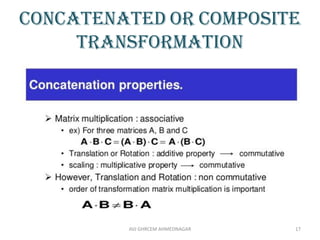
Concatenated or composite
transformation
AVJ GHRCEM AHMEDNAGAR 17
MAPPING OF GEOMETRIC
MODELS
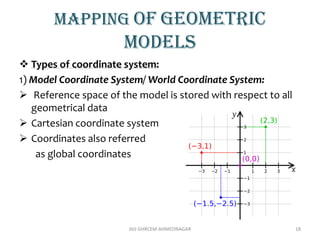
 Types of coordinate system:
1) Model Coordinate System/ World Coordinate System:
 Reference space of the model is stored with respect to all
geometrical data
 Cartesian coordinate system
 Coordinates also referred
as global coordinates
AVJ GHRCEM AHMEDNAGAR 18
MAPPING OF GEOMETRIC MODELS
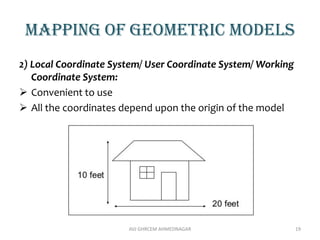
2) Local Coordinate System/ User Coordinate System/ Working
Coordinate System:
 Convenient to use
 All the coordinates depend upon the origin of the model
AVJ GHRCEM AHMEDNAGAR 19
Three dimensional
transformations
 The transformation takes place on a 3D plane
 Generalize from 2D by including z coordinate
 Straight forward for translation and scale, rotation
 more difficult
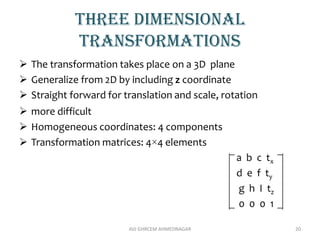
 Homogeneous coordinates: 4 components
 Transformation matrices: 4×4 elements
a b c tx
d e f ty
g h I tz
0 0 0 1
AVJ GHRCEM AHMEDNAGAR 20
Projections of geometric
models
 3D objects need to be displayed in 2D form
 Types of projections are:
1) Parallel projection
2) Perspective projection
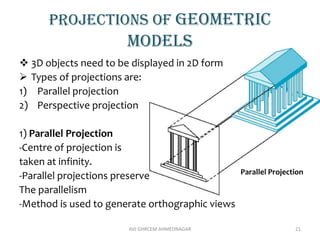
1) Parallel Projection
-Centre of projection is
taken at infinity.
-Parallel projections preserve
The parallelism
-Method is used to generate orthographic views
AVJ GHRCEM AHMEDNAGAR 21
Parallel Projection
Projections of geometric
models
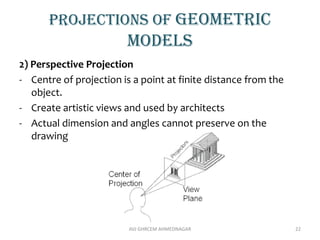
2) Perspective Projection
- Centre of projection is a point at finite distance from the
object.
- Create artistic views and used by architects
- Actual dimension and angles cannot preserve on the
drawing
AVJ GHRCEM AHMEDNAGAR 22
23
AVJ GHRCEM AHMEDNAGAR

CAD/CAM & Automation Unit I computer graphics

  • 1.
    Chapter 1 computer graphics S.G.R.Education Foundation G H RAISONI COLLEGE OF ENGINEERING AND MANAGEMENT AHMEDNAGAR NAAC ACCREDITED (APPROVED BY AICTE, NEW DELHI, RECOGNIZED BY GOVT. OF MAHARASHTRA & AFFILIATED TO SAVITRIBAI PHULE PUNE UNIVERSITY) - Prof. Aniket V. Joshi Asst. Professor Mechanical Engineering Department GHRCEM, A’Nagar.
  • 2.
    Introduction  CAD: useof computer to assist the user in design of system. Stages in CAD: Create Modify Analyze Optimize 2 AVJ GHRCEM AHMEDNAGAR
  • 3.
    Introduction Interactive Computer Graphics: o Displaysdata and information in the form of graphics o Data entered is get converted into graphical form by using software and hardware o User can create, modify and explore further possibilities and options o Major advantage is change in the image 3 AVJ GHRCEM AHMEDNAGAR
  • 4.
  • 5.
    GEOMETRIC TRANSFORMATION  Transformations:changes performed on the original graphic image by changing database.  Used to alter the orientation, scale, position of the drawing  Applications of Transformations: a. Must be creation of model b. To express location of objects relative to others c. To view an object from different positions and directions d. To perform transformations like translate/move, rotate, scale, mirror, etc.. e. To obtain orthographic and perspective views of model f. To create animation AVJ GHRCEM AHMEDNAGAR 5
  • 6.
    Formulation • Point canbe represented as P= [x,y] • Line can be represented as L= • L’=L [TM] where [TM]= Transformation Matrix AVJ GHRCEM AHMEDNAGAR 6
  • 7.
    translation o Entity ofa geometric model remains parallel to its initial position o Every point on geometric model moves by equal distance T = [tx ty] AVJ GHRCEM AHMEDNAGAR 7 A’B’C’D’ = ABCD + T
  • 8.
    translation  Translation canbe applied to curves such as circles, parabolas, surfaces and solids. These shapes are treated as a geometric entity.  Limitations for translation of circle: a) Circle would be broken down into finite points and transformations for each of these points would then have to be done b) Resulting entity would lose its identity of being a circle. AVJ GHRCEM AHMEDNAGAR 8
  • 9.
    rotation  Turning theobject through angle ‘θ’ about the origin (@ z axis).  Used to view object from different angles.  Allows the user to create an array of objects. AVJ GHRCEM AHMEDNAGAR 9 A’B’ = AB * R
  • 10.
    scaling  Alters thesize of an object.  It can be Uniform (equal in both X and Y directions) or non- uniform (different in X and Y directions) P’ = P * S [x’ y’] = [x y] AVJ GHRCEM AHMEDNAGAR 10
  • 11.
    Reflection (mirror)  Processof obtaining a mirror of the original shape  Used in symmetrical objects P’= P*M AVJ GHRCEM AHMEDNAGAR 11
  • 12.
    shear • Causes theimage to slant. P’ = P*SH AVJ GHRCEM AHMEDNAGAR 12
  • 13.
    Homogeneous co-ordinates  Need: oFor quick and efficient calculations, it is desirable to express all transformations in the form of multiplications. o To represent points at infinity and non intersection of parallel lines. o To represent multiple operations which include translation. o To draw perspective views of geometrical models AVJ GHRCEM AHMEDNAGAR 13
  • 14.
    Homogeneous co-ordinates • Inhomogeneous coordinate system, point P(x, y) can be expressed as P(x’ y’ h) Where AVJ GHRCEM AHMEDNAGAR 14  h is non zero number, convenient value is 1 General 3x3 matrix for homogeneous transformation. a d 0 b e 0 c f 1
  • 15.
  • 16.
    Inverse transformations • Inverseof matrix is another matrix such that when two are multiplied, an identity matrix results. i.e. T*T-1 = I • For point p, p’ is transformed point Then P’= P*T P’*T-1 = P*T* T-1 P’*T-1 = P*I P’*T-1 = P AVJ GHRCEM AHMEDNAGAR 16
  • 17.
  • 18.
    MAPPING OF GEOMETRIC MODELS Types of coordinate system: 1) Model Coordinate System/ World Coordinate System:  Reference space of the model is stored with respect to all geometrical data  Cartesian coordinate system  Coordinates also referred as global coordinates AVJ GHRCEM AHMEDNAGAR 18
  • 19.
    MAPPING OF GEOMETRICMODELS 2) Local Coordinate System/ User Coordinate System/ Working Coordinate System:  Convenient to use  All the coordinates depend upon the origin of the model AVJ GHRCEM AHMEDNAGAR 19
  • 20.
    Three dimensional transformations  Thetransformation takes place on a 3D plane  Generalize from 2D by including z coordinate  Straight forward for translation and scale, rotation  more difficult  Homogeneous coordinates: 4 components  Transformation matrices: 4×4 elements a b c tx d e f ty g h I tz 0 0 0 1 AVJ GHRCEM AHMEDNAGAR 20
  • 21.
    Projections of geometric models 3D objects need to be displayed in 2D form  Types of projections are: 1) Parallel projection 2) Perspective projection 1) Parallel Projection -Centre of projection is taken at infinity. -Parallel projections preserve The parallelism -Method is used to generate orthographic views AVJ GHRCEM AHMEDNAGAR 21 Parallel Projection
  • 22.
    Projections of geometric models 2)Perspective Projection - Centre of projection is a point at finite distance from the object. - Create artistic views and used by architects - Actual dimension and angles cannot preserve on the drawing AVJ GHRCEM AHMEDNAGAR 22
  • 23.