CHAPTER 5
The Straight Line
Learning Objectives
5.1 Understand the concept of gradient of a
straight line.
5.2 Understand the concept of gradient of a
straight line in Cartesian coordinates.
5.3 Understand the concept of intercept.
5.4 Understand and use equation of a straight
line.
5.5 Understand and use the concept of parallel
lines.
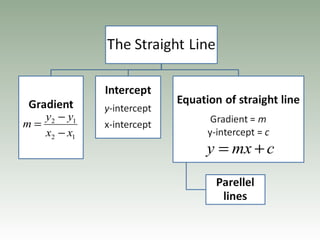
12
12
xx
yy
m
−
−
=
cmxy +=
5.1 graDient OF a
straigHt Line
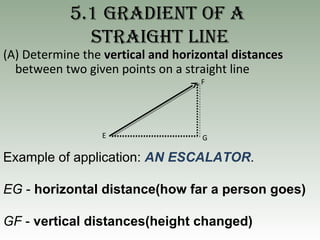
(A) Determine the vertical and horizontal distancesvertical and horizontal distances
between two given points on a straight line
E
F
G
Example of application: AN ESCALATOR.
EG - horizontal distance(how far a person goes)
GF - vertical distances(height changed)
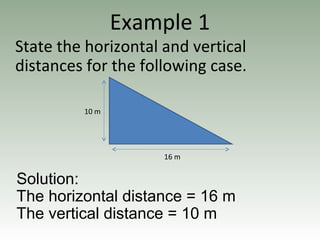
Example 1
State the horizontal and vertical
distances for the following case.
10 m
16 m
Solution:
The horizontal distance = 16 m
The vertical distance = 10 m
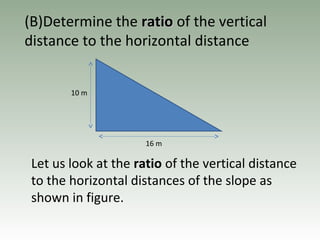
(B)Determine the ratioratio of the vertical
distance to the horizontal distance
Let us look at the ratio of the vertical distance
to the horizontal distances of the slope as
shown in figure.
10 m
16 m
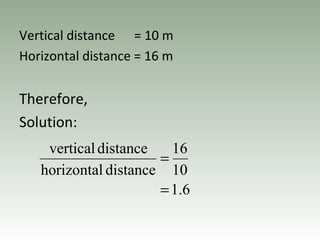
Vertical distance = 10 m
Horizontal distance = 16 m
Therefore,
Solution:
6.1
10
16
distancehorizontal
distancevertical
=
=
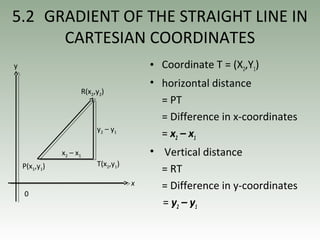
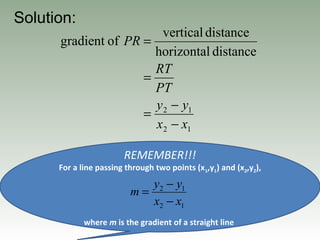
5.2 GRADIENT OF THE STRAIGHT LINE IN
CARTESIAN COORDINATES
• Coordinate T = (X2,Y1)
• horizontal distance
= PT
= Difference in x-coordinates
= x2 – x1
• Vertical distance
= RT
= Difference in y-coordinates
= y2 – y1
y
x
0
P(x1,y1)
R(x2,y2)
T(x2,y1)
y2 – y1
x2 – x1
REMEMBER!!!
For a line passing through two points (x1,y1) and (x2,y2),
where m is the gradient of a straight line
12
12
distancehorizontal
distancevertical
ofgradient
xx
yy
PT
RT
PR
−
−
=
=
=
Solution:
12
12
xx
yy
m
−
−
=
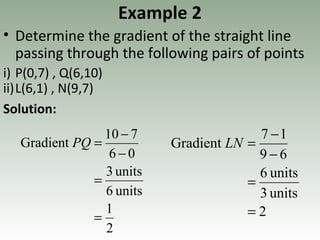
Example 2
• Determine the gradient of the straight line
passing through the following pairs of points
i) P(0,7) , Q(6,10)
ii)L(6,1) , N(9,7)
Solution:
2
1
units6
units3
06
710
Gradient
=
=
−
−
=PQ
2
units3
units6
69
17
Gradient
=
=
−
−
=LN
(C) Determine the relationship between
the value of the gradient and the
(i)Steepness
(ii)Direction of inclination of a straight line
• What does gradient represents??
Steepness of a line with respect to the x-
axis.
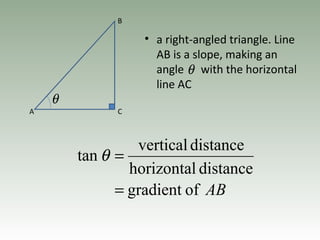
• a right-angled triangle. Line
AB is a slope, making an
angle with the horizontal
line AC
B
CA
θ
θ
ABofgradient
distancehorizontal
distancevertical
tan
=
=θ
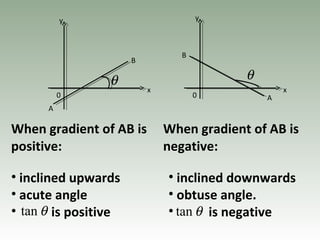
When gradient of AB is
positive:
When gradient of AB is
negative:
• inclined upwards
• acute angle
• is positive
• inclined downwards
• obtuse angle.
• is negative
y
x
y
x
0 0
B
A
B
A
θ θ
θtan θtan
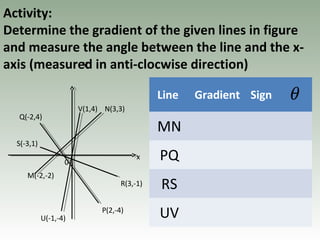
Activity:
Determine the gradient of the given lines in figure
and measure the angle between the line and the x-
axis (measured in anti-clocwise direction)
Line Gradient Sign
MN
PQ
RS
UV
y
x
N(3,3)V(1,4)
R(3,-1)
P(2,-4)
U(-1,-4)
M(-2,-2)
0
S(-3,1)
Q(-2,4)
θ
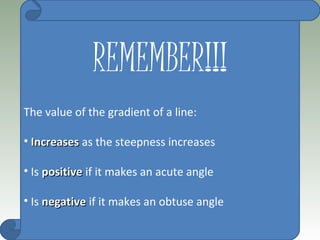
REMEMBER!!!
The value of the gradient of a line:
• IncreasesIncreases as the steepness increases
• Is positivepositive if it makes an acute angle
• Is negativenegative if it makes an obtuse angle
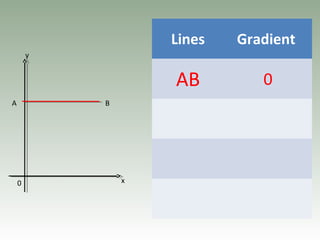
0
y
x
A B
Lines Gradient
AB 0
0
y
x
D
C
Lines Gradient
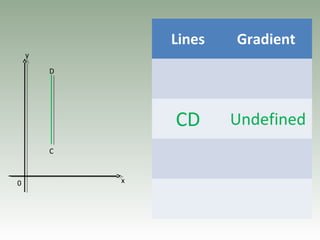
CD Undefined
0
y
x
F
E
Lines Gradient
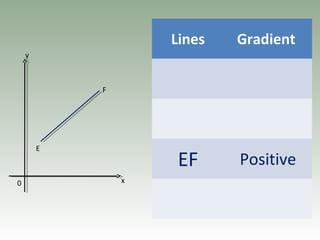
EF Positive
0
y
x
H
G
Lines Gradient
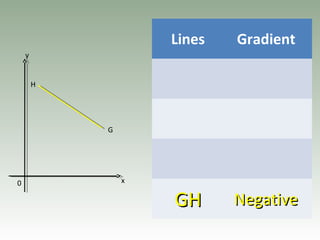
GHGH NegativeNegative
0
y
x
A
D
H
F
B
G
CE
Lines Gradient
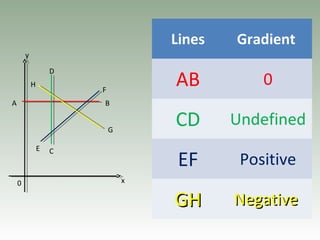
AB 0
CD Undefined
EF Positive
GHGH NegativeNegative
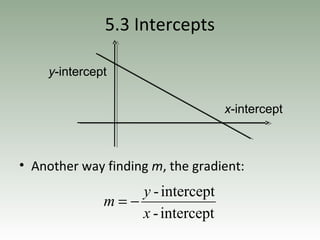
5.3 Intercepts
• Another way finding m, the gradient:
x-intercept
y-intercept
intercept-
intercept-
x
y
m −=
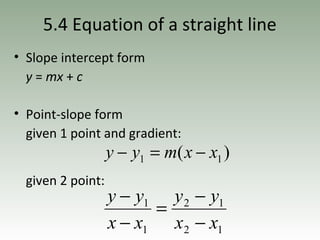
5.4 Equation of a straight line
• Slope intercept form
y = mx + c
• Point-slope form
given 1 point and gradient:
given 2 point:
)( 11 xxmyy −=−
12
12
1
1
xx
yy
xx
yy
−
−
=
−
−
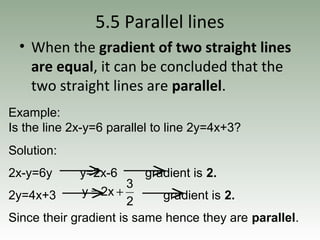
5.5 Parallel lines
• When the gradient of two straight lines
are equal, it can be concluded that the
two straight lines are parallel.
Solution:
2x-y=6y y=2x-6 gradient is 2.
2y=4x+3 gradient is 2.
Since their gradient is same hence they are parallel.
→ →
2
3
2xy +=→ →
Example:
Is the line 2x-y=6 parallel to line 2y=4x+3?

pembinaan geometri

  • 1.
  • 2.
    Learning Objectives 5.1 Understandthe concept of gradient of a straight line. 5.2 Understand the concept of gradient of a straight line in Cartesian coordinates. 5.3 Understand the concept of intercept. 5.4 Understand and use equation of a straight line. 5.5 Understand and use the concept of parallel lines.
  • 3.
  • 4.
    5.1 graDient OFa straigHt Line (A) Determine the vertical and horizontal distancesvertical and horizontal distances between two given points on a straight line E F G Example of application: AN ESCALATOR. EG - horizontal distance(how far a person goes) GF - vertical distances(height changed)
  • 5.
    Example 1 State thehorizontal and vertical distances for the following case. 10 m 16 m Solution: The horizontal distance = 16 m The vertical distance = 10 m
  • 6.
    (B)Determine the ratioratioof the vertical distance to the horizontal distance Let us look at the ratio of the vertical distance to the horizontal distances of the slope as shown in figure. 10 m 16 m
  • 7.
    Vertical distance =10 m Horizontal distance = 16 m Therefore, Solution: 6.1 10 16 distancehorizontal distancevertical = =
  • 8.
    5.2 GRADIENT OFTHE STRAIGHT LINE IN CARTESIAN COORDINATES • Coordinate T = (X2,Y1) • horizontal distance = PT = Difference in x-coordinates = x2 – x1 • Vertical distance = RT = Difference in y-coordinates = y2 – y1 y x 0 P(x1,y1) R(x2,y2) T(x2,y1) y2 – y1 x2 – x1
  • 9.
    REMEMBER!!! For a linepassing through two points (x1,y1) and (x2,y2), where m is the gradient of a straight line 12 12 distancehorizontal distancevertical ofgradient xx yy PT RT PR − − = = = Solution: 12 12 xx yy m − − =
  • 10.
    Example 2 • Determinethe gradient of the straight line passing through the following pairs of points i) P(0,7) , Q(6,10) ii)L(6,1) , N(9,7) Solution: 2 1 units6 units3 06 710 Gradient = = − − =PQ 2 units3 units6 69 17 Gradient = = − − =LN
  • 11.
    (C) Determine therelationship between the value of the gradient and the (i)Steepness (ii)Direction of inclination of a straight line • What does gradient represents?? Steepness of a line with respect to the x- axis.
  • 12.
    • a right-angledtriangle. Line AB is a slope, making an angle with the horizontal line AC B CA θ θ ABofgradient distancehorizontal distancevertical tan = =θ
  • 13.
    When gradient ofAB is positive: When gradient of AB is negative: • inclined upwards • acute angle • is positive • inclined downwards • obtuse angle. • is negative y x y x 0 0 B A B A θ θ θtan θtan
  • 14.
    Activity: Determine the gradientof the given lines in figure and measure the angle between the line and the x- axis (measured in anti-clocwise direction) Line Gradient Sign MN PQ RS UV y x N(3,3)V(1,4) R(3,-1) P(2,-4) U(-1,-4) M(-2,-2) 0 S(-3,1) Q(-2,4) θ
  • 15.
    REMEMBER!!! The value ofthe gradient of a line: • IncreasesIncreases as the steepness increases • Is positivepositive if it makes an acute angle • Is negativenegative if it makes an obtuse angle
  • 16.
  • 17.
  • 18.
  • 19.
  • 20.
    0 y x A D H F B G CE Lines Gradient AB 0 CDUndefined EF Positive GHGH NegativeNegative
  • 21.
    5.3 Intercepts • Anotherway finding m, the gradient: x-intercept y-intercept intercept- intercept- x y m −=
  • 22.
    5.4 Equation ofa straight line • Slope intercept form y = mx + c • Point-slope form given 1 point and gradient: given 2 point: )( 11 xxmyy −=− 12 12 1 1 xx yy xx yy − − = − −
  • 23.
    5.5 Parallel lines •When the gradient of two straight lines are equal, it can be concluded that the two straight lines are parallel. Solution: 2x-y=6y y=2x-6 gradient is 2. 2y=4x+3 gradient is 2. Since their gradient is same hence they are parallel. → → 2 3 2xy +=→ → Example: Is the line 2x-y=6 parallel to line 2y=4x+3?