



• TARGET AUDIENCE : GRADES 7-9
• DURATION: 1 HOUR
Transformation geometry is the geometry of moving
points and shapes.
• The type of transformation dealt with in this
module is:
• Translations of p units horizontally and q
units vertically.
• A translation is a horizontal or vertical slide.
• The object translated does not change its
shape or size, that is the object and the
image are congruent.
TRANSLATION OF POINTS
• Let us first revise the
plotting of points on the
cartesian plane.
• Plot the following points on
the grid provided.
• A(2;4), B(-3;6),C(-5;-6),
• D(6;-4)
• Now translate each point 2
units to the right and 1 unit
downward.
EXAMPLE ONE
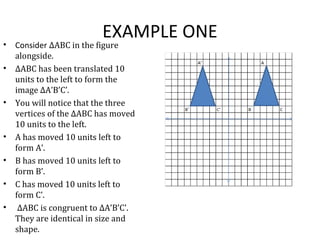
• Consider ∆ABC in the figure
alongside.
• ∆ABC has been translated 10
units to the left to form the
image ∆A’B’C’.
• You will notice that the three
vertices of the ∆ABC has moved
10 units to the left.
• A has moved 10 units left to
form A’.
• B has moved 10 units left to
form B’.
• C has moved 10 units left to
form C’.
• ∆ABC is congruent to ∆A’B’C’.
They are identical in size and
shape.
EXAMPLE TWO
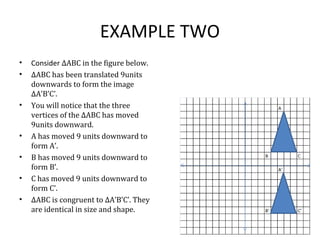
• Consider ∆ABC in the figure below.
• ∆ABC has been translated 9units
downwards to form the image
∆A’B’C’.
• You will notice that the three
vertices of the ∆ABC has moved
9units downward.
• A has moved 9 units downward to
form A’.
• B has moved 9 units downward to
form B’.
• C has moved 9 units downward to
form C’.
• ∆ABC is congruent to ∆A’B’C’. They
are identical in size and shape.
EXAMPLE THREE
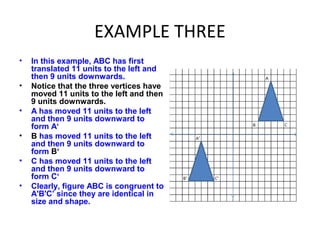
• In this example, ABC has first
translated 11 units to the left and
then 9 units downwards.
• Notice that the three vertices have
moved 11 units to the left and then
9 units downwards.
• A has moved 11 units to the left
and then 9 units downward to
form A‘
• B has moved 11 units to the left
and then 9 units downward to
form B‘
• C has moved 11 units to the left
and then 9 units downward to
form C‘
• Clearly, figure ABC is congruent to
A'B'C’ since they are identical in
size and shape.
EXAMPLE FOUR
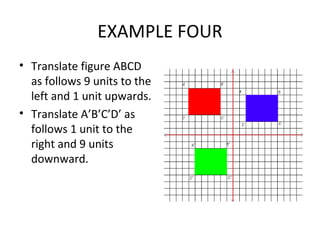
• Translate figure ABCD
as follows 9 units to the
left and 1 unit upwards.
• Translate A’B’C’D’ as
follows 1 unit to the
right and 9 units
downward.
In each of the following
diagrams, a point has been
translated by a horizontal
move followed by a vertical
move to form its image.
Describe the translation and then represent the translation
in mathematical notation (algebraically).
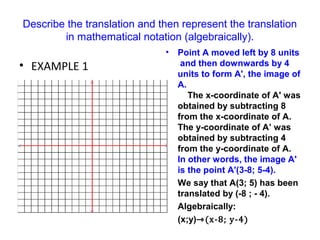
• EXAMPLE 1
• Point A moved left by 8 units
and then downwards by 4
units to form A', the image of
A.
The x-coordinate of A' was
obtained by subtracting 8
from the x-coordinate of A.
The y-coordinate of A’ was
obtained by subtracting 4
from the y-coordinate of A.
In other words, the image A'
is the point A'(3-8; 5-4).
We say that A(3; 5) has been
translated by (-8 ; - 4).
Algebraically:
(x;y)⇾(x-8; y-4)
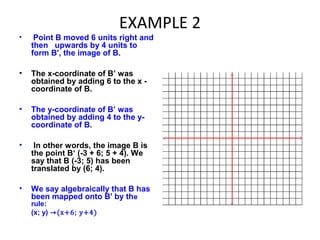
EXAMPLE 2
• Point B moved 6 units right and
then upwards by 4 units to
form B', the image of B.
• The x-coordinate of B’ was
obtained by adding 6 to the x -
coordinate of B.
• The y-coordinate of B’ was
obtained by adding 4 to the y-
coordinate of B.
• In other words, the image B is
the point B‘ (-3 + 6; 5 + 4). We
say that B (-3; 5) has been
translated by (6; 4).
• We say algebraically that B has
been mapped onto B' by the
rule:
(x; y) ⇾(x+6; y+4)
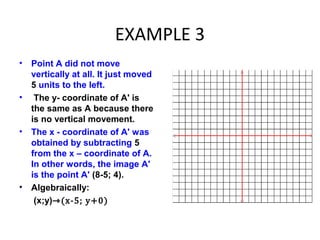
EXAMPLE 3
• Point A did not move
vertically at all. It just moved
5 units to the left.
• The y- coordinate of A' is
the same as A because there
is no vertical movement.
• The x - coordinate of A' was
obtained by subtracting 5
from the x – coordinate of A.
In other words, the image A'
is the point A' (8-5; 4).
• Algebraically:
(x;y)⇾(x-5; y+0)
To summarize:
• We translate the point (x; y) to the point
(x + p; y + q) by a translation of (p ; q)
• Where p is a horizontal move and q is a vertical move.
• If p > 0, the horizontal translation is to the right.
• If p < 0, the horizontal translation is to the left.
• If q > 0, the vertical translation is upward.
• If q < 0, the vertical translation is downward.
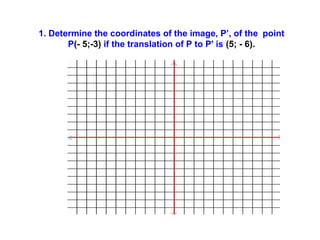
1. Determine the coordinates of the image, P’, of the point
P(- 5;-3) if the translation of P to P' is (5; - 6).
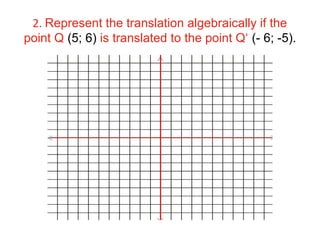
2. Represent the translation algebraically if the
point Q (5; 6) is translated to the point Q‘ (- 6; -5).
TRANSLATION OF A FIGURE
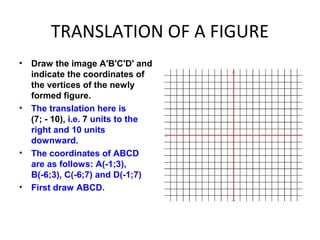
• Draw the image A'B'C'D' and
indicate the coordinates of
the vertices of the newly
formed figure.
• The translation here is
(7; - 10), i.e. 7 units to the
right and 10 units
downward.
• The coordinates of ABCD
are as follows: A(-1;3),
B(-6;3), C(-6;7) and D(-1;7)
• First draw ABCD.
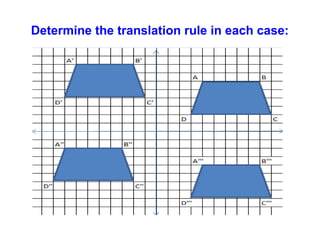
Determine the translation rule in each case:
Transformation Geometry

Transformation Geometry

  • 1.
    • TARGET AUDIENCE: GRADES 7-9 • DURATION: 1 HOUR
  • 3.
    Transformation geometry isthe geometry of moving points and shapes. • The type of transformation dealt with in this module is: • Translations of p units horizontally and q units vertically. • A translation is a horizontal or vertical slide. • The object translated does not change its shape or size, that is the object and the image are congruent.
  • 4.
    TRANSLATION OF POINTS •Let us first revise the plotting of points on the cartesian plane. • Plot the following points on the grid provided. • A(2;4), B(-3;6),C(-5;-6), • D(6;-4) • Now translate each point 2 units to the right and 1 unit downward.
  • 5.
    EXAMPLE ONE • Consider∆ABC in the figure alongside. • ∆ABC has been translated 10 units to the left to form the image ∆A’B’C’. • You will notice that the three vertices of the ∆ABC has moved 10 units to the left. • A has moved 10 units left to form A’. • B has moved 10 units left to form B’. • C has moved 10 units left to form C’. • ∆ABC is congruent to ∆A’B’C’. They are identical in size and shape.
  • 6.
    EXAMPLE TWO • Consider∆ABC in the figure below. • ∆ABC has been translated 9units downwards to form the image ∆A’B’C’. • You will notice that the three vertices of the ∆ABC has moved 9units downward. • A has moved 9 units downward to form A’. • B has moved 9 units downward to form B’. • C has moved 9 units downward to form C’. • ∆ABC is congruent to ∆A’B’C’. They are identical in size and shape.
  • 7.
    EXAMPLE THREE • Inthis example, ABC has first translated 11 units to the left and then 9 units downwards. • Notice that the three vertices have moved 11 units to the left and then 9 units downwards. • A has moved 11 units to the left and then 9 units downward to form A‘ • B has moved 11 units to the left and then 9 units downward to form B‘ • C has moved 11 units to the left and then 9 units downward to form C‘ • Clearly, figure ABC is congruent to A'B'C’ since they are identical in size and shape.
  • 8.
    EXAMPLE FOUR • Translatefigure ABCD as follows 9 units to the left and 1 unit upwards. • Translate A’B’C’D’ as follows 1 unit to the right and 9 units downward.
  • 9.
    In each ofthe following diagrams, a point has been translated by a horizontal move followed by a vertical move to form its image.
  • 10.
    Describe the translationand then represent the translation in mathematical notation (algebraically). • EXAMPLE 1 • Point A moved left by 8 units and then downwards by 4 units to form A', the image of A. The x-coordinate of A' was obtained by subtracting 8 from the x-coordinate of A. The y-coordinate of A’ was obtained by subtracting 4 from the y-coordinate of A. In other words, the image A' is the point A'(3-8; 5-4). We say that A(3; 5) has been translated by (-8 ; - 4). Algebraically: (x;y)⇾(x-8; y-4)
  • 11.
    EXAMPLE 2 • PointB moved 6 units right and then upwards by 4 units to form B', the image of B. • The x-coordinate of B’ was obtained by adding 6 to the x - coordinate of B. • The y-coordinate of B’ was obtained by adding 4 to the y- coordinate of B. • In other words, the image B is the point B‘ (-3 + 6; 5 + 4). We say that B (-3; 5) has been translated by (6; 4). • We say algebraically that B has been mapped onto B' by the rule: (x; y) ⇾(x+6; y+4)
  • 12.
    EXAMPLE 3 • PointA did not move vertically at all. It just moved 5 units to the left. • The y- coordinate of A' is the same as A because there is no vertical movement. • The x - coordinate of A' was obtained by subtracting 5 from the x – coordinate of A. In other words, the image A' is the point A' (8-5; 4). • Algebraically: (x;y)⇾(x-5; y+0)
  • 13.
    To summarize: • Wetranslate the point (x; y) to the point (x + p; y + q) by a translation of (p ; q) • Where p is a horizontal move and q is a vertical move. • If p > 0, the horizontal translation is to the right. • If p < 0, the horizontal translation is to the left. • If q > 0, the vertical translation is upward. • If q < 0, the vertical translation is downward.
  • 15.
    1. Determine thecoordinates of the image, P’, of the point P(- 5;-3) if the translation of P to P' is (5; - 6).
  • 16.
    2. Represent thetranslation algebraically if the point Q (5; 6) is translated to the point Q‘ (- 6; -5).
  • 17.
    TRANSLATION OF AFIGURE • Draw the image A'B'C'D' and indicate the coordinates of the vertices of the newly formed figure. • The translation here is (7; - 10), i.e. 7 units to the right and 10 units downward. • The coordinates of ABCD are as follows: A(-1;3), B(-6;3), C(-6;7) and D(-1;7) • First draw ABCD.
  • 18.
    Determine the translationrule in each case: