Page 1 of 13
prdm
Definition
Transformation is a Geometrical operation that maps /shifts/moves a set of point(s)/
coordinates (objects) from one position to another position (image) following certain
specified set of rule(s).
TYPES OF TRANSFORMATIONS
Basically there are six types of Transformations namely:
1. Translation (T)
2. Reflection (M) Congruencies/ Isometries
3. Rotation (R)
4. Enlargement (E) Similarity
5. Shear (H)
6. Stretch (S) Affines
1. Translation (T)
In a Translation,
 The object and the image have exactly the same size and shape. (Congruent).
 The object and the image face the same direction.
 A Translation is fully described by a column vector / translation vector. x
y
It is important to be aware of the positive and negative vector components of the
translation.
Objectives:
 Identify and name a translation.
 Calculate the column Vector
 Describing the translation fully.
 Calculate coordinates and draw the image or the object on
the Cartesian plane.
TRANSFORMATIONS
Page 2 of 13
prdm
ACTIVITY 1
(a) Triangle A has coordinates (1, 1), (4, 1) and (1, 2) and Triangle B has Vertices
(3, 4), (6, 4) and (3, 5). Draw and label the Triangles A and B clearly.
(b) Name the transformation that maps ∆ A onto ∆ B
(c) ∆ A is mapped onto ∆ C whose vertices are (-3, -4), (0, -4) and (-3, -3) by a
translation. Write down its column vector.
(d) ∆ A is mapped onto ∆ D by a translation whose column vector is - 5
2
Calculate the coordinates of ∆ D, hence draw and label ∆ D clearly.
(e) Describe fully the single transformation that maps ∆ D onto ∆ B
Solutions:
(a)
(b)
(c)
(d)
(e)
Page 3 of 13
prdm
2. Reflection (M)
In a Reflection,
 The object and the image have exactly the same size and shape.(Congruent).
 The object and the image face the exact opposite direction.
 A refection is fully described by the equation of the mirror line ( Usually drawn as
a dotted line)
 The mirror line is the perpendicular bisector of the two corresponding points
(from the Object and the Image)
Objectives: - Identify and name a reflection.
- Calculate the equation and draw the mirror line.
- Describe the reflection fully.
- Calculate coordinates and draw the image or the object on the
Cartesian plane.
Introduction of matrices for reflection in the x-axis and the y-axis.
ACTIVITY 2
(a) Name the transformation that maps ∆ABC onto triangle ∆ A1B1C1.
(b) ∆ ABC is reflected onto ∆A2B2C2 by a reflection in the y-axis. Draw and label
∆A2B2C2.
(c) ∆A2B2C2 is reflected onto ∆A3B3C3 in the line M. Draw, label and write down the
equation of line M.
(d) ∆ABC is reflected onto ∆A4B4C4 in the line y = x. Draw and label ∆A4B4C4
(e) Name the transformation that maps ∆ABC onto ∆A3B3C3.
(f) Name the transformation that maps ∆A4B4C4 onto ∆A2B2C2.
NOTE
The matrix 1 0 represents a reflection mirror line x-axis
0 -1
The matrix – 1 0 represents a reflection mirror line y-axis
0 1
Page 4 of 13
prdm
(a)
(b)
(c)
(d)
(e)
(f)
Page 5 of 13
prdm
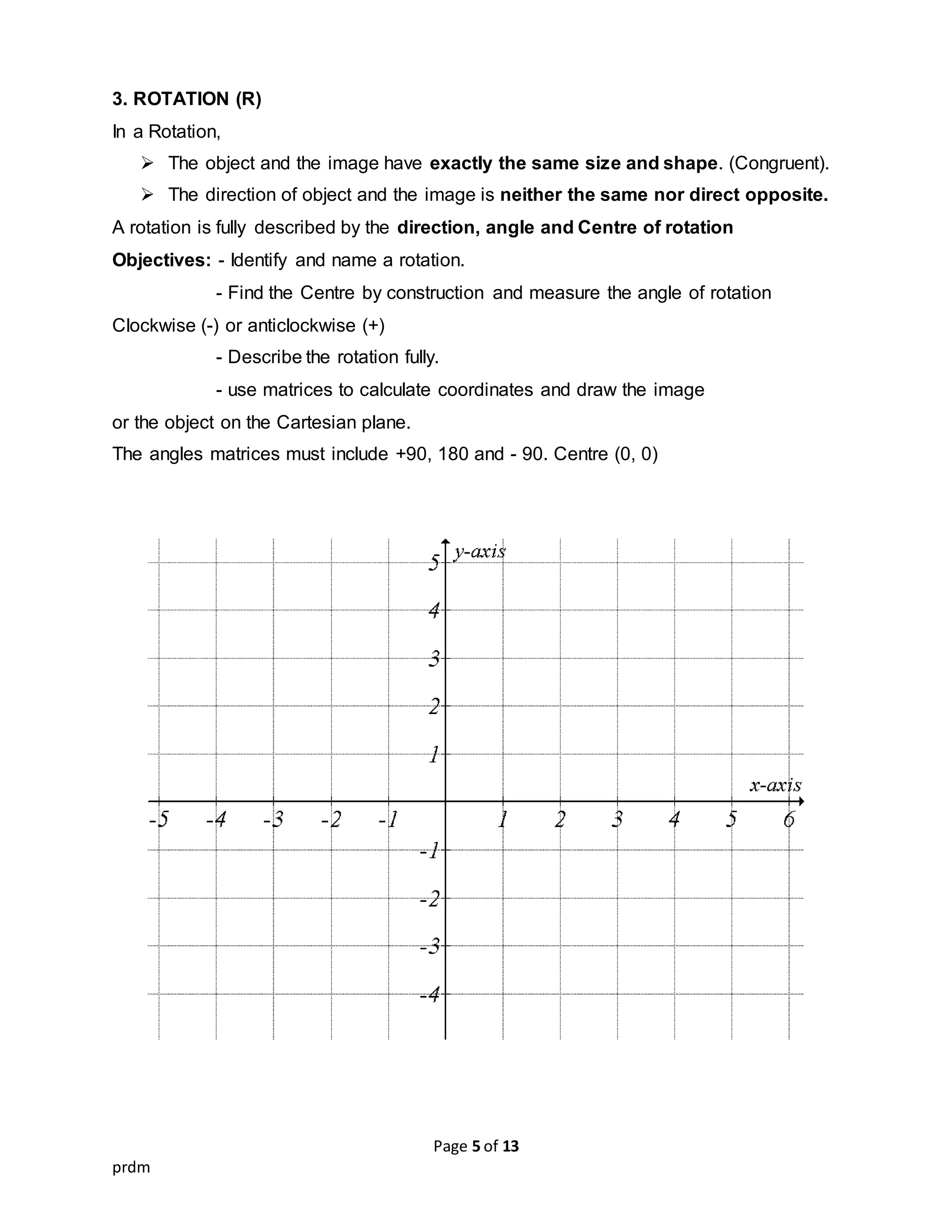
3. ROTATION (R)
In a Rotation,
 The object and the image have exactly the same size and shape. (Congruent).
 The direction of object and the image is neither the same nor direct opposite.
A rotation is fully described by the direction, angle and Centre of rotation
Objectives: - Identify and name a rotation.
- Find the Centre by construction and measure the angle of rotation
Clockwise (-) or anticlockwise (+)
- Describe the rotation fully.
- use matrices to calculate coordinates and draw the image
or the object on the Cartesian plane.
The angles matrices must include +90, 180 and - 90. Centre (0, 0)
Page 6 of 13
prdm
MATRICES REPRESENTING ROTATION ABOUT (0,0)
 The Matrix 0 -1 represents an anticlockwise rotation of 900about ( 0, 0 )
1 0
 The Matrix -1 0 represents an anticlockwise rotation of 1800 about ( 0, 0)
0 -1
 The Matrix 0 1 represents an clockwise rotation of 900about ( 0, 0 )
-1 0
Activity 3
(a) ∆ABC is mapped onto ∆ PQR by an anticlockwise rotation of 900. Find the centre
of rotation.
(b) ∆ ABC is mapped onto ∆A1B1C1 by a clockwise rotation of 900 about (0,0). Draw
and label ∆A1B1C1.
(c) ∆PQR is mapped onto ∆P1Q1R by a clockwise rotation of 900. Draw and label
∆P1Q1R.
(d) Name the transformation that maps ∆ABC onto ∆P1Q1R.
(e) ∆P1Q1R. is translated onto ∆A2B2C2 by a column vector 2 Draw and label
clearly ∆A2B2C2. - 6
(f) Describe fully the transformation that maps ∆A2B2C2 onto ∆A1B1C1.
Solutions
(a)
(b)
(c)
(d)
(e)
Page 7 of 13
prdm
(f)
ACTIVITY 4
Page 8 of 13
prdm
Describe fully the transformation that maps
(a) ABCD onto PQRS
(b) ABCD onto QPSR
(c) ABCD onto RSPQ
(d) ABCD onto SPQR
Solutions
(a)
(b)
(c)
(d)
ENLARGEMENT (E)
In an Enlargement,
 The object and the image are Similar i.e. corresponding sides are in the same
ratio.
 The direction of object and the image can either be the same or opposite.
An Enlargement is fully described by the centre and Scale factor
Objectives: - Identify and name an Enlargement.
- Find the Scale factor of an Enlargement
- Find the centre of enlargement
- Recall the matrix for enlargement Centre (0,0) and apply it to find the
Co-ordinates of the Image or object.
The matrix k 0 represents an enlargement centre (0,0) and Scale factor k
0 k
Page 9 of 13
prdm
ACTIVITY
(a) Draw x and y axes for – 8 ≤ x ≤ 8 and – 8 ≤ y ≤ 8
(b) Draw and clearly label ∆ABC for which A(2,1), B(2,4) and C(1,4)
(c) ∆ABC is mapped onto ∆A1B1C1 by a matrix 2 0 Draw and label ∆A1B1C1
0 2
(d) Describe fully the Transformation that maps ∆ABC onto ∆A1B1C1
(e) ∆ABC is mapped onto ∆A2B2C2 by an Enlargement centre (0,0) and scale factor – 2.
Draw and clearly label ∆A2B2C2
(f) ∆ABC is mapped onto ∆A3B3C3 by an Enlargement. Find the centre of enlargement
and the scale factor.
(g) Describe fully the transformation that maps ∆A2B2C2 onto ∆A3B3C3.
Page 10 of 13
prdm
(a)
(b)
(c)
(d)
(e)
(f)
(g)
SHEAR (H)
 In a shear the Object is sheared onto the Image with its area and perpendicular
height maintained.
 In a Shear the movement of the points is parallel to the invariant line.
 A shear is fully described by the equation of the invariant line and the shear
factor (± k).
Objectives: - Identify and name a Shear.
- Find the Shear factor and the equation of the Invariant line.
- Recall the matrix for Shear x-axis / y-axis as the invariant
line and use it to find the coordinates of the Image or object.
The matrix 1 k represents a shear x-axis as the invariant and Shear factor k
0 1
The matrix 1 0 represents a shear y-axis as the invariant and Shear factor k
k 1
Page 11 of 13
prdm
SHEAR PARALLEL TO THE X-AXIS
 ABCD is mapped onto ABC1D1 by a shear.
Line AB is the invariant and Shear factor = DD1
AD (positive shear factor)
 ABCD is mapped onto ABC2D2 by a shear.
Line AB is the invariant and Shear factor = DD2
AD (Negative shear factor
Page 12 of 13
prdm
STRETCH (S)
 A Stretch is an Enlargement in one direction.
 In a stretch the movement of points is perpendicular to the Invariant line.
 A stretch is fully described by the equation of the invariant line and the Stretch
factor ( ± k )
Objectives:- Identify and name a Stretch.
- Find the Stretch factor and equation of the Invariant line.
- Recall the matrix for Stretch x-axis/ y-axis as the invariant line and
use it to find the coordinates of the Image or object.
The matrix 1 0 represents a stretch x-axis as the invariant and Shear factor k
0 k
The matrix k 0 represents a stretch y-axis as the invariant and Shear factor k
0 1
STRETCH PERPENDICULAR TO THE X-AXIS
Page 13 of 13
prdm

Transf handout

  • 1.
    Page 1 of13 prdm Definition Transformation is a Geometrical operation that maps /shifts/moves a set of point(s)/ coordinates (objects) from one position to another position (image) following certain specified set of rule(s). TYPES OF TRANSFORMATIONS Basically there are six types of Transformations namely: 1. Translation (T) 2. Reflection (M) Congruencies/ Isometries 3. Rotation (R) 4. Enlargement (E) Similarity 5. Shear (H) 6. Stretch (S) Affines 1. Translation (T) In a Translation,  The object and the image have exactly the same size and shape. (Congruent).  The object and the image face the same direction.  A Translation is fully described by a column vector / translation vector. x y It is important to be aware of the positive and negative vector components of the translation. Objectives:  Identify and name a translation.  Calculate the column Vector  Describing the translation fully.  Calculate coordinates and draw the image or the object on the Cartesian plane. TRANSFORMATIONS
  • 2.
    Page 2 of13 prdm ACTIVITY 1 (a) Triangle A has coordinates (1, 1), (4, 1) and (1, 2) and Triangle B has Vertices (3, 4), (6, 4) and (3, 5). Draw and label the Triangles A and B clearly. (b) Name the transformation that maps ∆ A onto ∆ B (c) ∆ A is mapped onto ∆ C whose vertices are (-3, -4), (0, -4) and (-3, -3) by a translation. Write down its column vector. (d) ∆ A is mapped onto ∆ D by a translation whose column vector is - 5 2 Calculate the coordinates of ∆ D, hence draw and label ∆ D clearly. (e) Describe fully the single transformation that maps ∆ D onto ∆ B Solutions: (a) (b) (c) (d) (e)
  • 3.
    Page 3 of13 prdm 2. Reflection (M) In a Reflection,  The object and the image have exactly the same size and shape.(Congruent).  The object and the image face the exact opposite direction.  A refection is fully described by the equation of the mirror line ( Usually drawn as a dotted line)  The mirror line is the perpendicular bisector of the two corresponding points (from the Object and the Image) Objectives: - Identify and name a reflection. - Calculate the equation and draw the mirror line. - Describe the reflection fully. - Calculate coordinates and draw the image or the object on the Cartesian plane. Introduction of matrices for reflection in the x-axis and the y-axis. ACTIVITY 2 (a) Name the transformation that maps ∆ABC onto triangle ∆ A1B1C1. (b) ∆ ABC is reflected onto ∆A2B2C2 by a reflection in the y-axis. Draw and label ∆A2B2C2. (c) ∆A2B2C2 is reflected onto ∆A3B3C3 in the line M. Draw, label and write down the equation of line M. (d) ∆ABC is reflected onto ∆A4B4C4 in the line y = x. Draw and label ∆A4B4C4 (e) Name the transformation that maps ∆ABC onto ∆A3B3C3. (f) Name the transformation that maps ∆A4B4C4 onto ∆A2B2C2. NOTE The matrix 1 0 represents a reflection mirror line x-axis 0 -1 The matrix – 1 0 represents a reflection mirror line y-axis 0 1
  • 4.
    Page 4 of13 prdm (a) (b) (c) (d) (e) (f)
  • 5.
    Page 5 of13 prdm 3. ROTATION (R) In a Rotation,  The object and the image have exactly the same size and shape. (Congruent).  The direction of object and the image is neither the same nor direct opposite. A rotation is fully described by the direction, angle and Centre of rotation Objectives: - Identify and name a rotation. - Find the Centre by construction and measure the angle of rotation Clockwise (-) or anticlockwise (+) - Describe the rotation fully. - use matrices to calculate coordinates and draw the image or the object on the Cartesian plane. The angles matrices must include +90, 180 and - 90. Centre (0, 0)
  • 6.
    Page 6 of13 prdm MATRICES REPRESENTING ROTATION ABOUT (0,0)  The Matrix 0 -1 represents an anticlockwise rotation of 900about ( 0, 0 ) 1 0  The Matrix -1 0 represents an anticlockwise rotation of 1800 about ( 0, 0) 0 -1  The Matrix 0 1 represents an clockwise rotation of 900about ( 0, 0 ) -1 0 Activity 3 (a) ∆ABC is mapped onto ∆ PQR by an anticlockwise rotation of 900. Find the centre of rotation. (b) ∆ ABC is mapped onto ∆A1B1C1 by a clockwise rotation of 900 about (0,0). Draw and label ∆A1B1C1. (c) ∆PQR is mapped onto ∆P1Q1R by a clockwise rotation of 900. Draw and label ∆P1Q1R. (d) Name the transformation that maps ∆ABC onto ∆P1Q1R. (e) ∆P1Q1R. is translated onto ∆A2B2C2 by a column vector 2 Draw and label clearly ∆A2B2C2. - 6 (f) Describe fully the transformation that maps ∆A2B2C2 onto ∆A1B1C1. Solutions (a) (b) (c) (d) (e)
  • 7.
    Page 7 of13 prdm (f) ACTIVITY 4
  • 8.
    Page 8 of13 prdm Describe fully the transformation that maps (a) ABCD onto PQRS (b) ABCD onto QPSR (c) ABCD onto RSPQ (d) ABCD onto SPQR Solutions (a) (b) (c) (d) ENLARGEMENT (E) In an Enlargement,  The object and the image are Similar i.e. corresponding sides are in the same ratio.  The direction of object and the image can either be the same or opposite. An Enlargement is fully described by the centre and Scale factor Objectives: - Identify and name an Enlargement. - Find the Scale factor of an Enlargement - Find the centre of enlargement - Recall the matrix for enlargement Centre (0,0) and apply it to find the Co-ordinates of the Image or object. The matrix k 0 represents an enlargement centre (0,0) and Scale factor k 0 k
  • 9.
    Page 9 of13 prdm ACTIVITY (a) Draw x and y axes for – 8 ≤ x ≤ 8 and – 8 ≤ y ≤ 8 (b) Draw and clearly label ∆ABC for which A(2,1), B(2,4) and C(1,4) (c) ∆ABC is mapped onto ∆A1B1C1 by a matrix 2 0 Draw and label ∆A1B1C1 0 2 (d) Describe fully the Transformation that maps ∆ABC onto ∆A1B1C1 (e) ∆ABC is mapped onto ∆A2B2C2 by an Enlargement centre (0,0) and scale factor – 2. Draw and clearly label ∆A2B2C2 (f) ∆ABC is mapped onto ∆A3B3C3 by an Enlargement. Find the centre of enlargement and the scale factor. (g) Describe fully the transformation that maps ∆A2B2C2 onto ∆A3B3C3.
  • 10.
    Page 10 of13 prdm (a) (b) (c) (d) (e) (f) (g) SHEAR (H)  In a shear the Object is sheared onto the Image with its area and perpendicular height maintained.  In a Shear the movement of the points is parallel to the invariant line.  A shear is fully described by the equation of the invariant line and the shear factor (± k). Objectives: - Identify and name a Shear. - Find the Shear factor and the equation of the Invariant line. - Recall the matrix for Shear x-axis / y-axis as the invariant line and use it to find the coordinates of the Image or object. The matrix 1 k represents a shear x-axis as the invariant and Shear factor k 0 1 The matrix 1 0 represents a shear y-axis as the invariant and Shear factor k k 1
  • 11.
    Page 11 of13 prdm SHEAR PARALLEL TO THE X-AXIS  ABCD is mapped onto ABC1D1 by a shear. Line AB is the invariant and Shear factor = DD1 AD (positive shear factor)  ABCD is mapped onto ABC2D2 by a shear. Line AB is the invariant and Shear factor = DD2 AD (Negative shear factor
  • 12.
    Page 12 of13 prdm STRETCH (S)  A Stretch is an Enlargement in one direction.  In a stretch the movement of points is perpendicular to the Invariant line.  A stretch is fully described by the equation of the invariant line and the Stretch factor ( ± k ) Objectives:- Identify and name a Stretch. - Find the Stretch factor and equation of the Invariant line. - Recall the matrix for Stretch x-axis/ y-axis as the invariant line and use it to find the coordinates of the Image or object. The matrix 1 0 represents a stretch x-axis as the invariant and Shear factor k 0 k The matrix k 0 represents a stretch y-axis as the invariant and Shear factor k 0 1 STRETCH PERPENDICULAR TO THE X-AXIS
  • 13.
    Page 13 of13 prdm