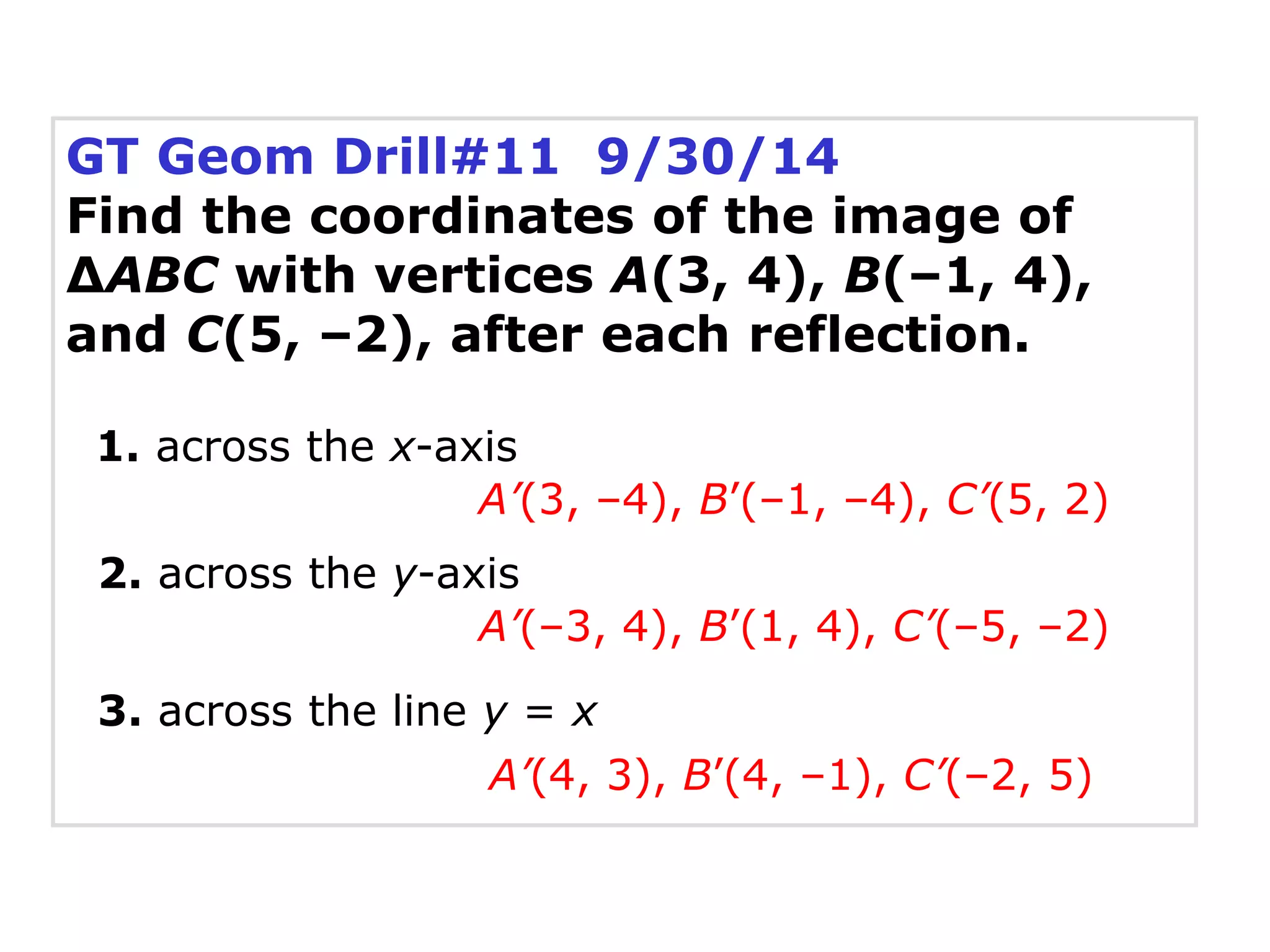
GT Geom Drill#11 9/30/14 
Find the coordinates of the image of 
ΔABC with vertices A(3, 4), B(–1, 4), 
and C(5, –2), after each reflection. 
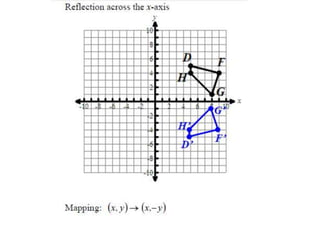
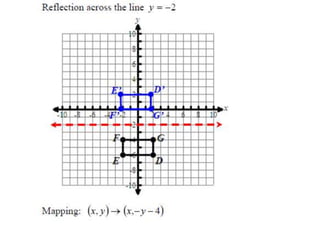
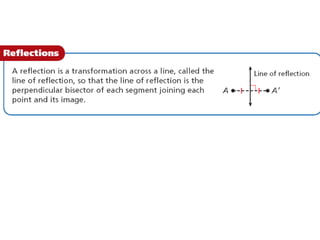
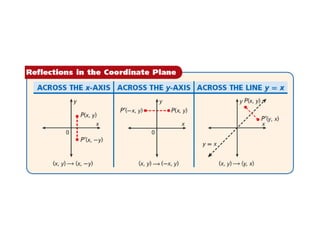
1. across the x-axis 
A’(3, –4), B’(–1, –4), C’(5, 2) 
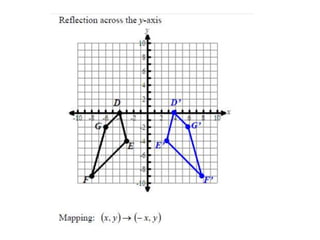
2. across the y-axis 
A’(–3, 4), B’(1, 4), C’(–5, –2) 
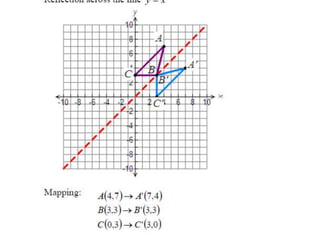
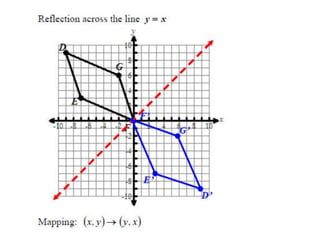
3. across the line y = x 
A’(4, 3), B’(4, –1), C’(–2, 5)
Objective 
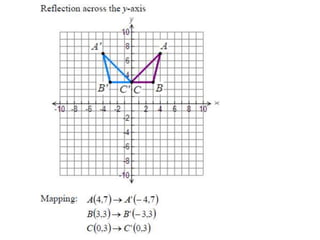
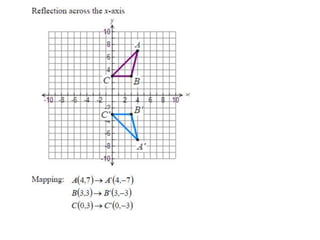
Identify and draw reflections. 
Identify and draw translations.
isometry 
Vocabulary
An isometry is a transformation that does not 
change the shape or size of a figure. 
Reflections, translations, and rotations are 
all isometries. Isometries are also called 
congruence transformations or rigid motions.
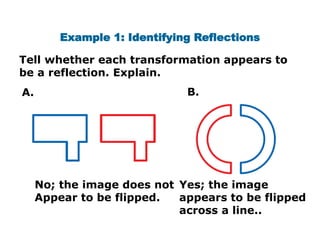
Example 1: Identifying Reflections 
Tell whether each transformation appears to 
be a reflection. Explain. 
A. B. 
No; the image does not 
Appear to be flipped. 
Yes; the image 
appears to be flipped 
across a line..
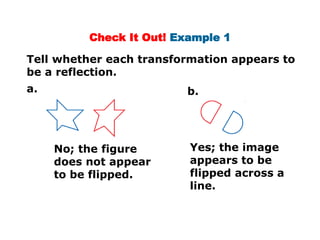
Check It Out! Example 1 
Tell whether each transformation appears to 
be a reflection. 
a. b. 
No; the figure 
does not appear 
to be flipped. 
Yes; the image 
appears to be 
flipped across a 
line.
12-2 Translations 
A translation is a transformation where all the 
points of a figure are moved the same distance in 
the same direction. A translation is an isometry, so 
the image of a translated figure is congruent to the 
preimage. 
Holt McDougal Geometry
12-2 Translations 
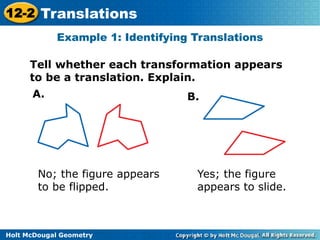
Example 1: Identifying Translations 
Tell whether each transformation appears 
to be a translation. Explain. 
A. B. 
No; the figure appears 
to be flipped. 
Holt McDougal Geometry 
Yes; the figure 
appears to slide.
12-2 Translations 
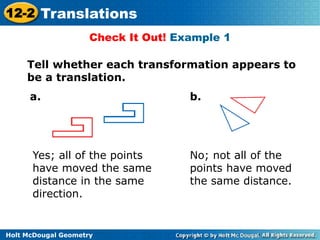
Check It Out! Example 1 
Tell whether each transformation appears to 
be a translation. 
a. b. 
Holt McDougal Geometry 
No; not all of the 
points have moved 
the same distance. 
Yes; all of the points 
have moved the same 
distance in the same 
direction.
12-2 Translations 
Holt McDougal Geometry
12-2 Translations 
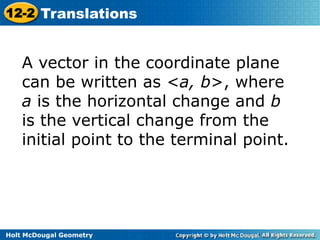
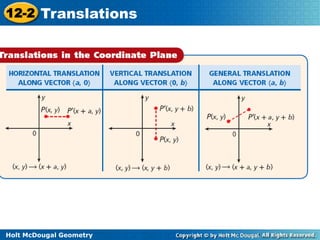
A vector in the coordinate plane 
can be written as <a, b>, where 
a is the horizontal change and b 
is the vertical change from the 
initial point to the terminal point. 
Holt McDougal Geometry
12-2 Translations 
Holt McDougal Geometry
12-2 Translations 
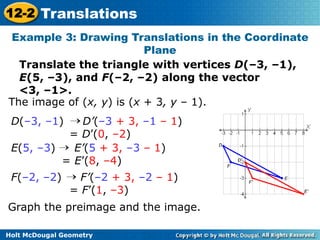
Example 3: Drawing Translations in the Coordinate 
Holt McDougal Geometry 
Plane 
Translate the triangle with vertices D(–3, –1), 
E(5, –3), and F(–2, –2) along the vector 
<3, –1>. 
The image of (x, y) is (x + 3, y – 1). 
D(–3, –1) D’(–3 + 3, –1 – 1) 
= D’(0, –2) 
E(5, –3) E’(5 + 3, –3 – 1) 
= E’(8, –4) 
F(–2, –2) F’(–2 + 3, –2 – 1) 
= F’(1, –3) 
Graph the preimage and the image.
12-2 Translations 
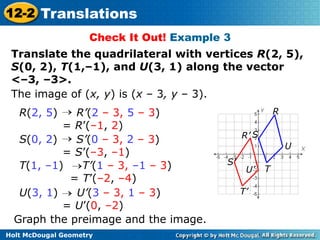
Check It Out! Example 3 
Translate the quadrilateral with vertices R(2, 5), 
S(0, 2), T(1,–1), and U(3, 1) along the vector 
<–3, –3>. 
The image of (x, y) is (x – 3, y – 3). 
R(2, 5) R’(2 – 3, 5 – 3) 
= R’(–1, 2) 
S(0, 2) S’(0 – 3, 2 – 3) 
= S’(–3, –1) 
T(1, –1) T’(1 – 3, –1 – 3) 
= T’(–2, –4) 
U(3, 1) U’(3 – 3, 1 – 3) 
= U’(0, –2) 
Graph the preimage and the image. 
Holt McDougal Geometry 
R 
S 
T 
U 
R’ 
S’ 
U’ 
T’
12-2 Translations 
Example 3: Recreation Application 
A sailboat has coordinates 100° west and 5° 
south. The boat sails 50° due west. Then the 
boat sails 10° due south. What is the boat’s 
final position? What single translation vector 
moves it from its first position to its final 
position? 
Holt McDougal Geometry
12-2 Translations 
Example 3: Recreation Application 
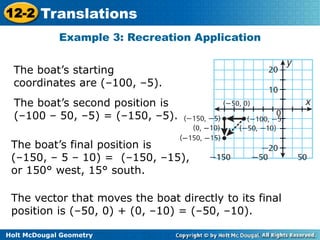
The boat’s starting 
coordinates are (–100, –5). 
The boat’s second position is 
(–100 – 50, –5) = (–150, –5). 
The boat’s final position is 
(–150, – 5 – 10) = (–150, –15), 
or 150° west, 15° south. 
The vector that moves the boat directly to its final 
position is (–50, 0) + (0, –10) = (–50, –10). 
Holt McDougal Geometry
12-2 Translations 
Holt McDougal Geometry
12-2 Translations 
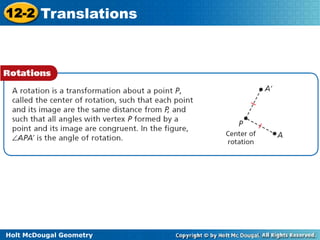
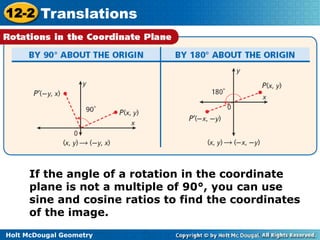
If the angle of a rotation in the coordinate 
plane is not a multiple of 90°, you can use 
sine and cosine ratios to find the coordinates 
of the image. 
Holt McDougal Geometry
12-2 Translations 
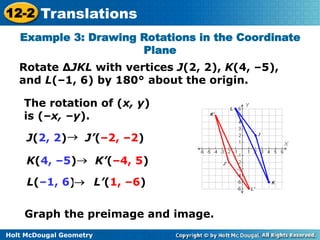
Example 3: Drawing Rotations in the Coordinate 
J(2, 2) J’(–2, –2) 
K(4, –5) K’(–4, 5) 
L(–1, 6) L’(1, –6) 
Holt McDougal Geometry 
Plane 
Rotate ΔJKL with vertices J(2, 2), K(4, –5), 
and L(–1, 6) by 180° about the origin. 
The rotation of (x, y) 
is (–x, –y). 
Graph the preimage and image.
12-2 Translations 
Check It Out! Example 3 
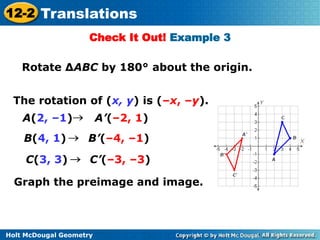
Rotate ΔABC by 180° about the origin. 
The rotation of (x, y) is (–x, –y). 
A(2, –1) A’(–2, 1) 
B(4, 1) B’(–4, –1) 
C(3, 3) C’(–3, –3) 
Graph the preimage and image. 
Holt McDougal Geometry

2002 more with transformations

  • 1.
    GT Geom Drill#119/30/14 Find the coordinates of the image of ΔABC with vertices A(3, 4), B(–1, 4), and C(5, –2), after each reflection. 1. across the x-axis A’(3, –4), B’(–1, –4), C’(5, 2) 2. across the y-axis A’(–3, 4), B’(1, 4), C’(–5, –2) 3. across the line y = x A’(4, 3), B’(4, –1), C’(–2, 5)
  • 2.
    Objective Identify anddraw reflections. Identify and draw translations.
  • 11.
  • 12.
    An isometry isa transformation that does not change the shape or size of a figure. Reflections, translations, and rotations are all isometries. Isometries are also called congruence transformations or rigid motions.
  • 13.
    Example 1: IdentifyingReflections Tell whether each transformation appears to be a reflection. Explain. A. B. No; the image does not Appear to be flipped. Yes; the image appears to be flipped across a line..
  • 14.
    Check It Out!Example 1 Tell whether each transformation appears to be a reflection. a. b. No; the figure does not appear to be flipped. Yes; the image appears to be flipped across a line.
  • 17.
    12-2 Translations Atranslation is a transformation where all the points of a figure are moved the same distance in the same direction. A translation is an isometry, so the image of a translated figure is congruent to the preimage. Holt McDougal Geometry
  • 18.
    12-2 Translations Example1: Identifying Translations Tell whether each transformation appears to be a translation. Explain. A. B. No; the figure appears to be flipped. Holt McDougal Geometry Yes; the figure appears to slide.
  • 19.
    12-2 Translations CheckIt Out! Example 1 Tell whether each transformation appears to be a translation. a. b. Holt McDougal Geometry No; not all of the points have moved the same distance. Yes; all of the points have moved the same distance in the same direction.
  • 20.
    12-2 Translations HoltMcDougal Geometry
  • 21.
    12-2 Translations Avector in the coordinate plane can be written as <a, b>, where a is the horizontal change and b is the vertical change from the initial point to the terminal point. Holt McDougal Geometry
  • 22.
    12-2 Translations HoltMcDougal Geometry
  • 23.
    12-2 Translations Example3: Drawing Translations in the Coordinate Holt McDougal Geometry Plane Translate the triangle with vertices D(–3, –1), E(5, –3), and F(–2, –2) along the vector <3, –1>. The image of (x, y) is (x + 3, y – 1). D(–3, –1) D’(–3 + 3, –1 – 1) = D’(0, –2) E(5, –3) E’(5 + 3, –3 – 1) = E’(8, –4) F(–2, –2) F’(–2 + 3, –2 – 1) = F’(1, –3) Graph the preimage and the image.
  • 24.
    12-2 Translations CheckIt Out! Example 3 Translate the quadrilateral with vertices R(2, 5), S(0, 2), T(1,–1), and U(3, 1) along the vector <–3, –3>. The image of (x, y) is (x – 3, y – 3). R(2, 5) R’(2 – 3, 5 – 3) = R’(–1, 2) S(0, 2) S’(0 – 3, 2 – 3) = S’(–3, –1) T(1, –1) T’(1 – 3, –1 – 3) = T’(–2, –4) U(3, 1) U’(3 – 3, 1 – 3) = U’(0, –2) Graph the preimage and the image. Holt McDougal Geometry R S T U R’ S’ U’ T’
  • 25.
    12-2 Translations Example3: Recreation Application A sailboat has coordinates 100° west and 5° south. The boat sails 50° due west. Then the boat sails 10° due south. What is the boat’s final position? What single translation vector moves it from its first position to its final position? Holt McDougal Geometry
  • 26.
    12-2 Translations Example3: Recreation Application The boat’s starting coordinates are (–100, –5). The boat’s second position is (–100 – 50, –5) = (–150, –5). The boat’s final position is (–150, – 5 – 10) = (–150, –15), or 150° west, 15° south. The vector that moves the boat directly to its final position is (–50, 0) + (0, –10) = (–50, –10). Holt McDougal Geometry
  • 27.
    12-2 Translations HoltMcDougal Geometry
  • 28.
    12-2 Translations Ifthe angle of a rotation in the coordinate plane is not a multiple of 90°, you can use sine and cosine ratios to find the coordinates of the image. Holt McDougal Geometry
  • 29.
    12-2 Translations Example3: Drawing Rotations in the Coordinate J(2, 2) J’(–2, –2) K(4, –5) K’(–4, 5) L(–1, 6) L’(1, –6) Holt McDougal Geometry Plane Rotate ΔJKL with vertices J(2, 2), K(4, –5), and L(–1, 6) by 180° about the origin. The rotation of (x, y) is (–x, –y). Graph the preimage and image.
  • 30.
    12-2 Translations CheckIt Out! Example 3 Rotate ΔABC by 180° about the origin. The rotation of (x, y) is (–x, –y). A(2, –1) A’(–2, 1) B(4, 1) B’(–4, –1) C(3, 3) C’(–3, –3) Graph the preimage and image. Holt McDougal Geometry