Nucleophilic Substitution, 
SN1, SN2, Nucleophile, Halogenoalkane 
In Organic Chemistry
IB Chemistry, Nucleophilic Substitution, SN1, SN2, Halogenoalkanes, 
Nucleophile in Organic Chemistry 
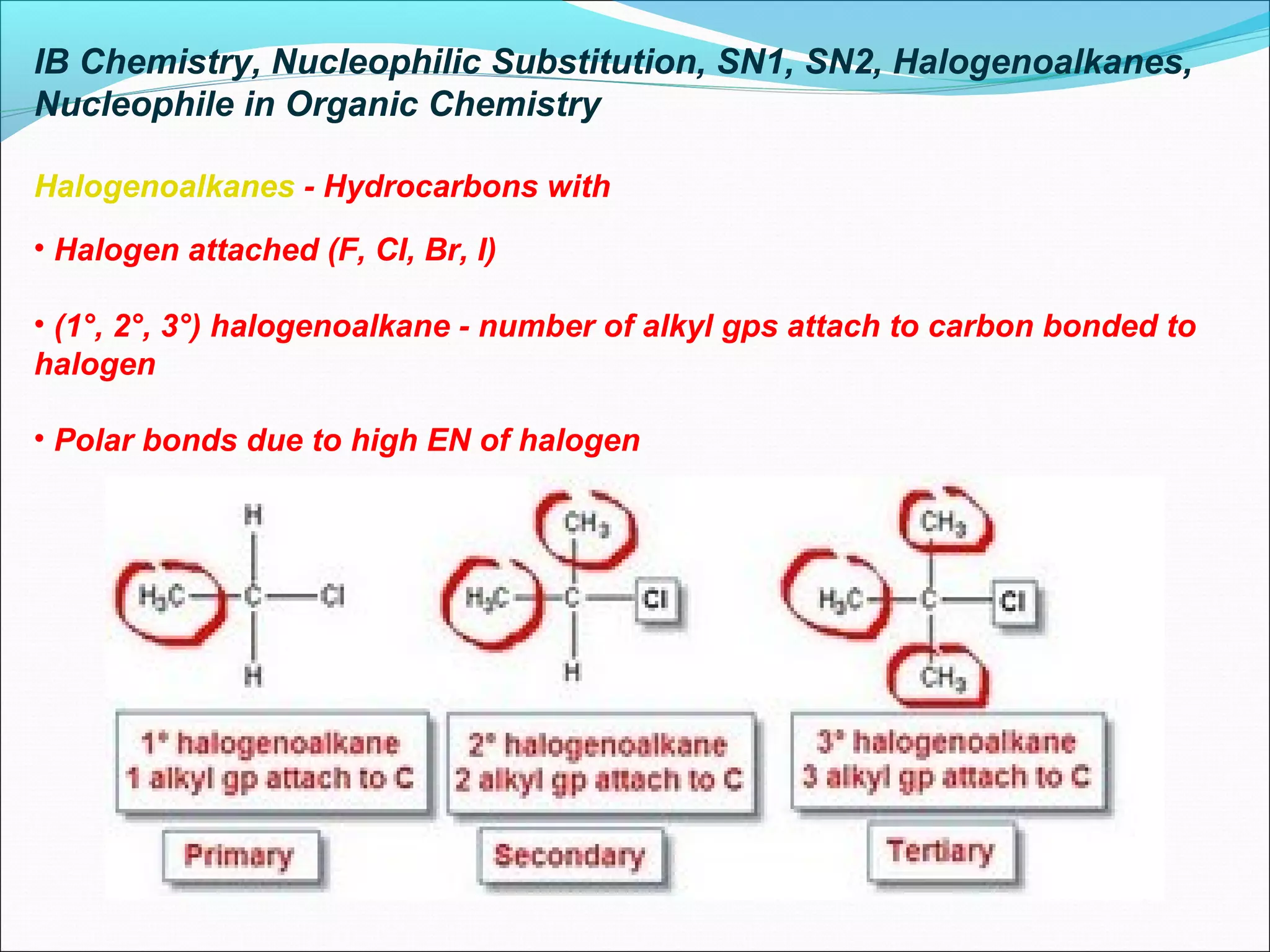
Halogenoalkanes - Hydrocarbons with 
• Halogen attached (F, CI, Br, I) 
• (1°, 2°, 3°) halogenoalkane - number of alkyl gps attach to carbon bonded to 
halogen 
• Polar bonds due to high EN of halogen
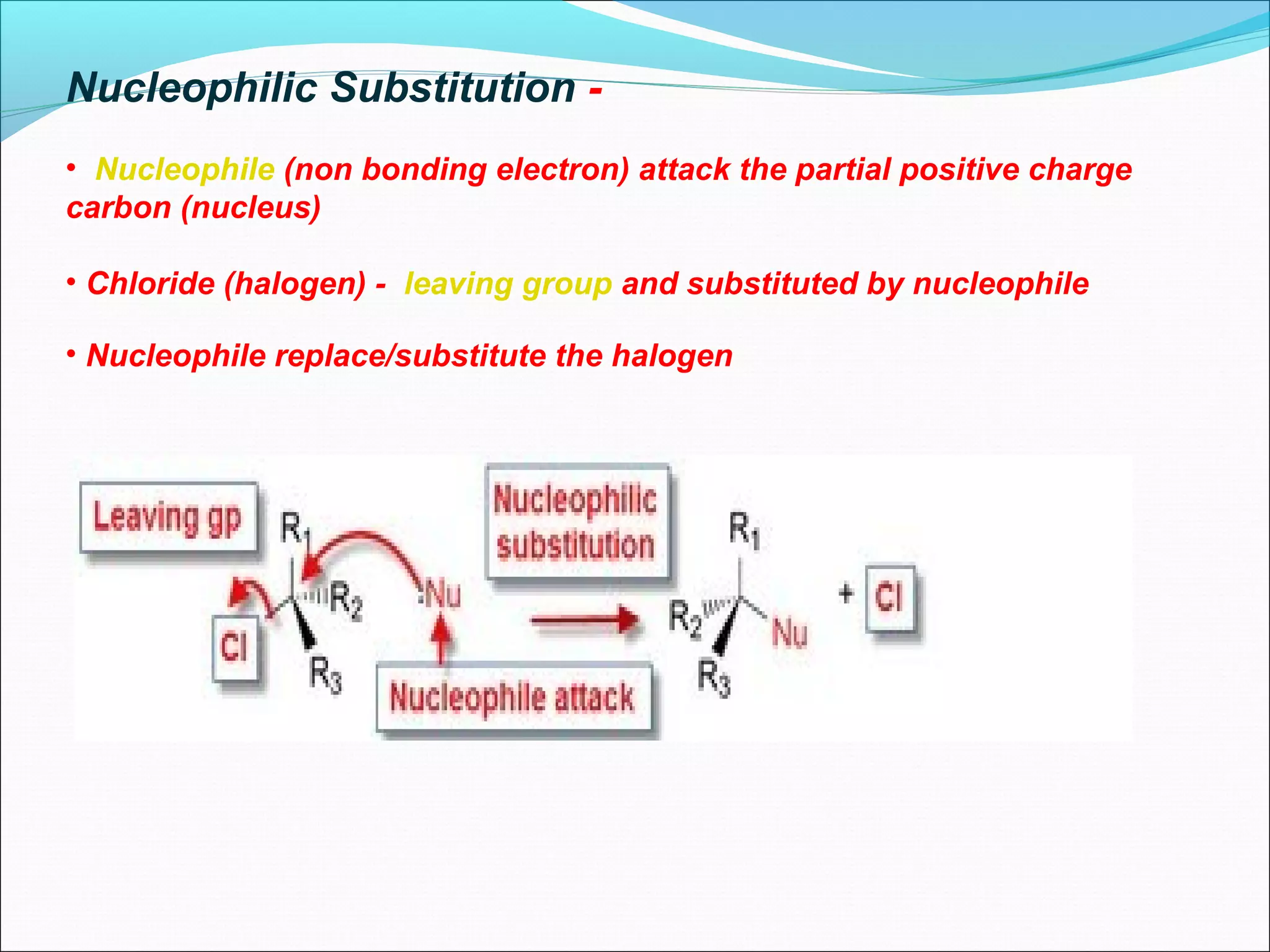
Nucleophilic Substitution - 
• Nucleophile (non bonding electron) attack the partial positive charge 
carbon (nucleus) 
• Chloride (halogen) - leaving group and substituted by nucleophile 
• Nucleophile replace/substitute the halogen
Mechanism of Nucleophilic Substitution (SN1 and SN2 ) 
SN1 - Substitution Nucleophilic Unimolecular 
• SN1 - 2 steps, unimolecular ( first order) 
• 1st step - slow/rds, Carbocation formation 
• 2nd step - fast, Nucleophilic attack 
carbocation 
• Rate = k [substrate], First order overall 
• Rate depend on conc substrate 
NOT conc nucleophile 
• Nature of the nucleophile doesn’t 
affect the rate 
Click HERE for more info
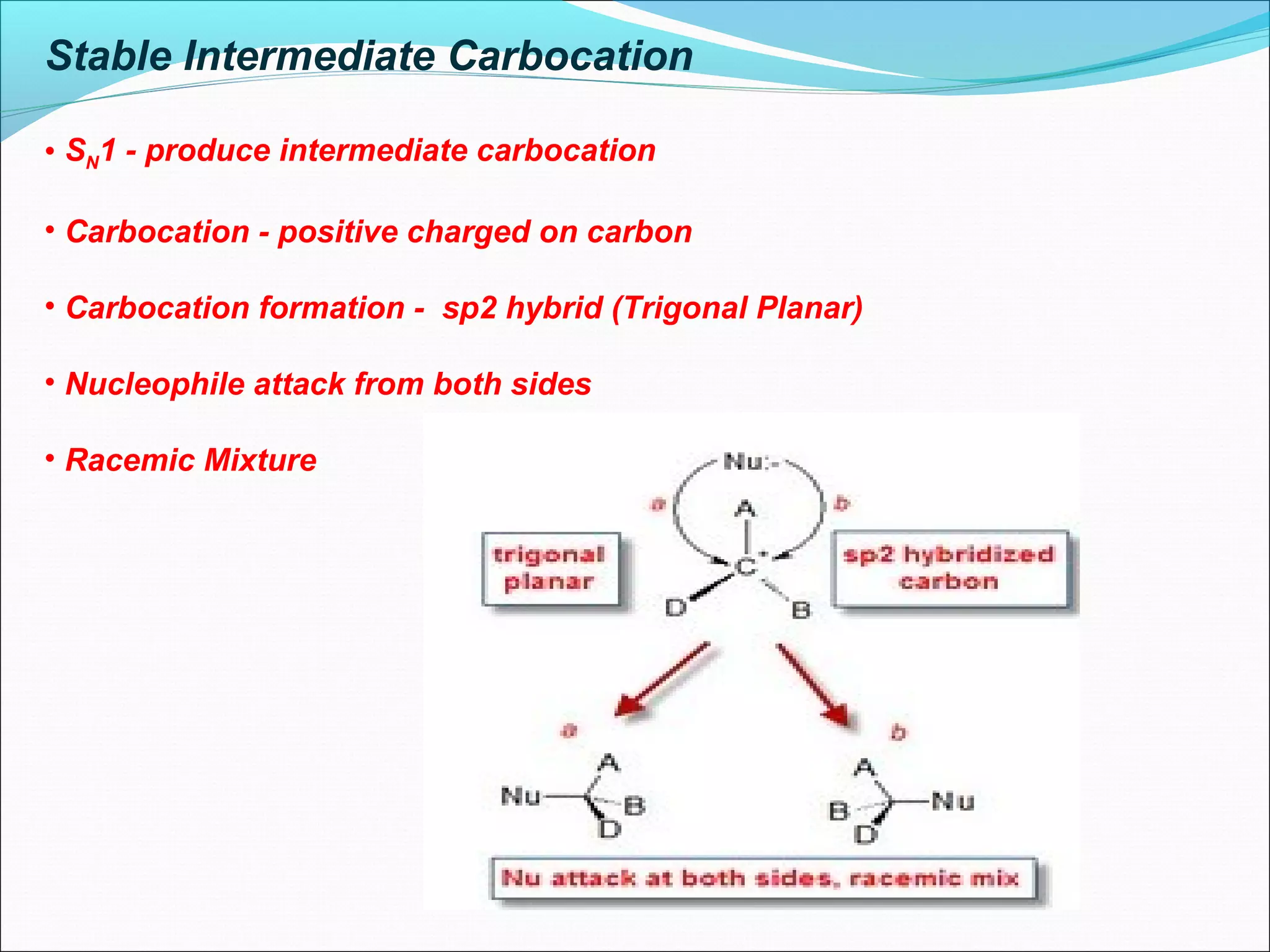
Stable Intermediate Carbocation 
• SN1 - produce intermediate carbocation 
• Carbocation - positive charged on carbon 
• Carbocation formation - sp2 hybrid (Trigonal Planar) 
• Nucleophile attack from both sides 
• Racemic Mixture
SN2 - Substitution Nucleophilic Bimolecular 
• 1 step mechanism, Bimolecular collision 
• Rate = k[substrate][nucleophile], Second order overall 
• Rate depend on conc of substrate and nucleophile 
• Bond making/breaking occur together result in trigonal bipyramidal shape 
• Inverted configuration (backside attack by Nucleophile)
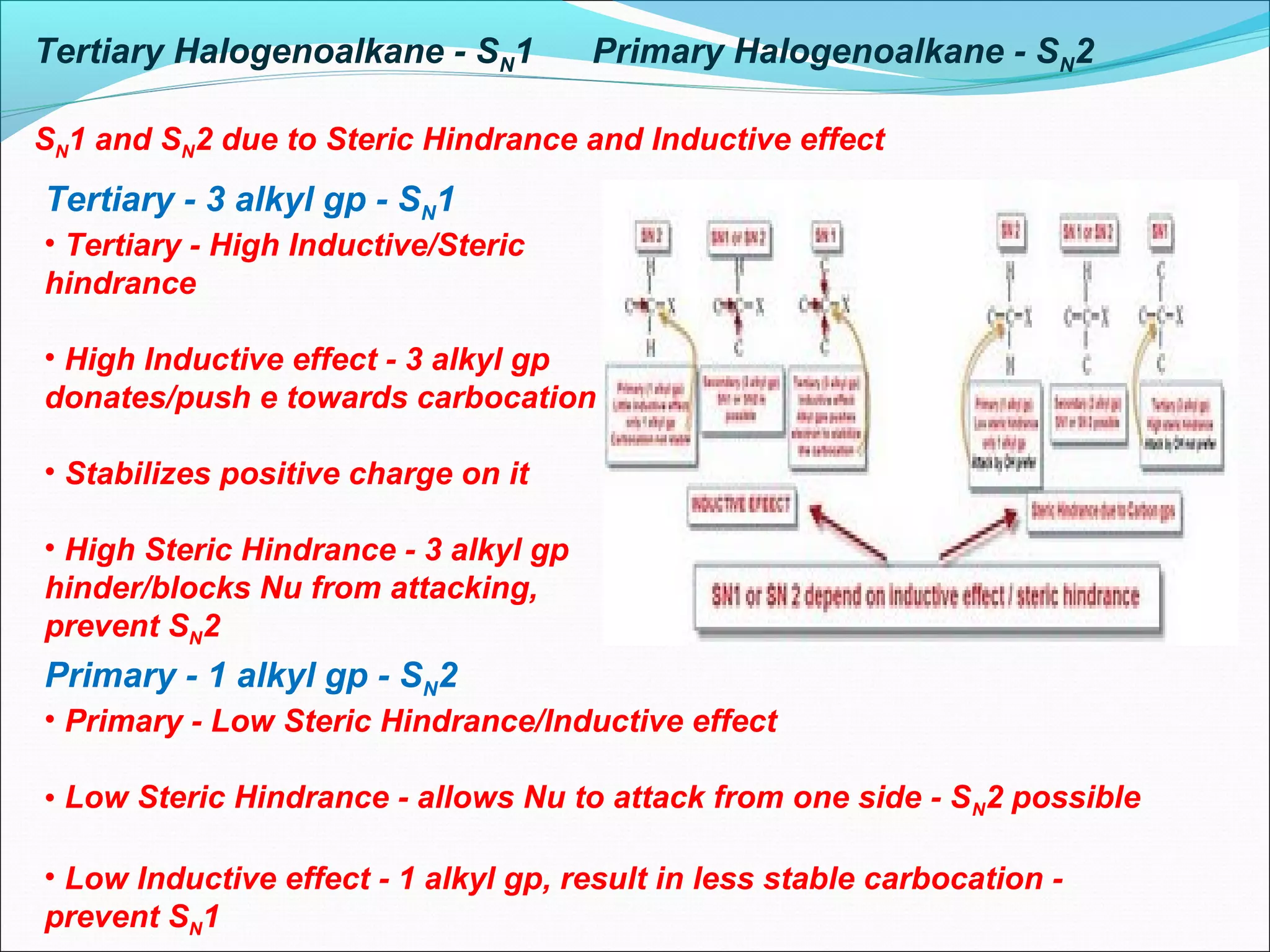
Tertiary Halogenoalkane - SN1 Primary Halogenoalkane - SN2 
SN1 and SN2 due to Steric Hindrance and Inductive effect 
Tertiary - 3 alkyl gp - SN1 
• Tertiary - High Inductive/Steric 
hindrance 
• High Inductive effect - 3 alkyl gp 
donates/push e towards carbocation 
• Stabilizes positive charge on it 
• High Steric Hindrance - 3 alkyl gp 
hinder/blocks Nu from attacking, 
prevent SN2 
Primary - 1 alkyl gp - SN2 
• Primary - Low Steric Hindrance/Inductive effect 
• Low Steric Hindrance - allows Nu to attack from one side - SN2 possible 
• Low Inductive effect - 1 alkyl gp, result in less stable carbocation - 
prevent SN1
IB examples for SN1 and SN2 reactions 
SN1 reaction, Hydrolysis of 2 -Bromo 2- Methylpropane with warm aq dil NaOH 
(CH3)3CBr + OH- ------> (CH3)3COH + Br- 
Tertiary - SN1 
• 2 steps mechanism 
• 1st step, slow/rds, Heterolysis (breaking C-Br bond) forming carbocation 
• 2nd step, fast, nucleophile OH- reacts with carbocation 
Click HERE to view
SN2 reaction, Hydrolysis of Bromoethane with warm aq NaOH 
CH3CH2Br + OH → CH3CH2OH + Br 
• Primary - SN2 
• One step mechanism 
• Bond making/breaking 
simultaneous in transition state 
Click HERE to view
Factor affecting rate of Nucleophilic Substitution (SN1 / SN2) 
1. Nature of Halogen 
• Bond length increase, Bond strength 
decrease from CI to I, easier for 
nucleophile to attack by SN2 
2. Nature of Halogenoalkane 
• Tertiary (SN1) faster than Primary (SN2) 
Formation Carbocation (SN1) faster than 
formation of transition state (SN2) 
3. Nature of Nucleophile 
• Negatively charged more reactive than 
neutral nucleophile 
Click HERE to view
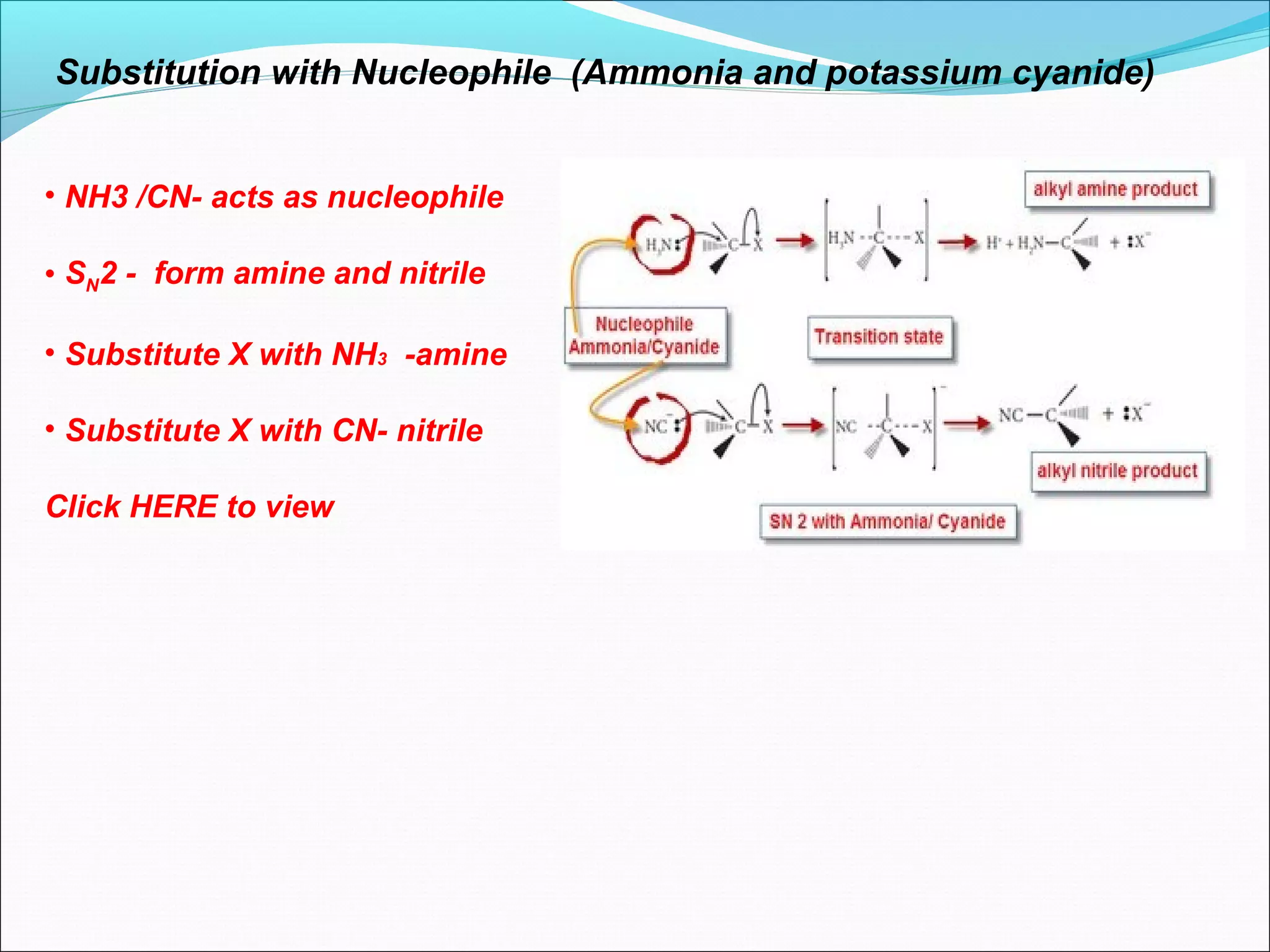
Substitution with Nucleophile (Ammonia and potassium cyanide) 
• NH3 /CN- acts as nucleophile 
• SN2 - form amine and nitrile 
• Substitute X with NH3 -amine 
• Substitute X with CN- nitrile 
Click HERE to view
Bromoethane with aq ethanolic ammonia/ potassium cyanide 
CH3CH2Br + NH3 ---> CH3CH2NH2 + HBr 
• NH3 as nucleophile 
• SN2 pathway, one step 
• Product - Alkyl amine 
CH3CH2Br + CN- ----> CH3CH2CN + Br- 
• CN- as a nucleophile 
• Product - Alkyl nitrile , addition 1 carbon 
• Reduction of nitrile with H2/catalyst nickel - produce amine
Reaction Pathway with SN2 substitution (OH-, NH3, CN-) 
CH3CH2Br + OH-  CH3CH2OH + Br- 
CH3CH2Br + NH3  CH3CH2NH2 + HBr 
CH3CH2Br + CN- ---- > CH3CH2CN + H2/Ni  CH3CH2CH2NH2 
(2 carbon) ( 3 carbon ) ( 3 carbon ) 
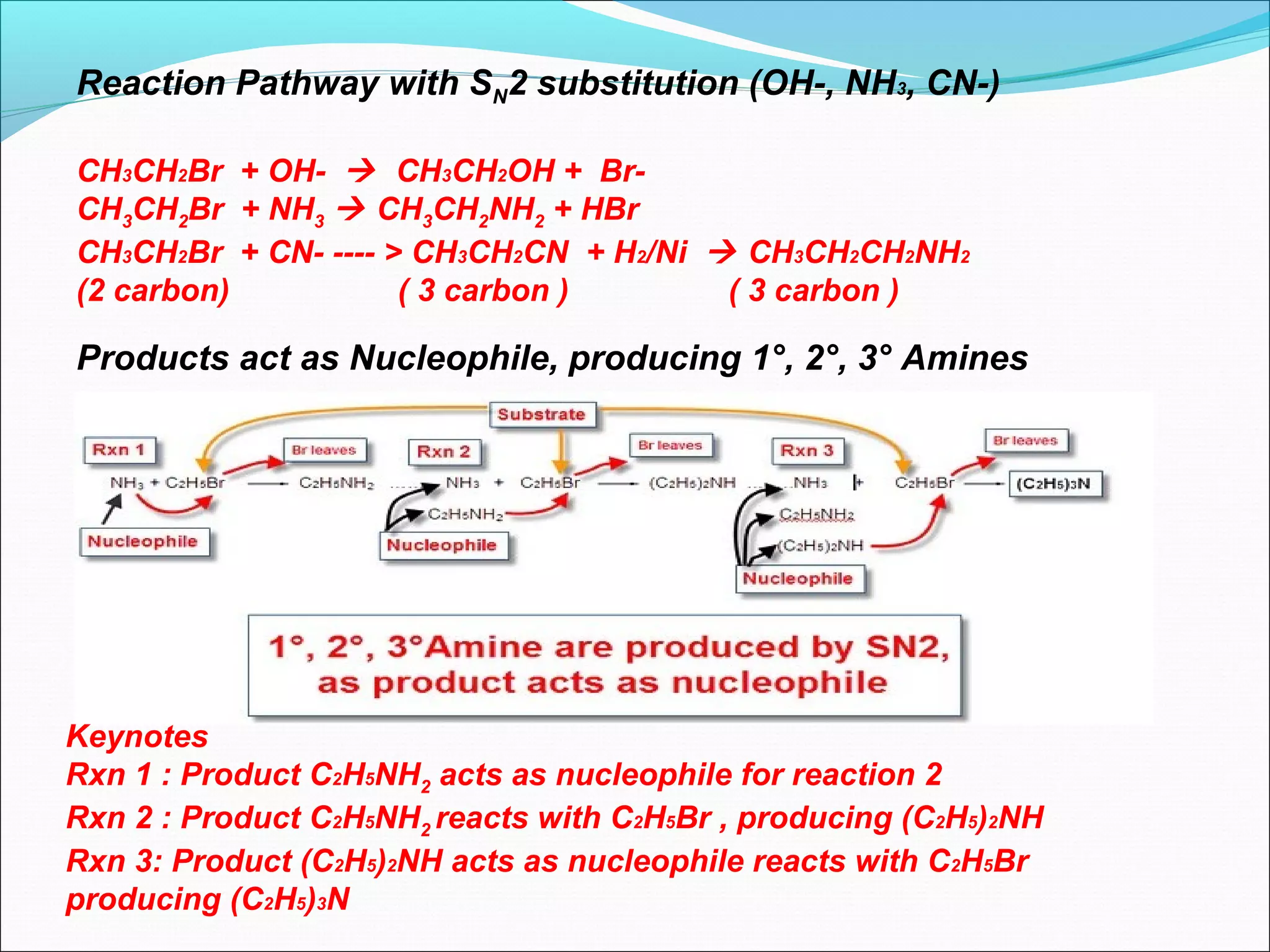
Products act as Nucleophile, producing 1°, 2°, 3° Amines 
Keynotes 
Rxn 1 : Product C2H5NH2 acts as nucleophile for reaction 2 
Rxn 2 : Product C2H5NH2 reacts with C2H5Br , producing (C2H5)2NH 
Rxn 3: Product (C2H5)2NH acts as nucleophile reacts with C2H5Br 
producing (C2H5)3N
Video, SN2 reaction with NH3 and KCN 
More Video on SN1 and SN2 
Click HERE to view 
Thanks to all pictures and video contributors for the above post
Acknowledgements 
Thanks to source of pictures and video used in this presentation 
Thanks to Creative Commons for excellent contribution on licenses 
http://creativecommons.org/licenses/ 
Prepared by Lawrence Kok 
Check out more video tutorials from my site and hope you enjoy this tutorial 
http://lawrencekok.blogspot.com

Nucleophilic substitution sn1 sn2 nucleophile halogenoalkane in organic chemistry

  • 1.
    Nucleophilic Substitution, SN1,SN2, Nucleophile, Halogenoalkane In Organic Chemistry
  • 2.
    IB Chemistry, NucleophilicSubstitution, SN1, SN2, Halogenoalkanes, Nucleophile in Organic Chemistry Halogenoalkanes - Hydrocarbons with • Halogen attached (F, CI, Br, I) • (1°, 2°, 3°) halogenoalkane - number of alkyl gps attach to carbon bonded to halogen • Polar bonds due to high EN of halogen
  • 3.
    Nucleophilic Substitution - • Nucleophile (non bonding electron) attack the partial positive charge carbon (nucleus) • Chloride (halogen) - leaving group and substituted by nucleophile • Nucleophile replace/substitute the halogen
  • 4.
    Mechanism of NucleophilicSubstitution (SN1 and SN2 ) SN1 - Substitution Nucleophilic Unimolecular • SN1 - 2 steps, unimolecular ( first order) • 1st step - slow/rds, Carbocation formation • 2nd step - fast, Nucleophilic attack carbocation • Rate = k [substrate], First order overall • Rate depend on conc substrate NOT conc nucleophile • Nature of the nucleophile doesn’t affect the rate Click HERE for more info
  • 5.
    Stable Intermediate Carbocation • SN1 - produce intermediate carbocation • Carbocation - positive charged on carbon • Carbocation formation - sp2 hybrid (Trigonal Planar) • Nucleophile attack from both sides • Racemic Mixture
  • 6.
    SN2 - SubstitutionNucleophilic Bimolecular • 1 step mechanism, Bimolecular collision • Rate = k[substrate][nucleophile], Second order overall • Rate depend on conc of substrate and nucleophile • Bond making/breaking occur together result in trigonal bipyramidal shape • Inverted configuration (backside attack by Nucleophile)
  • 7.
    Tertiary Halogenoalkane -SN1 Primary Halogenoalkane - SN2 SN1 and SN2 due to Steric Hindrance and Inductive effect Tertiary - 3 alkyl gp - SN1 • Tertiary - High Inductive/Steric hindrance • High Inductive effect - 3 alkyl gp donates/push e towards carbocation • Stabilizes positive charge on it • High Steric Hindrance - 3 alkyl gp hinder/blocks Nu from attacking, prevent SN2 Primary - 1 alkyl gp - SN2 • Primary - Low Steric Hindrance/Inductive effect • Low Steric Hindrance - allows Nu to attack from one side - SN2 possible • Low Inductive effect - 1 alkyl gp, result in less stable carbocation - prevent SN1
  • 8.
    IB examples forSN1 and SN2 reactions SN1 reaction, Hydrolysis of 2 -Bromo 2- Methylpropane with warm aq dil NaOH (CH3)3CBr + OH- ------> (CH3)3COH + Br- Tertiary - SN1 • 2 steps mechanism • 1st step, slow/rds, Heterolysis (breaking C-Br bond) forming carbocation • 2nd step, fast, nucleophile OH- reacts with carbocation Click HERE to view
  • 9.
    SN2 reaction, Hydrolysisof Bromoethane with warm aq NaOH CH3CH2Br + OH → CH3CH2OH + Br • Primary - SN2 • One step mechanism • Bond making/breaking simultaneous in transition state Click HERE to view
  • 10.
    Factor affecting rateof Nucleophilic Substitution (SN1 / SN2) 1. Nature of Halogen • Bond length increase, Bond strength decrease from CI to I, easier for nucleophile to attack by SN2 2. Nature of Halogenoalkane • Tertiary (SN1) faster than Primary (SN2) Formation Carbocation (SN1) faster than formation of transition state (SN2) 3. Nature of Nucleophile • Negatively charged more reactive than neutral nucleophile Click HERE to view
  • 11.
    Substitution with Nucleophile(Ammonia and potassium cyanide) • NH3 /CN- acts as nucleophile • SN2 - form amine and nitrile • Substitute X with NH3 -amine • Substitute X with CN- nitrile Click HERE to view
  • 12.
    Bromoethane with aqethanolic ammonia/ potassium cyanide CH3CH2Br + NH3 ---> CH3CH2NH2 + HBr • NH3 as nucleophile • SN2 pathway, one step • Product - Alkyl amine CH3CH2Br + CN- ----> CH3CH2CN + Br- • CN- as a nucleophile • Product - Alkyl nitrile , addition 1 carbon • Reduction of nitrile with H2/catalyst nickel - produce amine
  • 13.
    Reaction Pathway withSN2 substitution (OH-, NH3, CN-) CH3CH2Br + OH-  CH3CH2OH + Br- CH3CH2Br + NH3  CH3CH2NH2 + HBr CH3CH2Br + CN- ---- > CH3CH2CN + H2/Ni  CH3CH2CH2NH2 (2 carbon) ( 3 carbon ) ( 3 carbon ) Products act as Nucleophile, producing 1°, 2°, 3° Amines Keynotes Rxn 1 : Product C2H5NH2 acts as nucleophile for reaction 2 Rxn 2 : Product C2H5NH2 reacts with C2H5Br , producing (C2H5)2NH Rxn 3: Product (C2H5)2NH acts as nucleophile reacts with C2H5Br producing (C2H5)3N
  • 14.
    Video, SN2 reactionwith NH3 and KCN More Video on SN1 and SN2 Click HERE to view Thanks to all pictures and video contributors for the above post
  • 15.
    Acknowledgements Thanks tosource of pictures and video used in this presentation Thanks to Creative Commons for excellent contribution on licenses http://creativecommons.org/licenses/ Prepared by Lawrence Kok Check out more video tutorials from my site and hope you enjoy this tutorial http://lawrencekok.blogspot.com