Chapter 4 Alkynes
Introduction
1. Alkynyl Groups
2. Nomenclature of Alkynes
3. Isomerism in Alkynes
4. Physical Properties of Alkynes
5. Chemical Properties of Alkynes
6. Preparation of Alkynes
7. Acetylene
Table of Contents
Chapter 4
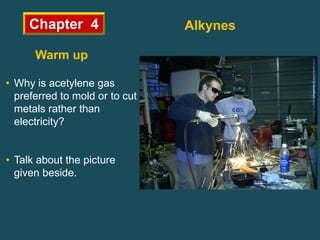
Warm up
• Why is acetylene gas
preferred to mold or to cut
metals rather than
electricity?
• Talk about the picture
given beside.
Alkynes
Chapter 4 Introduction
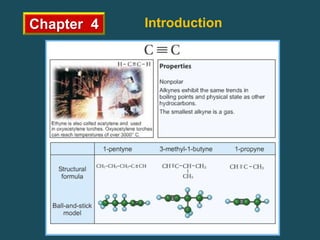
• Unsaturated hydrocarbons containing C≡C bond are called
alkynes.
• Carbon atoms having triple bond make sp hybridization.
• They are also known as acetylenes.
• General formula is Cn H2n-2.
• Simplest member is ethyne, or acetylene, C2H2.
• Change –ane ending with –yne to name alkynes.
Chapter 4 Introduction
Chapter 4 1.Alkynyl Groups
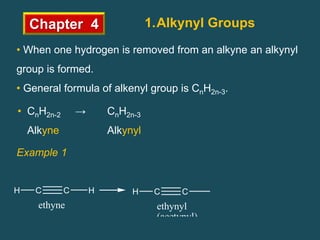
• When one hydrogen is removed from an alkyne an alkynyl
group is formed.
• General formula of alkenyl group is CnH2n-3.
• CnH2n-2 → CnH2n-3
Alkyne Alkynyl
Example 1
C
H C
ethyne
H C
H C
ethynyl
(acetynyl)
Chapter 4 1.Alkenyl Groups
10% of the molecular weight of an alkyne is hydrogen. What is
the molecular formula of the alkyne? (C:12, H:1)
Example 2
A 2.7 g of an alkyne is burned and produces 8.8 g of carbon
dioxde. What is the molecular formula of the alkyne? (C:12,
H:1)
Example 3
When an alkyne is burned, the mass of water produced is the
same as the mass of alkyne used up. What is the molecular
formula of the alkyne? (C:12, H:1)
Example 4
Chapter 4 2. Nomenclature of Alkynes
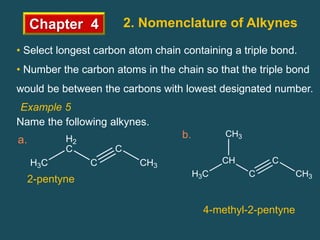
• Select longest carbon atom chain containing a triple bond.
• Number the carbon atoms in the chain so that the triple bond
would be between the carbons with lowest designated number.
Name the following alkynes.
Example 5
a.
H3C
H2
C
C
C
CH3
b.
H3C
CH
C
C
CH3
CH3
2-pentyne
4-methyl-2-pentyne
Chapter 4 2. Nomenclature of Alkynes
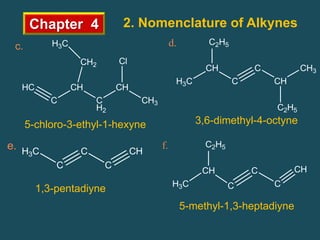
c.
HC
C
CH
C
H2
CH
CH3
CH2
H3C
Cl
d.
H3C
CH
C
C
CH
CH3
C2H5
C2H5
5-chloro-3-ethyl-1-hexyne 3,6-dimethyl-4-octyne
e. H3C
C
C
C
CH
1,3-pentadiyne
f.
H3C
CH
C
C
C
CH
C2H5
5-methyl-1,3-heptadiyne
Chapter 4 2. Nomenclature of Alkynes
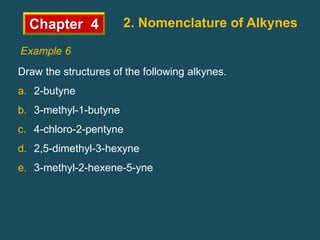
Example 6
Draw the structures of the following alkynes.
a. 2-butyne
b. 3-methyl-1-butyne
c. 4-chloro-2-pentyne
d. 2,5-dimethyl-3-hexyne
e. 3-methyl-2-hexene-5-yne
Chapter 4 3. Isomerism in Alkynes
• In alkynes only structural isomerism is possible, according to
position of triple bond. For the first and second members
there is only one possible structure.
• Structural isomers of alkynes have different physical
properties.
H3C
C
C
CH3
2-butyne
H3C
C
H2
C
CH
1-butyne
Chapter 4 4. Physical Properties of
Alkynes
• The physical properties of alkynes are similar to those of
alkenes and alkanes.
• Acetylene, propyne and butyne are gases at room
temperature, others are liquids.
• Boiling points increase as the number of carbon atom
increases.
• They are quite soluble in organic solvents, but insoluble in
water.
• Branching as it is other hydrocarbons decreases the boiling
point.
Chapter 4 5. Chemical Properties of
Alkynes
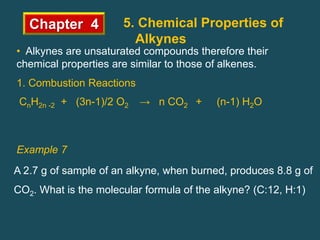
• Alkynes are unsaturated compounds therefore their
chemical properties are similar to those of alkenes.
1. Combustion Reactions
CnH2n -2 + (3n-1)/2 O2 → n CO2 + (n-1) H2O
A 2.7 g of sample of an alkyne, when burned, produces 8.8 g of
CO2. What is the molecular formula of the alkyne? (C:12, H:1)
Example 7
Chapter 4 5. Chemical Properties of
Alkynes
1. Combustion Reactions
Chapter 4 5. Chemical Properties of
Alkynes
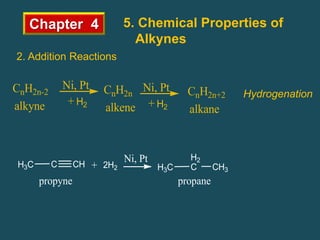
2. Addition Reactions
+ H2
alkyne
Ni, Pt
CnH2n-2
alkene
CnH2n
+ H2
Ni, Pt
alkane
CnH2n+2 Hydrogenation
C CH
H3C + 2H2
H2
C CH3
H3C
propyne propane
Ni, Pt
Chapter 4 5. Chemical Properties of
Alkynes
2. Addition Reactions
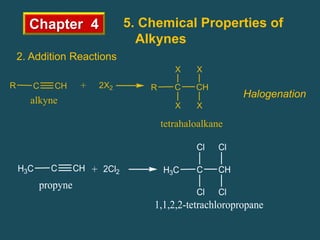
Halogenation
C CH
H3C + 2Cl2 C CH
H3C
propyne
1,1,2,2-tetrachloropropane
Cl Cl
Cl Cl
C CH
R + 2X2 C CH
R
X X
alkyne
tetrahaloalkane
X X
Chapter 4 5. Chemical Properties of
Alkynes
2. Addition Reactions
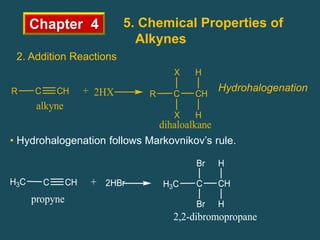
Hydrohalogenation
C CH
R + C CH
R
X H
dihaloalkane
alkyne
2HX
H
X
• Hydrohalogenation follows Markovnikov’s rule.
C CH
H3C + 2HBr C CH
H3C
Br H
propyne
2,2-dibromopropane
Br H
Chapter 4 5. Chemical Properties of
Alkynes
2. Addition Reactions
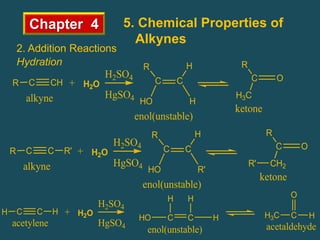
Hydration
C CH
R + H2O C C
R
HO H
alkyne
enol(unstable)
H
C
R
H3C
ketone
O
H2SO4
HgSO4
C C
R + H2O C C
R
HO R'
alkyne
enol(unstable)
H
C
R
CH2
ketone
O
H2SO4
HgSO4
R'
R'
C C
H + H2O
C C
H
HO H
acetylene
enol(unstable)
H
C H
H3C
acetaldehyde
O
H2SO4
HgSO4
H
Chapter 4 5. Chemical Properties of
Alkynes
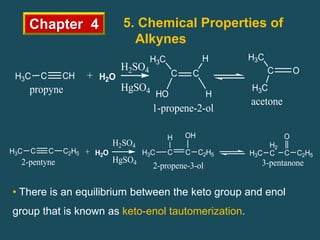
C CH
H3C + H2O C C
H3C
HO H
propyne
1-propene-2-ol
H
C
H3C
H3C
acetone
O
H2SO4
HgSO4
C C
H3C + H2O C C
H3C
H
C2H5
2-pentyne 2-propene-3-ol
OH
C
H2
C C2H5
3-pentanone
O
H2SO4
HgSO4
C2H5 H3C
• There is an equilibrium between the keto group and enol
group that is known as keto-enol tautomerization.
Chapter 4 5. Chemical Properties of
Alkynes
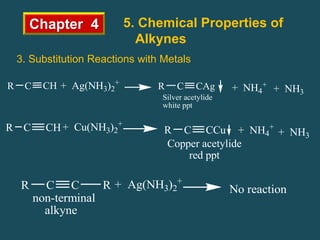
3. Substitution Reactions with Metals
+ Ag(NH3)2
+
CH
C
R CAg
C
R
Silver acetylide
white ppt
+ NH4
+
+ NH3
CH
C
R CCu
C
R + NH3
+ Cu(NH3)2
+
Copper acetylide
red ppt
+ NH4
+
C
C
R + Ag(NH3)2
+
No reaction
R
non-terminal
alkyne
Chapter 4 5. Chemical Properties of
Alkynes
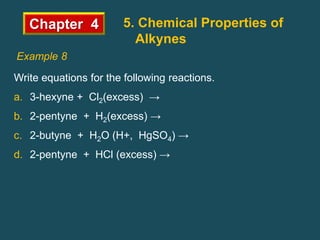
Example 8
Write equations for the following reactions.
a. 3-hexyne + Cl2(excess) →
b. 2-pentyne + H2(excess) →
c. 2-butyne + H2O (H+, HgSO4) →
d. 2-pentyne + HCl (excess) →
Chapter 4 5. Chemical Properties of
Alkynes
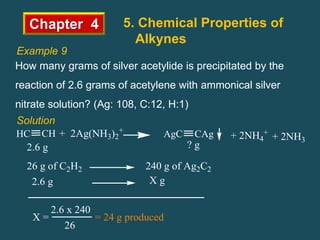
Example 9
How many grams of silver acetylide is precipitated by the
reaction of 2.6 grams of acetylene with ammonical silver
nitrate solution? (Ag: 108, C:12, H:1)
Solution
+ 2Ag(NH3)2
+
CH
HC CAg
AgC + 2NH4
+
+ 2NH3
2.6 g ? g
26 g of C2H2 240 g of Ag2C2
2.6 g X g
2.6 x 240
26
X = = 24 g produced
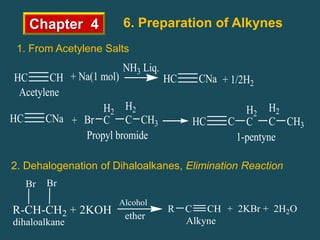
Chapter 4 6. Preparation of Alkynes
1. From Acetylene Salts
+ Na(1 mol)
CH
HC
NH3 Liq.
CNa
HC + 1/2H2
CNa
HC
Propyl bromide
H2
C
H2
C CH3
Br
+ C
HC
1-pentyne
H2
C
H2
C CH3
Acetylene
2. Dehalogenation of Dihaloalkanes, Elimination Reaction
R-CH-CH2 + 2KOH + 2KBr + 2H2O
Alkyne
Alcohol
Br
dihaloalkane
Br
CH
C
R
ether
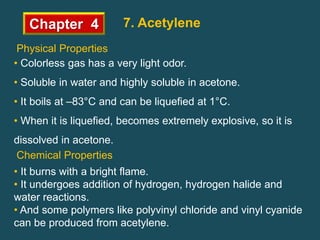
Chapter 4 7. Acetylene
• Colorless gas has a very light odor.
• Soluble in water and highly soluble in acetone.
• It boils at –83°C and can be liquefied at 1°C.
• When it is liquefied, becomes extremely explosive, so it is
dissolved in acetone.
Physical Properties
Chemical Properties
• It burns with a bright flame.
• It undergoes addition of hydrogen, hydrogen halide and
water reactions.
• And some polymers like polyvinyl chloride and vinyl cyanide
can be produced from acetylene..
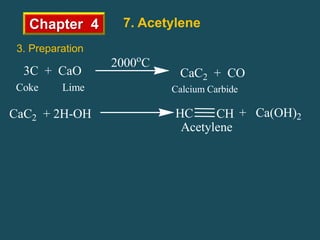
Chapter 4 7. Acetylene
3. Preparation
3C + CaO CaC2 + CO
2000o
C
Coke Lime Calcium Carbide
CaC2 + 2H-OH
Acetylene
HC CH + Ca(OH)2
Chapter 4 7. Acetylene
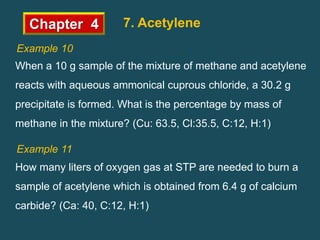
Example 10
When a 10 g sample of the mixture of methane and acetylene
reacts with aqueous ammonical cuprous chloride, a 30.2 g
precipitate is formed. What is the percentage by mass of
methane in the mixture? (Cu: 63.5, Cl:35.5, C:12, H:1)
Example 11
How many liters of oxygen gas at STP are needed to burn a
sample of acetylene which is obtained from 6.4 g of calcium
carbide? (Ca: 40, C:12, H:1)
Chapter 4 7. Acetylene
End of the chapter 4

Alkynes.pptx

  • 1.
    Chapter 4 Alkynes Introduction 1.Alkynyl Groups 2. Nomenclature of Alkynes 3. Isomerism in Alkynes 4. Physical Properties of Alkynes 5. Chemical Properties of Alkynes 6. Preparation of Alkynes 7. Acetylene Table of Contents
  • 2.
    Chapter 4 Warm up •Why is acetylene gas preferred to mold or to cut metals rather than electricity? • Talk about the picture given beside. Alkynes
  • 3.
    Chapter 4 Introduction •Unsaturated hydrocarbons containing C≡C bond are called alkynes. • Carbon atoms having triple bond make sp hybridization. • They are also known as acetylenes. • General formula is Cn H2n-2. • Simplest member is ethyne, or acetylene, C2H2. • Change –ane ending with –yne to name alkynes.
  • 4.
  • 5.
    Chapter 4 1.AlkynylGroups • When one hydrogen is removed from an alkyne an alkynyl group is formed. • General formula of alkenyl group is CnH2n-3. • CnH2n-2 → CnH2n-3 Alkyne Alkynyl Example 1 C H C ethyne H C H C ethynyl (acetynyl)
  • 6.
    Chapter 4 1.AlkenylGroups 10% of the molecular weight of an alkyne is hydrogen. What is the molecular formula of the alkyne? (C:12, H:1) Example 2 A 2.7 g of an alkyne is burned and produces 8.8 g of carbon dioxde. What is the molecular formula of the alkyne? (C:12, H:1) Example 3 When an alkyne is burned, the mass of water produced is the same as the mass of alkyne used up. What is the molecular formula of the alkyne? (C:12, H:1) Example 4
  • 7.
    Chapter 4 2.Nomenclature of Alkynes • Select longest carbon atom chain containing a triple bond. • Number the carbon atoms in the chain so that the triple bond would be between the carbons with lowest designated number. Name the following alkynes. Example 5 a. H3C H2 C C C CH3 b. H3C CH C C CH3 CH3 2-pentyne 4-methyl-2-pentyne
  • 8.
    Chapter 4 2.Nomenclature of Alkynes c. HC C CH C H2 CH CH3 CH2 H3C Cl d. H3C CH C C CH CH3 C2H5 C2H5 5-chloro-3-ethyl-1-hexyne 3,6-dimethyl-4-octyne e. H3C C C C CH 1,3-pentadiyne f. H3C CH C C C CH C2H5 5-methyl-1,3-heptadiyne
  • 9.
    Chapter 4 2.Nomenclature of Alkynes Example 6 Draw the structures of the following alkynes. a. 2-butyne b. 3-methyl-1-butyne c. 4-chloro-2-pentyne d. 2,5-dimethyl-3-hexyne e. 3-methyl-2-hexene-5-yne
  • 10.
    Chapter 4 3.Isomerism in Alkynes • In alkynes only structural isomerism is possible, according to position of triple bond. For the first and second members there is only one possible structure. • Structural isomers of alkynes have different physical properties. H3C C C CH3 2-butyne H3C C H2 C CH 1-butyne
  • 11.
    Chapter 4 4.Physical Properties of Alkynes • The physical properties of alkynes are similar to those of alkenes and alkanes. • Acetylene, propyne and butyne are gases at room temperature, others are liquids. • Boiling points increase as the number of carbon atom increases. • They are quite soluble in organic solvents, but insoluble in water. • Branching as it is other hydrocarbons decreases the boiling point.
  • 12.
    Chapter 4 5.Chemical Properties of Alkynes • Alkynes are unsaturated compounds therefore their chemical properties are similar to those of alkenes. 1. Combustion Reactions CnH2n -2 + (3n-1)/2 O2 → n CO2 + (n-1) H2O A 2.7 g of sample of an alkyne, when burned, produces 8.8 g of CO2. What is the molecular formula of the alkyne? (C:12, H:1) Example 7
  • 13.
    Chapter 4 5.Chemical Properties of Alkynes 1. Combustion Reactions
  • 14.
    Chapter 4 5.Chemical Properties of Alkynes 2. Addition Reactions + H2 alkyne Ni, Pt CnH2n-2 alkene CnH2n + H2 Ni, Pt alkane CnH2n+2 Hydrogenation C CH H3C + 2H2 H2 C CH3 H3C propyne propane Ni, Pt
  • 15.
    Chapter 4 5.Chemical Properties of Alkynes 2. Addition Reactions Halogenation C CH H3C + 2Cl2 C CH H3C propyne 1,1,2,2-tetrachloropropane Cl Cl Cl Cl C CH R + 2X2 C CH R X X alkyne tetrahaloalkane X X
  • 16.
    Chapter 4 5.Chemical Properties of Alkynes 2. Addition Reactions Hydrohalogenation C CH R + C CH R X H dihaloalkane alkyne 2HX H X • Hydrohalogenation follows Markovnikov’s rule. C CH H3C + 2HBr C CH H3C Br H propyne 2,2-dibromopropane Br H
  • 17.
    Chapter 4 5.Chemical Properties of Alkynes 2. Addition Reactions Hydration C CH R + H2O C C R HO H alkyne enol(unstable) H C R H3C ketone O H2SO4 HgSO4 C C R + H2O C C R HO R' alkyne enol(unstable) H C R CH2 ketone O H2SO4 HgSO4 R' R' C C H + H2O C C H HO H acetylene enol(unstable) H C H H3C acetaldehyde O H2SO4 HgSO4 H
  • 18.
    Chapter 4 5.Chemical Properties of Alkynes C CH H3C + H2O C C H3C HO H propyne 1-propene-2-ol H C H3C H3C acetone O H2SO4 HgSO4 C C H3C + H2O C C H3C H C2H5 2-pentyne 2-propene-3-ol OH C H2 C C2H5 3-pentanone O H2SO4 HgSO4 C2H5 H3C • There is an equilibrium between the keto group and enol group that is known as keto-enol tautomerization.
  • 19.
    Chapter 4 5.Chemical Properties of Alkynes 3. Substitution Reactions with Metals + Ag(NH3)2 + CH C R CAg C R Silver acetylide white ppt + NH4 + + NH3 CH C R CCu C R + NH3 + Cu(NH3)2 + Copper acetylide red ppt + NH4 + C C R + Ag(NH3)2 + No reaction R non-terminal alkyne
  • 20.
    Chapter 4 5.Chemical Properties of Alkynes Example 8 Write equations for the following reactions. a. 3-hexyne + Cl2(excess) → b. 2-pentyne + H2(excess) → c. 2-butyne + H2O (H+, HgSO4) → d. 2-pentyne + HCl (excess) →
  • 21.
    Chapter 4 5.Chemical Properties of Alkynes Example 9 How many grams of silver acetylide is precipitated by the reaction of 2.6 grams of acetylene with ammonical silver nitrate solution? (Ag: 108, C:12, H:1) Solution + 2Ag(NH3)2 + CH HC CAg AgC + 2NH4 + + 2NH3 2.6 g ? g 26 g of C2H2 240 g of Ag2C2 2.6 g X g 2.6 x 240 26 X = = 24 g produced
  • 22.
    Chapter 4 6.Preparation of Alkynes 1. From Acetylene Salts + Na(1 mol) CH HC NH3 Liq. CNa HC + 1/2H2 CNa HC Propyl bromide H2 C H2 C CH3 Br + C HC 1-pentyne H2 C H2 C CH3 Acetylene 2. Dehalogenation of Dihaloalkanes, Elimination Reaction R-CH-CH2 + 2KOH + 2KBr + 2H2O Alkyne Alcohol Br dihaloalkane Br CH C R ether
  • 23.
    Chapter 4 7.Acetylene • Colorless gas has a very light odor. • Soluble in water and highly soluble in acetone. • It boils at –83°C and can be liquefied at 1°C. • When it is liquefied, becomes extremely explosive, so it is dissolved in acetone. Physical Properties Chemical Properties • It burns with a bright flame. • It undergoes addition of hydrogen, hydrogen halide and water reactions. • And some polymers like polyvinyl chloride and vinyl cyanide can be produced from acetylene..
  • 24.
    Chapter 4 7.Acetylene 3. Preparation 3C + CaO CaC2 + CO 2000o C Coke Lime Calcium Carbide CaC2 + 2H-OH Acetylene HC CH + Ca(OH)2
  • 25.
    Chapter 4 7.Acetylene Example 10 When a 10 g sample of the mixture of methane and acetylene reacts with aqueous ammonical cuprous chloride, a 30.2 g precipitate is formed. What is the percentage by mass of methane in the mixture? (Cu: 63.5, Cl:35.5, C:12, H:1) Example 11 How many liters of oxygen gas at STP are needed to burn a sample of acetylene which is obtained from 6.4 g of calcium carbide? (Ca: 40, C:12, H:1)
  • 26.
    Chapter 4 7.Acetylene
  • 27.
    End of thechapter 4