10/01/15 1
THE CONCEPT OF HSAB
HARD AND SOFT ACIDS AND BASES
10/01/15 2
The Goldschmidt (1935) :
Geochemical Ore Classification
Nickel (Ni), zinc (Zn), and copper (Cu) ores are
exclusively found as sulfides, whilst aluminum (Al)
and calcium (Ca) are usually found as oxide and
carbonate, respectively.
Why?
10/01/15 3
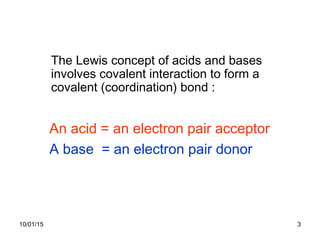
An acid = an electron pair acceptor
A base = an electron pair donor
The Lewis concept of acids and bases
involves covalent interaction to form a
covalent (coordination) bond :
10/01/15 4
1963 :1963 : Ralph Pearson introduced the hard-soft-acid-baseRalph Pearson introduced the hard-soft-acid-base
(HSAB) principle.(HSAB) principle.
““Hard acids prefer to coordinate the hard bases andHard acids prefer to coordinate the hard bases and
soft acids to soft bases”.soft acids to soft bases”.
This very simple concept was used to rationalize aThis very simple concept was used to rationalize a
variety of chemical information, as an attempt tovariety of chemical information, as an attempt to
unify inorganic and organic reactions.unify inorganic and organic reactions.
1983 :1983 : By Ralph Pearson and Robert Parr, the qualitativeBy Ralph Pearson and Robert Parr, the qualitative
definition of HSAB was converted to a quantitativedefinition of HSAB was converted to a quantitative
one by using the idea of polarizability.one by using the idea of polarizability.
A less easily polarized atom or ion is “hard”A less easily polarized atom or ion is “hard”
and a more easily polarized atom or ion isand a more easily polarized atom or ion is
“soft”“soft”
10/01/15 5
PolarizabilityPolarizability
The capacity of a group of atoms in a molecule and/or
an ion to polarize its electron.
N
HH
H
..
δ-
δ+
N
HH
H
..
polarization
10/01/15 6
PolarizabilityPolarizability
HARDHARD
SOFTSOFT
CHEMICACHEMICA
LL
SPECIESSPECIES
A less easily polarized speciesA less easily polarized species
ELECTROSTATIC (IONIC)ELECTROSTATIC (IONIC)
INTERCTIONINTERCTION
A more easily polarized speciesA more easily polarized species
ELECTRON SHARINGELECTRON SHARING
(COVALENT) INTERCTION(COVALENT) INTERCTION
10/01/15 7
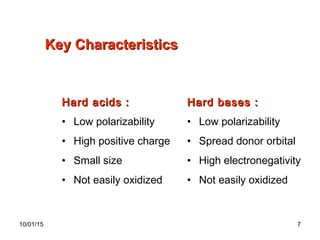
Key CharacteristicsKey Characteristics
Hard acids :Hard acids :
• Low polarizability
• High positive charge
• Small size
• Not easily oxidized
Hard bases :Hard bases :
• Low polarizability
• Spread donor orbital
• High electronegativity
• Not easily oxidized
10/01/15 8
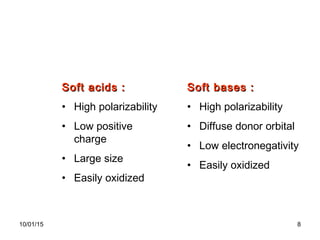
Soft acids :Soft acids :
• High polarizability
• Low positive
charge
• Large size
• Easily oxidized
Soft bases :Soft bases :
• High polarizability
• Diffuse donor orbital
• Low electronegativity
• Easily oxidized
10/01/15 9
The HSAB concept is now widely used to explain :
- Stability of compounds,
- Chemical reactions in term of their
mechanisms and pathways
The theory is used in contexts where a qualitative,
rather than quantitative description would help in
understanding the predominant factors which drive
chemical properties and reactions.
10/01/15 10
The HSAB TheoryThe HSAB Theory
Providing all other factors being equal,Providing all other factors being equal, softsoft acidsacids
react faster and form stronger bonds withreact faster and form stronger bonds with softsoft
bases, whereasbases, whereas hardhard acids react faster and formacids react faster and form
stronger bonds withstronger bonds with hardhard bases.bases.
The classification in the original work was mostlyThe classification in the original work was mostly
based on equilibrium constants for reaction ofbased on equilibrium constants for reaction of
two Lewis bases competing for a Lewis acid.two Lewis bases competing for a Lewis acid.
10/01/15 11
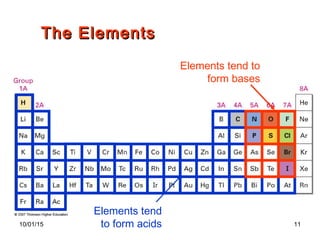
Elements tend to
form bases
Elements tend
to form acids
The ElementsThe Elements
10/01/15 12
N O F
P S Cl
As Se Br
Sb Te I
Elements tend to form bases
Harder
Base
Softer
Base
Electronegativity factors
Size
factor
10/01/15 13
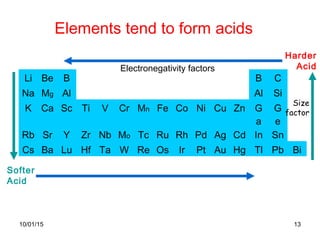
Li Be B B C
Na Mg Al Al Si
K Ca Sc Ti V Cr Mn Fe Co Ni Cu Zn G
a
G
e
Rb Sr Y Zr Nb Mo Tc Ru Rh Pd Ag Cd In Sn
Cs Ba Lu Hf Ta W Re Os Ir Pt Au Hg Tl Pb Bi
Elements tend to form acids
Harder
Acid
Softer
Acid
Electronegativity factors
Size
factor
10/01/15 14
The ElementsThe Elements
Soft Acid BorderlineBorderline
Hard Acid
Elements tend to
form bases
10/01/15 15
Pearson, R.G., Journal of American Chemical Society, 1963, 85, 3533–3539.
class (a) metal ions : class (b) metal ions
• Alkali : H+
, Li+
, Na+
, K+
,
Rb+
, and Cs+
,
• Heavier transition me-
tals of lower oxidation
states :
• alkaline earth: Be2+
,
Mg2+
, Ca2+
, Sr2+
, and
Ba2+
,
Cu+
, Ag+
, Hg+
, Hg2+
,
Pd2+
, and Pt2+
.
• Lighter transition metals
of higher oxidation
states : Ti4+
, Cr3+
, Fe3+
,
and Co2+
.
Pearson’s classification of metalPearson’s classification of metal
ions :ions :
10/01/15 16
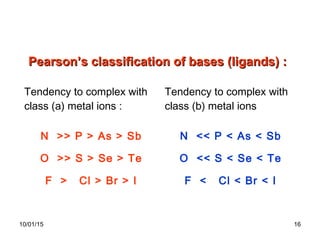
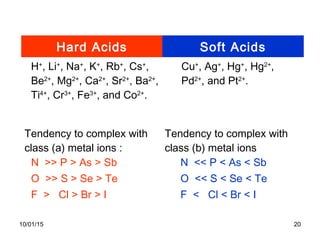
Tendency to complex with
class (a) metal ions :
Tendency to complex with
class (b) metal ions
N >> P > As > Sb N << P < As < Sb
O >> S > Se > Te O << S < Se < Te
F > Cl > Br > I F < Cl < Br < I
Pearson’s classification of bases (ligands) :Pearson’s classification of bases (ligands) :
10/01/15 17
Tendency to complex with
class (a) metal ions :
Tendency to complex with
class (b) metal ions
N >> P > As > Sb N << P < As < Sb
O >> S > Se > Te O << S < Se < Te
F > Cl > Br > I F < Cl < Br < I
class (a) metal ions : class (b) metal ions
H+
, Li+
, Na+
, K+
, Rb+
, Cs+
,
Be2+
, Mg2+
, Ca2+
, Sr2+
, Ba2+
,
Ti4+
, Cr3+
, Fe3+
, and Co2+
.
Cu+
, Ag+
, Hg+
, Hg2+
,
Pd2+
, and Pt2+
.
10/01/15 18
N O F
P S Cl
As Se Br
Sb Te I
Elements tend to form bases
Harder
Base
Softer
Base
Electronegativity factors
Size
factor
10/01/15 19
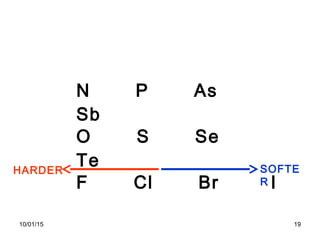
N P As
Sb
O S Se
Te
F Cl Br I
SOFTE
R
HARDER
10/01/15 20
Tendency to complex with
class (a) metal ions :
Tendency to complex with
class (b) metal ions
N >> P > As > Sb N << P < As < Sb
O >> S > Se > Te O << S < Se < Te
F > Cl > Br > I F < Cl < Br < I
class (a) metal ions : class (b) metal ions
H+
, Li+
, Na+
, K+
, Rb+
, Cs+
,
Be2+
, Mg2+
, Ca2+
, Sr2+
, Ba2+
,
Ti4+
, Cr3+
, Fe3+
, and Co2+
.
Cu+
, Ag+
, Hg+
, Hg2+
,
Pd2+
, and Pt2+
.
Hard Acids Soft Acids
10/01/15 21
Hard Acids
Soft Acids
Hard Bases
Soft Bases
10/01/15 22
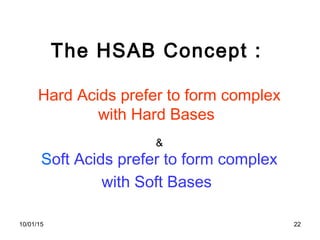
The HSAB Concept :
Hard Acids prefer to form complex
with Hard Bases
&
Soft Acids prefer to form complex
with Soft Bases
10/01/15 23
Hard Borderline Soft
ACIDS H+
, Li+
, Na+
, K+
,
Rb+
, Cs+
, Be2+
,
Mg2+
, Ca2+
, Ba2+
,
Cr3+
, SO3, BF3.
Fe2+
, Co2+
, Ni2+
,
Cu2+
, Zn2+
, Pb2+
,
SO2, BBr3.
Cu+
, Ag+
, Au+
, Tl+
,
Hg+
, Pd2+
, Cd2+
,
Pt2+
, Hg2+
, BH3.
BASES F-
, OH-
, H2O, NH3,
CO3
2-
, NO3
-
, O2-
,
SO4
2-
, PO4
3-
, ClO4
-
.
NO2
-
, SO3
2-
, N3
-
Cl-
, C6H5N, SCN-
H-
, R-
, CN-
, CO, I-
,
R3P, C6H6, R2S
HSAB Classification of Acids and BasesHSAB Classification of Acids and Bases
10/01/15 24
It is important to remember that :
• The listings in the tables do not have a sharp
dividing line between them.
• These terms, “hard” & “soft”, are relative in nature
• Some are borderline and even though within the
same category are not all of the same degree of
“hardness” and “softness”
10/01/15 25
Examples
• Although all alkali metals in ionic form M+
are
“hard”, the larger, more polarizable, Cs+
ion is
much softer than Li+
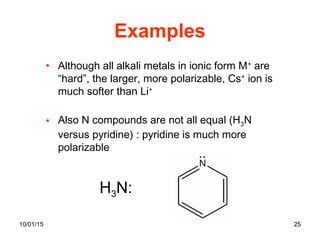
• Also N compounds are not all equal (H3N
versus pyridine) : pyridine is much more
polarizable
H3N:
10/01/15 26
Examples
Common soft species :
PR3, SR2, are soft bases
Hg2+
, Pd2+
, Pt2+
are soft acids
Common hard species :
NH3, ROH, H2O are hard bases
Ti4+
, Si4+
, Co3+
are hard acids

Hsab theory

  • 1.
    10/01/15 1 THE CONCEPTOF HSAB HARD AND SOFT ACIDS AND BASES
  • 2.
    10/01/15 2 The Goldschmidt(1935) : Geochemical Ore Classification Nickel (Ni), zinc (Zn), and copper (Cu) ores are exclusively found as sulfides, whilst aluminum (Al) and calcium (Ca) are usually found as oxide and carbonate, respectively. Why?
  • 3.
    10/01/15 3 An acid= an electron pair acceptor A base = an electron pair donor The Lewis concept of acids and bases involves covalent interaction to form a covalent (coordination) bond :
  • 4.
    10/01/15 4 1963 :1963: Ralph Pearson introduced the hard-soft-acid-baseRalph Pearson introduced the hard-soft-acid-base (HSAB) principle.(HSAB) principle. ““Hard acids prefer to coordinate the hard bases andHard acids prefer to coordinate the hard bases and soft acids to soft bases”.soft acids to soft bases”. This very simple concept was used to rationalize aThis very simple concept was used to rationalize a variety of chemical information, as an attempt tovariety of chemical information, as an attempt to unify inorganic and organic reactions.unify inorganic and organic reactions. 1983 :1983 : By Ralph Pearson and Robert Parr, the qualitativeBy Ralph Pearson and Robert Parr, the qualitative definition of HSAB was converted to a quantitativedefinition of HSAB was converted to a quantitative one by using the idea of polarizability.one by using the idea of polarizability. A less easily polarized atom or ion is “hard”A less easily polarized atom or ion is “hard” and a more easily polarized atom or ion isand a more easily polarized atom or ion is “soft”“soft”
  • 5.
    10/01/15 5 PolarizabilityPolarizability The capacityof a group of atoms in a molecule and/or an ion to polarize its electron. N HH H .. δ- δ+ N HH H .. polarization
  • 6.
    10/01/15 6 PolarizabilityPolarizability HARDHARD SOFTSOFT CHEMICACHEMICA LL SPECIESSPECIES A lesseasily polarized speciesA less easily polarized species ELECTROSTATIC (IONIC)ELECTROSTATIC (IONIC) INTERCTIONINTERCTION A more easily polarized speciesA more easily polarized species ELECTRON SHARINGELECTRON SHARING (COVALENT) INTERCTION(COVALENT) INTERCTION
  • 7.
    10/01/15 7 Key CharacteristicsKeyCharacteristics Hard acids :Hard acids : • Low polarizability • High positive charge • Small size • Not easily oxidized Hard bases :Hard bases : • Low polarizability • Spread donor orbital • High electronegativity • Not easily oxidized
  • 8.
    10/01/15 8 Soft acids:Soft acids : • High polarizability • Low positive charge • Large size • Easily oxidized Soft bases :Soft bases : • High polarizability • Diffuse donor orbital • Low electronegativity • Easily oxidized
  • 9.
    10/01/15 9 The HSABconcept is now widely used to explain : - Stability of compounds, - Chemical reactions in term of their mechanisms and pathways The theory is used in contexts where a qualitative, rather than quantitative description would help in understanding the predominant factors which drive chemical properties and reactions.
  • 10.
    10/01/15 10 The HSABTheoryThe HSAB Theory Providing all other factors being equal,Providing all other factors being equal, softsoft acidsacids react faster and form stronger bonds withreact faster and form stronger bonds with softsoft bases, whereasbases, whereas hardhard acids react faster and formacids react faster and form stronger bonds withstronger bonds with hardhard bases.bases. The classification in the original work was mostlyThe classification in the original work was mostly based on equilibrium constants for reaction ofbased on equilibrium constants for reaction of two Lewis bases competing for a Lewis acid.two Lewis bases competing for a Lewis acid.
  • 11.
    10/01/15 11 Elements tendto form bases Elements tend to form acids The ElementsThe Elements
  • 12.
    10/01/15 12 N OF P S Cl As Se Br Sb Te I Elements tend to form bases Harder Base Softer Base Electronegativity factors Size factor
  • 13.
    10/01/15 13 Li BeB B C Na Mg Al Al Si K Ca Sc Ti V Cr Mn Fe Co Ni Cu Zn G a G e Rb Sr Y Zr Nb Mo Tc Ru Rh Pd Ag Cd In Sn Cs Ba Lu Hf Ta W Re Os Ir Pt Au Hg Tl Pb Bi Elements tend to form acids Harder Acid Softer Acid Electronegativity factors Size factor
  • 14.
    10/01/15 14 The ElementsTheElements Soft Acid BorderlineBorderline Hard Acid Elements tend to form bases
  • 15.
    10/01/15 15 Pearson, R.G.,Journal of American Chemical Society, 1963, 85, 3533–3539. class (a) metal ions : class (b) metal ions • Alkali : H+ , Li+ , Na+ , K+ , Rb+ , and Cs+ , • Heavier transition me- tals of lower oxidation states : • alkaline earth: Be2+ , Mg2+ , Ca2+ , Sr2+ , and Ba2+ , Cu+ , Ag+ , Hg+ , Hg2+ , Pd2+ , and Pt2+ . • Lighter transition metals of higher oxidation states : Ti4+ , Cr3+ , Fe3+ , and Co2+ . Pearson’s classification of metalPearson’s classification of metal ions :ions :
  • 16.
    10/01/15 16 Tendency tocomplex with class (a) metal ions : Tendency to complex with class (b) metal ions N >> P > As > Sb N << P < As < Sb O >> S > Se > Te O << S < Se < Te F > Cl > Br > I F < Cl < Br < I Pearson’s classification of bases (ligands) :Pearson’s classification of bases (ligands) :
  • 17.
    10/01/15 17 Tendency tocomplex with class (a) metal ions : Tendency to complex with class (b) metal ions N >> P > As > Sb N << P < As < Sb O >> S > Se > Te O << S < Se < Te F > Cl > Br > I F < Cl < Br < I class (a) metal ions : class (b) metal ions H+ , Li+ , Na+ , K+ , Rb+ , Cs+ , Be2+ , Mg2+ , Ca2+ , Sr2+ , Ba2+ , Ti4+ , Cr3+ , Fe3+ , and Co2+ . Cu+ , Ag+ , Hg+ , Hg2+ , Pd2+ , and Pt2+ .
  • 18.
    10/01/15 18 N OF P S Cl As Se Br Sb Te I Elements tend to form bases Harder Base Softer Base Electronegativity factors Size factor
  • 19.
    10/01/15 19 N PAs Sb O S Se Te F Cl Br I SOFTE R HARDER
  • 20.
    10/01/15 20 Tendency tocomplex with class (a) metal ions : Tendency to complex with class (b) metal ions N >> P > As > Sb N << P < As < Sb O >> S > Se > Te O << S < Se < Te F > Cl > Br > I F < Cl < Br < I class (a) metal ions : class (b) metal ions H+ , Li+ , Na+ , K+ , Rb+ , Cs+ , Be2+ , Mg2+ , Ca2+ , Sr2+ , Ba2+ , Ti4+ , Cr3+ , Fe3+ , and Co2+ . Cu+ , Ag+ , Hg+ , Hg2+ , Pd2+ , and Pt2+ . Hard Acids Soft Acids
  • 21.
    10/01/15 21 Hard Acids SoftAcids Hard Bases Soft Bases
  • 22.
    10/01/15 22 The HSABConcept : Hard Acids prefer to form complex with Hard Bases & Soft Acids prefer to form complex with Soft Bases
  • 23.
    10/01/15 23 Hard BorderlineSoft ACIDS H+ , Li+ , Na+ , K+ , Rb+ , Cs+ , Be2+ , Mg2+ , Ca2+ , Ba2+ , Cr3+ , SO3, BF3. Fe2+ , Co2+ , Ni2+ , Cu2+ , Zn2+ , Pb2+ , SO2, BBr3. Cu+ , Ag+ , Au+ , Tl+ , Hg+ , Pd2+ , Cd2+ , Pt2+ , Hg2+ , BH3. BASES F- , OH- , H2O, NH3, CO3 2- , NO3 - , O2- , SO4 2- , PO4 3- , ClO4 - . NO2 - , SO3 2- , N3 - Cl- , C6H5N, SCN- H- , R- , CN- , CO, I- , R3P, C6H6, R2S HSAB Classification of Acids and BasesHSAB Classification of Acids and Bases
  • 24.
    10/01/15 24 It isimportant to remember that : • The listings in the tables do not have a sharp dividing line between them. • These terms, “hard” & “soft”, are relative in nature • Some are borderline and even though within the same category are not all of the same degree of “hardness” and “softness”
  • 25.
    10/01/15 25 Examples • Althoughall alkali metals in ionic form M+ are “hard”, the larger, more polarizable, Cs+ ion is much softer than Li+ • Also N compounds are not all equal (H3N versus pyridine) : pyridine is much more polarizable H3N:
  • 26.
    10/01/15 26 Examples Common softspecies : PR3, SR2, are soft bases Hg2+ , Pd2+ , Pt2+ are soft acids Common hard species : NH3, ROH, H2O are hard bases Ti4+ , Si4+ , Co3+ are hard acids