ISOMERISMISOMERISM
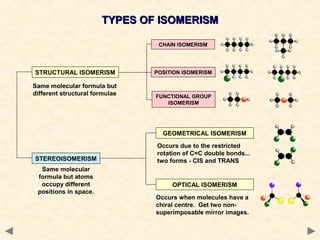
TYPES OF ISOMERISMTYPES OF ISOMERISM
Occurs due to the restricted
rotation of C=C double bonds...
two forms - CIS and TRANS
STRUCTURAL ISOMERISM
STEREOISOMERISM
GEOMETRICAL ISOMERISM
OPTICAL ISOMERISM
CHAIN ISOMERISM
Same molecular formula but
different structural formulae
Occurs when molecules have a
chiral centre. Get two non-
superimposable mirror images.
Same molecular
formula but atoms
occupy different
positions in space.
POSITION ISOMERISM
FUNCTIONAL GROUP
ISOMERISM
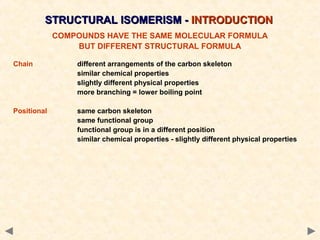
STRUCTURAL ISOMERISM -STRUCTURAL ISOMERISM - INTRODUCTIONINTRODUCTION
COMPOUNDS HAVE THE SAME MOLECULAR FORMULA
BUT DIFFERENT STRUCTURAL FORMULA
Chain different arrangements of the carbon skeleton
similar chemical properties
slightly different physical properties
more branching = lower boiling point
STRUCTURAL ISOMERISM -STRUCTURAL ISOMERISM - INTRODUCTIONINTRODUCTION
COMPOUNDS HAVE THE SAME MOLECULAR FORMULA
BUT DIFFERENT STRUCTURAL FORMULA
Chain different arrangements of the carbon skeleton
similar chemical properties
slightly different physical properties
more branching = lower boiling point
Positional same carbon skeleton
same functional group
functional group is in a different position
similar chemical properties - slightly different physical properties
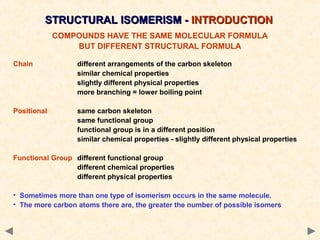
STRUCTURAL ISOMERISM -STRUCTURAL ISOMERISM - INTRODUCTIONINTRODUCTION
COMPOUNDS HAVE THE SAME MOLECULAR FORMULA
BUT DIFFERENT STRUCTURAL FORMULA
Chain different arrangements of the carbon skeleton
similar chemical properties
slightly different physical properties
more branching = lower boiling point
Positional same carbon skeleton
same functional group
functional group is in a different position
similar chemical properties - slightly different physical properties
Functional Group different functional group
different chemical properties
different physical properties
• Sometimes more than one type of isomerism occurs in the same molecule.
• The more carbon atoms there are, the greater the number of possible isomers
caused by different arrangements of the carbon skeleton
similar chemical properties
slightly different physical properties
more branching = lower boiling point
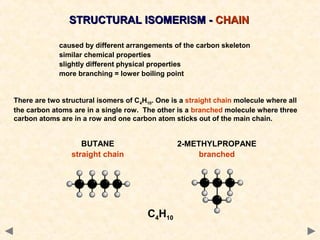
There are two structural isomers of C4H10. One is a straight chain molecule where all
the carbon atoms are in a single row. The other is a branched molecule where three
carbon atoms are in a row and one carbon atom sticks out of the main chain.
BUTANE
straight chain
2-METHYLPROPANE
branched
C4H10
STRUCTURAL ISOMERISM -STRUCTURAL ISOMERISM - CHAINCHAIN
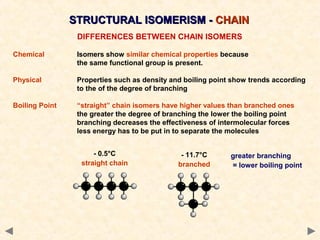
DIFFERENCES BETWEEN CHAIN ISOMERS
Chemical Isomers show similar chemical properties because
the same functional group is present.
Physical Properties such as density and boiling point show trends according
to the of the degree of branching
Boiling Point “straight” chain isomers have higher values than branched ones
the greater the degree of branching the lower the boiling point
branching decreases the effectiveness of intermolecular forces
less energy has to be put in to separate the molecules
- 0.5°C
straight chain
- 11.7°C
branched
greater branching
= lower boiling point
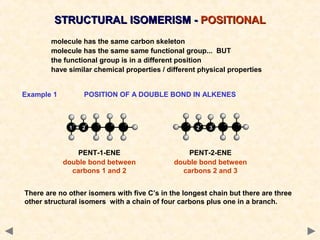
POSITION OF A DOUBLE BOND IN ALKENES
PENT-1-ENE
double bond between
carbons 1 and 2
PENT-2-ENE
double bond between
carbons 2 and 3
1 2 2 3
There are no other isomers with five C’s in the longest chain but there are three
other structural isomers with a chain of four carbons plus one in a branch.
Example 1
STRUCTURAL ISOMERISM -STRUCTURAL ISOMERISM - POSITIONALPOSITIONAL
molecule has the same carbon skeleton
molecule has the same same functional group... BUT
the functional group is in a different position
have similar chemical properties / different physical properties
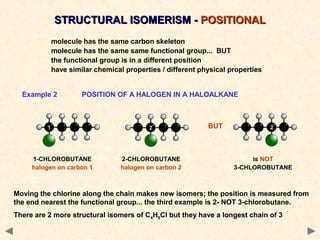
1-CHLOROBUTANE
halogen on carbon 1
1 2
Moving the chlorine along the chain makes new isomers; the position is measured from
the end nearest the functional group... the third example is 2- NOT 3-chlorobutane.
There are 2 more structural isomers of C4H9Cl but they have a longest chain of 3
2-CHLOROBUTANE
halogen on carbon 2
BUT
is NOT
3-CHLOROBUTANE
2
POSITION OF A HALOGEN IN A HALOALKANEExample 2
STRUCTURAL ISOMERISM -STRUCTURAL ISOMERISM - POSITIONALPOSITIONAL
molecule has the same carbon skeleton
molecule has the same same functional group... BUT
the functional group is in a different position
have similar chemical properties / different physical properties
STRUCTURAL ISOMERISM -STRUCTURAL ISOMERISM - POSITIONALPOSITIONAL
1,3-DICHLOROBENZENE
meta dichlorobenzene
1,2-DICHLOROBENZENE
ortho dichlorobenzene
1,4-DICHLOROBENZENE
para dichlorobenzene
RELATIVE POSITIONS ON A BENZENE RINGExample 3
molecule has the same carbon skeleton
molecule has the same same functional group... BUT
the functional group is in a different position
have similar chemical properties / different physical properties
STRUCTURAL ISOMERISM –STRUCTURAL ISOMERISM – FUNCTIONAL GROUPFUNCTIONAL GROUP
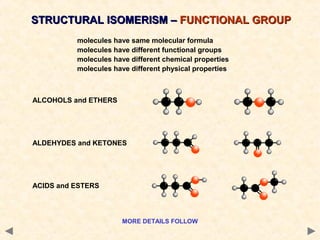
molecules have same molecular formula
molecules have different functional groups
molecules have different chemical properties
molecules have different physical properties
ALCOHOLS and ETHERS
ALDEHYDES and KETONES
ACIDS and ESTERS
MORE DETAILS FOLLOW
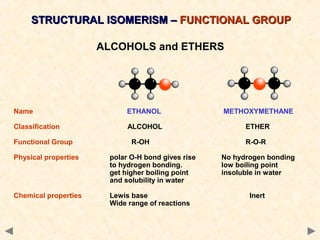
ALCOHOLS and ETHERS
Name ETHANOL METHOXYMETHANE
Classification ALCOHOL ETHER
Functional Group R-OH R-O-R
Physical properties polar O-H bond gives rise No hydrogen bonding
to hydrogen bonding. low boiling point
get higher boiling point insoluble in water
and solubility in water
Chemical properties Lewis base Inert
Wide range of reactions
STRUCTURAL ISOMERISM –STRUCTURAL ISOMERISM – FUNCTIONAL GROUPFUNCTIONAL GROUP
ALDEHYDES and KETONES
Name PROPANAL PROPANONE
Classification ALDEHYDE KETONE
Functional Group R-CHO R-CO-R
Physical properties polar C=O bond gives polar C=O bond gives
dipole-dipole interaction dipole-dipole interaction
Chemical properties easily oxidised to acids of undergo oxidation under
same number of carbons extreme conditions only
reduced to 1° alcohols reduced to 1° alcohols
STRUCTURAL ISOMERISM –STRUCTURAL ISOMERISM – FUNCTIONAL GROUPFUNCTIONAL GROUP
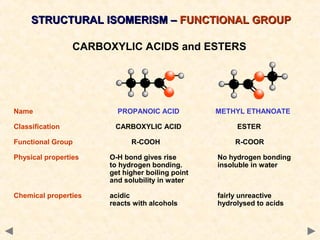
CARBOXYLIC ACIDS and ESTERS
Name PROPANOIC ACID METHYL ETHANOATE
Classification CARBOXYLIC ACID ESTER
Functional Group R-COOH R-COOR
Physical properties O-H bond gives rise No hydrogen bonding
to hydrogen bonding. insoluble in water
get higher boiling point
and solubility in water
Chemical properties acidic fairly unreactive
reacts with alcohols hydrolysed to acids
STRUCTURAL ISOMERISM –STRUCTURAL ISOMERISM – FUNCTIONAL GROUPFUNCTIONAL GROUP
STEREOISOMERISMSTEREOISOMERISM
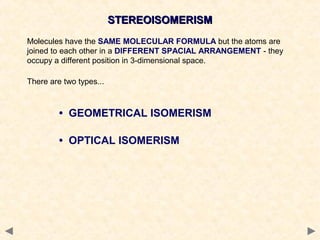
Molecules have the SAME MOLECULAR FORMULA but the atoms are
joined to each other in a DIFFERENT SPACIAL ARRANGEMENT - they
occupy a different position in 3-dimensional space.
There are two types...
• GEOMETRICAL ISOMERISM
• OPTICAL ISOMERISM
GEOMETRICAL ISOMERISM IN ALKENESGEOMETRICAL ISOMERISM IN ALKENES
Introduction
• an example of stereoisomersim
• found in some, but not all, alkenes
• occurs due to the RESTRICTED ROTATION OF C=C bonds
• get two forms....
CIS
Groups/atoms are on the
SAME SIDE of the double bond
TRANS
Groups/atoms are on OPPOSITE
SIDES across the double bond
Isomers - have different physical properties - e.g. boiling points, density
- have similar chemical properties - in most cases
GEOMETRICAL ISOMERISMGEOMETRICAL ISOMERISM
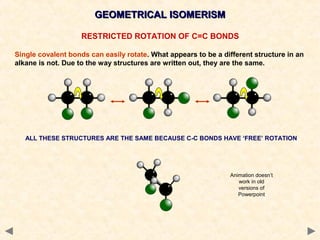
RESTRICTED ROTATION OF C=C BONDS
Single covalent bonds can easily rotate. What appears to be a different structure in an
alkane is not. Due to the way structures are written out, they are the same.
ALL THESE STRUCTURES ARE THE SAME BECAUSE C-C BONDS HAVE ‘FREE’ ROTATION
Animation doesn’t
work in old
versions of
Powerpoint
GEOMETRICAL ISOMERISMGEOMETRICAL ISOMERISM
RESTRICTED ROTATION OF C=C BONDS
C=C bonds have restricted rotation so the groups on either end of the bond are
‘frozen’ in one position; it isn’t easy to flip between the two.
This produces two possibilities. The two structures cannot interchange easily
so the atoms in the two molecules occupy different positions in space.
Animation doesn’t
work in old
versions of
Powerpoint
GEOMETRICAL ISOMERISMGEOMETRICAL ISOMERISM
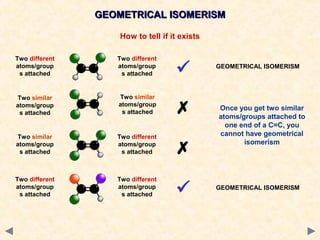
How to tell if it exists




Two different
atoms/group
s attached
Two different
atoms/group
s attached
Two similar
atoms/group
s attached
Two similar
atoms/group
s attached
Two similar
atoms/group
s attached
Two different
atoms/group
s attached
Two different
atoms/group
s attached
Two different
atoms/group
s attached
GEOMETRICAL ISOMERISM
Once you get two similar
atoms/groups attached to
one end of a C=C, you
cannot have geometrical
isomerism
GEOMETRICAL ISOMERISMGEOMETRICAL ISOMERISM
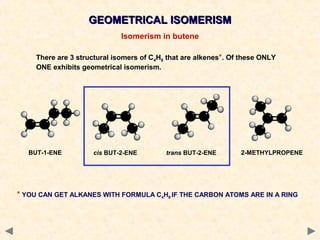
Isomerism in butene
There are 3 structural isomers of C4H8 that are alkenes*. Of these ONLY
ONE exhibits geometrical isomerism.
BUT-1-ENE 2-METHYLPROPENEtrans BUT-2-ENEcis BUT-2-ENE
* YOU CAN GET ALKANES WITH FORMULA C4H8 IF THE CARBON ATOMS ARE IN A RING
OPTICAL ISOMERISMOPTICAL ISOMERISM
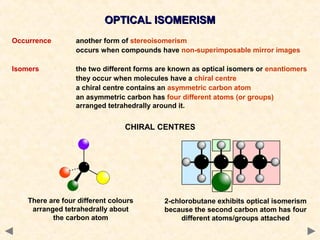
Occurrence another form of stereoisomerism
occurs when compounds have non-superimposable mirror images
Isomers the two different forms are known as optical isomers or enantiomers
they occur when molecules have a chiral centre
a chiral centre contains an asymmetric carbon atom
an asymmetric carbon has four different atoms (or groups)
arranged tetrahedrally around it.
There are four different colours
arranged tetrahedrally about
the carbon atom
2-chlorobutane exhibits optical isomerism
because the second carbon atom has four
different atoms/groups attached
CHIRAL CENTRES
OPTICAL ISOMERISMOPTICAL ISOMERISM
CONTENTSCONTENTS
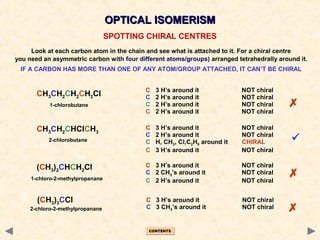
SPOTTING CHIRAL CENTRES
Look at each carbon atom in the chain and see what is attached to it. For a chiral centre
you need an asymmetric carbon with four different atoms/groups) arranged tetrahedrally around it.
IF A CARBON HAS MORE THAN ONE OF ANY ATOM/GROUP ATTACHED, IT CAN’T BE CHIRAL
CH3CH2CHClCH3
CH3CH2CH2CH2Cl
C 3 H’s around it NOT chiral
C 2 H’s around it NOT chiral
C 3 H’s around it NOT chiral
C 2 H’s around it NOT chiral
C H, CH3, Cl,C2H5 around it CHIRAL
C 3 H’s around it NOT chiral
(CH3)3CCl C 3 H’s around it NOT chiral
C 3 CH3’s around it NOT chiral
1-chlorobutane
2-chlorobutane
2-chloro-2-methylpropanane
(CH3)2CHCH2Cl C 3 H’s around it NOT chiral
C 2 CH3’s around it NOT chiral
C 2 H’s around it NOT chiral1-chloro-2-methylpropanane




OPTICAL ISOMERISMOPTICAL ISOMERISM
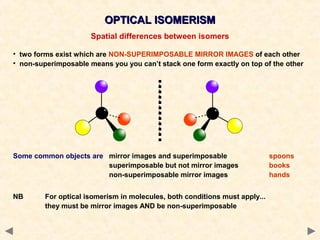
Spatial differences between isomers
• two forms exist which are NON-SUPERIMPOSABLE MIRROR IMAGES of each other
• non-superimposable means you you can’t stack one form exactly on top of the other
Some common objects are mirror images and superimposable spoons
superimposable but not mirror images books
non-superimposable mirror images hands
NB For optical isomerism in molecules, both conditions must apply...
they must be mirror images AND be non-superimposable
OPTICAL ISOMERISMOPTICAL ISOMERISM
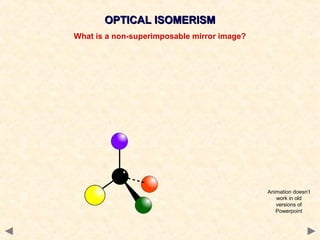
What is a non-superimposable mirror image?
Animation doesn’t
work in old
versions of
Powerpoint
OPTICAL ISOMERS -OPTICAL ISOMERS - DIFFERENCEDIFFERENCE
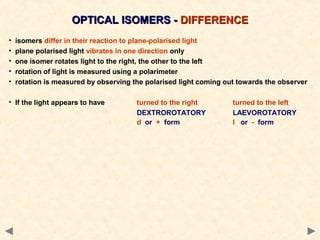
• isomers differ in their reaction to plane-polarised light
• plane polarised light vibrates in one direction only
• one isomer rotates light to the right, the other to the left
• rotation of light is measured using a polarimeter
• rotation is measured by observing the polarised light coming out towards the observer
• If the light appears to have turned to the right turned to the left
DEXTROROTATORY LAEVOROTATORY
d or + form l or - form
OPTICAL ISOMERS -OPTICAL ISOMERS - DIFFERENCEDIFFERENCE
• isomers differ in their reaction to plane-polarised light
• plane polarised light vibrates in one direction only
• one isomer rotates light to the right, the other to the left
• rotation of light is measured using a polarimeter
• rotation is measured by observing the polarised light coming out towards the observer
• If the light appears to have turned to the right turned to the left
DEXTROROTATORY LAEVOROTATORY
d or + form l or - form
Racemate a 50-50 mixture of the two enantiomers (dl) or (±) is a racemic mixture.
The opposite optical effects of each isomer cancel each other out
Examples Optical activity is common in biochemistry and pharmaceuticals
• Most amino acids exhibit optical activity
• many drugs must be made of one optical isomer to be effective
- need smaller doses (safer and cost effective)
- get reduced side effects
- improved pharmacological activity
OPTICAL ISOMERISMOPTICAL ISOMERISM
The polarimeter
If the light appears to have turned to the right turned to the left
DEXTROROTATORY LAEVOROTATORY
A Light source produces light vibrating in all directions
B Polarising filter only allows through light vibrating in one direction
C Plane polarised light passes through sample
D If substance is optically active it rotates the plane polarised light
E Analysing filter is turned so that light reaches a maximum
F Direction of rotation is measured coming towards the observer
A B
C D
E
F

Isomerism

  • 1.
  • 2.
    TYPES OF ISOMERISMTYPESOF ISOMERISM Occurs due to the restricted rotation of C=C double bonds... two forms - CIS and TRANS STRUCTURAL ISOMERISM STEREOISOMERISM GEOMETRICAL ISOMERISM OPTICAL ISOMERISM CHAIN ISOMERISM Same molecular formula but different structural formulae Occurs when molecules have a chiral centre. Get two non- superimposable mirror images. Same molecular formula but atoms occupy different positions in space. POSITION ISOMERISM FUNCTIONAL GROUP ISOMERISM
  • 3.
    STRUCTURAL ISOMERISM -STRUCTURALISOMERISM - INTRODUCTIONINTRODUCTION COMPOUNDS HAVE THE SAME MOLECULAR FORMULA BUT DIFFERENT STRUCTURAL FORMULA Chain different arrangements of the carbon skeleton similar chemical properties slightly different physical properties more branching = lower boiling point
  • 4.
    STRUCTURAL ISOMERISM -STRUCTURALISOMERISM - INTRODUCTIONINTRODUCTION COMPOUNDS HAVE THE SAME MOLECULAR FORMULA BUT DIFFERENT STRUCTURAL FORMULA Chain different arrangements of the carbon skeleton similar chemical properties slightly different physical properties more branching = lower boiling point Positional same carbon skeleton same functional group functional group is in a different position similar chemical properties - slightly different physical properties
  • 5.
    STRUCTURAL ISOMERISM -STRUCTURALISOMERISM - INTRODUCTIONINTRODUCTION COMPOUNDS HAVE THE SAME MOLECULAR FORMULA BUT DIFFERENT STRUCTURAL FORMULA Chain different arrangements of the carbon skeleton similar chemical properties slightly different physical properties more branching = lower boiling point Positional same carbon skeleton same functional group functional group is in a different position similar chemical properties - slightly different physical properties Functional Group different functional group different chemical properties different physical properties • Sometimes more than one type of isomerism occurs in the same molecule. • The more carbon atoms there are, the greater the number of possible isomers
  • 6.
    caused by differentarrangements of the carbon skeleton similar chemical properties slightly different physical properties more branching = lower boiling point There are two structural isomers of C4H10. One is a straight chain molecule where all the carbon atoms are in a single row. The other is a branched molecule where three carbon atoms are in a row and one carbon atom sticks out of the main chain. BUTANE straight chain 2-METHYLPROPANE branched C4H10 STRUCTURAL ISOMERISM -STRUCTURAL ISOMERISM - CHAINCHAIN
  • 7.
    STRUCTURAL ISOMERISM -STRUCTURALISOMERISM - CHAINCHAIN DIFFERENCES BETWEEN CHAIN ISOMERS Chemical Isomers show similar chemical properties because the same functional group is present. Physical Properties such as density and boiling point show trends according to the of the degree of branching Boiling Point “straight” chain isomers have higher values than branched ones the greater the degree of branching the lower the boiling point branching decreases the effectiveness of intermolecular forces less energy has to be put in to separate the molecules - 0.5°C straight chain - 11.7°C branched greater branching = lower boiling point
  • 8.
    POSITION OF ADOUBLE BOND IN ALKENES PENT-1-ENE double bond between carbons 1 and 2 PENT-2-ENE double bond between carbons 2 and 3 1 2 2 3 There are no other isomers with five C’s in the longest chain but there are three other structural isomers with a chain of four carbons plus one in a branch. Example 1 STRUCTURAL ISOMERISM -STRUCTURAL ISOMERISM - POSITIONALPOSITIONAL molecule has the same carbon skeleton molecule has the same same functional group... BUT the functional group is in a different position have similar chemical properties / different physical properties
  • 9.
    1-CHLOROBUTANE halogen on carbon1 1 2 Moving the chlorine along the chain makes new isomers; the position is measured from the end nearest the functional group... the third example is 2- NOT 3-chlorobutane. There are 2 more structural isomers of C4H9Cl but they have a longest chain of 3 2-CHLOROBUTANE halogen on carbon 2 BUT is NOT 3-CHLOROBUTANE 2 POSITION OF A HALOGEN IN A HALOALKANEExample 2 STRUCTURAL ISOMERISM -STRUCTURAL ISOMERISM - POSITIONALPOSITIONAL molecule has the same carbon skeleton molecule has the same same functional group... BUT the functional group is in a different position have similar chemical properties / different physical properties
  • 10.
    STRUCTURAL ISOMERISM -STRUCTURALISOMERISM - POSITIONALPOSITIONAL 1,3-DICHLOROBENZENE meta dichlorobenzene 1,2-DICHLOROBENZENE ortho dichlorobenzene 1,4-DICHLOROBENZENE para dichlorobenzene RELATIVE POSITIONS ON A BENZENE RINGExample 3 molecule has the same carbon skeleton molecule has the same same functional group... BUT the functional group is in a different position have similar chemical properties / different physical properties
  • 11.
    STRUCTURAL ISOMERISM –STRUCTURALISOMERISM – FUNCTIONAL GROUPFUNCTIONAL GROUP molecules have same molecular formula molecules have different functional groups molecules have different chemical properties molecules have different physical properties ALCOHOLS and ETHERS ALDEHYDES and KETONES ACIDS and ESTERS MORE DETAILS FOLLOW
  • 12.
    ALCOHOLS and ETHERS NameETHANOL METHOXYMETHANE Classification ALCOHOL ETHER Functional Group R-OH R-O-R Physical properties polar O-H bond gives rise No hydrogen bonding to hydrogen bonding. low boiling point get higher boiling point insoluble in water and solubility in water Chemical properties Lewis base Inert Wide range of reactions STRUCTURAL ISOMERISM –STRUCTURAL ISOMERISM – FUNCTIONAL GROUPFUNCTIONAL GROUP
  • 13.
    ALDEHYDES and KETONES NamePROPANAL PROPANONE Classification ALDEHYDE KETONE Functional Group R-CHO R-CO-R Physical properties polar C=O bond gives polar C=O bond gives dipole-dipole interaction dipole-dipole interaction Chemical properties easily oxidised to acids of undergo oxidation under same number of carbons extreme conditions only reduced to 1° alcohols reduced to 1° alcohols STRUCTURAL ISOMERISM –STRUCTURAL ISOMERISM – FUNCTIONAL GROUPFUNCTIONAL GROUP
  • 14.
    CARBOXYLIC ACIDS andESTERS Name PROPANOIC ACID METHYL ETHANOATE Classification CARBOXYLIC ACID ESTER Functional Group R-COOH R-COOR Physical properties O-H bond gives rise No hydrogen bonding to hydrogen bonding. insoluble in water get higher boiling point and solubility in water Chemical properties acidic fairly unreactive reacts with alcohols hydrolysed to acids STRUCTURAL ISOMERISM –STRUCTURAL ISOMERISM – FUNCTIONAL GROUPFUNCTIONAL GROUP
  • 15.
    STEREOISOMERISMSTEREOISOMERISM Molecules have theSAME MOLECULAR FORMULA but the atoms are joined to each other in a DIFFERENT SPACIAL ARRANGEMENT - they occupy a different position in 3-dimensional space. There are two types... • GEOMETRICAL ISOMERISM • OPTICAL ISOMERISM
  • 16.
    GEOMETRICAL ISOMERISM INALKENESGEOMETRICAL ISOMERISM IN ALKENES Introduction • an example of stereoisomersim • found in some, but not all, alkenes • occurs due to the RESTRICTED ROTATION OF C=C bonds • get two forms.... CIS Groups/atoms are on the SAME SIDE of the double bond TRANS Groups/atoms are on OPPOSITE SIDES across the double bond Isomers - have different physical properties - e.g. boiling points, density - have similar chemical properties - in most cases
  • 17.
    GEOMETRICAL ISOMERISMGEOMETRICAL ISOMERISM RESTRICTEDROTATION OF C=C BONDS Single covalent bonds can easily rotate. What appears to be a different structure in an alkane is not. Due to the way structures are written out, they are the same. ALL THESE STRUCTURES ARE THE SAME BECAUSE C-C BONDS HAVE ‘FREE’ ROTATION Animation doesn’t work in old versions of Powerpoint
  • 18.
    GEOMETRICAL ISOMERISMGEOMETRICAL ISOMERISM RESTRICTEDROTATION OF C=C BONDS C=C bonds have restricted rotation so the groups on either end of the bond are ‘frozen’ in one position; it isn’t easy to flip between the two. This produces two possibilities. The two structures cannot interchange easily so the atoms in the two molecules occupy different positions in space. Animation doesn’t work in old versions of Powerpoint
  • 19.
    GEOMETRICAL ISOMERISMGEOMETRICAL ISOMERISM Howto tell if it exists     Two different atoms/group s attached Two different atoms/group s attached Two similar atoms/group s attached Two similar atoms/group s attached Two similar atoms/group s attached Two different atoms/group s attached Two different atoms/group s attached Two different atoms/group s attached GEOMETRICAL ISOMERISM GEOMETRICAL ISOMERISM Once you get two similar atoms/groups attached to one end of a C=C, you cannot have geometrical isomerism
  • 20.
    GEOMETRICAL ISOMERISMGEOMETRICAL ISOMERISM Isomerismin butene There are 3 structural isomers of C4H8 that are alkenes*. Of these ONLY ONE exhibits geometrical isomerism. BUT-1-ENE 2-METHYLPROPENEtrans BUT-2-ENEcis BUT-2-ENE * YOU CAN GET ALKANES WITH FORMULA C4H8 IF THE CARBON ATOMS ARE IN A RING
  • 21.
    OPTICAL ISOMERISMOPTICAL ISOMERISM Occurrenceanother form of stereoisomerism occurs when compounds have non-superimposable mirror images Isomers the two different forms are known as optical isomers or enantiomers they occur when molecules have a chiral centre a chiral centre contains an asymmetric carbon atom an asymmetric carbon has four different atoms (or groups) arranged tetrahedrally around it. There are four different colours arranged tetrahedrally about the carbon atom 2-chlorobutane exhibits optical isomerism because the second carbon atom has four different atoms/groups attached CHIRAL CENTRES
  • 22.
    OPTICAL ISOMERISMOPTICAL ISOMERISM CONTENTSCONTENTS SPOTTINGCHIRAL CENTRES Look at each carbon atom in the chain and see what is attached to it. For a chiral centre you need an asymmetric carbon with four different atoms/groups) arranged tetrahedrally around it. IF A CARBON HAS MORE THAN ONE OF ANY ATOM/GROUP ATTACHED, IT CAN’T BE CHIRAL CH3CH2CHClCH3 CH3CH2CH2CH2Cl C 3 H’s around it NOT chiral C 2 H’s around it NOT chiral C 2 H’s around it NOT chiral C 2 H’s around it NOT chiral C 3 H’s around it NOT chiral C 2 H’s around it NOT chiral C H, CH3, Cl,C2H5 around it CHIRAL C 3 H’s around it NOT chiral (CH3)3CCl C 3 H’s around it NOT chiral C 3 CH3’s around it NOT chiral 1-chlorobutane 2-chlorobutane 2-chloro-2-methylpropanane (CH3)2CHCH2Cl C 3 H’s around it NOT chiral C 2 CH3’s around it NOT chiral C 2 H’s around it NOT chiral1-chloro-2-methylpropanane    
  • 23.
    OPTICAL ISOMERISMOPTICAL ISOMERISM Spatialdifferences between isomers • two forms exist which are NON-SUPERIMPOSABLE MIRROR IMAGES of each other • non-superimposable means you you can’t stack one form exactly on top of the other Some common objects are mirror images and superimposable spoons superimposable but not mirror images books non-superimposable mirror images hands NB For optical isomerism in molecules, both conditions must apply... they must be mirror images AND be non-superimposable
  • 24.
    OPTICAL ISOMERISMOPTICAL ISOMERISM Whatis a non-superimposable mirror image? Animation doesn’t work in old versions of Powerpoint
  • 25.
    OPTICAL ISOMERS -OPTICALISOMERS - DIFFERENCEDIFFERENCE • isomers differ in their reaction to plane-polarised light • plane polarised light vibrates in one direction only • one isomer rotates light to the right, the other to the left • rotation of light is measured using a polarimeter • rotation is measured by observing the polarised light coming out towards the observer • If the light appears to have turned to the right turned to the left DEXTROROTATORY LAEVOROTATORY d or + form l or - form
  • 26.
    OPTICAL ISOMERS -OPTICALISOMERS - DIFFERENCEDIFFERENCE • isomers differ in their reaction to plane-polarised light • plane polarised light vibrates in one direction only • one isomer rotates light to the right, the other to the left • rotation of light is measured using a polarimeter • rotation is measured by observing the polarised light coming out towards the observer • If the light appears to have turned to the right turned to the left DEXTROROTATORY LAEVOROTATORY d or + form l or - form Racemate a 50-50 mixture of the two enantiomers (dl) or (±) is a racemic mixture. The opposite optical effects of each isomer cancel each other out Examples Optical activity is common in biochemistry and pharmaceuticals • Most amino acids exhibit optical activity • many drugs must be made of one optical isomer to be effective - need smaller doses (safer and cost effective) - get reduced side effects - improved pharmacological activity
  • 27.
    OPTICAL ISOMERISMOPTICAL ISOMERISM Thepolarimeter If the light appears to have turned to the right turned to the left DEXTROROTATORY LAEVOROTATORY A Light source produces light vibrating in all directions B Polarising filter only allows through light vibrating in one direction C Plane polarised light passes through sample D If substance is optically active it rotates the plane polarised light E Analysing filter is turned so that light reaches a maximum F Direction of rotation is measured coming towards the observer A B C D E F