Chapter 5
Stereochemistry
Organic Chemistry
Chapter 5 2
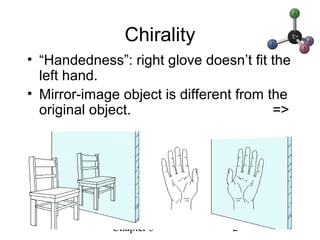
Chirality
• “Handedness”: right glove doesn’t fit the
left hand.
• Mirror-image object is different from the
original object. =>
Chapter 5 3
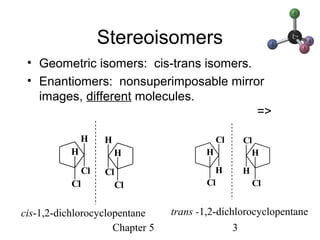
Stereoisomers
• Geometric isomers: cis-trans isomers.
• Enantiomers: nonsuperimposable mirror
images, different molecules.
=>
cis-1,2-dichlorocyclopentane trans -1,2-dichlorocyclopentane
H
Cl
H
Cl
H
Cl
H
Cl
H
Cl
Cl
H
H
Cl
Cl
H
Chapter 5 4
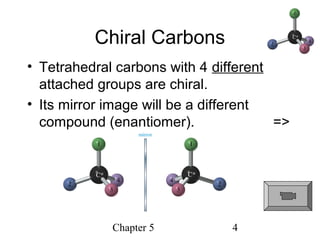
Chiral Carbons
• Tetrahedral carbons with 4 different
attached groups are chiral.
• Its mirror image will be a different
compound (enantiomer). =>
Chapter 5 5
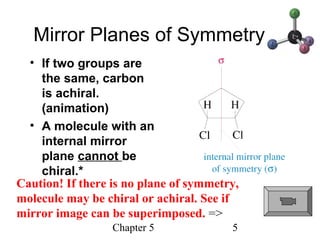
Mirror Planes of Symmetry
• If two groups are
the same, carbon
is achiral.
(animation)
• A molecule with an
internal mirror
plane cannot be
chiral.*
Caution! If there is no plane of symmetry,
molecule may be chiral or achiral. See if
mirror image can be superimposed. =>
Chapter 5 6
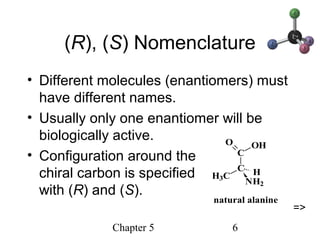
(R), (S) Nomenclature
• Different molecules (enantiomers) must
have different names.
• Usually only one enantiomer will be
biologically active.
• Configuration around the
chiral carbon is specified
with (R) and (S).
C
C
O OH
H3C
NH2
H
natural alanine
=>
Chapter 5 7
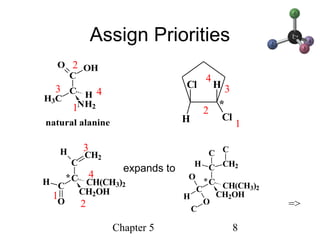
Cahn-Ingold-Prelog Rules
• Assign a priority number to each group
attached to the chiral carbon.
• Atom with highest atomic number
assigned the highest priority #1.
• In case of ties, look at the next atoms
along the chain.
• Double and triple bonds are treated like
bonds to duplicate atoms.
=>
Chapter 5 8
Assign Priorities
C
C
O OH
H3C
NH2
H
natural alanine
1
2
3 4
Cl
HCl
H
*
1
2
3
4
1
2
3
4
=>
C
C
O
H
C
H CH2
CH2OH
CH(CH3)2
* C
C
C
CH2OH
CH(CH3)2
H
O
O
C
C
H CH2
C
*
expands to
Chapter 5 9
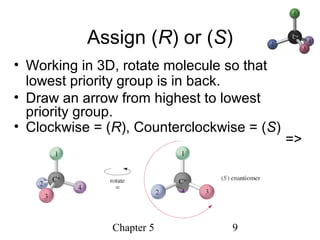
Assign (R) or (S)
• Working in 3D, rotate molecule so that
lowest priority group is in back.
• Draw an arrow from highest to lowest
priority group.
• Clockwise = (R), Counterclockwise = (S)
=>
Chapter 5 10
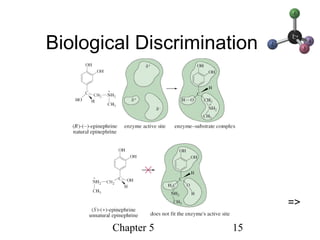
Properties of Enantiomers
• Same boiling point, melting point, density
• Same refractive index
• Different direction of rotation in polarimeter
• Different interaction with other chiral
molecules
– Enzymes
– Taste buds, scent
=>
Chapter 5 11
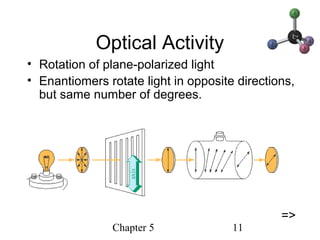
Optical Activity
• Rotation of plane-polarized light
• Enantiomers rotate light in opposite directions,
but same number of degrees.
=>
Chapter 5 12
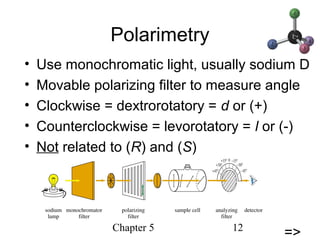
Polarimetry
• Use monochromatic light, usually sodium D
• Movable polarizing filter to measure angle
• Clockwise = dextrorotatory = d or (+)
• Counterclockwise = levorotatory = l or (-)
• Not related to (R) and (S)
=>
Chapter 5 13
Specific Rotation
Observed rotation depends on the length
of the cell and concentration, as well as
the strength of optical activity,
temperature, and wavelength of light.
[α] = α (observed)
c • l
c is concentration in g/mL
l is length of path in decimeters.
=>
Chapter 5 14
Calculate [α]D
• A 1.00-g sample is dissolved in 20.0 mL
ethanol. 5.00 mL of this solution is
placed in a 20.0-cm polarimeter tube at
25°C. The observed rotation is 1.25°
counterclockwise.
=>
Chapter 5 15
Biological Discrimination
=>
Chapter 5 16
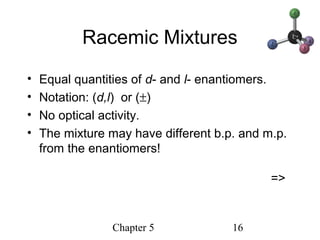
Racemic Mixtures
• Equal quantities of d- and l- enantiomers.
• Notation: (d,l) or (±)
• No optical activity.
• The mixture may have different b.p. and m.p.
from the enantiomers!
=>
Chapter 5 17
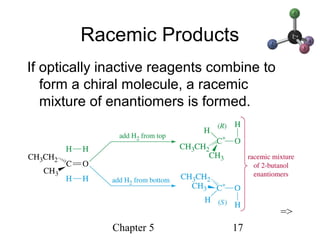
Racemic Products
If optically inactive reagents combine to
form a chiral molecule, a racemic
mixture of enantiomers is formed.
=>
Chapter 5 18
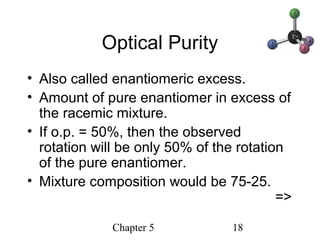
Optical Purity
• Also called enantiomeric excess.
• Amount of pure enantiomer in excess of
the racemic mixture.
• If o.p. = 50%, then the observed
rotation will be only 50% of the rotation
of the pure enantiomer.
• Mixture composition would be 75-25.
=>
Chapter 5 19
Calculate % Composition
The specific rotation of (S)-2-iodobutane is
+15.90°. Determine the % composition of a
mixture of (R)- and (S)-2-iodobutane if the
specific rotation of the mixture is -3.18°.
=>
Chapter 5 20
Chirality of Conformers
• If equilibrium exists between two chiral
conformers, molecule is not chiral.
• Judge chirality by looking at the most
symmetrical conformer.
• Cyclohexane can be considered to be
planar, on average.
=>
Chapter 5 21
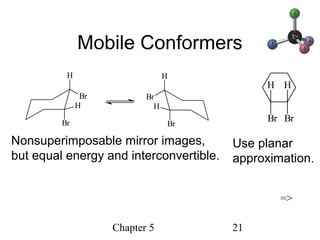
Mobile Conformers
H
Br
H
Br
H
Br
H
Br
Nonsuperimposable mirror images,
but equal energy and interconvertible.
BrBr
H H
Use planar
approximation.
=>
Chapter 5 22
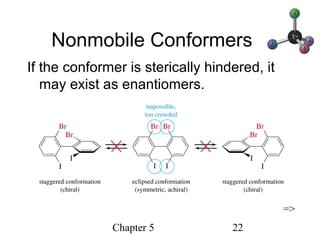
Nonmobile Conformers
If the conformer is sterically hindered, it
may exist as enantiomers.
=>
Chapter 5 23
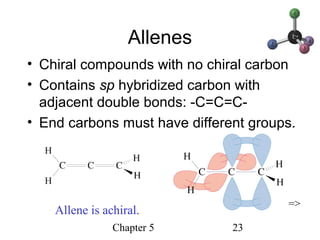
Allenes
• Chiral compounds with no chiral carbon
• Contains sp hybridized carbon with
adjacent double bonds: -C=C=C-
• End carbons must have different groups.
Allene is achiral.
=>
Chapter 5 24
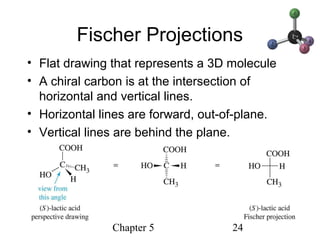
Fischer Projections
• Flat drawing that represents a 3D molecule
• A chiral carbon is at the intersection of
horizontal and vertical lines.
• Horizontal lines are forward, out-of-plane.
• Vertical lines are behind the plane.
Chapter 5 25
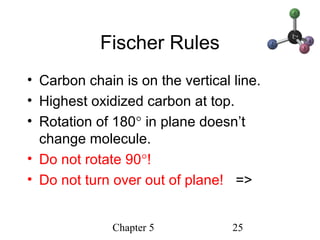
Fischer Rules
• Carbon chain is on the vertical line.
• Highest oxidized carbon at top.
• Rotation of 180° in plane doesn’t
change molecule.
• Do not rotate 90°!
• Do not turn over out of plane! =>
Chapter 5 26
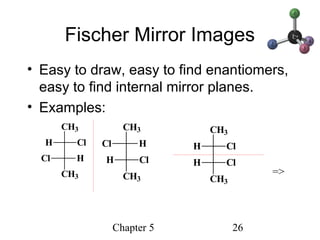
Fischer Mirror Images
• Easy to draw, easy to find enantiomers,
easy to find internal mirror planes.
• Examples:
CH3
H Cl
Cl H
CH3
CH3
Cl H
H Cl
CH3
CH3
H Cl
H Cl
CH3
=>
Chapter 5 27
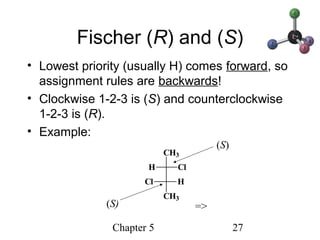
Fischer (R) and (S)
• Lowest priority (usually H) comes forward, so
assignment rules are backwards!
• Clockwise 1-2-3 is (S) and counterclockwise
1-2-3 is (R).
• Example:
CH3
H Cl
Cl H
CH3
(S)
(S) =>
Chapter 5 28
Diastereomers
• Stereoisomers that are not mirror images.
• Geometric isomers (cis-trans)
• Molecules with 2 or more chiral carbons.
=>
Chapter 5 29
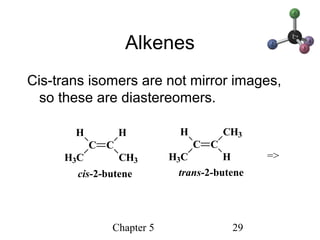
Alkenes
Cis-trans isomers are not mirror images,
so these are diastereomers.
C C
H H
CH3H3C
cis-2-butene trans-2-butene
C C
H
H3C
CH3
H =>
Chapter 5 30
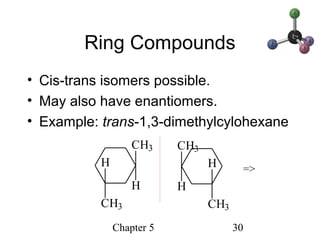
Ring Compounds
• Cis-trans isomers possible.
• May also have enantiomers.
• Example: trans-1,3-dimethylcylohexane
CH3
H
H
CH3
CH3
H
H
CH3
=>
Chapter 5 31
Two or More Chiral Carbons
• Enantiomer? Diastereomer? Meso? Assign
(R) or (S) to each chiral carbon.
• Enantiomers have opposite configurations at
each corresponding chiral carbon.
• Diastereomers have some matching, some
opposite configurations.
• Meso compounds have internal mirror plane.
• Maximum number is 2n
, where n = the number
of chiral carbons.
=>
Chapter 5 32
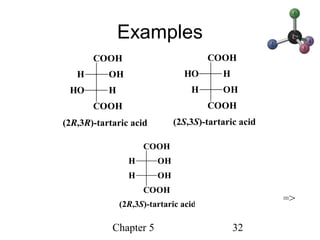
Examples
COOH
H OH
HO H
COOH
(2R,3R)-tartaric acid
COOH
COOH
HO H
H OH
(2S,3S)-tartaric acid
=>(2R,3S)-tartaric acid
COOH
COOH
H OH
H OH
Chapter 5 33
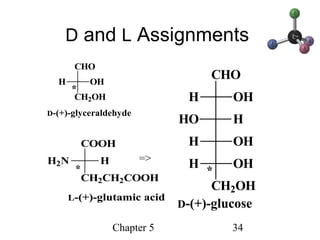
Fischer-Rosanoff Convention
• Before 1951, only relative configurations
could be known.
• Sugars and amino acids with same relative
configuration as (+)-glyceraldehyde were
assigned D and same as (-)-glyceraldehyde
were assigned L.
• With X-ray crystallography, now know
absolute configurations: D is (R) and L is (S).
• No relationship to dextro- or levorotatory.
=>
Chapter 5 34
D and L Assignments
CHO
H OH
CH2OH
D-(+)-glyceraldehyde
*
CHO
H OH
HO H
H OH
H OH
CH2OH
D-(+)-glucose
*
COOH
H2N H
CH2CH2COOH
L-(+)-glutamic acid
*
=>
Chapter 5 35
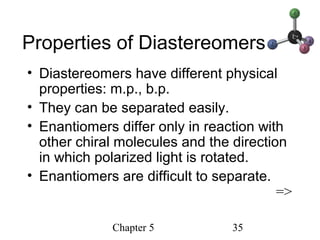
Properties of Diastereomers
• Diastereomers have different physical
properties: m.p., b.p.
• They can be separated easily.
• Enantiomers differ only in reaction with
other chiral molecules and the direction
in which polarized light is rotated.
• Enantiomers are difficult to separate.
=>
Chapter 5 36
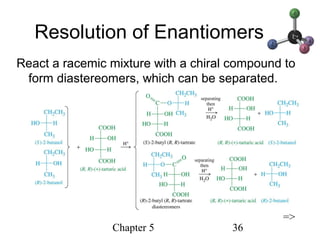
Resolution of Enantiomers
React a racemic mixture with a chiral compound to
form diastereomers, which can be separated.
=>
Chapter 5 37
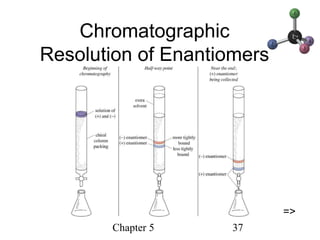
Chromatographic
Resolution of Enantiomers
=>
Chapter 5 38
End of Chapter 5

Stereochemistry

  • 1.
  • 2.
    Chapter 5 2 Chirality •“Handedness”: right glove doesn’t fit the left hand. • Mirror-image object is different from the original object. =>
  • 3.
    Chapter 5 3 Stereoisomers •Geometric isomers: cis-trans isomers. • Enantiomers: nonsuperimposable mirror images, different molecules. => cis-1,2-dichlorocyclopentane trans -1,2-dichlorocyclopentane H Cl H Cl H Cl H Cl H Cl Cl H H Cl Cl H
  • 4.
    Chapter 5 4 ChiralCarbons • Tetrahedral carbons with 4 different attached groups are chiral. • Its mirror image will be a different compound (enantiomer). =>
  • 5.
    Chapter 5 5 MirrorPlanes of Symmetry • If two groups are the same, carbon is achiral. (animation) • A molecule with an internal mirror plane cannot be chiral.* Caution! If there is no plane of symmetry, molecule may be chiral or achiral. See if mirror image can be superimposed. =>
  • 6.
    Chapter 5 6 (R),(S) Nomenclature • Different molecules (enantiomers) must have different names. • Usually only one enantiomer will be biologically active. • Configuration around the chiral carbon is specified with (R) and (S). C C O OH H3C NH2 H natural alanine =>
  • 7.
    Chapter 5 7 Cahn-Ingold-PrelogRules • Assign a priority number to each group attached to the chiral carbon. • Atom with highest atomic number assigned the highest priority #1. • In case of ties, look at the next atoms along the chain. • Double and triple bonds are treated like bonds to duplicate atoms. =>
  • 8.
    Chapter 5 8 AssignPriorities C C O OH H3C NH2 H natural alanine 1 2 3 4 Cl HCl H * 1 2 3 4 1 2 3 4 => C C O H C H CH2 CH2OH CH(CH3)2 * C C C CH2OH CH(CH3)2 H O O C C H CH2 C * expands to
  • 9.
    Chapter 5 9 Assign(R) or (S) • Working in 3D, rotate molecule so that lowest priority group is in back. • Draw an arrow from highest to lowest priority group. • Clockwise = (R), Counterclockwise = (S) =>
  • 10.
    Chapter 5 10 Propertiesof Enantiomers • Same boiling point, melting point, density • Same refractive index • Different direction of rotation in polarimeter • Different interaction with other chiral molecules – Enzymes – Taste buds, scent =>
  • 11.
    Chapter 5 11 OpticalActivity • Rotation of plane-polarized light • Enantiomers rotate light in opposite directions, but same number of degrees. =>
  • 12.
    Chapter 5 12 Polarimetry •Use monochromatic light, usually sodium D • Movable polarizing filter to measure angle • Clockwise = dextrorotatory = d or (+) • Counterclockwise = levorotatory = l or (-) • Not related to (R) and (S) =>
  • 13.
    Chapter 5 13 SpecificRotation Observed rotation depends on the length of the cell and concentration, as well as the strength of optical activity, temperature, and wavelength of light. [α] = α (observed) c • l c is concentration in g/mL l is length of path in decimeters. =>
  • 14.
    Chapter 5 14 Calculate[α]D • A 1.00-g sample is dissolved in 20.0 mL ethanol. 5.00 mL of this solution is placed in a 20.0-cm polarimeter tube at 25°C. The observed rotation is 1.25° counterclockwise. =>
  • 15.
    Chapter 5 15 BiologicalDiscrimination =>
  • 16.
    Chapter 5 16 RacemicMixtures • Equal quantities of d- and l- enantiomers. • Notation: (d,l) or (±) • No optical activity. • The mixture may have different b.p. and m.p. from the enantiomers! =>
  • 17.
    Chapter 5 17 RacemicProducts If optically inactive reagents combine to form a chiral molecule, a racemic mixture of enantiomers is formed. =>
  • 18.
    Chapter 5 18 OpticalPurity • Also called enantiomeric excess. • Amount of pure enantiomer in excess of the racemic mixture. • If o.p. = 50%, then the observed rotation will be only 50% of the rotation of the pure enantiomer. • Mixture composition would be 75-25. =>
  • 19.
    Chapter 5 19 Calculate% Composition The specific rotation of (S)-2-iodobutane is +15.90°. Determine the % composition of a mixture of (R)- and (S)-2-iodobutane if the specific rotation of the mixture is -3.18°. =>
  • 20.
    Chapter 5 20 Chiralityof Conformers • If equilibrium exists between two chiral conformers, molecule is not chiral. • Judge chirality by looking at the most symmetrical conformer. • Cyclohexane can be considered to be planar, on average. =>
  • 21.
    Chapter 5 21 MobileConformers H Br H Br H Br H Br Nonsuperimposable mirror images, but equal energy and interconvertible. BrBr H H Use planar approximation. =>
  • 22.
    Chapter 5 22 NonmobileConformers If the conformer is sterically hindered, it may exist as enantiomers. =>
  • 23.
    Chapter 5 23 Allenes •Chiral compounds with no chiral carbon • Contains sp hybridized carbon with adjacent double bonds: -C=C=C- • End carbons must have different groups. Allene is achiral. =>
  • 24.
    Chapter 5 24 FischerProjections • Flat drawing that represents a 3D molecule • A chiral carbon is at the intersection of horizontal and vertical lines. • Horizontal lines are forward, out-of-plane. • Vertical lines are behind the plane.
  • 25.
    Chapter 5 25 FischerRules • Carbon chain is on the vertical line. • Highest oxidized carbon at top. • Rotation of 180° in plane doesn’t change molecule. • Do not rotate 90°! • Do not turn over out of plane! =>
  • 26.
    Chapter 5 26 FischerMirror Images • Easy to draw, easy to find enantiomers, easy to find internal mirror planes. • Examples: CH3 H Cl Cl H CH3 CH3 Cl H H Cl CH3 CH3 H Cl H Cl CH3 =>
  • 27.
    Chapter 5 27 Fischer(R) and (S) • Lowest priority (usually H) comes forward, so assignment rules are backwards! • Clockwise 1-2-3 is (S) and counterclockwise 1-2-3 is (R). • Example: CH3 H Cl Cl H CH3 (S) (S) =>
  • 28.
    Chapter 5 28 Diastereomers •Stereoisomers that are not mirror images. • Geometric isomers (cis-trans) • Molecules with 2 or more chiral carbons. =>
  • 29.
    Chapter 5 29 Alkenes Cis-transisomers are not mirror images, so these are diastereomers. C C H H CH3H3C cis-2-butene trans-2-butene C C H H3C CH3 H =>
  • 30.
    Chapter 5 30 RingCompounds • Cis-trans isomers possible. • May also have enantiomers. • Example: trans-1,3-dimethylcylohexane CH3 H H CH3 CH3 H H CH3 =>
  • 31.
    Chapter 5 31 Twoor More Chiral Carbons • Enantiomer? Diastereomer? Meso? Assign (R) or (S) to each chiral carbon. • Enantiomers have opposite configurations at each corresponding chiral carbon. • Diastereomers have some matching, some opposite configurations. • Meso compounds have internal mirror plane. • Maximum number is 2n , where n = the number of chiral carbons. =>
  • 32.
    Chapter 5 32 Examples COOH HOH HO H COOH (2R,3R)-tartaric acid COOH COOH HO H H OH (2S,3S)-tartaric acid =>(2R,3S)-tartaric acid COOH COOH H OH H OH
  • 33.
    Chapter 5 33 Fischer-RosanoffConvention • Before 1951, only relative configurations could be known. • Sugars and amino acids with same relative configuration as (+)-glyceraldehyde were assigned D and same as (-)-glyceraldehyde were assigned L. • With X-ray crystallography, now know absolute configurations: D is (R) and L is (S). • No relationship to dextro- or levorotatory. =>
  • 34.
    Chapter 5 34 Dand L Assignments CHO H OH CH2OH D-(+)-glyceraldehyde * CHO H OH HO H H OH H OH CH2OH D-(+)-glucose * COOH H2N H CH2CH2COOH L-(+)-glutamic acid * =>
  • 35.
    Chapter 5 35 Propertiesof Diastereomers • Diastereomers have different physical properties: m.p., b.p. • They can be separated easily. • Enantiomers differ only in reaction with other chiral molecules and the direction in which polarized light is rotated. • Enantiomers are difficult to separate. =>
  • 36.
    Chapter 5 36 Resolutionof Enantiomers React a racemic mixture with a chiral compound to form diastereomers, which can be separated. =>
  • 37.
  • 38.
    Chapter 5 38 Endof Chapter 5