ASCII and BCD Arithmetic Chapter 11 S. Dandamudi
Outline Representation of Numbers ASCII representation BCD representation Unpacked BCD Packed BCD Processing ASCII numbers ASCII addition ASCII subtraction ASCII multiplication ASCII division Example: Multidigit ASCII addition Processing packed BCD numbers Packed BCD addition Packed BCD subtraction Example: Multibyte packed BCD addition Performance: Decimal versus binary arithmetic
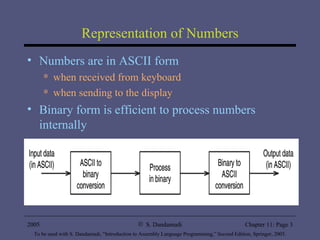
Representation of Numbers Numbers are in ASCII form when received from keyboard when sending to the display Binary form is efficient to process numbers internally
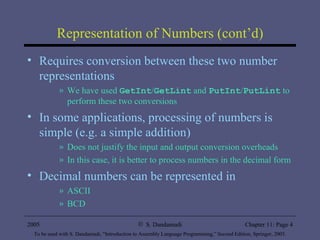
Representation of Numbers (cont’d) Requires conversion between these two number representations We have used  GetInt / GetLint  and  PutInt / PutLint  to perform these two conversions In some applications, processing of numbers is simple (e.g. a simple addition) Does not justify the input and output conversion overheads In this case, it is better to process numbers in the decimal form Decimal numbers can be represented in  ASCII BCD
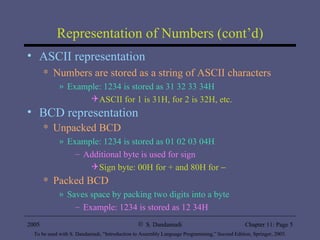
Representation of Numbers (cont’d) ASCII representation Numbers are stored as a string of ASCII characters Example: 1234 is stored as 31 32 33 34H ASCII for 1 is 31H, for 2 is 32H, etc. BCD representation Unpacked BCD Example: 1234 is stored as 01 02 03 04H Additional byte is used for sign Sign byte: 00H for + and 80H for   Packed BCD Saves space by packing two digits into a byte Example: 1234 is stored as 12 34H
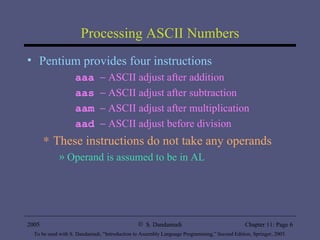
Processing ASCII Numbers Pentium provides four instructions aaa     ASCII adjust after addition aas     ASCII adjust after subtraction aam     ASCII adjust after multiplication aad     ASCII adjust before division These instructions do not take any operands Operand is assumed to be in AL
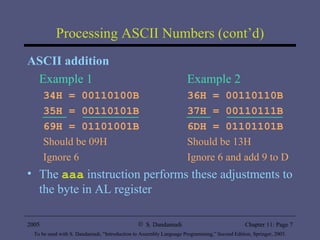
Processing ASCII Numbers (cont’d) ASCII addition Example 1 Example 2 34H = 00110100B 36H = 00110110B 35H = 00110101B 37H = 00110111B 69H = 01101001B 6DH = 01101101B Should be 09H Should be 13H Ignore 6 Ignore 6 and add 9 to D The  aaa  instruction performs these adjustments to the byte in AL register
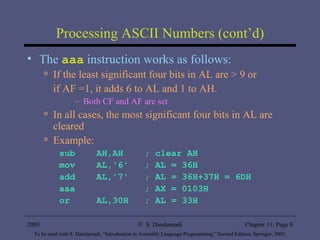
Processing ASCII Numbers (cont’d) The  aaa  instruction works as follows: If the least significant four bits in AL are > 9 or  if AF =1, it adds 6 to AL and 1 to AH. Both CF and AF are set In all cases, the most significant four bits in AL are cleared Example: sub  AH,AH  ; clear AH mov  AL,'6'  ; AL = 36H add  AL,'7'  ; AL = 36H+37H = 6DH aaa  ; AX = 0103H or  AL,30H  ; AL = 33H
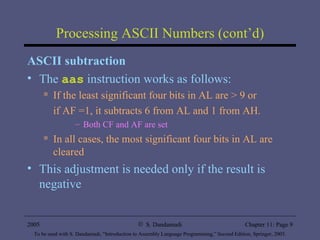
Processing ASCII Numbers (cont’d) ASCII subtraction The  aas  instruction works as follows: If the least significant four bits in AL are > 9 or  if AF =1, it subtracts 6 from AL and 1 from AH. Both CF and AF are set In all cases, the most significant four bits in AL are cleared This adjustment is needed only if the result is negative
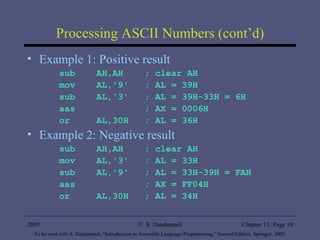
Processing ASCII Numbers (cont’d) Example 1: Positive result sub  AH,AH  ; clear AH mov  AL,'9'  ; AL = 39H sub  AL,'3'  ; AL = 39H-33H = 6H aas  ; AX = 0006H or  AL,30H  ; AL = 36H Example 2: Negative result sub  AH,AH  ; clear AH mov  AL,'3'  ; AL = 33H sub  AL,'9'  ; AL = 33H-39H = FAH aas  ; AX = FF04H or  AL,30H  ; AL = 34H
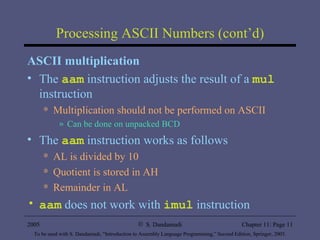
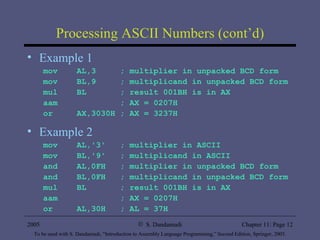
Processing ASCII Numbers (cont’d) ASCII multiplication The  aam  instruction adjusts the result of a  mul  instruction Multiplication should not be performed on ASCII Can be done on unpacked BCD The  aam  instruction works as follows AL is divided by 10 Quotient is stored in AH Remainder in AL aam  does not work with  imul  instruction
Processing ASCII Numbers (cont’d) Example 1 mov  AL,3  ; multiplier in unpacked BCD form mov  BL,9  ; multiplicand in unpacked BCD form mul  BL  ; result 001BH is in AX aam  ; AX = 0207H or  AX,3030H ; AX = 3237H Example 2 mov  AL,'3'  ; multiplier in ASCII mov  BL,'9'  ; multiplicand in ASCII and  AL,0FH  ; multiplier in unpacked BCD form and  BL,0FH  ; multiplicand in unpacked BCD form mul  BL  ; result 001BH is in AX aam  ; AX = 0207H or  AL,30H  ; AL = 37H
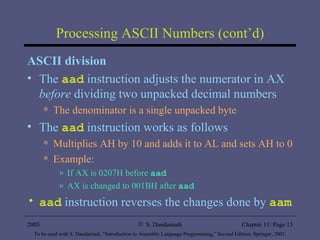
Processing ASCII Numbers (cont’d) ASCII division The  aad  instruction adjusts the numerator in AX  before  dividing two unpacked decimal numbers The denominator is a single unpacked byte The  aad  instruction works as follows Multiplies AH by 10 and adds it to AL and sets AH to 0 Example: If AX is 0207H before  aad AX is changed to 001BH after  aad aad  instruction reverses the changes done by  aam
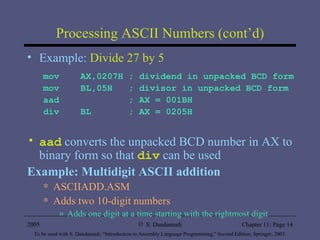
Processing ASCII Numbers (cont’d) Example:  Divide 27 by 5 mov  AX,0207H ; dividend in unpacked BCD form mov  BL,05H  ; divisor in unpacked BCD form aad  ; AX = 001BH div  BL  ; AX = 0205H aad  converts the unpacked BCD number in AX to binary form so that  div  can be used Example: Multidigit ASCII addition ASCIIADD.ASM Adds two 10-digit numbers Adds one digit at a time starting with the rightmost digit
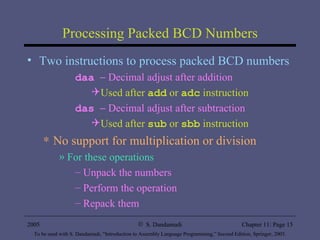
Processing Packed BCD Numbers Two instructions to process packed BCD numbers daa     Decimal adjust after addition Used after  add  or  adc  instruction das     Decimal adjust after subtraction Used after  sub  or  sbb  instruction No support for multiplication or division For these operations Unpack the numbers Perform the operation Repack them
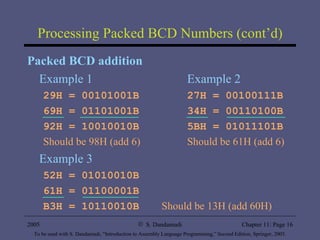
Processing Packed BCD Numbers (cont’d) Packed BCD addition Example 1 Example 2 29H = 00101001B 27H = 00100111B 69H = 01101001B 34H = 00110100B 92H = 10010010B 5BH = 01011101B Should be 98H (add 6) Should be 61H (add 6) Example 3 52H = 01010010B 61H = 01100001B B3H = 10110010B   Should be 13H (add 60H)
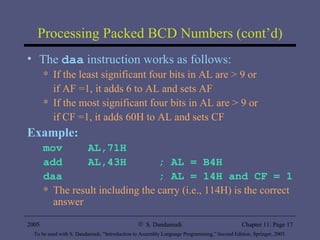
Processing Packed BCD Numbers (cont’d) The  daa  instruction works as follows: If the least significant four bits in AL are > 9 or  if AF =1, it adds 6 to AL and sets AF If the most significant four bits in AL are > 9 or  if CF =1, it adds 60H to AL and sets CF Example: mov  AL,71H add  AL,43H  ; AL = B4H daa  ; AL = 14H and CF = 1 The result including the carry (i.e., 114H) is the correct answer
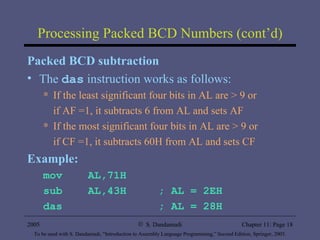
Processing Packed BCD Numbers (cont’d) Packed BCD subtraction The  das  instruction works as follows: If the least significant four bits in AL are > 9 or  if AF =1, it subtracts 6 from AL and sets AF If the most significant four bits in AL are > 9 or  if CF =1, it subtracts 60H from AL and sets CF Example: mov  AL,71H sub  AL,43H  ; AL = 2EH das  ; AL = 28H
Processing Packed BCD Numbers (cont’d) Example: Multibyte packed BCD addition Adds two 10-digit numbers Adds two digits at a time starting from the rightmost pair
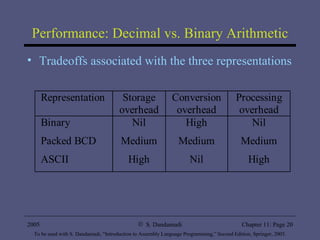
Performance: Decimal vs. Binary Arithmetic Tradeoffs associated with the three representations

Al2ed chapter11

  • 1.
    ASCII and BCDArithmetic Chapter 11 S. Dandamudi
  • 2.
    Outline Representation ofNumbers ASCII representation BCD representation Unpacked BCD Packed BCD Processing ASCII numbers ASCII addition ASCII subtraction ASCII multiplication ASCII division Example: Multidigit ASCII addition Processing packed BCD numbers Packed BCD addition Packed BCD subtraction Example: Multibyte packed BCD addition Performance: Decimal versus binary arithmetic
  • 3.
    Representation of NumbersNumbers are in ASCII form when received from keyboard when sending to the display Binary form is efficient to process numbers internally
  • 4.
    Representation of Numbers(cont’d) Requires conversion between these two number representations We have used GetInt / GetLint and PutInt / PutLint to perform these two conversions In some applications, processing of numbers is simple (e.g. a simple addition) Does not justify the input and output conversion overheads In this case, it is better to process numbers in the decimal form Decimal numbers can be represented in ASCII BCD
  • 5.
    Representation of Numbers(cont’d) ASCII representation Numbers are stored as a string of ASCII characters Example: 1234 is stored as 31 32 33 34H ASCII for 1 is 31H, for 2 is 32H, etc. BCD representation Unpacked BCD Example: 1234 is stored as 01 02 03 04H Additional byte is used for sign Sign byte: 00H for + and 80H for  Packed BCD Saves space by packing two digits into a byte Example: 1234 is stored as 12 34H
  • 6.
    Processing ASCII NumbersPentium provides four instructions aaa  ASCII adjust after addition aas  ASCII adjust after subtraction aam  ASCII adjust after multiplication aad  ASCII adjust before division These instructions do not take any operands Operand is assumed to be in AL
  • 7.
    Processing ASCII Numbers(cont’d) ASCII addition Example 1 Example 2 34H = 00110100B 36H = 00110110B 35H = 00110101B 37H = 00110111B 69H = 01101001B 6DH = 01101101B Should be 09H Should be 13H Ignore 6 Ignore 6 and add 9 to D The aaa instruction performs these adjustments to the byte in AL register
  • 8.
    Processing ASCII Numbers(cont’d) The aaa instruction works as follows: If the least significant four bits in AL are > 9 or if AF =1, it adds 6 to AL and 1 to AH. Both CF and AF are set In all cases, the most significant four bits in AL are cleared Example: sub AH,AH ; clear AH mov AL,'6' ; AL = 36H add AL,'7' ; AL = 36H+37H = 6DH aaa ; AX = 0103H or AL,30H ; AL = 33H
  • 9.
    Processing ASCII Numbers(cont’d) ASCII subtraction The aas instruction works as follows: If the least significant four bits in AL are > 9 or if AF =1, it subtracts 6 from AL and 1 from AH. Both CF and AF are set In all cases, the most significant four bits in AL are cleared This adjustment is needed only if the result is negative
  • 10.
    Processing ASCII Numbers(cont’d) Example 1: Positive result sub AH,AH ; clear AH mov AL,'9' ; AL = 39H sub AL,'3' ; AL = 39H-33H = 6H aas ; AX = 0006H or AL,30H ; AL = 36H Example 2: Negative result sub AH,AH ; clear AH mov AL,'3' ; AL = 33H sub AL,'9' ; AL = 33H-39H = FAH aas ; AX = FF04H or AL,30H ; AL = 34H
  • 11.
    Processing ASCII Numbers(cont’d) ASCII multiplication The aam instruction adjusts the result of a mul instruction Multiplication should not be performed on ASCII Can be done on unpacked BCD The aam instruction works as follows AL is divided by 10 Quotient is stored in AH Remainder in AL aam does not work with imul instruction
  • 12.
    Processing ASCII Numbers(cont’d) Example 1 mov AL,3 ; multiplier in unpacked BCD form mov BL,9 ; multiplicand in unpacked BCD form mul BL ; result 001BH is in AX aam ; AX = 0207H or AX,3030H ; AX = 3237H Example 2 mov AL,'3' ; multiplier in ASCII mov BL,'9' ; multiplicand in ASCII and AL,0FH ; multiplier in unpacked BCD form and BL,0FH ; multiplicand in unpacked BCD form mul BL ; result 001BH is in AX aam ; AX = 0207H or AL,30H ; AL = 37H
  • 13.
    Processing ASCII Numbers(cont’d) ASCII division The aad instruction adjusts the numerator in AX before dividing two unpacked decimal numbers The denominator is a single unpacked byte The aad instruction works as follows Multiplies AH by 10 and adds it to AL and sets AH to 0 Example: If AX is 0207H before aad AX is changed to 001BH after aad aad instruction reverses the changes done by aam
  • 14.
    Processing ASCII Numbers(cont’d) Example: Divide 27 by 5 mov AX,0207H ; dividend in unpacked BCD form mov BL,05H ; divisor in unpacked BCD form aad ; AX = 001BH div BL ; AX = 0205H aad converts the unpacked BCD number in AX to binary form so that div can be used Example: Multidigit ASCII addition ASCIIADD.ASM Adds two 10-digit numbers Adds one digit at a time starting with the rightmost digit
  • 15.
    Processing Packed BCDNumbers Two instructions to process packed BCD numbers daa  Decimal adjust after addition Used after add or adc instruction das  Decimal adjust after subtraction Used after sub or sbb instruction No support for multiplication or division For these operations Unpack the numbers Perform the operation Repack them
  • 16.
    Processing Packed BCDNumbers (cont’d) Packed BCD addition Example 1 Example 2 29H = 00101001B 27H = 00100111B 69H = 01101001B 34H = 00110100B 92H = 10010010B 5BH = 01011101B Should be 98H (add 6) Should be 61H (add 6) Example 3 52H = 01010010B 61H = 01100001B B3H = 10110010B Should be 13H (add 60H)
  • 17.
    Processing Packed BCDNumbers (cont’d) The daa instruction works as follows: If the least significant four bits in AL are > 9 or if AF =1, it adds 6 to AL and sets AF If the most significant four bits in AL are > 9 or if CF =1, it adds 60H to AL and sets CF Example: mov AL,71H add AL,43H ; AL = B4H daa ; AL = 14H and CF = 1 The result including the carry (i.e., 114H) is the correct answer
  • 18.
    Processing Packed BCDNumbers (cont’d) Packed BCD subtraction The das instruction works as follows: If the least significant four bits in AL are > 9 or if AF =1, it subtracts 6 from AL and sets AF If the most significant four bits in AL are > 9 or if CF =1, it subtracts 60H from AL and sets CF Example: mov AL,71H sub AL,43H ; AL = 2EH das ; AL = 28H
  • 19.
    Processing Packed BCDNumbers (cont’d) Example: Multibyte packed BCD addition Adds two 10-digit numbers Adds two digits at a time starting from the rightmost pair
  • 20.
    Performance: Decimal vs.Binary Arithmetic Tradeoffs associated with the three representations