

Introduction Chapter 1 S. Dandamudi
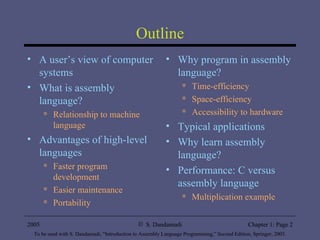
Outline A user’s view of computer systems What is assembly language? Relationship to machine language Advantages of high-level languages Faster program development Easier maintenance Portability Why program in assembly language? Time-efficiency Space-efficiency Accessibility to hardware Typical applications Why learn assembly language? Performance: C versus assembly language Multiplication example
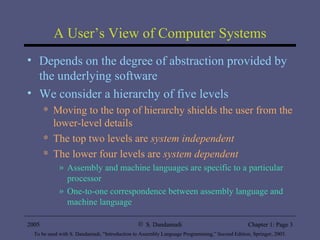
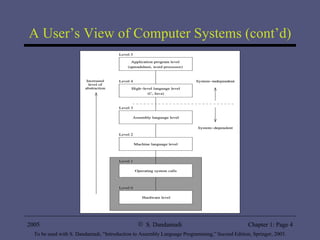
A User’s View of Computer Systems Depends on the degree of abstraction provided by the underlying software We consider a hierarchy of five levels Moving to the top of hierarchy shields the user from the lower-level details The top two levels are  system independent The lower four levels are  system dependent Assembly and machine languages are specific to a particular processor One-to-one correspondence between assembly language and machine language
A User’s View of Computer Systems (cont’d)
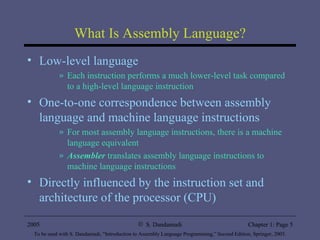
What Is Assembly Language? Low-level language Each instruction performs a much lower-level task compared to a high-level language instruction One-to-one correspondence between assembly language and machine language instructions For most assembly language instructions, there is a machine language equivalent Assembler  translates assembly language instructions to machine language instructions Directly influenced by the instruction set and architecture of the processor (CPU)
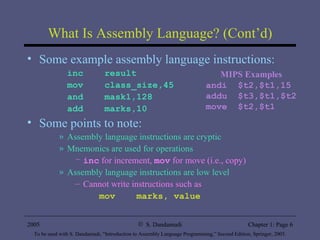
What Is Assembly Language? (Cont’d) Some example assembly language instructions: inc  result mov  class_size,45 and  mask1,128 add  marks,10 Some points to note: Assembly language instructions are cryptic Mnemonics are used for operations inc  for increment,  mov  for move (i.e., copy)  Assembly language instructions are low level Cannot write instructions such as mov  marks, value MIPS Examples andi  $t2,$t1,15 addu  $t3,$t1,$t2 move  $t2,$t1
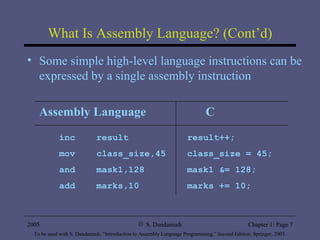
What Is Assembly Language? (Cont’d) Some simple high-level language instructions can be expressed by a single assembly instruction Assembly Language   C inc  result result++; mov  class_size,45 class_size = 45; and  mask1,128 mask1 &= 128; add  marks,10 marks += 10;
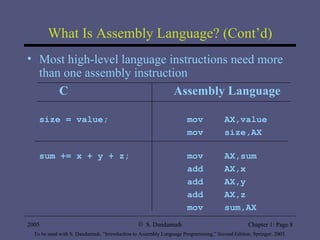
What Is Assembly Language? (Cont’d) Most high-level language instructions need more than one assembly instruction C     Assembly Language size = value; mov  AX,value mov  size,AX sum += x + y + z; mov  AX,sum add  AX,x add  AX,y add  AX,z mov  sum,AX
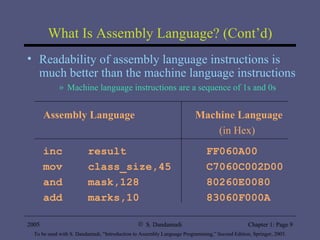
What Is Assembly Language? (Cont’d) Readability of assembly language instructions is much better than the machine language instructions Machine language instructions are a sequence of 1s and 0s Assembly Language     Machine Language   (in Hex) inc  result   FF060A00 mov  class_size,45   C7060C002D00 and  mask,128   80260E0080 add  marks,10   83060F000A
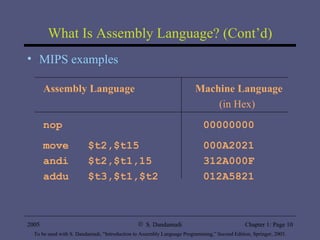
What Is Assembly Language? (Cont’d) MIPS examples Assembly Language     Machine Language   (in Hex) nop  00000000 move  $t2,$t15  000A2021 andi  $t2,$t1,15  312A000F addu  $t3,$t1,$t2  012A5821
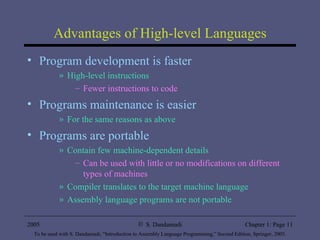
Advantages of High-level Languages Program development is faster High-level instructions Fewer instructions to code Programs maintenance is easier For the same reasons as above Programs are portable Contain few machine-dependent details Can be used with little or no modifications on different types of machines Compiler translates to the target machine language Assembly language programs are not portable
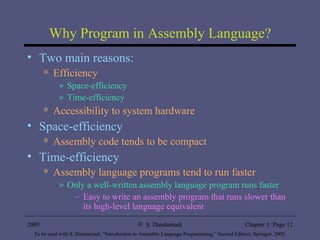
Why Program in Assembly Language? Two main reasons: Efficiency Space-efficiency Time-efficiency Accessibility to system hardware Space-efficiency Assembly code tends to be compact Time-efficiency Assembly language programs tend to run faster Only a well-written assembly language program runs faster Easy to write an assembly program that runs slower than its high-level language equivalent
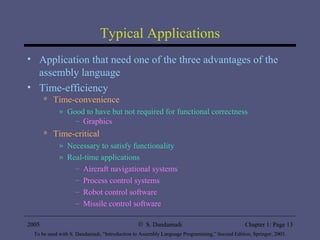
Typical Applications Application that need one of the three advantages of the assembly language Time-efficiency Time-convenience Good to have but not required for functional correctness Graphics Time-critical Necessary to satisfy functionality Real-time applications Aircraft navigational systems Process control systems Robot control software Missile control software
Typical Applications (cont’d) Accessibility to system hardware System software typically requires direct control of the system hardware devices Assemblers, linkers, compilers Network interfaces, device drivers Video games Space-efficiency Not a big plus point for most applications Code compactness is important in some cases Portable and hand-held device software Spacecraft control software
Why Learn Assembly Language? Some applications require programming in assembly language Typically only a small part of an application is coded in assembly language (rest written in a high-level language) Such programs are called  mixed mode   programs Assembly language can be used as a tool to learn computer organization You will know more about the organization and internal workings of a computer system Personal satisfaction of learning something something complicated and useful
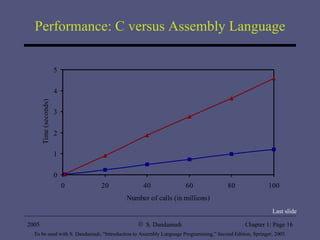
Performance: C versus Assembly Language Last slide

Al2ed chapter1

  • 1.
  • 2.
    Outline A user’sview of computer systems What is assembly language? Relationship to machine language Advantages of high-level languages Faster program development Easier maintenance Portability Why program in assembly language? Time-efficiency Space-efficiency Accessibility to hardware Typical applications Why learn assembly language? Performance: C versus assembly language Multiplication example
  • 3.
    A User’s Viewof Computer Systems Depends on the degree of abstraction provided by the underlying software We consider a hierarchy of five levels Moving to the top of hierarchy shields the user from the lower-level details The top two levels are system independent The lower four levels are system dependent Assembly and machine languages are specific to a particular processor One-to-one correspondence between assembly language and machine language
  • 4.
    A User’s Viewof Computer Systems (cont’d)
  • 5.
    What Is AssemblyLanguage? Low-level language Each instruction performs a much lower-level task compared to a high-level language instruction One-to-one correspondence between assembly language and machine language instructions For most assembly language instructions, there is a machine language equivalent Assembler translates assembly language instructions to machine language instructions Directly influenced by the instruction set and architecture of the processor (CPU)
  • 6.
    What Is AssemblyLanguage? (Cont’d) Some example assembly language instructions: inc result mov class_size,45 and mask1,128 add marks,10 Some points to note: Assembly language instructions are cryptic Mnemonics are used for operations inc for increment, mov for move (i.e., copy) Assembly language instructions are low level Cannot write instructions such as mov marks, value MIPS Examples andi $t2,$t1,15 addu $t3,$t1,$t2 move $t2,$t1
  • 7.
    What Is AssemblyLanguage? (Cont’d) Some simple high-level language instructions can be expressed by a single assembly instruction Assembly Language C inc result result++; mov class_size,45 class_size = 45; and mask1,128 mask1 &= 128; add marks,10 marks += 10;
  • 8.
    What Is AssemblyLanguage? (Cont’d) Most high-level language instructions need more than one assembly instruction C Assembly Language size = value; mov AX,value mov size,AX sum += x + y + z; mov AX,sum add AX,x add AX,y add AX,z mov sum,AX
  • 9.
    What Is AssemblyLanguage? (Cont’d) Readability of assembly language instructions is much better than the machine language instructions Machine language instructions are a sequence of 1s and 0s Assembly Language Machine Language (in Hex) inc result FF060A00 mov class_size,45 C7060C002D00 and mask,128 80260E0080 add marks,10 83060F000A
  • 10.
    What Is AssemblyLanguage? (Cont’d) MIPS examples Assembly Language Machine Language (in Hex) nop 00000000 move $t2,$t15 000A2021 andi $t2,$t1,15 312A000F addu $t3,$t1,$t2 012A5821
  • 11.
    Advantages of High-levelLanguages Program development is faster High-level instructions Fewer instructions to code Programs maintenance is easier For the same reasons as above Programs are portable Contain few machine-dependent details Can be used with little or no modifications on different types of machines Compiler translates to the target machine language Assembly language programs are not portable
  • 12.
    Why Program inAssembly Language? Two main reasons: Efficiency Space-efficiency Time-efficiency Accessibility to system hardware Space-efficiency Assembly code tends to be compact Time-efficiency Assembly language programs tend to run faster Only a well-written assembly language program runs faster Easy to write an assembly program that runs slower than its high-level language equivalent
  • 13.
    Typical Applications Applicationthat need one of the three advantages of the assembly language Time-efficiency Time-convenience Good to have but not required for functional correctness Graphics Time-critical Necessary to satisfy functionality Real-time applications Aircraft navigational systems Process control systems Robot control software Missile control software
  • 14.
    Typical Applications (cont’d)Accessibility to system hardware System software typically requires direct control of the system hardware devices Assemblers, linkers, compilers Network interfaces, device drivers Video games Space-efficiency Not a big plus point for most applications Code compactness is important in some cases Portable and hand-held device software Spacecraft control software
  • 15.
    Why Learn AssemblyLanguage? Some applications require programming in assembly language Typically only a small part of an application is coded in assembly language (rest written in a high-level language) Such programs are called mixed mode programs Assembly language can be used as a tool to learn computer organization You will know more about the organization and internal workings of a computer system Personal satisfaction of learning something something complicated and useful
  • 16.
    Performance: C versusAssembly Language Last slide