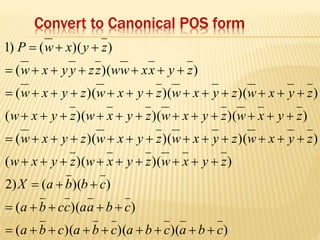
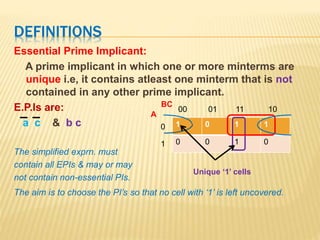
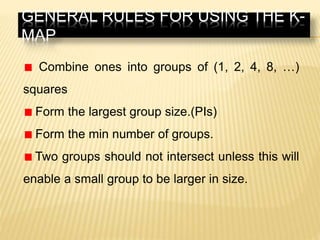
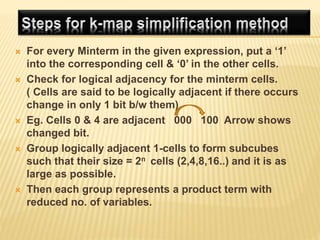
LOGIC DESIGN
PART A
Unit 1:
PRINCIPLES OF COMBINATIONAL LOGIC-1
Definition of Combinational logic:
It deals with the techniques of combining
basic gates into circuits that perform
some desired function.
 Outputs are functions of (present)
inputs.
 No memory element. (like flipflops)
 Do not have feedback from output
to input.
 Egs. Adder, subtractor, decoder,
encoder, multiplexer.
COMBINATIONAL LOGIC
BASICS OF DIGITAL ELECTRONICS
 Digital Electronics represents information (0, 1) with only
two discrete values.
 Ideally
“no voltage” (e.g., 0v) represents a 0 and
“full source voltage” (e.g., 5v) represents a 1
 Realistically
“low voltage” (e.g., <1v) represents a 0 and
“high voltage” (e.g., >4v) represents a 1
 We achieve these discrete values by using switches.
 We use transistor switches, which operates at high speed,
electronically, and small in size.
GATES
 The most basic digital devices are called
gates.
 Gates got their name from their function
of allowing or blocking (gating) the flow of
digital information.
 A gate has one or more inputs and
produces an output depending on the
input(s).
 A gate is called a combinational circuit.
 Three most important gates are: AND, OR,
GATES
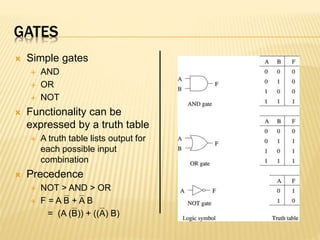
 Simple gates
 AND
 OR
 NOT
 Functionality can be
expressed by a truth table
 A truth table lists output for
each possible input
combination
 Precedence
 NOT > AND > OR
 F = A B + A B
= (A (B)) + ((A) B)
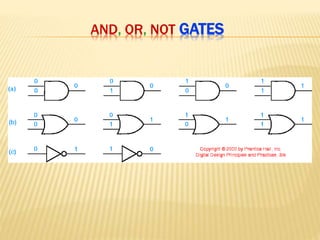
AND, OR, NOT GATES
GATES
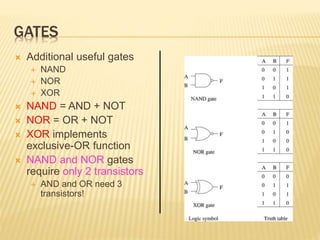
 Additional useful gates
 NAND
 NOR
 XOR
 NAND = AND + NOT
 NOR = OR + NOT
 XOR implements
exclusive-OR function
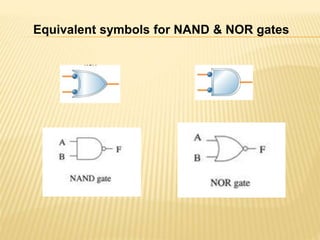
 NAND and NOR gates
require only 2 transistors
 AND and OR need 3
transistors!
Equivalent symbols for NAND & NOR gates
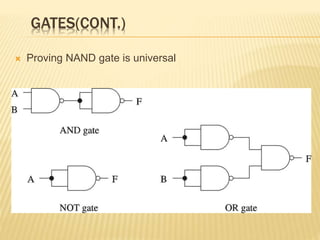
GATES(CONT.)
 Proving NAND gate is universal
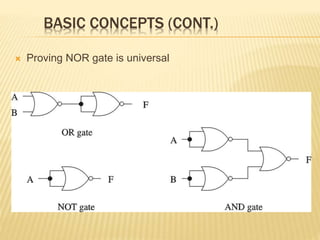
BASIC CONCEPTS (CONT.)
 Proving NOR gate is universal
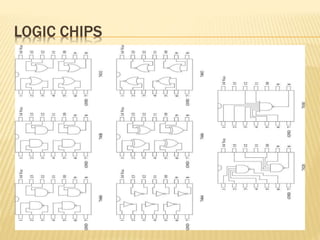
LOGIC CHIPS
LOGIC CHIPS (CONT.)
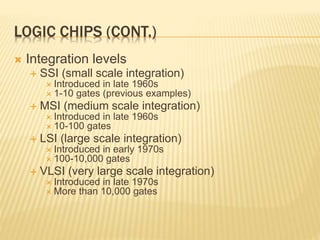
 Integration levels
 SSI (small scale integration)
 Introduced in late 1960s
 1-10 gates (previous examples)
 MSI (medium scale integration)
 Introduced in late 1960s
 10-100 gates
 LSI (large scale integration)
 Introduced in early 1970s
 100-10,000 gates
 VLSI (very large scale integration)
 Introduced in late 1970s
 More than 10,000 gates
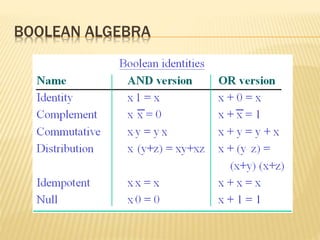
BOOLEAN ALGEBRA
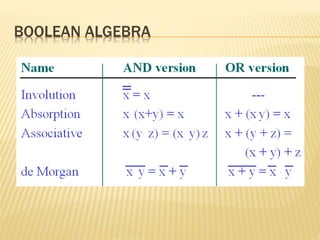
BOOLEAN ALGEBRA
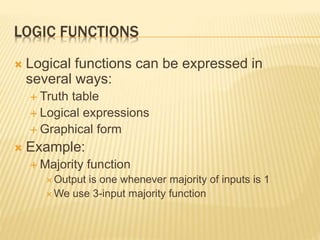
LOGIC FUNCTIONS
 Logical functions can be expressed in
several ways:
 Truth table
 Logical expressions
 Graphical form
 Example:
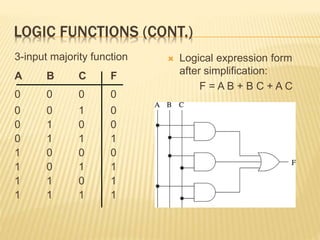
 Majority function
 Output is one whenever majority of inputs is 1
 We use 3-input majority function
LOGIC FUNCTIONS (CONT.)
3-input majority function
A B C F
0 0 0 0
0 0 1 0
0 1 0 0
0 1 1 1
1 0 0 0
1 0 1 1
1 1 0 1
1 1 1 1
 Logical expression form
after simplification:
F = A B + B C + A C
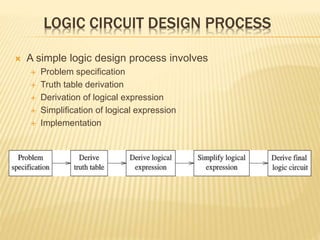
LOGIC CIRCUIT DESIGN PROCESS
 A simple logic design process involves
 Problem specification
 Truth table derivation
 Derivation of logical expression
 Simplification of logical expression
 Implementation
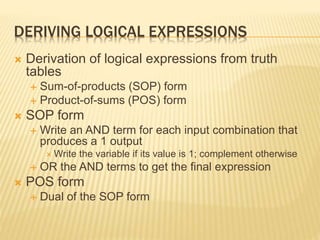
DERIVING LOGICAL EXPRESSIONS
 Derivation of logical expressions from truth
tables
 Sum-of-products (SOP) form
 Product-of-sums (POS) form
 SOP form
 Write an AND term for each input combination that
produces a 1 output
 Write the variable if its value is 1; complement otherwise
 OR the AND terms to get the final expression
 POS form
 Dual of the SOP form
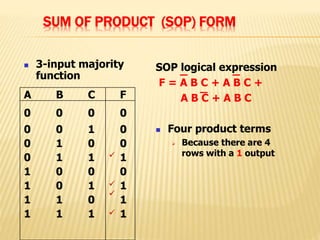
SUM OF PRODUCT (SOP) FORM
 3-input majority
function
A B C F
0 0 0 0
0 0 1 0
0 1 0 0
0 1 1 1
1 0 0 0
1 0 1 1
1 1 0 1
1 1 1 1
SOP logical expression
F = A B C + A B C +
A B C + A B C
 Four product terms
 Because there are 4
rows with a 1 output



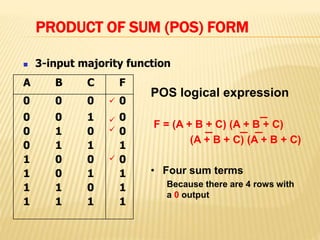
PRODUCT OF SUM (POS) FORM
 3-input majority function
A B C F
0 0 0 0
0 0 1 0
0 1 0 0
0 1 1 1
1 0 0 0
1 0 1 1
1 1 0 1
1 1 1 1




POS logical expression
F = (A + B + C) (A + B + C)
(A + B + C) (A + B + C)
• Four sum terms
Because there are 4 rows with
a 0 output
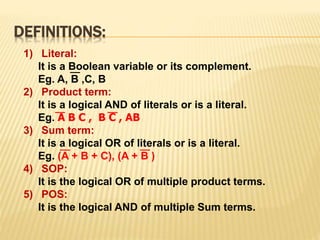
DEFINITIONS:
1) Literal:
It is a Boolean variable or its complement.
Eg. A, B ,C, B
2) Product term:
It is a logical AND of literals or is a literal.
Eg. A B C , B C , AB
3) Sum term:
It is a logical OR of literals or is a literal.
Eg. (A + B + C), (A + B )
4) SOP:
It is the logical OR of multiple product terms.
5) POS:
It is the logical AND of multiple Sum terms.
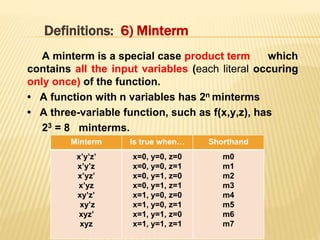
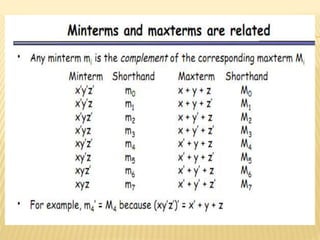
Definitions: 6) Minterm
A minterm is a special case product term which
contains all the input variables (each literal occuring
only once) of the function.
• A function with n variables has 2n minterms
• A three-variable function, such as f(x,y,z), has
23 = 8 minterms.
Minterm Is true when… Shorthand
x’y’z’
x’y’z
x’yz’
x’yz
xy’z’
xy’z
xyz’
xyz
x=0, y=0, z=0
x=0, y=0, z=1
x=0, y=1, z=0
x=0, y=1, z=1
x=1, y=0, z=0
x=1, y=0, z=1
x=1, y=1, z=0
x=1, y=1, z=1
m0
m1
m2
m3
m4
m5
m6
m7
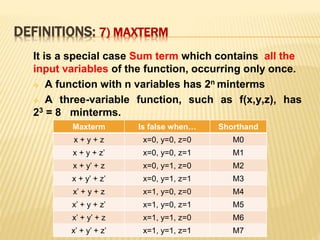
DEFINITIONS: 7) MAXTERM
It is a special case Sum term which contains all the
input variables of the function, occurring only once.
 A function with n variables has 2n minterms
 A three-variable function, such as f(x,y,z), has
23 = 8 minterms.
Maxterm Is false when… Shorthand
x + y + z x=0, y=0, z=0 M0
x + y + z’ x=0, y=0, z=1 M1
x + y’ + z x=0, y=1, z=0 M2
x + y’ + z’ x=0, y=1, z=1 M3
x’ + y + z x=1, y=0, z=0 M4
x’ + y + z’ x=1, y=0, z=1 M5
x’ + y’ + z x=1, y=1, z=0 M6
x’ + y’ + z’ x=1, y=1, z=1 M7
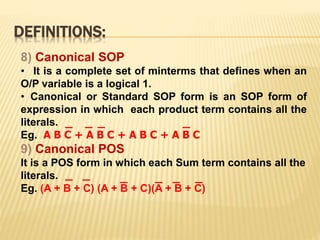
DEFINITIONS:
8) Canonical SOP
• It is a complete set of minterms that defines when an
O/P variable is a logical 1.
• Canonical or Standard SOP form is an SOP form of
expression in which each product term contains all the
literals.
Eg. A B C + A B C + A B C + A B C
9) Canonical POS
It is a POS form in which each Sum term contains all the
literals.
Eg. (A + B + C) (A + B + C)(A + B + C)
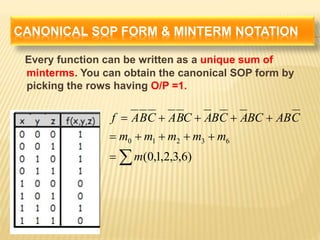
CANONICAL SOP FORM & MINTERM NOTATION
Every function can be written as a unique sum of
minterms. You can obtain the canonical SOP form by
picking the rows having O/P =1.



)6,3,2,1,0(
63210
m
mmmmm
CABBCACBACBACBAf
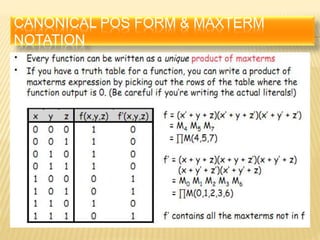
CANONICAL POS FORM & MAXTERM
NOTATION
CONVERSION
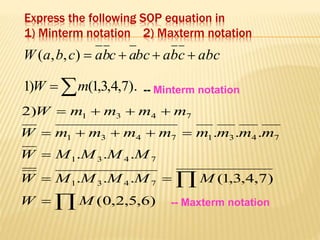
Express the following SOP equation in
1) Minterm notation 2) Maxterm notation
abccbabcacbacbaW ),,(
-- Minterm notation







)6,5,2,0(
)7,4,3,1(...
...
...
)2
7431
7431
74317431
7431
MW
MMMMMW
MMMMW
mmmmmmmmW
mmmmW
-- Maxterm notation
 ).7,4,3,1()1 mW
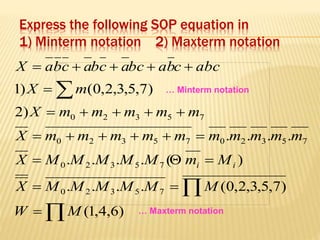
Express the following SOP equation in
1) Minterm notation 2) Maxterm notation










)6,4,1(
)7,5,3,2,0(....
)(....
....
)2
)7,5,3,2,0()1
75320
75320
7532075320
75320
MW
MMMMMMX
MmMMMMMX
mmmmmmmmmmX
mmmmmX
mX
abccbabcacbacbaX
ii
… Minterm notation
… Maxterm notation
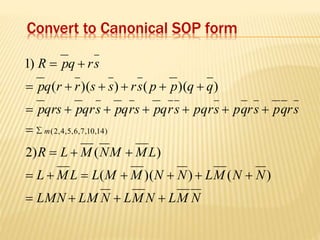
Convert to Canonical SOP form
NMLNMLNLMLMN
NNMLNNMMLLML
LMMNMLR
srqpsrqpspqrsrqpsrqpsqrpqrsp
qqppsrssrrqp
srqpR
m








)())((
)()2
))(())((
)1
)14,10,7,6,5,4,2(
Convert to Canonical POS form
))()()((
))((
))(()2
))()((
))()()((
))()()((
))()()((
))((
))(()1
cbacbacbacba
cbaaccba
cbbaX
zyxwzyxwzyxw
zyxwzyxwzyxwzyxw
zyxwzyxwzyxwzyxw
zyxwzyxwzyxwzyxw
zyxxwwzzyyxw
zyxwP









LOGICAL EXPRESSION SIMPLIFICATION
Methods:
 Algebraic manipulation
 Use Boolean laws to simplify the expression
 Difficult to use
 Don’t know if you have the simplified form
 Karnaugh map (K-map) method
 Graphical method
 Easy to use
 Can be used to simplify logical expressions with a few
variables.
 Quine Mc-Cluskey method
 Used for more than 6 variable functions
 Tedious procedure
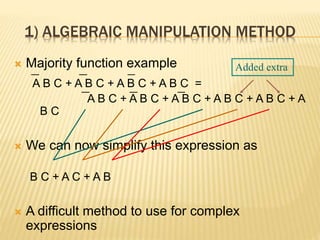
1) ALGEBRAIC MANIPULATION METHOD
 Majority function example
A B C + A B C + A B C + A B C =
A B C + A B C + A B C + A B C + A B C + A
B C
 We can now simplify this expression as
B C + A C + A B
 A difficult method to use for complex
expressions
Added extra
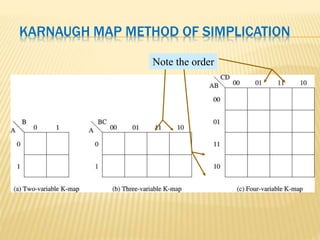
KARNAUGH MAP METHOD OF SIMPLICATION
Note the order
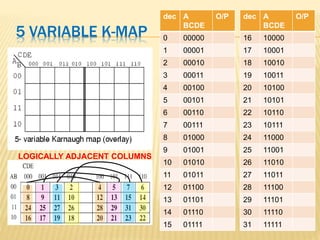
5 VARIABLE K-MAP
dec A
BCDE
O/P
0 00000
1 00001
2 00010
3 00011
4 00100
5 00101
6 00110
7 00111
8 01000
9 01001
10 01010
11 01011
12 01100
13 01101
14 01110
15 01111
dec A
BCDE
O/P
16 10000
17 10001
18 10010
19 10011
20 10100
21 10101
22 10110
23 10111
24 11000
25 11001
26 11010
27 11011
28 11100
29 11101
30 11110
31 11111
LOGICALLY ADJACENT COLUMNS
DEFINITIONS
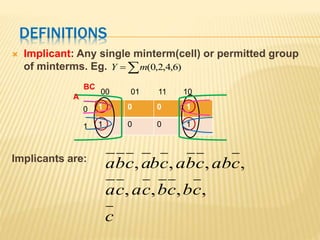
 Implicant: Any single minterm(cell) or permitted group
of minterms. Eg.
Implicants are:
 )6,4,2,0(mY
1 0 0 1
1 0 0 1
c
cbcbcaca
cabcbacbacba
,,,,
,,,,
0
1
00 01 11 10
A
BC
DEFINITIONS
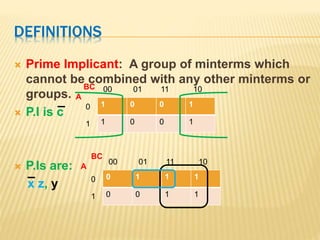
 Prime Implicant: A group of minterms which
cannot be combined with any other minterms or
groups.
 P.I is c
 P.Is are:
x z, y
1 0 0 1
1 0 0 1
0
1
00 01 11 10
0 1 1 1
0 0 1 1
0
1
00 01 11 10
A
BC
A
BC
DEFINITIONS
Essential Prime Implicant:
A prime implicant in which one or more minterms are
unique i.e, it contains atleast one minterm that is not
contained in any other prime implicant.
E.P.Is are:
a c & b c
The simplified exprn. must
contain all EPIs & may or may
not contain non-essential PIs.
The aim is to choose the PI’s so that no cell with ‘1’ is left uncovered.
1 0 1 1
0 0 1 0
0
1
00 01 11 10
Unique ‘1’ cells
A
BC
GENERAL RULES FOR USING THE K-
MAP
Combine ones into groups of (1, 2, 4, 8, …)
squares
Form the largest group size.(PIs)
Form the min number of groups.
Two groups should not intersect unless this will
enable a small group to be larger in size.
 For every Minterm in the given expression, put a ‘1’
into the corresponding cell & ‘0’ in the other cells.
 Check for logical adjacency for the minterm cells.
( Cells are said to be logically adjacent if there occurs
change in only 1 bit b/w them)
 Eg. Cells 0 & 4 are adjacent 000 100 Arrow shows
changed bit.
 Group logically adjacent 1-cells to form subcubes
such that their size = 2n cells (2,4,8,16..) and it is as
large as possible.
 Then each group represents a product term with
reduced no. of variables.
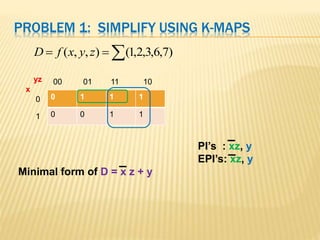
PROBLEM 1: SIMPLIFY USING K-MAPS
 )7,6,3,2,1(),,( zyxfD
0 1 1 1
0 0 1 1
0
1
00 01 11 10
x
yz
PI’s : xz, y
EPI’s: xz, y
Minimal form of D = x z + y
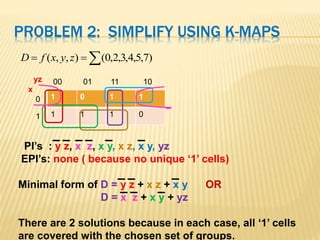
PROBLEM 2: SIMPLIFY USING K-MAPS
 )7,5,4,3,2,0(),,( zyxfD
0
1
00 01 11 10
x
yz
1 0 1 1
1 1 1 0
PI’s : y z, x z, x y, x z, x y, yz
EPI’s: none ( because no unique ‘1’ cells)
Minimal form of D = y z + x z + x y OR
D = x z + x y + yz
There are 2 solutions because in each case, all ‘1’ cells
are covered with the chosen set of groups.
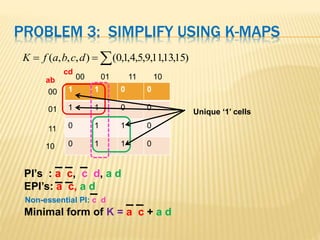
PROBLEM 3: SIMPLIFY USING K-MAPS
 )15,13,11,9,5,4,1,0(),,,( dcbafK
PI’s : a c, c d, a d
EPI’s: a c, a d
Non-essential PI: c d
Minimal form of K = a c + a d
1 1 0 0
1 1 0 0
0 1 1 0
0 1 1 0
cd
ab 00 01 11 10
00
01
11
10
Unique ‘1’ cells
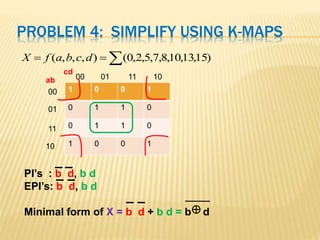
PROBLEM 4: SIMPLIFY USING K-MAPS
 )15,13,10,8,7,5,2,0(),,,( dcbafX
PI’s : b d, b d
EPI’s: b d, b d
Minimal form of X = b d + b d = b d
1 0 0 1
0 1 1 0
0 1 1 0
1 0 0 1
cd
ab 00 01 11 10
00
01
11
10
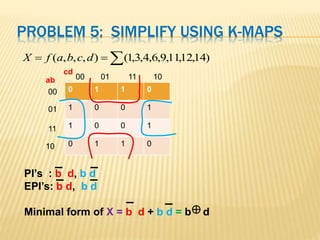
PROBLEM 5: SIMPLIFY USING K-MAPS
 )14,12,11,9,6,4,3,1(),,,( dcbafX
PI’s : b d, b d
EPI’s: b d, b d
Minimal form of X = b d + b d = b d
0 1 1 0
1 0 0 1
1 0 0 1
0 1 1 0
cd
ab 00 01 11 10
00
01
11
10
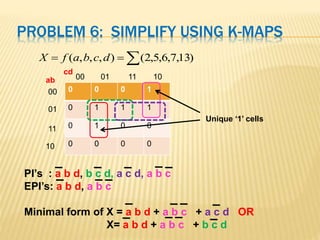
PROBLEM 6: SIMPLIFY USING K-MAPS
 )13,7,6,5,2(),,,( dcbafX
PI’s : a b d, b c d, a c d, a b c
EPI’s: a b d, a b c
Minimal form of X = a b d + a b c + a c d OR
X= a b d + a b c + b c d
0 0 0 1
0 1 1 1
0 1 0 0
0 0 0 0
cd
ab 00 01 11 10
00
01
11
10
Unique ‘1’ cells
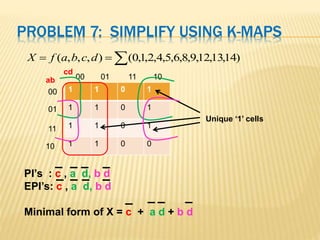
PROBLEM 7: SIMPLIFY USING K-MAPS
 )14,13,12,9,8,6,5,4,2,1,0(),,,( dcbafX
PI’s : c , a d, b d
EPI’s: c , a d, b d
Minimal form of X = c + a d + b d
1 1 0 1
1 1 0 1
1 1 0 1
1 1 0 0
cd
ab 00 01 11 10
00
01
11
10
Unique ‘1’ cells
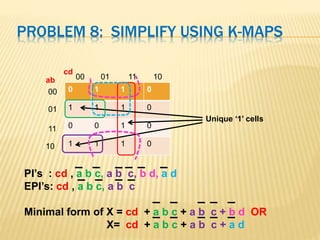
PROBLEM 8: SIMPLIFY USING K-MAPS
PI’s : cd , a b c, a b c, b d, a d
EPI’s: cd , a b c, a b c
Minimal form of X = cd + a b c + a b c + b d OR
X= cd + a b c + a b c + a d
0 1 1 0
1 1 1 0
0 0 1 0
1 1 1 0
cd
ab 00 01 11 10
00
01
11
10
Unique ‘1’ cells
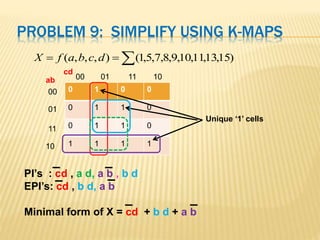
PROBLEM 9: SIMPLIFY USING K-MAPS
 )15,13,11,10,9,8,7,5,1(),,,( dcbafX
0 1 0 0
0 1 1 0
0 1 1 0
1 1 1 1
cd
ab 00 01 11 10
00
01
11
10
Unique ‘1’ cells
PI’s : cd , a d, a b , b d
EPI’s: cd , b d, a b
Minimal form of X = cd + b d + a b
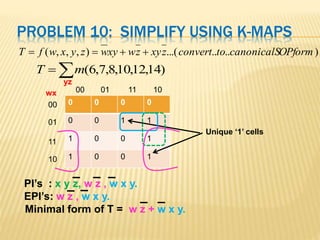
PROBLEM 10: SIMPLIFY USING K-MAPS
).......(),,,( OPformcanonicalStoconvertzxyzwxywzyxwfT 
 )14,12,10,8,7,6(mT
0 0 0 0
0 0 1 1
1 0 0 1
1 0 0 1
wx 00 01 11 10
00
01
11
10
Unique ‘1’ cells
yz
PI’s : x y z, w z , w x y.
EPI’s: w z , w x y.
Minimal form of T = w z + w x y.
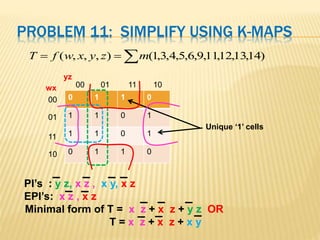
PROBLEM 11: SIMPLIFY USING K-MAPS
 )14,13,12,11,9,6,5,4,3,1(),,,( mzyxwfT
0 1 1 0
1 1 0 1
1 1 0 1
0 1 1 0
wx 00 01 11 10
00
01
11
10
Unique ‘1’ cells
yz
PI’s : y z, x z , x y, x z
EPI’s: x z , x z
Minimal form of T = x z + x z + y z OR
T = x z + x z + x y
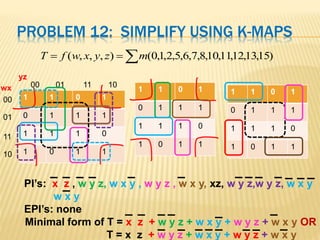
PROBLEM 12: SIMPLIFY USING K-MAPS
 )15,13,12,11,10,8,7,6,5,2,1,0(),,,( mzyxwfT
1 1 0 1
0 1 1 1
1 1 1 0
1 0 1 1
wx 00 01 11 10
00
01
11
10
yz
PI’s: x z , w y z, w x y , w y z , w x y, xz, w y z,w y z, w x y
w x y
EPI’s: none
Minimal form of T = x z + w y z + w x y + w y z + w x y OR
T = x z + w y z + w x y + w y z + w x y
1 1 0 1
0 1 1 1
1 1 1 0
1 0 1 1
1 1 0 1
0 1 1 1
1 1 1 0
1 0 1 1
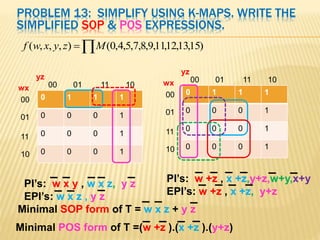
PROBLEM 13: SIMPLIFY USING K-MAPS. WRITE THE
SIMPLIFIED SOP & POS EXPRESSIONS.
 )15,13,12,11,9,8,7,5,4,0(),,,( Mzyxwf
0 1 1 1
0 0 0 1
0 0 0 1
0 0 0 1
wx 00 01 11 10
00
01
11
10
yz
PI’s: w x y , w x z, y z
EPI’s: w x z , y z
0 1 1 1
0 0 0 1
0 0 0 1
0 0 0 1
wx 00 01 11 10
00
01
11
10
yz
Minimal SOP form of T = w x z + y z
PI’s: w +z , x +z,y+z,w+y,x+y
EPI’s: w +z , x +z, y+z
Minimal POS form of T =(w +z ).(x +z ).(y+z)
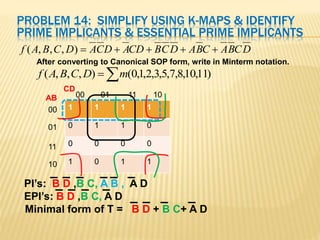
PROBLEM 14: SIMPLIFY USING K-MAPS & IDENTIFY
PRIME IMPLICANTS & ESSENTIAL PRIME IMPLICANTS
DCBACBADCBCDADCADCBAf ),,,(
1 1 1 1
0 1 1 0
0 0 0 0
1 0 1 1
AB 00 01 11 10
00
01
11
10
CD
PI’s: B D ,B C, A B , A D
EPI’s: B D ,B C, A D
Minimal form of T = B D + B C+ A D
After converting to Canonical SOP form, write in Minterm notation.
 )11,10,8,7,5,3,2,1,0(),,,( mDCBAf
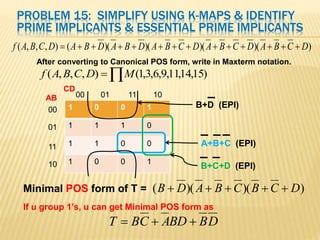
PROBLEM 15: SIMPLIFY USING K-MAPS & IDENTIFY
PRIME IMPLICANTS & ESSENTIAL PRIME IMPLICANTS
))()()()((),,,( DCBADCBADCBADBADBADCBAf 
1 0 0 1
1 1 1 0
1 1 0 0
1 0 0 1
AB 00 01 11 10
00
01
11
10
CD
Minimal POS form of T =
After converting to Canonical POS form, write in Maxterm notation.
 )15,14,11,9,6,3,1(),,,( MDCBAf
B+D (EPI)
A+B+C (EPI)
B+C+D (EPI)
))()(( DCBCBADB 
DBBDACBT 
If u group 1’s, u can get Minimal POS form as
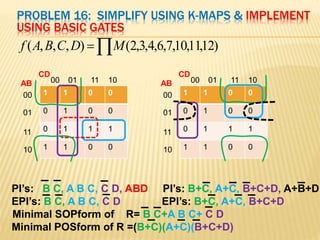
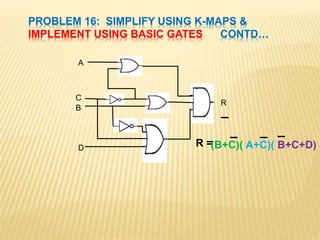
PROBLEM 16: SIMPLIFY USING K-MAPS & IMPLEMENT
USING BASIC GATES
 )12,11,10,7,6,4,3,2(),,,( MDCBAf
1 1 0 0
0 1 0 0
0 1 1 1
1 1 0 0
AB 00 01 11 10
00
01
11
10
CD
PI’s: B C, A B C, C D, ABD PI’s: B+C, A+C, B+C+D, A+B+D
EPI’s: B C, A B C, C D EPI’s: B+C, A+C, B+C+D
Minimal SOPform of R= B C+A B C+ C D
Minimal POSform of R =(B+C)(A+C)(B+C+D)
1 1 0 0
0 1 0 0
0 1 1 1
1 1 0 0
AB 00 01 11 10
00
01
11
10
CD
A
B
C
R
D
PROBLEM 16: SIMPLIFY USING K-MAPS &
IMPLEMENT USING BASIC GATES CONTD…
R =(B+C)( A+C)( B+C+D)
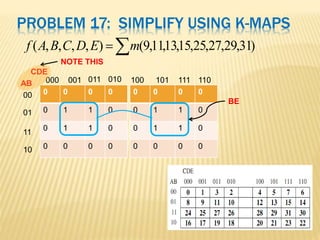
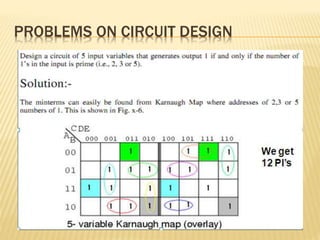
 )31,29,27,25,15,13,11,9(),,,,( mEDCBAf
PROBLEM 17: SIMPLIFY USING K-MAPS
0 0 0 0
0 1 1 0
0 1 1 0
0 0 0 0
0 0 0 0
0 1 1 0
0 1 1 0
0 0 0 0
AB 000 001 011
00
01
11
10
CDE
110111101100010
NOTE THIS
BE
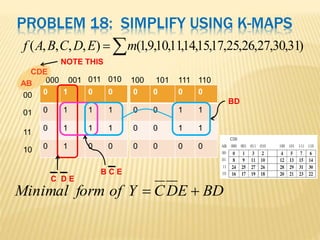
PROBLEM 18: SIMPLIFY USING K-MAPS
 )31,30,27,26,25,17,15,14,11,10,9,1(),,,,( mEDCBAf
0 1 0 0
0 1 1 1
0 1 1 1
0 1 0 0
0 0 0 0
0 0 1 1
0 0 1 1
0 0 0 0
AB 000 001 011
00
01
11
10
CDE
110111101100010
NOTE THIS
BD
C D E
B C E
BDEDCYofformMinimal 
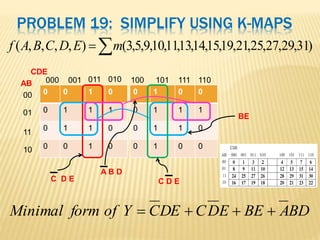
PROBLEM 19: SIMPLIFY USING K-MAPS
 )31,29,27,25,21,19,15,14,13,11,10,9,5,3(),,,,( mEDCBAf
0 0 1 0
0 1 1 1
0 1 1 0
0 0 1 0
0 1 0 0
0 1 1 1
0 1 1 0
0 1 0 0
AB 000 001 011
00
01
11
10
CDE
110111101100010
BE
C D E
A B D
BDABEEDCDECYofformMinimal 
C D E
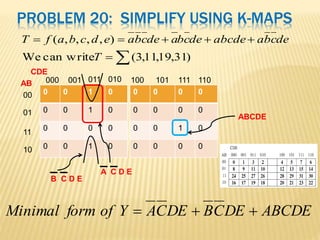
PROBLEM 20: SIMPLIFY USING K-MAPS


)31,19,11,3(can writeWe
),,,,(
T
decbaabcdedecbadecbaedcbafT
ABCDEDECBDECAYofformMinimal 
0 0 1 0
0 0 1 0
0 0 0 0
0 0 1 0
0 0 0 0
0 0 0 0
0 0 1 0
0 0 0 0
AB 000 001 011
00
01
11
10
CDE
110111101100010
B C D E
A C D E
ABCDE
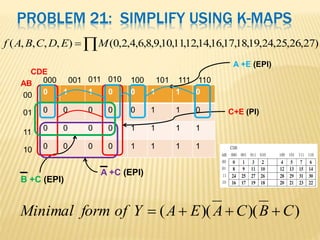
PROBLEM 21: SIMPLIFY USING K-MAPS
 )27,26,25,24,19,18,17,16,14,12,11,10,9,8,6,4,2,0(),,,,( MEDCBAf
))()(( CBCAEAYofformMinimal 
0 1 1 0
0 0 0 0
0 0 0 0
0 0 0 0
0 1 1 0
0 1 1 0
1 1 1 1
1 1 1 1
AB 000 001 011
00
01
11
10
CDE
110111101100010
B +C (EPI)
A +C (EPI)
A +E (EPI)
C+E (PI)
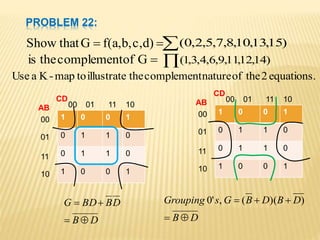
 d)c,b,f(a,GthatShow  )15,13,10,8,7,5,2,0(
 )14,12,11,9,6,4,3,1(Gofcomplementtheis
equations.2theofnaturecomplementtheillustratetomap-KaUse
1 0 0 1
0 1 1 0
0 1 1 0
1 0 0 1
AB 00 01 11 10
00
01
11
10
CD
1 0 0 1
0 1 1 0
0 1 1 0
1 0 0 1
AB 00 01 11 10
00
01
11
10
CD
DB
DBBDG


DB
DBDBGsGrouping

 ))((,'0
PROBLEM 22:
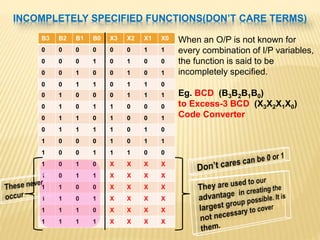
INCOMPLETELY SPECIFIED FUNCTIONS(DON’T CARE TERMS)
When an O/P is not known for
every combination of I/P variables,
the function is said to be
incompletely specified.
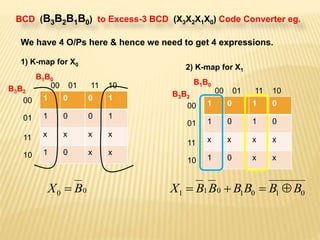
Eg. BCD (B3B2B1B0)
to Excess-3 BCD (X3X2X1X0)
Code Converter
B3 B2 B1 B0 X3 X2 X1 X0
0 0 0 0 0 0 1 1
0 0 0 1 0 1 0 0
0 0 1 0 0 1 0 1
0 0 1 1 0 1 1 0
0 1 0 0 0 1 1 1
0 1 0 1 1 0 0 0
0 1 1 0 1 0 0 1
0 1 1 1 1 0 1 0
1 0 0 0 1 0 1 1
1 0 0 1 1 1 0 0
1 0 1 0 X X X X
1 0 1 1 X X X X
1 1 0 0 X X X X
1 1 0 1 X X X X
1 1 1 0 X X X X
1 1 1 1 X X X X
1 0 1 0
1 0 1 0
x x x x
1 0 x x
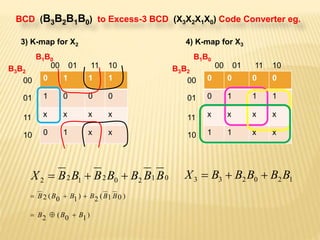
BCD (B3B2B1B0) to Excess-3 BCD (X3X2X1X0) Code Converter eg.
We have 4 O/Ps here & hence we need to get 4 expressions.
1 0 0 1
1 0 0 1
x x x x
1 0 x x
B3B2
00 01 11 10
00
01
11
10
00 BX 
B1B0
2) K-map for X1
B3B2
00 01 11 10
00
01
11
10
B1B0
0101011 BBBBBBX 
1) K-map for X0
0 0 0 0
0 1 1 1
x x x x
1 1 x x
0 1 1 1
1 0 0 0
x x x x
0 1 x x
B3B2
00 01 11 10
00
01
11
10
)10(2
)01(2)10(2
01202122
BBB
BBBBBB
BBBBBBBX



B1B0
4) K-map for X3
B3B2
00 01 11 10
00
01
11
10
B1B0
120233 BBBBBX 
BCD (B3B2B1B0) to Excess-3 BCD (X3X2X1X0) Code Converter eg.
3) K-map for X2
0 0 1 1
1 1 0 0
0 1 1 0
X X X X
00 01 11 10
00
01
11
10
B1B0
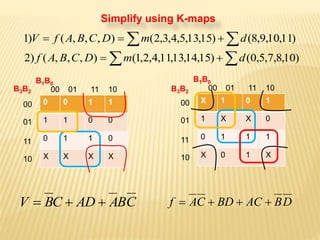
Simplify using K-maps
 
 


)10,8,7,5,0()15,14,13,11,4,2,1(),,,()2
)11,10,9,8()15,13,5,4,3,2(),,,()1
dmDCBAf
dmDCBAfV
CBAADCBV 
X 1 0 1
1 X X 0
0 1 1 1
X 0 1 X
00 01 11 10
00
01
11
10
B1B0
B3B2 B3B2
DBACBDCAf 
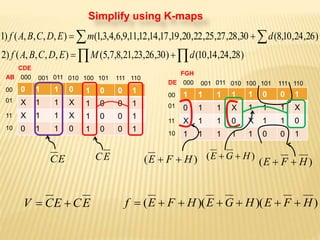
Simplify using K-maps
 
 


)28,24,14,10()30,26,23,21,8,7,5(),,,,()2
)26,24,10,8(30,28,27,25,22,20,19,17,14,12,11,9,6,4,3,1(),,,,()1
dMEDCBAf
dmEDCBAf
ECECV  ))()(( HFEHGEHFEf 
0 1 1 0
X 1 1 X
X 1 1 X
0 1 1 0
1 0 0 1
1 0 0 1
1 0 0 1
1 0 0 1
AB 000 001 011
00
01
11
10
CDE
110111101100010
1 1 1 1
0 1 1 X
X 1 1 0
1 1 1 1
1 0 0 1
1 1 1 X
X 1 1 0
1 0 0 1
DE 000 001 011
00
01
11
10
FGH
110111101100010
)( HFE  )( HGE 
)( HFE EC EC
PROBLEMS ON CIRCUIT DESIGN
PROBLEMS ON DESIGN
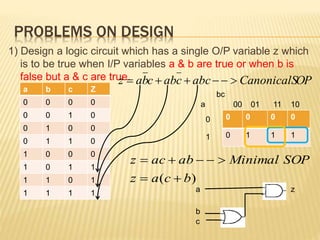
1) Design a logic circuit which has a single O/P variable z which
is to be true when I/P variables a & b are true or when b is
false but a & c are true.
a b c Z
0 0 0 0
0 0 1 0
0 1 0 0
0 1 1 0
1 0 0 0
1 0 1 1
1 1 0 1
1 1 1 1
OPCanonicalSabccabcbaz 
0 0 0 0
0 1 1 1
00 01 11 10
0
1
a
bc
)( bcaz
SOPMinimalabacz


a
b
c
z
2) Design a logic circuit whose O/P is to be true when the value
if I/P s exceeds 3. The weighting for each I/P variable is as
follows.
w=3, x=3, y=2, z=1. (Left as an exercise)
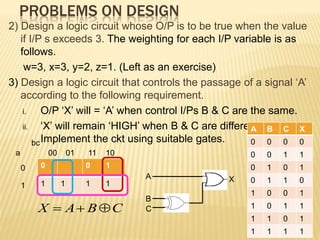
3) Design a logic circuit that controls the passage of a signal ‘A’
according to the following requirement.
i. O/P ‘X’ will = ‘A’ when control I/Ps B & C are the same.
ii. ‘X’ will remain ‘HIGH’ when B & C are different.
Implement the ckt using suitable gates.
PROBLEMS ON DESIGN
A B C X
0 0 0 0
0 0 1 1
0 1 0 1
0 1 1 0
1 0 0 1
1 0 1 1
1 1 0 1
1 1 1 1
0 0 1
1 1 1 1
00 01 11 10
0
1
a
bc
CBAX 
A
B
C
X
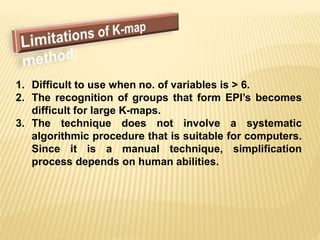
1. Difficult to use when no. of variables is > 6.
2. The recognition of groups that form EPI’s becomes
difficult for large K-maps.
3. The technique does not involve a systematic
algorithmic procedure that is suitable for computers.
Since it is a manual technique, simplification
process depends on human abilities.

Principles of Combinational Logic-1

  • 1.
    LOGIC DESIGN PART A Unit1: PRINCIPLES OF COMBINATIONAL LOGIC-1 Definition of Combinational logic: It deals with the techniques of combining basic gates into circuits that perform some desired function.
  • 2.
     Outputs arefunctions of (present) inputs.  No memory element. (like flipflops)  Do not have feedback from output to input.  Egs. Adder, subtractor, decoder, encoder, multiplexer. COMBINATIONAL LOGIC
  • 3.
    BASICS OF DIGITALELECTRONICS  Digital Electronics represents information (0, 1) with only two discrete values.  Ideally “no voltage” (e.g., 0v) represents a 0 and “full source voltage” (e.g., 5v) represents a 1  Realistically “low voltage” (e.g., <1v) represents a 0 and “high voltage” (e.g., >4v) represents a 1  We achieve these discrete values by using switches.  We use transistor switches, which operates at high speed, electronically, and small in size.
  • 4.
    GATES  The mostbasic digital devices are called gates.  Gates got their name from their function of allowing or blocking (gating) the flow of digital information.  A gate has one or more inputs and produces an output depending on the input(s).  A gate is called a combinational circuit.  Three most important gates are: AND, OR,
  • 5.
    GATES  Simple gates AND  OR  NOT  Functionality can be expressed by a truth table  A truth table lists output for each possible input combination  Precedence  NOT > AND > OR  F = A B + A B = (A (B)) + ((A) B)
  • 6.
  • 7.
    GATES  Additional usefulgates  NAND  NOR  XOR  NAND = AND + NOT  NOR = OR + NOT  XOR implements exclusive-OR function  NAND and NOR gates require only 2 transistors  AND and OR need 3 transistors!
  • 8.
    Equivalent symbols forNAND & NOR gates
  • 9.
  • 10.
    BASIC CONCEPTS (CONT.) Proving NOR gate is universal
  • 11.
  • 12.
    LOGIC CHIPS (CONT.) Integration levels  SSI (small scale integration)  Introduced in late 1960s  1-10 gates (previous examples)  MSI (medium scale integration)  Introduced in late 1960s  10-100 gates  LSI (large scale integration)  Introduced in early 1970s  100-10,000 gates  VLSI (very large scale integration)  Introduced in late 1970s  More than 10,000 gates
  • 13.
  • 14.
  • 15.
    LOGIC FUNCTIONS  Logicalfunctions can be expressed in several ways:  Truth table  Logical expressions  Graphical form  Example:  Majority function  Output is one whenever majority of inputs is 1  We use 3-input majority function
  • 16.
    LOGIC FUNCTIONS (CONT.) 3-inputmajority function A B C F 0 0 0 0 0 0 1 0 0 1 0 0 0 1 1 1 1 0 0 0 1 0 1 1 1 1 0 1 1 1 1 1  Logical expression form after simplification: F = A B + B C + A C
  • 17.
    LOGIC CIRCUIT DESIGNPROCESS  A simple logic design process involves  Problem specification  Truth table derivation  Derivation of logical expression  Simplification of logical expression  Implementation
  • 18.
    DERIVING LOGICAL EXPRESSIONS Derivation of logical expressions from truth tables  Sum-of-products (SOP) form  Product-of-sums (POS) form  SOP form  Write an AND term for each input combination that produces a 1 output  Write the variable if its value is 1; complement otherwise  OR the AND terms to get the final expression  POS form  Dual of the SOP form
  • 19.
    SUM OF PRODUCT(SOP) FORM  3-input majority function A B C F 0 0 0 0 0 0 1 0 0 1 0 0 0 1 1 1 1 0 0 0 1 0 1 1 1 1 0 1 1 1 1 1 SOP logical expression F = A B C + A B C + A B C + A B C  Four product terms  Because there are 4 rows with a 1 output   
  • 20.
    PRODUCT OF SUM(POS) FORM  3-input majority function A B C F 0 0 0 0 0 0 1 0 0 1 0 0 0 1 1 1 1 0 0 0 1 0 1 1 1 1 0 1 1 1 1 1     POS logical expression F = (A + B + C) (A + B + C) (A + B + C) (A + B + C) • Four sum terms Because there are 4 rows with a 0 output
  • 21.
    DEFINITIONS: 1) Literal: It isa Boolean variable or its complement. Eg. A, B ,C, B 2) Product term: It is a logical AND of literals or is a literal. Eg. A B C , B C , AB 3) Sum term: It is a logical OR of literals or is a literal. Eg. (A + B + C), (A + B ) 4) SOP: It is the logical OR of multiple product terms. 5) POS: It is the logical AND of multiple Sum terms.
  • 22.
    Definitions: 6) Minterm Aminterm is a special case product term which contains all the input variables (each literal occuring only once) of the function. • A function with n variables has 2n minterms • A three-variable function, such as f(x,y,z), has 23 = 8 minterms. Minterm Is true when… Shorthand x’y’z’ x’y’z x’yz’ x’yz xy’z’ xy’z xyz’ xyz x=0, y=0, z=0 x=0, y=0, z=1 x=0, y=1, z=0 x=0, y=1, z=1 x=1, y=0, z=0 x=1, y=0, z=1 x=1, y=1, z=0 x=1, y=1, z=1 m0 m1 m2 m3 m4 m5 m6 m7
  • 23.
    DEFINITIONS: 7) MAXTERM Itis a special case Sum term which contains all the input variables of the function, occurring only once.  A function with n variables has 2n minterms  A three-variable function, such as f(x,y,z), has 23 = 8 minterms. Maxterm Is false when… Shorthand x + y + z x=0, y=0, z=0 M0 x + y + z’ x=0, y=0, z=1 M1 x + y’ + z x=0, y=1, z=0 M2 x + y’ + z’ x=0, y=1, z=1 M3 x’ + y + z x=1, y=0, z=0 M4 x’ + y + z’ x=1, y=0, z=1 M5 x’ + y’ + z x=1, y=1, z=0 M6 x’ + y’ + z’ x=1, y=1, z=1 M7
  • 25.
    DEFINITIONS: 8) Canonical SOP •It is a complete set of minterms that defines when an O/P variable is a logical 1. • Canonical or Standard SOP form is an SOP form of expression in which each product term contains all the literals. Eg. A B C + A B C + A B C + A B C 9) Canonical POS It is a POS form in which each Sum term contains all the literals. Eg. (A + B + C) (A + B + C)(A + B + C)
  • 26.
    CANONICAL SOP FORM& MINTERM NOTATION Every function can be written as a unique sum of minterms. You can obtain the canonical SOP form by picking the rows having O/P =1.    )6,3,2,1,0( 63210 m mmmmm CABBCACBACBACBAf
  • 27.
    CANONICAL POS FORM& MAXTERM NOTATION
  • 28.
  • 29.
    Express the followingSOP equation in 1) Minterm notation 2) Maxterm notation abccbabcacbacbaW ),,( -- Minterm notation        )6,5,2,0( )7,4,3,1(... ... ... )2 7431 7431 74317431 7431 MW MMMMMW MMMMW mmmmmmmmW mmmmW -- Maxterm notation  ).7,4,3,1()1 mW
  • 30.
    Express the followingSOP equation in 1) Minterm notation 2) Maxterm notation           )6,4,1( )7,5,3,2,0(.... )(.... .... )2 )7,5,3,2,0()1 75320 75320 7532075320 75320 MW MMMMMMX MmMMMMMX mmmmmmmmmmX mmmmmX mX abccbabcacbacbaX ii … Minterm notation … Maxterm notation
  • 31.
    Convert to CanonicalSOP form NMLNMLNLMLMN NNMLNNMMLLML LMMNMLR srqpsrqpspqrsrqpsrqpsqrpqrsp qqppsrssrrqp srqpR m         )())(( )()2 ))(())(( )1 )14,10,7,6,5,4,2(
  • 32.
    Convert to CanonicalPOS form ))()()(( ))(( ))(()2 ))()(( ))()()(( ))()()(( ))()()(( ))(( ))(()1 cbacbacbacba cbaaccba cbbaX zyxwzyxwzyxw zyxwzyxwzyxwzyxw zyxwzyxwzyxwzyxw zyxwzyxwzyxwzyxw zyxxwwzzyyxw zyxwP         
  • 33.
    LOGICAL EXPRESSION SIMPLIFICATION Methods: Algebraic manipulation  Use Boolean laws to simplify the expression  Difficult to use  Don’t know if you have the simplified form  Karnaugh map (K-map) method  Graphical method  Easy to use  Can be used to simplify logical expressions with a few variables.  Quine Mc-Cluskey method  Used for more than 6 variable functions  Tedious procedure
  • 34.
    1) ALGEBRAIC MANIPULATIONMETHOD  Majority function example A B C + A B C + A B C + A B C = A B C + A B C + A B C + A B C + A B C + A B C  We can now simplify this expression as B C + A C + A B  A difficult method to use for complex expressions Added extra
  • 35.
    KARNAUGH MAP METHODOF SIMPLICATION Note the order
  • 36.
    5 VARIABLE K-MAP decA BCDE O/P 0 00000 1 00001 2 00010 3 00011 4 00100 5 00101 6 00110 7 00111 8 01000 9 01001 10 01010 11 01011 12 01100 13 01101 14 01110 15 01111 dec A BCDE O/P 16 10000 17 10001 18 10010 19 10011 20 10100 21 10101 22 10110 23 10111 24 11000 25 11001 26 11010 27 11011 28 11100 29 11101 30 11110 31 11111 LOGICALLY ADJACENT COLUMNS
  • 37.
    DEFINITIONS  Implicant: Anysingle minterm(cell) or permitted group of minterms. Eg. Implicants are:  )6,4,2,0(mY 1 0 0 1 1 0 0 1 c cbcbcaca cabcbacbacba ,,,, ,,,, 0 1 00 01 11 10 A BC
  • 38.
    DEFINITIONS  Prime Implicant:A group of minterms which cannot be combined with any other minterms or groups.  P.I is c  P.Is are: x z, y 1 0 0 1 1 0 0 1 0 1 00 01 11 10 0 1 1 1 0 0 1 1 0 1 00 01 11 10 A BC A BC
  • 39.
    DEFINITIONS Essential Prime Implicant: Aprime implicant in which one or more minterms are unique i.e, it contains atleast one minterm that is not contained in any other prime implicant. E.P.Is are: a c & b c The simplified exprn. must contain all EPIs & may or may not contain non-essential PIs. The aim is to choose the PI’s so that no cell with ‘1’ is left uncovered. 1 0 1 1 0 0 1 0 0 1 00 01 11 10 Unique ‘1’ cells A BC
  • 40.
    GENERAL RULES FORUSING THE K- MAP Combine ones into groups of (1, 2, 4, 8, …) squares Form the largest group size.(PIs) Form the min number of groups. Two groups should not intersect unless this will enable a small group to be larger in size.
  • 41.
     For everyMinterm in the given expression, put a ‘1’ into the corresponding cell & ‘0’ in the other cells.  Check for logical adjacency for the minterm cells. ( Cells are said to be logically adjacent if there occurs change in only 1 bit b/w them)  Eg. Cells 0 & 4 are adjacent 000 100 Arrow shows changed bit.  Group logically adjacent 1-cells to form subcubes such that their size = 2n cells (2,4,8,16..) and it is as large as possible.  Then each group represents a product term with reduced no. of variables.
  • 42.
    PROBLEM 1: SIMPLIFYUSING K-MAPS  )7,6,3,2,1(),,( zyxfD 0 1 1 1 0 0 1 1 0 1 00 01 11 10 x yz PI’s : xz, y EPI’s: xz, y Minimal form of D = x z + y
  • 43.
    PROBLEM 2: SIMPLIFYUSING K-MAPS  )7,5,4,3,2,0(),,( zyxfD 0 1 00 01 11 10 x yz 1 0 1 1 1 1 1 0 PI’s : y z, x z, x y, x z, x y, yz EPI’s: none ( because no unique ‘1’ cells) Minimal form of D = y z + x z + x y OR D = x z + x y + yz There are 2 solutions because in each case, all ‘1’ cells are covered with the chosen set of groups.
  • 44.
    PROBLEM 3: SIMPLIFYUSING K-MAPS  )15,13,11,9,5,4,1,0(),,,( dcbafK PI’s : a c, c d, a d EPI’s: a c, a d Non-essential PI: c d Minimal form of K = a c + a d 1 1 0 0 1 1 0 0 0 1 1 0 0 1 1 0 cd ab 00 01 11 10 00 01 11 10 Unique ‘1’ cells
  • 45.
    PROBLEM 4: SIMPLIFYUSING K-MAPS  )15,13,10,8,7,5,2,0(),,,( dcbafX PI’s : b d, b d EPI’s: b d, b d Minimal form of X = b d + b d = b d 1 0 0 1 0 1 1 0 0 1 1 0 1 0 0 1 cd ab 00 01 11 10 00 01 11 10
  • 46.
    PROBLEM 5: SIMPLIFYUSING K-MAPS  )14,12,11,9,6,4,3,1(),,,( dcbafX PI’s : b d, b d EPI’s: b d, b d Minimal form of X = b d + b d = b d 0 1 1 0 1 0 0 1 1 0 0 1 0 1 1 0 cd ab 00 01 11 10 00 01 11 10
  • 47.
    PROBLEM 6: SIMPLIFYUSING K-MAPS  )13,7,6,5,2(),,,( dcbafX PI’s : a b d, b c d, a c d, a b c EPI’s: a b d, a b c Minimal form of X = a b d + a b c + a c d OR X= a b d + a b c + b c d 0 0 0 1 0 1 1 1 0 1 0 0 0 0 0 0 cd ab 00 01 11 10 00 01 11 10 Unique ‘1’ cells
  • 48.
    PROBLEM 7: SIMPLIFYUSING K-MAPS  )14,13,12,9,8,6,5,4,2,1,0(),,,( dcbafX PI’s : c , a d, b d EPI’s: c , a d, b d Minimal form of X = c + a d + b d 1 1 0 1 1 1 0 1 1 1 0 1 1 1 0 0 cd ab 00 01 11 10 00 01 11 10 Unique ‘1’ cells
  • 49.
    PROBLEM 8: SIMPLIFYUSING K-MAPS PI’s : cd , a b c, a b c, b d, a d EPI’s: cd , a b c, a b c Minimal form of X = cd + a b c + a b c + b d OR X= cd + a b c + a b c + a d 0 1 1 0 1 1 1 0 0 0 1 0 1 1 1 0 cd ab 00 01 11 10 00 01 11 10 Unique ‘1’ cells
  • 50.
    PROBLEM 9: SIMPLIFYUSING K-MAPS  )15,13,11,10,9,8,7,5,1(),,,( dcbafX 0 1 0 0 0 1 1 0 0 1 1 0 1 1 1 1 cd ab 00 01 11 10 00 01 11 10 Unique ‘1’ cells PI’s : cd , a d, a b , b d EPI’s: cd , b d, a b Minimal form of X = cd + b d + a b
  • 51.
    PROBLEM 10: SIMPLIFYUSING K-MAPS ).......(),,,( OPformcanonicalStoconvertzxyzwxywzyxwfT   )14,12,10,8,7,6(mT 0 0 0 0 0 0 1 1 1 0 0 1 1 0 0 1 wx 00 01 11 10 00 01 11 10 Unique ‘1’ cells yz PI’s : x y z, w z , w x y. EPI’s: w z , w x y. Minimal form of T = w z + w x y.
  • 52.
    PROBLEM 11: SIMPLIFYUSING K-MAPS  )14,13,12,11,9,6,5,4,3,1(),,,( mzyxwfT 0 1 1 0 1 1 0 1 1 1 0 1 0 1 1 0 wx 00 01 11 10 00 01 11 10 Unique ‘1’ cells yz PI’s : y z, x z , x y, x z EPI’s: x z , x z Minimal form of T = x z + x z + y z OR T = x z + x z + x y
  • 53.
    PROBLEM 12: SIMPLIFYUSING K-MAPS  )15,13,12,11,10,8,7,6,5,2,1,0(),,,( mzyxwfT 1 1 0 1 0 1 1 1 1 1 1 0 1 0 1 1 wx 00 01 11 10 00 01 11 10 yz PI’s: x z , w y z, w x y , w y z , w x y, xz, w y z,w y z, w x y w x y EPI’s: none Minimal form of T = x z + w y z + w x y + w y z + w x y OR T = x z + w y z + w x y + w y z + w x y 1 1 0 1 0 1 1 1 1 1 1 0 1 0 1 1 1 1 0 1 0 1 1 1 1 1 1 0 1 0 1 1
  • 54.
    PROBLEM 13: SIMPLIFYUSING K-MAPS. WRITE THE SIMPLIFIED SOP & POS EXPRESSIONS.  )15,13,12,11,9,8,7,5,4,0(),,,( Mzyxwf 0 1 1 1 0 0 0 1 0 0 0 1 0 0 0 1 wx 00 01 11 10 00 01 11 10 yz PI’s: w x y , w x z, y z EPI’s: w x z , y z 0 1 1 1 0 0 0 1 0 0 0 1 0 0 0 1 wx 00 01 11 10 00 01 11 10 yz Minimal SOP form of T = w x z + y z PI’s: w +z , x +z,y+z,w+y,x+y EPI’s: w +z , x +z, y+z Minimal POS form of T =(w +z ).(x +z ).(y+z)
  • 55.
    PROBLEM 14: SIMPLIFYUSING K-MAPS & IDENTIFY PRIME IMPLICANTS & ESSENTIAL PRIME IMPLICANTS DCBACBADCBCDADCADCBAf ),,,( 1 1 1 1 0 1 1 0 0 0 0 0 1 0 1 1 AB 00 01 11 10 00 01 11 10 CD PI’s: B D ,B C, A B , A D EPI’s: B D ,B C, A D Minimal form of T = B D + B C+ A D After converting to Canonical SOP form, write in Minterm notation.  )11,10,8,7,5,3,2,1,0(),,,( mDCBAf
  • 56.
    PROBLEM 15: SIMPLIFYUSING K-MAPS & IDENTIFY PRIME IMPLICANTS & ESSENTIAL PRIME IMPLICANTS ))()()()((),,,( DCBADCBADCBADBADBADCBAf  1 0 0 1 1 1 1 0 1 1 0 0 1 0 0 1 AB 00 01 11 10 00 01 11 10 CD Minimal POS form of T = After converting to Canonical POS form, write in Maxterm notation.  )15,14,11,9,6,3,1(),,,( MDCBAf B+D (EPI) A+B+C (EPI) B+C+D (EPI) ))()(( DCBCBADB  DBBDACBT  If u group 1’s, u can get Minimal POS form as
  • 57.
    PROBLEM 16: SIMPLIFYUSING K-MAPS & IMPLEMENT USING BASIC GATES  )12,11,10,7,6,4,3,2(),,,( MDCBAf 1 1 0 0 0 1 0 0 0 1 1 1 1 1 0 0 AB 00 01 11 10 00 01 11 10 CD PI’s: B C, A B C, C D, ABD PI’s: B+C, A+C, B+C+D, A+B+D EPI’s: B C, A B C, C D EPI’s: B+C, A+C, B+C+D Minimal SOPform of R= B C+A B C+ C D Minimal POSform of R =(B+C)(A+C)(B+C+D) 1 1 0 0 0 1 0 0 0 1 1 1 1 1 0 0 AB 00 01 11 10 00 01 11 10 CD
  • 58.
    A B C R D PROBLEM 16: SIMPLIFYUSING K-MAPS & IMPLEMENT USING BASIC GATES CONTD… R =(B+C)( A+C)( B+C+D)
  • 59.
     )31,29,27,25,15,13,11,9(),,,,( mEDCBAf PROBLEM17: SIMPLIFY USING K-MAPS 0 0 0 0 0 1 1 0 0 1 1 0 0 0 0 0 0 0 0 0 0 1 1 0 0 1 1 0 0 0 0 0 AB 000 001 011 00 01 11 10 CDE 110111101100010 NOTE THIS BE
  • 60.
    PROBLEM 18: SIMPLIFYUSING K-MAPS  )31,30,27,26,25,17,15,14,11,10,9,1(),,,,( mEDCBAf 0 1 0 0 0 1 1 1 0 1 1 1 0 1 0 0 0 0 0 0 0 0 1 1 0 0 1 1 0 0 0 0 AB 000 001 011 00 01 11 10 CDE 110111101100010 NOTE THIS BD C D E B C E BDEDCYofformMinimal 
  • 61.
    PROBLEM 19: SIMPLIFYUSING K-MAPS  )31,29,27,25,21,19,15,14,13,11,10,9,5,3(),,,,( mEDCBAf 0 0 1 0 0 1 1 1 0 1 1 0 0 0 1 0 0 1 0 0 0 1 1 1 0 1 1 0 0 1 0 0 AB 000 001 011 00 01 11 10 CDE 110111101100010 BE C D E A B D BDABEEDCDECYofformMinimal  C D E
  • 62.
    PROBLEM 20: SIMPLIFYUSING K-MAPS   )31,19,11,3(can writeWe ),,,,( T decbaabcdedecbadecbaedcbafT ABCDEDECBDECAYofformMinimal  0 0 1 0 0 0 1 0 0 0 0 0 0 0 1 0 0 0 0 0 0 0 0 0 0 0 1 0 0 0 0 0 AB 000 001 011 00 01 11 10 CDE 110111101100010 B C D E A C D E ABCDE
  • 63.
    PROBLEM 21: SIMPLIFYUSING K-MAPS  )27,26,25,24,19,18,17,16,14,12,11,10,9,8,6,4,2,0(),,,,( MEDCBAf ))()(( CBCAEAYofformMinimal  0 1 1 0 0 0 0 0 0 0 0 0 0 0 0 0 0 1 1 0 0 1 1 0 1 1 1 1 1 1 1 1 AB 000 001 011 00 01 11 10 CDE 110111101100010 B +C (EPI) A +C (EPI) A +E (EPI) C+E (PI)
  • 64.
     d)c,b,f(a,GthatShow )15,13,10,8,7,5,2,0(  )14,12,11,9,6,4,3,1(Gofcomplementtheis equations.2theofnaturecomplementtheillustratetomap-KaUse 1 0 0 1 0 1 1 0 0 1 1 0 1 0 0 1 AB 00 01 11 10 00 01 11 10 CD 1 0 0 1 0 1 1 0 0 1 1 0 1 0 0 1 AB 00 01 11 10 00 01 11 10 CD DB DBBDG   DB DBDBGsGrouping   ))((,'0 PROBLEM 22:
  • 65.
    INCOMPLETELY SPECIFIED FUNCTIONS(DON’TCARE TERMS) When an O/P is not known for every combination of I/P variables, the function is said to be incompletely specified. Eg. BCD (B3B2B1B0) to Excess-3 BCD (X3X2X1X0) Code Converter B3 B2 B1 B0 X3 X2 X1 X0 0 0 0 0 0 0 1 1 0 0 0 1 0 1 0 0 0 0 1 0 0 1 0 1 0 0 1 1 0 1 1 0 0 1 0 0 0 1 1 1 0 1 0 1 1 0 0 0 0 1 1 0 1 0 0 1 0 1 1 1 1 0 1 0 1 0 0 0 1 0 1 1 1 0 0 1 1 1 0 0 1 0 1 0 X X X X 1 0 1 1 X X X X 1 1 0 0 X X X X 1 1 0 1 X X X X 1 1 1 0 X X X X 1 1 1 1 X X X X
  • 66.
    1 0 10 1 0 1 0 x x x x 1 0 x x BCD (B3B2B1B0) to Excess-3 BCD (X3X2X1X0) Code Converter eg. We have 4 O/Ps here & hence we need to get 4 expressions. 1 0 0 1 1 0 0 1 x x x x 1 0 x x B3B2 00 01 11 10 00 01 11 10 00 BX  B1B0 2) K-map for X1 B3B2 00 01 11 10 00 01 11 10 B1B0 0101011 BBBBBBX  1) K-map for X0
  • 67.
    0 0 00 0 1 1 1 x x x x 1 1 x x 0 1 1 1 1 0 0 0 x x x x 0 1 x x B3B2 00 01 11 10 00 01 11 10 )10(2 )01(2)10(2 01202122 BBB BBBBBB BBBBBBBX    B1B0 4) K-map for X3 B3B2 00 01 11 10 00 01 11 10 B1B0 120233 BBBBBX  BCD (B3B2B1B0) to Excess-3 BCD (X3X2X1X0) Code Converter eg. 3) K-map for X2
  • 68.
    0 0 11 1 1 0 0 0 1 1 0 X X X X 00 01 11 10 00 01 11 10 B1B0 Simplify using K-maps       )10,8,7,5,0()15,14,13,11,4,2,1(),,,()2 )11,10,9,8()15,13,5,4,3,2(),,,()1 dmDCBAf dmDCBAfV CBAADCBV  X 1 0 1 1 X X 0 0 1 1 1 X 0 1 X 00 01 11 10 00 01 11 10 B1B0 B3B2 B3B2 DBACBDCAf 
  • 69.
    Simplify using K-maps      )28,24,14,10()30,26,23,21,8,7,5(),,,,()2 )26,24,10,8(30,28,27,25,22,20,19,17,14,12,11,9,6,4,3,1(),,,,()1 dMEDCBAf dmEDCBAf ECECV  ))()(( HFEHGEHFEf  0 1 1 0 X 1 1 X X 1 1 X 0 1 1 0 1 0 0 1 1 0 0 1 1 0 0 1 1 0 0 1 AB 000 001 011 00 01 11 10 CDE 110111101100010 1 1 1 1 0 1 1 X X 1 1 0 1 1 1 1 1 0 0 1 1 1 1 X X 1 1 0 1 0 0 1 DE 000 001 011 00 01 11 10 FGH 110111101100010 )( HFE  )( HGE  )( HFE EC EC
  • 70.
  • 71.
    PROBLEMS ON DESIGN 1)Design a logic circuit which has a single O/P variable z which is to be true when I/P variables a & b are true or when b is false but a & c are true. a b c Z 0 0 0 0 0 0 1 0 0 1 0 0 0 1 1 0 1 0 0 0 1 0 1 1 1 1 0 1 1 1 1 1 OPCanonicalSabccabcbaz  0 0 0 0 0 1 1 1 00 01 11 10 0 1 a bc )( bcaz SOPMinimalabacz   a b c z
  • 72.
    2) Design alogic circuit whose O/P is to be true when the value if I/P s exceeds 3. The weighting for each I/P variable is as follows. w=3, x=3, y=2, z=1. (Left as an exercise) 3) Design a logic circuit that controls the passage of a signal ‘A’ according to the following requirement. i. O/P ‘X’ will = ‘A’ when control I/Ps B & C are the same. ii. ‘X’ will remain ‘HIGH’ when B & C are different. Implement the ckt using suitable gates. PROBLEMS ON DESIGN A B C X 0 0 0 0 0 0 1 1 0 1 0 1 0 1 1 0 1 0 0 1 1 0 1 1 1 1 0 1 1 1 1 1 0 0 1 1 1 1 1 00 01 11 10 0 1 a bc CBAX  A B C X
  • 73.
    1. Difficult touse when no. of variables is > 6. 2. The recognition of groups that form EPI’s becomes difficult for large K-maps. 3. The technique does not involve a systematic algorithmic procedure that is suitable for computers. Since it is a manual technique, simplification process depends on human abilities.