MIPS Processor Chapter 12 S. Dandamudi
Outline Introduction Evolution of CISC Processors RISC Design Principles MIPS Architecture
Introduction CISC Complex instruction set Pentium is the most popular example RISC Simple instructions Reduced complexity Modern processors use this design philosophy PowerPC, MIPS, SPARC, Intel Itanium Borrow some features from CISC No precise definition We can identify some common characteristics
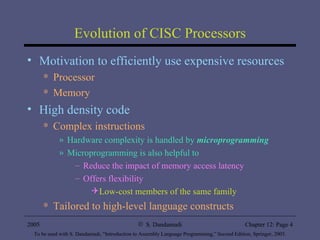
Evolution of CISC Processors Motivation to efficiently use expensive resources Processor Memory High density code Complex instructions Hardware complexity is handled by  microprogramming Microprogramming is also helpful to Reduce the impact of memory access latency Offers flexibility Low-cost members of the same family Tailored to high-level language constructs
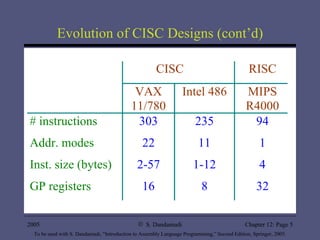
Evolution of CISC Designs (cont’d)
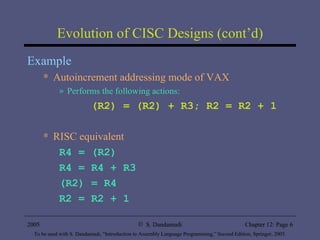
Evolution of CISC Designs (cont’d) Example Autoincrement addressing mode of VAX Performs the following actions: (R2) = (R2) + R3; R2 = R2 + 1 RISC equivalent R4 = (R2) R4 = R4 + R3 (R2) = R4 R2 = R2 + 1
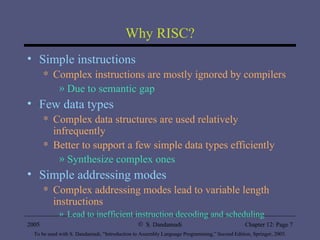
Why RISC? Simple instructions Complex instructions are mostly ignored by compilers Due to semantic gap Few data types Complex data structures are used relatively infrequently Better to support a few simple data types efficiently Synthesize complex ones Simple addressing modes Complex addressing modes lead to variable length instructions Lead to inefficient instruction decoding and scheduling
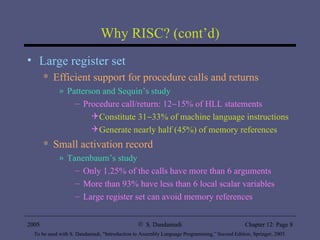
Why RISC? (cont’d) Large register set Efficient support for procedure calls and returns Patterson and Sequin’s study Procedure call/return: 12  15% of HLL statements Constitute 31  33% of machine language instructions Generate nearly half (45%) of memory references Small activation record Tanenbaum’s study Only 1.25% of the calls have more than 6 arguments More than 93% have less than 6 local scalar variables Large register set can avoid memory references
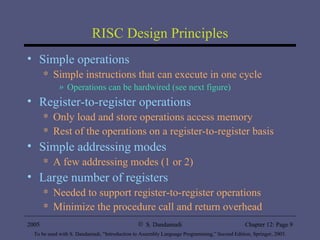
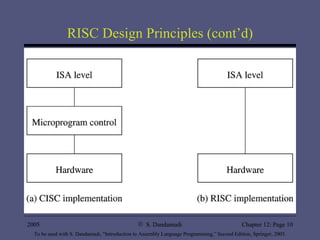
RISC Design Principles Simple operations Simple instructions that can execute in one cycle Operations can be hardwired (see next figure) Register-to-register operations Only load and store operations access memory Rest of the operations on a register-to-register basis Simple addressing modes A few addressing modes (1 or 2) Large number of registers Needed to support register-to-register operations Minimize the procedure call and return overhead
RISC Design Principles (cont’d)
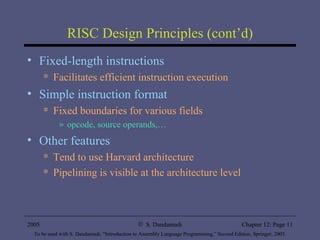
RISC Design Principles (cont’d) Fixed-length instructions Facilitates efficient instruction execution Simple instruction format Fixed boundaries for various fields  opcode, source operands,… Other features Tend to use Harvard architecture Pipelining is visible at the architecture level
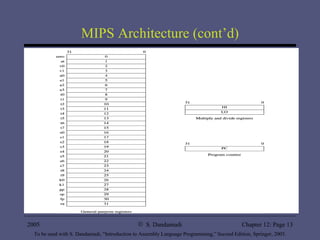
MIPS Architecture Registers 32 general-purpose Identified as $0, $1, …,$31 Register $0 is hardwired to zero Used when zero operand is needed Register $31 is used as the link register Used to store the return address of a procedure A Program counter (PC) 2 special-purpose  HI and LO registers Used in multiply and divide operations
MIPS Architecture (cont’d)
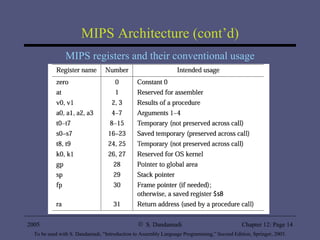
MIPS Architecture (cont’d) MIPS registers and their conventional usage
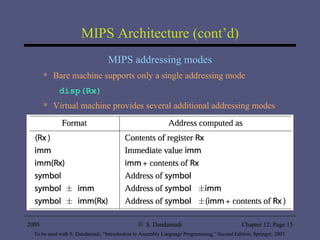
MIPS Architecture (cont’d) MIPS addressing modes Bare machine supports only a single addressing mode disp(Rx) Virtual machine provides several additional addressing modes
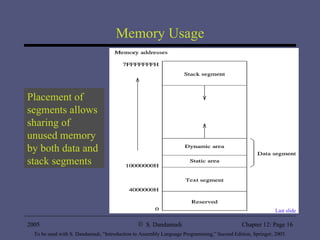
Memory Usage Placement of segments allows sharing of unused memory by both data and stack segments   Last slide

Al2ed chapter12

  • 1.
    MIPS Processor Chapter12 S. Dandamudi
  • 2.
    Outline Introduction Evolutionof CISC Processors RISC Design Principles MIPS Architecture
  • 3.
    Introduction CISC Complexinstruction set Pentium is the most popular example RISC Simple instructions Reduced complexity Modern processors use this design philosophy PowerPC, MIPS, SPARC, Intel Itanium Borrow some features from CISC No precise definition We can identify some common characteristics
  • 4.
    Evolution of CISCProcessors Motivation to efficiently use expensive resources Processor Memory High density code Complex instructions Hardware complexity is handled by microprogramming Microprogramming is also helpful to Reduce the impact of memory access latency Offers flexibility Low-cost members of the same family Tailored to high-level language constructs
  • 5.
    Evolution of CISCDesigns (cont’d)
  • 6.
    Evolution of CISCDesigns (cont’d) Example Autoincrement addressing mode of VAX Performs the following actions: (R2) = (R2) + R3; R2 = R2 + 1 RISC equivalent R4 = (R2) R4 = R4 + R3 (R2) = R4 R2 = R2 + 1
  • 7.
    Why RISC? Simpleinstructions Complex instructions are mostly ignored by compilers Due to semantic gap Few data types Complex data structures are used relatively infrequently Better to support a few simple data types efficiently Synthesize complex ones Simple addressing modes Complex addressing modes lead to variable length instructions Lead to inefficient instruction decoding and scheduling
  • 8.
    Why RISC? (cont’d)Large register set Efficient support for procedure calls and returns Patterson and Sequin’s study Procedure call/return: 12  15% of HLL statements Constitute 31  33% of machine language instructions Generate nearly half (45%) of memory references Small activation record Tanenbaum’s study Only 1.25% of the calls have more than 6 arguments More than 93% have less than 6 local scalar variables Large register set can avoid memory references
  • 9.
    RISC Design PrinciplesSimple operations Simple instructions that can execute in one cycle Operations can be hardwired (see next figure) Register-to-register operations Only load and store operations access memory Rest of the operations on a register-to-register basis Simple addressing modes A few addressing modes (1 or 2) Large number of registers Needed to support register-to-register operations Minimize the procedure call and return overhead
  • 10.
  • 11.
    RISC Design Principles(cont’d) Fixed-length instructions Facilitates efficient instruction execution Simple instruction format Fixed boundaries for various fields opcode, source operands,… Other features Tend to use Harvard architecture Pipelining is visible at the architecture level
  • 12.
    MIPS Architecture Registers32 general-purpose Identified as $0, $1, …,$31 Register $0 is hardwired to zero Used when zero operand is needed Register $31 is used as the link register Used to store the return address of a procedure A Program counter (PC) 2 special-purpose HI and LO registers Used in multiply and divide operations
  • 13.
  • 14.
    MIPS Architecture (cont’d)MIPS registers and their conventional usage
  • 15.
    MIPS Architecture (cont’d)MIPS addressing modes Bare machine supports only a single addressing mode disp(Rx) Virtual machine provides several additional addressing modes
  • 16.
    Memory Usage Placementof segments allows sharing of unused memory by both data and stack segments Last slide