Recursion Chapter 16 S. Dandamudi
Outline Introduction Recursion Recursion vs. Iteration
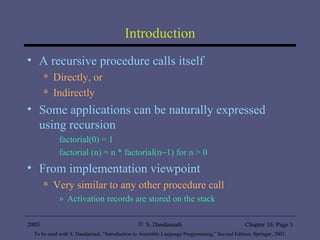
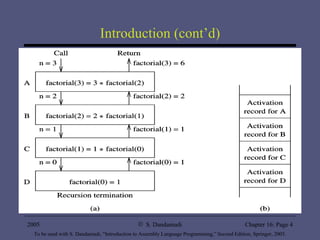
Introduction A recursive procedure calls itself Directly, or Indirectly Some applications can be naturally expressed using recursion factorial(0) = 1 factorial (n) = n * factorial(n  1) for n > 0 From implementation viewpoint Very similar to any other procedure call Activation records are stored on the stack
Introduction (cont’d)
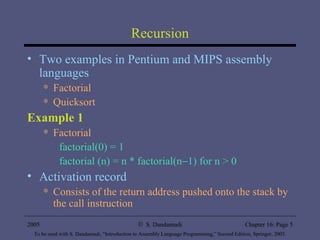
Recursion Two examples in Pentium and MIPS assembly languages Factorial  Quicksort Example 1 Factorial factorial(0) = 1 factorial (n) = n * factorial(n  1) for n > 0 Activation record Consists of the return address pushed onto the stack by the call instruction
Recursion (cont’d) Example 2 Quicksort  Sort an N-element array Basic algorithm Selects a partition element  x Assume that the final position of  x  is array[ i ] Moves elements less than  x  into array[0]…array[ i  1] Moves elements greater than  x  into array[ i +1]…array[ N  1] Applies quicksort recursively to sort these two subarrays
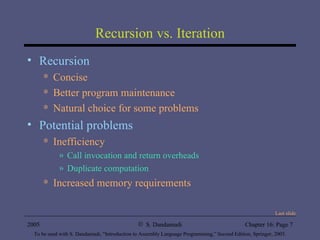
Recursion vs. Iteration Recursion Concise Better program maintenance Natural choice for some problems Potential problems Inefficiency Call invocation and return overheads Duplicate computation Increased memory requirements Last slide

Al2ed chapter16

  • 1.
  • 2.
    Outline Introduction RecursionRecursion vs. Iteration
  • 3.
    Introduction A recursiveprocedure calls itself Directly, or Indirectly Some applications can be naturally expressed using recursion factorial(0) = 1 factorial (n) = n * factorial(n  1) for n > 0 From implementation viewpoint Very similar to any other procedure call Activation records are stored on the stack
  • 4.
  • 5.
    Recursion Two examplesin Pentium and MIPS assembly languages Factorial Quicksort Example 1 Factorial factorial(0) = 1 factorial (n) = n * factorial(n  1) for n > 0 Activation record Consists of the return address pushed onto the stack by the call instruction
  • 6.
    Recursion (cont’d) Example2 Quicksort Sort an N-element array Basic algorithm Selects a partition element x Assume that the final position of x is array[ i ] Moves elements less than x into array[0]…array[ i  1] Moves elements greater than x into array[ i +1]…array[ N  1] Applies quicksort recursively to sort these two subarrays
  • 7.
    Recursion vs. IterationRecursion Concise Better program maintenance Natural choice for some problems Potential problems Inefficiency Call invocation and return overheads Duplicate computation Increased memory requirements Last slide