Procedures and the Stack Chapter 5 S. Dandamudi
Outline What is stack? Pentium implementation of stack Stack instructions Uses of stack Procedures Pentium instructions Parameter passing Register method Stack method Examples Call-by-value Call-by-reference Bubble sort Procedures with variable number of parameters Local variables Multiple source program modules Performance: Procedure overheads 2005 To be used with S. Dandamudi, “Introduction to Assembly Language Programming,” Second Edition, Springer, 2005. S. Dandamudi Chapter 5: Page
What is a Stack? Stack is a last-in-first-out (LIFO) data structure If we view the stack as a linear array of elements, both insertion and deletion operations are restricted to one end of the array Only the element at the top-of-stack (TOS) is directly accessible Two basic stack operations: push (insertion) pop (deletion) 2005 To be used with S. Dandamudi, “Introduction to Assembly Language Programming,” Second Edition, Springer, 2005. S. Dandamudi Chapter 5: Page
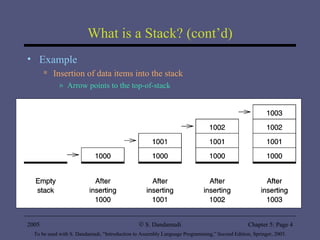
What is a Stack? (cont’d) Example Insertion of data items into the stack Arrow points to the top-of-stack 2005 To be used with S. Dandamudi, “Introduction to Assembly Language Programming,” Second Edition, Springer, 2005. S. Dandamudi Chapter 5: Page
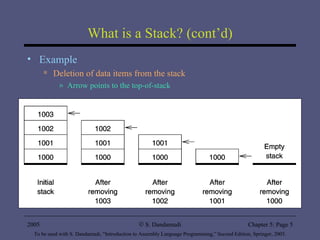
What is a Stack? (cont’d) Example Deletion of data items from the stack Arrow points to the top-of-stack 2005 To be used with S. Dandamudi, “Introduction to Assembly Language Programming,” Second Edition, Springer, 2005. S. Dandamudi Chapter 5: Page
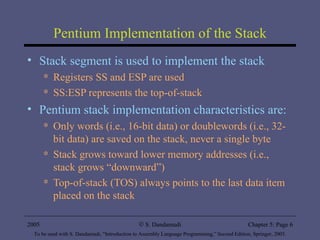
Pentium Implementation of the Stack Stack segment is used to implement the stack Registers SS and ESP are used SS:ESP represents the top-of-stack Pentium stack implementation characteristics are: Only words (i.e., 16-bit data) or doublewords (i.e., 32-bit data) are saved on the stack, never a single byte Stack grows toward lower memory addresses (i.e., stack grows “downward”) Top-of-stack (TOS) always points to the last data item placed on the stack 2005 To be used with S. Dandamudi, “Introduction to Assembly Language Programming,” Second Edition, Springer, 2005. S. Dandamudi Chapter 5: Page
Pentium Stack Instructions Pentium provides two  basic  instructions: push  source pop  destination source  and  destination  can be a 16- or 32-bit general register a segment register a word or doubleword in memory source  of  push  can also be an  immediate operand  of size 8, 16, or 32 bits 2005 To be used with S. Dandamudi, “Introduction to Assembly Language Programming,” Second Edition, Springer, 2005. S. Dandamudi Chapter 5: Page
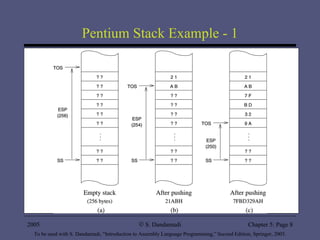
Pentium Stack Example - 1 2005 To be used with S. Dandamudi, “Introduction to Assembly Language Programming,” Second Edition, Springer, 2005. S. Dandamudi Chapter 5: Page
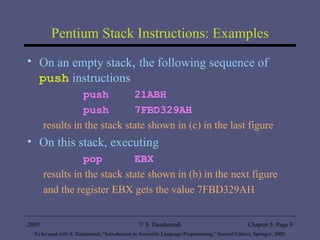
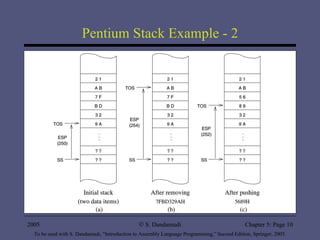
Pentium Stack Instructions: Examples On an empty stack ,  the following sequence of  push  instructions push  21ABH push  7FBD329AH results in the stack state shown in (c) in the last figure On this stack, executing pop  EBX results in the stack state shown in (b) in the next figure and the register EBX gets the value 7FBD329AH 2005 To be used with S. Dandamudi, “Introduction to Assembly Language Programming,” Second Edition, Springer, 2005. S. Dandamudi Chapter 5: Page
Pentium Stack Example - 2 2005 To be used with S. Dandamudi, “Introduction to Assembly Language Programming,” Second Edition, Springer, 2005. S. Dandamudi Chapter 5: Page
Additional Pentium Stack Instructions Stack Operations on Flags push  and  pop  instructions cannot be used with the Flags register Two special instructions for this purpose are pushfd (push 32-bit flags) popfd  (pop 32-bit flags) No operands are required Use  pushfw  and  popfw  for 16-bit flags (FLAGS) 2005 To be used with S. Dandamudi, “Introduction to Assembly Language Programming,” Second Edition, Springer, 2005. S. Dandamudi Chapter 5: Page
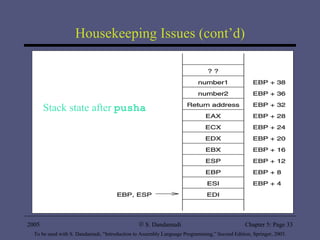
Additional Pentium Stack Instructions (cont’d) Stack Operations on All General-Purpose Registers pushad  and  popad  instructions can be used to save and restore the eight general-purpose registers EAX, ECX, EDX, EBX, ESP, EBP, ESI, and EDI Pushad  pushes these eight registers in the above order (EAX first and EDI last) popad  restores these registers except that ESP value is not loaded into the ESP register Use  pushaw  and  popaw  for saving and restoring 16-bit registers 2005 To be used with S. Dandamudi, “Introduction to Assembly Language Programming,” Second Edition, Springer, 2005. S. Dandamudi Chapter 5: Page
Uses of the Stack Three main uses Temporary storage of data Transfer of control Parameter passing Temporary Storage of Data Example : Exchanging  value1  and  value2  can be done by using the stack to temporarily hold data push  value1 push  value2 pop  value1 pop  value2 2005 To be used with S. Dandamudi, “Introduction to Assembly Language Programming,” Second Edition, Springer, 2005. S. Dandamudi Chapter 5: Page
Uses of the Stack (cont’d) Often used to free a set of registers ;save EAX & EBX registers on the stack push  EAX push  EBX ;EAX and EBX registers can now be used mov  EAX,value1 mov  EBX,value2 mov  value1,EBX mov  value2,EAX ;restore EAX & EBX registers from the stack pop  EBX pop  EAX . . . 2005 To be used with S. Dandamudi, “Introduction to Assembly Language Programming,” Second Edition, Springer, 2005. S. Dandamudi Chapter 5: Page
Uses of the Stack (cont’d) Transfer of Control In procedure calls and interrupts, the return address is stored on the stack Our discussion on procedure calls clarifies this particular use of the stack Parameter Passing Stack is extensively used for parameter passing Our discussion later on parameter passing describes how the stack is used for this purpose 2005 To be used with S. Dandamudi, “Introduction to Assembly Language Programming,” Second Edition, Springer, 2005. S. Dandamudi Chapter 5: Page
Procedures Two types Call-by-value Receives only values Similar to mathematical functions Call-by-reference Receives pointers Directly manipulates parameter storage 2005 To be used with S. Dandamudi, “Introduction to Assembly Language Programming,” Second Edition, Springer, 2005. S. Dandamudi Chapter 5: Page
Pentium Instructions for Procedures Pentium provides two instructions:  call  and  ret call  instruction is used to invoke a procedure The format is call  proc-name proc-name  is the procedure name   Actions taken during a near procedure call: ESP = ESP - 4  ; push return address  SS:ESP = EIP  ; onto the stack EIP = EIP +  relative displacement   ; update EIP to point to the procedure 2005 To be used with S. Dandamudi, “Introduction to Assembly Language Programming,” Second Edition, Springer, 2005. S. Dandamudi Chapter 5: Page
Pentium Instructions for Procedures (cont’d) ret  instruction is used to transfer control back to the calling procedure  How will the processor know where to return? Uses the return address pushed onto the stack as part of executing the  call  instruction Important that TOS points to this return address when  ret  instruction is executed Actions taken during the execution of  ret  are: EIP = SS:ESP  ; pop return address ESP = ESP + 4 ; from the stack 2005 To be used with S. Dandamudi, “Introduction to Assembly Language Programming,” Second Edition, Springer, 2005. S. Dandamudi Chapter 5: Page
Pentium Instructions for Procedures (cont’d) We can specify an optional integer in the  ret  instruction The format is ret  optional-integer Example:  ret 8 Actions taken on  ret  with optional-integer are: EIP = SS:ESP  ESP = ESP + 4 + optional-integer 2005 To be used with S. Dandamudi, “Introduction to Assembly Language Programming,” Second Edition, Springer, 2005. S. Dandamudi Chapter 5: Page
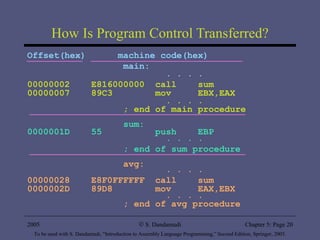
How Is Program Control Transferred? Offset(hex)  machine code(hex) main:   . . . .  00000002 E816000000 call  sum 00000007 89C3 mov  EBX,EAX   . . . .  ; end of main procedure sum: 0000001D 55  push  EBP   . . . .  ; end of sum procedure avg:   . . . .  00000028 E8F0FFFFFF call  sum 0000002D 89D8 mov  EAX,EBX   . . . .  ; end of avg procedure 2005 To be used with S. Dandamudi, “Introduction to Assembly Language Programming,” Second Edition, Springer, 2005. S. Dandamudi Chapter 5: Page
Parameter Passing Parameter passing is different and complicated than in a high-level language In assembly language You should first place all required parameters in a mutually accessible storage area Then call the procedure  Type of storage area used Registers (general-purpose registers are used) Memory (stack is used) Two common methods of parameter passing: Register method Stack method 2005 To be used with S. Dandamudi, “Introduction to Assembly Language Programming,” Second Edition, Springer, 2005. S. Dandamudi Chapter 5: Page
Parameter Passing: Register Method Calling procedure places the necessary parameters in the general-purpose registers before invoking the procedure through the  call  instruction  Examples: PROCEX1.ASM call-by-value using the register method  a simple sum procedure PROCEX2.ASM call-by-reference using the register method string length procedure 2005 To be used with S. Dandamudi, “Introduction to Assembly Language Programming,” Second Edition, Springer, 2005. S. Dandamudi Chapter 5: Page
Pros and Cons of the Register Method Advantages Convenient and easier Faster Disadvantages Only a few parameters can be passed using the register method Only a small number of registers are available Often these registers are not free freeing them by pushing their values onto the stack negates the second advantage 2005 To be used with S. Dandamudi, “Introduction to Assembly Language Programming,” Second Edition, Springer, 2005. S. Dandamudi Chapter 5: Page
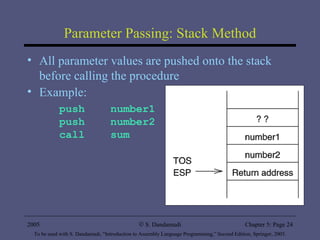
Parameter Passing: Stack Method All parameter values are pushed onto the stack before calling the procedure Example: push  number1 push  number2 call  sum 2005 To be used with S. Dandamudi, “Introduction to Assembly Language Programming,” Second Edition, Springer, 2005. S. Dandamudi Chapter 5: Page
Accessing Parameters on the Stack Parameter values are buried inside the stack We can use the following to read  number2 mov  EBX,[ESP+4]  Problem:  The ESP value changes with  push  and  pop  operations Relative offset depends of the stack operations performed Not desirable Is there a better alternative? Use EBP to access parameters on the stack 2005 To be used with S. Dandamudi, “Introduction to Assembly Language Programming,” Second Edition, Springer, 2005. S. Dandamudi Chapter 5: Page
Using BP Register to Access Parameters Preferred method of accessing parameters on the stack is mov  EBP,ESP mov  EAX,[EBP+4] to access  number2   in the previous example Problem: BP contents are lost! We have to preserve the contents of BP Use the stack (caution: offset value changes) push  EBP mov  EBP,ESP 2005 To be used with S. Dandamudi, “Introduction to Assembly Language Programming,” Second Edition, Springer, 2005. S. Dandamudi Chapter 5: Page
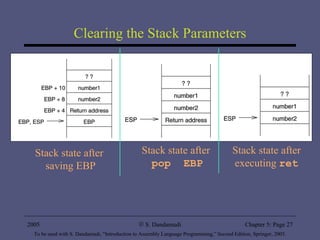
Clearing the Stack Parameters 2005 To be used with S. Dandamudi, “Introduction to Assembly Language Programming,” Second Edition, Springer, 2005. S. Dandamudi Chapter 5: Page  Stack state after saving EBP Stack state after  pop  EBP Stack state after executing  ret
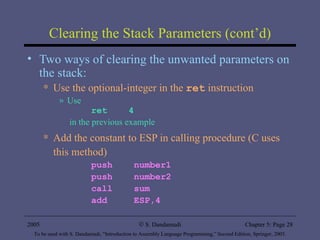
Clearing the Stack Parameters (cont’d) Two ways of clearing the unwanted parameters on the stack: Use the optional-integer in the  ret  instruction Use  ret  4   in the previous example Add the constant to ESP in calling procedure (C uses this method) push  number1 push  number2 call  sum add  ESP,4 2005 To be used with S. Dandamudi, “Introduction to Assembly Language Programming,” Second Edition, Springer, 2005. S. Dandamudi Chapter 5: Page
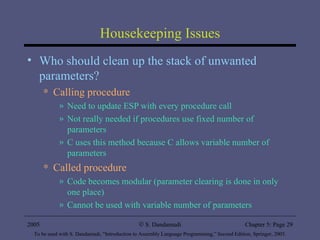
Housekeeping Issues Who should clean up the stack of unwanted parameters? Calling procedure Need to update ESP with every procedure call Not really needed if procedures use fixed number of parameters C uses this method because C allows variable number of parameters Called procedure Code becomes modular (parameter clearing is done in only one place) Cannot be used with variable number of parameters 2005 To be used with S. Dandamudi, “Introduction to Assembly Language Programming,” Second Edition, Springer, 2005. S. Dandamudi Chapter 5: Page
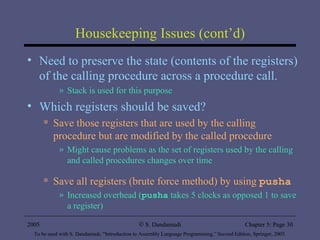
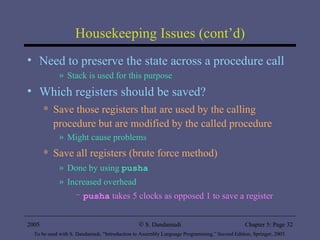
Housekeeping Issues (cont’d) Need to preserve the state (contents of the registers) of the calling procedure across a procedure call.  Stack is used for this purpose Which registers should be saved? Save those registers that are used by the calling procedure but are modified by the called procedure Might cause problems as the set of registers used by the calling and called procedures changes over time Save all registers (brute force method) by using  pusha Increased overhead ( pusha  takes 5 clocks as opposed 1 to save a register) 2005 To be used with S. Dandamudi, “Introduction to Assembly Language Programming,” Second Edition, Springer, 2005. S. Dandamudi Chapter 5: Page
Housekeeping Issues (cont’d) Who should preserve the state of the calling procedure? Calling procedure Need to know the registers used by the called procedure Need to include instructions to save and restore registers with every procedure call Causes program maintenance problems Called procedure Preferred method as the code becomes modular (state preservation is done only once and in one place) Avoids the program maintenance problems mentioned 2005 To be used with S. Dandamudi, “Introduction to Assembly Language Programming,” Second Edition, Springer, 2005. S. Dandamudi Chapter 5: Page
Housekeeping Issues (cont’d) Need to preserve the state across a procedure call Stack is used for this purpose Which registers should be saved? Save those registers that are used by the calling procedure but are modified by the called procedure Might cause problems Save all registers (brute force method)  Done by using  pusha Increased overhead  pusha  takes 5 clocks as opposed 1 to save a register 2005 To be used with S. Dandamudi, “Introduction to Assembly Language Programming,” Second Edition, Springer, 2005. S. Dandamudi Chapter 5: Page
Housekeeping Issues (cont’d) 2005 To be used with S. Dandamudi, “Introduction to Assembly Language Programming,” Second Edition, Springer, 2005. S. Dandamudi Chapter 5: Page  Stack state after  pusha
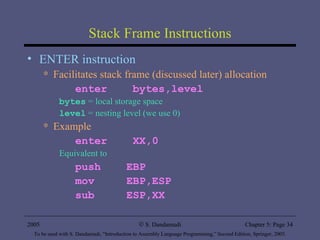
Stack Frame Instructions ENTER instruction Facilitates stack frame (discussed later) allocation enter  bytes,level bytes  = local storage space level  = nesting level (we use 0) Example enter  XX,0 Equivalent to  push  EBP mov  EBP,ESP sub  ESP,XX 2005 To be used with S. Dandamudi, “Introduction to Assembly Language Programming,” Second Edition, Springer, 2005. S. Dandamudi Chapter 5: Page
Stack Frame Instructions (cont’d) LEAVE instruction Releases stack frame leave Takes no operands Equivalent to  mov  ESP,EBP pop  EBP 2005 To be used with S. Dandamudi, “Introduction to Assembly Language Programming,” Second Edition, Springer, 2005. S. Dandamudi Chapter 5: Page
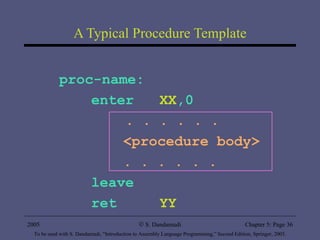
A Typical Procedure Template proc-name: enter  XX ,0   . . . . . . <procedure body> . . . . . . leave ret  YY 2005 To be used with S. Dandamudi, “Introduction to Assembly Language Programming,” Second Edition, Springer, 2005. S. Dandamudi Chapter 5: Page
Stack Parameter Passing: Examples PROCEX3.ASM call-by-value using the stack method  a simple sum procedure PROCSWAP.ASM call-by-reference using the stack method first two characters of the input string are swapped BBLSORT.ASM implements bubble sort algorithm uses  pusha  and  popa  to save and restore registers 2005 To be used with S. Dandamudi, “Introduction to Assembly Language Programming,” Second Edition, Springer, 2005. S. Dandamudi Chapter 5: Page
Variable Number of Parameters For most procedures, the number of parameters is fixed Every time the procedure is called, the same number of parameter values are passed) In procedures that can have variable number of parameters With each procedure call, the number of parameter values passed can be different C supports procedures with variable number of parameters  Easy to support variable number of parameters using the stack method  2005 To be used with S. Dandamudi, “Introduction to Assembly Language Programming,” Second Edition, Springer, 2005. S. Dandamudi Chapter 5: Page
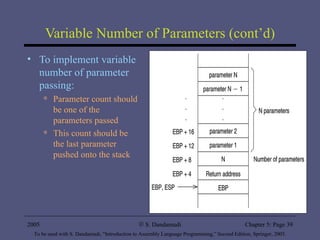
Variable Number of Parameters (cont’d) To implement variable number of parameter passing: Parameter count should be one of the parameters passed This count should be the last parameter pushed onto the stack 2005 To be used with S. Dandamudi, “Introduction to Assembly Language Programming,” Second Edition, Springer, 2005. S. Dandamudi Chapter 5: Page
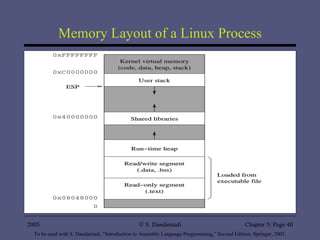
Memory Layout of a Linux Process 2005 To be used with S. Dandamudi, “Introduction to Assembly Language Programming,” Second Edition, Springer, 2005. S. Dandamudi Chapter 5: Page
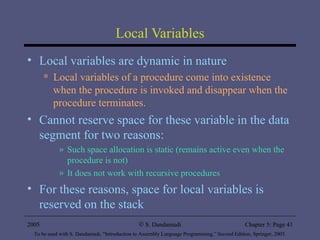
Local Variables Local variables are dynamic in nature Local variables of a procedure come into existence when the procedure is invoked and disappear when the procedure terminates. Cannot reserve space for these variable in the data segment for two reasons: Such space allocation is static (remains active even when the procedure is not) It does not work with recursive procedures For these reasons, space for local variables is reserved on the stack 2005 To be used with S. Dandamudi, “Introduction to Assembly Language Programming,” Second Edition, Springer, 2005. S. Dandamudi Chapter 5: Page
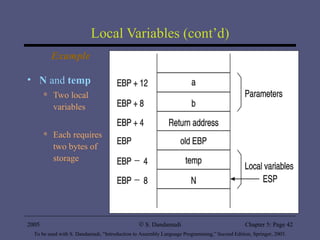
Local Variables (cont’d) Example N  and  temp   Two local variables Each requires two bytes of storage 2005 To be used with S. Dandamudi, “Introduction to Assembly Language Programming,” Second Edition, Springer, 2005. S. Dandamudi Chapter 5: Page
Local Variables (cont’d) The information stored in the stack parameters returns address old BP value local variables is collectively called  stack frame In high-level languages, stack frame is also referred to as the  activation record Because each procedure activation requires all this information The EBP value is referred to as the  frame pointer Once the EBP value is known, we can access all the data in the stack frame 2005 To be used with S. Dandamudi, “Introduction to Assembly Language Programming,” Second Edition, Springer, 2005. S. Dandamudi Chapter 5: Page
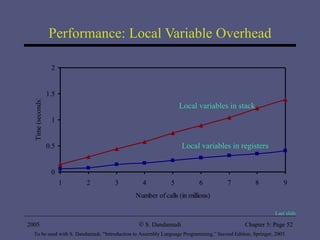
Local Variables: Examples PROCFIB1.ASM For simple procedures, registers can also be used for local variable storage  Uses registers for local variable storage Outputs the largest Fibonacci number that is less than the given input number PROCFIB2.ASM Uses the stack for local variable storage Performance implications of using registers versus stack are discussed later 2005 To be used with S. Dandamudi, “Introduction to Assembly Language Programming,” Second Edition, Springer, 2005. S. Dandamudi Chapter 5: Page
Multiple Module Programs In multi-module programs, a single program is split into multiple source files Advantages If a module is modified, only that module needs to be reassembled (not the whole program) Several programmers can share the work Making modifications is easier with several short files Unintended modifications can be avoided To facilitate separate assembly, two assembler directives are provided: GLOBAL and EXTERN 2005 To be used with S. Dandamudi, “Introduction to Assembly Language Programming,” Second Edition, Springer, 2005. S. Dandamudi Chapter 5: Page
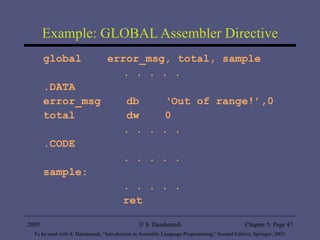
GLOBAL Assembler Directive The GLOBAL directive makes the associated labels public Makes these labels available for other modules of the program The format is global  label1, label2, . . . Almost any label can be made public including procedure names variable names equated labels In the GLOBAL statement, it is not necessary to specify the type of label 2005 To be used with S. Dandamudi, “Introduction to Assembly Language Programming,” Second Edition, Springer, 2005. S. Dandamudi Chapter 5: Page
Example: GLOBAL Assembler Directive global  error_msg, total, sample . . . . .  .DATA error_msg  db  ‘Out of range!’,0 total  dw  0 . . . . .  .CODE . . . . .  sample: . . . . .  ret 2005 To be used with S. Dandamudi, “Introduction to Assembly Language Programming,” Second Edition, Springer, 2005. S. Dandamudi Chapter 5: Page
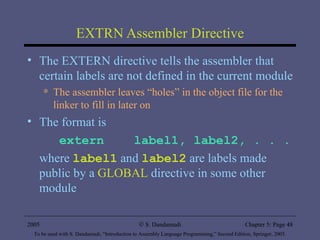
EXTRN Assembler Directive The EXTERN directive tells the assembler that certain labels are not defined in the current module The assembler leaves “holes” in the object file for the linker to fill in later on The format is extern  label1, label2, . . . where  label1  and  label2  are labels made public by a  GLOBAL  directive in some other module 2005 To be used with S. Dandamudi, “Introduction to Assembly Language Programming,” Second Edition, Springer, 2005. S. Dandamudi Chapter 5: Page
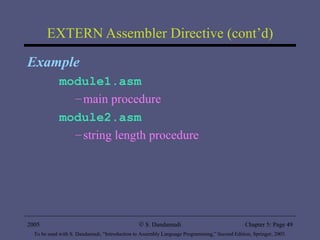
EXTERN Assembler Directive (cont’d) Example module1.asm   main procedure module2.asm string length procedure 2005 To be used with S. Dandamudi, “Introduction to Assembly Language Programming,” Second Edition, Springer, 2005. S. Dandamudi Chapter 5: Page
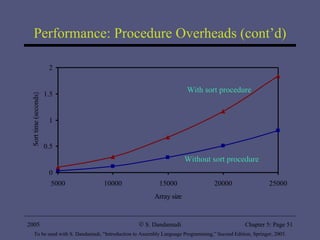
Performance: Procedure Overheads Stack versus Registers No swap procedure (Program 5.5, lines 95-99) swap: mov  [ESI+4],EAX mov  [ESI],EBX mov  EDX,UNSORTED  SWAP procedure (replaces the above code) swap_proc: mov  [ESI+4],EAX mov  [ESI],EBX mov  EDX,UNSORTED ret 2005 To be used with S. Dandamudi, “Introduction to Assembly Language Programming,” Second Edition, Springer, 2005. S. Dandamudi Chapter 5: Page
Performance: Procedure Overheads (cont’d) 2005 To be used with S. Dandamudi, “Introduction to Assembly Language Programming,” Second Edition, Springer, 2005. S. Dandamudi Chapter 5: Page  With sort procedure Without sort procedure
Performance: Local Variable Overhead 2005 To be used with S. Dandamudi, “Introduction to Assembly Language Programming,” Second Edition, Springer, 2005. S. Dandamudi Chapter 5: Page  Local variables in stack Local variables in registers Last slide

Al2ed chapter5

  • 1.
    Procedures and theStack Chapter 5 S. Dandamudi
  • 2.
    Outline What isstack? Pentium implementation of stack Stack instructions Uses of stack Procedures Pentium instructions Parameter passing Register method Stack method Examples Call-by-value Call-by-reference Bubble sort Procedures with variable number of parameters Local variables Multiple source program modules Performance: Procedure overheads 2005 To be used with S. Dandamudi, “Introduction to Assembly Language Programming,” Second Edition, Springer, 2005. S. Dandamudi Chapter 5: Page
  • 3.
    What is aStack? Stack is a last-in-first-out (LIFO) data structure If we view the stack as a linear array of elements, both insertion and deletion operations are restricted to one end of the array Only the element at the top-of-stack (TOS) is directly accessible Two basic stack operations: push (insertion) pop (deletion) 2005 To be used with S. Dandamudi, “Introduction to Assembly Language Programming,” Second Edition, Springer, 2005. S. Dandamudi Chapter 5: Page
  • 4.
    What is aStack? (cont’d) Example Insertion of data items into the stack Arrow points to the top-of-stack 2005 To be used with S. Dandamudi, “Introduction to Assembly Language Programming,” Second Edition, Springer, 2005. S. Dandamudi Chapter 5: Page
  • 5.
    What is aStack? (cont’d) Example Deletion of data items from the stack Arrow points to the top-of-stack 2005 To be used with S. Dandamudi, “Introduction to Assembly Language Programming,” Second Edition, Springer, 2005. S. Dandamudi Chapter 5: Page
  • 6.
    Pentium Implementation ofthe Stack Stack segment is used to implement the stack Registers SS and ESP are used SS:ESP represents the top-of-stack Pentium stack implementation characteristics are: Only words (i.e., 16-bit data) or doublewords (i.e., 32-bit data) are saved on the stack, never a single byte Stack grows toward lower memory addresses (i.e., stack grows “downward”) Top-of-stack (TOS) always points to the last data item placed on the stack 2005 To be used with S. Dandamudi, “Introduction to Assembly Language Programming,” Second Edition, Springer, 2005. S. Dandamudi Chapter 5: Page
  • 7.
    Pentium Stack InstructionsPentium provides two basic instructions: push source pop destination source and destination can be a 16- or 32-bit general register a segment register a word or doubleword in memory source of push can also be an immediate operand of size 8, 16, or 32 bits 2005 To be used with S. Dandamudi, “Introduction to Assembly Language Programming,” Second Edition, Springer, 2005. S. Dandamudi Chapter 5: Page
  • 8.
    Pentium Stack Example- 1 2005 To be used with S. Dandamudi, “Introduction to Assembly Language Programming,” Second Edition, Springer, 2005. S. Dandamudi Chapter 5: Page
  • 9.
    Pentium Stack Instructions:Examples On an empty stack , the following sequence of push instructions push 21ABH push 7FBD329AH results in the stack state shown in (c) in the last figure On this stack, executing pop EBX results in the stack state shown in (b) in the next figure and the register EBX gets the value 7FBD329AH 2005 To be used with S. Dandamudi, “Introduction to Assembly Language Programming,” Second Edition, Springer, 2005. S. Dandamudi Chapter 5: Page
  • 10.
    Pentium Stack Example- 2 2005 To be used with S. Dandamudi, “Introduction to Assembly Language Programming,” Second Edition, Springer, 2005. S. Dandamudi Chapter 5: Page
  • 11.
    Additional Pentium StackInstructions Stack Operations on Flags push and pop instructions cannot be used with the Flags register Two special instructions for this purpose are pushfd (push 32-bit flags) popfd (pop 32-bit flags) No operands are required Use pushfw and popfw for 16-bit flags (FLAGS) 2005 To be used with S. Dandamudi, “Introduction to Assembly Language Programming,” Second Edition, Springer, 2005. S. Dandamudi Chapter 5: Page
  • 12.
    Additional Pentium StackInstructions (cont’d) Stack Operations on All General-Purpose Registers pushad and popad instructions can be used to save and restore the eight general-purpose registers EAX, ECX, EDX, EBX, ESP, EBP, ESI, and EDI Pushad pushes these eight registers in the above order (EAX first and EDI last) popad restores these registers except that ESP value is not loaded into the ESP register Use pushaw and popaw for saving and restoring 16-bit registers 2005 To be used with S. Dandamudi, “Introduction to Assembly Language Programming,” Second Edition, Springer, 2005. S. Dandamudi Chapter 5: Page
  • 13.
    Uses of theStack Three main uses Temporary storage of data Transfer of control Parameter passing Temporary Storage of Data Example : Exchanging value1 and value2 can be done by using the stack to temporarily hold data push value1 push value2 pop value1 pop value2 2005 To be used with S. Dandamudi, “Introduction to Assembly Language Programming,” Second Edition, Springer, 2005. S. Dandamudi Chapter 5: Page
  • 14.
    Uses of theStack (cont’d) Often used to free a set of registers ;save EAX & EBX registers on the stack push EAX push EBX ;EAX and EBX registers can now be used mov EAX,value1 mov EBX,value2 mov value1,EBX mov value2,EAX ;restore EAX & EBX registers from the stack pop EBX pop EAX . . . 2005 To be used with S. Dandamudi, “Introduction to Assembly Language Programming,” Second Edition, Springer, 2005. S. Dandamudi Chapter 5: Page
  • 15.
    Uses of theStack (cont’d) Transfer of Control In procedure calls and interrupts, the return address is stored on the stack Our discussion on procedure calls clarifies this particular use of the stack Parameter Passing Stack is extensively used for parameter passing Our discussion later on parameter passing describes how the stack is used for this purpose 2005 To be used with S. Dandamudi, “Introduction to Assembly Language Programming,” Second Edition, Springer, 2005. S. Dandamudi Chapter 5: Page
  • 16.
    Procedures Two typesCall-by-value Receives only values Similar to mathematical functions Call-by-reference Receives pointers Directly manipulates parameter storage 2005 To be used with S. Dandamudi, “Introduction to Assembly Language Programming,” Second Edition, Springer, 2005. S. Dandamudi Chapter 5: Page
  • 17.
    Pentium Instructions forProcedures Pentium provides two instructions: call and ret call instruction is used to invoke a procedure The format is call proc-name proc-name is the procedure name Actions taken during a near procedure call: ESP = ESP - 4 ; push return address SS:ESP = EIP ; onto the stack EIP = EIP + relative displacement ; update EIP to point to the procedure 2005 To be used with S. Dandamudi, “Introduction to Assembly Language Programming,” Second Edition, Springer, 2005. S. Dandamudi Chapter 5: Page
  • 18.
    Pentium Instructions forProcedures (cont’d) ret instruction is used to transfer control back to the calling procedure How will the processor know where to return? Uses the return address pushed onto the stack as part of executing the call instruction Important that TOS points to this return address when ret instruction is executed Actions taken during the execution of ret are: EIP = SS:ESP ; pop return address ESP = ESP + 4 ; from the stack 2005 To be used with S. Dandamudi, “Introduction to Assembly Language Programming,” Second Edition, Springer, 2005. S. Dandamudi Chapter 5: Page
  • 19.
    Pentium Instructions forProcedures (cont’d) We can specify an optional integer in the ret instruction The format is ret optional-integer Example: ret 8 Actions taken on ret with optional-integer are: EIP = SS:ESP ESP = ESP + 4 + optional-integer 2005 To be used with S. Dandamudi, “Introduction to Assembly Language Programming,” Second Edition, Springer, 2005. S. Dandamudi Chapter 5: Page
  • 20.
    How Is ProgramControl Transferred? Offset(hex) machine code(hex) main: . . . . 00000002 E816000000 call sum 00000007 89C3 mov EBX,EAX . . . . ; end of main procedure sum: 0000001D 55 push EBP . . . . ; end of sum procedure avg: . . . . 00000028 E8F0FFFFFF call sum 0000002D 89D8 mov EAX,EBX . . . . ; end of avg procedure 2005 To be used with S. Dandamudi, “Introduction to Assembly Language Programming,” Second Edition, Springer, 2005. S. Dandamudi Chapter 5: Page
  • 21.
    Parameter Passing Parameterpassing is different and complicated than in a high-level language In assembly language You should first place all required parameters in a mutually accessible storage area Then call the procedure Type of storage area used Registers (general-purpose registers are used) Memory (stack is used) Two common methods of parameter passing: Register method Stack method 2005 To be used with S. Dandamudi, “Introduction to Assembly Language Programming,” Second Edition, Springer, 2005. S. Dandamudi Chapter 5: Page
  • 22.
    Parameter Passing: RegisterMethod Calling procedure places the necessary parameters in the general-purpose registers before invoking the procedure through the call instruction Examples: PROCEX1.ASM call-by-value using the register method a simple sum procedure PROCEX2.ASM call-by-reference using the register method string length procedure 2005 To be used with S. Dandamudi, “Introduction to Assembly Language Programming,” Second Edition, Springer, 2005. S. Dandamudi Chapter 5: Page
  • 23.
    Pros and Consof the Register Method Advantages Convenient and easier Faster Disadvantages Only a few parameters can be passed using the register method Only a small number of registers are available Often these registers are not free freeing them by pushing their values onto the stack negates the second advantage 2005 To be used with S. Dandamudi, “Introduction to Assembly Language Programming,” Second Edition, Springer, 2005. S. Dandamudi Chapter 5: Page
  • 24.
    Parameter Passing: StackMethod All parameter values are pushed onto the stack before calling the procedure Example: push number1 push number2 call sum 2005 To be used with S. Dandamudi, “Introduction to Assembly Language Programming,” Second Edition, Springer, 2005. S. Dandamudi Chapter 5: Page
  • 25.
    Accessing Parameters onthe Stack Parameter values are buried inside the stack We can use the following to read number2 mov EBX,[ESP+4] Problem: The ESP value changes with push and pop operations Relative offset depends of the stack operations performed Not desirable Is there a better alternative? Use EBP to access parameters on the stack 2005 To be used with S. Dandamudi, “Introduction to Assembly Language Programming,” Second Edition, Springer, 2005. S. Dandamudi Chapter 5: Page
  • 26.
    Using BP Registerto Access Parameters Preferred method of accessing parameters on the stack is mov EBP,ESP mov EAX,[EBP+4] to access number2 in the previous example Problem: BP contents are lost! We have to preserve the contents of BP Use the stack (caution: offset value changes) push EBP mov EBP,ESP 2005 To be used with S. Dandamudi, “Introduction to Assembly Language Programming,” Second Edition, Springer, 2005. S. Dandamudi Chapter 5: Page
  • 27.
    Clearing the StackParameters 2005 To be used with S. Dandamudi, “Introduction to Assembly Language Programming,” Second Edition, Springer, 2005. S. Dandamudi Chapter 5: Page Stack state after saving EBP Stack state after pop EBP Stack state after executing ret
  • 28.
    Clearing the StackParameters (cont’d) Two ways of clearing the unwanted parameters on the stack: Use the optional-integer in the ret instruction Use ret 4 in the previous example Add the constant to ESP in calling procedure (C uses this method) push number1 push number2 call sum add ESP,4 2005 To be used with S. Dandamudi, “Introduction to Assembly Language Programming,” Second Edition, Springer, 2005. S. Dandamudi Chapter 5: Page
  • 29.
    Housekeeping Issues Whoshould clean up the stack of unwanted parameters? Calling procedure Need to update ESP with every procedure call Not really needed if procedures use fixed number of parameters C uses this method because C allows variable number of parameters Called procedure Code becomes modular (parameter clearing is done in only one place) Cannot be used with variable number of parameters 2005 To be used with S. Dandamudi, “Introduction to Assembly Language Programming,” Second Edition, Springer, 2005. S. Dandamudi Chapter 5: Page
  • 30.
    Housekeeping Issues (cont’d)Need to preserve the state (contents of the registers) of the calling procedure across a procedure call. Stack is used for this purpose Which registers should be saved? Save those registers that are used by the calling procedure but are modified by the called procedure Might cause problems as the set of registers used by the calling and called procedures changes over time Save all registers (brute force method) by using pusha Increased overhead ( pusha takes 5 clocks as opposed 1 to save a register) 2005 To be used with S. Dandamudi, “Introduction to Assembly Language Programming,” Second Edition, Springer, 2005. S. Dandamudi Chapter 5: Page
  • 31.
    Housekeeping Issues (cont’d)Who should preserve the state of the calling procedure? Calling procedure Need to know the registers used by the called procedure Need to include instructions to save and restore registers with every procedure call Causes program maintenance problems Called procedure Preferred method as the code becomes modular (state preservation is done only once and in one place) Avoids the program maintenance problems mentioned 2005 To be used with S. Dandamudi, “Introduction to Assembly Language Programming,” Second Edition, Springer, 2005. S. Dandamudi Chapter 5: Page
  • 32.
    Housekeeping Issues (cont’d)Need to preserve the state across a procedure call Stack is used for this purpose Which registers should be saved? Save those registers that are used by the calling procedure but are modified by the called procedure Might cause problems Save all registers (brute force method) Done by using pusha Increased overhead pusha takes 5 clocks as opposed 1 to save a register 2005 To be used with S. Dandamudi, “Introduction to Assembly Language Programming,” Second Edition, Springer, 2005. S. Dandamudi Chapter 5: Page
  • 33.
    Housekeeping Issues (cont’d)2005 To be used with S. Dandamudi, “Introduction to Assembly Language Programming,” Second Edition, Springer, 2005. S. Dandamudi Chapter 5: Page Stack state after pusha
  • 34.
    Stack Frame InstructionsENTER instruction Facilitates stack frame (discussed later) allocation enter bytes,level bytes = local storage space level = nesting level (we use 0) Example enter XX,0 Equivalent to push EBP mov EBP,ESP sub ESP,XX 2005 To be used with S. Dandamudi, “Introduction to Assembly Language Programming,” Second Edition, Springer, 2005. S. Dandamudi Chapter 5: Page
  • 35.
    Stack Frame Instructions(cont’d) LEAVE instruction Releases stack frame leave Takes no operands Equivalent to mov ESP,EBP pop EBP 2005 To be used with S. Dandamudi, “Introduction to Assembly Language Programming,” Second Edition, Springer, 2005. S. Dandamudi Chapter 5: Page
  • 36.
    A Typical ProcedureTemplate proc-name: enter XX ,0 . . . . . . <procedure body> . . . . . . leave ret YY 2005 To be used with S. Dandamudi, “Introduction to Assembly Language Programming,” Second Edition, Springer, 2005. S. Dandamudi Chapter 5: Page
  • 37.
    Stack Parameter Passing:Examples PROCEX3.ASM call-by-value using the stack method a simple sum procedure PROCSWAP.ASM call-by-reference using the stack method first two characters of the input string are swapped BBLSORT.ASM implements bubble sort algorithm uses pusha and popa to save and restore registers 2005 To be used with S. Dandamudi, “Introduction to Assembly Language Programming,” Second Edition, Springer, 2005. S. Dandamudi Chapter 5: Page
  • 38.
    Variable Number ofParameters For most procedures, the number of parameters is fixed Every time the procedure is called, the same number of parameter values are passed) In procedures that can have variable number of parameters With each procedure call, the number of parameter values passed can be different C supports procedures with variable number of parameters Easy to support variable number of parameters using the stack method 2005 To be used with S. Dandamudi, “Introduction to Assembly Language Programming,” Second Edition, Springer, 2005. S. Dandamudi Chapter 5: Page
  • 39.
    Variable Number ofParameters (cont’d) To implement variable number of parameter passing: Parameter count should be one of the parameters passed This count should be the last parameter pushed onto the stack 2005 To be used with S. Dandamudi, “Introduction to Assembly Language Programming,” Second Edition, Springer, 2005. S. Dandamudi Chapter 5: Page
  • 40.
    Memory Layout ofa Linux Process 2005 To be used with S. Dandamudi, “Introduction to Assembly Language Programming,” Second Edition, Springer, 2005. S. Dandamudi Chapter 5: Page
  • 41.
    Local Variables Localvariables are dynamic in nature Local variables of a procedure come into existence when the procedure is invoked and disappear when the procedure terminates. Cannot reserve space for these variable in the data segment for two reasons: Such space allocation is static (remains active even when the procedure is not) It does not work with recursive procedures For these reasons, space for local variables is reserved on the stack 2005 To be used with S. Dandamudi, “Introduction to Assembly Language Programming,” Second Edition, Springer, 2005. S. Dandamudi Chapter 5: Page
  • 42.
    Local Variables (cont’d)Example N and temp Two local variables Each requires two bytes of storage 2005 To be used with S. Dandamudi, “Introduction to Assembly Language Programming,” Second Edition, Springer, 2005. S. Dandamudi Chapter 5: Page
  • 43.
    Local Variables (cont’d)The information stored in the stack parameters returns address old BP value local variables is collectively called stack frame In high-level languages, stack frame is also referred to as the activation record Because each procedure activation requires all this information The EBP value is referred to as the frame pointer Once the EBP value is known, we can access all the data in the stack frame 2005 To be used with S. Dandamudi, “Introduction to Assembly Language Programming,” Second Edition, Springer, 2005. S. Dandamudi Chapter 5: Page
  • 44.
    Local Variables: ExamplesPROCFIB1.ASM For simple procedures, registers can also be used for local variable storage Uses registers for local variable storage Outputs the largest Fibonacci number that is less than the given input number PROCFIB2.ASM Uses the stack for local variable storage Performance implications of using registers versus stack are discussed later 2005 To be used with S. Dandamudi, “Introduction to Assembly Language Programming,” Second Edition, Springer, 2005. S. Dandamudi Chapter 5: Page
  • 45.
    Multiple Module ProgramsIn multi-module programs, a single program is split into multiple source files Advantages If a module is modified, only that module needs to be reassembled (not the whole program) Several programmers can share the work Making modifications is easier with several short files Unintended modifications can be avoided To facilitate separate assembly, two assembler directives are provided: GLOBAL and EXTERN 2005 To be used with S. Dandamudi, “Introduction to Assembly Language Programming,” Second Edition, Springer, 2005. S. Dandamudi Chapter 5: Page
  • 46.
    GLOBAL Assembler DirectiveThe GLOBAL directive makes the associated labels public Makes these labels available for other modules of the program The format is global label1, label2, . . . Almost any label can be made public including procedure names variable names equated labels In the GLOBAL statement, it is not necessary to specify the type of label 2005 To be used with S. Dandamudi, “Introduction to Assembly Language Programming,” Second Edition, Springer, 2005. S. Dandamudi Chapter 5: Page
  • 47.
    Example: GLOBAL AssemblerDirective global error_msg, total, sample . . . . . .DATA error_msg db ‘Out of range!’,0 total dw 0 . . . . . .CODE . . . . . sample: . . . . . ret 2005 To be used with S. Dandamudi, “Introduction to Assembly Language Programming,” Second Edition, Springer, 2005. S. Dandamudi Chapter 5: Page
  • 48.
    EXTRN Assembler DirectiveThe EXTERN directive tells the assembler that certain labels are not defined in the current module The assembler leaves “holes” in the object file for the linker to fill in later on The format is extern label1, label2, . . . where label1 and label2 are labels made public by a GLOBAL directive in some other module 2005 To be used with S. Dandamudi, “Introduction to Assembly Language Programming,” Second Edition, Springer, 2005. S. Dandamudi Chapter 5: Page
  • 49.
    EXTERN Assembler Directive(cont’d) Example module1.asm main procedure module2.asm string length procedure 2005 To be used with S. Dandamudi, “Introduction to Assembly Language Programming,” Second Edition, Springer, 2005. S. Dandamudi Chapter 5: Page
  • 50.
    Performance: Procedure OverheadsStack versus Registers No swap procedure (Program 5.5, lines 95-99) swap: mov [ESI+4],EAX mov [ESI],EBX mov EDX,UNSORTED SWAP procedure (replaces the above code) swap_proc: mov [ESI+4],EAX mov [ESI],EBX mov EDX,UNSORTED ret 2005 To be used with S. Dandamudi, “Introduction to Assembly Language Programming,” Second Edition, Springer, 2005. S. Dandamudi Chapter 5: Page
  • 51.
    Performance: Procedure Overheads(cont’d) 2005 To be used with S. Dandamudi, “Introduction to Assembly Language Programming,” Second Edition, Springer, 2005. S. Dandamudi Chapter 5: Page With sort procedure Without sort procedure
  • 52.
    Performance: Local VariableOverhead 2005 To be used with S. Dandamudi, “Introduction to Assembly Language Programming,” Second Edition, Springer, 2005. S. Dandamudi Chapter 5: Page Local variables in stack Local variables in registers Last slide