Arithmetic Instructions
INC & DEC Instructions
• Syntax:
– INC operand ; operand=operand+1
– DEC operand ; operand=operand-1
• Operand can be a general register or memory.
• INC and DEC instructions affect all the flags.
• Examples:
– INC AX legal
– DEC BL legal
– INC [BX] illegal
– INC Byte PTR [BX] legal
– DEC I legal
– INC DS illegal
NEG instruction
• Syntax: NEG operand
– Operand 0 – operand
• Finds the two’s complement of operand.
• Operand can be a general register or memory location.
• NEG instruction affects all flags.
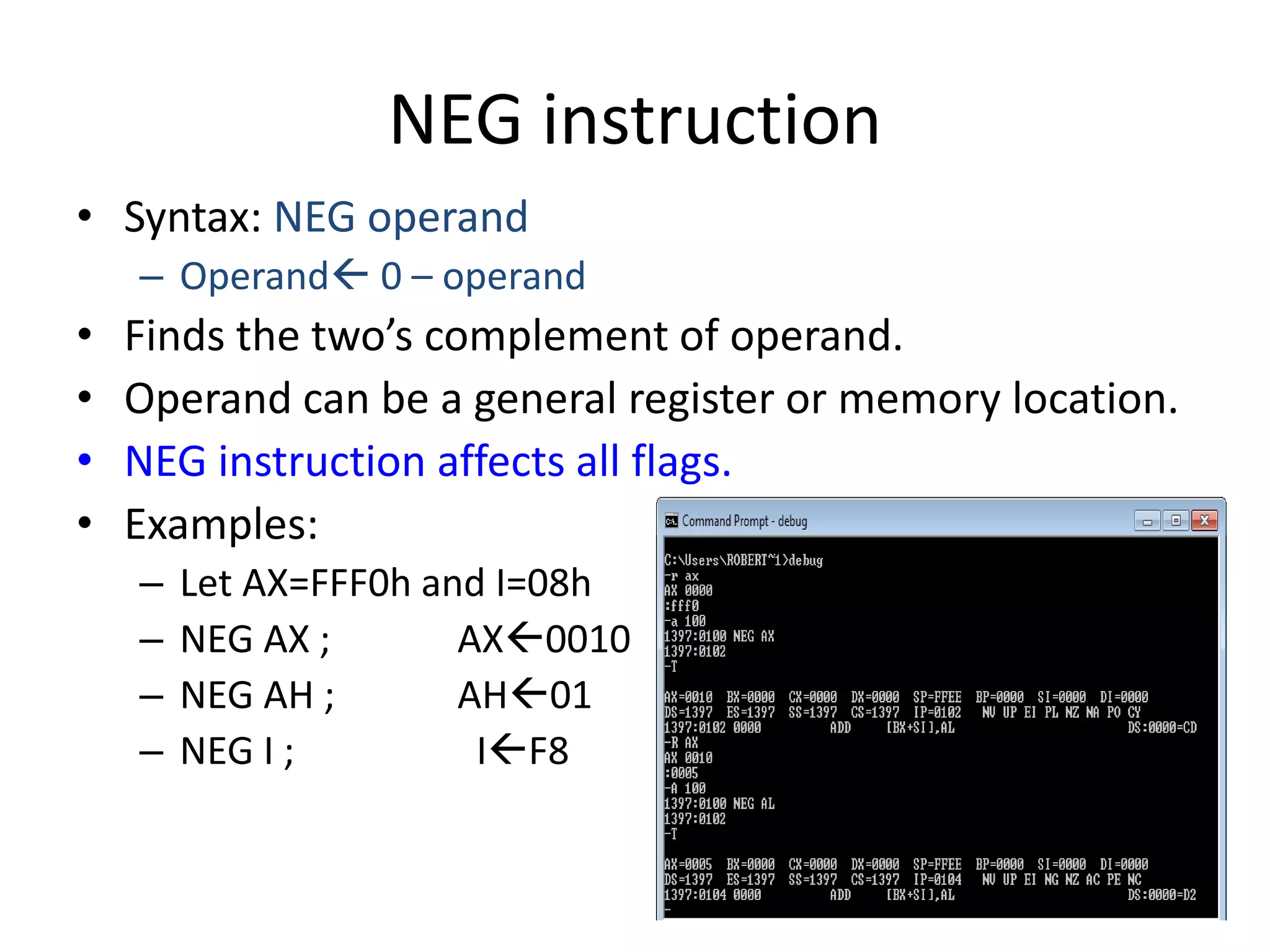
• Examples:
– Let AX=FFF0h and I=08h
– NEG AX ; AX0010
– NEG AH ; AH01
– NEG I ; IF8
CMP instruction
• Syntax: CMP operand1, operand2
– Operand1-operand2
• Subtracts operand2 from operand1 and
updates the flags based on the result.
• CMP instruction affects all the flags.
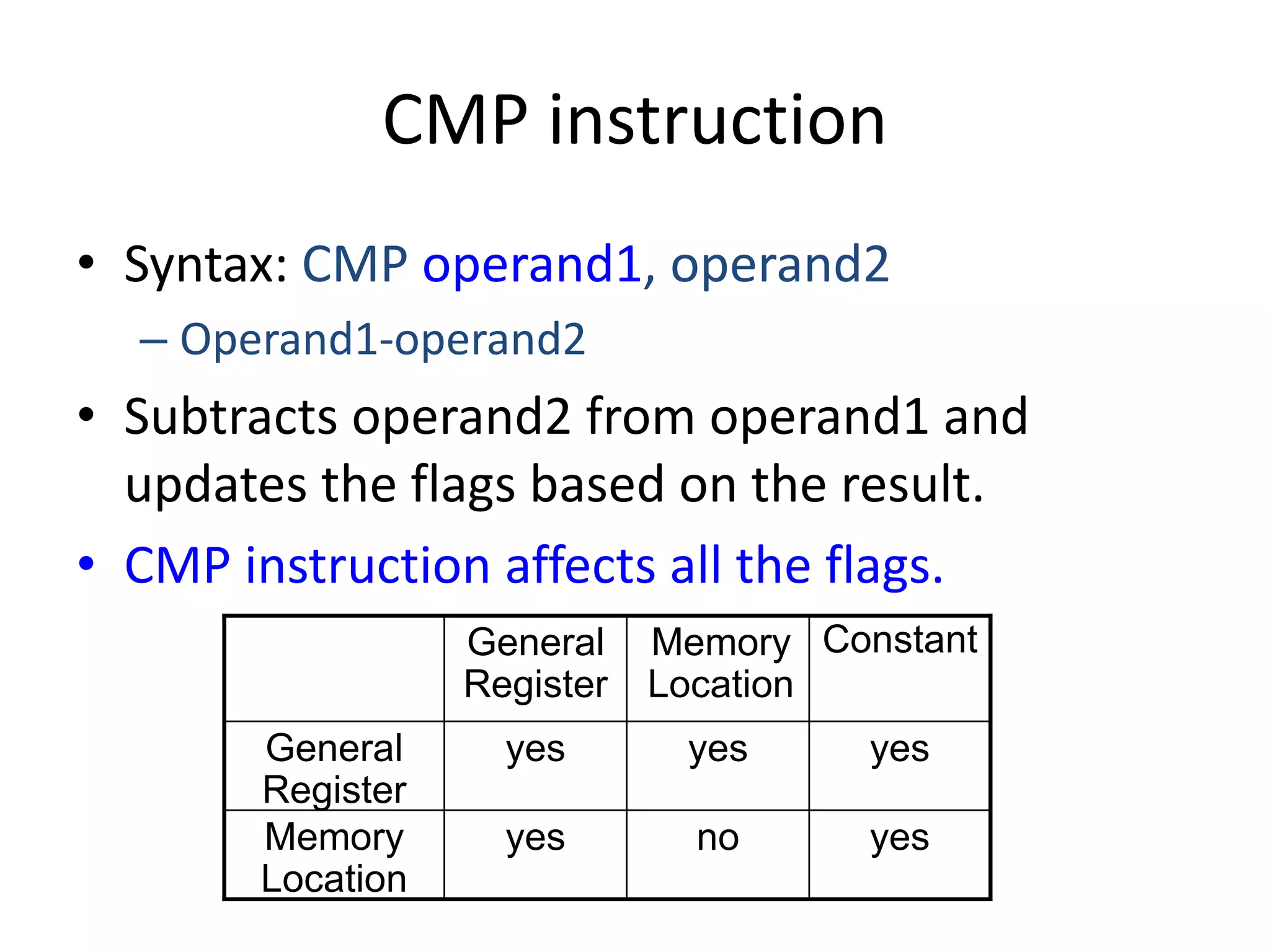
yesnoyesMemory
Location
yesyesyesGeneral
Register
ConstantMemory
Location
General
Register
ADC and SBB instruction
• Syntax:
– ADC destination, source ; destination=destination+source+CF
– SBB destination, source ; destination=destination-source-CF
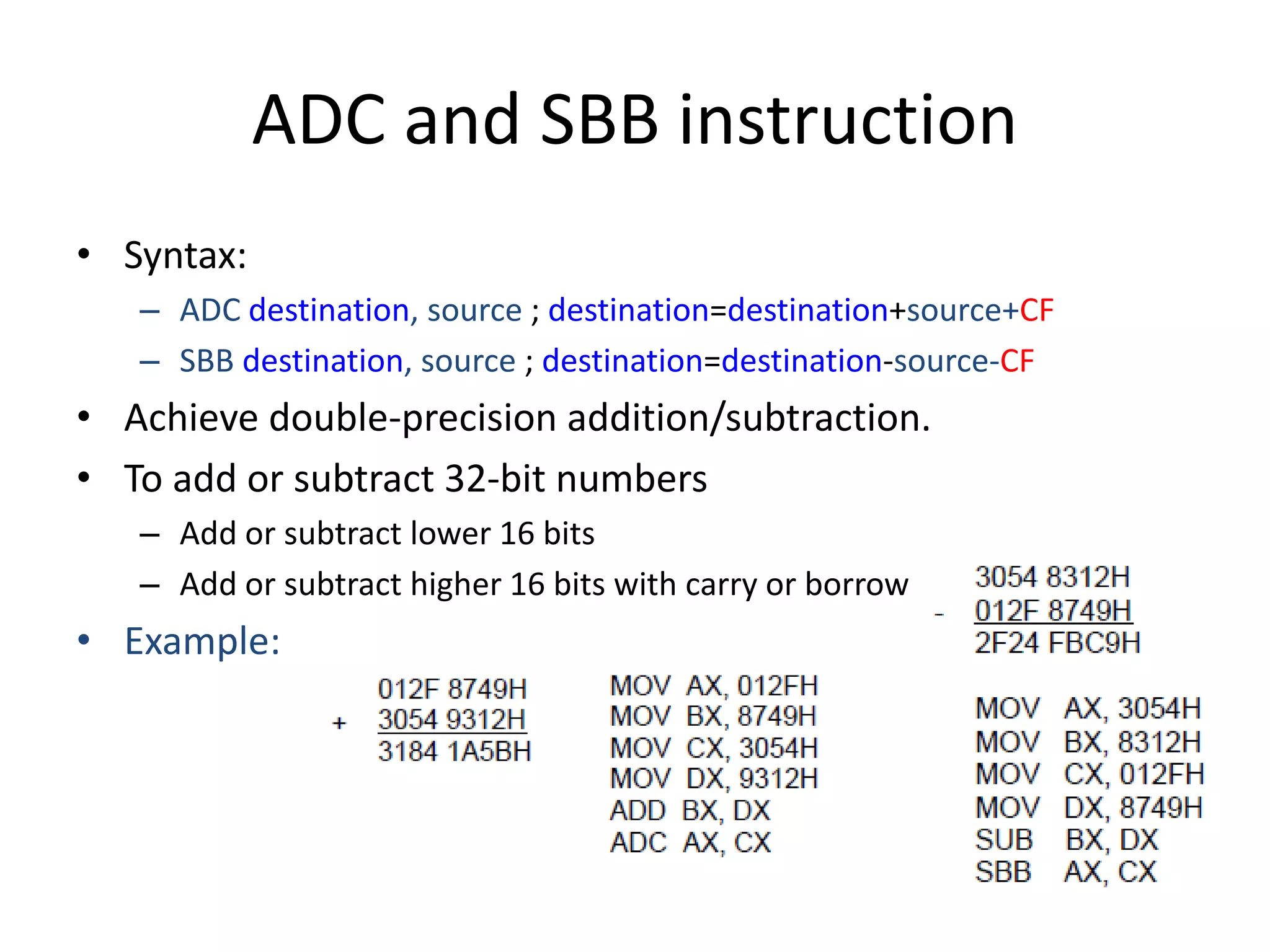
• Achieve double-precision addition/subtraction.
• To add or subtract 32-bit numbers
– Add or subtract lower 16 bits
– Add or subtract higher 16 bits with carry or borrow
• Example:
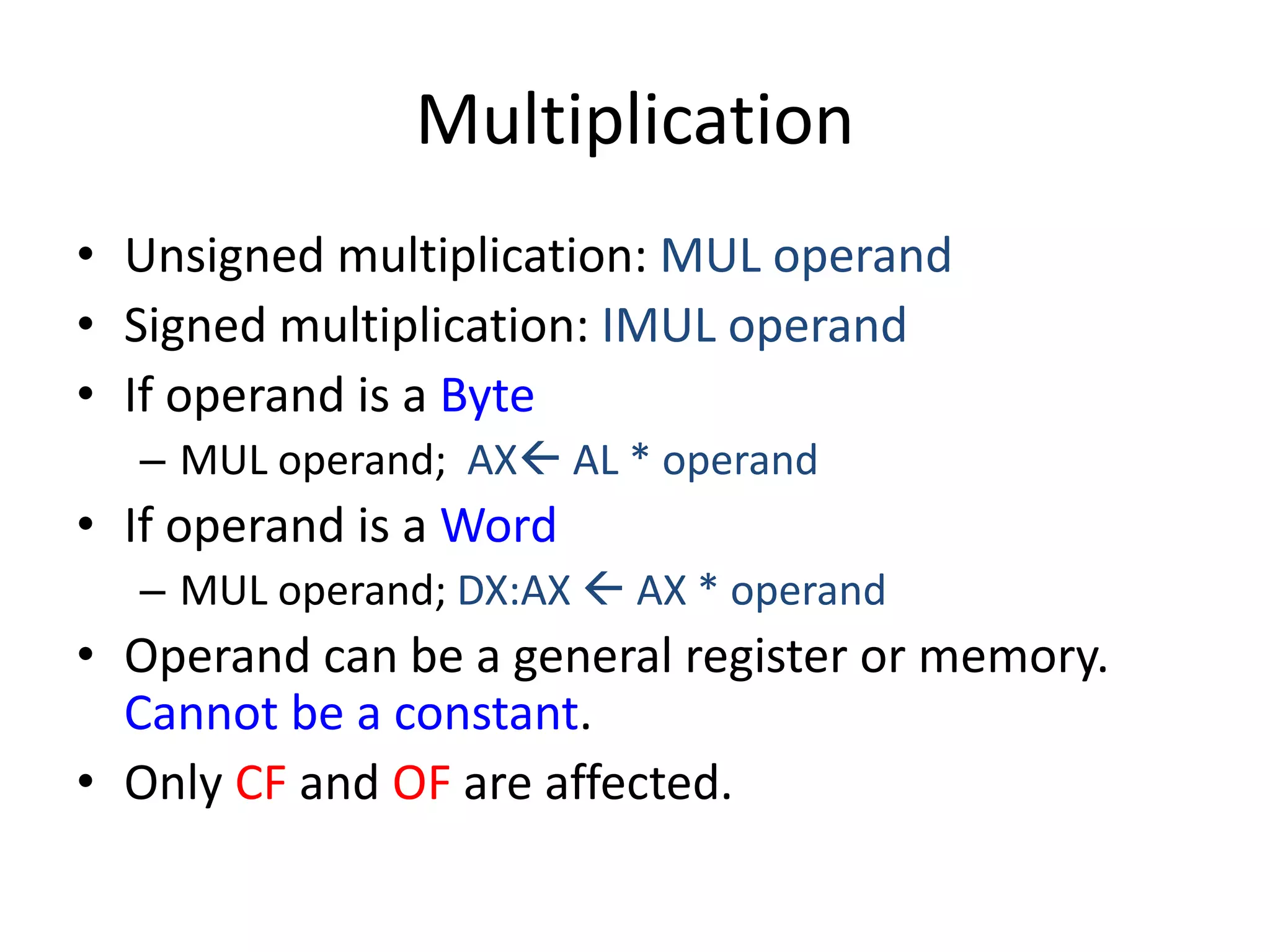
Multiplication
• Unsigned multiplication: MUL operand
• Signed multiplication: IMUL operand
• If operand is a Byte
– MUL operand; AX AL * operand
• If operand is a Word
– MUL operand; DX:AX  AX * operand
• Operand can be a general register or memory.
Cannot be a constant.
• Only CF and OF are affected.
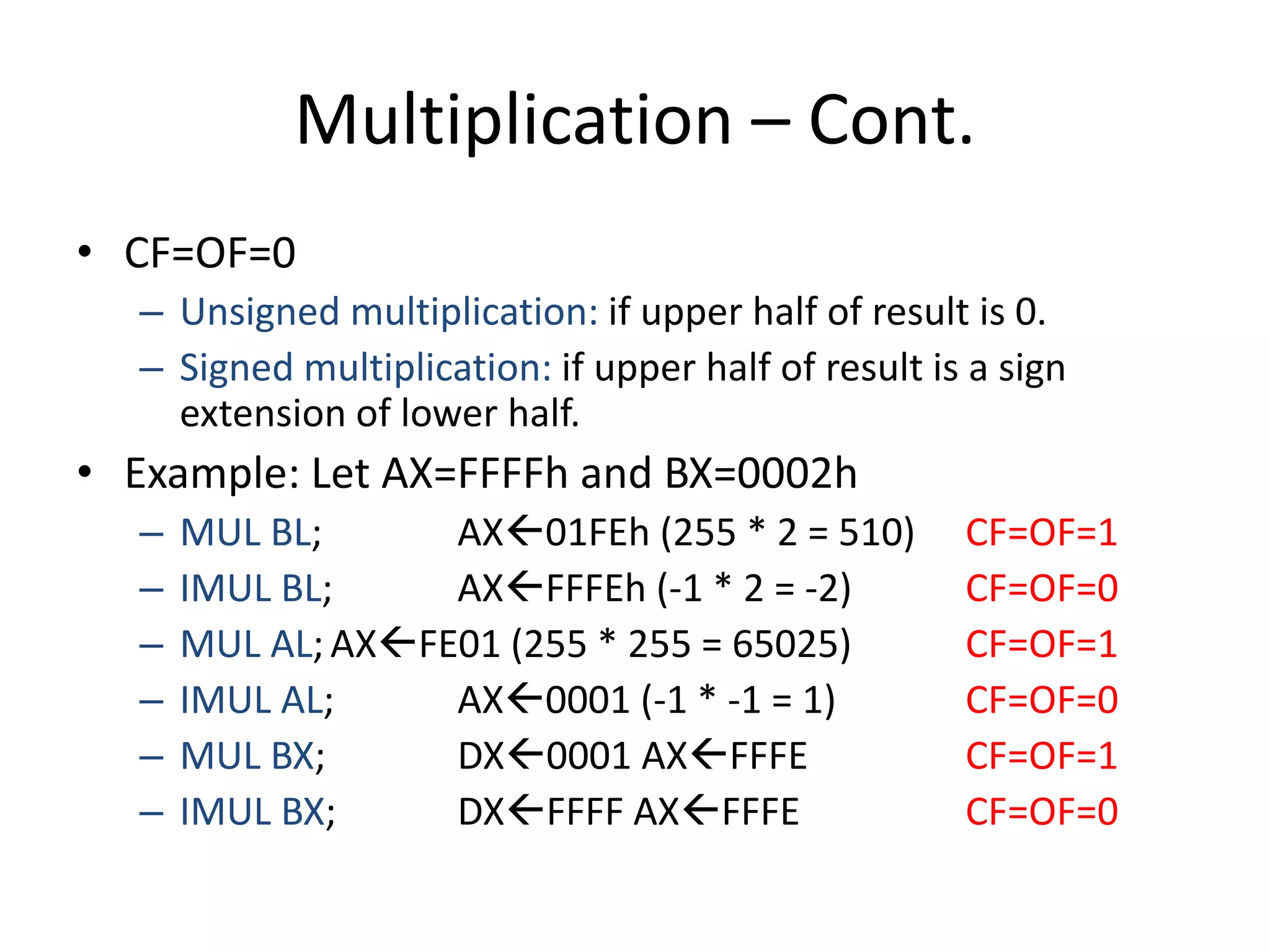
Multiplication – Cont.
• CF=OF=0
– Unsigned multiplication: if upper half of result is 0.
– Signed multiplication: if upper half of result is a sign
extension of lower half.
• Example: Let AX=FFFFh and BX=0002h
– MUL BL; AX01FEh (255 * 2 = 510) CF=OF=1
– IMUL BL; AXFFFEh (-1 * 2 = -2) CF=OF=0
– MUL AL; AXFE01 (255 * 255 = 65025) CF=OF=1
– IMUL AL; AX0001 (-1 * -1 = 1) CF=OF=0
– MUL BX; DX0001 AXFFFE CF=OF=1
– IMUL BX; DXFFFF AXFFFE CF=OF=0
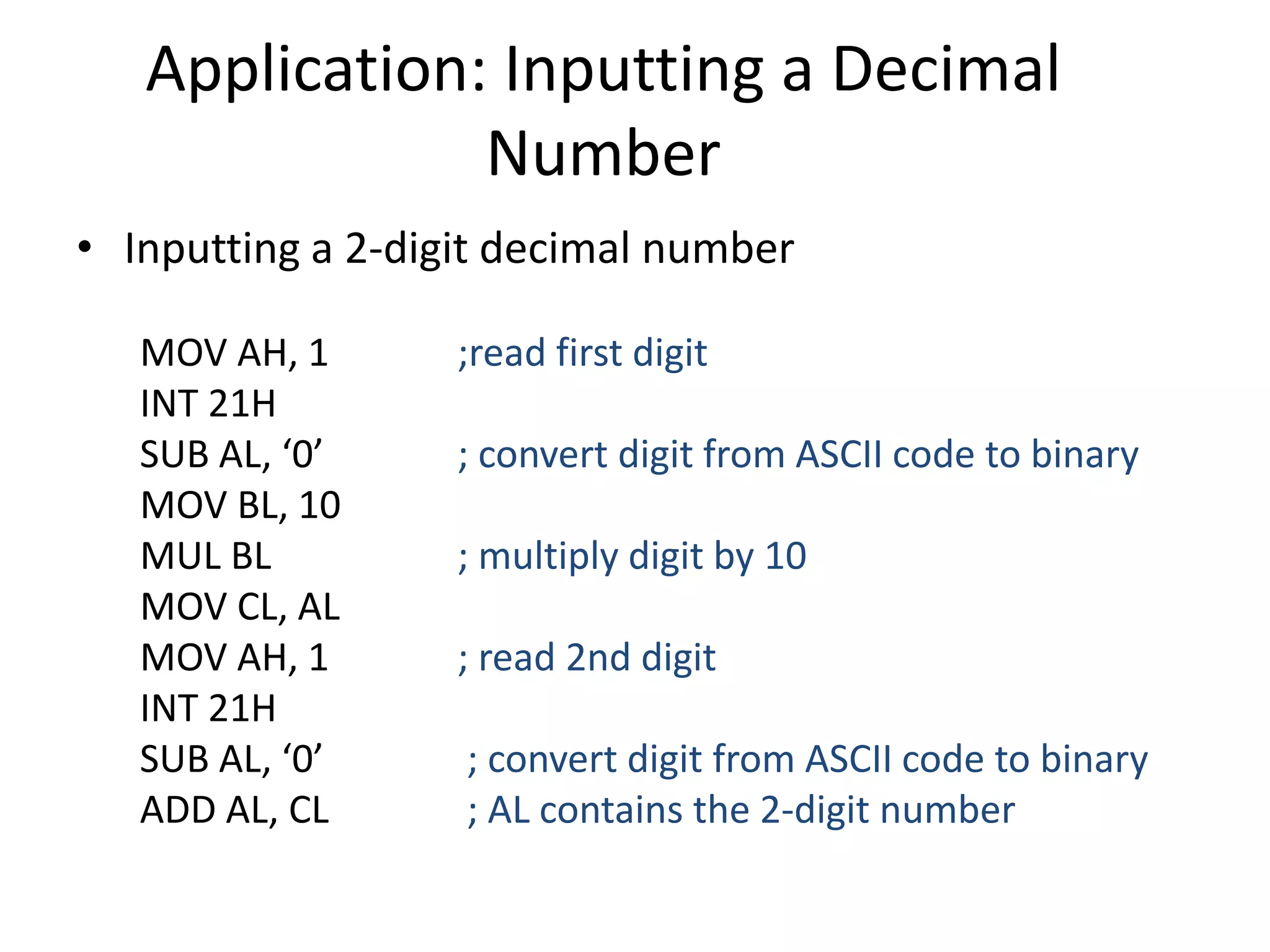
Application: Inputting a Decimal
Number
• Inputting a 2-digit decimal number
MOV AH, 1 ;read first digit
INT 21H
SUB AL, ‘0’ ; convert digit from ASCII code to binary
MOV BL, 10
MUL BL ; multiply digit by 10
MOV CL, AL
MOV AH, 1 ; read 2nd digit
INT 21H
SUB AL, ‘0’ ; convert digit from ASCII code to binary
ADD AL, CL ; AL contains the 2-digit number
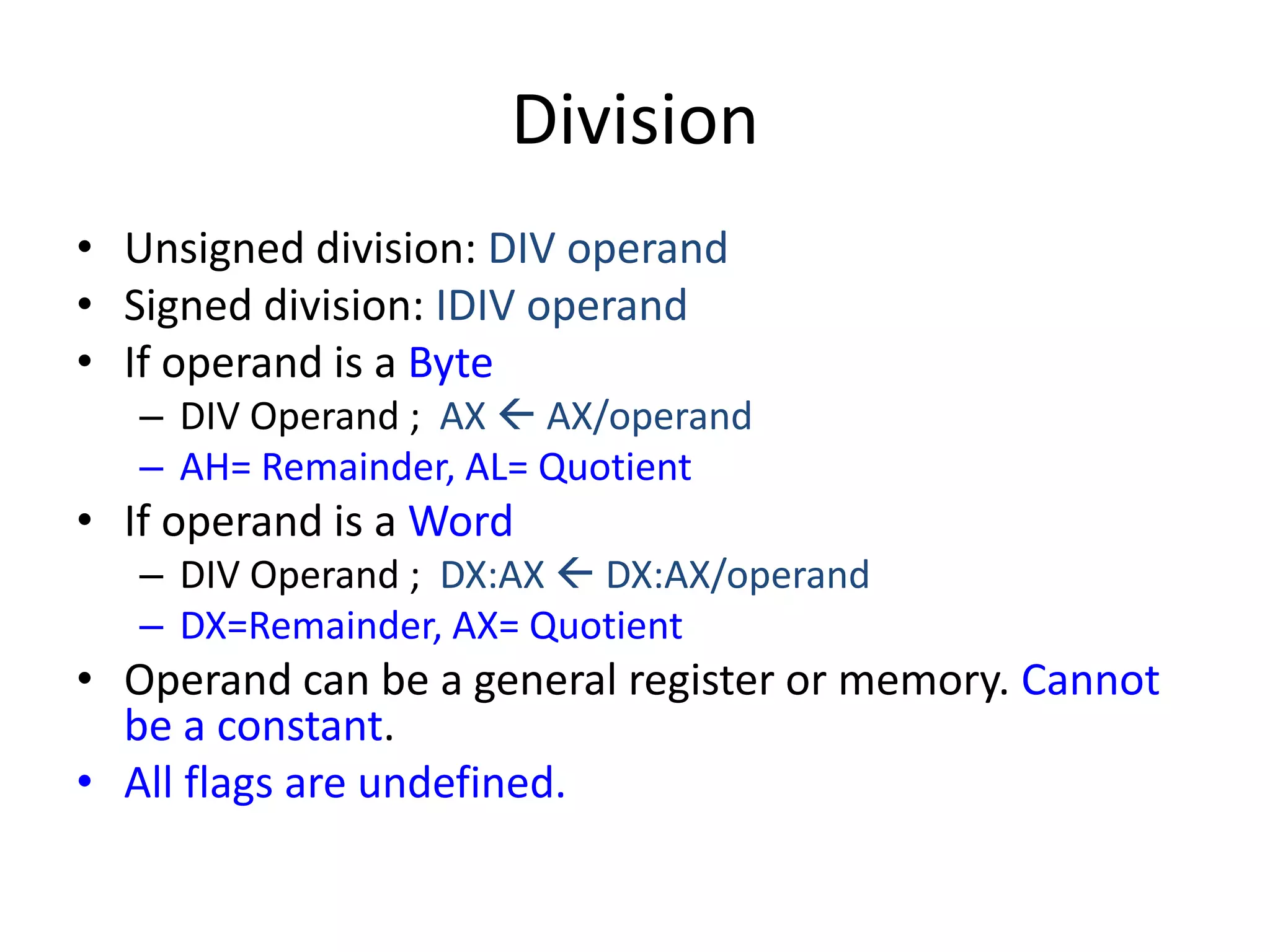
Division
• Unsigned division: DIV operand
• Signed division: IDIV operand
• If operand is a Byte
– DIV Operand ; AX  AX/operand
– AH= Remainder, AL= Quotient
• If operand is a Word
– DIV Operand ; DX:AX  DX:AX/operand
– DX=Remainder, AX= Quotient
• Operand can be a general register or memory. Cannot
be a constant.
• All flags are undefined.
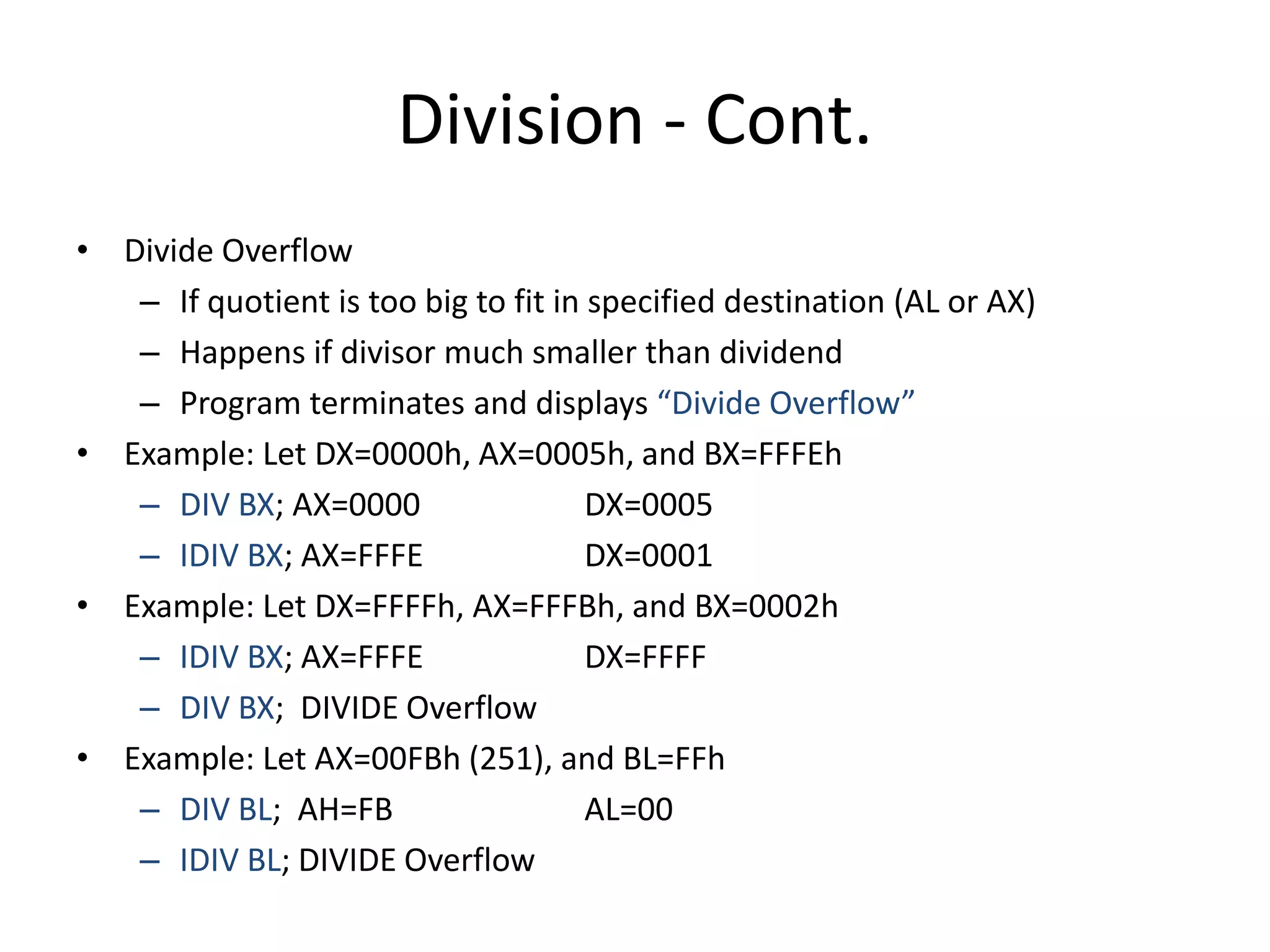
Division - Cont.
• Divide Overflow
– If quotient is too big to fit in specified destination (AL or AX)
– Happens if divisor much smaller than dividend
– Program terminates and displays “Divide Overflow”
• Example: Let DX=0000h, AX=0005h, and BX=FFFEh
– DIV BX; AX=0000 DX=0005
– IDIV BX; AX=FFFE DX=0001
• Example: Let DX=FFFFh, AX=FFFBh, and BX=0002h
– IDIV BX; AX=FFFE DX=FFFF
– DIV BX; DIVIDE Overflow
• Example: Let AX=00FBh (251), and BL=FFh
– DIV BL; AH=FB AL=00
– IDIV BL; DIVIDE Overflow
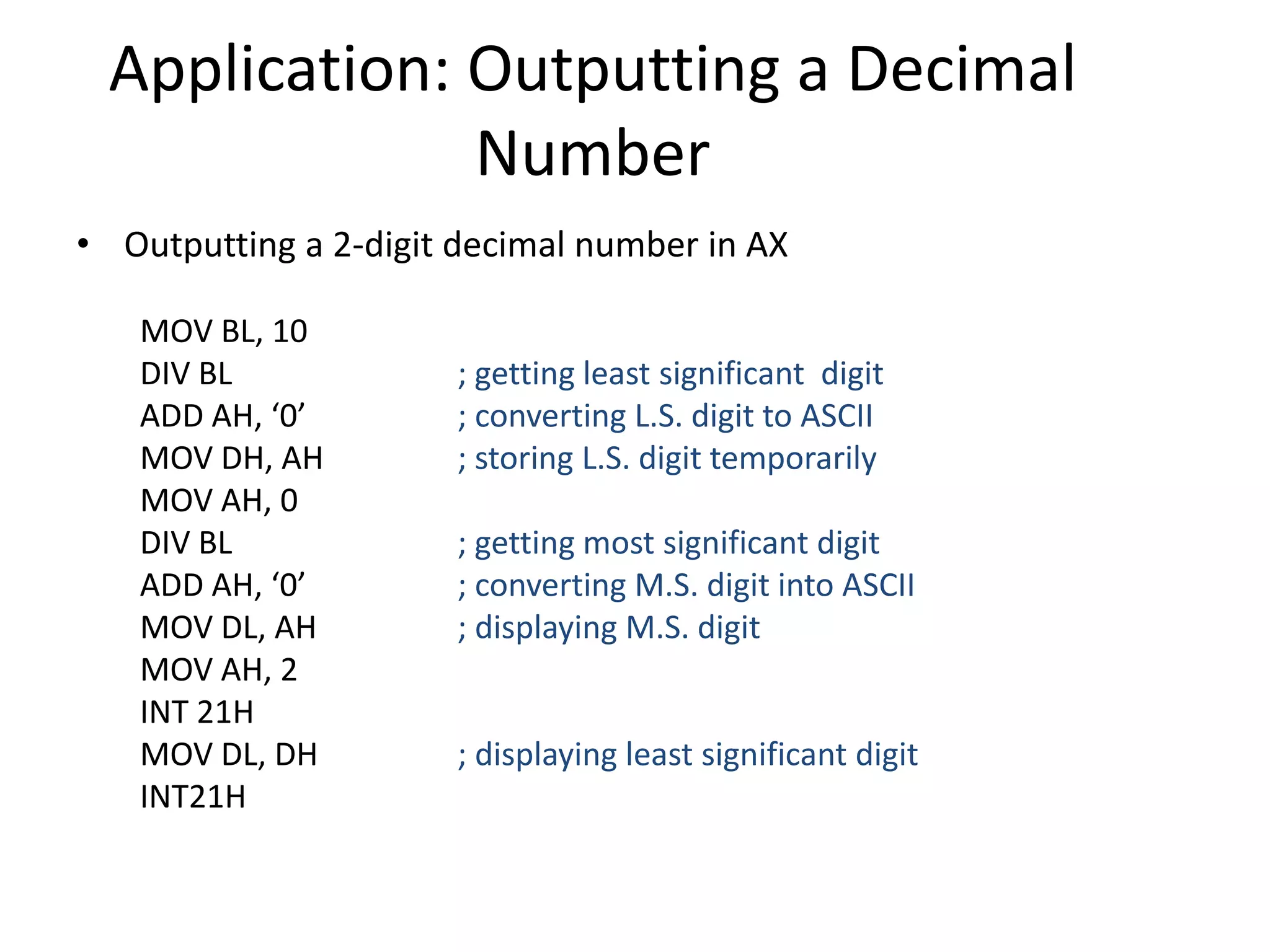
Application: Outputting a Decimal
Number
• Outputting a 2-digit decimal number in AX
MOV BL, 10
DIV BL ; getting least significant digit
ADD AH, ‘0’ ; converting L.S. digit to ASCII
MOV DH, AH ; storing L.S. digit temporarily
MOV AH, 0
DIV BL ; getting most significant digit
ADD AH, ‘0’ ; converting M.S. digit into ASCII
MOV DL, AH ; displaying M.S. digit
MOV AH, 2
INT 21H
MOV DL, DH ; displaying least significant digit
INT21H
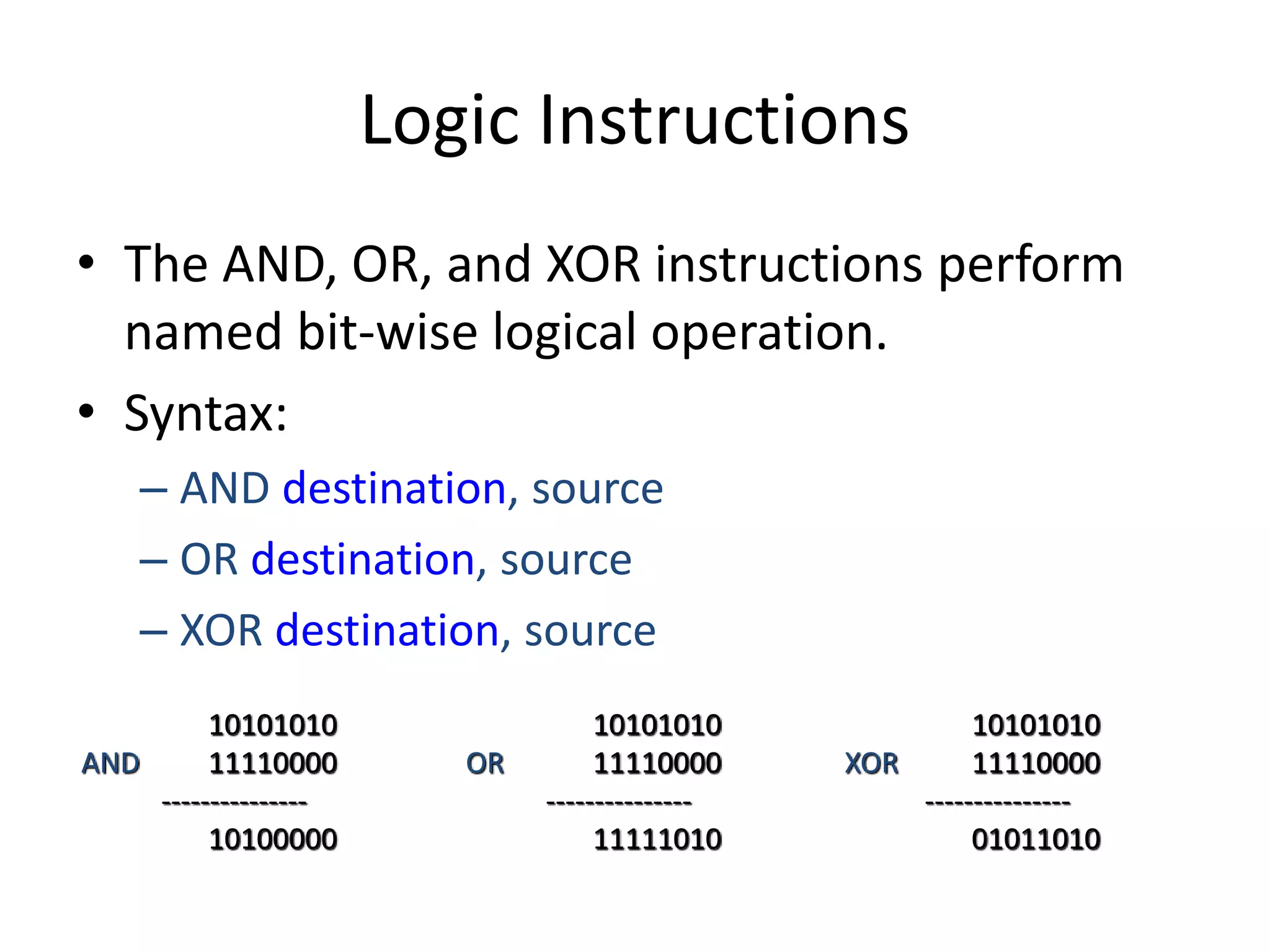
Logic Instructions
• The AND, OR, and XOR instructions perform
named bit-wise logical operation.
• Syntax:
– AND destination, source
– OR destination, source
– XOR destination, source
10101010
AND 11110000
---------------
10100000
10101010
OR 11110000
---------------
11111010
10101010
XOR 11110000
---------------
01011010
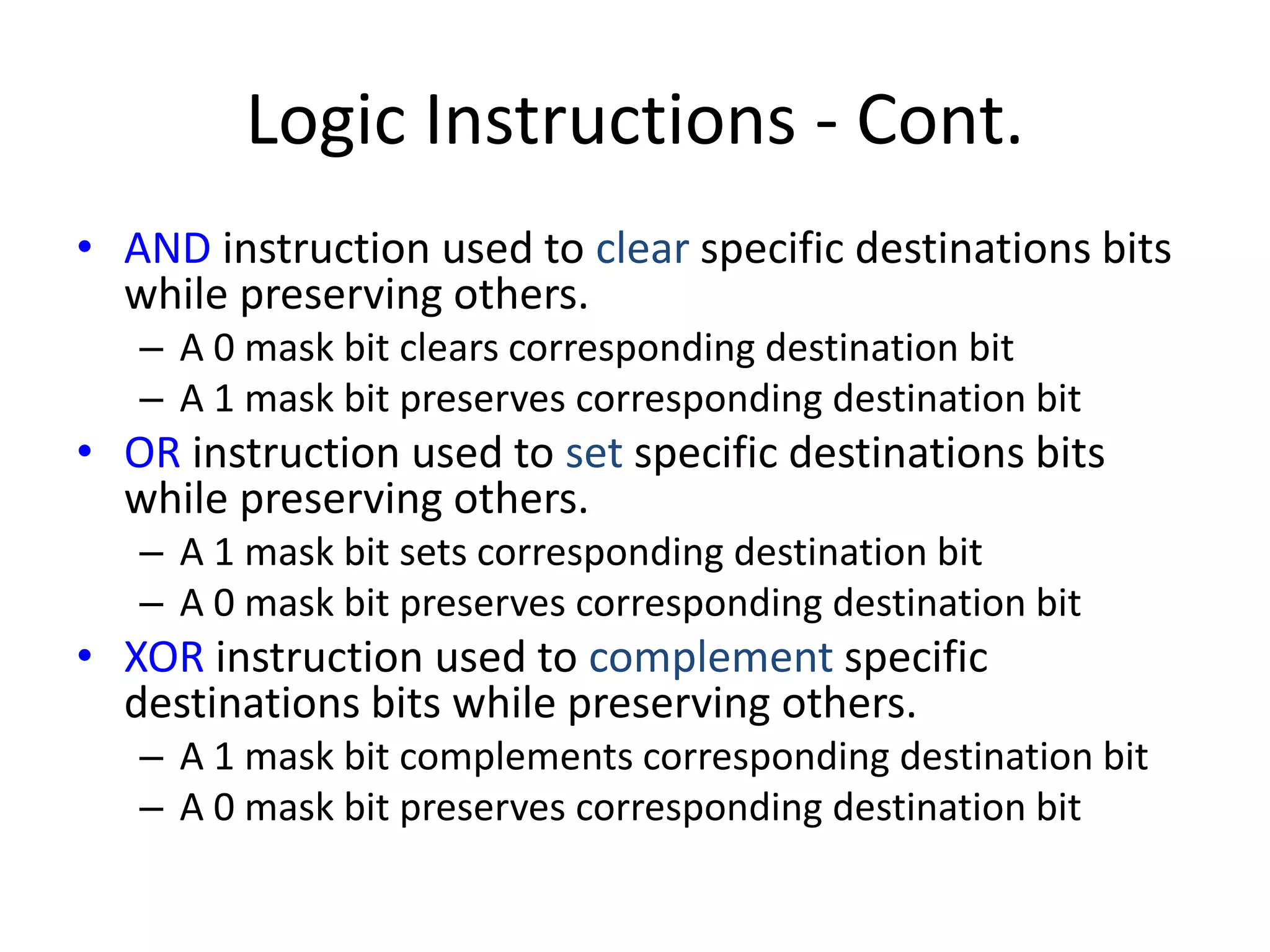
Logic Instructions - Cont.
• AND instruction used to clear specific destinations bits
while preserving others.
– A 0 mask bit clears corresponding destination bit
– A 1 mask bit preserves corresponding destination bit
• OR instruction used to set specific destinations bits
while preserving others.
– A 1 mask bit sets corresponding destination bit
– A 0 mask bit preserves corresponding destination bit
• XOR instruction used to complement specific
destinations bits while preserving others.
– A 1 mask bit complements corresponding destination bit
– A 0 mask bit preserves corresponding destination bit
Logic Instructions - Cont.
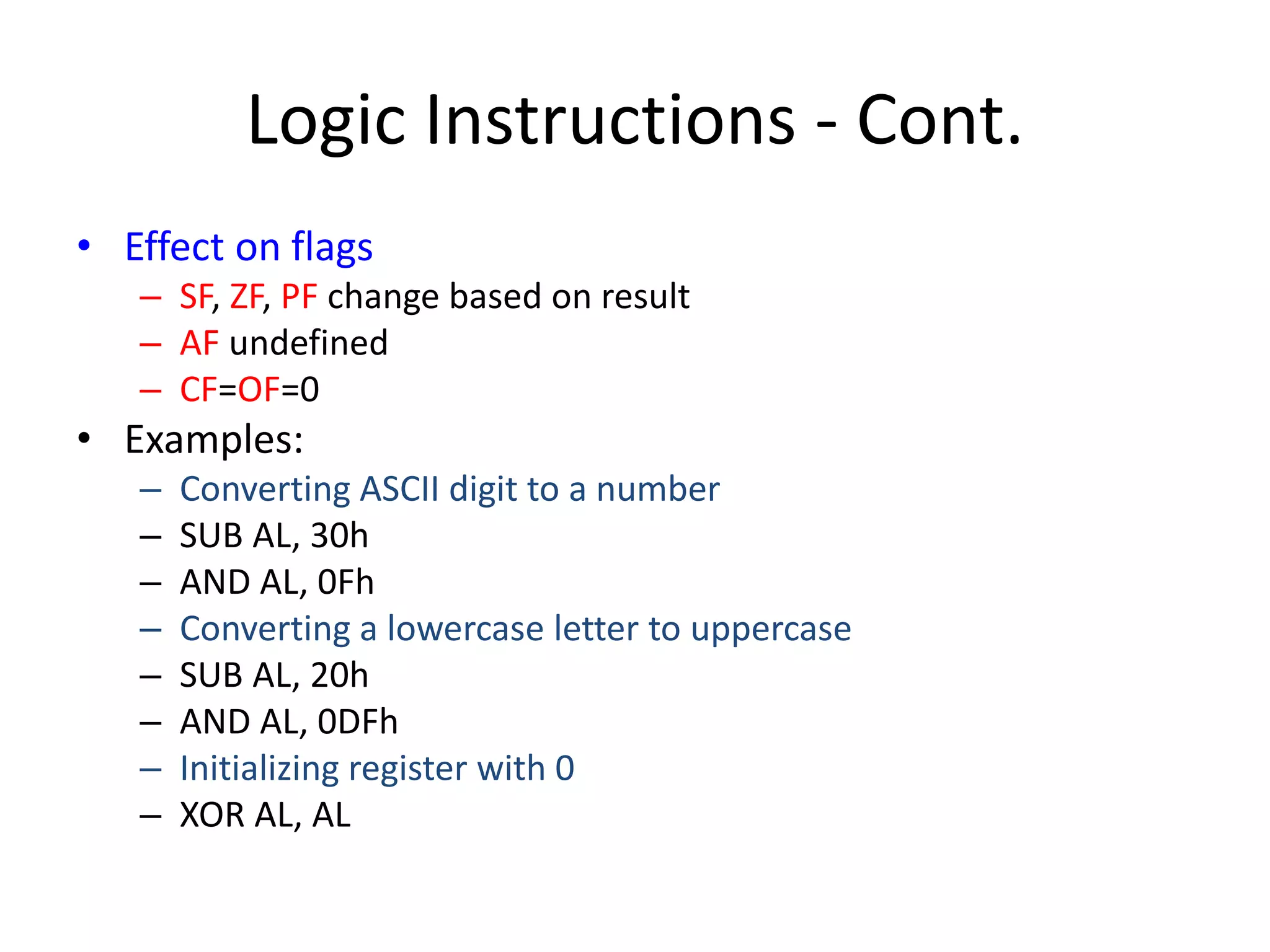
• Effect on flags
– SF, ZF, PF change based on result
– AF undefined
– CF=OF=0
• Examples:
– Converting ASCII digit to a number
– SUB AL, 30h
– AND AL, 0Fh
– Converting a lowercase letter to uppercase
– SUB AL, 20h
– AND AL, 0DFh
– Initializing register with 0
– XOR AL, AL
Logic Instructions - Cont.
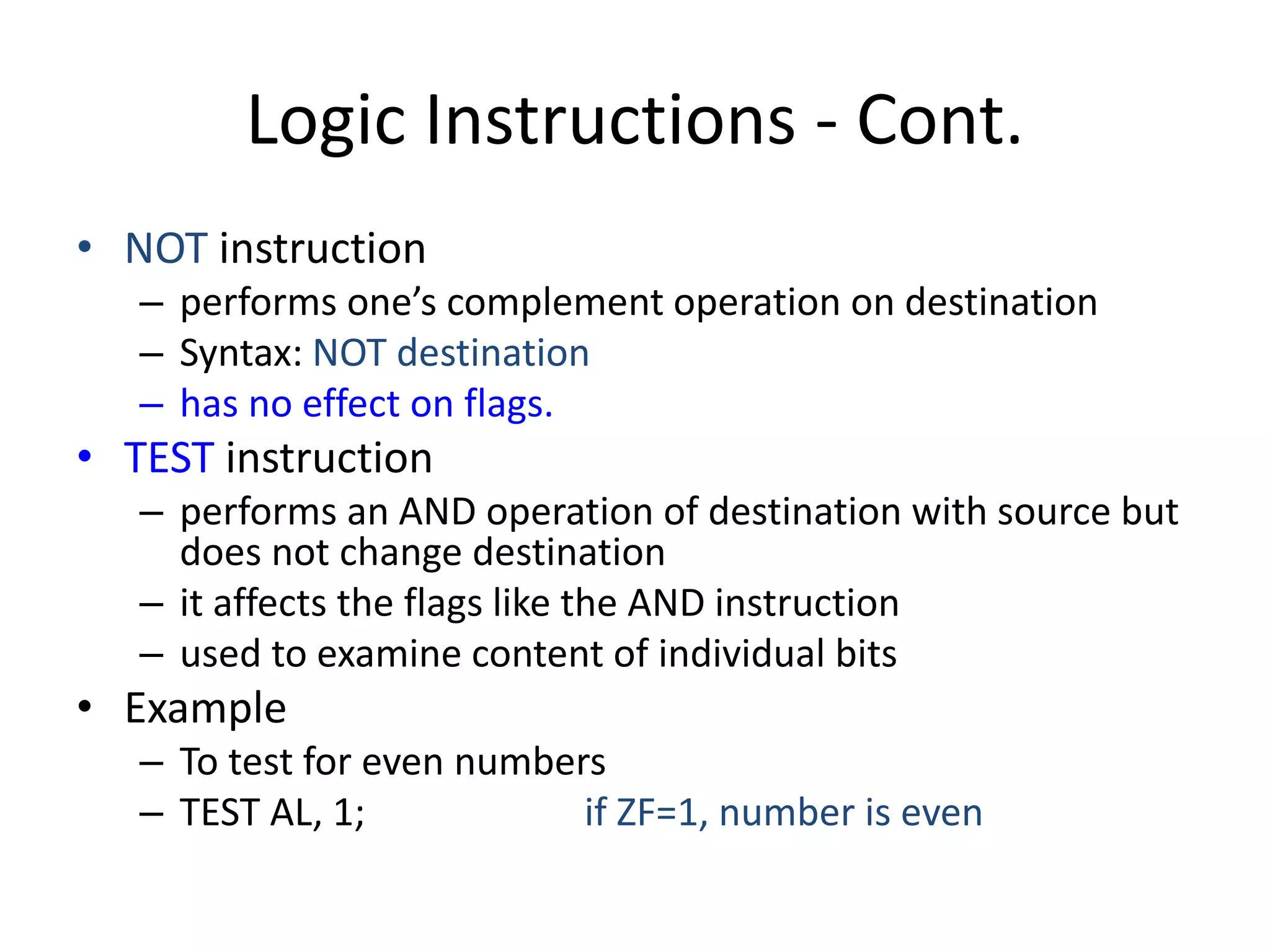
• NOT instruction
– performs one’s complement operation on destination
– Syntax: NOT destination
– has no effect on flags.
• TEST instruction
– performs an AND operation of destination with source but
does not change destination
– it affects the flags like the AND instruction
– used to examine content of individual bits
• Example
– To test for even numbers
– TEST AL, 1; if ZF=1, number is even
Shift Instructions
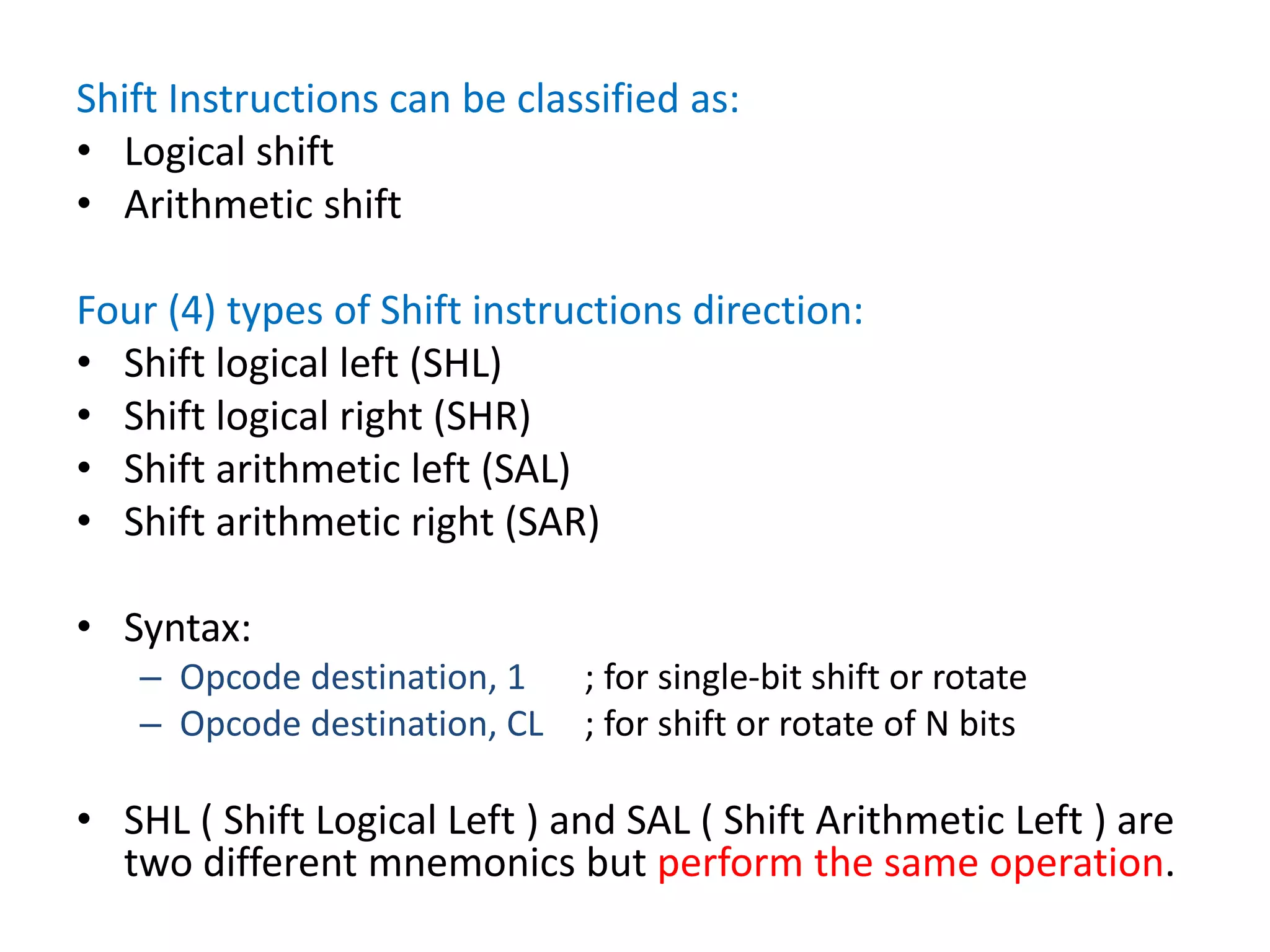
Shift Instructions can be classified as:
• Logical shift
• Arithmetic shift
Four (4) types of Shift instructions direction:
• Shift logical left (SHL)
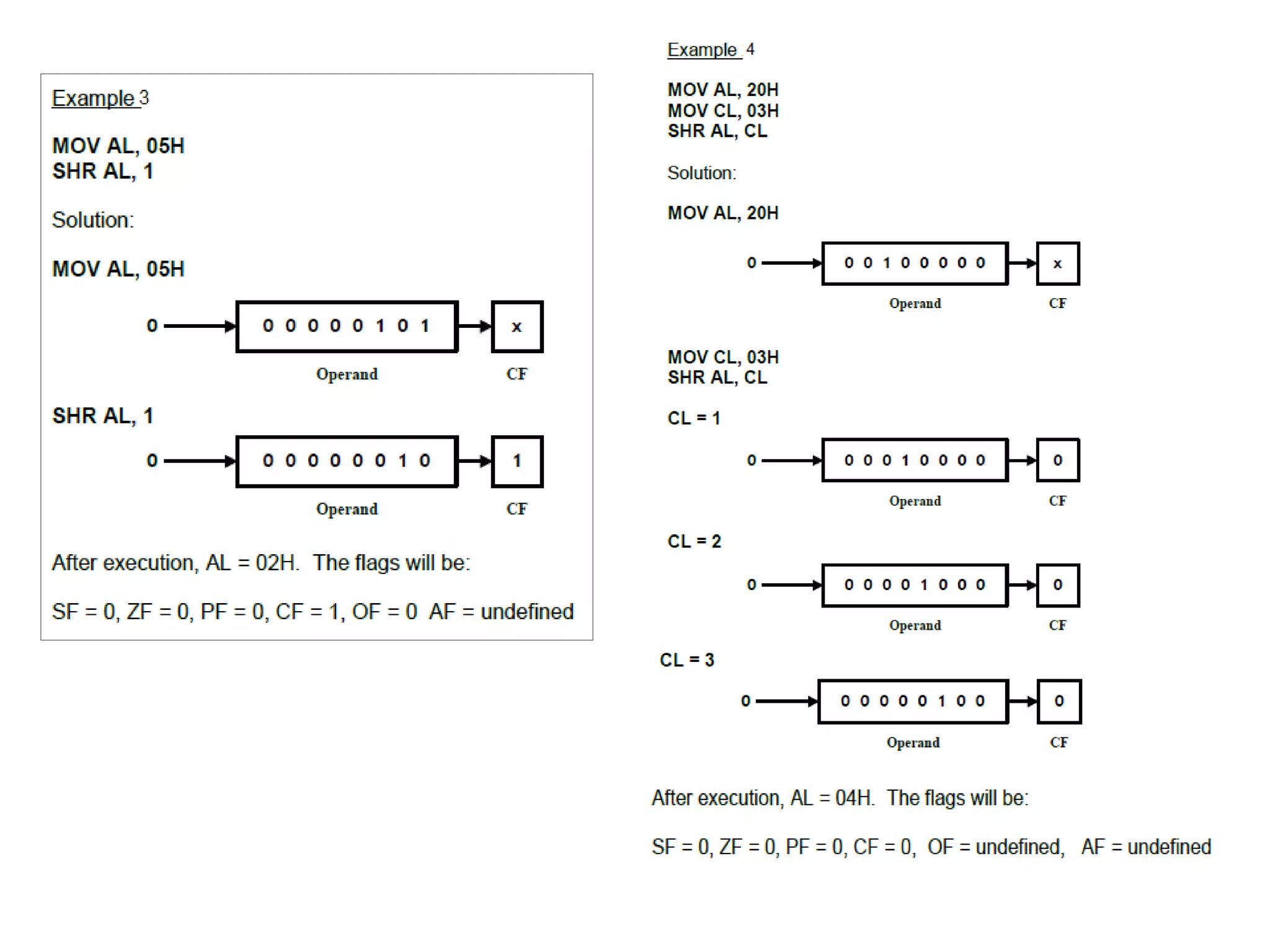
• Shift logical right (SHR)
• Shift arithmetic left (SAL)
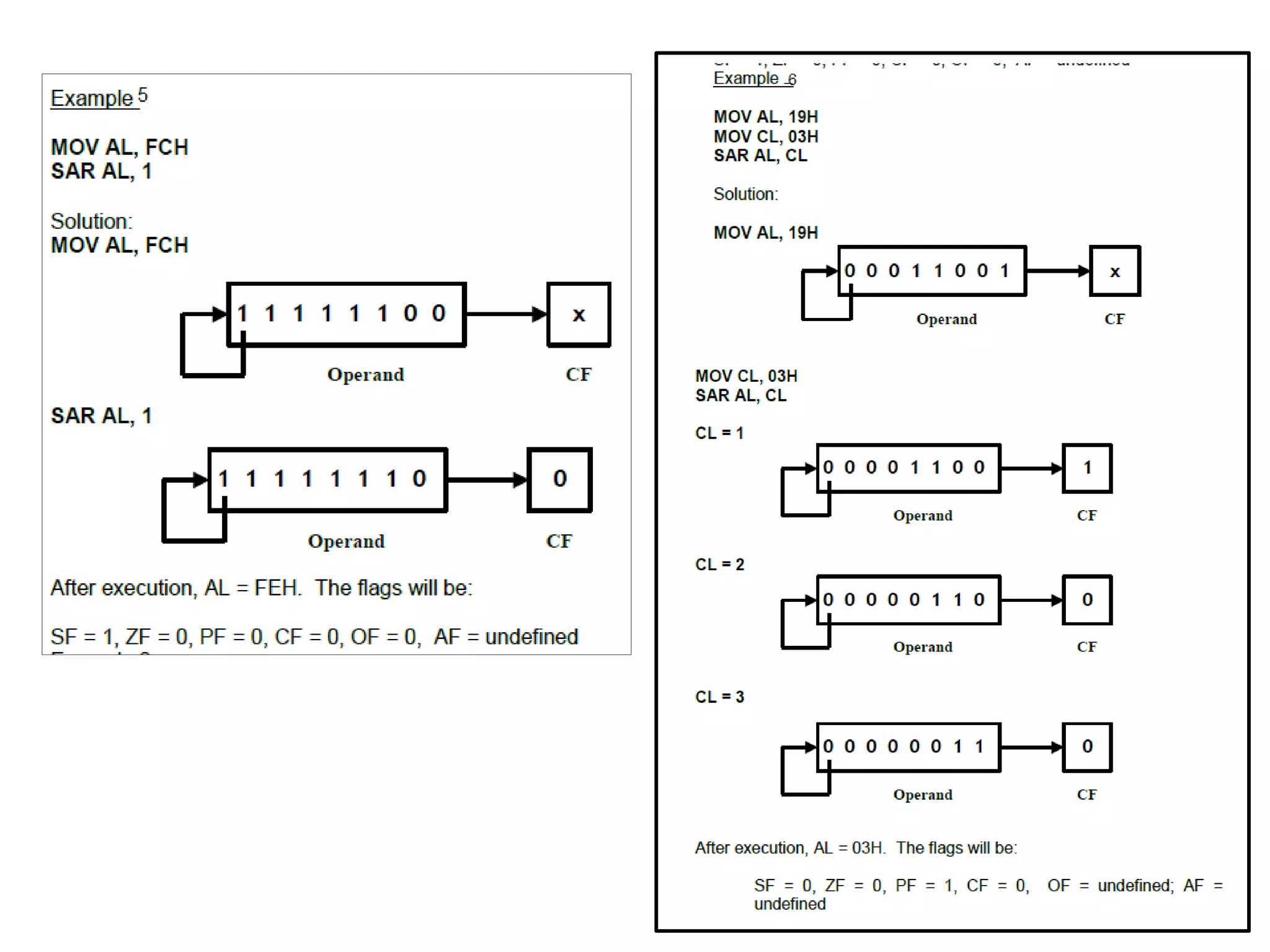
• Shift arithmetic right (SAR)
• Syntax:
– Opcode destination, 1 ; for single-bit shift or rotate
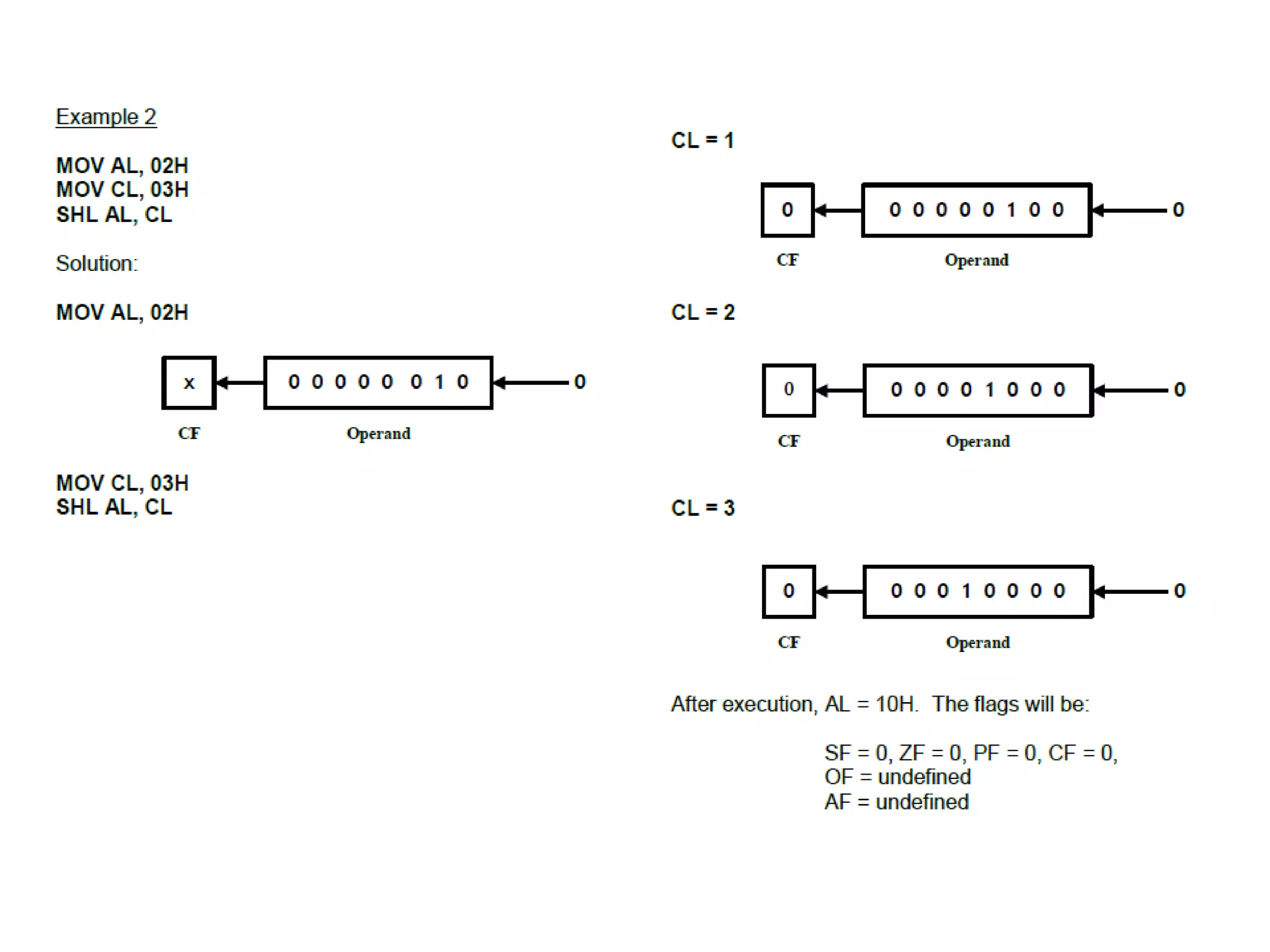
– Opcode destination, CL ; for shift or rotate of N bits
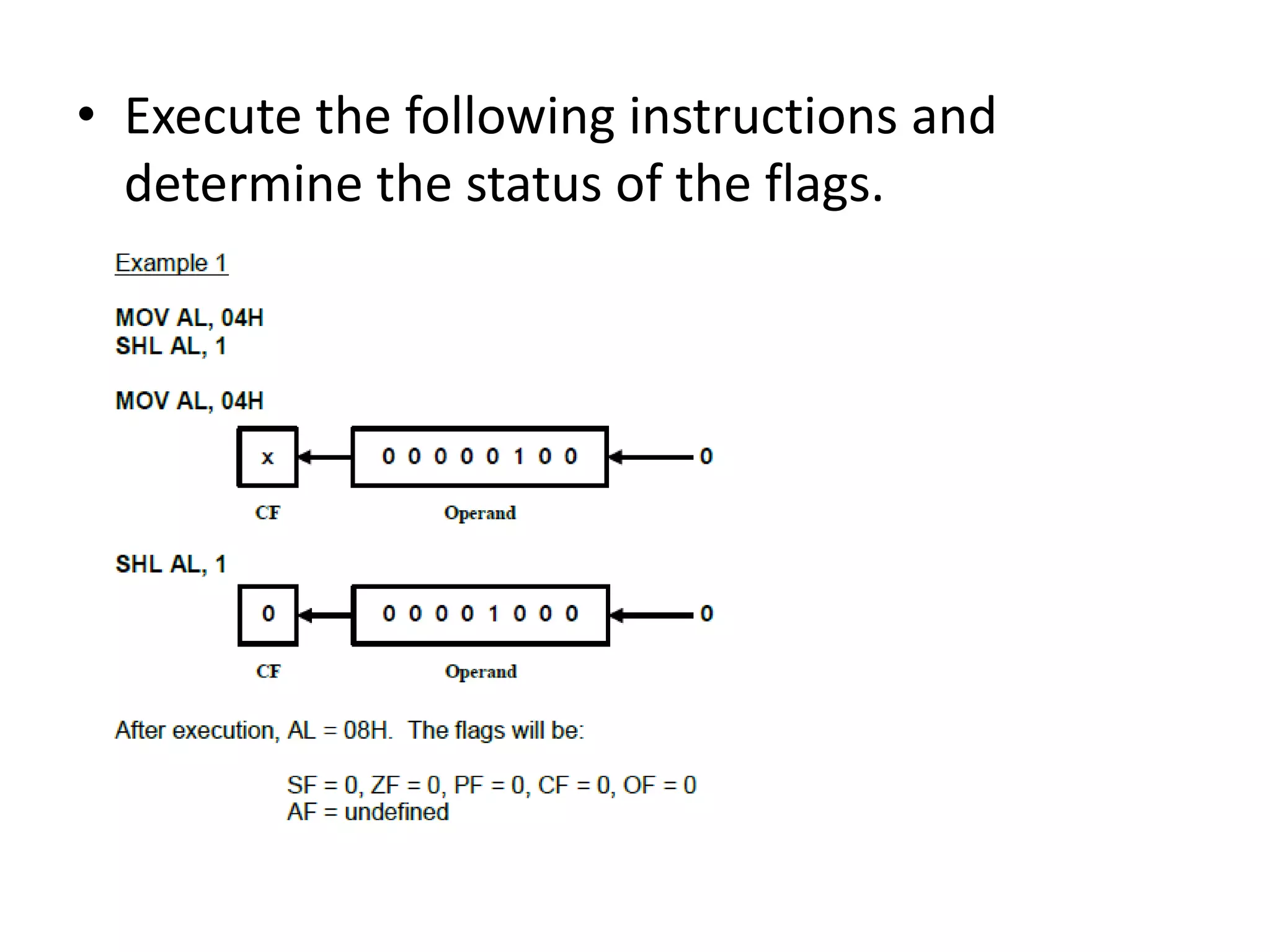
• SHL ( Shift Logical Left ) and SAL ( Shift Arithmetic Left ) are
two different mnemonics but perform the same operation.
• Execute the following instructions and
determine the status of the flags.
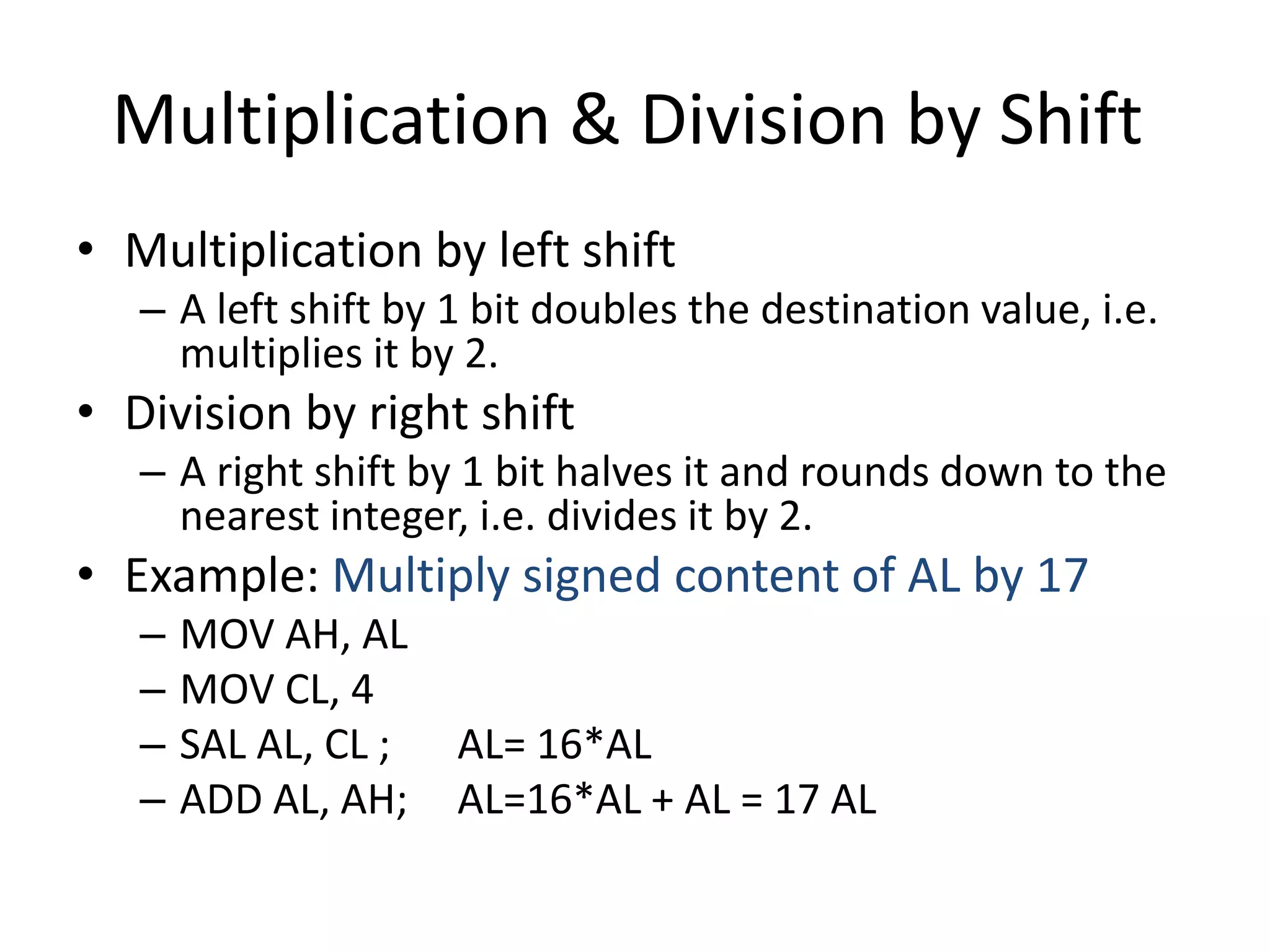
Multiplication & Division by Shift
• Multiplication by left shift
– A left shift by 1 bit doubles the destination value, i.e.
multiplies it by 2.
• Division by right shift
– A right shift by 1 bit halves it and rounds down to the
nearest integer, i.e. divides it by 2.
• Example: Multiply signed content of AL by 17
– MOV AH, AL
– MOV CL, 4
– SAL AL, CL ; AL= 16*AL
– ADD AL, AH; AL=16*AL + AL = 17 AL
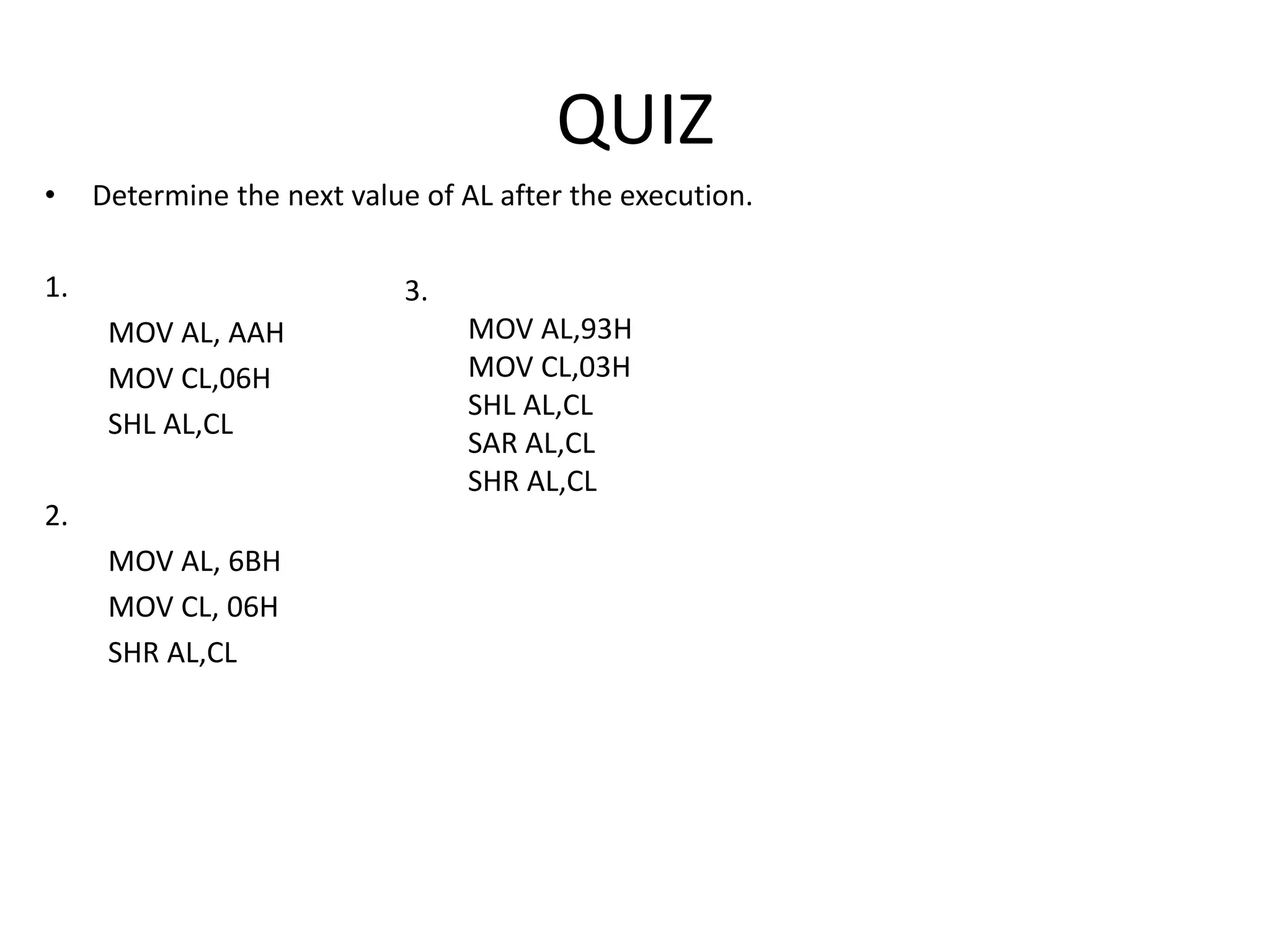
QUIZ
• Determine the next value of AL after the execution.
1.
MOV AL, AAH
MOV CL,06H
SHL AL,CL
2.
MOV AL, 6BH
MOV CL, 06H
SHR AL,CL
Ans:
1. AL = 80H
2. AL = 01H
3. AL =1FH
3.
MOV AL,93H
MOV CL,03H
SHL AL,CL
SAR AL,CL
SHR AL,CL
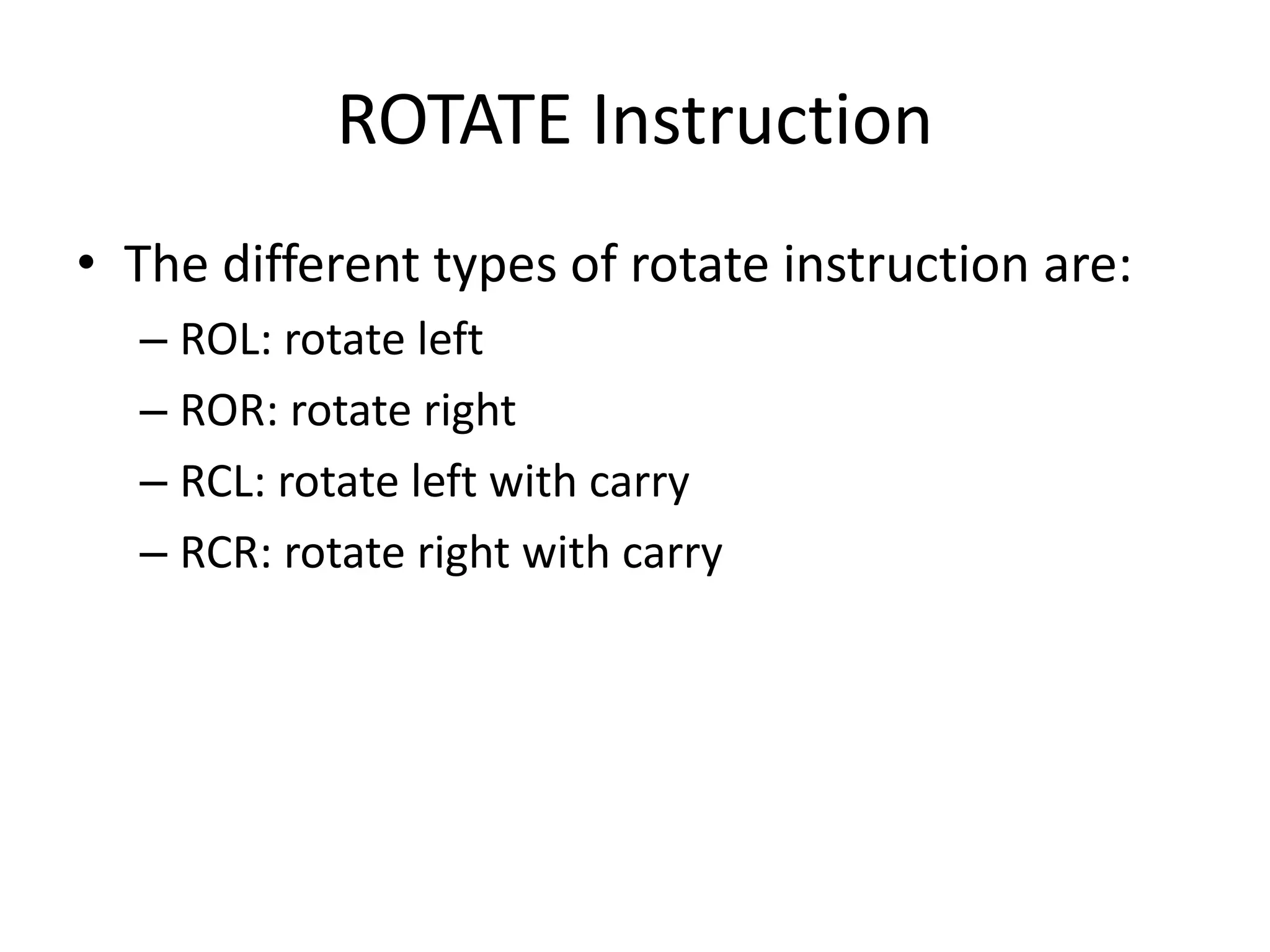
ROTATE Instruction
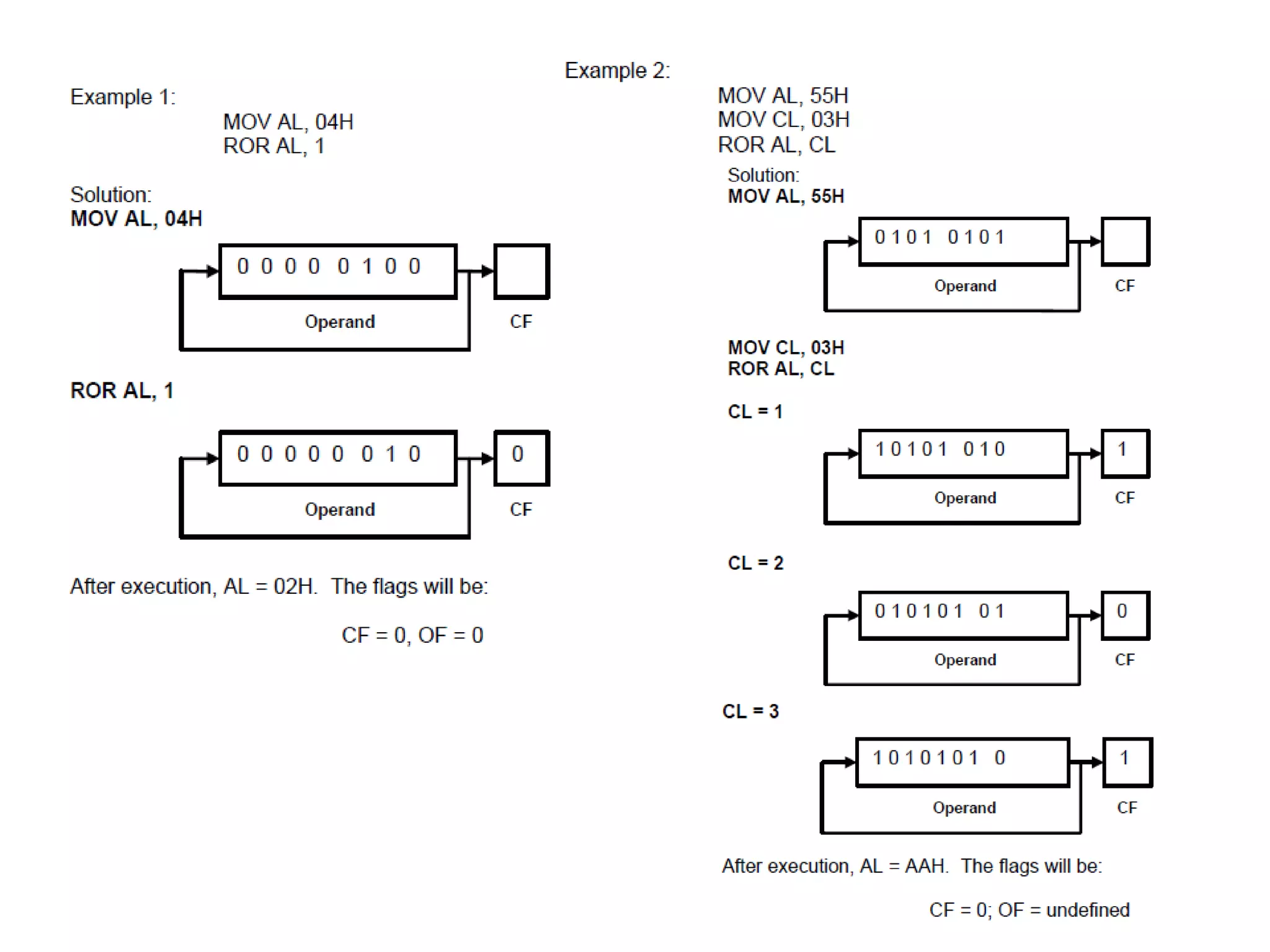
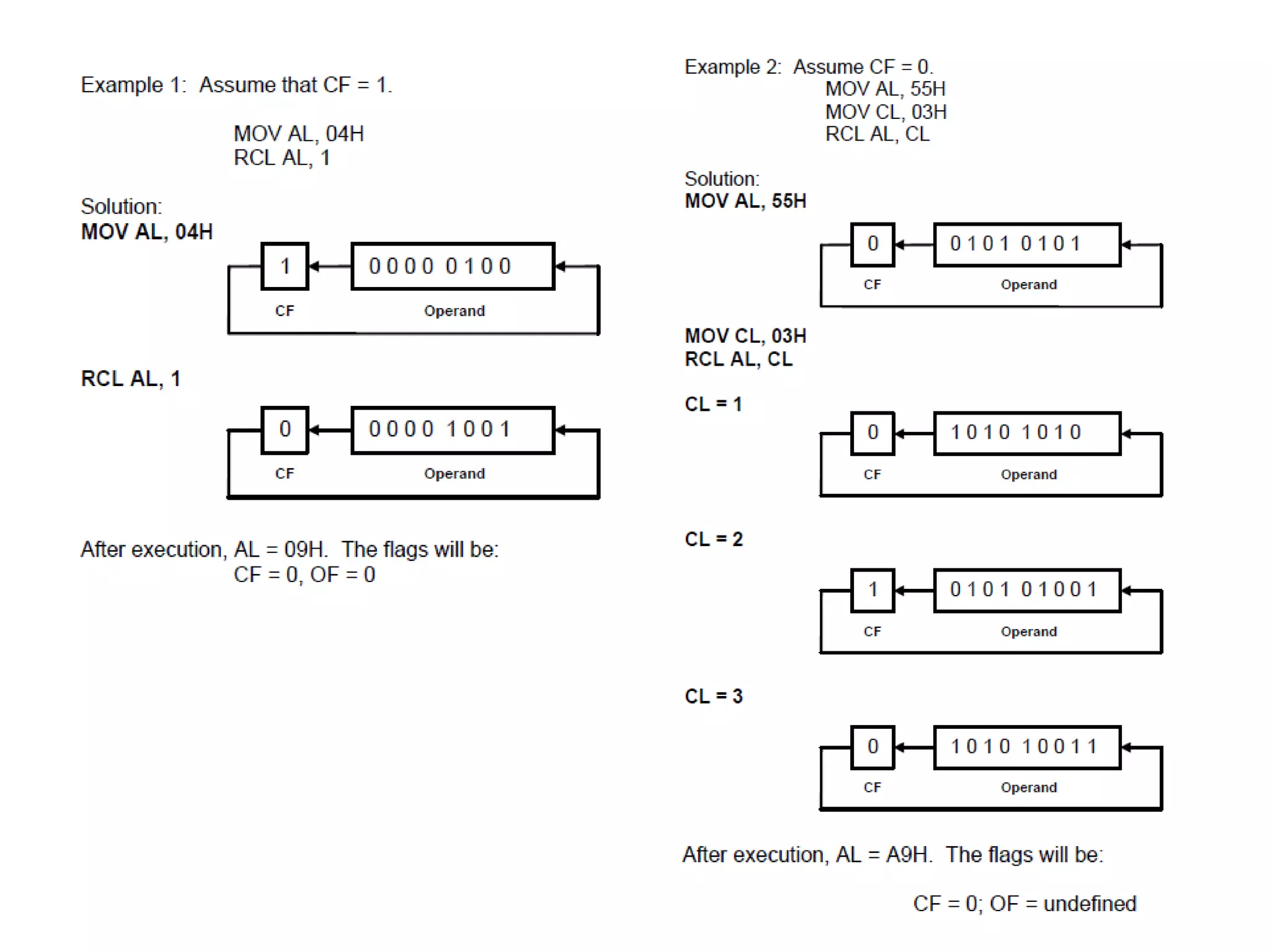
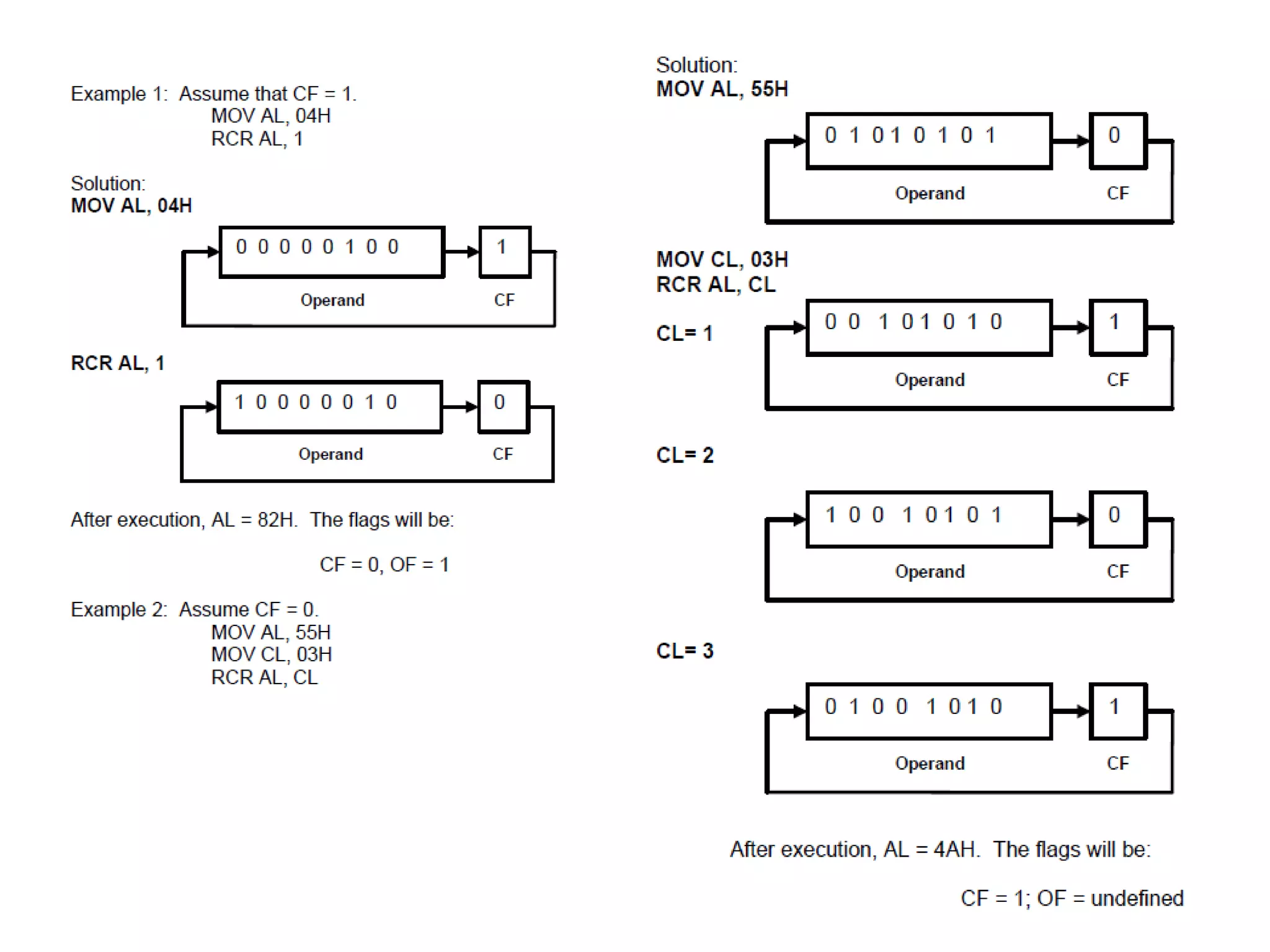
• The different types of rotate instruction are:
– ROL: rotate left
– ROR: rotate right
– RCL: rotate left with carry
– RCR: rotate right with carry
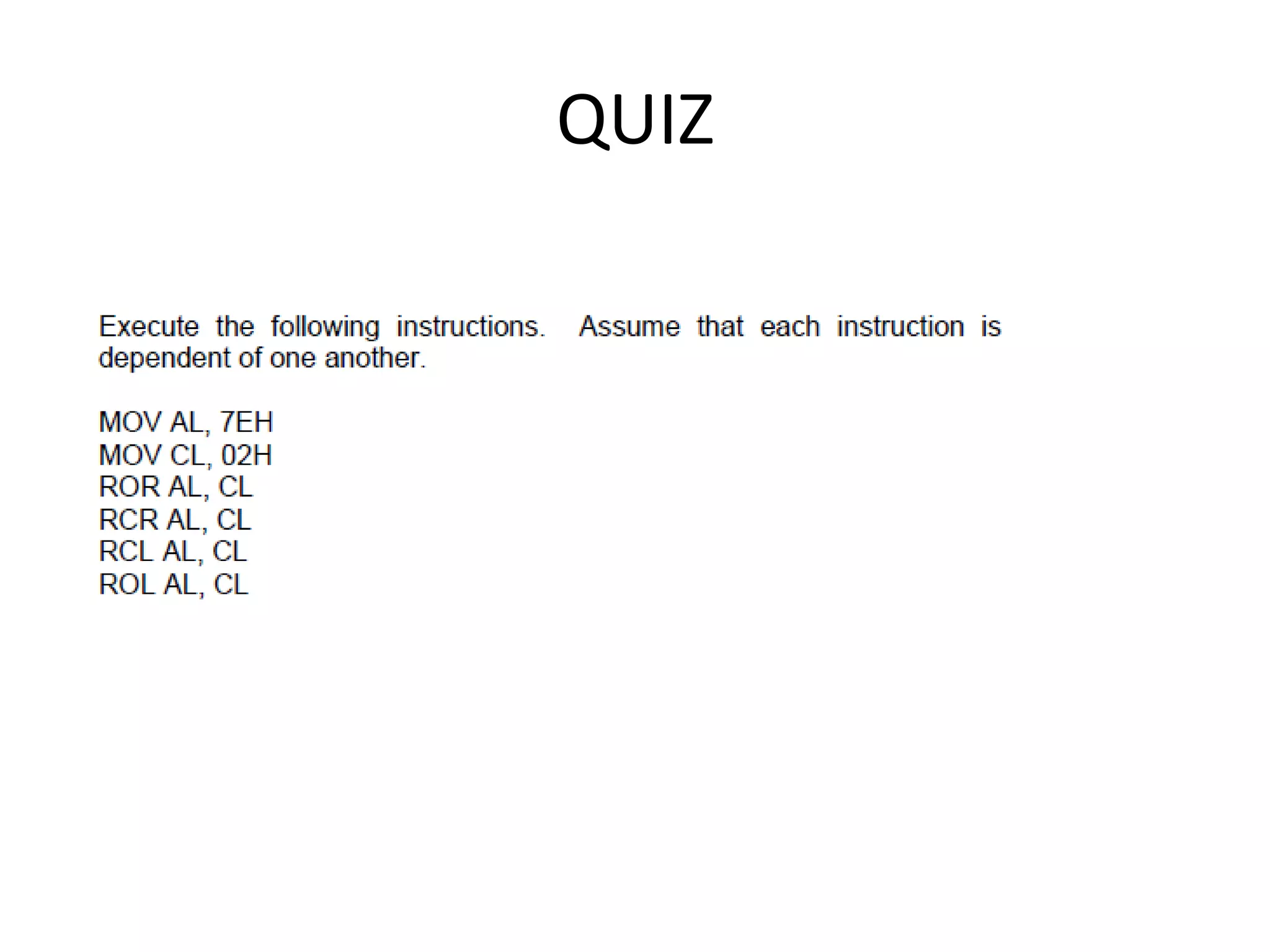
QUIZ

Arithmetic and logical instructions set

  • 1.
  • 2.
    INC & DECInstructions • Syntax: – INC operand ; operand=operand+1 – DEC operand ; operand=operand-1 • Operand can be a general register or memory. • INC and DEC instructions affect all the flags. • Examples: – INC AX legal – DEC BL legal – INC [BX] illegal – INC Byte PTR [BX] legal – DEC I legal – INC DS illegal
  • 3.
    NEG instruction • Syntax:NEG operand – Operand 0 – operand • Finds the two’s complement of operand. • Operand can be a general register or memory location. • NEG instruction affects all flags. • Examples: – Let AX=FFF0h and I=08h – NEG AX ; AX0010 – NEG AH ; AH01 – NEG I ; IF8
  • 4.
    CMP instruction • Syntax:CMP operand1, operand2 – Operand1-operand2 • Subtracts operand2 from operand1 and updates the flags based on the result. • CMP instruction affects all the flags. yesnoyesMemory Location yesyesyesGeneral Register ConstantMemory Location General Register
  • 5.
    ADC and SBBinstruction • Syntax: – ADC destination, source ; destination=destination+source+CF – SBB destination, source ; destination=destination-source-CF • Achieve double-precision addition/subtraction. • To add or subtract 32-bit numbers – Add or subtract lower 16 bits – Add or subtract higher 16 bits with carry or borrow • Example:
  • 6.
    Multiplication • Unsigned multiplication:MUL operand • Signed multiplication: IMUL operand • If operand is a Byte – MUL operand; AX AL * operand • If operand is a Word – MUL operand; DX:AX  AX * operand • Operand can be a general register or memory. Cannot be a constant. • Only CF and OF are affected.
  • 7.
    Multiplication – Cont. •CF=OF=0 – Unsigned multiplication: if upper half of result is 0. – Signed multiplication: if upper half of result is a sign extension of lower half. • Example: Let AX=FFFFh and BX=0002h – MUL BL; AX01FEh (255 * 2 = 510) CF=OF=1 – IMUL BL; AXFFFEh (-1 * 2 = -2) CF=OF=0 – MUL AL; AXFE01 (255 * 255 = 65025) CF=OF=1 – IMUL AL; AX0001 (-1 * -1 = 1) CF=OF=0 – MUL BX; DX0001 AXFFFE CF=OF=1 – IMUL BX; DXFFFF AXFFFE CF=OF=0
  • 8.
    Application: Inputting aDecimal Number • Inputting a 2-digit decimal number MOV AH, 1 ;read first digit INT 21H SUB AL, ‘0’ ; convert digit from ASCII code to binary MOV BL, 10 MUL BL ; multiply digit by 10 MOV CL, AL MOV AH, 1 ; read 2nd digit INT 21H SUB AL, ‘0’ ; convert digit from ASCII code to binary ADD AL, CL ; AL contains the 2-digit number
  • 9.
    Division • Unsigned division:DIV operand • Signed division: IDIV operand • If operand is a Byte – DIV Operand ; AX  AX/operand – AH= Remainder, AL= Quotient • If operand is a Word – DIV Operand ; DX:AX  DX:AX/operand – DX=Remainder, AX= Quotient • Operand can be a general register or memory. Cannot be a constant. • All flags are undefined.
  • 10.
    Division - Cont. •Divide Overflow – If quotient is too big to fit in specified destination (AL or AX) – Happens if divisor much smaller than dividend – Program terminates and displays “Divide Overflow” • Example: Let DX=0000h, AX=0005h, and BX=FFFEh – DIV BX; AX=0000 DX=0005 – IDIV BX; AX=FFFE DX=0001 • Example: Let DX=FFFFh, AX=FFFBh, and BX=0002h – IDIV BX; AX=FFFE DX=FFFF – DIV BX; DIVIDE Overflow • Example: Let AX=00FBh (251), and BL=FFh – DIV BL; AH=FB AL=00 – IDIV BL; DIVIDE Overflow
  • 11.
    Application: Outputting aDecimal Number • Outputting a 2-digit decimal number in AX MOV BL, 10 DIV BL ; getting least significant digit ADD AH, ‘0’ ; converting L.S. digit to ASCII MOV DH, AH ; storing L.S. digit temporarily MOV AH, 0 DIV BL ; getting most significant digit ADD AH, ‘0’ ; converting M.S. digit into ASCII MOV DL, AH ; displaying M.S. digit MOV AH, 2 INT 21H MOV DL, DH ; displaying least significant digit INT21H
  • 12.
    Logic Instructions • TheAND, OR, and XOR instructions perform named bit-wise logical operation. • Syntax: – AND destination, source – OR destination, source – XOR destination, source 10101010 AND 11110000 --------------- 10100000 10101010 OR 11110000 --------------- 11111010 10101010 XOR 11110000 --------------- 01011010
  • 13.
    Logic Instructions -Cont. • AND instruction used to clear specific destinations bits while preserving others. – A 0 mask bit clears corresponding destination bit – A 1 mask bit preserves corresponding destination bit • OR instruction used to set specific destinations bits while preserving others. – A 1 mask bit sets corresponding destination bit – A 0 mask bit preserves corresponding destination bit • XOR instruction used to complement specific destinations bits while preserving others. – A 1 mask bit complements corresponding destination bit – A 0 mask bit preserves corresponding destination bit
  • 14.
    Logic Instructions -Cont. • Effect on flags – SF, ZF, PF change based on result – AF undefined – CF=OF=0 • Examples: – Converting ASCII digit to a number – SUB AL, 30h – AND AL, 0Fh – Converting a lowercase letter to uppercase – SUB AL, 20h – AND AL, 0DFh – Initializing register with 0 – XOR AL, AL
  • 15.
    Logic Instructions -Cont. • NOT instruction – performs one’s complement operation on destination – Syntax: NOT destination – has no effect on flags. • TEST instruction – performs an AND operation of destination with source but does not change destination – it affects the flags like the AND instruction – used to examine content of individual bits • Example – To test for even numbers – TEST AL, 1; if ZF=1, number is even
  • 16.
  • 17.
    Shift Instructions canbe classified as: • Logical shift • Arithmetic shift Four (4) types of Shift instructions direction: • Shift logical left (SHL) • Shift logical right (SHR) • Shift arithmetic left (SAL) • Shift arithmetic right (SAR) • Syntax: – Opcode destination, 1 ; for single-bit shift or rotate – Opcode destination, CL ; for shift or rotate of N bits • SHL ( Shift Logical Left ) and SAL ( Shift Arithmetic Left ) are two different mnemonics but perform the same operation.
  • 18.
    • Execute thefollowing instructions and determine the status of the flags.
  • 22.
    Multiplication & Divisionby Shift • Multiplication by left shift – A left shift by 1 bit doubles the destination value, i.e. multiplies it by 2. • Division by right shift – A right shift by 1 bit halves it and rounds down to the nearest integer, i.e. divides it by 2. • Example: Multiply signed content of AL by 17 – MOV AH, AL – MOV CL, 4 – SAL AL, CL ; AL= 16*AL – ADD AL, AH; AL=16*AL + AL = 17 AL
  • 23.
    QUIZ • Determine thenext value of AL after the execution. 1. MOV AL, AAH MOV CL,06H SHL AL,CL 2. MOV AL, 6BH MOV CL, 06H SHR AL,CL Ans: 1. AL = 80H 2. AL = 01H 3. AL =1FH 3. MOV AL,93H MOV CL,03H SHL AL,CL SAR AL,CL SHR AL,CL
  • 24.
    ROTATE Instruction • Thedifferent types of rotate instruction are: – ROL: rotate left – ROR: rotate right – RCL: rotate left with carry – RCR: rotate right with carry
  • 29.