Logical and Bit Operations Chapter 9 S. Dandamudi
Outline Logical instructions AND OR XOR NOT TEST Shift instructions Logical shift instructions Arithmetic shift instructions Rotate instructions Rotate without carry Rotate through carry Logical expressions in high-level languages Representation of Boolean data Logical expressions Bit manipulation Evaluation of logical expressions Bit instructions Bit test and modify instructions Bit scan instructions Illustrative examples
Logical Instructions Logical instructions operate on bit-by-bit basis Five logical instructions: AND OR XOR NOT TEST All logical instructions affect the status flags
Logical Instructions (cont’d) Since logical instructions operate on a bit-by-bit basis, no carry or overflow is generated Logical instructions Clear carry flag (CF) and overflow flag (OF) AF is undefined Remaining three flags record useful information Zero flag Sign flag Parity flag
Logical Instructions (cont’d) AND instruction Format and  destination,source Usage To support compound logical expressions and bitwise AND operation of HLLs To clear one or more bits of a byte, word, or doubleword To isolate one or more bits of a byte, word, or doubleword
Logical Instructions (cont’d) OR instruction Format or  destination,source Usage To support compound logical expressions and bitwise OR operation of HLLs To set one or more bits of a byte, word, or doubleword To paste one or more bits of a byte, word, or doubleword
Logical Instructions (cont’d) XOR instruction Format xor  destination,source Usage To support compound logical expressions of HLLs To toggle one or more bits of a byte, word, or doubleword To initialize registers to zero Example:  xor  AX,AX
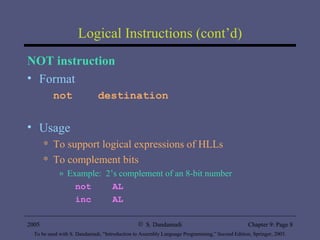
Logical Instructions (cont’d) NOT instruction Format not  destination Usage To support logical expressions of HLLs To complement bits Example:  2’s complement of an 8-bit number not  AL inc  AL
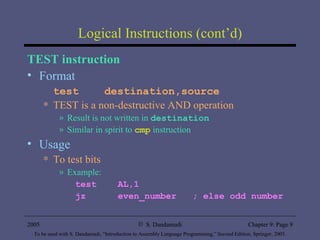
Logical Instructions (cont’d) TEST instruction Format test  destination,source TEST is a non-destructive AND operation Result is not written in  destination Similar in spirit to  cmp  instruction Usage To test bits Example: test  AL,1 jz  even_number  ; else odd number
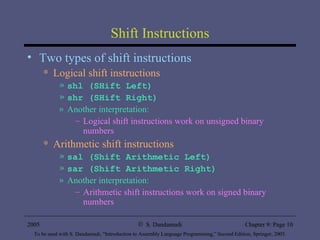
Shift Instructions Two types of shift instructions Logical shift instructions shl (SHift Left) shr (SHift Right)  Another interpretation: Logical shift instructions work on unsigned binary numbers Arithmetic shift instructions sal (Shift Arithmetic Left) sar (Shift Arithmetic Right) Another interpretation: Arithmetic shift instructions work on signed binary numbers
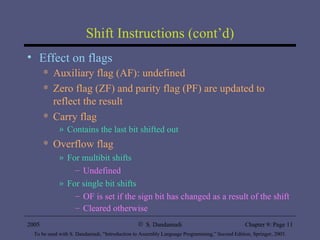
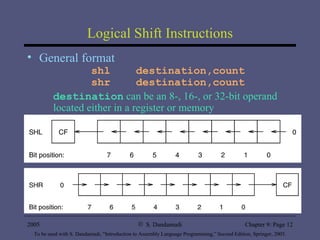
Shift Instructions (cont’d) Effect on flags Auxiliary flag (AF): undefined Zero flag (ZF) and parity flag (PF) are updated to reflect the result Carry flag Contains the last bit shifted out Overflow flag For multibit shifts Undefined For single bit shifts OF is set if the sign bit has changed as a result of the shift Cleared otherwise
Logical Shift Instructions General format shl  destination,count shr  destination,count destination  can be an 8-, 16-, or 32-bit operand located either in a register or memory
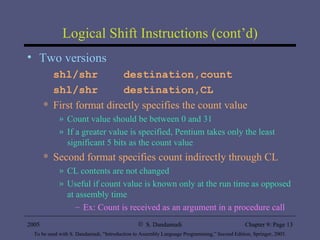
Logical Shift Instructions (cont’d) Two versions  shl/shr  destination,count shl/shr  destination,CL First format directly specifies the count value Count value should be between 0 and 31 If a greater value is specified, Pentium takes only the least significant 5 bits as the count value Second format specifies count indirectly through CL CL contents are not changed Useful if count value is known only at the run time as opposed at assembly time Ex: Count is received as an argument in a procedure call
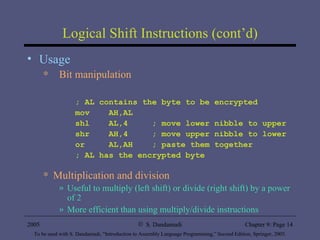
Logical Shift Instructions (cont’d) Usage  Bit manipulation ; AL contains the byte to be encrypted mov  AH,AL shl  AL,4  ; move lower nibble to upper shr  AH,4  ; move upper nibble to lower or  AL,AH  ; paste them together ; AL has the encrypted byte Multiplication and division Useful to multiply (left shift) or divide (right shift) by a power of 2 More efficient than using multiply/divide instructions
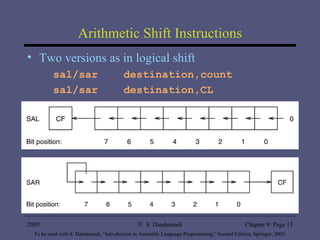
Arithmetic Shift Instructions Two versions as in logical shift sal/sar  destination,count sal/sar  destination,CL
Double Shift Instructions Double shift instructions work on either 32- or 64-bit operands Format  Takes three operands shld  dest,src,count  ; left-shift shrd  dest,src,count  ; right-shift dest  can be in memory or register src  must be a register count  can be an immediate value or in CL as in other shift instructions
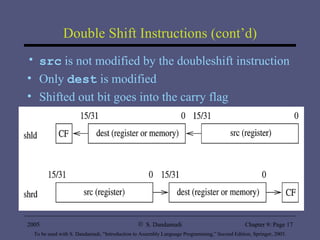
Double Shift Instructions (cont’d) src  is not modified by the doubleshift instruction Only  dest  is modified Shifted out bit goes into the carry flag
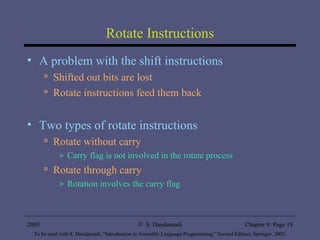
Rotate Instructions A problem with the shift instructions Shifted out bits are lost Rotate instructions feed them back Two types of rotate instructions Rotate without carry Carry flag is not involved in the rotate process Rotate through carry Rotation involves the carry flag
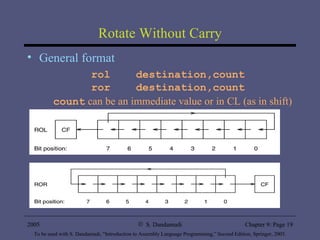
Rotate Without Carry General format rol  destination,count ror  destination,count count  can be an immediate value or in CL (as in shift)
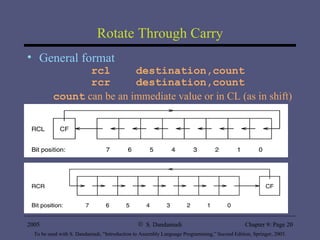
Rotate Through Carry General format rcl  destination,count rcr  destination,count count  can be an immediate value or in CL (as in shift)
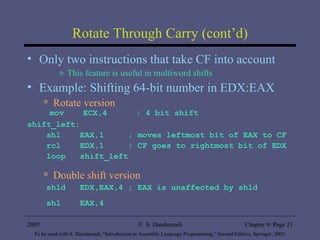
Rotate Through Carry (cont’d) Only two instructions that take CF into account This feature is useful in multiword shifts Example: Shifting 64-bit number in EDX:EAX Rotate version mov  ECX,4  ; 4 bit shift shift_left: shl  EAX,1  ; moves leftmost bit of EAX to CF rcl  EDX,1  ; CF goes to rightmost bit of EDX loop  shift_left Double shift version shld  EDX,EAX,4 ; EAX is unaffected by shld shl  EAX,4
Logical Expressions in HLLs Representation of Boolean data Only a single bit is needed to represent Boolean data Usually a single byte is used For example, in C All zero bits represents  false A non-zero value represents  true Logical expressions Logical instructions AND, OR, etc. are used Bit manipulation Logical, shift, and rotate instructions are used
Evaluation of Logical Expressions Two basic ways Full evaluation Entire expression is evaluated before assigning a value PASCAL uses full evaluation Partial evaluation Assigns as soon as the final outcome is known without blindly evaluating the entire logical expression Two rules help: cond1 AND cond2 If  cond1  is false, no need to evaluate  cond2 cond1 OR cond2 If  cond1  is true, no need to evaluate  cond2
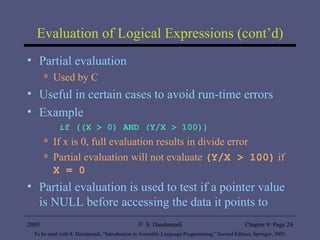
Evaluation of Logical Expressions (cont’d) Partial evaluation Used by C Useful in certain cases to avoid run-time errors Example if ((X > 0) AND (Y/X > 100)) If x is 0, full evaluation results in divide error Partial evaluation will not evaluate  (Y/X > 100)  if  X = 0   Partial evaluation is used to test if a pointer value is NULL before accessing the data it points to
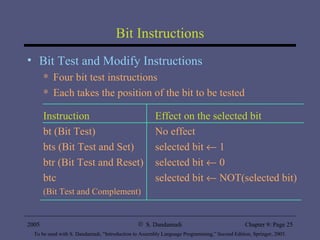
Bit Instructions Bit Test and Modify Instructions Four bit test instructions Each takes the position of the bit to be tested Instruction Effect on the selected bit bt (Bit Test) No effect bts (Bit Test and Set) selected bit    1 btr (Bit Test and Reset) selected bit    0 btc  selected bit    NOT(selected bit) (Bit Test and Complement)
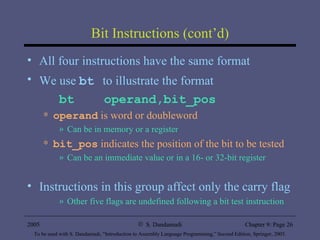
Bit Instructions (cont’d) All four instructions have the same format We use  bt   to illustrate the format bt  operand,bit_pos operand  is word or doubleword Can be in memory or a register bit_pos  indicates the position of the bit to be tested Can be an immediate value or in a 16- or 32-bit register Instructions in this group affect only the carry flag Other five flags are undefined following a bit test instruction
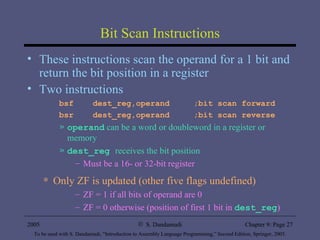
Bit Scan Instructions These instructions scan the operand for a 1 bit and return the bit position in a register Two instructions bsf  dest_reg,operand  ;bit scan forward bsr  dest_reg,operand  ;bit scan reverse operand  can be a word or doubleword in a register or memory dest_reg   receives the bit position Must be a 16- or 32-bit register Only ZF is updated (other five flags undefined) ZF = 1 if all bits of operand are 0 ZF = 0 otherwise (position of first 1 bit in  dest_reg )
Illustrative Examples Example 1 Multiplication using shift and add operations Multiplies two unsigned 8-bit numbers Uses a loop that iterates 8 times Example 2 Same as Example 1 (efficient version) We loop only for the number of 1 bits Uses bit test instructions Example 3 Conversion of octal to binary Last slide

Al2ed chapter9

  • 1.
    Logical and BitOperations Chapter 9 S. Dandamudi
  • 2.
    Outline Logical instructionsAND OR XOR NOT TEST Shift instructions Logical shift instructions Arithmetic shift instructions Rotate instructions Rotate without carry Rotate through carry Logical expressions in high-level languages Representation of Boolean data Logical expressions Bit manipulation Evaluation of logical expressions Bit instructions Bit test and modify instructions Bit scan instructions Illustrative examples
  • 3.
    Logical Instructions Logicalinstructions operate on bit-by-bit basis Five logical instructions: AND OR XOR NOT TEST All logical instructions affect the status flags
  • 4.
    Logical Instructions (cont’d)Since logical instructions operate on a bit-by-bit basis, no carry or overflow is generated Logical instructions Clear carry flag (CF) and overflow flag (OF) AF is undefined Remaining three flags record useful information Zero flag Sign flag Parity flag
  • 5.
    Logical Instructions (cont’d)AND instruction Format and destination,source Usage To support compound logical expressions and bitwise AND operation of HLLs To clear one or more bits of a byte, word, or doubleword To isolate one or more bits of a byte, word, or doubleword
  • 6.
    Logical Instructions (cont’d)OR instruction Format or destination,source Usage To support compound logical expressions and bitwise OR operation of HLLs To set one or more bits of a byte, word, or doubleword To paste one or more bits of a byte, word, or doubleword
  • 7.
    Logical Instructions (cont’d)XOR instruction Format xor destination,source Usage To support compound logical expressions of HLLs To toggle one or more bits of a byte, word, or doubleword To initialize registers to zero Example: xor AX,AX
  • 8.
    Logical Instructions (cont’d)NOT instruction Format not destination Usage To support logical expressions of HLLs To complement bits Example: 2’s complement of an 8-bit number not AL inc AL
  • 9.
    Logical Instructions (cont’d)TEST instruction Format test destination,source TEST is a non-destructive AND operation Result is not written in destination Similar in spirit to cmp instruction Usage To test bits Example: test AL,1 jz even_number ; else odd number
  • 10.
    Shift Instructions Twotypes of shift instructions Logical shift instructions shl (SHift Left) shr (SHift Right) Another interpretation: Logical shift instructions work on unsigned binary numbers Arithmetic shift instructions sal (Shift Arithmetic Left) sar (Shift Arithmetic Right) Another interpretation: Arithmetic shift instructions work on signed binary numbers
  • 11.
    Shift Instructions (cont’d)Effect on flags Auxiliary flag (AF): undefined Zero flag (ZF) and parity flag (PF) are updated to reflect the result Carry flag Contains the last bit shifted out Overflow flag For multibit shifts Undefined For single bit shifts OF is set if the sign bit has changed as a result of the shift Cleared otherwise
  • 12.
    Logical Shift InstructionsGeneral format shl destination,count shr destination,count destination can be an 8-, 16-, or 32-bit operand located either in a register or memory
  • 13.
    Logical Shift Instructions(cont’d) Two versions shl/shr destination,count shl/shr destination,CL First format directly specifies the count value Count value should be between 0 and 31 If a greater value is specified, Pentium takes only the least significant 5 bits as the count value Second format specifies count indirectly through CL CL contents are not changed Useful if count value is known only at the run time as opposed at assembly time Ex: Count is received as an argument in a procedure call
  • 14.
    Logical Shift Instructions(cont’d) Usage Bit manipulation ; AL contains the byte to be encrypted mov AH,AL shl AL,4 ; move lower nibble to upper shr AH,4 ; move upper nibble to lower or AL,AH ; paste them together ; AL has the encrypted byte Multiplication and division Useful to multiply (left shift) or divide (right shift) by a power of 2 More efficient than using multiply/divide instructions
  • 15.
    Arithmetic Shift InstructionsTwo versions as in logical shift sal/sar destination,count sal/sar destination,CL
  • 16.
    Double Shift InstructionsDouble shift instructions work on either 32- or 64-bit operands Format Takes three operands shld dest,src,count ; left-shift shrd dest,src,count ; right-shift dest can be in memory or register src must be a register count can be an immediate value or in CL as in other shift instructions
  • 17.
    Double Shift Instructions(cont’d) src is not modified by the doubleshift instruction Only dest is modified Shifted out bit goes into the carry flag
  • 18.
    Rotate Instructions Aproblem with the shift instructions Shifted out bits are lost Rotate instructions feed them back Two types of rotate instructions Rotate without carry Carry flag is not involved in the rotate process Rotate through carry Rotation involves the carry flag
  • 19.
    Rotate Without CarryGeneral format rol destination,count ror destination,count count can be an immediate value or in CL (as in shift)
  • 20.
    Rotate Through CarryGeneral format rcl destination,count rcr destination,count count can be an immediate value or in CL (as in shift)
  • 21.
    Rotate Through Carry(cont’d) Only two instructions that take CF into account This feature is useful in multiword shifts Example: Shifting 64-bit number in EDX:EAX Rotate version mov ECX,4 ; 4 bit shift shift_left: shl EAX,1 ; moves leftmost bit of EAX to CF rcl EDX,1 ; CF goes to rightmost bit of EDX loop shift_left Double shift version shld EDX,EAX,4 ; EAX is unaffected by shld shl EAX,4
  • 22.
    Logical Expressions inHLLs Representation of Boolean data Only a single bit is needed to represent Boolean data Usually a single byte is used For example, in C All zero bits represents false A non-zero value represents true Logical expressions Logical instructions AND, OR, etc. are used Bit manipulation Logical, shift, and rotate instructions are used
  • 23.
    Evaluation of LogicalExpressions Two basic ways Full evaluation Entire expression is evaluated before assigning a value PASCAL uses full evaluation Partial evaluation Assigns as soon as the final outcome is known without blindly evaluating the entire logical expression Two rules help: cond1 AND cond2 If cond1 is false, no need to evaluate cond2 cond1 OR cond2 If cond1 is true, no need to evaluate cond2
  • 24.
    Evaluation of LogicalExpressions (cont’d) Partial evaluation Used by C Useful in certain cases to avoid run-time errors Example if ((X > 0) AND (Y/X > 100)) If x is 0, full evaluation results in divide error Partial evaluation will not evaluate (Y/X > 100) if X = 0 Partial evaluation is used to test if a pointer value is NULL before accessing the data it points to
  • 25.
    Bit Instructions BitTest and Modify Instructions Four bit test instructions Each takes the position of the bit to be tested Instruction Effect on the selected bit bt (Bit Test) No effect bts (Bit Test and Set) selected bit  1 btr (Bit Test and Reset) selected bit  0 btc selected bit  NOT(selected bit) (Bit Test and Complement)
  • 26.
    Bit Instructions (cont’d)All four instructions have the same format We use bt to illustrate the format bt operand,bit_pos operand is word or doubleword Can be in memory or a register bit_pos indicates the position of the bit to be tested Can be an immediate value or in a 16- or 32-bit register Instructions in this group affect only the carry flag Other five flags are undefined following a bit test instruction
  • 27.
    Bit Scan InstructionsThese instructions scan the operand for a 1 bit and return the bit position in a register Two instructions bsf dest_reg,operand ;bit scan forward bsr dest_reg,operand ;bit scan reverse operand can be a word or doubleword in a register or memory dest_reg receives the bit position Must be a 16- or 32-bit register Only ZF is updated (other five flags undefined) ZF = 1 if all bits of operand are 0 ZF = 0 otherwise (position of first 1 bit in dest_reg )
  • 28.
    Illustrative Examples Example1 Multiplication using shift and add operations Multiplies two unsigned 8-bit numbers Uses a loop that iterates 8 times Example 2 Same as Example 1 (efficient version) We loop only for the number of 1 bits Uses bit test instructions Example 3 Conversion of octal to binary Last slide