
Air Pollution 
Lectured By- 
Dr. Rajendra Singh Thakur
Air pollution :Definition 
 The presence of one or more chemicals in the atmosphere in 
sufficient quantities and duration to cause harm to humans etc. 
Dr. Rajendra Singh Thakur 2 
or 
 Excessive discharge of undesirable foreign substances into the 
atmospheric air thereby adversely affecting the quality of air and 
causing damage to human, plants and animal lives. 
 Air pollution is the introduction into the atmosphere of chemicals, 
particulates, or biological materials that cause discomfort, disease, or 
death to humans, damage other living organisms such as food crops, 
or damage the natural environment or built environment.
Air Pollution 
 Air pollution results from human activities such as burning fossil 
fuels (oil, coal, and gasoline) to create electricity and power 
automobiles, and manufacture industrial products such as 
chemicals and plastic. 
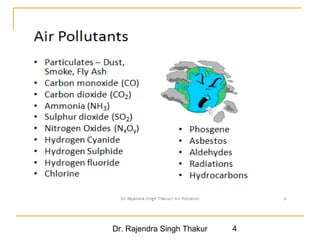
 The air pollutants are particulates, HC, CO2, CO, NO, NO2, SO3 
Dr. Rajendra Singh Thakur 3 
-- 
source may be industrial, autos, etc. 
 The increased carbon dioxide in the atmosphere contributes to the 
warming of the global climate, the so-called "greenhouse effect." 
 The increased Chloro-fluoro-carbons in the atmosphere has been 
depleting stratospheric ozone.
Dr. Rajendra Singh Thakur 4
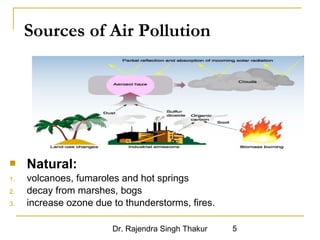
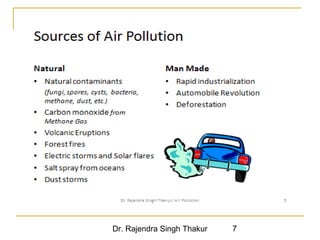
Sources of Air Pollution 
 Natural: 
1. volcanoes, fumaroles and hot springs 
2. decay from marshes, bogs 
3. increase ozone due to thunderstorms, fires. 
Dr. Rajendra Singh Thakur 5
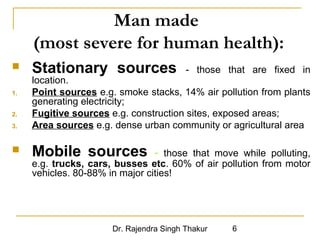
Man made 
(most severe for human health): 
 Stationary sources - those that are fixed in 
Dr. Rajendra Singh Thakur 6 
location. 
1. Point sources e.g. smoke stacks, 14% air pollution from plants 
generating electricity; 
2. Fugitive sources e.g. construction sites, exposed areas; 
3. Area sources e.g. dense urban community or agricultural area 
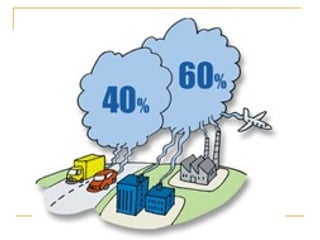
 Mobile sources - those that move while polluting, 
e.g. trucks, cars, busses etc. 60% of air pollution from motor 
vehicles. 80-88% in major cities!
Dr. Rajendra Singh Thakur 7
Dr. Rajendra Singh Thakur 8
CLASSIFICATION OF 
AIR POLLUTANTS? 
Dr. Rajendra Singh Thakur 9
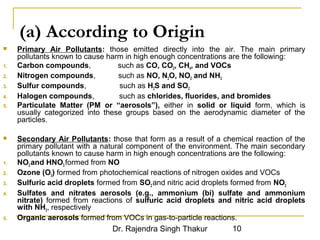
(a) According to Origin 
 Primary Air Pollutants: those emitted directly into the air. The main primary 
pollutants known to cause harm in high enough concentrations are the following: 
1. Carbon compounds, such as CO, CO2, CH4, and VOCs 
2. Nitrogen compounds, such as NO, N2O, NO2 and NH3 
3. Sulfur compounds, such as H2S and SO2 
4. Halogen compounds, such as chlorides, fluorides, and bromides 
5. Particulate Matter (PM or “aerosols”), either in solid or liquid form, which is 
usually categorized into these groups based on the aerodynamic diameter of the 
particles. 
 Secondary Air Pollutants: those that form as a result of a chemical reaction of the 
primary pollutant with a natural component of the environment. The main secondary 
pollutants known to cause harm in high enough concentrations are the following: 
1. NO2 and HNO3 formed from NO 
2. Ozone (O3) formed from photochemical reactions of nitrogen oxides and VOCs 
3. Sulfuric acid droplets formed from SO2 and nitric acid droplets formed from NO2 
4. Sulfates and nitrates aerosols (e.g., ammonium (bi) sulfate and ammonium 
nitrate) formed from reactions of sulfuric acid droplets and nitric acid droplets 
with NH3, respectively 
5. Organic aerosols formed from VOCs in gas-to-particle reactions. 
Dr. Rajendra Singh Thakur 10
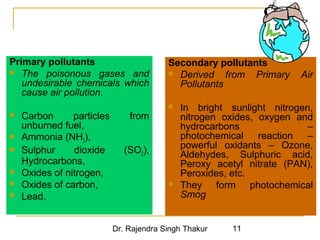
Primary pollutants 
 The poisonous gases and 
undesirable chemicals which 
cause air pollution. 
 Carbon particles from 
unburned fuel, 
 Ammonia (NH3), 
 Sulphur dioxide (SO2), 
Hydrocarbons, 
 Oxides of nitrogen, 
 Oxides of carbon, 
 Lead. 
Secondary pollutants 
 Derived from Primary Air 
Pollutants 
 In bright sunlight nitrogen, 
nitrogen oxides, oxygen and 
hydrocarbons – 
photochemical reaction – 
powerful oxidants – Ozone, 
Aldehydes, Sulphuric acid, 
Peroxy acetyl nitrate (PAN), 
Peroxides, etc. 
 They form photochemical 
Smog 
Dr. Rajendra Singh Thakur 11
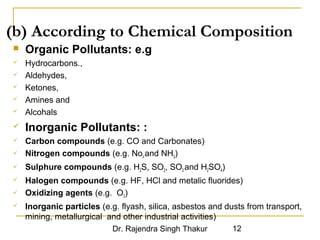
(b) According to Chemical Composition 
 Organic Pollutants: e.g 
 Hydrocarbons., 
 Aldehydes, 
 Ketones, 
 Amines and 
 Alcohals 
 Inorganic Pollutants: : 
 Carbon compounds (e.g. CO and Carbonates) 
 Nitrogen compounds (e.g. Nox and NH3) 
 Sulphure compounds (e.g. H2S, SO2, SO3 and H2SO4) 
 Halogen compounds (e.g. HF, HCl and metalic fluorides) 
 Oxidizing agents (e.g. O3) 
 Inorganic particles (e.g. flyash, silica, asbestos and dusts from transport, 
mining, metallurgical and other industrial activities) 
Dr. Rajendra Singh Thakur 12
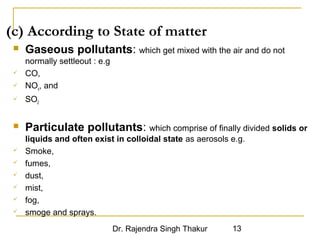
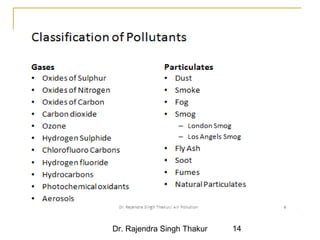
(c) According to State of matter 
 Gaseous pollutants: which get mixed with the air and do not 
Dr. Rajendra Singh Thakur 13 
normally settleout : e.g 
 CO, 
 NOx, and 
 SO2 
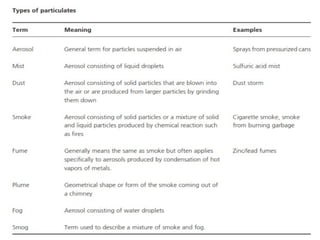
 Particulate pollutants: which comprise of finally divided solids or 
liquids and often exist in colloidal state as aerosols e.g. 
 Smoke, 
 fumes, 
 dust, 
 mist, 
 fog, 
 smoge and sprays.
Dr. Rajendra Singh Thakur 14
Dr. Rajendra Singh Thakur 15
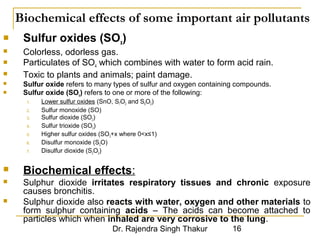
Biochemical effects of some important air pollutants 
 Sulfur oxides (SOx) 
 Colorless, odorless gas. 
 Particulates of SO4 which combines with water to form acid rain. 
 Toxic to plants and animals; paint damage. 
 Sulfur oxide refers to many types of sulfur and oxygen containing compounds. 
 Sulfur oxide (SOx) refers to one or more of the following: 
1. Lower sulfur oxides (SnO, S7O2 and S6O2) 
2. Sulfur monoxide (SO) 
3. Sulfur dioxide (SO2) 
4. Sulfur trioxide (SO3) 
5. Higher sulfur oxides (SO3+x where 0<x≤1) 
6. Disulfur monoxide (S2O) 
7. Disulfur dioxide (S2O2) 
 Biochemical effects: 
 Sulphur dioxide irritates respiratory tissues and chronic exposure 
Dr. Rajendra Singh Thakur 16 
causes bronchitis. 
 Sulphur dioxide also reacts with water, oxygen and other materials to 
form sulphur containing acids – The acids can become attached to 
particles which when inhaled are very corrosive to the lung.
 Nitrogen oxides, (NOx) 
 Nitric oxide and nitrogen dioxide NO2, 
 NO2 yellow brown to reddish gas. 
 (NOx) Converted to nitrates in atmosphere causing acid rain. 
 Biochemical effects 
 Nitrogen oxides and suspended particles both can irritate lungs, 
aggravate asthma or chronic bronchitis and increase respiratory 
infections. 
Dr. Rajendra Singh Thakur 17
 Carbon monoxide (CO) 
 Colorless, odorless gas, readily combines with hemoglobin in blood to 
Toxic. 
 Biochemical effects 
 (Under normal condition) O2 + Hb = O2Hb (Oxyhaemoglobin) 
 (In presence of CO) O2Hb + CO = COHb + O2 (Carbxyhaemoglobin) 
 Cigarette smoking is responsible for the greatest exposure to carbon 
monoxide. 
 CO is attached to blood hemoglobin reduces the oxygen carrying 
capacity of blood. This impairs perception and thinking, slows 
reflexes and causes headaches, drowsiness, dizziness and 
nausea and blurred vision. 
 CO, carbon monoxide, 90% natural, 10% from incomplete 
combustion, cigarettes, combines with hemoglobin and reduces 
bloods ability to carry oxygen. 1,50,000 to 3,50,000 deaths/yr. 
Dr. Rajendra Singh Thakur 18
 Ozone (O3) 
 Ozone or trioxygen, is an inorganic compound with the chemical 
formula O3. 
 It is a pale blue gas with a distinctively pungent smell. 
 It is an allotrope of oxygen that is much less stable than 
the diatomic allotrope O2, breaking down in the lower atmosphere to 
normal dioxygen. 
 Ozone is formed from dioxygen by the action of ultraviolet light and 
also atmospheric electrical discharges, and is present in low 
concentrations throughout the Earth's atmosphere. 
 Biochemical effects- Ground Level Ozone 
 Damage to crops 
 Irritates the respiratory tract and eyes 
 High levels of O3 results in chest tightness, coughing and wheezing 
 Increased hospital admissions and premature death 
Dr. Rajendra Singh Thakur 19
 Hydrocarbons (other volatile organic 
compounds): very reactive. React with many kinds of 
compound yielding many kinds of products. Volatile HC and other 
organic compounds participate in atmospheric reactions generating 
ozone. 
 Biochemical effects 
 Many volatile organic compounds such as benzene and 
formaldehyde and toxic particulates such as lead and cadmium 
can cause mutations, reproductive problems and cancer, 
breathlessness and irritation of the eye, nose and throat. 
Dr. Rajendra Singh Thakur 20
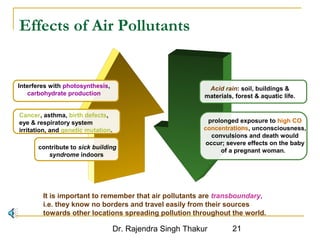
Effects of Air Pollutants 
Dr. Rajendra Singh Thakur 21 
Interferes with photosynthesis, 
carbohydrate production 
Cancer, asthma, birth defects, 
eye & respiratory system 
irritation, and genetic mutation. 
contribute to sick building 
syndrome indoors 
Acid rain: soil, buildings & 
materials, forest & aquatic life. 
prolonged exposure to high CO 
concentrations, unconsciousness, 
convulsions and death would 
occur; severe effects on the baby 
of a pregnant woman. 
It is important to remember that air pollutants are transboundary, 
i.e. they know no borders and travel easily from their sources 
towards other locations spreading pollution throughout the world.
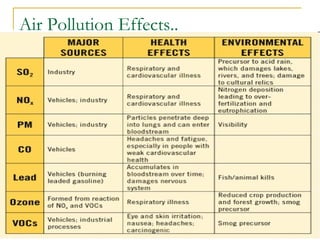
Air Pollution Effects.. 
Dr. Rajendra Singh Thakur 22
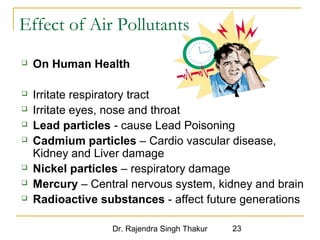
Effect of Air Pollutants 
 On Human Health 
 Irritate respiratory tract 
 Irritate eyes, nose and throat 
 Lead particles - cause Lead Poisoning 
 Cadmium particles – Cardio vascular disease, 
Kidney and Liver damage 
 Nickel particles – respiratory damage 
 Mercury – Central nervous system, kidney and brain 
 Radioactive substances - affect future generations 
Dr. Rajendra Singh Thakur 23
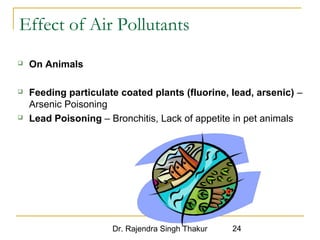
Effect of Air Pollutants 
Dr. Rajendra Singh Thakur 24 
 On Animals 
 Feeding particulate coated plants (fluorine, lead, arsenic) – 
Arsenic Poisoning 
 Lead Poisoning – Bronchitis, Lack of appetite in pet animals
Effect of Air Pollutants 
Dr. Rajendra Singh Thakur 25 
 On Plants 
 Spraying Pesticides, Organic manure and agricultural 
applications – affect growth of plants 
 Destroy chlorophyll formation – disturb photosynthesis 
 SO2 – decreases chlorophyll content – causes Chlorosis 
 NO2 – permanent leaf fall 
 Ozone – Necrosis - dead area on leaf – damages the leaves
Effect of Air Pollutants 
Dr. Rajendra Singh Thakur 26 
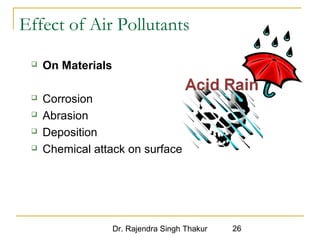
 On Materials 
 Corrosion 
 Abrasion 
 Deposition 
 Chemical attack on surface
Effect of Air Pollutants 
Dr. Rajendra Singh Thakur 27 
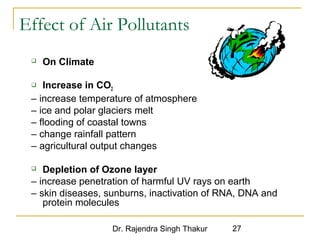
 On Climate 
 Increase in CO2 
– increase temperature of atmosphere 
– ice and polar glaciers melt 
– flooding of coastal towns 
– change rainfall pattern 
– agricultural output changes 
 Depletion of Ozone layer 
– increase penetration of harmful UV rays on earth 
– skin diseases, sunburns, inactivation of RNA, DNA and 
protein molecules
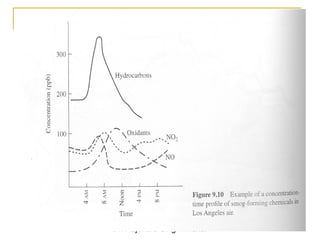
Photochemical 
Smog
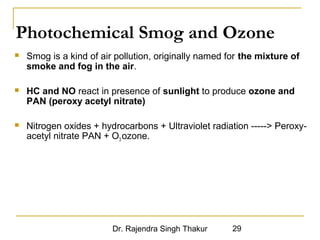
Photochemical Smog and Ozone 
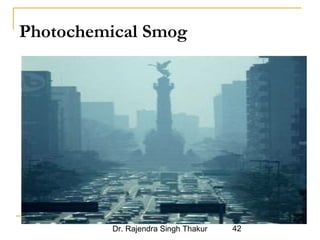
 Smog is a kind of air pollution, originally named for the mixture of 
smoke and fog in the air. 
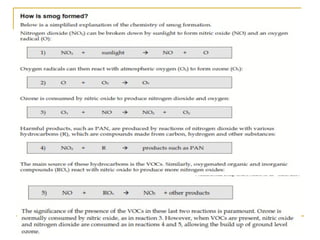
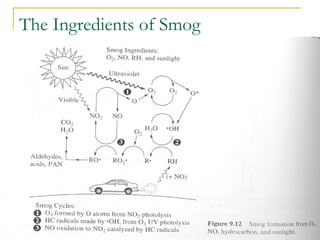
 HC and NO react in presence of sunlight to produce ozone and 
PAN (peroxy acetyl nitrate) 
 Nitrogen oxides + hydrocarbons + Ultraviolet radiation -----> Peroxy-acetyl 
nitrate PAN + O3 ozone. 
Dr. Rajendra Singh Thakur 29
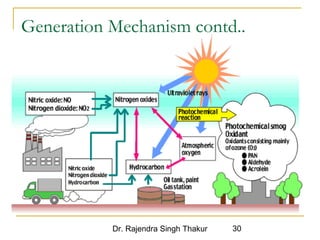
Generation Mechanism contd.. 
Dr. Rajendra Singh Thakur 30
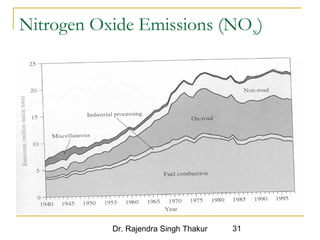
Nitrogen Oxide Emissions (NOx) 
Dr. Rajendra Singh Thakur 31
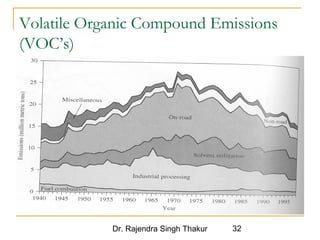
Volatile Organic Compound Emissions 
(VOC’s) 
Dr. Rajendra Singh Thakur 32
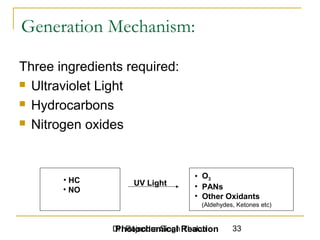
Generation Mechanism: 
Three ingredients required: 
 Ultraviolet Light 
 Hydrocarbons 
 Nitrogen oxides 
Dr. Rajendra Singh Thakur 33 
• HC 
• NO 
UV Light 
• O3 
• PANs 
• Other Oxidants 
(Aldehydes, Ketones etc) 
Photochemical Reaction
Dr. Rajendra Singh Thakur 34
The Ingredients of Smog 
Dr. Rajendra Singh Thakur 35
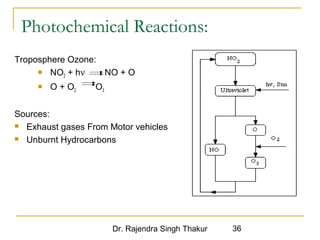
Photochemical Reactions: 
Dr. Rajendra Singh Thakur 36 
Troposphere Ozone: 
 NO2 + hn NO + O 
 O + O2 O3 
Sources: 
 Exhaust gases From Motor vehicles 
 Unburnt Hydrocarbons
Photochemical Reaction Contd.. 
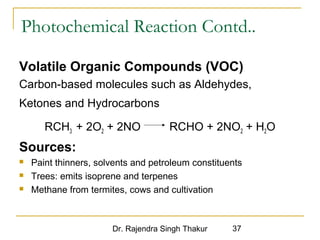
Volatile Organic Compounds (VOC) 
Carbon-based molecules such as Aldehydes, 
Ketones and Hydrocarbons 
RCH3 + 2O2 + 2NO RCHO + 2NO2 + H2O 
Sources: 
 Paint thinners, solvents and petroleum constituents 
 Trees: emits isoprene and terpenes 
 Methane from termites, cows and cultivation 
Dr. Rajendra Singh Thakur 37
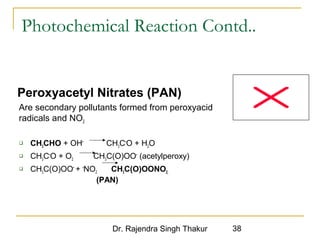
Photochemical Reaction Contd.. 
Peroxyacetyl Nitrates (PAN) 
Are secondary pollutants formed from peroxyacid 
radicals and NO2 
 CH3CHO + OH• CH3C•O + H2O 
 CH3C•O + O2 CH3C(O)OO• (acetylperoxy) 
 CH3C(O)OO• + •NO2 
CH3C(O)OONO2 
(PAN) 
Dr. Rajendra Singh Thakur 38
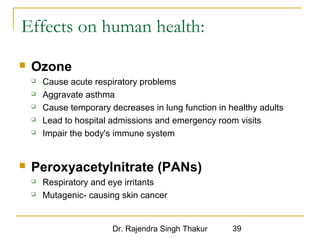
Effects on human health: 
Dr. Rajendra Singh Thakur 39 
 Ozone 
 Cause acute respiratory problems 
 Aggravate asthma 
 Cause temporary decreases in lung function in healthy adults 
 Lead to hospital admissions and emergency room visits 
 Impair the body's immune system 
 Peroxyacetylnitrate (PANs) 
 Respiratory and eye irritants 
 Mutagenic- causing skin cancer
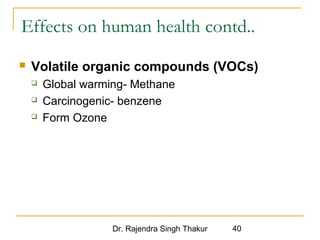
Effects on human health contd.. 
 Volatile organic compounds (VOCs) 
 Global warming- Methane 
 Carcinogenic- benzene 
 Form Ozone 
Dr. Rajendra Singh Thakur 40
Dr. Rajendra Singh Thakur 41
Photochemical Smog 
Dr. Rajendra Singh Thakur 42
Greenhouse Effect And 
Global Warming 
Dr. Rajendra Singh Thakur 43
GREENHOUSE EFFECT 
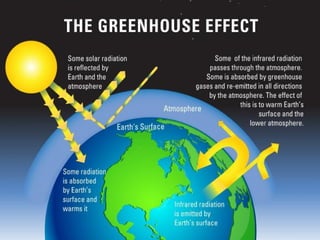
 The atmosphere over the earth contains certain gases that play significant role in 
maintaining the mean effective planetary temperature. 
 To allows short- wave solar radiation to enter the greenhouse but the long- wave and 
infrared heat- producing re- radiation from inside the greenhouse can not pass through the 
walls. 
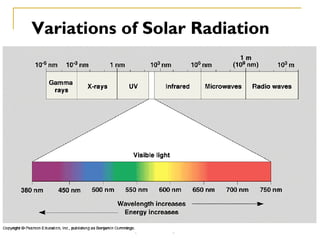
 Due to the presence of certain gases, the atmosphere strongly absorbs the infrared 
radiation resulting in atmospheric heating. 
 Thus the temperature within the greenhouse becomes higher than outside. 
 The gases that absorb strongly in long wave and particularly in infrared region are 
commonly called “Greenhouse Gases”. 
 The heating of atmosphere due to presence of these greenhouse gases is commonly 
Dr. Rajendra Singh Thakur 44 
called “Greenhouse Effect” 
 This greenhouse effect is thought to be responsible for global warming. 
 Carbon dioxide contributes to only 56% of greenhouse heating. 
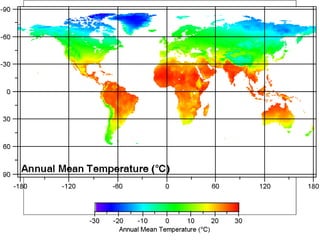
 The average surface temperature of Earth is about 15 to 18°C . 
 Global Warming is increase in the average temperature of the atmosphere, oceans, and 
landmasses of Earth.
.Variations of Solar Radiation 
ns of Solar Radiation 
Dr. Rajendra Singh Thakur 45
Greenhouse effect 
Dr. Rajendra Singh Thakur 46
Greenhouse effect 
Dr. Rajendra Singh Thakur 47
Dr. Rajendra Singh Thakur 48
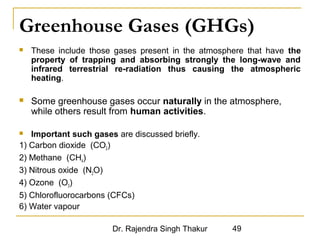
Greenhouse Gases (GHGs) 
 These include those gases present in the atmosphere that have the 
property of trapping and absorbing strongly the long-wave and 
infrared terrestrial re-radiation thus causing the atmospheric 
heating. 
 Some greenhouse gases occur naturally in the atmosphere, 
while others result from human activities. 
 Important such gases are discussed briefly. 
1) Carbon dioxide (CO2) 
2) Methane (CH4) 
3) Nitrous oxide (N2O) 
4) Ozone (O3) 
5) Chlorofluorocarbons (CFCs) 
6) Water vapour 
Dr. Rajendra Singh Thakur 49
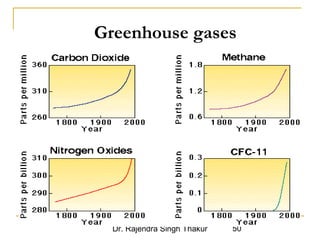
Greenhouse gases 
Dr. Rajendra Singh Thakur 50
Greenhouse Gases (GHGs) 
 1) Carbon dioxide (CO2): 
 The percentage of this gas by volume in dry air is about 0.035%. 
 The gas is involved in a complex global cycle. 
 It is released from the interior of the earth and is produced by respiration 
of living organisms, soil processes, combustion of organic matter and 
oceanic evaporation. 
 On the other hand, it is dissolved in the water bodies on the earth and is 
also consumed in the photosynthesis of plants. 
 2) Methane (CH4): 
 In dry air, the proportion of this gas by volume is about 0.0017%. 
 It is produced primarily by anaerobic processes in the natural wetlands, 
rice paddies, digestive processes of animals, biomass burning and other 
human activities. 
 It is destroyed in the troposphere by a reaction with hydroxyl (OH) ion. 
Dr. Rajendra Singh Thakur 51
 3) Nitrous oxide (N2O): 
 This gas is produced by biological processes in the oceans as well as 
soils, by industrial combustion, burning of fossil fuels and by use of 
chemical fertilizers. 
 It is destroyed by photochemical reactions in the stratosphere involving 
the production of nitrogen oxides (NOx). 
 The gas has quite long lifetime of about 132 years in the atmosphere. 
 4) Ozone (O3): 
 The volume wise proportion of this gas in atmosphere is about 0.00006%. 
 It is produced by high level breakup of oxygen molecules by solar ultra-violet 
radiation and is destroyed by photochemical reactions involving 
nitrogen oxides and chlorine in the middle and upper stratosphere. 
Dr. Rajendra Singh Thakur 52
 5) Chlorofluorocarbons (CFCs): 
 These gases are produced solely by human activities i.e. by aerosol propellants, 
refrigeration coolents, cleansers and air conditioning plants. 
 Chief among these are CFCl2 and CFCl3. 
 These gases released into the atmosphere near ground level quickly move up and 
Dr. Rajendra Singh Thakur 53 
reach the stratosphere. 
 Within the stratosphere, the gases move towards poles. 
 These gases are decomposed to chlorine by photochemical reactions. The average 
lifetime of these gases in atmosphere is 55- 116 years. 
 6) Water vapour: 
 Water vapor in clouds re-radiate heat back to Earth. 
 Though water vapour is not a gas in the strict chemical sense, it is an important 
atmospheric constituent. 
 Its average proportion in the air by volume is about 1.0%. 
 The amount of water vapour in the atmosphere is highly variable depending upon the 
place ant time.
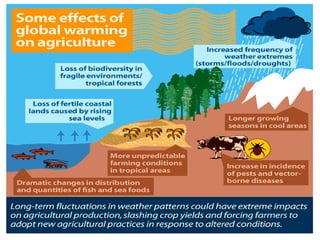
Impact Of Global Warming 
• Temperature extremes 
• Rise in sea level, and change in precipitation 
• Injuries from storms, coastal flooding 
• Interruption of power supply, contamination of drinking water 
Dr. Rajendra Singh Thakur 54 
• Drought 
• Food shortages due to shift in agricultural food production 
• Air pollution (made worse by warming) 
• Asthma, bronchitis, emphysema complications 
• Increased need due to population migrations 
• Unable to contain spread of infectious diseases
Dr. Rajendra Singh Thakur 55
The Ozone Layer: 
Formation and Depletion 
Dr. Rajendra Singh Thakur 56
Ground Level Ozone 
 Ozone (O3) is a key constituent of the troposphere. 
 Ozone (Greek word ozein, mean “to smell”), pale blue, highly 
poisonous gas with a strong odor. 
 Ozone is considered a pollutant at ground level. 
 Breathing O3 affects both the respiratory and nervous systems, 
resulting in respiratory distress, headache, and exhaustion. 
 Ozone is damaging to plants, resulting in leaf mottling and reduced 
growth. 
Dr. Rajendra Singh Thakur 57
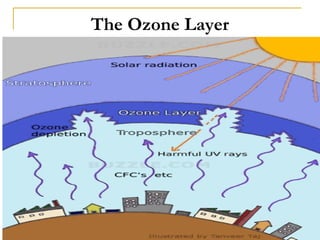
The Ozone Layer 
 The stratosphere contains the ozone shield, a layer of ozone (O3) in 
the stratosphere, 50 km above the ground. 
 Ozone layer is a thin, fragile shield that contains relatively high 
concentrations of ozone. 
 It shields the entire Earth from much of the harmful UV radiation that 
comes from the sun 
 Damage in the ozone layer will naturally mean the entry of harmful 
rays in to the atmosphere. 
 In the 1970s, the scientists discovered that the ozone layer is being 
depleted. 
Dr. Rajendra Singh Thakur 58
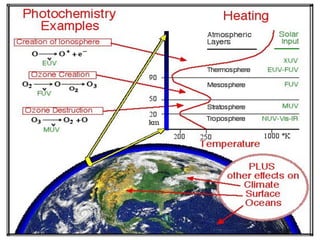
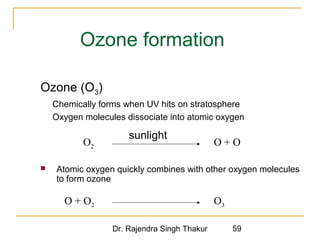
Ozone formation 
Ozone (O3) 
 Chemically forms when UV hits on stratosphere 
 Oxygen molecules dissociate into atomic oxygen 
sunlight 
O2 O + O 
 Atomic oxygen quickly combines with other oxygen molecules 
Dr. Rajendra Singh Thakur 59 
to form ozone 
O + O2 O3
Ozone formation 
 Ozone (O3) 
 A component of photochemical smog 
 Important for our survival 
 Absorbs some of the potentially harmful UV radiation which can 
cause skin cancer and damage to vegetation 
 Highest concentration in the upper atmosphere 
 Occurs naturally as a layer in the stratosphere 
 The layer is thinnest around the equator and the concentration 
increases towards the poles 
 The amount of ozone above a point on the earth’s surface is measured 
in Dobson units (DU) 
– ~ 260 DU near the Tropics 
– higher elsewhere 
Dr. Rajendra Singh Thakur 60
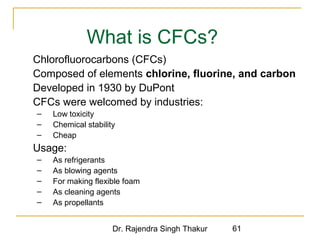
What is CFCs? 
 Chlorofluorocarbons (CFCs) 
 Composed of elements chlorine, fluorine, and carbon 
 Developed in 1930 by DuPont 
 CFCs were welcomed by industries: 
– Low toxicity 
– Chemical stability 
– Cheap 
Dr. Rajendra Singh Thakur 61 
 Usage: 
– As refrigerants 
– As blowing agents 
– For making flexible foam 
– As cleaning agents 
– As propellants
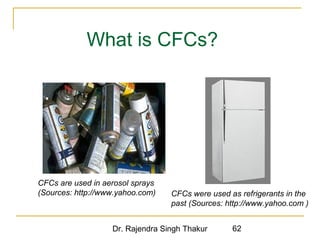
What is CFCs? 
CFCs are used in aerosol sprays 
(Sources: http://www.yahoo.com) CFCs were used as refrigerants in the 
past (Sources: http://www.yahoo.com ) 
Dr. Rajendra Singh Thakur 62
Present situation 
 Stratospheric ozone over Antarctica: 
– Has been depleted over the last 15 years 
– The ozone hole: 
 enlarging 
 large enough to cover most of the North America 
 would take at least 50 years to restore 
Dr. Rajendra Singh Thakur 63
Dr. Rajendra Singh Thakur 64
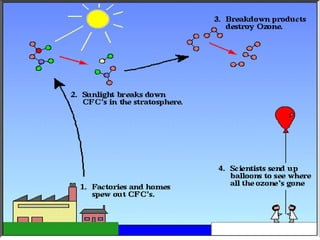
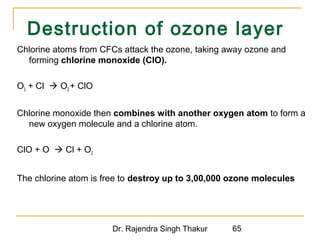
Destruction of ozone layer 
Chlorine atoms from CFCs attack the ozone, taking away ozone and 
forming chlorine monoxide (ClO). 
Dr. Rajendra Singh Thakur 65 
O3 + Cl  O2 + ClO 
Chlorine monoxide then combines with another oxygen atom to form a 
new oxygen molecule and a chlorine atom. 
ClO + O  Cl + O2 
The chlorine atom is free to destroy up to 3,00,000 ozone molecules
The Ozone Layer 
Dr. Rajendra Singh Thakur 66
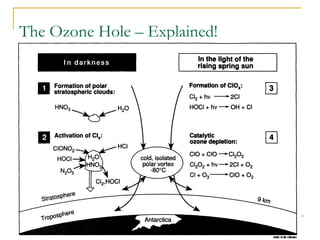
The Ozone Hole – Explained! 
Dr. Rajendra Singh Thakur 67
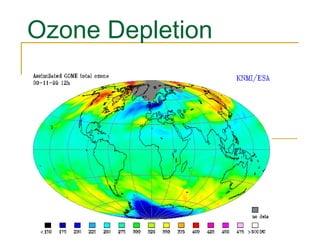
Ozone Depletion
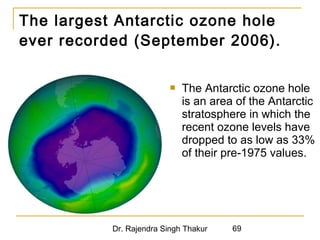
The largest Antarctic ozone hole 
ever recorded (September 2006). 
 The Antarctic ozone hole 
is an area of the Antarctic 
stratosphere in which the 
recent ozone levels have 
dropped to as low as 33% 
of their pre-1975 values. 
Dr. Rajendra Singh Thakur 69
Health effects of Ozone depletion 
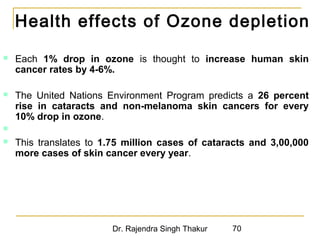
 Each 1% drop in ozone is thought to increase human skin 
cancer rates by 4-6%. 
 The United Nations Environment Program predicts a 26 percent 
rise in cataracts and non-melanoma skin cancers for every 
10% drop in ozone. 
 
 This translates to 1.75 million cases of cataracts and 3,00,000 
more cases of skin cancer every year. 
Dr. Rajendra Singh Thakur 70
Impact on Humans 
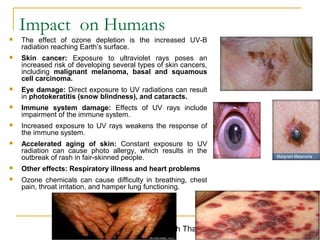
 The effect of ozone depletion is the increased UV-B 
radiation reaching Earth’s surface. 
 Skin cancer: Exposure to ultraviolet rays poses an 
increased risk of developing several types of skin cancers, 
including malignant melanoma, basal and squamous 
cell carcinoma. 
 Eye damage: Direct exposure to UV radiations can result 
in photokeratitis (snow blindness), and cataracts. 
 Immune system damage: Effects of UV rays include 
impairment of the immune system. 
 Increased exposure to UV rays weakens the response of 
Dr. Rajendra Singh Thakur 71 
the immune system. 
 Accelerated aging of skin: Constant exposure to UV 
radiation can cause photo allergy, which results in the 
outbreak of rash in fair-skinned people. 
 Other effects: Respiratory illness and heart problems 
 Ozone chemicals can cause difficulty in breathing, chest 
pain, throat irritation, and hamper lung functioning.
Effects on Amphibians 
Ozone depletion is listed as one of the causes for the declining 
numbers of amphibian species. Ozone depletion affects many 
species of amphibians at every stage of their life cycle. Some of 
the effects are mentioned below. 
 Hampers growth and development in larvae 
 Changes behaviour and habits 
 Causes deformities in some species 
 Decreases immunity. Some species have become more 
vulnerable to diseases and death 
 Retinal damage and blindness in some species 
Dr. Rajendra Singh Thakur 72
Effects on Marine Ecosystems 
 In particular, plankton (phytoplankton and bacterioplankton) are 
threatened by increased UV radiation. 
 Marine phytoplankton play a fundamental role in both the food 
chain as well as the oceanic carbon cycle. 
 Plankton play an important role in converting atmospheric carbon 
dioxide into oxygen. 
 Ultraviolet rays can influence the survival rates of these 
microscopic organisms, by affecting their orientation and 
mobility. 
 This eventually disturbs and affects the entire ecosystem. 
Dr. Rajendra Singh Thakur 73
Impact on Plants 
 In some species of plants, UV radiation can alter the 
time of flowering, as well as the number of flowers. 
 Plant growth can be directly affected by UV-B 
radiation. 
 Despite mechanisms to reduce or repair these 
effects, physiological and developmental processes 
of plants are affected. 
Dr. Rajendra Singh Thakur 74
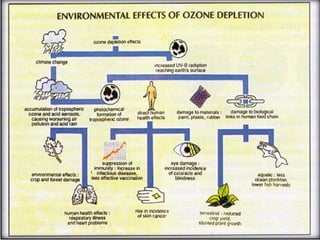
Effects on the Environment 
 Global warming 
 Climate change 
 Crop and forest damage 
 Infections and skin diseases on animals 
 Less ocean plankton 
 Less fish harvest 
Dr. Rajendra Singh Thakur 75
Dr. Rajendra Singh Thakur 76
Food supply 
 Reduce photosynthesis - crops 
affected. 
 Kills plankton  fish ¯ 
Dr. Rajendra Singh Thakur 77
Impacts on other animals 
 Reduces plankton population 
 Reduces penguin population 
 Reduces the percentage of hatching of frog eggs 
Dr. Rajendra Singh Thakur 78
What is Acid Rain; 
what are its Causes and Effects? 
Dr. Rajendra Singh Thakur 79
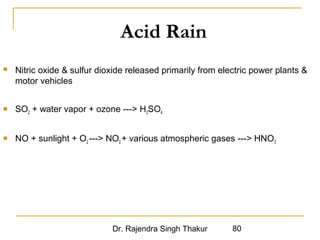
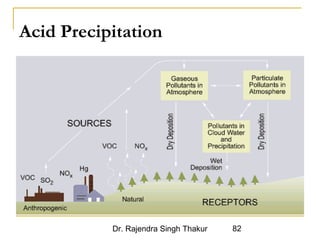
Acid Rain 
 Nitric oxide  sulfur dioxide released primarily from electric power plants  
motor vehicles 
 SO2 + water vapor + ozone --- H2SO4 
 NO + sunlight + O2 --- NO2 + various atmospheric gases --- HNO3 
Dr. Rajendra Singh Thakur 80
Wet and dry acid deposition 
 Caused by SO2 and NO2. 
 Alone cause dry acid deposition, with all forms of water vapor, 
these form sulfuric and nitric acid - acid rain downwind of sites of 
emission. 
 Normal rain water pH 5.0-5.6 approx. Acid rain 5.0 
Affects industrialized areas worldwide. 
 Developing countries have more pollution, fewer controls than 
developed countries. 
Dr. Rajendra Singh Thakur 81
Acid Precipitation 
Dr. Rajendra Singh Thakur 82
Environmental Impact of Acid deposition 
Sterilization of lakes and forests. 
Reducing the populations of small invertebrates and decomposers. 
Reducing agricultural yields. 
Causing extensive structural damage by corroding marble, metal, 
and stonework. 
Degrading water supplies by leaching heavy metals from the soil into 
drinking-water supplies. 
Increases in lung cancer and colon cancer. 
kill fish, plants; stress and defoliate trees due to moss growth, insect 
attack, and loss of nutrients. 
Dr. Rajendra Singh Thakur 83
Dr. Rajendra Singh Thakur 84
Dr. Rajendra Singh Thakur 85
Dr. Rajendra Singh Thakur 86
Dr. Rajendra Singh Thakur 87
Dr. Rajendra Singh Thakur 88 
Thank 
You

Air Pollution

  • 1.
    Air Pollution LecturedBy- Dr. Rajendra Singh Thakur
  • 2.
    Air pollution :Definition  The presence of one or more chemicals in the atmosphere in sufficient quantities and duration to cause harm to humans etc. Dr. Rajendra Singh Thakur 2 or  Excessive discharge of undesirable foreign substances into the atmospheric air thereby adversely affecting the quality of air and causing damage to human, plants and animal lives.  Air pollution is the introduction into the atmosphere of chemicals, particulates, or biological materials that cause discomfort, disease, or death to humans, damage other living organisms such as food crops, or damage the natural environment or built environment.
  • 3.
    Air Pollution Air pollution results from human activities such as burning fossil fuels (oil, coal, and gasoline) to create electricity and power automobiles, and manufacture industrial products such as chemicals and plastic.  The air pollutants are particulates, HC, CO2, CO, NO, NO2, SO3 Dr. Rajendra Singh Thakur 3 -- source may be industrial, autos, etc.  The increased carbon dioxide in the atmosphere contributes to the warming of the global climate, the so-called "greenhouse effect."  The increased Chloro-fluoro-carbons in the atmosphere has been depleting stratospheric ozone.
  • 4.
  • 5.
    Sources of AirPollution  Natural: 1. volcanoes, fumaroles and hot springs 2. decay from marshes, bogs 3. increase ozone due to thunderstorms, fires. Dr. Rajendra Singh Thakur 5
  • 6.
    Man made (mostsevere for human health):  Stationary sources - those that are fixed in Dr. Rajendra Singh Thakur 6 location. 1. Point sources e.g. smoke stacks, 14% air pollution from plants generating electricity; 2. Fugitive sources e.g. construction sites, exposed areas; 3. Area sources e.g. dense urban community or agricultural area  Mobile sources - those that move while polluting, e.g. trucks, cars, busses etc. 60% of air pollution from motor vehicles. 80-88% in major cities!
  • 7.
  • 8.
  • 9.
    CLASSIFICATION OF AIRPOLLUTANTS? Dr. Rajendra Singh Thakur 9
  • 10.
    (a) According toOrigin  Primary Air Pollutants: those emitted directly into the air. The main primary pollutants known to cause harm in high enough concentrations are the following: 1. Carbon compounds, such as CO, CO2, CH4, and VOCs 2. Nitrogen compounds, such as NO, N2O, NO2 and NH3 3. Sulfur compounds, such as H2S and SO2 4. Halogen compounds, such as chlorides, fluorides, and bromides 5. Particulate Matter (PM or “aerosols”), either in solid or liquid form, which is usually categorized into these groups based on the aerodynamic diameter of the particles.  Secondary Air Pollutants: those that form as a result of a chemical reaction of the primary pollutant with a natural component of the environment. The main secondary pollutants known to cause harm in high enough concentrations are the following: 1. NO2 and HNO3 formed from NO 2. Ozone (O3) formed from photochemical reactions of nitrogen oxides and VOCs 3. Sulfuric acid droplets formed from SO2 and nitric acid droplets formed from NO2 4. Sulfates and nitrates aerosols (e.g., ammonium (bi) sulfate and ammonium nitrate) formed from reactions of sulfuric acid droplets and nitric acid droplets with NH3, respectively 5. Organic aerosols formed from VOCs in gas-to-particle reactions. Dr. Rajendra Singh Thakur 10
  • 11.
    Primary pollutants The poisonous gases and undesirable chemicals which cause air pollution.  Carbon particles from unburned fuel,  Ammonia (NH3),  Sulphur dioxide (SO2), Hydrocarbons,  Oxides of nitrogen,  Oxides of carbon,  Lead. Secondary pollutants  Derived from Primary Air Pollutants  In bright sunlight nitrogen, nitrogen oxides, oxygen and hydrocarbons – photochemical reaction – powerful oxidants – Ozone, Aldehydes, Sulphuric acid, Peroxy acetyl nitrate (PAN), Peroxides, etc.  They form photochemical Smog Dr. Rajendra Singh Thakur 11
  • 12.
    (b) According toChemical Composition  Organic Pollutants: e.g  Hydrocarbons.,  Aldehydes,  Ketones,  Amines and  Alcohals  Inorganic Pollutants: :  Carbon compounds (e.g. CO and Carbonates)  Nitrogen compounds (e.g. Nox and NH3)  Sulphure compounds (e.g. H2S, SO2, SO3 and H2SO4)  Halogen compounds (e.g. HF, HCl and metalic fluorides)  Oxidizing agents (e.g. O3)  Inorganic particles (e.g. flyash, silica, asbestos and dusts from transport, mining, metallurgical and other industrial activities) Dr. Rajendra Singh Thakur 12
  • 13.
    (c) According toState of matter  Gaseous pollutants: which get mixed with the air and do not Dr. Rajendra Singh Thakur 13 normally settleout : e.g  CO,  NOx, and  SO2  Particulate pollutants: which comprise of finally divided solids or liquids and often exist in colloidal state as aerosols e.g.  Smoke,  fumes,  dust,  mist,  fog,  smoge and sprays.
  • 14.
  • 15.
  • 16.
    Biochemical effects ofsome important air pollutants  Sulfur oxides (SOx)  Colorless, odorless gas.  Particulates of SO4 which combines with water to form acid rain.  Toxic to plants and animals; paint damage.  Sulfur oxide refers to many types of sulfur and oxygen containing compounds.  Sulfur oxide (SOx) refers to one or more of the following: 1. Lower sulfur oxides (SnO, S7O2 and S6O2) 2. Sulfur monoxide (SO) 3. Sulfur dioxide (SO2) 4. Sulfur trioxide (SO3) 5. Higher sulfur oxides (SO3+x where 0<x≤1) 6. Disulfur monoxide (S2O) 7. Disulfur dioxide (S2O2)  Biochemical effects:  Sulphur dioxide irritates respiratory tissues and chronic exposure Dr. Rajendra Singh Thakur 16 causes bronchitis.  Sulphur dioxide also reacts with water, oxygen and other materials to form sulphur containing acids – The acids can become attached to particles which when inhaled are very corrosive to the lung.
  • 17.
     Nitrogen oxides,(NOx)  Nitric oxide and nitrogen dioxide NO2,  NO2 yellow brown to reddish gas.  (NOx) Converted to nitrates in atmosphere causing acid rain.  Biochemical effects  Nitrogen oxides and suspended particles both can irritate lungs, aggravate asthma or chronic bronchitis and increase respiratory infections. Dr. Rajendra Singh Thakur 17
  • 18.
     Carbon monoxide(CO)  Colorless, odorless gas, readily combines with hemoglobin in blood to Toxic.  Biochemical effects  (Under normal condition) O2 + Hb = O2Hb (Oxyhaemoglobin)  (In presence of CO) O2Hb + CO = COHb + O2 (Carbxyhaemoglobin)  Cigarette smoking is responsible for the greatest exposure to carbon monoxide.  CO is attached to blood hemoglobin reduces the oxygen carrying capacity of blood. This impairs perception and thinking, slows reflexes and causes headaches, drowsiness, dizziness and nausea and blurred vision.  CO, carbon monoxide, 90% natural, 10% from incomplete combustion, cigarettes, combines with hemoglobin and reduces bloods ability to carry oxygen. 1,50,000 to 3,50,000 deaths/yr. Dr. Rajendra Singh Thakur 18
  • 19.
     Ozone (O3)  Ozone or trioxygen, is an inorganic compound with the chemical formula O3.  It is a pale blue gas with a distinctively pungent smell.  It is an allotrope of oxygen that is much less stable than the diatomic allotrope O2, breaking down in the lower atmosphere to normal dioxygen.  Ozone is formed from dioxygen by the action of ultraviolet light and also atmospheric electrical discharges, and is present in low concentrations throughout the Earth's atmosphere.  Biochemical effects- Ground Level Ozone  Damage to crops  Irritates the respiratory tract and eyes  High levels of O3 results in chest tightness, coughing and wheezing  Increased hospital admissions and premature death Dr. Rajendra Singh Thakur 19
  • 20.
     Hydrocarbons (othervolatile organic compounds): very reactive. React with many kinds of compound yielding many kinds of products. Volatile HC and other organic compounds participate in atmospheric reactions generating ozone.  Biochemical effects  Many volatile organic compounds such as benzene and formaldehyde and toxic particulates such as lead and cadmium can cause mutations, reproductive problems and cancer, breathlessness and irritation of the eye, nose and throat. Dr. Rajendra Singh Thakur 20
  • 21.
    Effects of AirPollutants Dr. Rajendra Singh Thakur 21 Interferes with photosynthesis, carbohydrate production Cancer, asthma, birth defects, eye & respiratory system irritation, and genetic mutation. contribute to sick building syndrome indoors Acid rain: soil, buildings & materials, forest & aquatic life. prolonged exposure to high CO concentrations, unconsciousness, convulsions and death would occur; severe effects on the baby of a pregnant woman. It is important to remember that air pollutants are transboundary, i.e. they know no borders and travel easily from their sources towards other locations spreading pollution throughout the world.
  • 22.
    Air Pollution Effects.. Dr. Rajendra Singh Thakur 22
  • 23.
    Effect of AirPollutants  On Human Health  Irritate respiratory tract  Irritate eyes, nose and throat  Lead particles - cause Lead Poisoning  Cadmium particles – Cardio vascular disease, Kidney and Liver damage  Nickel particles – respiratory damage  Mercury – Central nervous system, kidney and brain  Radioactive substances - affect future generations Dr. Rajendra Singh Thakur 23
  • 24.
    Effect of AirPollutants Dr. Rajendra Singh Thakur 24  On Animals  Feeding particulate coated plants (fluorine, lead, arsenic) – Arsenic Poisoning  Lead Poisoning – Bronchitis, Lack of appetite in pet animals
  • 25.
    Effect of AirPollutants Dr. Rajendra Singh Thakur 25  On Plants  Spraying Pesticides, Organic manure and agricultural applications – affect growth of plants  Destroy chlorophyll formation – disturb photosynthesis  SO2 – decreases chlorophyll content – causes Chlorosis  NO2 – permanent leaf fall  Ozone – Necrosis - dead area on leaf – damages the leaves
  • 26.
    Effect of AirPollutants Dr. Rajendra Singh Thakur 26  On Materials  Corrosion  Abrasion  Deposition  Chemical attack on surface
  • 27.
    Effect of AirPollutants Dr. Rajendra Singh Thakur 27  On Climate  Increase in CO2 – increase temperature of atmosphere – ice and polar glaciers melt – flooding of coastal towns – change rainfall pattern – agricultural output changes  Depletion of Ozone layer – increase penetration of harmful UV rays on earth – skin diseases, sunburns, inactivation of RNA, DNA and protein molecules
  • 28.
  • 29.
    Photochemical Smog andOzone  Smog is a kind of air pollution, originally named for the mixture of smoke and fog in the air.  HC and NO react in presence of sunlight to produce ozone and PAN (peroxy acetyl nitrate)  Nitrogen oxides + hydrocarbons + Ultraviolet radiation -----> Peroxy-acetyl nitrate PAN + O3 ozone. Dr. Rajendra Singh Thakur 29
  • 30.
    Generation Mechanism contd.. Dr. Rajendra Singh Thakur 30
  • 31.
    Nitrogen Oxide Emissions(NOx) Dr. Rajendra Singh Thakur 31
  • 32.
    Volatile Organic CompoundEmissions (VOC’s) Dr. Rajendra Singh Thakur 32
  • 33.
    Generation Mechanism: Threeingredients required:  Ultraviolet Light  Hydrocarbons  Nitrogen oxides Dr. Rajendra Singh Thakur 33 • HC • NO UV Light • O3 • PANs • Other Oxidants (Aldehydes, Ketones etc) Photochemical Reaction
  • 34.
  • 35.
    The Ingredients ofSmog Dr. Rajendra Singh Thakur 35
  • 36.
    Photochemical Reactions: Dr.Rajendra Singh Thakur 36 Troposphere Ozone:  NO2 + hn NO + O  O + O2 O3 Sources:  Exhaust gases From Motor vehicles  Unburnt Hydrocarbons
  • 37.
    Photochemical Reaction Contd.. Volatile Organic Compounds (VOC) Carbon-based molecules such as Aldehydes, Ketones and Hydrocarbons RCH3 + 2O2 + 2NO RCHO + 2NO2 + H2O Sources:  Paint thinners, solvents and petroleum constituents  Trees: emits isoprene and terpenes  Methane from termites, cows and cultivation Dr. Rajendra Singh Thakur 37
  • 38.
    Photochemical Reaction Contd.. Peroxyacetyl Nitrates (PAN) Are secondary pollutants formed from peroxyacid radicals and NO2  CH3CHO + OH• CH3C•O + H2O  CH3C•O + O2 CH3C(O)OO• (acetylperoxy)  CH3C(O)OO• + •NO2 CH3C(O)OONO2 (PAN) Dr. Rajendra Singh Thakur 38
  • 39.
    Effects on humanhealth: Dr. Rajendra Singh Thakur 39  Ozone  Cause acute respiratory problems  Aggravate asthma  Cause temporary decreases in lung function in healthy adults  Lead to hospital admissions and emergency room visits  Impair the body's immune system  Peroxyacetylnitrate (PANs)  Respiratory and eye irritants  Mutagenic- causing skin cancer
  • 40.
    Effects on humanhealth contd..  Volatile organic compounds (VOCs)  Global warming- Methane  Carcinogenic- benzene  Form Ozone Dr. Rajendra Singh Thakur 40
  • 41.
  • 42.
    Photochemical Smog Dr.Rajendra Singh Thakur 42
  • 43.
    Greenhouse Effect And Global Warming Dr. Rajendra Singh Thakur 43
  • 44.
    GREENHOUSE EFFECT The atmosphere over the earth contains certain gases that play significant role in maintaining the mean effective planetary temperature.  To allows short- wave solar radiation to enter the greenhouse but the long- wave and infrared heat- producing re- radiation from inside the greenhouse can not pass through the walls.  Due to the presence of certain gases, the atmosphere strongly absorbs the infrared radiation resulting in atmospheric heating.  Thus the temperature within the greenhouse becomes higher than outside.  The gases that absorb strongly in long wave and particularly in infrared region are commonly called “Greenhouse Gases”.  The heating of atmosphere due to presence of these greenhouse gases is commonly Dr. Rajendra Singh Thakur 44 called “Greenhouse Effect”  This greenhouse effect is thought to be responsible for global warming.  Carbon dioxide contributes to only 56% of greenhouse heating.  The average surface temperature of Earth is about 15 to 18°C .  Global Warming is increase in the average temperature of the atmosphere, oceans, and landmasses of Earth.
  • 45.
    .Variations of SolarRadiation ns of Solar Radiation Dr. Rajendra Singh Thakur 45
  • 46.
    Greenhouse effect Dr.Rajendra Singh Thakur 46
  • 47.
    Greenhouse effect Dr.Rajendra Singh Thakur 47
  • 48.
  • 49.
    Greenhouse Gases (GHGs)  These include those gases present in the atmosphere that have the property of trapping and absorbing strongly the long-wave and infrared terrestrial re-radiation thus causing the atmospheric heating.  Some greenhouse gases occur naturally in the atmosphere, while others result from human activities.  Important such gases are discussed briefly. 1) Carbon dioxide (CO2) 2) Methane (CH4) 3) Nitrous oxide (N2O) 4) Ozone (O3) 5) Chlorofluorocarbons (CFCs) 6) Water vapour Dr. Rajendra Singh Thakur 49
  • 50.
    Greenhouse gases Dr.Rajendra Singh Thakur 50
  • 51.
    Greenhouse Gases (GHGs)  1) Carbon dioxide (CO2):  The percentage of this gas by volume in dry air is about 0.035%.  The gas is involved in a complex global cycle.  It is released from the interior of the earth and is produced by respiration of living organisms, soil processes, combustion of organic matter and oceanic evaporation.  On the other hand, it is dissolved in the water bodies on the earth and is also consumed in the photosynthesis of plants.  2) Methane (CH4):  In dry air, the proportion of this gas by volume is about 0.0017%.  It is produced primarily by anaerobic processes in the natural wetlands, rice paddies, digestive processes of animals, biomass burning and other human activities.  It is destroyed in the troposphere by a reaction with hydroxyl (OH) ion. Dr. Rajendra Singh Thakur 51
  • 52.
     3) Nitrousoxide (N2O):  This gas is produced by biological processes in the oceans as well as soils, by industrial combustion, burning of fossil fuels and by use of chemical fertilizers.  It is destroyed by photochemical reactions in the stratosphere involving the production of nitrogen oxides (NOx).  The gas has quite long lifetime of about 132 years in the atmosphere.  4) Ozone (O3):  The volume wise proportion of this gas in atmosphere is about 0.00006%.  It is produced by high level breakup of oxygen molecules by solar ultra-violet radiation and is destroyed by photochemical reactions involving nitrogen oxides and chlorine in the middle and upper stratosphere. Dr. Rajendra Singh Thakur 52
  • 53.
     5) Chlorofluorocarbons(CFCs):  These gases are produced solely by human activities i.e. by aerosol propellants, refrigeration coolents, cleansers and air conditioning plants.  Chief among these are CFCl2 and CFCl3.  These gases released into the atmosphere near ground level quickly move up and Dr. Rajendra Singh Thakur 53 reach the stratosphere.  Within the stratosphere, the gases move towards poles.  These gases are decomposed to chlorine by photochemical reactions. The average lifetime of these gases in atmosphere is 55- 116 years.  6) Water vapour:  Water vapor in clouds re-radiate heat back to Earth.  Though water vapour is not a gas in the strict chemical sense, it is an important atmospheric constituent.  Its average proportion in the air by volume is about 1.0%.  The amount of water vapour in the atmosphere is highly variable depending upon the place ant time.
  • 54.
    Impact Of GlobalWarming • Temperature extremes • Rise in sea level, and change in precipitation • Injuries from storms, coastal flooding • Interruption of power supply, contamination of drinking water Dr. Rajendra Singh Thakur 54 • Drought • Food shortages due to shift in agricultural food production • Air pollution (made worse by warming) • Asthma, bronchitis, emphysema complications • Increased need due to population migrations • Unable to contain spread of infectious diseases
  • 55.
  • 56.
    The Ozone Layer: Formation and Depletion Dr. Rajendra Singh Thakur 56
  • 57.
    Ground Level Ozone  Ozone (O3) is a key constituent of the troposphere.  Ozone (Greek word ozein, mean “to smell”), pale blue, highly poisonous gas with a strong odor.  Ozone is considered a pollutant at ground level.  Breathing O3 affects both the respiratory and nervous systems, resulting in respiratory distress, headache, and exhaustion.  Ozone is damaging to plants, resulting in leaf mottling and reduced growth. Dr. Rajendra Singh Thakur 57
  • 58.
    The Ozone Layer  The stratosphere contains the ozone shield, a layer of ozone (O3) in the stratosphere, 50 km above the ground.  Ozone layer is a thin, fragile shield that contains relatively high concentrations of ozone.  It shields the entire Earth from much of the harmful UV radiation that comes from the sun  Damage in the ozone layer will naturally mean the entry of harmful rays in to the atmosphere.  In the 1970s, the scientists discovered that the ozone layer is being depleted. Dr. Rajendra Singh Thakur 58
  • 59.
    Ozone formation Ozone(O3) Chemically forms when UV hits on stratosphere Oxygen molecules dissociate into atomic oxygen sunlight O2 O + O  Atomic oxygen quickly combines with other oxygen molecules Dr. Rajendra Singh Thakur 59 to form ozone O + O2 O3
  • 60.
    Ozone formation Ozone (O3) A component of photochemical smog Important for our survival Absorbs some of the potentially harmful UV radiation which can cause skin cancer and damage to vegetation Highest concentration in the upper atmosphere Occurs naturally as a layer in the stratosphere The layer is thinnest around the equator and the concentration increases towards the poles The amount of ozone above a point on the earth’s surface is measured in Dobson units (DU) – ~ 260 DU near the Tropics – higher elsewhere Dr. Rajendra Singh Thakur 60
  • 61.
    What is CFCs? Chlorofluorocarbons (CFCs) Composed of elements chlorine, fluorine, and carbon Developed in 1930 by DuPont CFCs were welcomed by industries: – Low toxicity – Chemical stability – Cheap Dr. Rajendra Singh Thakur 61 Usage: – As refrigerants – As blowing agents – For making flexible foam – As cleaning agents – As propellants
  • 62.
    What is CFCs? CFCs are used in aerosol sprays (Sources: http://www.yahoo.com) CFCs were used as refrigerants in the past (Sources: http://www.yahoo.com ) Dr. Rajendra Singh Thakur 62
  • 63.
    Present situation Stratospheric ozone over Antarctica: – Has been depleted over the last 15 years – The ozone hole: enlarging large enough to cover most of the North America would take at least 50 years to restore Dr. Rajendra Singh Thakur 63
  • 64.
  • 65.
    Destruction of ozonelayer Chlorine atoms from CFCs attack the ozone, taking away ozone and forming chlorine monoxide (ClO). Dr. Rajendra Singh Thakur 65 O3 + Cl  O2 + ClO Chlorine monoxide then combines with another oxygen atom to form a new oxygen molecule and a chlorine atom. ClO + O  Cl + O2 The chlorine atom is free to destroy up to 3,00,000 ozone molecules
  • 66.
    The Ozone Layer Dr. Rajendra Singh Thakur 66
  • 67.
    The Ozone Hole– Explained! Dr. Rajendra Singh Thakur 67
  • 68.
  • 69.
    The largest Antarcticozone hole ever recorded (September 2006).  The Antarctic ozone hole is an area of the Antarctic stratosphere in which the recent ozone levels have dropped to as low as 33% of their pre-1975 values. Dr. Rajendra Singh Thakur 69
  • 70.
    Health effects ofOzone depletion  Each 1% drop in ozone is thought to increase human skin cancer rates by 4-6%.  The United Nations Environment Program predicts a 26 percent rise in cataracts and non-melanoma skin cancers for every 10% drop in ozone.   This translates to 1.75 million cases of cataracts and 3,00,000 more cases of skin cancer every year. Dr. Rajendra Singh Thakur 70
  • 71.
    Impact on Humans  The effect of ozone depletion is the increased UV-B radiation reaching Earth’s surface.  Skin cancer: Exposure to ultraviolet rays poses an increased risk of developing several types of skin cancers, including malignant melanoma, basal and squamous cell carcinoma.  Eye damage: Direct exposure to UV radiations can result in photokeratitis (snow blindness), and cataracts.  Immune system damage: Effects of UV rays include impairment of the immune system.  Increased exposure to UV rays weakens the response of Dr. Rajendra Singh Thakur 71 the immune system.  Accelerated aging of skin: Constant exposure to UV radiation can cause photo allergy, which results in the outbreak of rash in fair-skinned people.  Other effects: Respiratory illness and heart problems  Ozone chemicals can cause difficulty in breathing, chest pain, throat irritation, and hamper lung functioning.
  • 72.
    Effects on Amphibians Ozone depletion is listed as one of the causes for the declining numbers of amphibian species. Ozone depletion affects many species of amphibians at every stage of their life cycle. Some of the effects are mentioned below.  Hampers growth and development in larvae  Changes behaviour and habits  Causes deformities in some species  Decreases immunity. Some species have become more vulnerable to diseases and death  Retinal damage and blindness in some species Dr. Rajendra Singh Thakur 72
  • 73.
    Effects on MarineEcosystems  In particular, plankton (phytoplankton and bacterioplankton) are threatened by increased UV radiation.  Marine phytoplankton play a fundamental role in both the food chain as well as the oceanic carbon cycle.  Plankton play an important role in converting atmospheric carbon dioxide into oxygen.  Ultraviolet rays can influence the survival rates of these microscopic organisms, by affecting their orientation and mobility.  This eventually disturbs and affects the entire ecosystem. Dr. Rajendra Singh Thakur 73
  • 74.
    Impact on Plants  In some species of plants, UV radiation can alter the time of flowering, as well as the number of flowers.  Plant growth can be directly affected by UV-B radiation.  Despite mechanisms to reduce or repair these effects, physiological and developmental processes of plants are affected. Dr. Rajendra Singh Thakur 74
  • 75.
    Effects on theEnvironment  Global warming  Climate change  Crop and forest damage  Infections and skin diseases on animals  Less ocean plankton  Less fish harvest Dr. Rajendra Singh Thakur 75
  • 76.
  • 77.
    Food supply Reduce photosynthesis - crops affected.  Kills plankton  fish ¯ Dr. Rajendra Singh Thakur 77
  • 78.
    Impacts on otheranimals  Reduces plankton population  Reduces penguin population  Reduces the percentage of hatching of frog eggs Dr. Rajendra Singh Thakur 78
  • 79.
    What is AcidRain; what are its Causes and Effects? Dr. Rajendra Singh Thakur 79
  • 80.
    Acid Rain Nitric oxide sulfur dioxide released primarily from electric power plants motor vehicles  SO2 + water vapor + ozone --- H2SO4  NO + sunlight + O2 --- NO2 + various atmospheric gases --- HNO3 Dr. Rajendra Singh Thakur 80
  • 81.
    Wet and dryacid deposition  Caused by SO2 and NO2.  Alone cause dry acid deposition, with all forms of water vapor, these form sulfuric and nitric acid - acid rain downwind of sites of emission.  Normal rain water pH 5.0-5.6 approx. Acid rain 5.0 Affects industrialized areas worldwide.  Developing countries have more pollution, fewer controls than developed countries. Dr. Rajendra Singh Thakur 81
  • 82.
    Acid Precipitation Dr.Rajendra Singh Thakur 82
  • 83.
    Environmental Impact ofAcid deposition Sterilization of lakes and forests. Reducing the populations of small invertebrates and decomposers. Reducing agricultural yields. Causing extensive structural damage by corroding marble, metal, and stonework. Degrading water supplies by leaching heavy metals from the soil into drinking-water supplies. Increases in lung cancer and colon cancer. kill fish, plants; stress and defoliate trees due to moss growth, insect attack, and loss of nutrients. Dr. Rajendra Singh Thakur 83
  • 84.
  • 85.
  • 86.
  • 87.
  • 88.
    Dr. Rajendra SinghThakur 88 Thank You

Editor's Notes

  • #68 review again the sequence of events leading the the formation of the ozone hole