Air polutionc control and its techniques, methods etc
1.
AIR POLLUTION
SUBMITTED BY, SUBMITTED TO,
SREETHU NAMBIAR P DR THANKAVELU A
ROLL NO : 6 ASSISTANT PROFESSOR
1st MSC ENVIRONMENTAL SCIENCE DEPARTMENT OF
KANNUR UNIVERSITY ENVIRONMENTAL STUDIES
KANNUR UNIVERSITY
2.
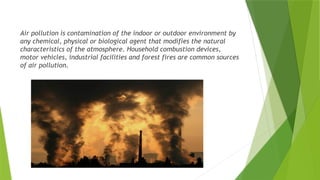
Air pollution iscontamination of the indoor or outdoor environment by
any chemical, physical or biological agent that modifies the natural
characteristics of the atmosphere. Household combustion devices,
motor vehicles, industrial facilities and forest fires are common sources
of air pollution.
3.
TYPES OF AIRPOLLUTION
Indoor Air Pollution
Pollutions from the housing made materials and living and working
activities of the house. The inside environment of houses often has a higher
level of air pollution than the surroundings in cities and towns.
Causes : Burning of traditional fuel for cooking, temperature, allergens,
tobacco smoke, artificial building materials and poor ventilation , etc.
Out door Air Pollution
Pollutions from out door services and environmental mixings, such as:
transportation-automobiles, industries-refineries, Atomic energy plant-
nuclear, and community activities-cleaning of streets.
4.
Air Pollutants
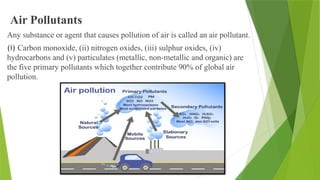
Any substanceor agent that causes pollution of air is called an air pollutant.
(i) Carbon monoxide, (ii) nitrogen oxides, (iii) sulphur oxides, (iv)
hydrocarbons and (v) particulates (metallic, non-metallic and organic) are
the five primary pollutants which together contribute 90% of global air
pollution.
5.
CLASSIFICATION OF AIRPOLLUTANTS
1. Natural Contaminants
Pollen : Pollen grains are the male gametophytes of gymnosperms and
angiosperms and they are discharged into the atmosphere from weeds,
grasses and trees .
Aerosols : Aerosols refer to the dispersion of solid or liquid particles
of microscopic size in gaseous media, such as dust, smoke, or mist.
Gases : Sulphur Dioxide , Hydrogen Sulphide, Hydrogen Chloride,
oxides of nitrogen , Methane, etc. Are some of the major gaseous air
pollutants.
These pollutants are released during volcanic eruptions, forest fires,
and grass fires.
6.
2. Primary andsecondary air pollutants
Primary air pollutants are those emitted directly from identifiable
sources.
Eg :- Finer particles, oxides of nitrogen, Carbon Monoxide
Secondary air pollutants are those which are produced in the air by
the interaction among two or more primary pollutants, or by
reaction with normal atmospheric constituents, with or without
photo activation.
Eg :- Ozone , Formaldehyde, PAN
7.
Emissions (air pollutants)may be classified by source, as
stationary or mobile.
A stationary source is any fixed emitter of air pollutants, such
as fossil fuel burning power plants, petroleum refineries,
petrochemical plants, food processing plants and other heavy
industrial sources.
Mobile sources are sources that move, such as cars, trucks,
planes, boats, buses, and trains.
8.
Another methodof classifying emission sources is by:
1.Point sources : large stationary sources
Eg :- Industrial processing, Power plants, oil combustion
2. Area sources : Small Stationary sources and mobile sources
with indefinite routes
Eg :- Residential heating ,open burning, Institutional heating
3.Line Sources : Mobile sources with definite routes
Eg :- Motor vehicle exhaust, Rail road locomotives, air crafts
9.
SOURCES OF AIRPOLLUTION
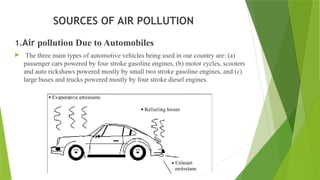
1.Air pollution Due to Automobiles
The three main types of automotive vehicles being used in our country are: (a)
passenger cars powered by four stroke gasoline engines, (b) motor cycles, scooters
and auto rickshaws powered mostly by small two stroke gasoline engines, and (c)
large buses and trucks powered mostly by four stroke diesel engines.
10.
GASES PRESENTIN THE AUTOMOBILE EXHAUST :
Carbon dioxide, Carbon monoxide ,Hydrocarbons, NO, Oxygen, Nitrogen ,
Sulphur dioxide , Sulphur oxide, Nitrogen oxide
These pollutants released to the atmosphere causes the depletion of ozone and
contribute to greenhouse gases
Motor vehicle emissions can be reduced by:-
1)Controlling vehicle performance
2) Altering fuel composition
3)Modifications in the engine design and operating variables
4)Treatment of exhaust gases after emission from the engine
Alternatives:- Electric car, Natural gas ,etc.
11.
2.Air Pollution fromIndustrial Sources
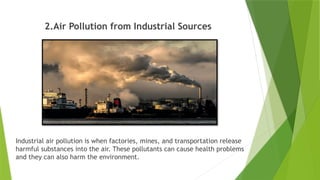
Industrial air pollution is when factories, mines, and transportation release
harmful substances into the air. These pollutants can cause health problems
and they can also harm the environment.
12.
Major Industries causingair pollution
Mining Product Industries
Lime production
Coal preparation
Glass manufacturing
Concrete batching
Asbestos processing
Cement Industry
Lime stone crushing plant
Grinding mills
Petroleum refining
Thermal power plants
13.
PHOTOCHEMICALAIR POLLUTION
Photochemicalair pollution occurs predominantly in highly motorised areas and
where inversion conditions prevail in the atmosphere. For e.g., Los Angeles.
It is due to the action of sunlight on the two pollutants-hydro carbons and
nitrogen oxides.
The major source of these two pollutants are the exhaust gases from the
automobiles.
Air pollution due to photochemical smog is characterized by intense eye
irritation, unusual odour, and reduction in atmospheric visibility.
causes damage to plants. can hinder photosynthesis, thus inhibiting plant
growth.
Other undesirable effects of photochemical smog are cracking of rubber and
fading of dyes.
14.
PHOTOCHEMICAL SMOG
Photochemicalsmog is formed due to photochemical oxidation of
hydro- carbons and nitrogen oxides
The major reasons are the volumetrically lower concentrations of
unburnt or partially burnt hydrocarbons and nitrogen oxides.
The relative concentration of either pollutant varies with the engine
operation.
Effects of photochemical smog
Eye irritation
Vegetation damage
Visibility reduction
Cracking of rubber
Fading of Dyes
15.
OTHER SOURCES OFAIR POLLUTION
The smoke from houses contains CO, SO , NO, NO2, etc. And soot
₂
particles.
The wear and tear of asbestos products like roofing materials,
floor tiles, coatings, etc.
The demolition of buildings cause the presence of dangerous
asbestos dust and fibre in air.
Incineration of domestic waste, use of Freon’s as refrigerants and
in aerosol sprays, tobacco smoking, use of electric power
generators, etc.
frequent occurrence of wars and terrorist activities in various
parts of the world.
16.
Meteorology and AirPollution
The degree to which air pollutants discharged from various sources
concentrate in a particular area depends largely on meteorological conditions.
Meteorological Factors that influence air pollution can be divided in to two -
Primary Parameters and Secondary Parameters
Primary parameters are:
Wind direction and speed
Temperature
Atmospheric stability
Mixing height
Secondary parameters are:
• Precipitation
• Humidity
• Solar radiation
• Visibility
17.
EFFECTS OF AIRPOLLUTION
EFFECTS OF AIR POLLUTION ON HUMAN BEINGS
An average man breathes 22,000 times a day and takes in 16 kg of air each day.
All the impurities in the inhaled air do not necessarily cause harm. Depending
upon the chemical nature of the pollutants, some may be harmful when present
in the air in small concentrations and others only if they are present in high
concentrations.
Prime factors affecting human health are :
1. Nature of the pollutants
2. Concentration of the pollutants
3. Duration of exposure
4. State of health of the receptor
5. Age group of the receptor
18.
HEALTH EFFECTS
EyeIrritation.
Nose and throat irritation.
Irritation of the respiratory tract.
Gases like hydrogen sulphide, ammonia and mercaptans cause
odour nuisance even at low concentrations.
Increase in mortality rate and morbidity rate.
A variety of particulates particularly pollens, initiate asthmatic
attacks.
Chronic pulmonary diseases like bronchitis and asthma, are
aggravated by a high concentration of SO2, NO2, particulate
matter and photochemical smog.
19.
Carbon monoxide combineswith the haemoglobin in the blood and
consequently increases stress on those suffering from cardiovascular
and pulmonary diseases.
Hydrogen fluoride causes diseases of the bone (fluorosis), and
mottling of teeth.
Carcinogenic agents cause cancer.
Dust particles cause respiratory diseases. Diseases like silicosis,
asbestosis, etc., result from specific dusts.
Certain heavy metals like lead may enter the body through the
lungs and cause poisoning.
20.
Specific Pollutants
Sulphur Dioxide:
Sulphur dioxide is an irritant gas which affects the mucous membranes when
inhaled.
Under certain conditions, some of the air-borne sulphur dioxide gas is oxidised
to sulphur trioxide.
Sulphur trioxide is a very strong irritant, much stronger than sulphur dioxide,
causing severe bronchospasms at relatively low levels of concentration.
Carbon Monoxide :
Carbon monoxide has a strong affinity for combining with the haemoglobin of
the blood to form carboxyhaemoglobin, COHb.
This reduces the ability of the haemoglobin to carry oxygen to the body tissues.
Carbon-monoxide also affects the central nervous system. It is also responsible
for heart attacks and a high mortality rate.
21.
Oxides of Nitrogen:
Of the seven oxides of nitrogen known to exist in the ambient air, nitric
oxide (NO) and nitrogen dioxide (NO2) are thought to affect human health.
Long-term exposure to high levels of nitrogen dioxide cause chronic lung
disease.
Ozone :
Ozone is a gas that has an irritant action in the respiratory tract, reaching
much deeper into the lungs than the oxides of sulphur.
Insecticides :
Insecticides are not only harmful for insects but also poisonous for man,
e.g., DDT (Dichloro diphenyl trichloroethane). They can affect the central
nervous system and may attack other vital organs.
22.
MAJOR DISASTERS
1. MEUSEVALLEY BELGIUM 1930
In December of 1930, a thick smog that contained multiple
pollutants, including sulphur, covered the densely populated
valley for several days and caused the death of up to 60 persons,
as well as several thousand cases of pulmonary attacks.
2. DONORA PENNSYLVANIA IN 1948
In October 1948, the communities of Donora and Webster in
Pennsylvania were visited by a smog that caused the death of20
individuals while an additional 5900—43% of the population of
Donora were affected by the smog.
23.
3. THE GREATSMOG OF LONDON 1952
The Great Smog of London or Great Smog of 1952, was a severe
air pollution event that affected London, England, in December
1952.
A period of unusually cold weather, combined with an
anticyclone and windless conditions, collected airborne pollutants
—mostly arising from the use of coal—to form a thick layer of
smog over the city.
It lasted from Friday 5 December to Tuesday 9 December 1952,
then dispersed quickly when the weather changed.
24.
EFFECTS OF AIRPOLLUTION ON ANIMALS
Damage to respiratory systems
Neurological problems
Skin irritation
Air Pollution Effects on Farm Animals
The process by which farm animals get poisoned is entirely different from that by
which human beings exposed to polluted atmospheres are poisoned. In case of farm
animals it is a two-step process.
1. Accumulation of the air-borne contaminant in the vegetation and forage
2. Subsequent poisoning of the animals when they eat the contaminated vegetation.
Pets And Pollution
Canine patients are found to be suffering from bronchitis, asthma and lack of
appetite.
Many dogs also suffer from coughs, nose and throat diseases due to increasing air
pollution.
FORMS OF DAMAGETO LEAVES
1. Necrosis: Necrosis is the killing or collapse of tissue.
2. Chlorosis: Chlorosis is the loss or reduction of the green plant
pigment, chlorophyll.
3. Abscission: Leaf abscission is dropping of leaves.
4. Epinasty : Leaf Epinasty is a downward curvature of the leaf due
to higher rate of growth on the upper surface.
KINDS OF INJURY TO PLANTS
Acute Injury
Chronic Injury
Growth or Yield Retardation
27.
ECONOMIC EFFECTS OFAIR POLLUTION
Air pollutants cause damage to materials by five mechanisms:
Abrasion
Corrosion
Deposition and removal
Direct Chemical attack
Indirect chemical attack
Factors which influence the rate of attack of damaging pollutants.
Moisture
Temperature
Sunlight
Air movement
28.
ECONOMIC LOSSES
Building Materials
Most sensitive are calcareous and ferrous materials.
Damage include losses of mass, changes in porosity, discoloration and
embrittlement
Smoke and aerosols adhere to stone, brick, and other building surfaces
to produce unsightly coatings.
Paints
Paints contain both pigments and a vehicle.
Pigments provide colour, hiding power, and durability. The vehicle
holds the pigment to the surface.
Air pollutants may limit both of these functions by damaging the
protective coating and by exposing the underlying surface to attack.
Common pollutants are sulphur dioxide, ozone, hydrogen sulphide
and aerosols.
29.
Textiles
Sulphur oxidescause deterioration of natural and some synthetic
textile fibres.
Cotton, which is a cellulose fibre is weakened by sulphur dioxide.
Nylon hose deterioration caused by sulphuric acid Mist
Leather
Initially, chemical decay book bindings can be observed by the
cracking that takes place on the top inside hinges of the book.
The cracks generally spread apart and as further material is exposed,
the leather loses its resiliency and disintegrates to a reddish brown
powder. After sometime, the entire book may get detached.
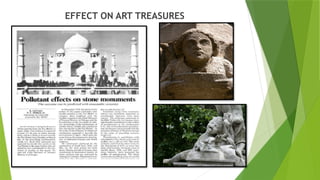
FADING BEAUTY OFTAJ MAHAL
The Taj Mahal a miracle in marble and a historical monument is
facing grave danger from pollution created by existing foundries,
power houses, railway yards and other industrial units.
According to some environmentalists, the problem now seems to have
been aggravated because of the commissioning of the Mathura Oil
Refinery, about 40 km from the priceless monument.
Sulphur dioxide from the various sources mentioned, mixes with the
atmospheric moisture and gets converted into sulphuric acid which
settles down on the exterior of the Taj Mahal. The acid reacts with the
marble (calcium carbonate) and corrosion and discolouration of the
monument is the ultimate result.
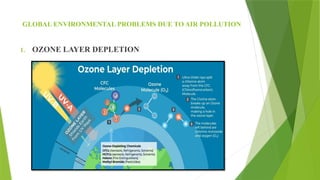
Ozone ispresent in the stratosphere. It is formed from oxygen and
decomposed back to oxygen photo chemically by various
mechanisms.
Depletion begins when CFC’s get into the stratosphere. Ultra
violet radiation from the sun breaks up these CFCs.
The breaking up action releases Chlorine atoms. Chlorine atoms
react with Ozone, starting a chemical cycle that destroys the good
ozone in that area.
The chlorine radicals are continuously regenerated and cause the
breakdown of ozone. Since, by this mechanism, each chlorine free
radical generated can cause the destruction of up to one lakh ozone
molecules, a phenomenal depletion of stratospheric ozone is being
caused by CFCs.
34.
Impacts of ozonelayer depletion
The exposure to ultraviolet-B rays causes skin cancer. It is estimated that a 1%
reduction in ozone may cause as much as 6% increase in skin cancer cases due
to increased exposure to ultraviolet radiation.
Leads to leukaemia and breast cancer.
UV rays absorbed by cornea and lens in the eye leading to photo keratitis and
cataract without the person even knowing about it.
The yields of agricultural crops are reduced .
Decreases chlorophyll content of the leaves of plants leading to a decrease in
photosynthesis and damage to the leaves.
Causes destruction of aquatic organisms as they are not able to withstand the
increased exposure to ultraviolet radiation.
Cause serious climatic changes on earth because the ozone umbrella contributes
to a great extent towards maintaining the thermal balance on earth.
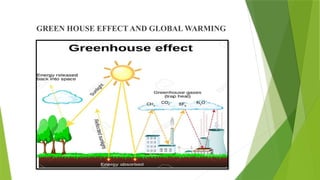
The greenhouseeffect is the progressive warming up of the earth’s
surface and atmosphere due to the blanketing effect of CO, and certain
other gases in the atmosphere.
Greenhouse gases : Carbon dioxide , Methane, Nitrous oxide,
Chlorofluorocarbon, Ozone ,Water vapour
Earth receives energy from sun in the form of UV, visible and near
infrared radiation. About 26% of the incoming energy is reflected to
space by atmosphere.
Most of the remaining energy is absorbed at the surface of the earth and
radiated into atmosphere.
Few gases in atmosphere are active in radiating energy. These gases
radiate energy in all directions.
Part of this radiation is directed towards the earth’s surface and warming
it. This phenomenon is called as greenhouse effect.
37.
GLOBAL WARMING
The increaseof atmospheric temperature near earth’s surface as a
result of greenhouse effect is called as global warming.
The reasons for global warming are:
Increase in the concentration of greenhouse gases in atmosphere.
Rise in population and urbanization
Industrialization
Deforestation
Burning of vegetation and other organic materials
Use of inorganic fertilizers which release nitrous oxide into
atmosphere
38.
Consequences of globalwarming
1. Climatic changes
2. Drop in agricultural production:
3. Sea level rise
4. Destruction of aquatic organisms
5. Refugee problems
39.
ACID RAIN
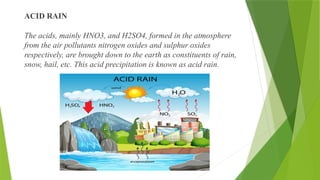
The acids,mainly HNO3, and H2SO4, formed in the atmosphere
from the air pollutants nitrogen oxides and sulphur oxides
respectively, are brought down to the earth as constituents of rain,
snow, hail, etc. This acid precipitation is known as acid rain.
40.
Adverse effects ofacid rain
Acid rain increases the acidity of the soil and thereby causes
serious damage to agricultural crops. Cadmium absorption of
plants increases posing a grave health hazard to plants and
humans.
It damages leaves of trees, reduces their photosynthetic
capability and retard their growth, thereby destroying forests.
Thus, the natural resources for the production of wood pulp,
paper, etc. are decreased.
Acid rain makes the water in tanks, ponds, lakes and rivers so
much acidic that fish and other aquatic life are eliminated in such
regions.
41.
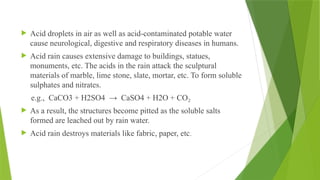
Acid dropletsin air as well as acid-contaminated potable water
cause neurological, digestive and respiratory diseases in humans.
Acid rain causes extensive damage to buildings, statues,
monuments, etc. The acids in the rain attack the sculptural
materials of marble, lime stone, slate, mortar, etc. To form soluble
sulphates and nitrates.
e.g., CaCO3 + H2SO4 → CaSO4 + H2O + CO₂
As a result, the structures become pitted as the soluble salts
formed are leached out by rain water.
Acid rain destroys materials like fabric, paper, etc.
42.
CONTROL OF AIRPOLLUTION
Better automobile engines should be designed to ensure complete
combustion of the fuel so that the toxic pollutants carbon
monoxide and hydrocarbons would not be present in the exhaust
gases.
In order to avoid the presence of volatile lead compounds in
automobile exhaust gases, the use of leaded petrol should be
completely banned. Only the use of unleaded petrol must be
permitted.
Use of gaseous fuels in automobiles would ensure more or less
complete combustion of the fuel and thereby reduce emission of
toxic pollutants like CO and hydrocarbons.
43.
Entry ofnoxious waste products into air from industries and power
plants should be prevented by using proper equipment’s such as
filters, electrostatic precipitators, dust traps, adsorbent columns
containing activated carbon, etc.
The heights of chimneys of factories should be raised for allowing
atmospheric dilution of the effluent gases.
Soluble gaseous pollutants like SO, in industrial effluent gases may
be dissolved away by passing through a device called ‘scrubber’ in
which a fine spray of water is used.
44.
Excessive useof pesticides and chlorofluorocarbons should be
prevented.
The use of asbestos should be totally banned in order to prevent
air pollution by the highly harmful asbestos dust.
Cigarette smoking should be banned in all public places.
Trees, which can serve as natural ‘sinks’ for various pollutants
should be planted on large scale around industrial centres.