EETTHHIICCSS AANNDD 
MMOORRAALL VVAALLUUEESS 
By 
Dr. Rajendra Singh Thakur
Dr. Rajendra Singh Thakur/ 2 Environmental Ethics 
EEtthhiiccss 
TThhee bbooddyy ooff mmoorraall pprriinncciipplleess oorr vvaalluueess ffoolllloowweedd bbyy aann 
iinnddiivviidduuaall.. 
TThheessee aarree yyoouurr AACCTTIIOONNSS!!!! 
EEtthhiiccss aarree aa ssyysstteemm ooff mmoorraall pprriinncciipplleess aanndd aa bbrraanncchh 
ooff pphhiilloossoopphhyy wwhhiicchh ddeeffiinneess wwhhaatt iiss ggoooodd ffoorr 
iinnddiivviidduuaallss aanndd ssoocciieettyy..
Dr. Rajendra Singh Thakur/ 3 Environmental Ethics 
Morals 
““WWhhaatt iiss rriigghhtt vvss.. wwhhaatt iiss wwrroonngg””.. 
Morals are principles and values based on what a 
person or society believes are the right, proper or 
acceptable ways of behaving.
Dr. Rajendra Singh Thakur/ 4 Environmental Ethics 
Values 
““WWoorrtthh iinn iimmppoorrttaannccee ppllaacceedd oonn ssoommeetthhiinngg oorr 
ssoommeeoonnee bbyy aa ppeerrssoonn””.. 
Values of a person or group are the moral principles 
and beliefs that they think are important in life and 
that they tend to live their lives by such values as 
guiding principles.
Three Key Branches of Ethics 
Descriptive ethics involves describing, characterizing and 
studying morality 
 “What is” 
Normative ethics involves supplying and justifying moral 
systems 
 “What should be” 
Applied Ethics about “how” moral outcomes can be achieved 
in specific situations; 
Dr. Rajendra Singh Thakur/ 5 Environmental Ethics
Moral Values. 
Moral values are the standards of good and evil, 
which govern an individual’s behavior and choices. 
Dr. Rajendra Singh Thakur/ 6 Environmental Ethics 
OR 
Values are the criteria for determining good and bad, 
fair and unfair, just and unjust.
Types of “Values”. 
Universal Values: 
It has the same value or worth for all, or 
almost all people. 
Eg, Sanctity of human life, Peace, and human dignity. 
Instrumental Values: 
These are values that can be used to 
get something else. 
Examples of these would include Progress (which allows leisure 
time), Freedom (Through which we can get dignity and/or self 
actualization), and Knowledge (which helps us to get economic 
prosperity, and progress). 
Dr. Rajendra Singh Thakur/ 7 Environmental Ethics
Intrinsic Values: ( opposite to 
instrumental value) 
Something has intrinsic worth simply 
because of what it is, and not necessarily what it will lead to. 
For example ,beauty, artistic expression and happiness. We value them 
because they are an important aspect of life. 
Prerequisite Values: 
These are values that are necessary before you 
can get to some bigger goal. 
Examples of this type of value include safety (which is needed before 
people can even think about having anything else), Justice (which is 
needed before we can move onto equality), or the common good 
(which must be honored if we can ever get to a state of peace). 
Dr. Rajendra Singh Thakur/ 8 Environmental Ethics
Paramount Values: 
It is the value which is above all other 
things. 
For example, freedom (which many people have given up their 
lives for and see as essential to a decent life). 
Operative Values: 
These types of values are the ways that 
we make judgments on how to live the rest of our lives. We use 
these values as the overarching and guiding principles which tell 
us what is always right and wrong. 
For example, Integrity, Honesty, and Loyalty. 
Dr. Rajendra Singh Thakur/ 9 Environmental Ethics
Other many sources of 
Values. 
The Individual 
Conscience 
Dr. Rajendra Singh Thakur/ 10 Environmental Ethics 
Fellow Workers 
Family 
Friends 
The Law 
Regions of 
Country 
Profession 
Employer 
Society at Large 
Fellow Workers 
Religious 
Beliefs
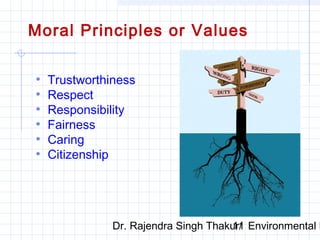
Moral Principles or Values 
• Trustworthiness 
• Respect 
• Responsibility 
• Fairness 
• Caring 
• Citizenship 
Dr. Rajendra Singh Thakur/ 11 Environmental Ethics
Moral Principles or Values 
Trustworthiness 
 Work with little supervision, yet seek 
guidance as needed. 
 Be honest, reliable, and ethical in all 
dealings. 
 Refuse to steal, misuse or abuse company 
time, property or equipment. 
 Refuse to lie, cheat, deceive, manipulate, 
exploit or take advantage of others. 
Dr. Rajendra Singh Thakur/ 12 Environmental Ethics
Moral Principles or Values 
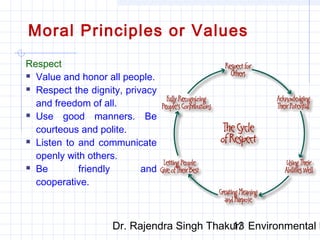
Respect 
 Value and honor all people. 
 Respect the dignity, privacy 
and freedom of all. 
 Use good manners. Be 
courteous and polite. 
 Listen to and communicate 
openly with others. 
 Be friendly and 
cooperative. 
Dr. Rajendra Singh Thakur/ 13 Environmental Ethics
Moral Principles or Values 
Dr. Rajendra Singh Thakur/ 14 Environmental Ethics 
Responsibility 
 Show initiative. Pay attention to detail. Pursue 
excellence. 
 Be loyal. 
 Strive to improve abilities, learn new skills and 
take on broader responsibilities. 
 Be accountable. Fulfill commitments, persevere 
and get the job done.
Moral Principles or Values 
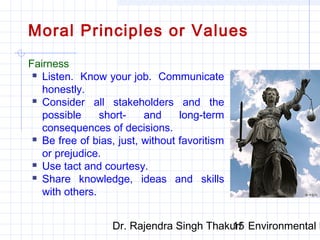
Fairness 
 Listen. Know your job. Communicate 
honestly. 
 Consider all stakeholders and the 
possible short- and long-term 
consequences of decisions. 
 Be free of bias, just, without favoritism 
or prejudice. 
 Use tact and courtesy. 
 Share knowledge, ideas and skills 
with others. 
Dr. Rajendra Singh Thakur/ 15 Environmental Ethics
Moral Principles or Values 
Dr. Rajendra Singh Thakur/ 16 Environmental Ethics 
Caring 
 Strive for harmonious, mutually beneficial 
relationships. 
 Show kindness and sensitivity to the feelings of 
others. 
 Express gratitude. 
 Show personal concern for others. 
 Take time to help others. 
 Be kind. Be kind. Be kind.
Moral Principles or Values 
Dr. Rajendra Singh Thakur/ 17 Environmental Ethics 
Citizenship 
 Understand and contribute to the 
organization. 
 Take care of equipment and 
resources. 
 Pursue life-long learning. 
 Volunteer without expectation of 
recognition or reward. 
 Be a role model and mentor to 
new employees.
Character is like a tree and reputation like its 
shadow. The shadow is what we think of it; the tree is 
the real thing. 
Abraham Lincoln 
Dr. Rajendra Singh Thakur/ 18 Environmental Ethics
What is Character? 
WRITE IT DOWN!!! 
The inherent complex of attributes 
that determine a persons moral and 
ethical actions and reactions. 
Dr. Rajendra Singh Thakur/ 19 Environmental Ethics
What are Characteristics of Character? 
WRITE IT DOWN!!! 
Trustworthiness Respect 
Inspiring 
Integrity Confident 
Dr. Rajendra Singh Thakur/ 20 Environmental Ethics 
Honesty 
Competent 
Courageous 
Tact 
Fairness 
Loyal 
Unselfish 
Responsibility 
Citizenship 
Caring
Why is Character Important? 
Warren Bennis says, “that after vision and 
passion, INTEGRITY (character) is the most 
basic fundamental competency to be a 
leader.” 
He further points out that Integrity is the 
basis of TRUST. 
Dr. Rajendra Singh Thakur/ 21 Environmental Ethics
Who Cares About Character? 
• The Age of Accountability 
• The Importance of Family Values 
PEOPLE ARE ALWAYS 
WATCHING!!! 
Dr. Rajendra Singh Thakur/ 22 Environmental Ethics
Impacting Moral & Character 
Development 
Four major questions need to be addressed 
when focusing on character development: 
1. What is good character? 
2. What causes or prevents good character? 
3. How can good character be measured ? 
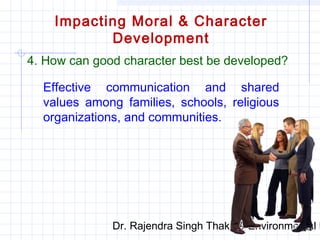
4. How can good character best be developed? 
Dr. Rajendra Singh Thakur/ 23 Environmental Ethics
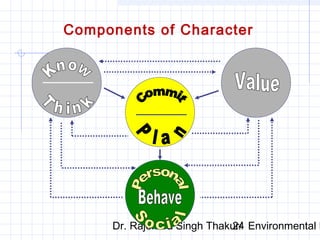
Components of Character 
Dr. Rajendra Singh Thakur/ 24 Environmental Ethics
Impacting Moral & Character 
Development 
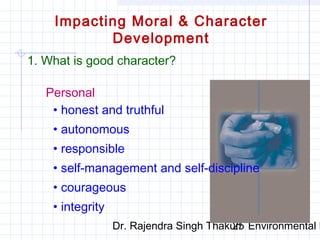
1. What is good character? 
Personal 
• honest and truthful 
• autonomous 
• responsible 
• self-management and self-discipline 
• courageous 
• integrity 
Dr. Rajendra Singh Thakur/ 25 Environmental Ethics
Impacting Moral & Character 
Development 
1. What is good character? 
Dr. Rajendra Singh Thakur/ 26 Environmental Ethics 
Social 
• sociable 
• benevolent 
• compassionate 
• courteous 
• trustworthy
Impacting Moral & Character 
Development 
2. What causes or prevents good character? 
1. heredity 
2. early childhood experience 
3. modeling by important adults & older youth 
4. peer influence 
5. general physical and social environment 
6. communications media 
7. content taught in the schools, etc. 
8. specific situations and roles 
Dr. Rajendra Singh Thakur/ 27 Environmental Ethics
Impacting Moral & Character 
Development 
3. How can good character be measured ? 
• Cognitive knowledge 
• Age appropriate cognitive and moral 
development. 
• Values expressed 
• Commitments expressed 
• Written plans 
• Personal and social overt behavior 
Dr. Rajendra Singh Thakur/ 28 Environmental Ethics
Impacting Moral & Character 
Development 
4. How can good character best be developed? 
Effective communication and shared 
values among families, schools, religious 
organizations, and communities. 
Dr. Rajendra Singh Thakur/ 29 Environmental Ethics
Personal experience - Moral Values 
 I have learnt through this assignment how to 
behave in a society with morals, values and 
principles. 
 I learnt to be honest, reliable, and ethical in all 
dealings pertaining to my job and career. 
 I learnt how to respect, honour and value the 
people. 
Dr. Rajendra Singh Thakur/ 30 Environmental Ethics
Personal experience - Moral Values 
 I learnt how to strive to improve abilities, learn 
new skills and take on broader responsibilities. 
 I learnt how to share knowledge, ideas and 
skills with others. 
 I learnt to show kindness and sensitivity to the 
feelings of others. 
Dr. Rajendra Singh Thakur/ 31 Environmental Ethics
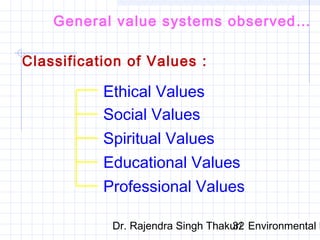
General value systems observed… 
Classification of Values : 
Ethical Values 
Social Values 
Spiritual Values 
Educational Values 
Professional Values 
Dr. Rajendra Singh Thakur/ 32 Environmental Ethics
Ethical Values / Moral Values : 
Concept - Right / Wrong 
Good / Bad 
Virtue / Vice 
Influence the activities of Human being 
Dr. Rajendra Singh Thakur/ 33 Environmental Ethics
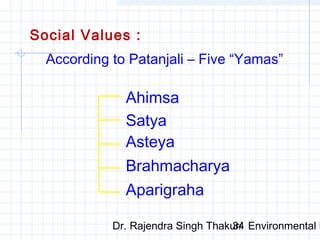
Social Values : 
According to Patanjali – Five “Yamas” 
Ahimsa 
Satya 
Asteya 
Brahmacharya 
Aparigraha 
Dr. Rajendra Singh Thakur/ 34 Environmental Ethics
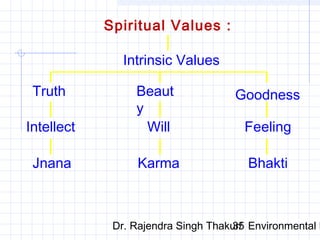
Spiritual Values : 
Intrinsic Values 
Truth Beaut 
y 
Goodness 
Intellect Will Feeling 
Jnana Karma Bhakti 
Dr. Rajendra Singh Thakur/ 35 Environmental Ethics
Educational 
Values : 
According to Vivekananda – Man making Education 
Dr. Rajendra Singh Thakur/ 36 Environmental Ethics 
Physica 
l 
Psychological Social Moral
Man making 
Education 
Samveg Samskara 
s 
Swabhav 
a 
Emotions Formed habits behaviour 
Righteous conduct 
Dr. Rajendra Singh Thakur/ 37 Environmental Ethics 
Right emotions 
Noble associations
Learning domains according to Psychology 
Cognitive – Affective - Psychomotor 
Receiving 
Responding 
Valuing 
Organization 
Characterization 
Dr. Rajendra Singh Thakur/ 38 Environmental Ethics
Dr. Rajendra Singh Thakur/ 39 Environmental Ethics 
Valuing :- 
Commitment to certain goal 
Commitment to certain Idea 
Commitment to certain belief
Organisation :- 
Value system and behaviour 
Characterization : 
- 
By value / value complex 
Dr. Rajendra Singh Thakur/ 40 Environmental Ethics
Educational Values : 
Good 
Useful 
Valuable 
Dr. Rajendra Singh Thakur/ 41 Environmental Ethics 
Activities - 
- in Education
SCOPE OF VALUE BASED 
EDUCATION 
INCULCATING SOCIALLY 
RESPONSIBLE BEHAVIOR 
CREATINGVALUE 
BASED QUALITY PROMOTING ETHICAL 
BEHAVIOR 
VALUE BASED 
EDUCATION 
DEFINING INSTITUTIONAL 
IDEOLOGY 
Dr. Rajendra Singh Thakur/ 42 Environmental Ethics
DIMENSIONS OF 
DEVELOPMENT 
VALUES 
1.Physical Discipline 
Healthy living 
Dignity of labor 
Punctuality 
2. Intellectual Truth 
Scientific temper 
Rational outlook 
Quest for knowledge 
Dr. Rajendra Singh Thakur/ 43 Environmental Ethics
Dr. Rajendra Singh Thakur/ 44 Environmental Ethics 
3. Moral/Ethical 
Resistance to temptation 
Righteousness 
Sense of responsibility 
Self control 
Non-violence 
4. Spiritual Purity, Tolerance 
Faith , Freedom 
5. Social 
Co-operation 
Mutual respect 
Sharing, Concern 
DIMENSIONS OF 
DEVELOPMENT 
VALUES
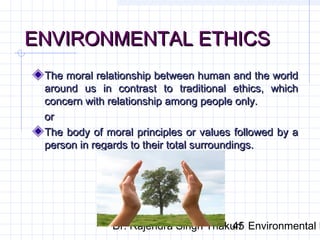
EENNVVIIRROONNMMEENNTTAALL EETTHHIICCSS 
TThhee mmoorraall rreellaattiioonnsshhiipp bbeettwweeeenn hhuummaann aanndd tthhee wwoorrlldd 
aarroouunndd uuss iinn ccoonnttrraasstt ttoo ttrraaddiittiioonnaall eetthhiiccss,, wwhhiicchh 
ccoonncceerrnn wwiitthh rreellaattiioonnsshhiipp aammoonngg ppeeooppllee oonnllyy.. 
oorr 
TThhee bbooddyy ooff mmoorraall pprriinncciipplleess oorr vvaalluueess ffoolllloowweedd bbyy aa 
ppeerrssoonn iinn rreeggaarrddss ttoo tthheeiirr ttoottaall ssuurrrroouunnddiinnggss.. 
Dr. Rajendra Singh Thakur/ 45 Environmental Ethics
The needs of Environmental Ethics has 
arisen as results of the following three 
factors- 
1. New effects on nature 
2. New knowledge about nature 
3. Expending moral concern 
Dr. Rajendra Singh Thakur/ 46 Environmental Ethics
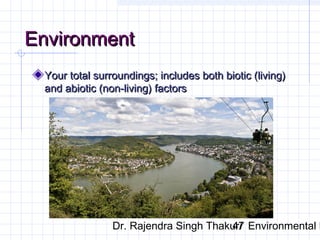
EEnnvviirroonnmmeenntt 
YYoouurr ttoottaall ssuurrrroouunnddiinnggss;; iinncclluuddeess bbootthh bbiioottiicc ((lliivviinngg)) 
aanndd aabbiioottiicc ((nnoonn--lliivviinngg)) ffaaccttoorrss 
Dr. Rajendra Singh Thakur/ 47 Environmental Ethics
EEccoollooggyy 
TThhee ssttuuddyy ooff oorrggaanniissmmss aanndd tthheeiirr 
iinntteerrrreellaattiioonnsshhiippss wwiitthh tthheeiirr eennvviirroonnmmeenntt 
Dr. Rajendra Singh Thakur/ 48 Environmental Ethics
SSuussttaaiinnaabbllee EEnnvviirroonnmmeenntt 
AAnn eennvviirroonnmmeenntt iinn wwhhiicchh tthhee eesssseennttiiaall qquuaalliittiieess ooff lliiffee 
aarree nneeiitthheerr lleesssseenneedd nnoorr ddeepplleetteedd.. 
EEsssseennttiiaall qquuaalliittiieess ooff lliiffee:: 
 OOxxyyggeenn,, ffoooodd,, wwaatteerr,, nnuuttrriieennttss,, wwaarrmmtthh,, sshheelltteerr,, 
Dr. Rajendra Singh Thakur/ 49 Environmental Ethics
UUnnssuussttaaiinnaabbllee EEnnvviirroonnmmeenntt 
AAnn eennvviirroonnmmeenntt iinn wwhhiicchh tthhee eesssseennttiiaall qquuaalliittiieess ooff lliiffee 
aarree lleesssseenneedd oorr ddeepplleetteedd.. 
Dr. Rajendra Singh Thakur/ 50 Environmental Ethics
EEccoossyysstteemm 
AAnn aarreeaa wwiitthh aa bboouunnddaarryy ccoommppoosseedd ooff bbiioottiicc ((lliivviinngg)) 
aanndd aabbiioottiicc ((nnoonnlliivviinngg)) ccoommppoonneennttss,, wwhhiicchh iinntteerraacctt 
wwiitthh oonnee aannootthheerr.. 
Dr. Rajendra Singh Thakur/ 51 Environmental Ethics
EEccoollooggiiccaall FFoooottpprriinntt 
AA mmeeaassuurree ooff hhooww mmuucchh llaanndd aanndd wwaatteerr aann iinnddiivviidduuaall,, 
ppooppuullaattiioonn oorr aaccttiivviittyy rreeqquuiirreess ttoo pprroodduuccee aallll tthhee 
rreessoouurrcceess iitt ccoonnssuummeess aanndd ttoo aabbssoorrbb tthhee wwaassttee iitt 
ggeenneerraatteess.. 
• ((aakkaa hhooww mmuucchh hhuummaannss 
iimmppaacctt aann eeccoossyysstteemm bbyy tthheeiirr 
uussee ooff llaanndd,, wwaatteerr aanndd ootthheerr 
nnaattuurraall rreessoouurrcceess)) 
Dr. Rajendra Singh Thakur/ 52 Environmental Ethics
Thank you all... 
Dr. Rajendra Singh Thakur/ 53 Environmental Ethics

Ethics and Moral Value

  • 1.
    EETTHHIICCSS AANNDD MMOORRAALLVVAALLUUEESS By Dr. Rajendra Singh Thakur
  • 2.
    Dr. Rajendra SinghThakur/ 2 Environmental Ethics EEtthhiiccss TThhee bbooddyy ooff mmoorraall pprriinncciipplleess oorr vvaalluueess ffoolllloowweedd bbyy aann iinnddiivviidduuaall.. TThheessee aarree yyoouurr AACCTTIIOONNSS!!!! EEtthhiiccss aarree aa ssyysstteemm ooff mmoorraall pprriinncciipplleess aanndd aa bbrraanncchh ooff pphhiilloossoopphhyy wwhhiicchh ddeeffiinneess wwhhaatt iiss ggoooodd ffoorr iinnddiivviidduuaallss aanndd ssoocciieettyy..
  • 3.
    Dr. Rajendra SinghThakur/ 3 Environmental Ethics Morals ““WWhhaatt iiss rriigghhtt vvss.. wwhhaatt iiss wwrroonngg””.. Morals are principles and values based on what a person or society believes are the right, proper or acceptable ways of behaving.
  • 4.
    Dr. Rajendra SinghThakur/ 4 Environmental Ethics Values ““WWoorrtthh iinn iimmppoorrttaannccee ppllaacceedd oonn ssoommeetthhiinngg oorr ssoommeeoonnee bbyy aa ppeerrssoonn””.. Values of a person or group are the moral principles and beliefs that they think are important in life and that they tend to live their lives by such values as guiding principles.
  • 5.
    Three Key Branchesof Ethics Descriptive ethics involves describing, characterizing and studying morality  “What is” Normative ethics involves supplying and justifying moral systems  “What should be” Applied Ethics about “how” moral outcomes can be achieved in specific situations; Dr. Rajendra Singh Thakur/ 5 Environmental Ethics
  • 6.
    Moral Values. Moralvalues are the standards of good and evil, which govern an individual’s behavior and choices. Dr. Rajendra Singh Thakur/ 6 Environmental Ethics OR Values are the criteria for determining good and bad, fair and unfair, just and unjust.
  • 7.
    Types of “Values”. Universal Values: It has the same value or worth for all, or almost all people. Eg, Sanctity of human life, Peace, and human dignity. Instrumental Values: These are values that can be used to get something else. Examples of these would include Progress (which allows leisure time), Freedom (Through which we can get dignity and/or self actualization), and Knowledge (which helps us to get economic prosperity, and progress). Dr. Rajendra Singh Thakur/ 7 Environmental Ethics
  • 8.
    Intrinsic Values: (opposite to instrumental value) Something has intrinsic worth simply because of what it is, and not necessarily what it will lead to. For example ,beauty, artistic expression and happiness. We value them because they are an important aspect of life. Prerequisite Values: These are values that are necessary before you can get to some bigger goal. Examples of this type of value include safety (which is needed before people can even think about having anything else), Justice (which is needed before we can move onto equality), or the common good (which must be honored if we can ever get to a state of peace). Dr. Rajendra Singh Thakur/ 8 Environmental Ethics
  • 9.
    Paramount Values: Itis the value which is above all other things. For example, freedom (which many people have given up their lives for and see as essential to a decent life). Operative Values: These types of values are the ways that we make judgments on how to live the rest of our lives. We use these values as the overarching and guiding principles which tell us what is always right and wrong. For example, Integrity, Honesty, and Loyalty. Dr. Rajendra Singh Thakur/ 9 Environmental Ethics
  • 10.
    Other many sourcesof Values. The Individual Conscience Dr. Rajendra Singh Thakur/ 10 Environmental Ethics Fellow Workers Family Friends The Law Regions of Country Profession Employer Society at Large Fellow Workers Religious Beliefs
  • 11.
    Moral Principles orValues • Trustworthiness • Respect • Responsibility • Fairness • Caring • Citizenship Dr. Rajendra Singh Thakur/ 11 Environmental Ethics
  • 12.
    Moral Principles orValues Trustworthiness  Work with little supervision, yet seek guidance as needed.  Be honest, reliable, and ethical in all dealings.  Refuse to steal, misuse or abuse company time, property or equipment.  Refuse to lie, cheat, deceive, manipulate, exploit or take advantage of others. Dr. Rajendra Singh Thakur/ 12 Environmental Ethics
  • 13.
    Moral Principles orValues Respect  Value and honor all people.  Respect the dignity, privacy and freedom of all.  Use good manners. Be courteous and polite.  Listen to and communicate openly with others.  Be friendly and cooperative. Dr. Rajendra Singh Thakur/ 13 Environmental Ethics
  • 14.
    Moral Principles orValues Dr. Rajendra Singh Thakur/ 14 Environmental Ethics Responsibility  Show initiative. Pay attention to detail. Pursue excellence.  Be loyal.  Strive to improve abilities, learn new skills and take on broader responsibilities.  Be accountable. Fulfill commitments, persevere and get the job done.
  • 15.
    Moral Principles orValues Fairness  Listen. Know your job. Communicate honestly.  Consider all stakeholders and the possible short- and long-term consequences of decisions.  Be free of bias, just, without favoritism or prejudice.  Use tact and courtesy.  Share knowledge, ideas and skills with others. Dr. Rajendra Singh Thakur/ 15 Environmental Ethics
  • 16.
    Moral Principles orValues Dr. Rajendra Singh Thakur/ 16 Environmental Ethics Caring  Strive for harmonious, mutually beneficial relationships.  Show kindness and sensitivity to the feelings of others.  Express gratitude.  Show personal concern for others.  Take time to help others.  Be kind. Be kind. Be kind.
  • 17.
    Moral Principles orValues Dr. Rajendra Singh Thakur/ 17 Environmental Ethics Citizenship  Understand and contribute to the organization.  Take care of equipment and resources.  Pursue life-long learning.  Volunteer without expectation of recognition or reward.  Be a role model and mentor to new employees.
  • 18.
    Character is likea tree and reputation like its shadow. The shadow is what we think of it; the tree is the real thing. Abraham Lincoln Dr. Rajendra Singh Thakur/ 18 Environmental Ethics
  • 19.
    What is Character? WRITE IT DOWN!!! The inherent complex of attributes that determine a persons moral and ethical actions and reactions. Dr. Rajendra Singh Thakur/ 19 Environmental Ethics
  • 20.
    What are Characteristicsof Character? WRITE IT DOWN!!! Trustworthiness Respect Inspiring Integrity Confident Dr. Rajendra Singh Thakur/ 20 Environmental Ethics Honesty Competent Courageous Tact Fairness Loyal Unselfish Responsibility Citizenship Caring
  • 21.
    Why is CharacterImportant? Warren Bennis says, “that after vision and passion, INTEGRITY (character) is the most basic fundamental competency to be a leader.” He further points out that Integrity is the basis of TRUST. Dr. Rajendra Singh Thakur/ 21 Environmental Ethics
  • 22.
    Who Cares AboutCharacter? • The Age of Accountability • The Importance of Family Values PEOPLE ARE ALWAYS WATCHING!!! Dr. Rajendra Singh Thakur/ 22 Environmental Ethics
  • 23.
    Impacting Moral &Character Development Four major questions need to be addressed when focusing on character development: 1. What is good character? 2. What causes or prevents good character? 3. How can good character be measured ? 4. How can good character best be developed? Dr. Rajendra Singh Thakur/ 23 Environmental Ethics
  • 24.
    Components of Character Dr. Rajendra Singh Thakur/ 24 Environmental Ethics
  • 25.
    Impacting Moral &Character Development 1. What is good character? Personal • honest and truthful • autonomous • responsible • self-management and self-discipline • courageous • integrity Dr. Rajendra Singh Thakur/ 25 Environmental Ethics
  • 26.
    Impacting Moral &Character Development 1. What is good character? Dr. Rajendra Singh Thakur/ 26 Environmental Ethics Social • sociable • benevolent • compassionate • courteous • trustworthy
  • 27.
    Impacting Moral &Character Development 2. What causes or prevents good character? 1. heredity 2. early childhood experience 3. modeling by important adults & older youth 4. peer influence 5. general physical and social environment 6. communications media 7. content taught in the schools, etc. 8. specific situations and roles Dr. Rajendra Singh Thakur/ 27 Environmental Ethics
  • 28.
    Impacting Moral &Character Development 3. How can good character be measured ? • Cognitive knowledge • Age appropriate cognitive and moral development. • Values expressed • Commitments expressed • Written plans • Personal and social overt behavior Dr. Rajendra Singh Thakur/ 28 Environmental Ethics
  • 29.
    Impacting Moral &Character Development 4. How can good character best be developed? Effective communication and shared values among families, schools, religious organizations, and communities. Dr. Rajendra Singh Thakur/ 29 Environmental Ethics
  • 30.
    Personal experience -Moral Values  I have learnt through this assignment how to behave in a society with morals, values and principles.  I learnt to be honest, reliable, and ethical in all dealings pertaining to my job and career.  I learnt how to respect, honour and value the people. Dr. Rajendra Singh Thakur/ 30 Environmental Ethics
  • 31.
    Personal experience -Moral Values  I learnt how to strive to improve abilities, learn new skills and take on broader responsibilities.  I learnt how to share knowledge, ideas and skills with others.  I learnt to show kindness and sensitivity to the feelings of others. Dr. Rajendra Singh Thakur/ 31 Environmental Ethics
  • 32.
    General value systemsobserved… Classification of Values : Ethical Values Social Values Spiritual Values Educational Values Professional Values Dr. Rajendra Singh Thakur/ 32 Environmental Ethics
  • 33.
    Ethical Values /Moral Values : Concept - Right / Wrong Good / Bad Virtue / Vice Influence the activities of Human being Dr. Rajendra Singh Thakur/ 33 Environmental Ethics
  • 34.
    Social Values : According to Patanjali – Five “Yamas” Ahimsa Satya Asteya Brahmacharya Aparigraha Dr. Rajendra Singh Thakur/ 34 Environmental Ethics
  • 35.
    Spiritual Values : Intrinsic Values Truth Beaut y Goodness Intellect Will Feeling Jnana Karma Bhakti Dr. Rajendra Singh Thakur/ 35 Environmental Ethics
  • 36.
    Educational Values : According to Vivekananda – Man making Education Dr. Rajendra Singh Thakur/ 36 Environmental Ethics Physica l Psychological Social Moral
  • 37.
    Man making Education Samveg Samskara s Swabhav a Emotions Formed habits behaviour Righteous conduct Dr. Rajendra Singh Thakur/ 37 Environmental Ethics Right emotions Noble associations
  • 38.
    Learning domains accordingto Psychology Cognitive – Affective - Psychomotor Receiving Responding Valuing Organization Characterization Dr. Rajendra Singh Thakur/ 38 Environmental Ethics
  • 39.
    Dr. Rajendra SinghThakur/ 39 Environmental Ethics Valuing :- Commitment to certain goal Commitment to certain Idea Commitment to certain belief
  • 40.
    Organisation :- Valuesystem and behaviour Characterization : - By value / value complex Dr. Rajendra Singh Thakur/ 40 Environmental Ethics
  • 41.
    Educational Values : Good Useful Valuable Dr. Rajendra Singh Thakur/ 41 Environmental Ethics Activities - - in Education
  • 42.
    SCOPE OF VALUEBASED EDUCATION INCULCATING SOCIALLY RESPONSIBLE BEHAVIOR CREATINGVALUE BASED QUALITY PROMOTING ETHICAL BEHAVIOR VALUE BASED EDUCATION DEFINING INSTITUTIONAL IDEOLOGY Dr. Rajendra Singh Thakur/ 42 Environmental Ethics
  • 43.
    DIMENSIONS OF DEVELOPMENT VALUES 1.Physical Discipline Healthy living Dignity of labor Punctuality 2. Intellectual Truth Scientific temper Rational outlook Quest for knowledge Dr. Rajendra Singh Thakur/ 43 Environmental Ethics
  • 44.
    Dr. Rajendra SinghThakur/ 44 Environmental Ethics 3. Moral/Ethical Resistance to temptation Righteousness Sense of responsibility Self control Non-violence 4. Spiritual Purity, Tolerance Faith , Freedom 5. Social Co-operation Mutual respect Sharing, Concern DIMENSIONS OF DEVELOPMENT VALUES
  • 45.
    EENNVVIIRROONNMMEENNTTAALL EETTHHIICCSS TThheemmoorraall rreellaattiioonnsshhiipp bbeettwweeeenn hhuummaann aanndd tthhee wwoorrlldd aarroouunndd uuss iinn ccoonnttrraasstt ttoo ttrraaddiittiioonnaall eetthhiiccss,, wwhhiicchh ccoonncceerrnn wwiitthh rreellaattiioonnsshhiipp aammoonngg ppeeooppllee oonnllyy.. oorr TThhee bbooddyy ooff mmoorraall pprriinncciipplleess oorr vvaalluueess ffoolllloowweedd bbyy aa ppeerrssoonn iinn rreeggaarrddss ttoo tthheeiirr ttoottaall ssuurrrroouunnddiinnggss.. Dr. Rajendra Singh Thakur/ 45 Environmental Ethics
  • 46.
    The needs ofEnvironmental Ethics has arisen as results of the following three factors- 1. New effects on nature 2. New knowledge about nature 3. Expending moral concern Dr. Rajendra Singh Thakur/ 46 Environmental Ethics
  • 47.
    EEnnvviirroonnmmeenntt YYoouurr ttoottaallssuurrrroouunnddiinnggss;; iinncclluuddeess bbootthh bbiioottiicc ((lliivviinngg)) aanndd aabbiioottiicc ((nnoonn--lliivviinngg)) ffaaccttoorrss Dr. Rajendra Singh Thakur/ 47 Environmental Ethics
  • 48.
    EEccoollooggyy TThhee ssttuuddyyooff oorrggaanniissmmss aanndd tthheeiirr iinntteerrrreellaattiioonnsshhiippss wwiitthh tthheeiirr eennvviirroonnmmeenntt Dr. Rajendra Singh Thakur/ 48 Environmental Ethics
  • 49.
    SSuussttaaiinnaabbllee EEnnvviirroonnmmeenntt AAnneennvviirroonnmmeenntt iinn wwhhiicchh tthhee eesssseennttiiaall qquuaalliittiieess ooff lliiffee aarree nneeiitthheerr lleesssseenneedd nnoorr ddeepplleetteedd.. EEsssseennttiiaall qquuaalliittiieess ooff lliiffee::  OOxxyyggeenn,, ffoooodd,, wwaatteerr,, nnuuttrriieennttss,, wwaarrmmtthh,, sshheelltteerr,, Dr. Rajendra Singh Thakur/ 49 Environmental Ethics
  • 50.
    UUnnssuussttaaiinnaabbllee EEnnvviirroonnmmeenntt AAnneennvviirroonnmmeenntt iinn wwhhiicchh tthhee eesssseennttiiaall qquuaalliittiieess ooff lliiffee aarree lleesssseenneedd oorr ddeepplleetteedd.. Dr. Rajendra Singh Thakur/ 50 Environmental Ethics
  • 51.
    EEccoossyysstteemm AAnn aarreeaawwiitthh aa bboouunnddaarryy ccoommppoosseedd ooff bbiioottiicc ((lliivviinngg)) aanndd aabbiioottiicc ((nnoonnlliivviinngg)) ccoommppoonneennttss,, wwhhiicchh iinntteerraacctt wwiitthh oonnee aannootthheerr.. Dr. Rajendra Singh Thakur/ 51 Environmental Ethics
  • 52.
    EEccoollooggiiccaall FFoooottpprriinntt AAmmeeaassuurree ooff hhooww mmuucchh llaanndd aanndd wwaatteerr aann iinnddiivviidduuaall,, ppooppuullaattiioonn oorr aaccttiivviittyy rreeqquuiirreess ttoo pprroodduuccee aallll tthhee rreessoouurrcceess iitt ccoonnssuummeess aanndd ttoo aabbssoorrbb tthhee wwaassttee iitt ggeenneerraatteess.. • ((aakkaa hhooww mmuucchh hhuummaannss iimmppaacctt aann eeccoossyysstteemm bbyy tthheeiirr uussee ooff llaanndd,, wwaatteerr aanndd ootthheerr nnaattuurraall rreessoouurrcceess)) Dr. Rajendra Singh Thakur/ 52 Environmental Ethics
  • 53.
    Thank you all... Dr. Rajendra Singh Thakur/ 53 Environmental Ethics

Editor's Notes

  • #13 We must prove ourselves to be trustworthy