AIR POLLUTION
Overview
• Atmosphere as a Resource
• Types and Sources of Air Pollution
• Major Classes of Air Pollutants
• Sources of Outdoor Air Pollutants
• Urban Air Pollution
• Effects of Air Pollution
• Controlling Air Pollution
Atmosphere as a Resource
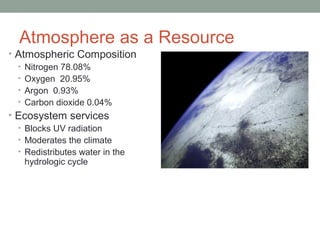
• Atmospheric Composition
• Nitrogen 78.08%
• Oxygen 20.95%
• Argon 0.93%
• Carbon dioxide 0.04%
• Ecosystem services
• Blocks UV radiation
• Moderates the climate
• Redistributes water in the
hydrologic cycle
Types and Sources of Air Pollution
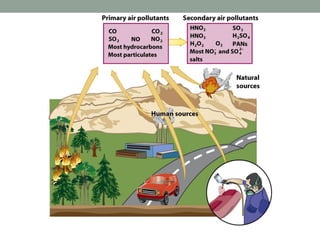
• Air Pollution
• Chemicals added to the atmosphere by natural events or human
activities in high enough concentrations to be harmful
• Two categories
• Primary Air Pollutant
• Harmful substance that is emitted directly into the atmosphere
• Secondary Air Pollutant
• Harmful substance formed in the atmosphere when a primary air
pollutant reacts with substances normally found in the atmosphere or
with other air pollutants
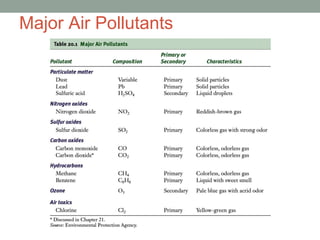
Major Air Pollutants
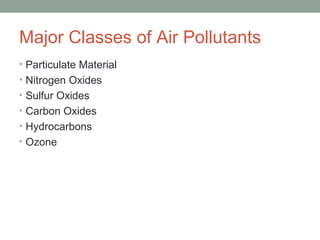
Major Classes of Air Pollutants
• Particulate Material
• Nitrogen Oxides
• Sulfur Oxides
• Carbon Oxides
• Hydrocarbons
• Ozone
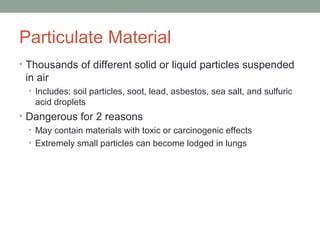
Particulate Material
• Thousands of different solid or liquid particles suspended
in air
• Includes: soil particles, soot, lead, asbestos, sea salt, and sulfuric
acid droplets
• Dangerous for 2 reasons
• May contain materials with toxic or carcinogenic effects
• Extremely small particles can become lodged in lungs
Nitrogen and Sulfur Oxides
• Nitrogen Oxides
• Gases produced by the chemical interactions between atmospheric
nitrogen and oxygen at high temperature
• Problems
• Greenhouse gases
• Cause difficulty breathing
• Sulfur Oxides
• Gases produced by the chemical interactions between sulfur and
oxygen
• Causes acid precipitation
Carbon Oxides and Hydrocarbons
• Carbon Oxides
• Gases carbon monoxide (CO) and carbon dioxide (CO2)
• Greenhouse gases
• Hydrocarbons
• Diverse group of organic compounds that contain only hydrogen
and carbon (ex: CH4- methane)
• Some are related to photochemical smog and greenhouse gases
Ozone
• Tropospheric Ozone
• Man- made pollutant in the lower atmosphere
• Secondary air pollutant
• Component of photochemical smog
• Stratospheric Ozone
• Essential component that screens out UV radiation in the upper
atmosphere
• Man- made pollutants (ex: CFCs) can destroy it
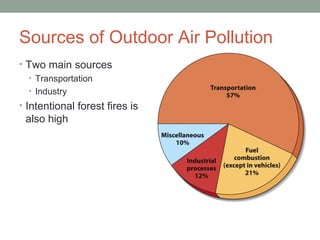
Sources of Outdoor Air Pollution
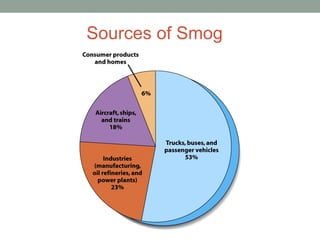
• Two main sources
• Transportation
• Industry
• Intentional forest fires is
also high
Urban Air Pollution
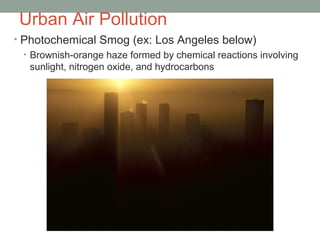
• Photochemical Smog (ex: Los Angeles below)
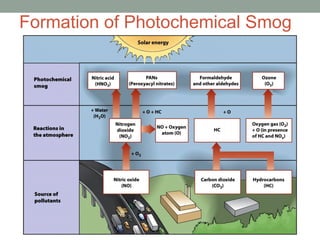
• Brownish-orange haze formed by chemical reactions involving
sunlight, nitrogen oxide, and hydrocarbons
Formation of Photochemical Smog
Sources of Smog
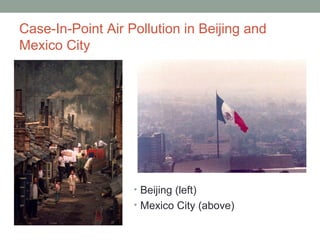
Case-In-Point Air Pollution in Beijing and
Mexico City
• Beijing (left)
• Mexico City (above)
Effects of Air Pollution
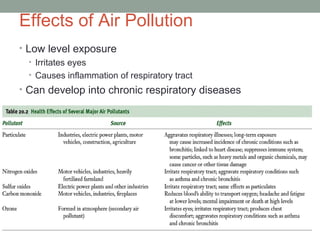
• Low level exposure
• Irritates eyes
• Causes inflammation of respiratory tract
• Can develop into chronic respiratory diseases
Health Effects of Air Pollution
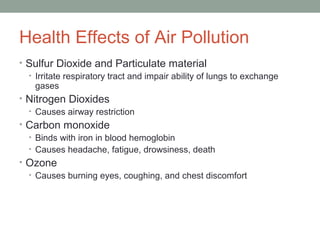
• Sulfur Dioxide and Particulate material
• Irritate respiratory tract and impair ability of lungs to exchange
gases
• Nitrogen Dioxides
• Causes airway restriction
• Carbon monoxide
• Binds with iron in blood hemoglobin
• Causes headache, fatigue, drowsiness, death
• Ozone
• Causes burning eyes, coughing, and chest discomfort
Children and Air Pollution
• Greater health threat to children than adults
• Air pollution can restrict lung development
• Children breath more often than adults
• Children who live in high ozone areas are more likely to
develop asthma
Controlling Air Pollution
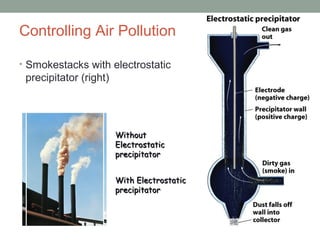
• Smokestacks with electrostatic
precipitator (right)
WithoutWithout
ElectrostaticElectrostatic
precipitatorprecipitator
With ElectrostaticWith Electrostatic
precipitatorprecipitator
Controlling Air Pollution
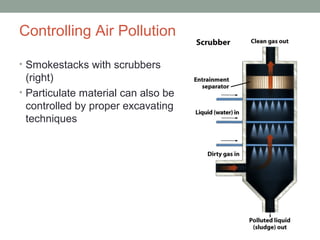
• Smokestacks with scrubbers
(right)
• Particulate material can also be
controlled by proper excavating
techniques
The Clean Air Act
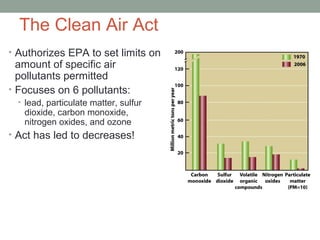
• Authorizes EPA to set limits on
amount of specific air
pollutants permitted
• Focuses on 6 pollutants:
• lead, particulate matter, sulfur
dioxide, carbon monoxide,
nitrogen oxides, and ozone
• Act has led to decreases!
Other Ways to Improve Air Quality
• Reduce sulfur content in gasoline from its current average
of 330 ppm to 30 ppm
• Sulfur clogs catalytic converters
• Set emission standards for all passenger vehicles
• Including SUVs, trucks and minivans
• Require emission testing for all vehicles
• Including diesel
Ozone Depletion in Stratosphere
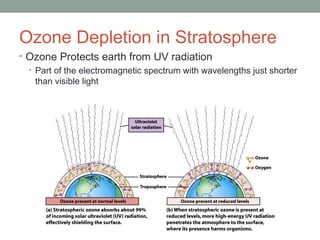
• Ozone Protects earth from UV radiation
• Part of the electromagnetic spectrum with wavelengths just shorter
than visible light
Ozone Depletion in Stratosphere
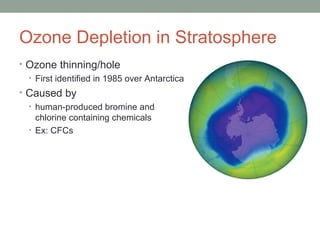
• Ozone thinning/hole
• First identified in 1985 over Antarctica
• Caused by
• human-produced bromine and
chlorine containing chemicals
• Ex: CFCs
Effects of Ozone Depletion
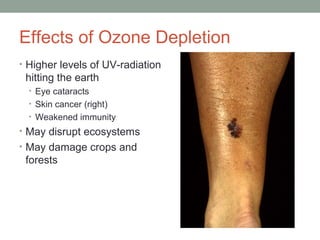
• Higher levels of UV-radiation
hitting the earth
• Eye cataracts
• Skin cancer (right)
• Weakened immunity
• May disrupt ecosystems
• May damage crops and
forests
Recovery of Ozone Layer
• Montreal Protocol (1987)
• Reduction of CFCs
• Started using HCFCs (greenhouse gas)
• Phase out of all ozone destroying chemicals is underway
globally
• Satellite pictures in 2000 indicated that ozone layer was
recovering
• Full recovery will not occur until 2050
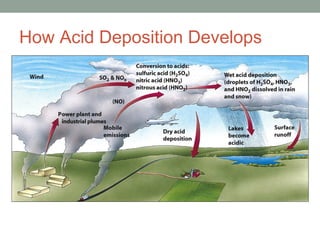
Acid Deposition
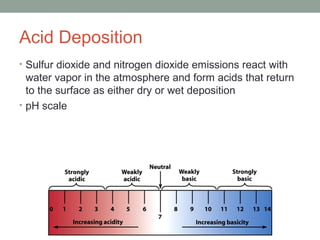
• Sulfur dioxide and nitrogen dioxide emissions react with
water vapor in the atmosphere and form acids that return
to the surface as either dry or wet deposition
• pH scale
How Acid Deposition Develops
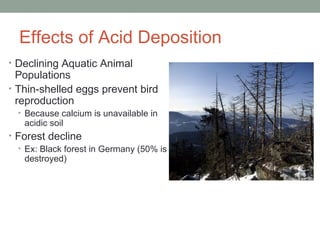
Effects of Acid Deposition
• Declining Aquatic Animal
Populations
• Thin-shelled eggs prevent bird
reproduction
• Because calcium is unavailable in
acidic soil
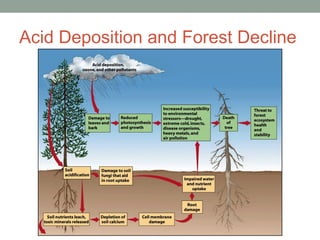
• Forest decline
• Ex: Black forest in Germany (50% is
destroyed)
Acid Deposition and Forest Decline
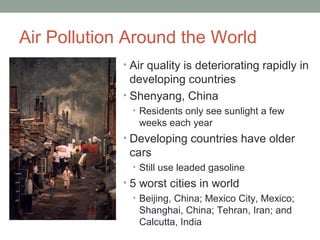
Air Pollution Around the World
• Air quality is deteriorating rapidly in
developing countries
• Shenyang, China
• Residents only see sunlight a few
weeks each year
• Developing countries have older
cars
• Still use leaded gasoline
• 5 worst cities in world
• Beijing, China; Mexico City, Mexico;
Shanghai, China; Tehran, Iran; and
Calcutta, India
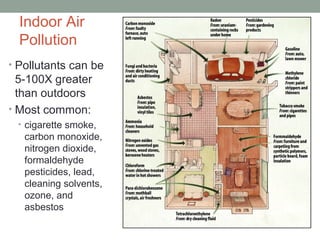
Indoor Air
Pollution
• Pollutants can be
5-100X greater
than outdoors
• Most common:
• cigarette smoke,
carbon monoxide,
nitrogen dioxide,
formaldehyde
pesticides, lead,
cleaning solvents,
ozone, and
asbestos
Steps Taken by India to control Air
Pollution• Bharat stage-IV emission norms have been implemented in 13 mega cities.
• Mass emission standards (Bharat Stage III) have been notified from April 1,
2010 throughout the country.
• Stringent Emission Standards have been implemented to regulate emissions
from in-use vehicles from October 2004.
• Supply of improved diesel and gasoline.
• Operating Compressed Natural Gas (CNG) mode public transport in Delhi.
• Introduction of metro in metros to promote use of mass public transport system.
• Central Pollution Control Board and State Pollution Control Boards are
implementing the Air (Prevention and Control of Pollution) Act 1981 to restore
air quality.
• A mutually time targeted programme is implemented under Corporate
Responsibility for Environment Protection (CREP).
• Special drives for prevention and control of pollution in 17 categories of highly
polluted industries.
• Standards are developed for Oxides of Nitrogen (NOx), Sulphur Dioxide (SO2).

Air pollution

  • 1.
  • 2.
    Overview • Atmosphere asa Resource • Types and Sources of Air Pollution • Major Classes of Air Pollutants • Sources of Outdoor Air Pollutants • Urban Air Pollution • Effects of Air Pollution • Controlling Air Pollution
  • 3.
    Atmosphere as aResource • Atmospheric Composition • Nitrogen 78.08% • Oxygen 20.95% • Argon 0.93% • Carbon dioxide 0.04% • Ecosystem services • Blocks UV radiation • Moderates the climate • Redistributes water in the hydrologic cycle
  • 4.
    Types and Sourcesof Air Pollution • Air Pollution • Chemicals added to the atmosphere by natural events or human activities in high enough concentrations to be harmful • Two categories • Primary Air Pollutant • Harmful substance that is emitted directly into the atmosphere • Secondary Air Pollutant • Harmful substance formed in the atmosphere when a primary air pollutant reacts with substances normally found in the atmosphere or with other air pollutants
  • 5.
  • 7.
    Major Classes ofAir Pollutants • Particulate Material • Nitrogen Oxides • Sulfur Oxides • Carbon Oxides • Hydrocarbons • Ozone
  • 8.
    Particulate Material • Thousandsof different solid or liquid particles suspended in air • Includes: soil particles, soot, lead, asbestos, sea salt, and sulfuric acid droplets • Dangerous for 2 reasons • May contain materials with toxic or carcinogenic effects • Extremely small particles can become lodged in lungs
  • 9.
    Nitrogen and SulfurOxides • Nitrogen Oxides • Gases produced by the chemical interactions between atmospheric nitrogen and oxygen at high temperature • Problems • Greenhouse gases • Cause difficulty breathing • Sulfur Oxides • Gases produced by the chemical interactions between sulfur and oxygen • Causes acid precipitation
  • 10.
    Carbon Oxides andHydrocarbons • Carbon Oxides • Gases carbon monoxide (CO) and carbon dioxide (CO2) • Greenhouse gases • Hydrocarbons • Diverse group of organic compounds that contain only hydrogen and carbon (ex: CH4- methane) • Some are related to photochemical smog and greenhouse gases
  • 11.
    Ozone • Tropospheric Ozone •Man- made pollutant in the lower atmosphere • Secondary air pollutant • Component of photochemical smog • Stratospheric Ozone • Essential component that screens out UV radiation in the upper atmosphere • Man- made pollutants (ex: CFCs) can destroy it
  • 12.
    Sources of OutdoorAir Pollution • Two main sources • Transportation • Industry • Intentional forest fires is also high
  • 13.
    Urban Air Pollution •Photochemical Smog (ex: Los Angeles below) • Brownish-orange haze formed by chemical reactions involving sunlight, nitrogen oxide, and hydrocarbons
  • 14.
  • 15.
  • 16.
    Case-In-Point Air Pollutionin Beijing and Mexico City • Beijing (left) • Mexico City (above)
  • 17.
    Effects of AirPollution • Low level exposure • Irritates eyes • Causes inflammation of respiratory tract • Can develop into chronic respiratory diseases
  • 18.
    Health Effects ofAir Pollution • Sulfur Dioxide and Particulate material • Irritate respiratory tract and impair ability of lungs to exchange gases • Nitrogen Dioxides • Causes airway restriction • Carbon monoxide • Binds with iron in blood hemoglobin • Causes headache, fatigue, drowsiness, death • Ozone • Causes burning eyes, coughing, and chest discomfort
  • 19.
    Children and AirPollution • Greater health threat to children than adults • Air pollution can restrict lung development • Children breath more often than adults • Children who live in high ozone areas are more likely to develop asthma
  • 20.
    Controlling Air Pollution •Smokestacks with electrostatic precipitator (right) WithoutWithout ElectrostaticElectrostatic precipitatorprecipitator With ElectrostaticWith Electrostatic precipitatorprecipitator
  • 21.
    Controlling Air Pollution •Smokestacks with scrubbers (right) • Particulate material can also be controlled by proper excavating techniques
  • 22.
    The Clean AirAct • Authorizes EPA to set limits on amount of specific air pollutants permitted • Focuses on 6 pollutants: • lead, particulate matter, sulfur dioxide, carbon monoxide, nitrogen oxides, and ozone • Act has led to decreases!
  • 23.
    Other Ways toImprove Air Quality • Reduce sulfur content in gasoline from its current average of 330 ppm to 30 ppm • Sulfur clogs catalytic converters • Set emission standards for all passenger vehicles • Including SUVs, trucks and minivans • Require emission testing for all vehicles • Including diesel
  • 24.
    Ozone Depletion inStratosphere • Ozone Protects earth from UV radiation • Part of the electromagnetic spectrum with wavelengths just shorter than visible light
  • 25.
    Ozone Depletion inStratosphere • Ozone thinning/hole • First identified in 1985 over Antarctica • Caused by • human-produced bromine and chlorine containing chemicals • Ex: CFCs
  • 26.
    Effects of OzoneDepletion • Higher levels of UV-radiation hitting the earth • Eye cataracts • Skin cancer (right) • Weakened immunity • May disrupt ecosystems • May damage crops and forests
  • 27.
    Recovery of OzoneLayer • Montreal Protocol (1987) • Reduction of CFCs • Started using HCFCs (greenhouse gas) • Phase out of all ozone destroying chemicals is underway globally • Satellite pictures in 2000 indicated that ozone layer was recovering • Full recovery will not occur until 2050
  • 28.
    Acid Deposition • Sulfurdioxide and nitrogen dioxide emissions react with water vapor in the atmosphere and form acids that return to the surface as either dry or wet deposition • pH scale
  • 29.
  • 30.
    Effects of AcidDeposition • Declining Aquatic Animal Populations • Thin-shelled eggs prevent bird reproduction • Because calcium is unavailable in acidic soil • Forest decline • Ex: Black forest in Germany (50% is destroyed)
  • 31.
    Acid Deposition andForest Decline
  • 32.
    Air Pollution Aroundthe World • Air quality is deteriorating rapidly in developing countries • Shenyang, China • Residents only see sunlight a few weeks each year • Developing countries have older cars • Still use leaded gasoline • 5 worst cities in world • Beijing, China; Mexico City, Mexico; Shanghai, China; Tehran, Iran; and Calcutta, India
  • 33.
    Indoor Air Pollution • Pollutantscan be 5-100X greater than outdoors • Most common: • cigarette smoke, carbon monoxide, nitrogen dioxide, formaldehyde pesticides, lead, cleaning solvents, ozone, and asbestos
  • 34.
    Steps Taken byIndia to control Air Pollution• Bharat stage-IV emission norms have been implemented in 13 mega cities. • Mass emission standards (Bharat Stage III) have been notified from April 1, 2010 throughout the country. • Stringent Emission Standards have been implemented to regulate emissions from in-use vehicles from October 2004. • Supply of improved diesel and gasoline. • Operating Compressed Natural Gas (CNG) mode public transport in Delhi. • Introduction of metro in metros to promote use of mass public transport system. • Central Pollution Control Board and State Pollution Control Boards are implementing the Air (Prevention and Control of Pollution) Act 1981 to restore air quality. • A mutually time targeted programme is implemented under Corporate Responsibility for Environment Protection (CREP). • Special drives for prevention and control of pollution in 17 categories of highly polluted industries. • Standards are developed for Oxides of Nitrogen (NOx), Sulphur Dioxide (SO2).