

PREPARED BY:-
Karm Balar
ASST. Prof.
S.S.A.S.I.T.
S.S.A.S.I.T G.T.U
SHREE SWAMI ATMANAND SARASWATI
INSTITUTE OF TECHNOLOGY, SURAT
Air Pollution
Environmental studies
Pollution
Water
AirNoise
Air Pollution
• Any visible or invisible particle or
gas found in the air that is not part
of the original, normal
composition.
Air pollution is defined as the presence of
unwanted and undesirable foreign particles and
gases in the air which may have adverse effects on
human beings , plants , vegetation's and important
structures.
Air pollution is of public health concern and can
occur as :
1. Indoor air pollution Micro scale
2.Outdoor air pollution Meso scale
3.Air pollution at global level Macro scale
CLASSIFICATION OF AIR POLLUTANTS
Based on
Origin
Primary air
pollutants
Secondary
air
pollutants
Based on states
of matter
Gaseous air
pollutants
Particulate
air
pollutants
Based on presence in
environment
Indoor air
pollutants
Outdoor air
pollutants
CLASSIFICATION OF AIR POLLUTANTS
I. Classification based on Origin of pollutants:
• Primary air pollutants: Primary air pollutants are those which are directly
emitted from the source into the atmosphere, and remains in the same form in
the atmosphere. For example: Sulphur oxides, Nitrogen oxides, Carbon monoxide,
etc. The air pollutants are emitted by man made sources like, transportation, fuel
combustion, industrial operations, etc.
• Secondary air pollutants: Secondary air pollutants are those which are formed
by chemical reactions among primary pollutants and atmospheric chemical
species. For example: Ozone, Sulphur trioxide, Ketones, etc.
II. Classification based on states of matter:
• Gaseous air pollutants: Gaseous air pollutants are those air pollutants which
are found in the gaseous state at normal temperature and pressure in the
atmosphere. For example: Carbon-monoxide, Carbon-dioxide, Nitrogen oxides,
Sulphur oxides, etc.
• Particulate air pollutants : Particulates are finely divided, air borne, solid and liquid
particles, which remain for very longtime in air, in suspension. Depending on their size
and mode of formation, particulate air pollutants are further classified as below:
• Aerosols: These are air borne suspensions of solid or liquid particles smaller than 1
mm size. Example: dust, smoke, mist, fume, etc.
• Dust: It consists of small solid particles (size 1 to 200 micro-meter) and are generated
by material crushing, grinding or blasting.
• Smoke: They are also fine solid particles of size around 0.1 to 1 micro-meter, formed
by the incomplete combustion of organic matter like coal and wood.
• Mist: It consist of liquid droplets of size around 0.1 to 10 micro-meter and formed by
the condensation of vapours in the atmosphere.
• Fog: If the mist is made up of water droplets at high concentration so as to obscure
vision then mist is called as fog.
• Soot: These are the carbon particles impregnated with tar, and released by the
incomplete combustion of carbonaceous materials.
• Classification based on presence in environment:
• Indoor air pollutants: The air pollutants which are generated from households
are called indoor air pollutants. For example: Cleaning agents, Pesticides, Paints,
Glues, gases from stoves, etc.
• Outdoor air pollutants: The air pollutants which are generated outside the
buildings are called outdoor air pollutants. For example: Automobile pollutants,
Industrial pollutants, Mining pollutants, etc.
Natural : forest fires, pollen, dust
storm, foul gases etc.
Unnatural : man-made; coal,
wood and other fuels used in
cars, homes, and factories for
energy.
Sources
How Why
A cloud of smoke
from the exhaust
of a vehicle
Increasing traffic
Industrialization Growing cities
Apathetic people Rapid economic
development
Cigarette smoke
Burning leaves
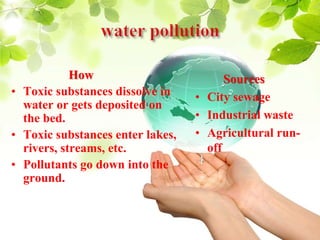
How
• Toxic substances dissolve in
water or gets deposited on
the bed.
• Toxic substances enter lakes,
rivers, streams, etc.
• Pollutants go down into the
ground.
Sources
• City sewage
• Industrial waste
• Agricultural run-
off
 According to W.H.O, an increase in any of the
constituents of the atmosphere which is
harmful to the living beings and their
environment, is known as air pollution
The view from the space
 Photo Chemical Smog  Photo Chemical Smog
Burning of Fire Wood Chimneys
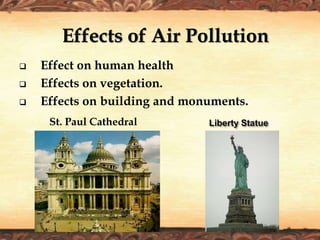
 Effect on human health
 Effects on vegetation.
 Effects on building and monuments.
Effects of Air Pollution
St. Paul Cathedral
Causes by air pollution
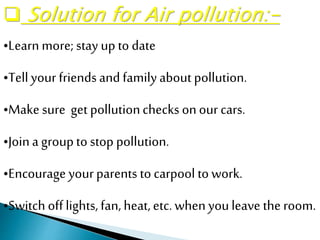
•Learn more; stay up to date
•Tellyour friendsand familyabout pollution.
•Make sure get pollutionchecks onour cars.
•Joina groupto stop pollution.
•Encourage yourparents to carpool to work.
•Switch offlights,fan, heat,etc.whenyouleave the room.
 Solution for Air pollution:-
 Air pollution can be controlled by a
thorough understanding of its causes.
 Establishment of industries away from the
towns and cities.
 Increasing the length of the chyeysmn in
industries.
 Growing more plants and trees.
 Use of efficient engines in automobiles.
 Use of smokeless choola.
 Use of petrol without lead (Unleaded petrol)
. The UNO must stop nuclear tests
Air polluction for environmental studies

Air polluction for environmental studies

  • 1.
    PREPARED BY:- Karm Balar ASST.Prof. S.S.A.S.I.T. S.S.A.S.I.T G.T.U SHREE SWAMI ATMANAND SARASWATI INSTITUTE OF TECHNOLOGY, SURAT Air Pollution Environmental studies
  • 3.
  • 4.
  • 5.
    • Any visibleor invisible particle or gas found in the air that is not part of the original, normal composition.
  • 6.
    Air pollution isdefined as the presence of unwanted and undesirable foreign particles and gases in the air which may have adverse effects on human beings , plants , vegetation's and important structures. Air pollution is of public health concern and can occur as : 1. Indoor air pollution Micro scale 2.Outdoor air pollution Meso scale 3.Air pollution at global level Macro scale
  • 7.
    CLASSIFICATION OF AIRPOLLUTANTS Based on Origin Primary air pollutants Secondary air pollutants Based on states of matter Gaseous air pollutants Particulate air pollutants Based on presence in environment Indoor air pollutants Outdoor air pollutants
  • 8.
    CLASSIFICATION OF AIRPOLLUTANTS I. Classification based on Origin of pollutants: • Primary air pollutants: Primary air pollutants are those which are directly emitted from the source into the atmosphere, and remains in the same form in the atmosphere. For example: Sulphur oxides, Nitrogen oxides, Carbon monoxide, etc. The air pollutants are emitted by man made sources like, transportation, fuel combustion, industrial operations, etc. • Secondary air pollutants: Secondary air pollutants are those which are formed by chemical reactions among primary pollutants and atmospheric chemical species. For example: Ozone, Sulphur trioxide, Ketones, etc. II. Classification based on states of matter: • Gaseous air pollutants: Gaseous air pollutants are those air pollutants which are found in the gaseous state at normal temperature and pressure in the atmosphere. For example: Carbon-monoxide, Carbon-dioxide, Nitrogen oxides, Sulphur oxides, etc.
  • 9.
    • Particulate airpollutants : Particulates are finely divided, air borne, solid and liquid particles, which remain for very longtime in air, in suspension. Depending on their size and mode of formation, particulate air pollutants are further classified as below: • Aerosols: These are air borne suspensions of solid or liquid particles smaller than 1 mm size. Example: dust, smoke, mist, fume, etc. • Dust: It consists of small solid particles (size 1 to 200 micro-meter) and are generated by material crushing, grinding or blasting. • Smoke: They are also fine solid particles of size around 0.1 to 1 micro-meter, formed by the incomplete combustion of organic matter like coal and wood. • Mist: It consist of liquid droplets of size around 0.1 to 10 micro-meter and formed by the condensation of vapours in the atmosphere. • Fog: If the mist is made up of water droplets at high concentration so as to obscure vision then mist is called as fog. • Soot: These are the carbon particles impregnated with tar, and released by the incomplete combustion of carbonaceous materials.
  • 10.
    • Classification basedon presence in environment: • Indoor air pollutants: The air pollutants which are generated from households are called indoor air pollutants. For example: Cleaning agents, Pesticides, Paints, Glues, gases from stoves, etc. • Outdoor air pollutants: The air pollutants which are generated outside the buildings are called outdoor air pollutants. For example: Automobile pollutants, Industrial pollutants, Mining pollutants, etc.
  • 11.
    Natural : forestfires, pollen, dust storm, foul gases etc. Unnatural : man-made; coal, wood and other fuels used in cars, homes, and factories for energy. Sources
  • 14.
    How Why A cloudof smoke from the exhaust of a vehicle Increasing traffic Industrialization Growing cities Apathetic people Rapid economic development Cigarette smoke Burning leaves
  • 15.
    How • Toxic substancesdissolve in water or gets deposited on the bed. • Toxic substances enter lakes, rivers, streams, etc. • Pollutants go down into the ground. Sources • City sewage • Industrial waste • Agricultural run- off
  • 16.
     According toW.H.O, an increase in any of the constituents of the atmosphere which is harmful to the living beings and their environment, is known as air pollution The view from the space
  • 17.
     Photo ChemicalSmog  Photo Chemical Smog
  • 19.
    Burning of FireWood Chimneys
  • 21.
     Effect onhuman health  Effects on vegetation.  Effects on building and monuments. Effects of Air Pollution St. Paul Cathedral
  • 22.
    Causes by airpollution
  • 27.
    •Learn more; stayup to date •Tellyour friendsand familyabout pollution. •Make sure get pollutionchecks onour cars. •Joina groupto stop pollution. •Encourage yourparents to carpool to work. •Switch offlights,fan, heat,etc.whenyouleave the room.  Solution for Air pollution:-
  • 28.
     Air pollutioncan be controlled by a thorough understanding of its causes.  Establishment of industries away from the towns and cities.  Increasing the length of the chyeysmn in industries.  Growing more plants and trees.  Use of efficient engines in automobiles.  Use of smokeless choola.  Use of petrol without lead (Unleaded petrol)
  • 29.
    . The UNOmust stop nuclear tests