AIR POLLUTANTS
Air Pollutants
 An air pollutant is a substance in the air
that can have adverse effects on humans
and the ecosystem. The substance can be
solid particles, liquid droplets, or gases. A
pollutant can be of natural origin or man-
made.
Types Of Air Pollutants
 Criteria Pollutants
 Non- Criteria Pollutants
Criteria Air Pollutants
It is a term used to
describe air pollutants
that have been regulated
and are used as
indicators of general air
quality. The regulations
or standards are based
on criteria that relate to
health and/or
environmental effects.
Sources of criteria
pollutants can either be
of natural or man-made.
Criteria Pollutants 1:
TOTAL SUSPENDED PARTICULATES
 Small solid or liquid particulates suspended in
the air primarily dust, smoke, metallic and
mineral particulates, soot, mist, and acid
fumes.
 The smaller the particulate, the more deeply it
can be inhaled into the lungs, and therefore
the greater its potential to affect health
 Separate air quality standards are often set for
coarse particulates (PM10) and for fine
particulates (2.5 microns and lesser in
diameter or PM2.5).
Criteria Pollutants 2:
SULFUR DIOXIDE
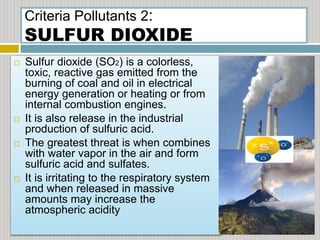
 Sulfur dioxide (SO2) is a colorless,
toxic, reactive gas emitted from the
burning of coal and oil in electrical
energy generation or heating or from
internal combustion engines.
 It is also release in the industrial
production of sulfuric acid.
 The greatest threat is when combines
with water vapor in the air and form
sulfuric acid and sulfates.
 It is irritating to the respiratory system
and when released in massive
amounts may increase the
atmospheric acidity
Criteria Pollutants 3:
NITROGEN DIOXIDE
 When air is heated to high temperature, such as
automobile cylinders or high temperature furnaces
of power plants and industrial boilers nitrogen
oxides (NOx) are produced..
 Nitrogen + OXYGEN = Nitric Oxides -> Nitrogen
dioxide
 Nitrogen dioxide + RAIN= NITRIC ACID
 Nitrogen dioxide + HYDROCARBON = SMOG
 Nitrogen dioxide + SULFUR DIOXIDE = ACID
RAIN
 Nitrogen dioxide is a brownish, highly reactive gas
present in all urban atmosphere.
Criteria Pollutants 4:
CARBON MONOXIDE
 Carbon monoxide (CO) is a colorless, odorless,
and poisonous gas , which is slightly lighter than
air.
 CO forms when the carbon in fuels does not
completely burn. Vehicle exhaust contributes
roughly 60% of all CO emissions nationwide and
up to 95% in cities.
 National guideline values for (CO) are 35μg/Ncm
(30 ppm) maximum for one-hour exposure and
10μg/Ncm (9ppm) maximum for 8-hour exposure
 Having a role in formation of ground-level ozone.
Criteria Pollutants 5:
LEAD
 Lead (Pb) is a metal found naturally in the environment
as well as in manufactured products. Exposure to lead
can occur through multiple pathways, including inhalation
of air and ingestion of lead in food, water, soil, or dust
and can cause various ailments.
 Historically, the major sources of lead emissions were
motor vehicles and industrial sources.
 The major source of lead emissions today is metals
processing and the highest levels of lead in air are
generally found near lead smelters, waste incinerators,
utilities, and lead-acid battery manufacturers.
 National guidelines values for lead are 1.5μg/Ncm
maximum for three-month exposure and 1.0μg/Ncm
maximum for a one-year exposure.
Criteria Pollutants 6:
OZONE AND RELATED OXIDANTS
 Ozone is a gas that forms in the atmosphere
when three atoms of oxygen are combined. It
is not emitted directly into the air but is created
at ground level by a chemical reaction
between oxides of nitrogen and volatile
organic compounds in the presence of
sunlight.
 Bad ozone is an air pollutant that damages
human health, vegetation, and many common
materials. It is a key ingredient of urban smog.
NON CRITERIA POLLUTANTS
 These are other pollutants that are less
prevalent in the environment. However, these
non-criteria pollutants include various
hazardous substances that can be a danger to
human health. Health risks include cancer,
lung damage and damage to the nervous,
reproductive and immune systems. Persistent
Organic Pollutants (POPs) and heavy metals
are two important categories of non-criteria
pollutants.
Non-Criteria Pollutants
 Solid and Metals
 Volatile Organic Compounds
 Ozone Depleting Substance
 Greenhouse Gases
 Radioactive Compounds
 Odors
NON-CRITERIA POLLUTANTS
Solid and Metals
 It is an incombustible,
chemical resistant, fibrous
material used for
fireproofing materials as
well as insulation, building
materials, and brake
linings.
 Asbestos fibers in ambient
air pose risk to human
health in the form of
cancer and other diseases
NON-CRITERIA POLLUTANTS
Solid and Metals
 Some of the deposited mercury ends
up in swamps, lake, and streams where
bacteria turn in to methyl mercury
 Mercury can be absorbed through the
skin and mucous membranes and
mercury vapors can be inhaled
 Heating of mercury, or of compounds of
mercury that may decompose when
heated, should be carried out with
adequate ventilation in order to
minimize exposure to mercury vapor.
NON-CRITERIA POLLUTANTS
Solid and Metals
3.COPPER
 It is a reddish-colored metal, with a
high electrical and thermal conductivity.
 It is insoluble in water.
 Copper can be released from copper
smelters, are essential to organisms as
trace elements, but they are toxic if
they are overabundant.
 Exposure to slightly higher
environmental levels of copper is
unlikely to have adverse effects on
health. High level exposure might
however cause chest pains, vomiting
and irritation of the eyes and nose.
NON-CRITERIA POLLUTANTS
Solid and Metals
 A moderately reactive metal that will
combine with the oxygen and other
non metals and will react with dilute
acids to release hydrogen
 It is the 4th most common metal in
use
 In the work place environment zinc
contagion can lead to a flu-like
condition known as metal fever. This
condition will pass after two days
and is caused by over sensitivity.
NON-CRITERIA POLLUTANTS
Solid and Metals
5.CADMIUM
 A soft, malleable, ductile
bluish-white bivalent which
can be easily cut by knife.
 Cadmium is not an element
that is used by the body,
and it is toxic. It mainly
affects kidneys and bones.
It is also a carcinogen by
inhalation.
NON-CRITERIA POLLUTANTS
Solid and Metals
 It is a silvery white, brittle, fusible,
crystalline solid that exhibits poor
electrical and heat conductivity
properties and vaporizes at low
temparture.
 Antimony can enter the body by
inhalation,by ingestion of food or
water containing antimony, or by
dermal contact with antimony.
 Inhalation of air containing antimony
may cause eye and lung irritation,
heart and lung damage, stomach
pains, diarrhea, vomiting and stomach
ulcers.
NON-CRITERIA POLLUTANTS
Solid and Metals
 Arsenic and its compound are
used as pesticides, herbicides,
insecticides and various alloy.
 Naturally occurring sources of
human exposure include
volcanic ash, weathering of
minerals and ores, and
mineralized groundwater.
 When heated it rapidly oxidizes
to arsenic trioxide, which has
garlic odor.
VOLATILE ORGANIC COMPOUND
 are organic chemicals that have a high vapor
pressure at ordinary room temperature. Their high
vapor pressure results from a low boiling point,
which causes large numbers of molecules
to evaporate or sublimate from the liquid or solid
form of the compound and enter the surrounding
air.
 Harmful VOCs typically are not acutely toxic, but
have compounding long-term health effects.
Because the concentrations are usually low and
the symptoms slow to develop, research into
VOCs and their effects is difficult.
VOLATILE ORGANIC COMPOUND
1. Total Hydrocarbons(HCS)
-are usually unburned fumes that evaporate
from gas tanks and are emitted from exhaust
of vehicles.
- Can also be the evaporating solvents of
asphalts, gaseous emissions of rotting
vegetation or the product of any reaction that
involves an organic material
VOLATILE ORGANIC COMPOUND
2. Aromatic like benzene
-emitted by internal combustion engines and
is carcinogenic.
-It is results from processing of oil to gasoline
OZONE-DEPLETING SUBSTANCES
 Ozone-depleting substances (ODS) generally
contain chlorine, fluorine, bromine, carbon, and
hydrogen in varying proportions and are often
described by the general term halocarbons
 These substances are effective ozone-depleters
for two reasons:
 The first is that they do not break down in the lower
atmosphere - they can remain in the atmosphere from
20 to 120 years or more.
 The second is that they contain either/both chlorine
and/or bromine and thus help the natural reactions
that destroy ozone.
OZONE-DEPLETING SUBSTANCES
CHLOROFLUOROCARBONS(CFCs)
- It is various compounds used as aerosol
propellants, solvents, and refrigerants.
-when released into the atmosphere contribute
to the breakdown of stratosphere ozone layer.
GREENHOUSE GASES
-a gas that contributes to the greenhouse
effect by absorbing infrared radiation
1.CARBON DIOXIDE (CO2)
2. METHANE (CH4)
3. NITROUS OXIDE (N2O)
4. HYDROFUOROCARBON(HFCs),
PERFLUOROCARBON(PCFs), SULFUR
HEXAFLUORID(SF6)
RADIOACTIVE COMPOUNDS
 Naturally made
- cosmic radiation from outer space
-terrestrial radiation from earth’s crust
 Man-made
-by the use of radio active
materials.
ODORS
 Odors are usually gases from anaerobic,
decomposition of putrescible materials. The
problem is most common around dumpsites
and landfills, but may also occur around
certain chemical plants.

AIR POLLUTANTS

  • 1.
  • 2.
    Air Pollutants  Anair pollutant is a substance in the air that can have adverse effects on humans and the ecosystem. The substance can be solid particles, liquid droplets, or gases. A pollutant can be of natural origin or man- made.
  • 3.
    Types Of AirPollutants  Criteria Pollutants  Non- Criteria Pollutants
  • 4.
    Criteria Air Pollutants Itis a term used to describe air pollutants that have been regulated and are used as indicators of general air quality. The regulations or standards are based on criteria that relate to health and/or environmental effects. Sources of criteria pollutants can either be of natural or man-made.
  • 5.
    Criteria Pollutants 1: TOTALSUSPENDED PARTICULATES  Small solid or liquid particulates suspended in the air primarily dust, smoke, metallic and mineral particulates, soot, mist, and acid fumes.  The smaller the particulate, the more deeply it can be inhaled into the lungs, and therefore the greater its potential to affect health  Separate air quality standards are often set for coarse particulates (PM10) and for fine particulates (2.5 microns and lesser in diameter or PM2.5).
  • 7.
    Criteria Pollutants 2: SULFURDIOXIDE  Sulfur dioxide (SO2) is a colorless, toxic, reactive gas emitted from the burning of coal and oil in electrical energy generation or heating or from internal combustion engines.  It is also release in the industrial production of sulfuric acid.  The greatest threat is when combines with water vapor in the air and form sulfuric acid and sulfates.  It is irritating to the respiratory system and when released in massive amounts may increase the atmospheric acidity
  • 8.
    Criteria Pollutants 3: NITROGENDIOXIDE  When air is heated to high temperature, such as automobile cylinders or high temperature furnaces of power plants and industrial boilers nitrogen oxides (NOx) are produced..  Nitrogen + OXYGEN = Nitric Oxides -> Nitrogen dioxide  Nitrogen dioxide + RAIN= NITRIC ACID  Nitrogen dioxide + HYDROCARBON = SMOG  Nitrogen dioxide + SULFUR DIOXIDE = ACID RAIN  Nitrogen dioxide is a brownish, highly reactive gas present in all urban atmosphere.
  • 9.
    Criteria Pollutants 4: CARBONMONOXIDE  Carbon monoxide (CO) is a colorless, odorless, and poisonous gas , which is slightly lighter than air.  CO forms when the carbon in fuels does not completely burn. Vehicle exhaust contributes roughly 60% of all CO emissions nationwide and up to 95% in cities.  National guideline values for (CO) are 35μg/Ncm (30 ppm) maximum for one-hour exposure and 10μg/Ncm (9ppm) maximum for 8-hour exposure  Having a role in formation of ground-level ozone.
  • 10.
    Criteria Pollutants 5: LEAD Lead (Pb) is a metal found naturally in the environment as well as in manufactured products. Exposure to lead can occur through multiple pathways, including inhalation of air and ingestion of lead in food, water, soil, or dust and can cause various ailments.  Historically, the major sources of lead emissions were motor vehicles and industrial sources.  The major source of lead emissions today is metals processing and the highest levels of lead in air are generally found near lead smelters, waste incinerators, utilities, and lead-acid battery manufacturers.  National guidelines values for lead are 1.5μg/Ncm maximum for three-month exposure and 1.0μg/Ncm maximum for a one-year exposure.
  • 11.
    Criteria Pollutants 6: OZONEAND RELATED OXIDANTS  Ozone is a gas that forms in the atmosphere when three atoms of oxygen are combined. It is not emitted directly into the air but is created at ground level by a chemical reaction between oxides of nitrogen and volatile organic compounds in the presence of sunlight.  Bad ozone is an air pollutant that damages human health, vegetation, and many common materials. It is a key ingredient of urban smog.
  • 12.
    NON CRITERIA POLLUTANTS These are other pollutants that are less prevalent in the environment. However, these non-criteria pollutants include various hazardous substances that can be a danger to human health. Health risks include cancer, lung damage and damage to the nervous, reproductive and immune systems. Persistent Organic Pollutants (POPs) and heavy metals are two important categories of non-criteria pollutants.
  • 13.
    Non-Criteria Pollutants  Solidand Metals  Volatile Organic Compounds  Ozone Depleting Substance  Greenhouse Gases  Radioactive Compounds  Odors
  • 14.
    NON-CRITERIA POLLUTANTS Solid andMetals  It is an incombustible, chemical resistant, fibrous material used for fireproofing materials as well as insulation, building materials, and brake linings.  Asbestos fibers in ambient air pose risk to human health in the form of cancer and other diseases
  • 15.
    NON-CRITERIA POLLUTANTS Solid andMetals  Some of the deposited mercury ends up in swamps, lake, and streams where bacteria turn in to methyl mercury  Mercury can be absorbed through the skin and mucous membranes and mercury vapors can be inhaled  Heating of mercury, or of compounds of mercury that may decompose when heated, should be carried out with adequate ventilation in order to minimize exposure to mercury vapor.
  • 16.
    NON-CRITERIA POLLUTANTS Solid andMetals 3.COPPER  It is a reddish-colored metal, with a high electrical and thermal conductivity.  It is insoluble in water.  Copper can be released from copper smelters, are essential to organisms as trace elements, but they are toxic if they are overabundant.  Exposure to slightly higher environmental levels of copper is unlikely to have adverse effects on health. High level exposure might however cause chest pains, vomiting and irritation of the eyes and nose.
  • 17.
    NON-CRITERIA POLLUTANTS Solid andMetals  A moderately reactive metal that will combine with the oxygen and other non metals and will react with dilute acids to release hydrogen  It is the 4th most common metal in use  In the work place environment zinc contagion can lead to a flu-like condition known as metal fever. This condition will pass after two days and is caused by over sensitivity.
  • 18.
    NON-CRITERIA POLLUTANTS Solid andMetals 5.CADMIUM  A soft, malleable, ductile bluish-white bivalent which can be easily cut by knife.  Cadmium is not an element that is used by the body, and it is toxic. It mainly affects kidneys and bones. It is also a carcinogen by inhalation.
  • 19.
    NON-CRITERIA POLLUTANTS Solid andMetals  It is a silvery white, brittle, fusible, crystalline solid that exhibits poor electrical and heat conductivity properties and vaporizes at low temparture.  Antimony can enter the body by inhalation,by ingestion of food or water containing antimony, or by dermal contact with antimony.  Inhalation of air containing antimony may cause eye and lung irritation, heart and lung damage, stomach pains, diarrhea, vomiting and stomach ulcers.
  • 20.
    NON-CRITERIA POLLUTANTS Solid andMetals  Arsenic and its compound are used as pesticides, herbicides, insecticides and various alloy.  Naturally occurring sources of human exposure include volcanic ash, weathering of minerals and ores, and mineralized groundwater.  When heated it rapidly oxidizes to arsenic trioxide, which has garlic odor.
  • 21.
    VOLATILE ORGANIC COMPOUND are organic chemicals that have a high vapor pressure at ordinary room temperature. Their high vapor pressure results from a low boiling point, which causes large numbers of molecules to evaporate or sublimate from the liquid or solid form of the compound and enter the surrounding air.  Harmful VOCs typically are not acutely toxic, but have compounding long-term health effects. Because the concentrations are usually low and the symptoms slow to develop, research into VOCs and their effects is difficult.
  • 22.
    VOLATILE ORGANIC COMPOUND 1.Total Hydrocarbons(HCS) -are usually unburned fumes that evaporate from gas tanks and are emitted from exhaust of vehicles. - Can also be the evaporating solvents of asphalts, gaseous emissions of rotting vegetation or the product of any reaction that involves an organic material
  • 23.
    VOLATILE ORGANIC COMPOUND 2.Aromatic like benzene -emitted by internal combustion engines and is carcinogenic. -It is results from processing of oil to gasoline
  • 24.
    OZONE-DEPLETING SUBSTANCES  Ozone-depletingsubstances (ODS) generally contain chlorine, fluorine, bromine, carbon, and hydrogen in varying proportions and are often described by the general term halocarbons  These substances are effective ozone-depleters for two reasons:  The first is that they do not break down in the lower atmosphere - they can remain in the atmosphere from 20 to 120 years or more.  The second is that they contain either/both chlorine and/or bromine and thus help the natural reactions that destroy ozone.
  • 25.
    OZONE-DEPLETING SUBSTANCES CHLOROFLUOROCARBONS(CFCs) - Itis various compounds used as aerosol propellants, solvents, and refrigerants. -when released into the atmosphere contribute to the breakdown of stratosphere ozone layer.
  • 26.
    GREENHOUSE GASES -a gasthat contributes to the greenhouse effect by absorbing infrared radiation 1.CARBON DIOXIDE (CO2) 2. METHANE (CH4) 3. NITROUS OXIDE (N2O) 4. HYDROFUOROCARBON(HFCs), PERFLUOROCARBON(PCFs), SULFUR HEXAFLUORID(SF6)
  • 27.
    RADIOACTIVE COMPOUNDS  Naturallymade - cosmic radiation from outer space -terrestrial radiation from earth’s crust  Man-made -by the use of radio active materials.
  • 28.
    ODORS  Odors areusually gases from anaerobic, decomposition of putrescible materials. The problem is most common around dumpsites and landfills, but may also occur around certain chemical plants.