Air Pollution Control Laws
and Regulations
&
Air Pollution Control Philosophies
• Air Pollution, its causes and effects, cost of air pollution
• Air Pollution control Laws and Regulations
• Air Pollution Control Philosophies
Air Pollution is not a joke. Air Pollution
will make you Choke
Air Pollution
• Most air pollution control engineers works with permits and also the
major facilities
• These permits are authorized by local, state, or federal authorities,
normally, expressed as:
• The emissions of pollutant X from the main stack factory Y shall not
exceed Z pound per hours
• Federal regulations direct the states to require a permit for each
facility that has the potential to emit 100 tons/ Yr of criteria
pollutants and 25 ton/ Yr of Hazardous pollutants.
• If the facility (emitter) is located in a severely polluted area, then the
values become smaller.
• Automobiles and gasoline emissions are directly regulated by the EPA
• Automobile industry needs State and EPA permits
Programs and Activities
• Air Quality and Emissions Limitations
• This section of the act declares that protecting and enhancing the
nation's air quality promotes public health
• The law encourages prevention of regional air pollution and control
programs
• It also provides technical and financial assistance for air pollution
prevention at both state and local governments
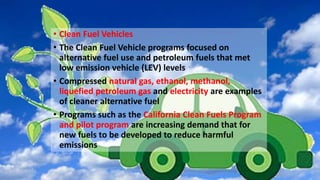
• Clean Fuel Vehicles
• The Clean Fuel Vehicle programs focused on
alternative fuel use and petroleum fuels that met
low emission vehicle (LEV) levels
• Compressed natural gas, ethanol, methanol,
liquefied petroleum gas and electricity are examples
of cleaner alternative fuel
• Programs such as the California Clean Fuels Program
and pilot program are increasing demand that for
new fuels to be developed to reduce harmful
emissions
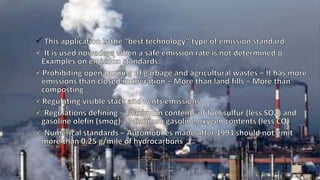
(cleanest possible air philosophy)
 Example: England 1863
 Leblanc factory for soda ash (Na2CO3)
 Large amounts of byproduct (HCl) were emitted as vapor
 HCl devastated the vegetation = problems with the industry
Alkali-inspectors found the best technique to reduce emissions at
the factory level
 The technique was enforced on all other factories emitting HCl

 This philosophy was the basis of most air pollution control activities
between 1863 and 1970
 Recent air pollution laws – 2 sections are pure emission standards
New Source Performance
Standard (NSPS)
 It blocks a firm from “pollution
shopping” = searching for the
least stringent air pollution
standard state
 Any regulation standard below
the NSPS leads to a polluted air
National Emissions Standards
for Hazardous Air Pollutants
(NESHAP)
 This regulation covers
pollutants which causes harm
without any threshold
Better to apply the toughest
control procedures to limit
emissions
The next two philosophies represent future alternatives.
Laws based on an emission tax philosophy would tax each
emitter of major pollutants according to its emission rate; – e.g.

X cents per pound of pollutant Y for all emitters.
This tax rate would be set so that most major polluters would
find it more economical to install pollution control equipment
than pay the taxes.
The emission tax philosophy assumes that the environment has
natural removal mechanisms for pollutants, with CFC’s as a
possible exception.
Emission taxes have also been proposed in combination with
air quality standard philosophy : in this combination, emission
taxes would act as an added incentive to reduce emissions to
lower levels than those required to meet air quality standards.
This philosophy also assume that for any contamination, the
environment has a renewable absorptive and/or dispersive
capacities.
The cost-benefit philosophy assumes that there are no
thresholds at all or there are very low thresholds.
This philosophy suggests
How much damage can we stand
 How much we are willing to spend to control damage
beyond the tolerance
The aim of this philosophy is to solve cost-benefit minimization.
It is highly cost-effective.
Cost distribution
If pollutants are emitted by autos
–Cost and damages are distributed on the population
If the emitter is an industry
–It can injure the rest of the community
–Costs will be unequally distributed
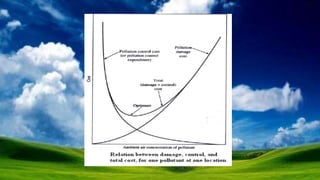
The figure is great simplification,
 it shows one control cost curve
 One damage cost curve
 And one atmospheric concentration
In reality there is:
 a damage curve for each individual exposed to air pollution
 Control curve for each emitter
 And concentration dimension for each pollutant at each
location
 The simple application shown in the figure does not consider
the question :
“ Whose costs? Whose benefits? ‘’
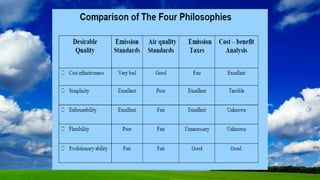
What is a perfect philosophy?
Air pollution control laws and regulations and Air Pollution Control Philosophies

Air pollution control laws and regulations and Air Pollution Control Philosophies

  • 1.
    Air Pollution ControlLaws and Regulations & Air Pollution Control Philosophies
  • 2.
    • Air Pollution,its causes and effects, cost of air pollution • Air Pollution control Laws and Regulations • Air Pollution Control Philosophies
  • 3.
    Air Pollution isnot a joke. Air Pollution will make you Choke
  • 6.
  • 10.
    • Most airpollution control engineers works with permits and also the major facilities • These permits are authorized by local, state, or federal authorities, normally, expressed as: • The emissions of pollutant X from the main stack factory Y shall not exceed Z pound per hours
  • 11.
    • Federal regulationsdirect the states to require a permit for each facility that has the potential to emit 100 tons/ Yr of criteria pollutants and 25 ton/ Yr of Hazardous pollutants.
  • 12.
    • If thefacility (emitter) is located in a severely polluted area, then the values become smaller. • Automobiles and gasoline emissions are directly regulated by the EPA • Automobile industry needs State and EPA permits
  • 14.
    Programs and Activities •Air Quality and Emissions Limitations • This section of the act declares that protecting and enhancing the nation's air quality promotes public health • The law encourages prevention of regional air pollution and control programs • It also provides technical and financial assistance for air pollution prevention at both state and local governments
  • 15.
    • Clean FuelVehicles • The Clean Fuel Vehicle programs focused on alternative fuel use and petroleum fuels that met low emission vehicle (LEV) levels • Compressed natural gas, ethanol, methanol, liquefied petroleum gas and electricity are examples of cleaner alternative fuel • Programs such as the California Clean Fuels Program and pilot program are increasing demand that for new fuels to be developed to reduce harmful emissions
  • 18.
  • 20.
     Example: England1863  Leblanc factory for soda ash (Na2CO3)  Large amounts of byproduct (HCl) were emitted as vapor  HCl devastated the vegetation = problems with the industry Alkali-inspectors found the best technique to reduce emissions at the factory level  The technique was enforced on all other factories emitting HCl
  • 21.
  • 22.
     This philosophywas the basis of most air pollution control activities between 1863 and 1970  Recent air pollution laws – 2 sections are pure emission standards
  • 23.
    New Source Performance Standard(NSPS)  It blocks a firm from “pollution shopping” = searching for the least stringent air pollution standard state  Any regulation standard below the NSPS leads to a polluted air National Emissions Standards for Hazardous Air Pollutants (NESHAP)  This regulation covers pollutants which causes harm without any threshold Better to apply the toughest control procedures to limit emissions
  • 30.
    The next twophilosophies represent future alternatives. Laws based on an emission tax philosophy would tax each emitter of major pollutants according to its emission rate; – e.g. X cents per pound of pollutant Y for all emitters. This tax rate would be set so that most major polluters would find it more economical to install pollution control equipment than pay the taxes.
  • 31.
    The emission taxphilosophy assumes that the environment has natural removal mechanisms for pollutants, with CFC’s as a possible exception. Emission taxes have also been proposed in combination with air quality standard philosophy : in this combination, emission taxes would act as an added incentive to reduce emissions to lower levels than those required to meet air quality standards. This philosophy also assume that for any contamination, the environment has a renewable absorptive and/or dispersive capacities.
  • 33.
    The cost-benefit philosophyassumes that there are no thresholds at all or there are very low thresholds. This philosophy suggests How much damage can we stand  How much we are willing to spend to control damage beyond the tolerance The aim of this philosophy is to solve cost-benefit minimization. It is highly cost-effective.
  • 34.
    Cost distribution If pollutantsare emitted by autos –Cost and damages are distributed on the population If the emitter is an industry –It can injure the rest of the community –Costs will be unequally distributed
  • 36.
    The figure isgreat simplification,  it shows one control cost curve  One damage cost curve  And one atmospheric concentration In reality there is:  a damage curve for each individual exposed to air pollution  Control curve for each emitter  And concentration dimension for each pollutant at each location
  • 37.
     The simpleapplication shown in the figure does not consider the question : “ Whose costs? Whose benefits? ‘’
  • 38.
    What is aperfect philosophy?