ENVIRONMENT 
AND 
ECOLOGY 
Dr. Rajendra Singh Thakur
ENVIRONMENT AND ITS SEGMENTS 
• Word “Environment” derived from French word “Environner” meaning 
“To encircle or Surround”. 
• Simply be defined as the surrounding of an organism in which the 
organism lives. 
• Surrounding includes things- 
 Non-living (Abiotic)- Air, Water, Soil etc. 
 Living (Biotic)- all other living beings which organism comes into regular 
contact in its environment. 
• Absence of these organism meaningless to speak of environment and 
vice versa. 
• In other words exists a mutual interaction between every organism and 
its environment. 
2 
Dr. Rajendra Singh Thakur/ ENVIRONMENT 
AND ECOLOGY
Global Environment 
Consist four segments- 
1. Atmosphere 
2. Hydrosphere 
3. Lithosphere 
4. Biosphere 
3 
Dr. Rajendra Singh Thakur/ ENVIRONMENT 
AND ECOLOGY
1. ATMOSPHERE 
 Definitions: “The thin envelope of gases surrounding the 
earth Highly compressible” 
 Absorb most cosmic rays from outer space and a major 
portion of electromagnetic radiation (EMR) from Sun 
and transmits only near UV, visible & IR radiation (300- 
2500nm) and radio wave while filtering out harmful UV 
radiation below 300nm. 
 Atmosphere is bound to earth by gravity. 
 Total mass of Atmosphere: 5x10⁵ tones which is 1 
millionth of Earth’s total mass. 
 Density decreases rapidly with height
Cont…. 
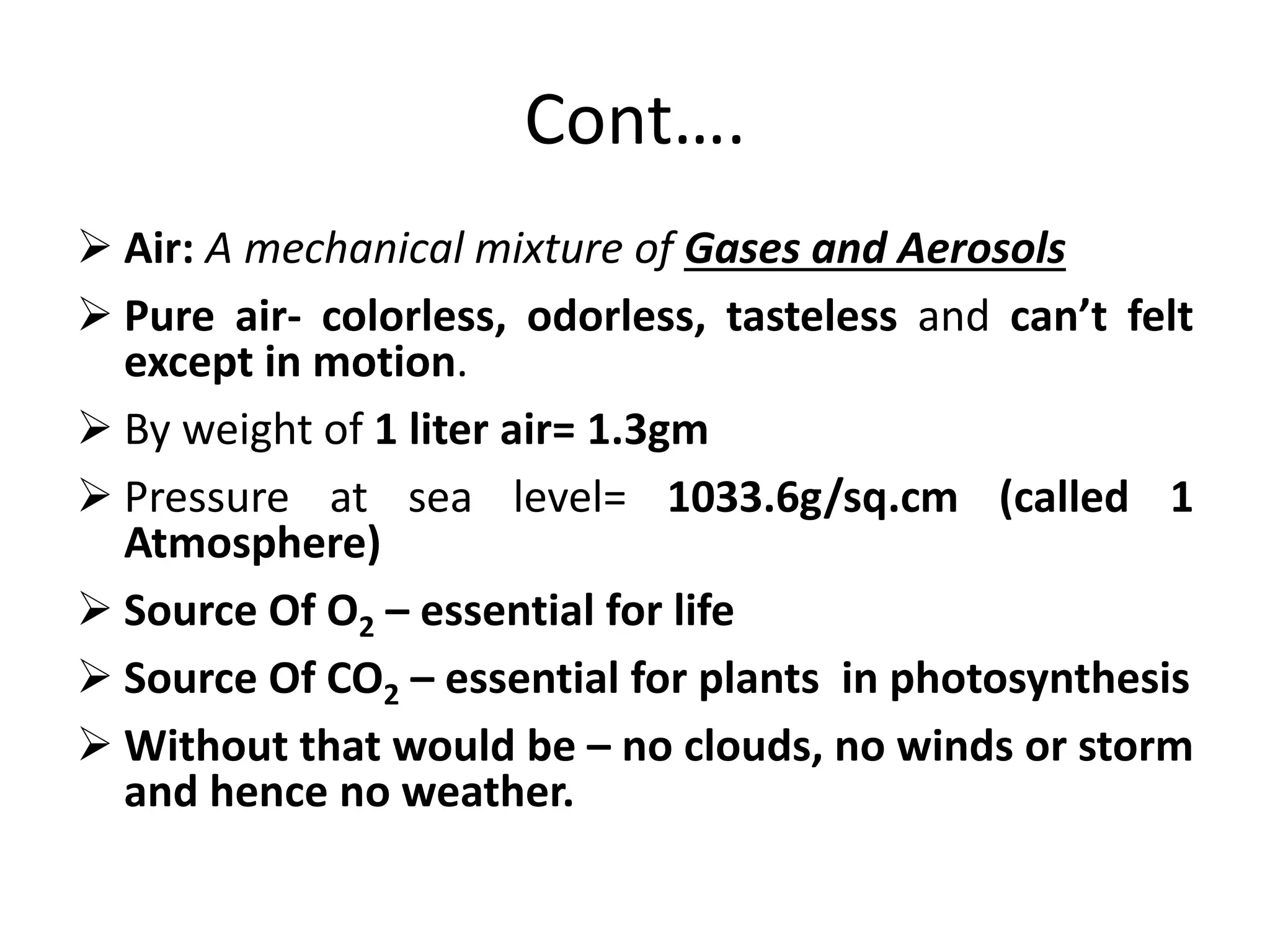
 Air: A mechanical mixture of Gases and Aerosols 
 Pure air- colorless, odorless, tasteless and can’t felt 
except in motion. 
 By weight of 1 liter air= 1.3gm 
 Pressure at sea level= 1033.6g/sq.cm (called 1 
Atmosphere) 
 Source Of O2 – essential for life 
 Source Of CO2 – essential for plants in photosynthesis 
 Without that would be – no clouds, no winds or storm 
and hence no weather.
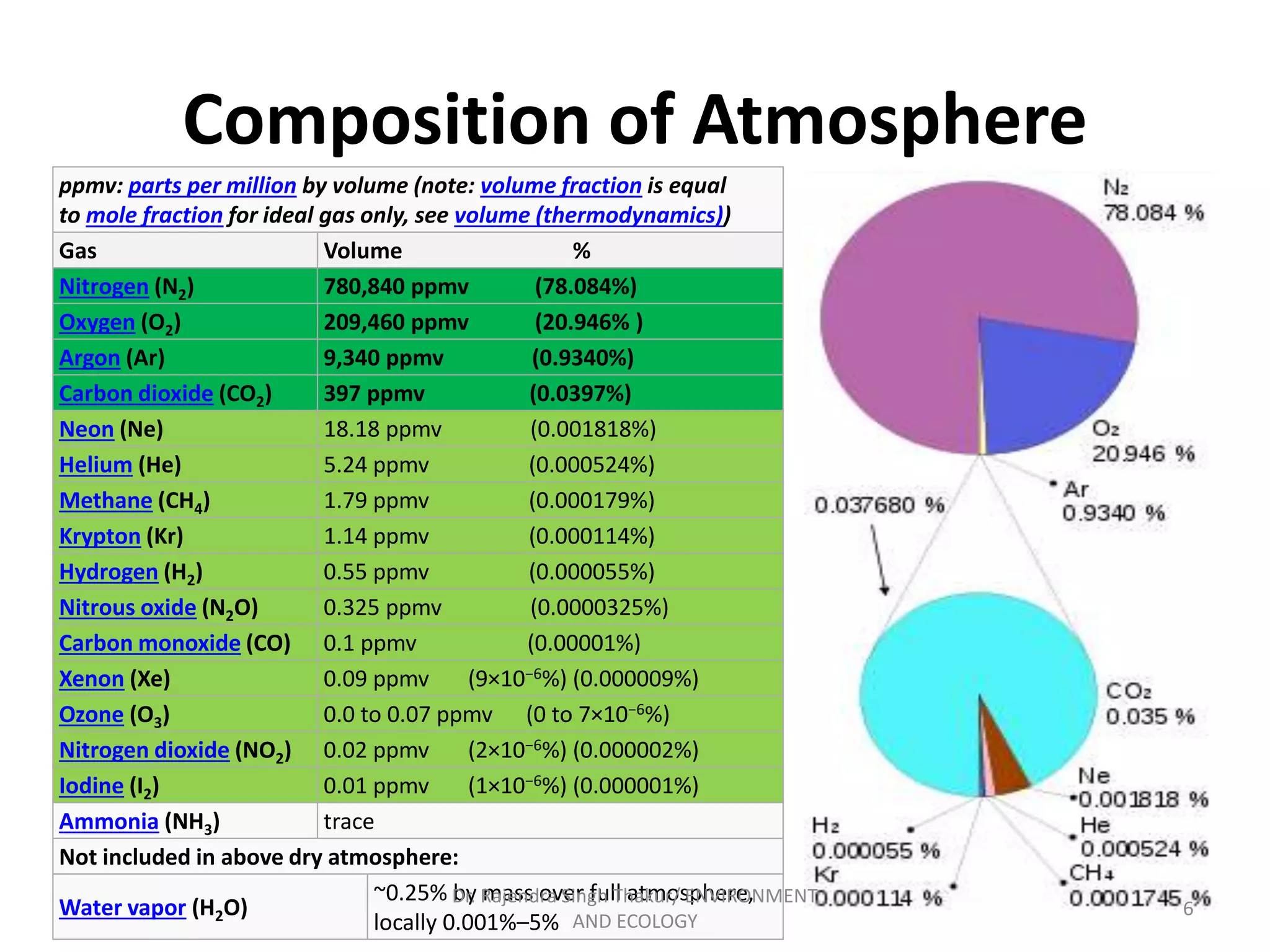
Composition of Atmosphere 
ppmv: parts per million by volume (note: volume fraction is equal 
to mole fraction for ideal gas only, see volume (thermodynamics)) 
Gas Volume % 
Nitrogen (N2) 780,840 ppmv (78.084%) 
Oxygen (O2) 209,460 ppmv (20.946% ) 
Argon (Ar) 9,340 ppmv (0.9340%) 
Carbon dioxide (CO2) 397 ppmv (0.0397%) 
Neon (Ne) 18.18 ppmv (0.001818%) 
Helium (He) 5.24 ppmv (0.000524%) 
Methane (CH4) 1.79 ppmv (0.000179%) 
Krypton (Kr) 1.14 ppmv (0.000114%) 
Hydrogen (H2) 0.55 ppmv (0.000055%) 
Nitrous oxide (N2O) 0.325 ppmv (0.0000325%) 
Carbon monoxide (CO) 0.1 ppmv (0.00001%) 
Xenon (Xe) 0.09 ppmv (9×10⁻⁶%) (0.000009%) 
Ozone (O3) 0.0 to 0.07 ppmv (0 to 7×10⁻⁶%) 
Nitrogen dioxide (NO2) 0.02 ppmv (2×10⁻⁶%) (0.000002%) 
Iodine (I2) 0.01 ppmv (1×10⁻⁶%) (0.000001%) 
Ammonia (NH3) trace 
Not included in above dry atmosphere: 
Water vapor (H2O) 
~0.25% by mass over full atmosphere, 
locally 0.001%–5% 
6 
Dr. Rajendra Singh Thakur/ ENVIRONMENT 
AND ECOLOGY
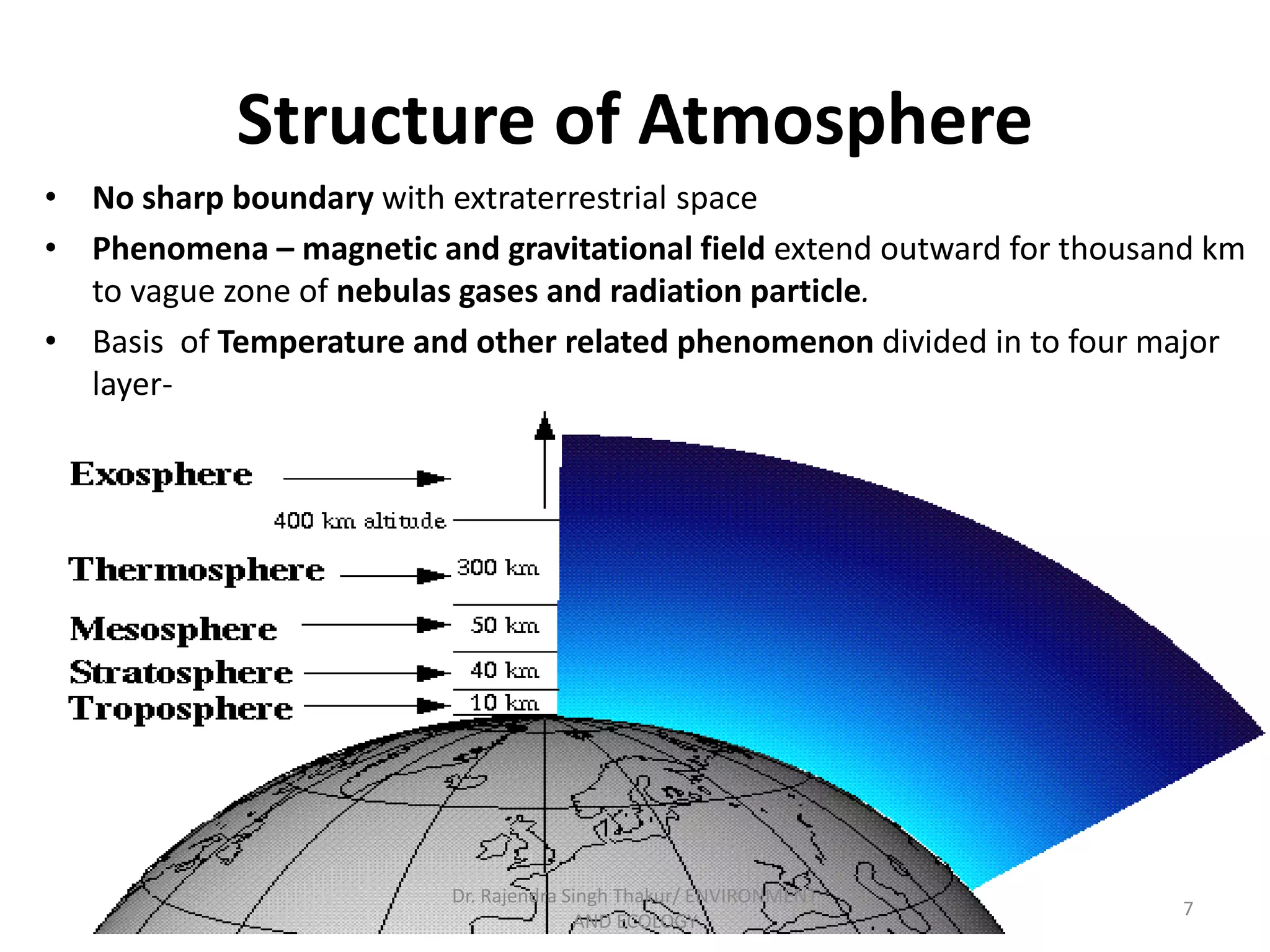
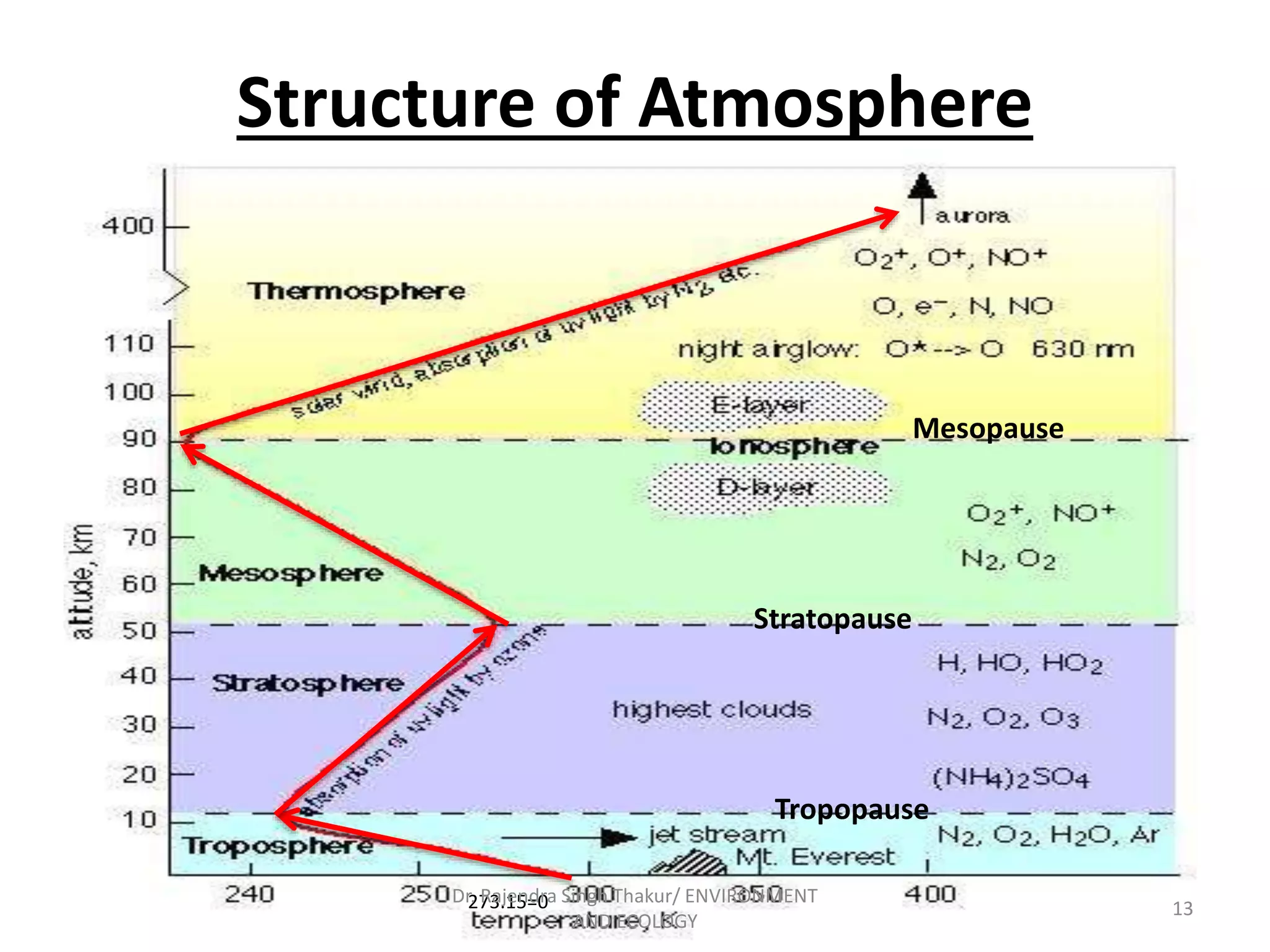
Structure of Atmosphere 
• No sharp boundary with extraterrestrial space 
• Phenomena – magnetic and gravitational field extend outward for thousand km 
to vague zone of nebulas gases and radiation particle. 
• Basis of Temperature and other related phenomenon divided in to four major 
layer- 
7 
Dr. Rajendra Singh Thakur/ ENVIRONMENT 
AND ECOLOGY
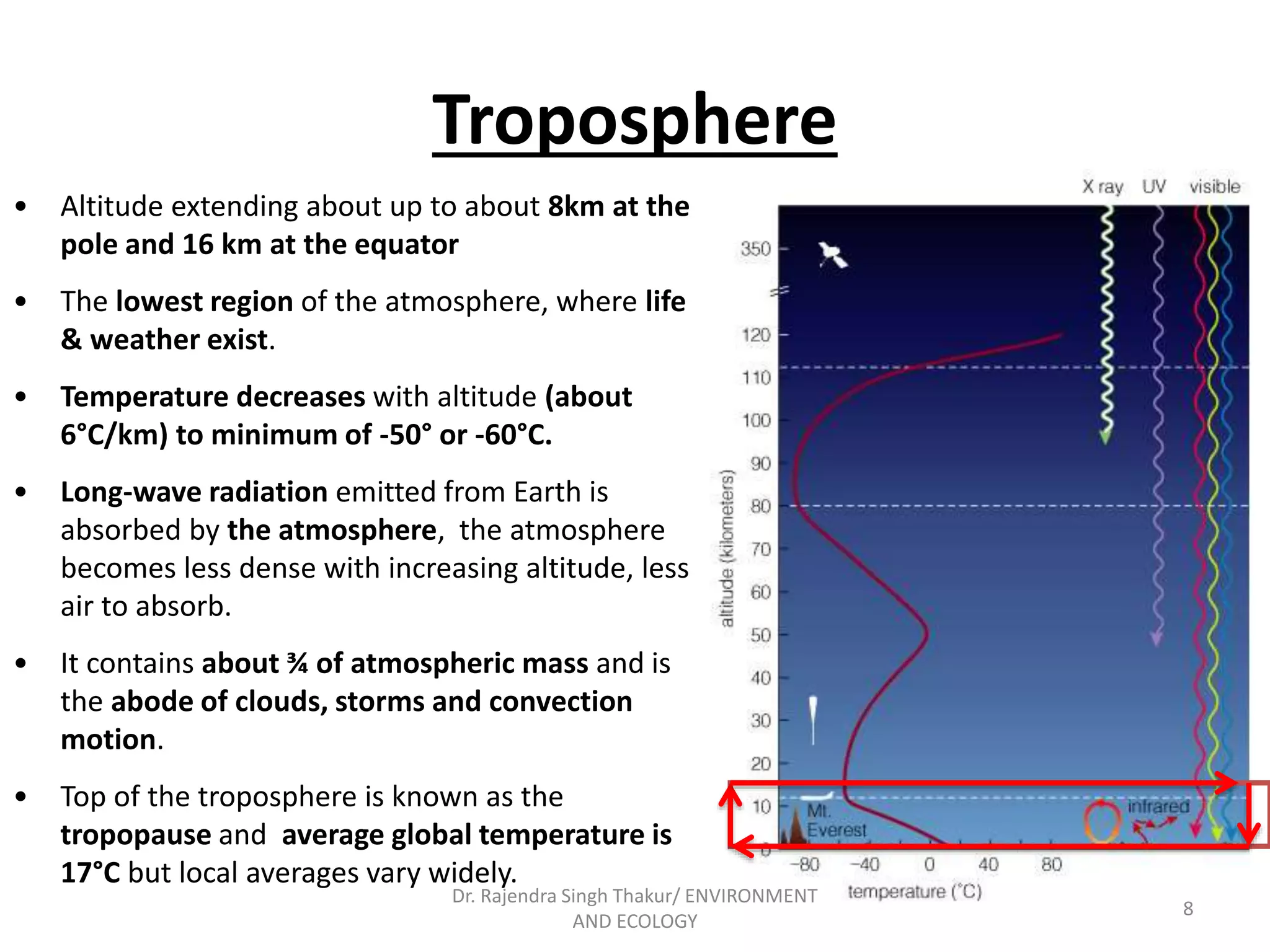
Troposphere 
• Altitude extending about up to about 8km at the 
pole and 16 km at the equator 
• The lowest region of the atmosphere, where life 
& weather exist. 
• Temperature decreases with altitude (about 
6°C/km) to minimum of -50° or -60°C. 
• Long-wave radiation emitted from Earth is 
absorbed by the atmosphere, the atmosphere 
becomes less dense with increasing altitude, less 
air to absorb. 
• It contains about ¾ of atmospheric mass and is 
the abode of clouds, storms and convection 
motion. 
• Top of the troposphere is known as the 
tropopause and average global temperature is 
17°C but local averages vary widely. 
8 
Dr. Rajendra Singh Thakur/ ENVIRONMENT 
AND ECOLOGY
Stratosphere 
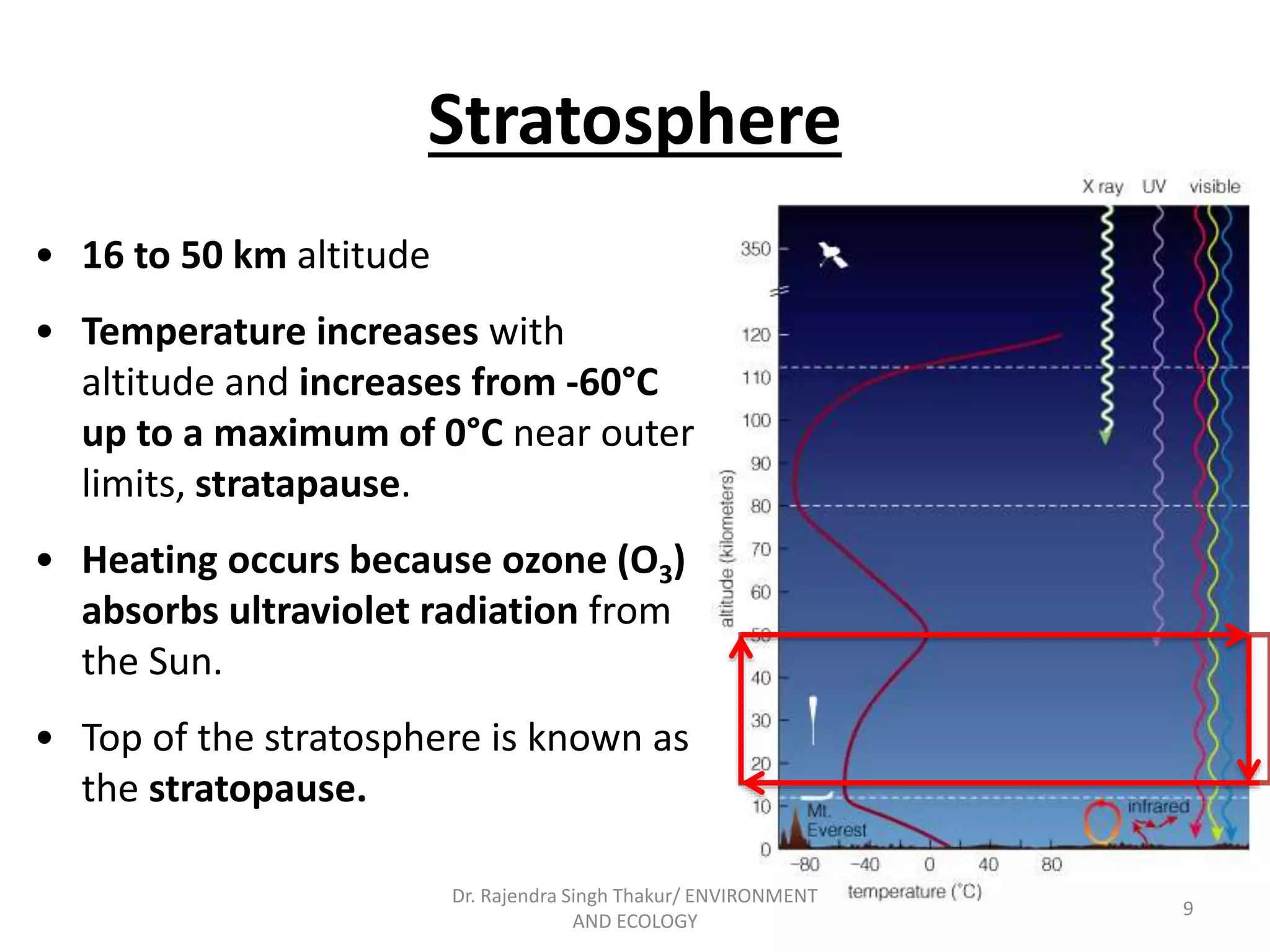
• 16 to 50 km altitude 
• Temperature increases with 
altitude and increases from -60°C 
up to a maximum of 0°C near outer 
limits, stratapause. 
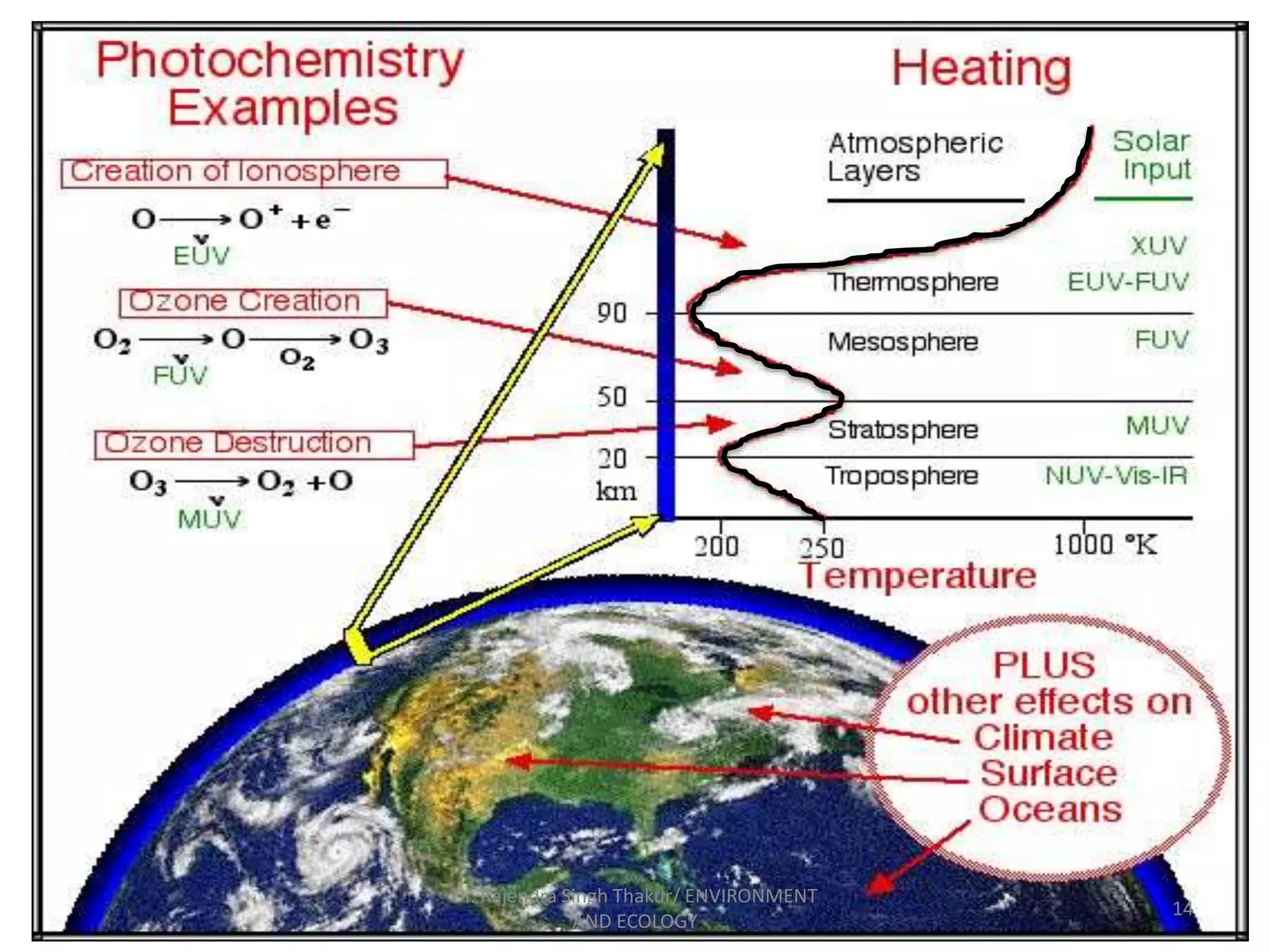
• Heating occurs because ozone (O3) 
absorbs ultraviolet radiation from 
the Sun. 
• Top of the stratosphere is known as 
the stratopause. 
9 
Dr. Rajendra Singh Thakur/ ENVIRONMENT 
AND ECOLOGY
Mesosphere 
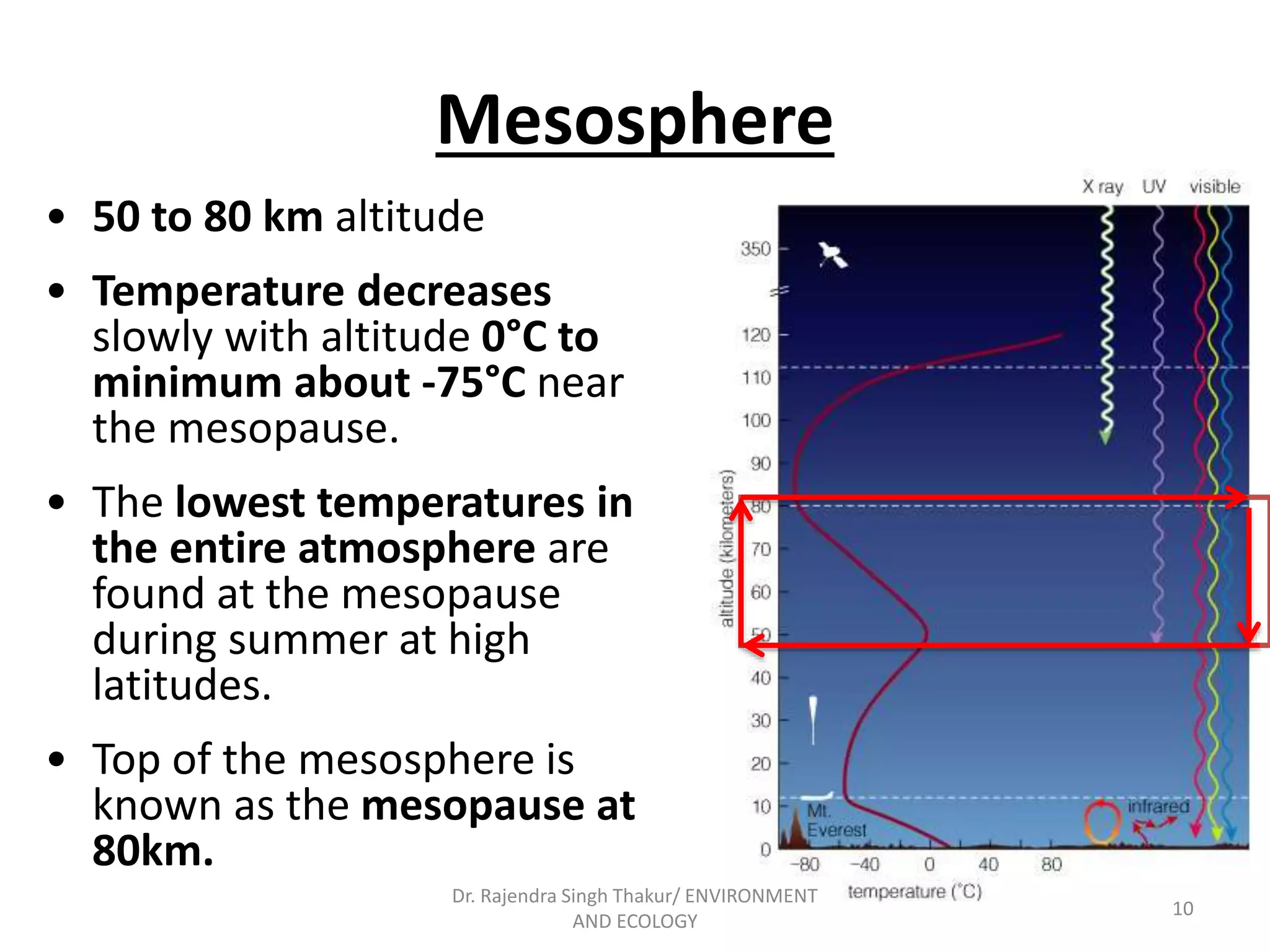
• 50 to 80 km altitude 
• Temperature decreases 
slowly with altitude 0°C to 
minimum about -75°C near 
the mesopause. 
• The lowest temperatures in 
the entire atmosphere are 
found at the mesopause 
during summer at high 
latitudes. 
• Top of the mesosphere is 
known as the mesopause at 
80km. 
10 
Dr. Rajendra Singh Thakur/ ENVIRONMENT 
AND ECOLOGY
Thermosphere 
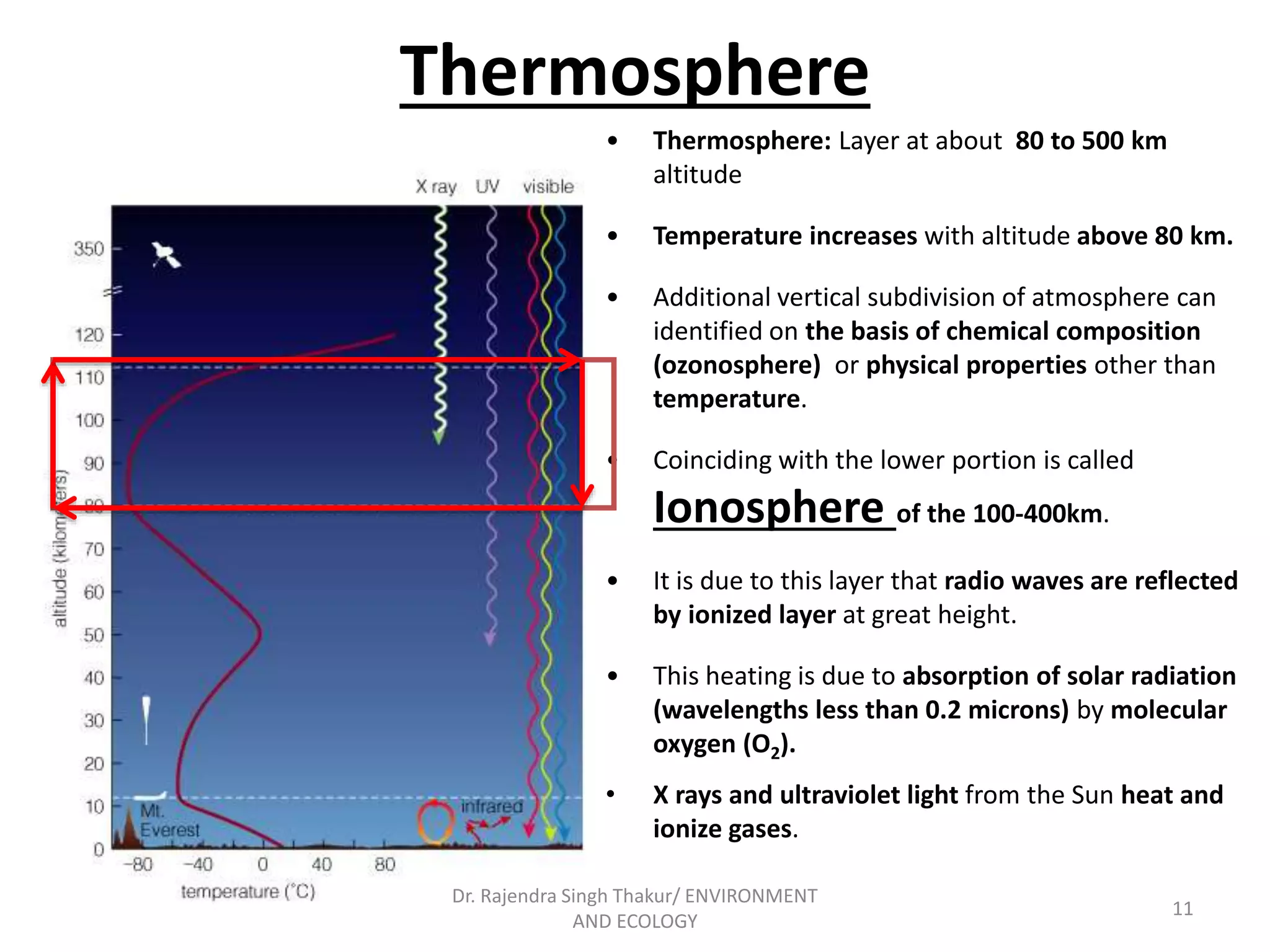
• Thermosphere: Layer at about 80 to 500 km 
altitude 
• Temperature increases with altitude above 80 km. 
• Additional vertical subdivision of atmosphere can 
identified on the basis of chemical composition 
(ozonosphere) or physical properties other than 
temperature. 
• Coinciding with the lower portion is called 
Ionosphere of the 100-400km. 
• It is due to this layer that radio waves are reflected 
by ionized layer at great height. 
• This heating is due to absorption of solar radiation 
(wavelengths less than 0.2 microns) by molecular 
oxygen (O2). 
• X rays and ultraviolet light from the Sun heat and 
ionize gases. 
11 
Dr. Rajendra Singh Thakur/ ENVIRONMENT 
AND ECOLOGY
Thermosphere 
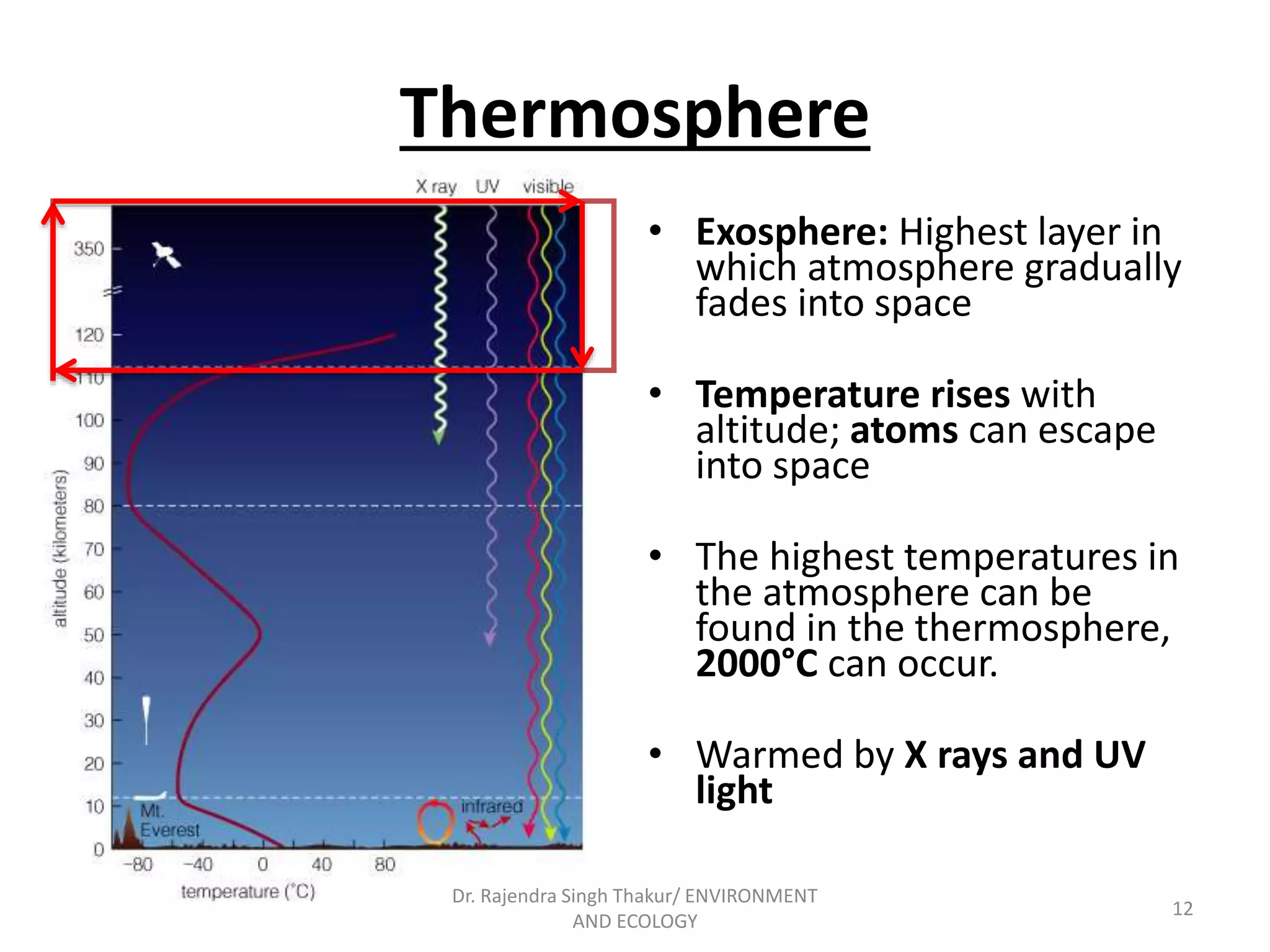
• Exosphere: Highest layer in 
which atmosphere gradually 
fades into space 
• Temperature rises with 
altitude; atoms can escape 
into space 
• The highest temperatures in 
the atmosphere can be 
found in the thermosphere, 
2000°C can occur. 
• Warmed by X rays and UV 
light 
12 
Dr. Rajendra Singh Thakur/ ENVIRONMENT 
AND ECOLOGY
Structure of Atmosphere 
Stratopause 
Mesopause 
Tropopause 
Dr. Rajendra Singh Thakur/ ENVIRONMENT 
273.15=0 13 
AND ECOLOGY
14 
Dr. Rajendra Singh Thakur/ ENVIRONMENT 
AND ECOLOGY
2. HYDROSPHERE 
15 
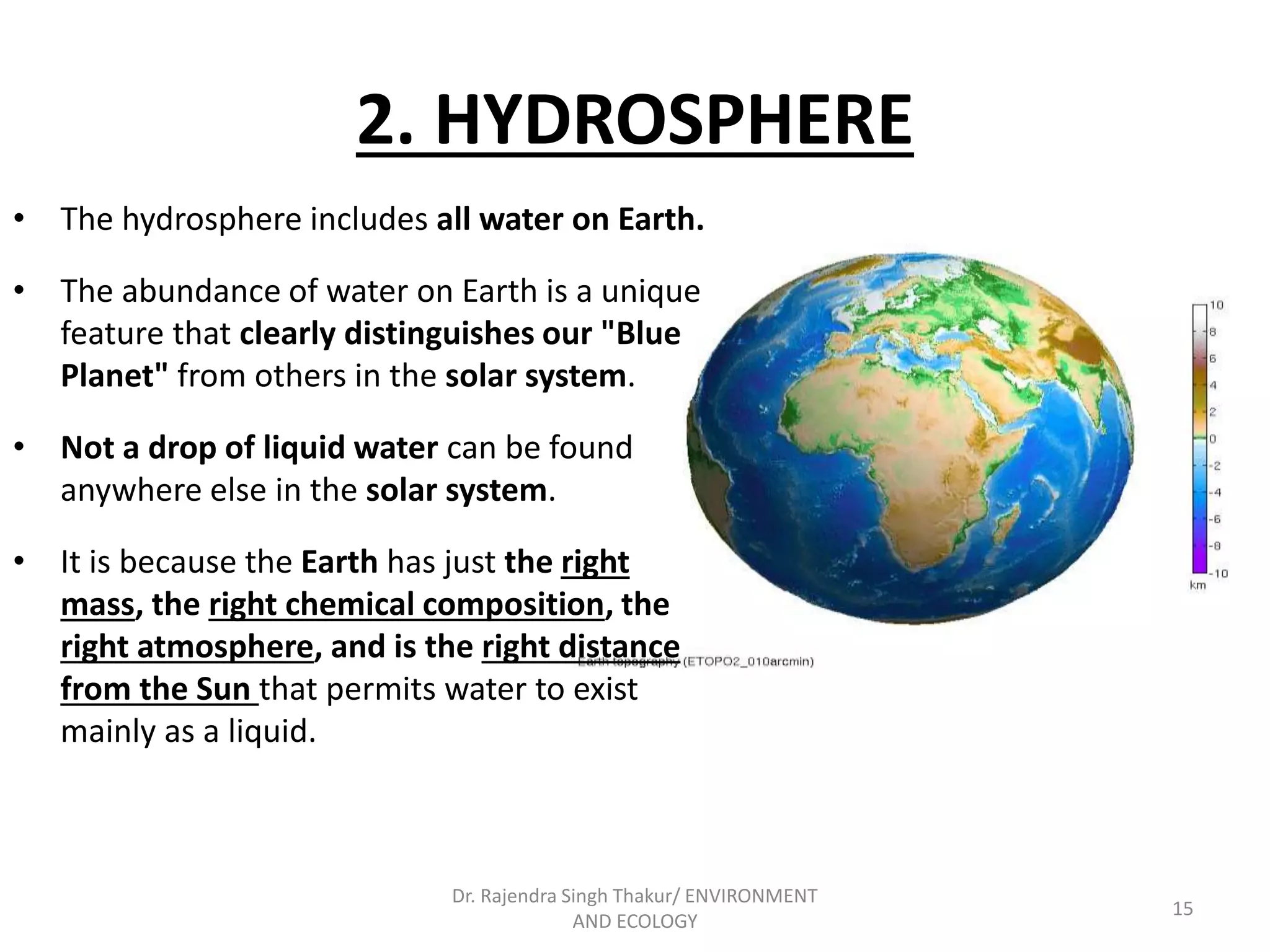
• The hydrosphere includes all water on Earth. 
• The abundance of water on Earth is a unique 
feature that clearly distinguishes our "Blue 
Planet" from others in the solar system. 
• Not a drop of liquid water can be found 
Dr. Rajendra Singh Thakur/ ENVIRONMENT 
AND ECOLOGY 
anywhere else in the solar system. 
• It is because the Earth has just the right 
mass, the right chemical composition, the 
right atmosphere, and is the right distance 
from the Sun that permits water to exist 
mainly as a liquid.
Hydrosphere 
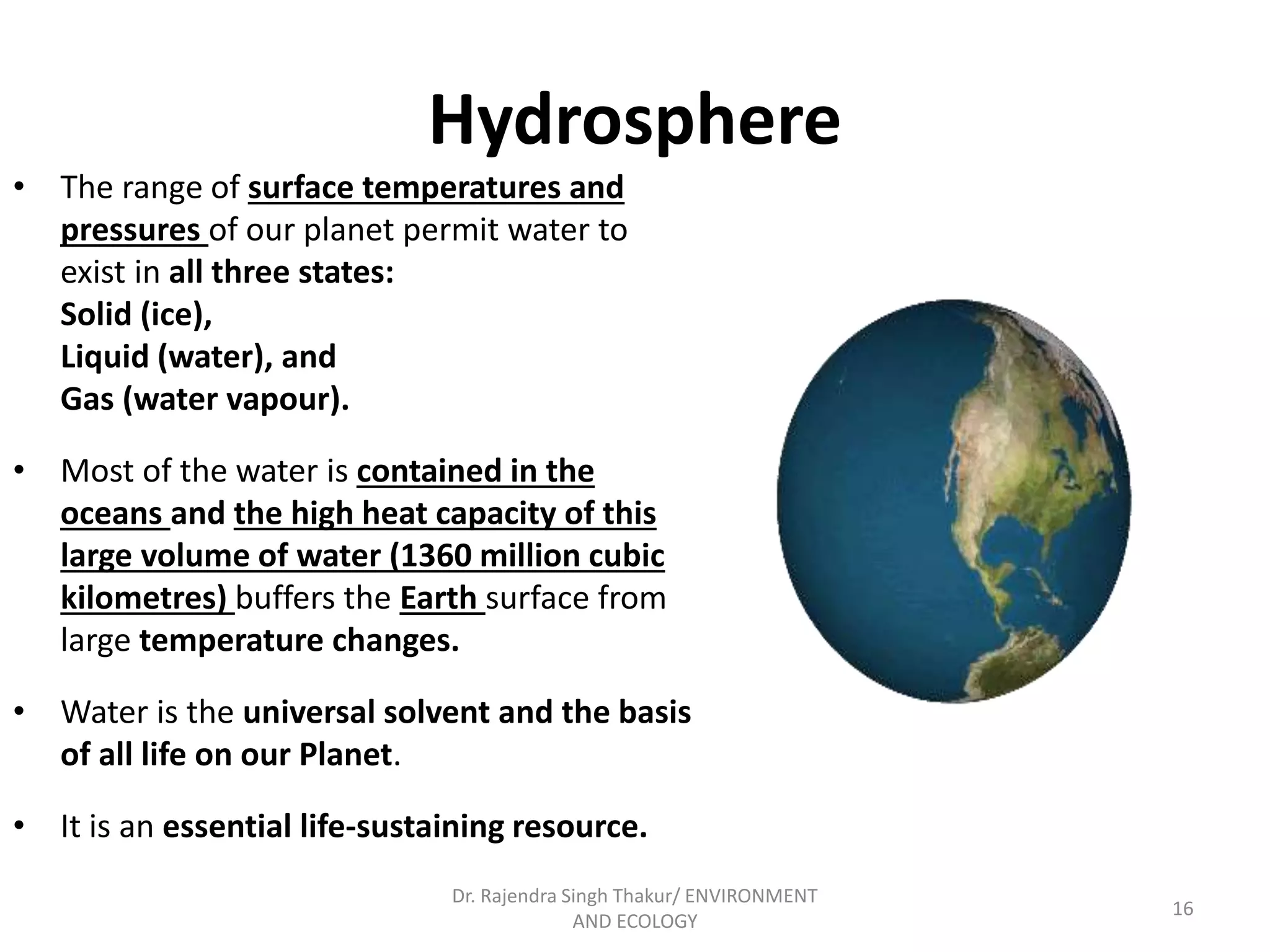
• The range of surface temperatures and 
pressures of our planet permit water to 
exist in all three states: 
Solid (ice), 
Liquid (water), and 
Gas (water vapour). 
• Most of the water is contained in the 
oceans and the high heat capacity of this 
large volume of water (1360 million cubic 
kilometres) buffers the Earth surface from 
large temperature changes. 
• Water is the universal solvent and the basis 
of all life on our Planet. 
• It is an essential life-sustaining resource. 
16 
Dr. Rajendra Singh Thakur/ ENVIRONMENT 
AND ECOLOGY
Hydrosphere 
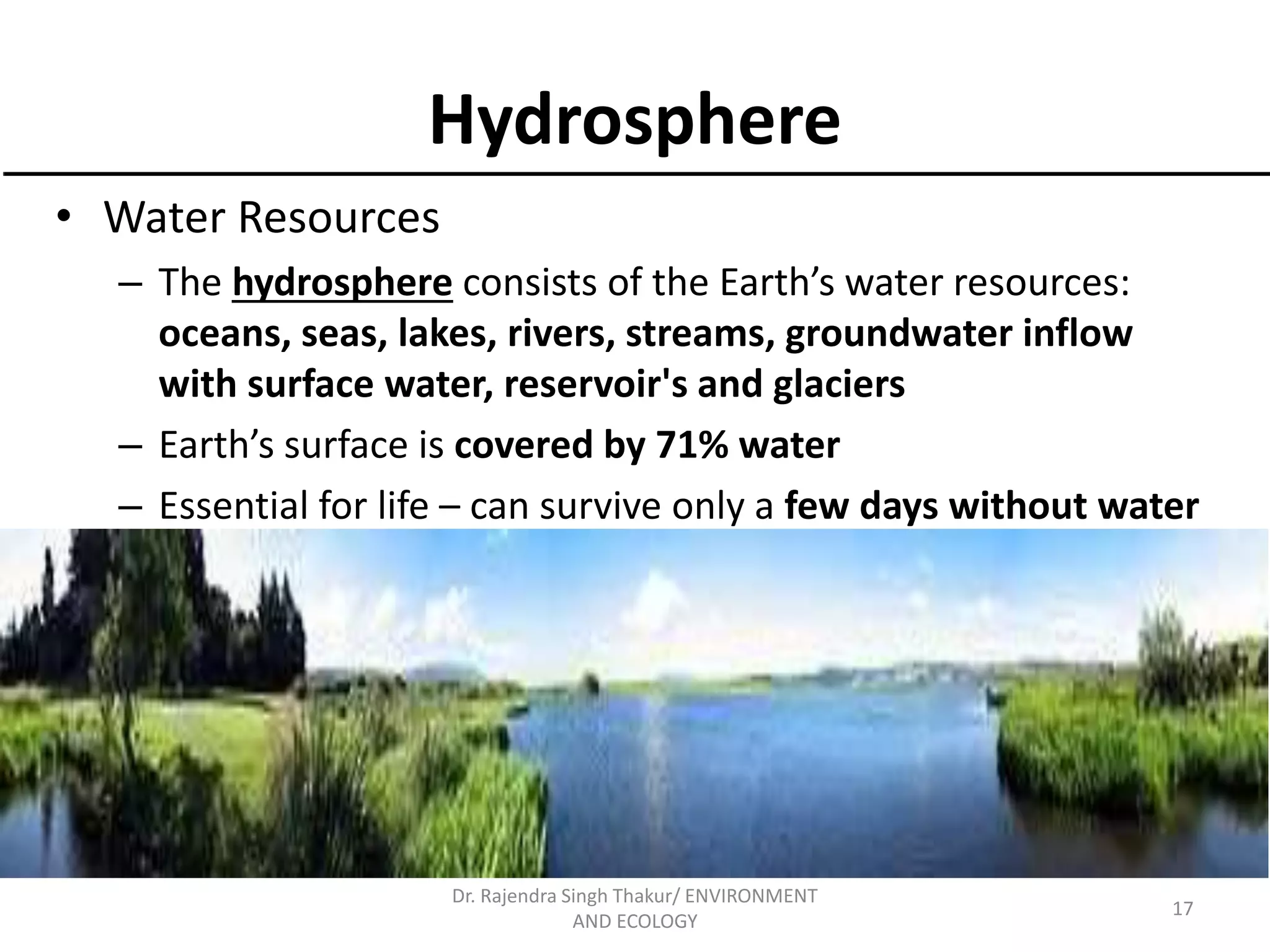
• Water Resources 
– The hydrosphere consists of the Earth’s water resources: 
oceans, seas, lakes, rivers, streams, groundwater inflow 
with surface water, reservoir's and glaciers 
– Earth’s surface is covered by 71% water 
– Essential for life – can survive only a few days without water 
17 
Dr. Rajendra Singh Thakur/ ENVIRONMENT 
AND ECOLOGY
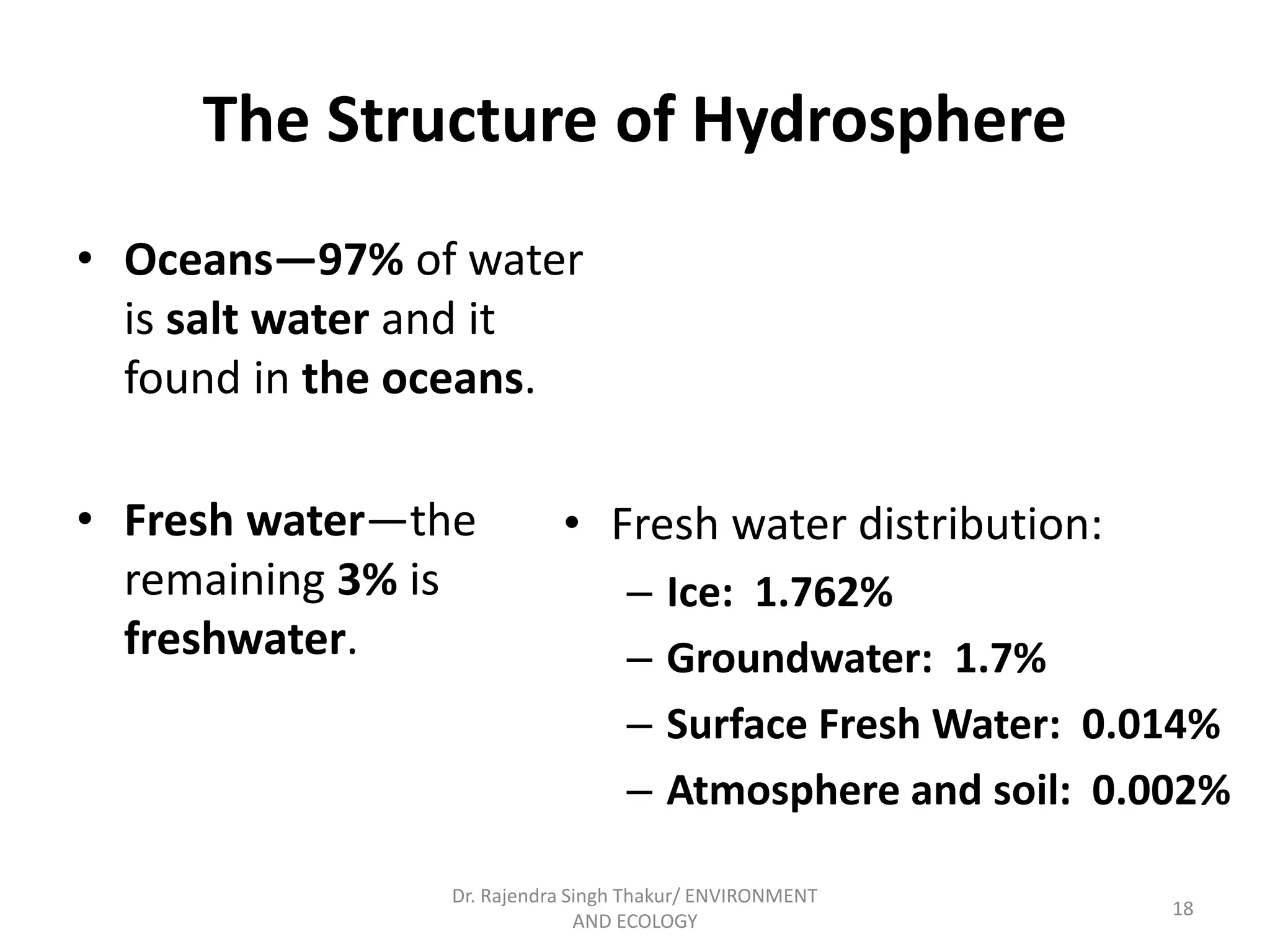
The Structure of Hydrosphere 
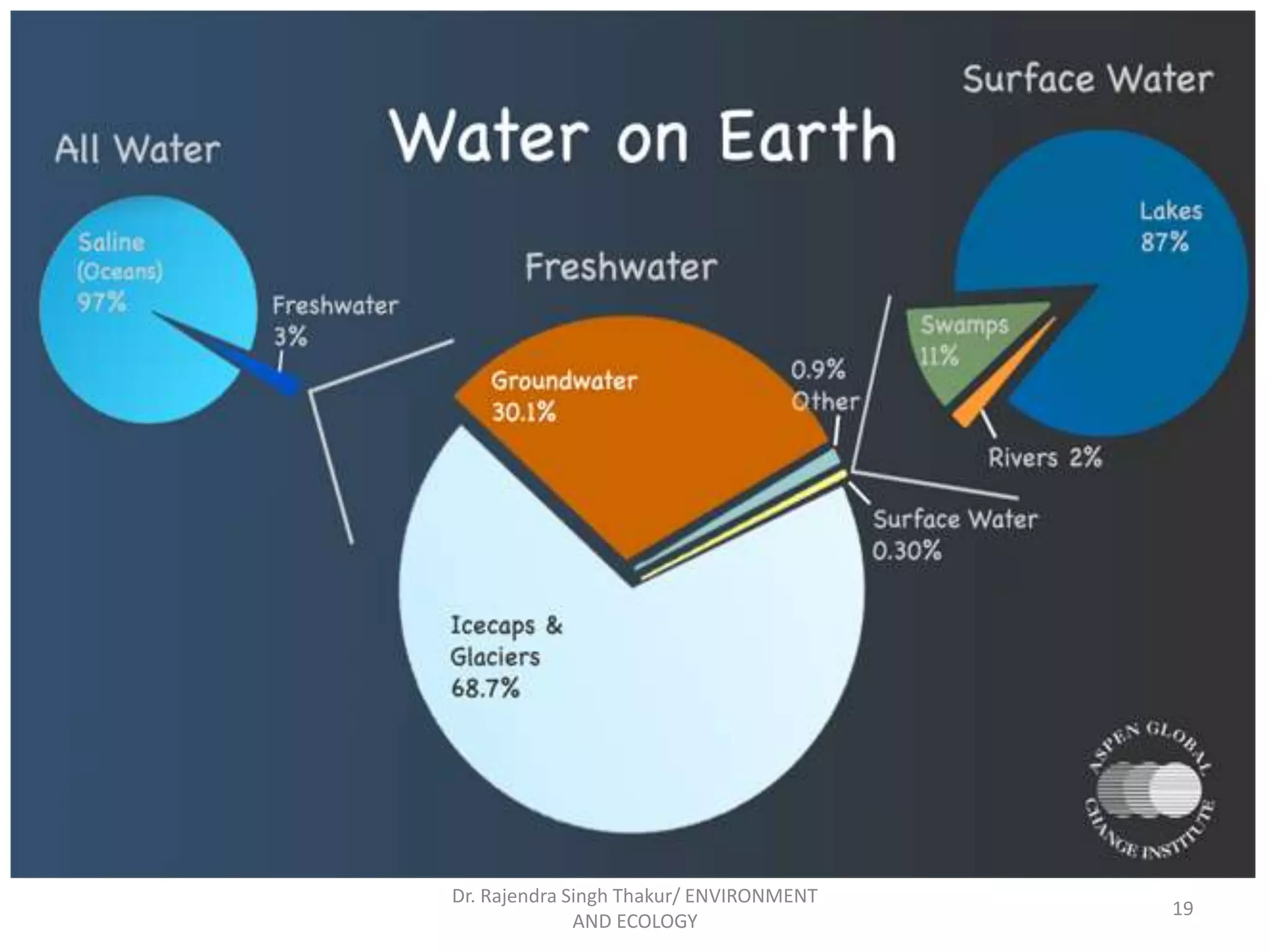
• Oceans—97% of water 
is salt water and it 
found in the oceans. 
• Fresh water—the 
remaining 3% is 
freshwater. 
• Fresh water distribution: 
– Ice: 1.762% 
– Groundwater: 1.7% 
– Surface Fresh Water: 0.014% 
– Atmosphere and soil: 0.002% 
18 
Dr. Rajendra Singh Thakur/ ENVIRONMENT 
AND ECOLOGY
19 
Dr. Rajendra Singh Thakur/ ENVIRONMENT 
AND ECOLOGY
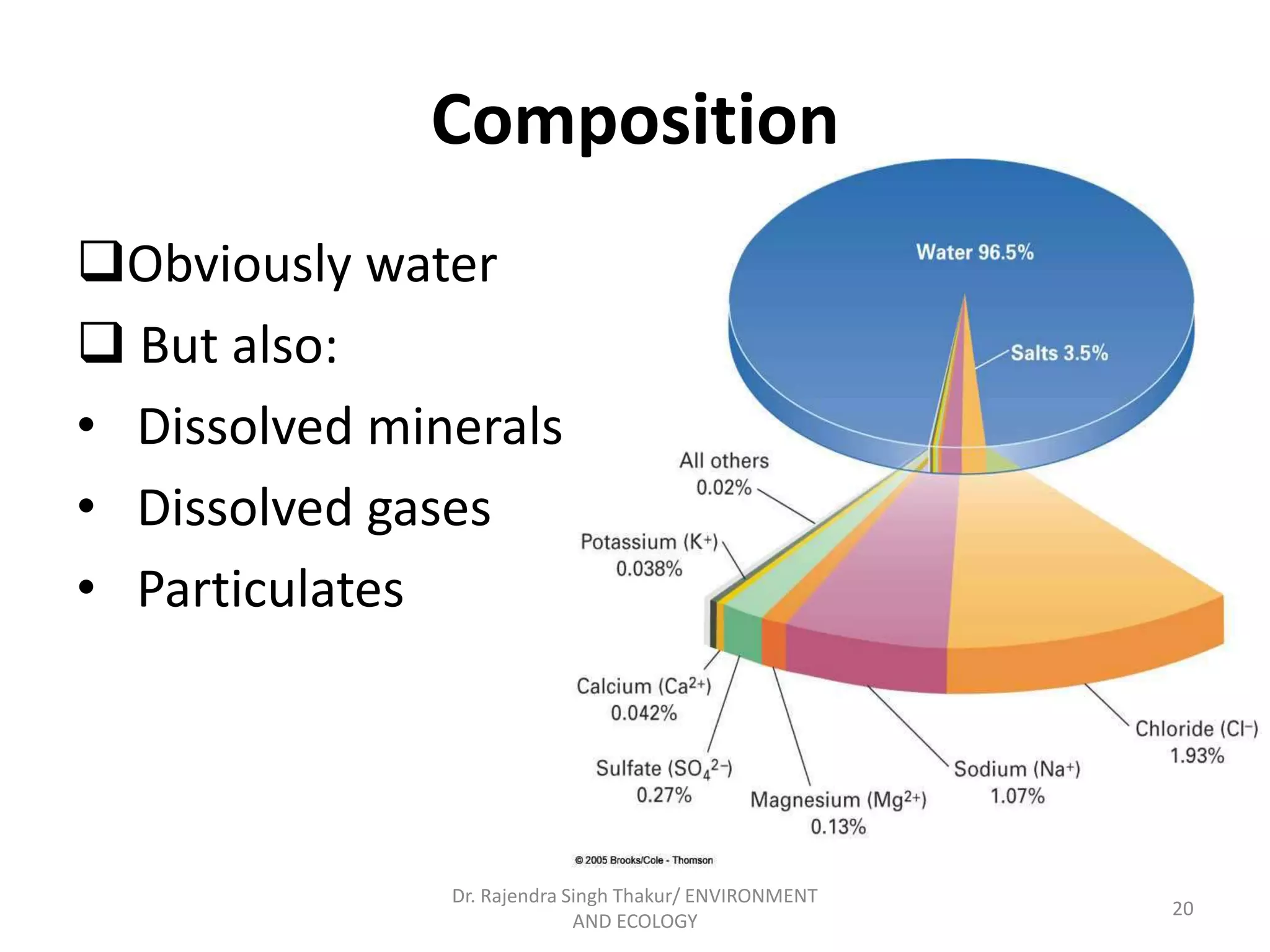
Composition 
Obviously water 
 But also: 
• Dissolved minerals 
• Dissolved gases 
• Particulates 
20 
Dr. Rajendra Singh Thakur/ ENVIRONMENT 
AND ECOLOGY
WATER CYCLE 
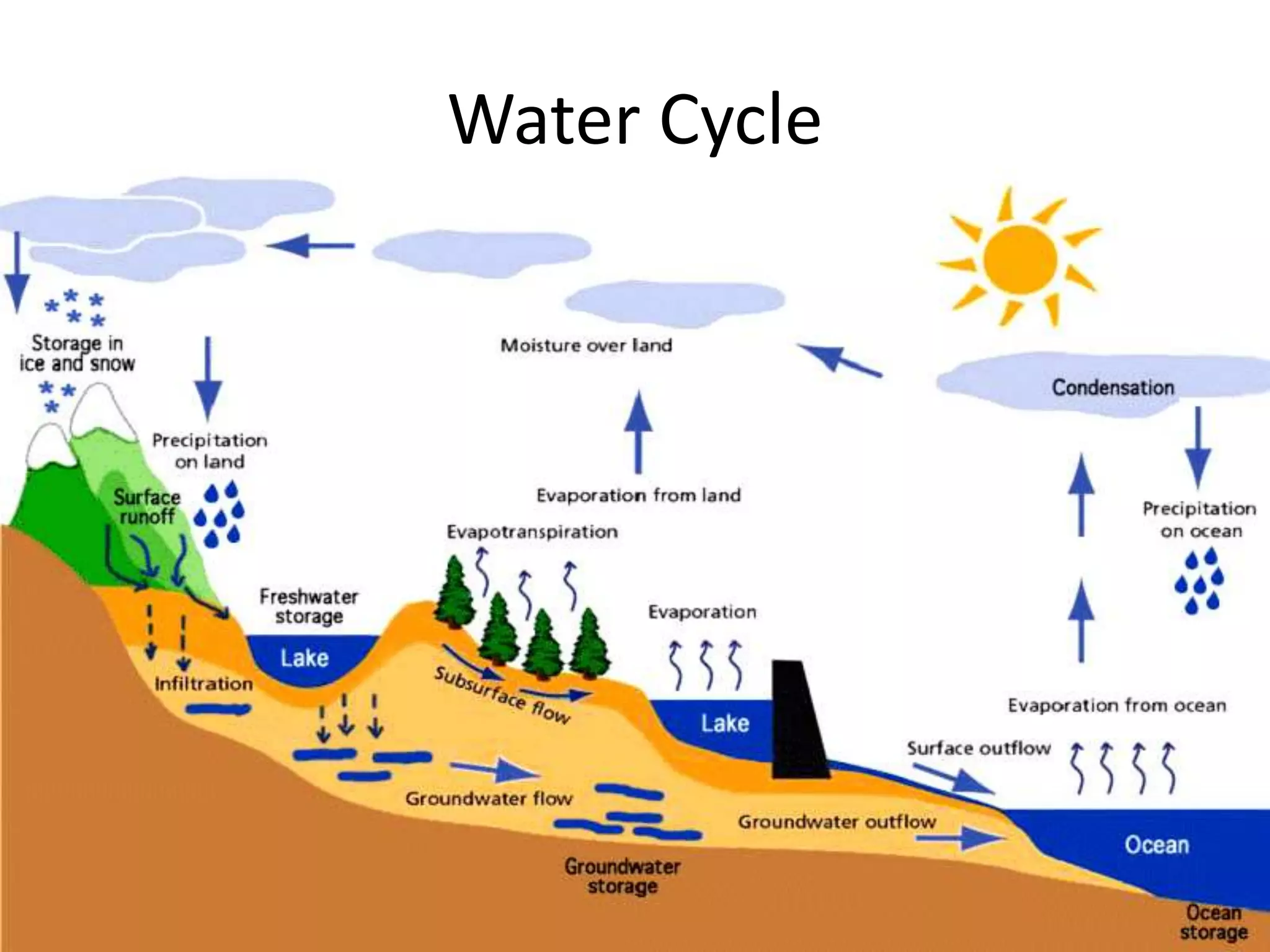
• The continuous movement of water into the air, onto land and then back to 
water sources is known “Water cycle”. 
• Evaporation is the process by which as liquid water is heated by the sun and 
then rises into the atmosphere as “water vapour”. 
• Water continually evaporates from Earth‘s oceans, lakes, streams, and soil, 
but the majority of the water evaporates from the oceans. 
• In the process of Condensation, water vapour forms water droplets on dust 
particles. 
• These water droplets form clouds, in which the droplets collide, stick 
together, and create larger, heavier droplets. 
• These larger droplets fall from clouds as rain in the process called 
“Precipitation”. 
• Precipitation may also take the form of snow, sleet, or hail.
Water Cycle
3.LITHOSPHERE 
• The lithosphere is the solid, outer part of the Earth. 
• Geological speaking, top crust of the earth on which the continent and ocean 
basin rest. 
• The Earth consists of three main layers: the core, or the inner layer; the mantle, 
in the middle; and the crust, which includes the continents and ocean floor. 
• Thickest in continental regions where average thickness 40km and thinnest in 
ocean 10-12km. 
• The movement of the lithosphere, called plate tectonics, is the reason behind a 
lot of Earth's most dramatic geologic events. 
• When one plate moves beneath another, or when two plates rub together, they 
can create earthquakes and volcanoes. 
23 
Dr. Rajendra Singh Thakur/ ENVIRONMENT 
AND ECOLOGY
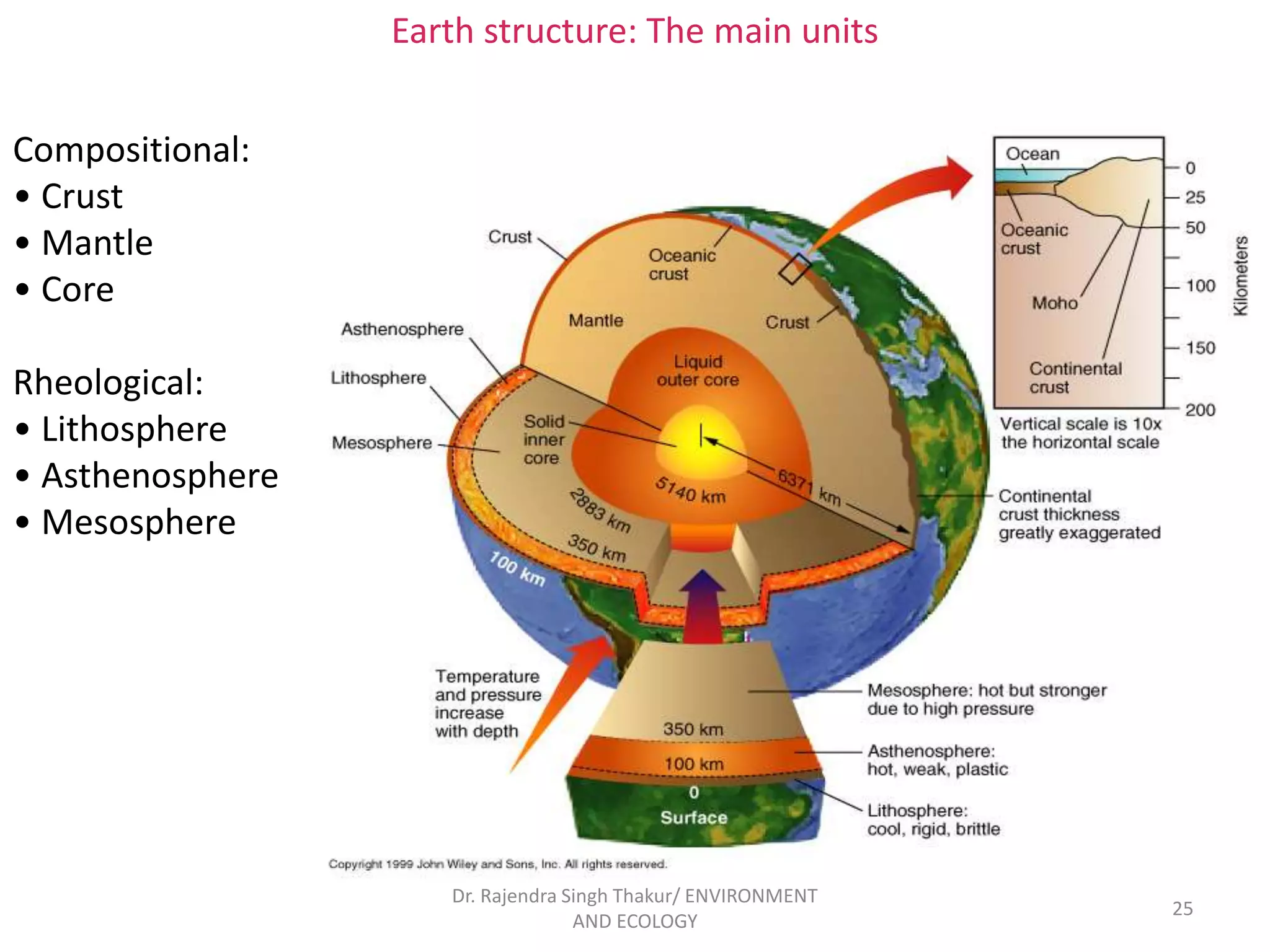
• The earth is divided into three layers –the crust, mantle, and core-based on 
what each one is made of- The lightest materials make up the outermost layer, 
and the densest materials make up the innermost layers. 
• The core is approximately 33% of the Earth’s mass and is the innermost layer. 
• The mantle is approximately 67% of the Earth’s mass. 
• The outermost layer is the crust approximately 1% of the Earth’s mass. 
• Environmental scientist- interest upper few feet of soil. 
• Soil which is important part for organic matter and biological activities 
• To produce food for human being & animals but also decomposition of organic 
waste is carried out by a host of micro-organism in the soil. 
24 
Dr. Rajendra Singh Thakur/ ENVIRONMENT 
AND ECOLOGY
Earth structure: The main units 
Compositional: 
• Crust 
• Mantle 
• Core 
Rheological: 
• Lithosphere 
• Asthenosphere 
• Mesosphere 
25 
Dr. Rajendra Singh Thakur/ ENVIRONMENT 
AND ECOLOGY
4.BIOSPHERE 
• The interaction of life with environment takes place of many levels. 
• A single bacterium in the soil interact with the water, air and particle of soil within a fraction of a cubic 
centimeter. 
• While forest extending hundred square km interact with large volume of water, air and soil. 
• Part of Earth in which life exists including land, water, and air or atmosphere. 
• We live in the natural world and use its resources (water, space, food, etc). 
• The natural world effects our lives (weather, fire, economy). 
• To protect biodiversity. 
• Thus all lower atmosphere and near surface part of lithosphere and hydrosphere affected by life is 
whole exist few meters of exists surface. 
• This region of the earth where life exist is known as “Biosphere”. 
• All living things required energy and materials. 
• In biosphere energy received from the sun and interior of the earth received energy is then used and 
Dr. Rajendra Singh Thakur/ ENVIRONMENT 
given off a material are recycled. 26 
AND ECOLOGY
Biosphere 
• The biosphere infect is a thin shell that encapsulates the earth which includes 
all life as well as the lower atmosphere and the oceans, rivers, lakes, soils and 
solid sediments that activity interchange materials with life. 
• According to an estimate biosphere contains- 
 More than 3.5 lacs species of plant (including-algae, fungi, mosses & higher 
from of plants). 
 More than 11 million species of animal (ranging from unicellular protozoa to 
man). 
• Supplies all the essential requisite of life-namely, light, heat, air, water, food & 
living space (habitats) for all these species. 
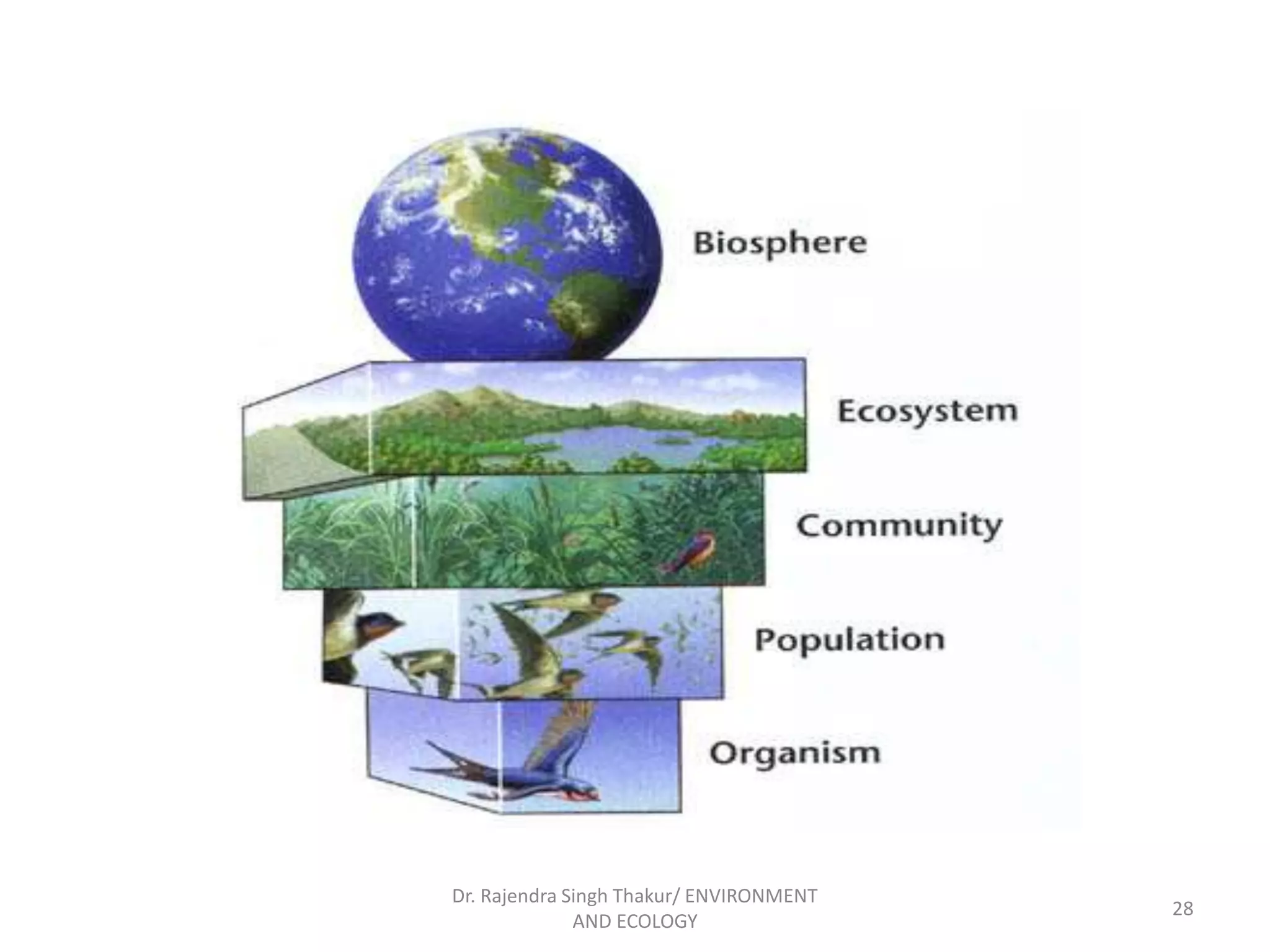
• Since biosphere is very large and complex then it better understanding by 
divided in to smaller units called “Ecosystems” or “Ecological systems.” 
27 
Dr. Rajendra Singh Thakur/ ENVIRONMENT 
AND ECOLOGY
28 
Dr. Rajendra Singh Thakur/ ENVIRONMENT 
AND ECOLOGY

Environment and its segments

  • 1.
    ENVIRONMENT AND ECOLOGY Dr. Rajendra Singh Thakur
  • 2.
    ENVIRONMENT AND ITSSEGMENTS • Word “Environment” derived from French word “Environner” meaning “To encircle or Surround”. • Simply be defined as the surrounding of an organism in which the organism lives. • Surrounding includes things-  Non-living (Abiotic)- Air, Water, Soil etc.  Living (Biotic)- all other living beings which organism comes into regular contact in its environment. • Absence of these organism meaningless to speak of environment and vice versa. • In other words exists a mutual interaction between every organism and its environment. 2 Dr. Rajendra Singh Thakur/ ENVIRONMENT AND ECOLOGY
  • 3.
    Global Environment Consistfour segments- 1. Atmosphere 2. Hydrosphere 3. Lithosphere 4. Biosphere 3 Dr. Rajendra Singh Thakur/ ENVIRONMENT AND ECOLOGY
  • 4.
    1. ATMOSPHERE Definitions: “The thin envelope of gases surrounding the earth Highly compressible”  Absorb most cosmic rays from outer space and a major portion of electromagnetic radiation (EMR) from Sun and transmits only near UV, visible & IR radiation (300- 2500nm) and radio wave while filtering out harmful UV radiation below 300nm.  Atmosphere is bound to earth by gravity.  Total mass of Atmosphere: 5x10⁵ tones which is 1 millionth of Earth’s total mass.  Density decreases rapidly with height
  • 5.
    Cont….  Air:A mechanical mixture of Gases and Aerosols  Pure air- colorless, odorless, tasteless and can’t felt except in motion.  By weight of 1 liter air= 1.3gm  Pressure at sea level= 1033.6g/sq.cm (called 1 Atmosphere)  Source Of O2 – essential for life  Source Of CO2 – essential for plants in photosynthesis  Without that would be – no clouds, no winds or storm and hence no weather.
  • 6.
    Composition of Atmosphere ppmv: parts per million by volume (note: volume fraction is equal to mole fraction for ideal gas only, see volume (thermodynamics)) Gas Volume % Nitrogen (N2) 780,840 ppmv (78.084%) Oxygen (O2) 209,460 ppmv (20.946% ) Argon (Ar) 9,340 ppmv (0.9340%) Carbon dioxide (CO2) 397 ppmv (0.0397%) Neon (Ne) 18.18 ppmv (0.001818%) Helium (He) 5.24 ppmv (0.000524%) Methane (CH4) 1.79 ppmv (0.000179%) Krypton (Kr) 1.14 ppmv (0.000114%) Hydrogen (H2) 0.55 ppmv (0.000055%) Nitrous oxide (N2O) 0.325 ppmv (0.0000325%) Carbon monoxide (CO) 0.1 ppmv (0.00001%) Xenon (Xe) 0.09 ppmv (9×10⁻⁶%) (0.000009%) Ozone (O3) 0.0 to 0.07 ppmv (0 to 7×10⁻⁶%) Nitrogen dioxide (NO2) 0.02 ppmv (2×10⁻⁶%) (0.000002%) Iodine (I2) 0.01 ppmv (1×10⁻⁶%) (0.000001%) Ammonia (NH3) trace Not included in above dry atmosphere: Water vapor (H2O) ~0.25% by mass over full atmosphere, locally 0.001%–5% 6 Dr. Rajendra Singh Thakur/ ENVIRONMENT AND ECOLOGY
  • 7.
    Structure of Atmosphere • No sharp boundary with extraterrestrial space • Phenomena – magnetic and gravitational field extend outward for thousand km to vague zone of nebulas gases and radiation particle. • Basis of Temperature and other related phenomenon divided in to four major layer- 7 Dr. Rajendra Singh Thakur/ ENVIRONMENT AND ECOLOGY
  • 8.
    Troposphere • Altitudeextending about up to about 8km at the pole and 16 km at the equator • The lowest region of the atmosphere, where life & weather exist. • Temperature decreases with altitude (about 6°C/km) to minimum of -50° or -60°C. • Long-wave radiation emitted from Earth is absorbed by the atmosphere, the atmosphere becomes less dense with increasing altitude, less air to absorb. • It contains about ¾ of atmospheric mass and is the abode of clouds, storms and convection motion. • Top of the troposphere is known as the tropopause and average global temperature is 17°C but local averages vary widely. 8 Dr. Rajendra Singh Thakur/ ENVIRONMENT AND ECOLOGY
  • 9.
    Stratosphere • 16to 50 km altitude • Temperature increases with altitude and increases from -60°C up to a maximum of 0°C near outer limits, stratapause. • Heating occurs because ozone (O3) absorbs ultraviolet radiation from the Sun. • Top of the stratosphere is known as the stratopause. 9 Dr. Rajendra Singh Thakur/ ENVIRONMENT AND ECOLOGY
  • 10.
    Mesosphere • 50to 80 km altitude • Temperature decreases slowly with altitude 0°C to minimum about -75°C near the mesopause. • The lowest temperatures in the entire atmosphere are found at the mesopause during summer at high latitudes. • Top of the mesosphere is known as the mesopause at 80km. 10 Dr. Rajendra Singh Thakur/ ENVIRONMENT AND ECOLOGY
  • 11.
    Thermosphere • Thermosphere:Layer at about 80 to 500 km altitude • Temperature increases with altitude above 80 km. • Additional vertical subdivision of atmosphere can identified on the basis of chemical composition (ozonosphere) or physical properties other than temperature. • Coinciding with the lower portion is called Ionosphere of the 100-400km. • It is due to this layer that radio waves are reflected by ionized layer at great height. • This heating is due to absorption of solar radiation (wavelengths less than 0.2 microns) by molecular oxygen (O2). • X rays and ultraviolet light from the Sun heat and ionize gases. 11 Dr. Rajendra Singh Thakur/ ENVIRONMENT AND ECOLOGY
  • 12.
    Thermosphere • Exosphere:Highest layer in which atmosphere gradually fades into space • Temperature rises with altitude; atoms can escape into space • The highest temperatures in the atmosphere can be found in the thermosphere, 2000°C can occur. • Warmed by X rays and UV light 12 Dr. Rajendra Singh Thakur/ ENVIRONMENT AND ECOLOGY
  • 13.
    Structure of Atmosphere Stratopause Mesopause Tropopause Dr. Rajendra Singh Thakur/ ENVIRONMENT 273.15=0 13 AND ECOLOGY
  • 14.
    14 Dr. RajendraSingh Thakur/ ENVIRONMENT AND ECOLOGY
  • 15.
    2. HYDROSPHERE 15 • The hydrosphere includes all water on Earth. • The abundance of water on Earth is a unique feature that clearly distinguishes our "Blue Planet" from others in the solar system. • Not a drop of liquid water can be found Dr. Rajendra Singh Thakur/ ENVIRONMENT AND ECOLOGY anywhere else in the solar system. • It is because the Earth has just the right mass, the right chemical composition, the right atmosphere, and is the right distance from the Sun that permits water to exist mainly as a liquid.
  • 16.
    Hydrosphere • Therange of surface temperatures and pressures of our planet permit water to exist in all three states: Solid (ice), Liquid (water), and Gas (water vapour). • Most of the water is contained in the oceans and the high heat capacity of this large volume of water (1360 million cubic kilometres) buffers the Earth surface from large temperature changes. • Water is the universal solvent and the basis of all life on our Planet. • It is an essential life-sustaining resource. 16 Dr. Rajendra Singh Thakur/ ENVIRONMENT AND ECOLOGY
  • 17.
    Hydrosphere • WaterResources – The hydrosphere consists of the Earth’s water resources: oceans, seas, lakes, rivers, streams, groundwater inflow with surface water, reservoir's and glaciers – Earth’s surface is covered by 71% water – Essential for life – can survive only a few days without water 17 Dr. Rajendra Singh Thakur/ ENVIRONMENT AND ECOLOGY
  • 18.
    The Structure ofHydrosphere • Oceans—97% of water is salt water and it found in the oceans. • Fresh water—the remaining 3% is freshwater. • Fresh water distribution: – Ice: 1.762% – Groundwater: 1.7% – Surface Fresh Water: 0.014% – Atmosphere and soil: 0.002% 18 Dr. Rajendra Singh Thakur/ ENVIRONMENT AND ECOLOGY
  • 19.
    19 Dr. RajendraSingh Thakur/ ENVIRONMENT AND ECOLOGY
  • 20.
    Composition Obviously water  But also: • Dissolved minerals • Dissolved gases • Particulates 20 Dr. Rajendra Singh Thakur/ ENVIRONMENT AND ECOLOGY
  • 21.
    WATER CYCLE •The continuous movement of water into the air, onto land and then back to water sources is known “Water cycle”. • Evaporation is the process by which as liquid water is heated by the sun and then rises into the atmosphere as “water vapour”. • Water continually evaporates from Earth‘s oceans, lakes, streams, and soil, but the majority of the water evaporates from the oceans. • In the process of Condensation, water vapour forms water droplets on dust particles. • These water droplets form clouds, in which the droplets collide, stick together, and create larger, heavier droplets. • These larger droplets fall from clouds as rain in the process called “Precipitation”. • Precipitation may also take the form of snow, sleet, or hail.
  • 22.
  • 23.
    3.LITHOSPHERE • Thelithosphere is the solid, outer part of the Earth. • Geological speaking, top crust of the earth on which the continent and ocean basin rest. • The Earth consists of three main layers: the core, or the inner layer; the mantle, in the middle; and the crust, which includes the continents and ocean floor. • Thickest in continental regions where average thickness 40km and thinnest in ocean 10-12km. • The movement of the lithosphere, called plate tectonics, is the reason behind a lot of Earth's most dramatic geologic events. • When one plate moves beneath another, or when two plates rub together, they can create earthquakes and volcanoes. 23 Dr. Rajendra Singh Thakur/ ENVIRONMENT AND ECOLOGY
  • 24.
    • The earthis divided into three layers –the crust, mantle, and core-based on what each one is made of- The lightest materials make up the outermost layer, and the densest materials make up the innermost layers. • The core is approximately 33% of the Earth’s mass and is the innermost layer. • The mantle is approximately 67% of the Earth’s mass. • The outermost layer is the crust approximately 1% of the Earth’s mass. • Environmental scientist- interest upper few feet of soil. • Soil which is important part for organic matter and biological activities • To produce food for human being & animals but also decomposition of organic waste is carried out by a host of micro-organism in the soil. 24 Dr. Rajendra Singh Thakur/ ENVIRONMENT AND ECOLOGY
  • 25.
    Earth structure: Themain units Compositional: • Crust • Mantle • Core Rheological: • Lithosphere • Asthenosphere • Mesosphere 25 Dr. Rajendra Singh Thakur/ ENVIRONMENT AND ECOLOGY
  • 26.
    4.BIOSPHERE • Theinteraction of life with environment takes place of many levels. • A single bacterium in the soil interact with the water, air and particle of soil within a fraction of a cubic centimeter. • While forest extending hundred square km interact with large volume of water, air and soil. • Part of Earth in which life exists including land, water, and air or atmosphere. • We live in the natural world and use its resources (water, space, food, etc). • The natural world effects our lives (weather, fire, economy). • To protect biodiversity. • Thus all lower atmosphere and near surface part of lithosphere and hydrosphere affected by life is whole exist few meters of exists surface. • This region of the earth where life exist is known as “Biosphere”. • All living things required energy and materials. • In biosphere energy received from the sun and interior of the earth received energy is then used and Dr. Rajendra Singh Thakur/ ENVIRONMENT given off a material are recycled. 26 AND ECOLOGY
  • 27.
    Biosphere • Thebiosphere infect is a thin shell that encapsulates the earth which includes all life as well as the lower atmosphere and the oceans, rivers, lakes, soils and solid sediments that activity interchange materials with life. • According to an estimate biosphere contains-  More than 3.5 lacs species of plant (including-algae, fungi, mosses & higher from of plants).  More than 11 million species of animal (ranging from unicellular protozoa to man). • Supplies all the essential requisite of life-namely, light, heat, air, water, food & living space (habitats) for all these species. • Since biosphere is very large and complex then it better understanding by divided in to smaller units called “Ecosystems” or “Ecological systems.” 27 Dr. Rajendra Singh Thakur/ ENVIRONMENT AND ECOLOGY
  • 28.
    28 Dr. RajendraSingh Thakur/ ENVIRONMENT AND ECOLOGY