AIDS
Presented by : Pooja Patel
BAMS 2ND YEAR
Batch 2017 -18
INTRODUCTION
• AIDS stands for Acquired immunodeficiency
syndrome caused by HIV (Human
immunodeficiency virus).
• It is severe immunosuppression leads to
opportunistic infections, secondary neoplasms, and
neurologic manifestations.
Index
 Introduction
 Epidemiology
 Etiology
 Routes of transmission
 Pathogenesis
 Symptoms
 Risk factors
 Diagnosis
 Management
 Conclusion
EPIDEMIOLOGY
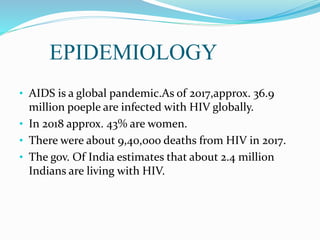
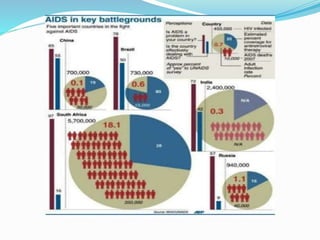
• AIDS is a global pandemic.As of 2017,approx. 36.9
million poeple are infected with HIV globally.
• In 2018 approx. 43% are women.
• There were about 9,40,000 deaths from HIV in 2017.
• The gov. Of India estimates that about 2.4 million
Indians are living with HIV.
ETIOLOGY
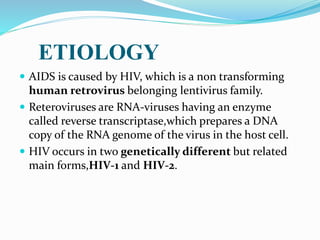
 AIDS is caused by HIV, which is a non transforming
human retrovirus belonging lentivirus family.
 Reteroviruses are RNA-viruses having an enzyme
called reverse transcriptase,which prepares a DNA
copy of the RNA genome of the virus in the host cell.
 HIV occurs in two genetically different but related
main forms,HIV-1 and HIV-2.
Structure of HIV
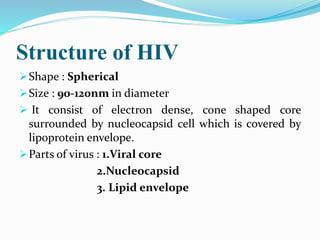
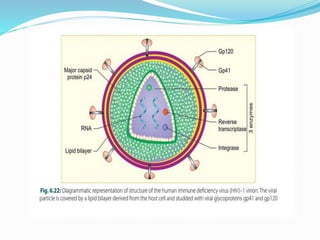
Shape : Spherical
Size : 90-120nm in diameter
 It consist of electron dense, cone shaped core
surrounded by nucleocapsid cell which is covered by
lipoprotein envelope.
Parts of virus : 1.Viral core
2.Nucleocapsid
3. Lipid envelope
continue......
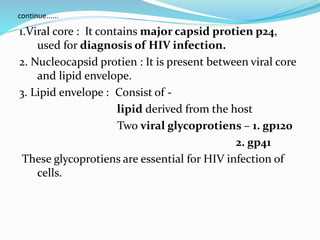
1.Viral core : It contains major capsid protien p24,
used for diagnosis of HIV infection.
2. Nucleocapsid protien : It is present between viral core
and lipid envelope.
3. Lipid envelope : Consist of -
lipid derived from the host
Two viral glycoprotiens – 1. gp120
2. gp41
These glycoprotiens are essential for HIV infection of
cells.
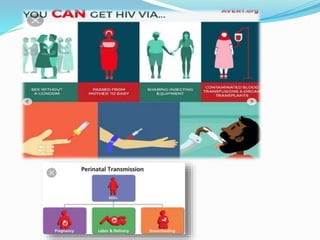
Routes of transmission
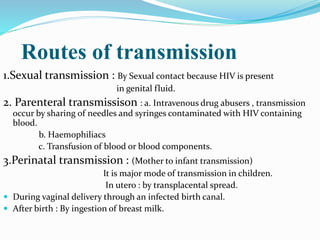
1.Sexual transmission : By Sexual contact because HIV is present
in genital fluid.
2. Parenteral transmissison : a. Intravenous drug abusers , transmission
occur by sharing of needles and syringes contaminated with HIV containing
blood.
b. Haemophiliacs
c. Transfusion of blood or blood components.
3.Perinatal transmission : (Mother to infant transmission)
It is major mode of transmission in children.
In utero : by transplacental spread.
 During vaginal delivery through an infected birth canal.
 After birth : By ingestion of breast milk.
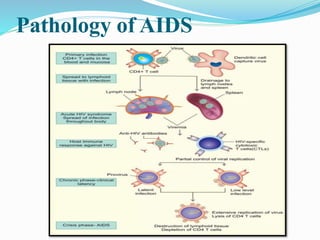
Pathology of AIDS
Pathogenesis
Infection is transmitted when the virus enters the blood or
tissues of an individual.
Major targets: HIV can infect many tissues, but two major targets of HIV
infection are the:
1. Immune system
2.Central nervous system (CNS).
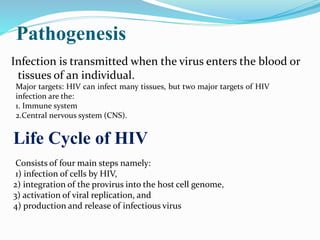
Life Cycle of HIV
Consists of four main steps namely:
1) infection of cells by HIV,
2) integration of the provirus into the host cell genome,
3) activation of viral replication, and
4) production and release of infectious virus
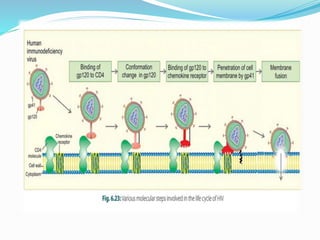
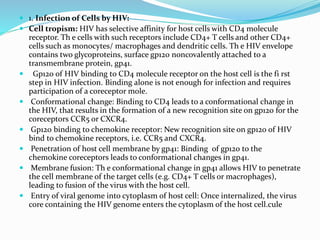
 1. Infection of Cells by HIV:
 Cell tropism: HIV has selective affinity for host cells with CD4 molecule
receptor. Th e cells with such receptors include CD4+ T cells and other CD4+
cells such as monocytes/ macrophages and dendritic cells. Th e HIV envelope
contains two glycoproteins, surface gp120 noncovalently attached to a
transmembrane protein, gp41.
 Gp120 of HIV binding to CD4 molecule receptor on the host cell is the fi rst
step in HIV infection. Binding alone is not enough for infection and requires
participation of a coreceptor mole.
 Conformational change: Binding to CD4 leads to a conformational change in
the HIV, that results in the formation of a new recognition site on gp120 for the
coreceptors CCR5 or CXCR4.
 Gp120 binding to chemokine receptor: New recognition site on gp120 of HIV
bind to chemokine receptors, i.e. CCR5 and CXCR4.
 Penetration of host cell membrane by gp41: Binding of gp120 to the
chemokine coreceptors leads to conformational changes in gp41.
 Membrane fusion: Th e conformational change in gp41 allows HIV to penetrate
the cell membrane of the target cells (e.g. CD4+ T cells or macrophages),
leading to fusion of the virus with the host cell.
 Entry of viral genome into cytoplasm of host cell: Once internalized, the virus
core containing the HIV genome enters the cytoplasm of the host cell.cule
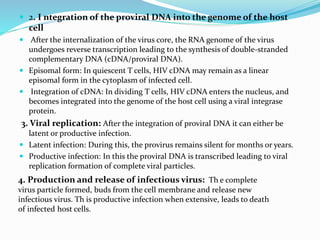
 2. I ntegration of the proviral DNA into the genome of the host
cell
 After the internalization of the virus core, the RNA genome of the virus
undergoes reverse transcription leading to the synthesis of double-stranded
complementary DNA (cDNA/proviral DNA).
 Episomal form: In quiescent T cells, HIV cDNA may remain as a linear
episomal form in the cytoplasm of infected cell.
 Integration of cDNA: In dividing T cells, HIV cDNA enters the nucleus, and
becomes integrated into the genome of the host cell using a viral integrase
protein.
3. Viral replication: After the integration of proviral DNA it can either be
latent or productive infection.
 Latent infection: During this, the provirus remains silent for months or years.
 Productive infection: In this the proviral DNA is transcribed leading to viral
replication formation of complete viral particles.
4. Production and release of infectious virus: Th e complete
virus particle formed, buds from the cell membrane and release new
infectious virus. Th is productive infection when extensive, leads to death
of infected host cells.
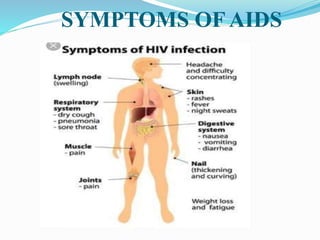
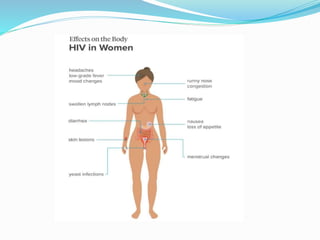
SYMPTOMS OF AIDS
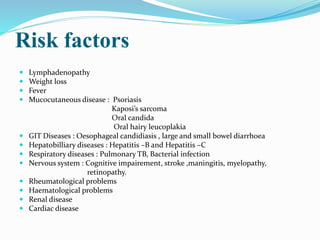
Risk factors
 Lymphadenopathy
 Weight loss
 Fever
 Mucocutaneous disease : Psoriasis
Kaposi’s sarcoma
Oral candida
Oral hairy leucoplakia
 GIT Diseases : Oesophageal candidiasis , large and small bowel diarrhoea
 Hepatobilliary diseases : Hepatitis –B and Hepatitis –C
 Respiratory diseases : Pulmonary TB, Bacterial infection
 Nervous system : Cognitive impairement, stroke ,maningitis, myelopathy,
retinopathy.
 Rheumatological problems
 Haematological problems
 Renal disease
 Cardiac disease
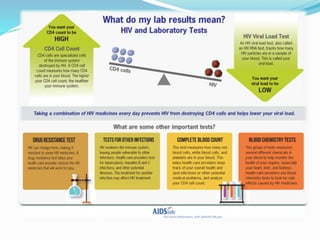
DIAGNOSIS
 ELISA (Enzyme linked immuno sorbent assay)
It detects antibodies against viral protiens.
It is the most sensitive and best screening test for the diagnosis of AIDS.
 Western blot : most specific or the confirmatory test for HIV.
 Direct detection of viral infection :
a. p24 antigen capture assay
b. Reverse transcriptase polymerase chain
reaction (RT-PCR).
C. DNA-PCR
d.Culture of virus from the monocyte and CD4 + T cells
The prognosis of AIDS is poor.
Western blot banding ELISA Kit
Management of AIDS
 Prevention of opportunistic infections
Effective ART is the best protection, but other protective measures
remain important:
● Avoidance of contaminated water.
● Barrier contraception.
● Avoidance of animal-borne infection (cats).
● Malaria vector control
Adherence to lifelong treatment is vital, and is enhanced by:
● Disclosure of HIV status.
● Joining support groups.
● Patientnominated treatment supporters.
● Management of coincident depression and substance abuse.demic
areas.
Myths about AIDS
AIDS.pptx
AIDS.pptx

AIDS.pptx

  • 1.
    AIDS Presented by :Pooja Patel BAMS 2ND YEAR Batch 2017 -18
  • 2.
    INTRODUCTION • AIDS standsfor Acquired immunodeficiency syndrome caused by HIV (Human immunodeficiency virus). • It is severe immunosuppression leads to opportunistic infections, secondary neoplasms, and neurologic manifestations.
  • 3.
    Index  Introduction  Epidemiology Etiology  Routes of transmission  Pathogenesis  Symptoms  Risk factors  Diagnosis  Management  Conclusion
  • 4.
    EPIDEMIOLOGY • AIDS isa global pandemic.As of 2017,approx. 36.9 million poeple are infected with HIV globally. • In 2018 approx. 43% are women. • There were about 9,40,000 deaths from HIV in 2017. • The gov. Of India estimates that about 2.4 million Indians are living with HIV.
  • 6.
    ETIOLOGY  AIDS iscaused by HIV, which is a non transforming human retrovirus belonging lentivirus family.  Reteroviruses are RNA-viruses having an enzyme called reverse transcriptase,which prepares a DNA copy of the RNA genome of the virus in the host cell.  HIV occurs in two genetically different but related main forms,HIV-1 and HIV-2.
  • 7.
    Structure of HIV Shape: Spherical Size : 90-120nm in diameter  It consist of electron dense, cone shaped core surrounded by nucleocapsid cell which is covered by lipoprotein envelope. Parts of virus : 1.Viral core 2.Nucleocapsid 3. Lipid envelope
  • 8.
    continue...... 1.Viral core :It contains major capsid protien p24, used for diagnosis of HIV infection. 2. Nucleocapsid protien : It is present between viral core and lipid envelope. 3. Lipid envelope : Consist of - lipid derived from the host Two viral glycoprotiens – 1. gp120 2. gp41 These glycoprotiens are essential for HIV infection of cells.
  • 10.
    Routes of transmission 1.Sexualtransmission : By Sexual contact because HIV is present in genital fluid. 2. Parenteral transmissison : a. Intravenous drug abusers , transmission occur by sharing of needles and syringes contaminated with HIV containing blood. b. Haemophiliacs c. Transfusion of blood or blood components. 3.Perinatal transmission : (Mother to infant transmission) It is major mode of transmission in children. In utero : by transplacental spread.  During vaginal delivery through an infected birth canal.  After birth : By ingestion of breast milk.
  • 12.
  • 13.
    Pathogenesis Infection is transmittedwhen the virus enters the blood or tissues of an individual. Major targets: HIV can infect many tissues, but two major targets of HIV infection are the: 1. Immune system 2.Central nervous system (CNS). Life Cycle of HIV Consists of four main steps namely: 1) infection of cells by HIV, 2) integration of the provirus into the host cell genome, 3) activation of viral replication, and 4) production and release of infectious virus
  • 15.
     1. Infectionof Cells by HIV:  Cell tropism: HIV has selective affinity for host cells with CD4 molecule receptor. Th e cells with such receptors include CD4+ T cells and other CD4+ cells such as monocytes/ macrophages and dendritic cells. Th e HIV envelope contains two glycoproteins, surface gp120 noncovalently attached to a transmembrane protein, gp41.  Gp120 of HIV binding to CD4 molecule receptor on the host cell is the fi rst step in HIV infection. Binding alone is not enough for infection and requires participation of a coreceptor mole.  Conformational change: Binding to CD4 leads to a conformational change in the HIV, that results in the formation of a new recognition site on gp120 for the coreceptors CCR5 or CXCR4.  Gp120 binding to chemokine receptor: New recognition site on gp120 of HIV bind to chemokine receptors, i.e. CCR5 and CXCR4.  Penetration of host cell membrane by gp41: Binding of gp120 to the chemokine coreceptors leads to conformational changes in gp41.  Membrane fusion: Th e conformational change in gp41 allows HIV to penetrate the cell membrane of the target cells (e.g. CD4+ T cells or macrophages), leading to fusion of the virus with the host cell.  Entry of viral genome into cytoplasm of host cell: Once internalized, the virus core containing the HIV genome enters the cytoplasm of the host cell.cule
  • 16.
     2. Integration of the proviral DNA into the genome of the host cell  After the internalization of the virus core, the RNA genome of the virus undergoes reverse transcription leading to the synthesis of double-stranded complementary DNA (cDNA/proviral DNA).  Episomal form: In quiescent T cells, HIV cDNA may remain as a linear episomal form in the cytoplasm of infected cell.  Integration of cDNA: In dividing T cells, HIV cDNA enters the nucleus, and becomes integrated into the genome of the host cell using a viral integrase protein. 3. Viral replication: After the integration of proviral DNA it can either be latent or productive infection.  Latent infection: During this, the provirus remains silent for months or years.  Productive infection: In this the proviral DNA is transcribed leading to viral replication formation of complete viral particles. 4. Production and release of infectious virus: Th e complete virus particle formed, buds from the cell membrane and release new infectious virus. Th is productive infection when extensive, leads to death of infected host cells.
  • 17.
  • 19.
    Risk factors  Lymphadenopathy Weight loss  Fever  Mucocutaneous disease : Psoriasis Kaposi’s sarcoma Oral candida Oral hairy leucoplakia  GIT Diseases : Oesophageal candidiasis , large and small bowel diarrhoea  Hepatobilliary diseases : Hepatitis –B and Hepatitis –C  Respiratory diseases : Pulmonary TB, Bacterial infection  Nervous system : Cognitive impairement, stroke ,maningitis, myelopathy, retinopathy.  Rheumatological problems  Haematological problems  Renal disease  Cardiac disease
  • 20.
    DIAGNOSIS  ELISA (Enzymelinked immuno sorbent assay) It detects antibodies against viral protiens. It is the most sensitive and best screening test for the diagnosis of AIDS.  Western blot : most specific or the confirmatory test for HIV.  Direct detection of viral infection : a. p24 antigen capture assay b. Reverse transcriptase polymerase chain reaction (RT-PCR). C. DNA-PCR d.Culture of virus from the monocyte and CD4 + T cells The prognosis of AIDS is poor.
  • 21.
  • 23.
    Management of AIDS Prevention of opportunistic infections Effective ART is the best protection, but other protective measures remain important: ● Avoidance of contaminated water. ● Barrier contraception. ● Avoidance of animal-borne infection (cats). ● Malaria vector control Adherence to lifelong treatment is vital, and is enhanced by: ● Disclosure of HIV status. ● Joining support groups. ● Patientnominated treatment supporters. ● Management of coincident depression and substance abuse.demic areas.
  • 24.