RESPIRATORY TRACT
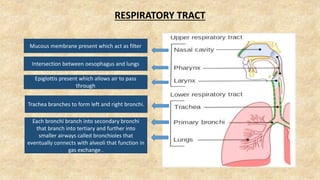
Mucous membrane present which act as filter
Intersection between oesophagus and lungs
Epiglottis present which allows air to pass
through
Trachea branches to form left and right bronchi.
Each bronchi branch into secondary bronchi
that branch into tertiary and further into
smaller airways called bronchioles that
eventually connects with alveoli that function in
gas exchange .
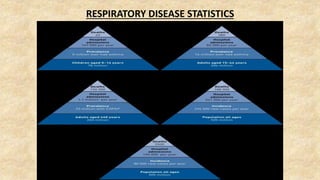
RESPIRATORY DISEASE STATISTICS
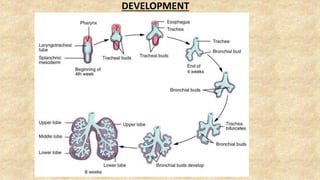
DEVELOPMENT OF RESPIRATORY SYSTEM
DEVELOPMENT
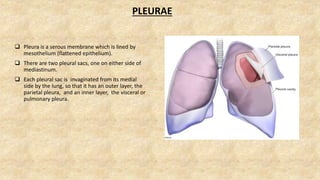
PLEURAE
 Pleura is a serous membrane which is lined by
mesothelium (flattened epithelium).
 There are two pleural sacs, one on either side of
mediastinum.
 Each pleural sac is invaginated from its medial
side by the lung, so that it has an outer layer, the
parietal pleura, and an inner layer, the visceral or
pulmonary pleura.
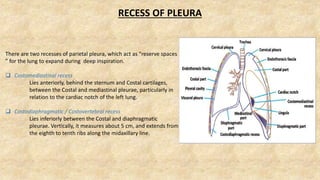
RECESS OF PLEURA
There are two recesses of parietal pleura, which act as “reserve spaces
” for the lung to expand during deep inspiration.
 Costomediastinal recess
Lies anteriorly, behind the sternum and Costal cartilages,
between the Costal and mediastinal pleurae, particularly in
relation to the cardiac notch of the left lung.
 Costodiaphragmatic / Costovertebral recess
Lies inferiorly between the Costal and diaphragmatic
pleurae. Vertically, it measures about 5 cm, and extends from
the eighth to tenth ribs along the midaxillary line.
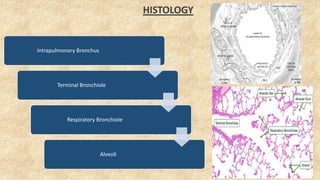
HISTOLOGY
Intrapulmonary Bronchus
Terminal Bronchiole
Respiratory Bronchiole
Alveoli
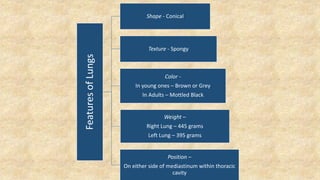
Features
of
Lungs
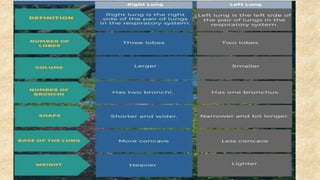
Shape - Conical
Texture - Spongy
Color -
In young ones – Brown or Grey
In Adults – Mottled Black
Weight –
Right Lung – 445 grams
Left Lung – 395 grams
Position –
On either side of mediastinum within thoracic
cavity
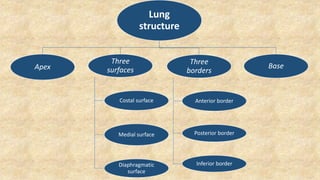
Lung
structure
Apex
Three
surfaces
Costal surface
Medial surface
Diaphragmatic
surface
Three
borders
Anterior border
Posterior border
Inferior border
Base
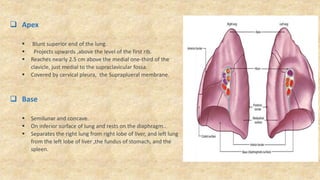
 Apex
 Blunt superior end of the lung.
 Projects upwards ,above the level of the first rib.
 Reaches nearly 2.5 cm above the medial one-third of the
clavicle, just medial to the supraclavicular fossa.
 Covered by cervical pleura, the Supraplueral membrane.
 Base
 Semilunar and concave.
 On inferior surface of lung and rests on the diaphragm..
 Separates the right lung from right lobe of liver, and left lung
from the left lobe of liver ,the fundus of stomach, and the
spleen.
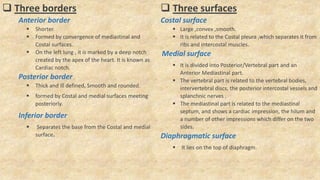
 Three borders
Anterior border
 Shorter.
 Formed by convergence of mediastinal and
Costal surfaces.
 On the left lung , it is marked by a deep notch
created by the apex of the heart. It is known as
Cardiac notch.
Posterior border
 Thick and ill defined, Smooth and rounded.
 formed by Costal and medial surfaces meeting
posteriorly.
Inferior border
 Separates the base from the Costal and medial
surface.
 Three surfaces
Costal surface
 Large ,convex ,smooth.
 It is related to the Costal pleura ,which separates it from
ribs and intercostal muscles.
Medial surface
 It is divided into Posterior/Vertebral part and an
Anterior Mediastinal part.
 The vertebral part is related to the vertebral bodies,
intervertebral discs, the posterior intercostal vessels and
splanchnic nerves .
 The mediastinal part is related to the mediastinal
septum, and shows a cardiac impression, the hilum and
a number of other impressions which differ on the two
sides.
Diaphragmatic surface
 It lies on the top of diaphragm.
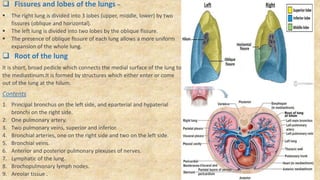
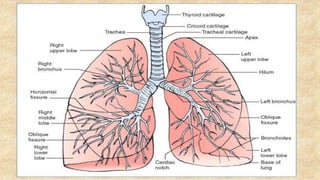
 Fissures and lobes of the lungs –
 The right lung is divided into 3 lobes (upper, middle, lower) by two
fissures (oblique and horizontal).
 The left lung is divided into two lobes by the oblique fissure.
 The presence of oblique fissure of each lung allows a more uniform
expansion of the whole lung.
 Root of the lung
It is short, broad pedicle which connects the medial surface of the lung to
the mediastinum.It is formed by structures which either enter or come
out of the lung at the hilum.
Contents
1. Principal bronchus on the left side, and eparterial and hypaterial
bronchi on the right side.
2. One pulmonary artery.
3. Two pulmonary veins, superior and inferior.
4. Bronchial arteries, one on the right side and two on the left side.
5. Bronchial veins.
6. Anterior and posterior pulmonary plexuses of nerves.
7. Lymphatic of the lung.
8. Brochopulmonary lymph nodes.
9. Areolar tissue .
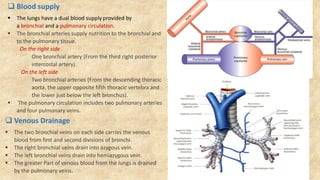
 Blood supply
 The lungs have a dual blood supply provided by
a bronchial and a pulmonary circulation.
 The bronchial arteries supply nutrition to the bronchial and
to the pulmonary tissue.
On the right side
One bronchial artery (From the third right posterior
intercostal artery).
On the left side
Two bronchial arteries (From the descending thoracic
aorta, the upper opposite fifth thoracic vertebra and
the lower just below the left bronchus).
 The pulmonary circulation includes two pulmonary arteries
and four pulmonary veins.
 Venous Drainage
 The two bronchial veins on each side carries the venous
blood from first and second divisions of bronchi.
 The right bronchial veins drain into azygous vein.
 The left bronchial veins drain into hemiazygous vein.
 The greater Part of venous blood from the lungs is drained
by the pulmonary veins.
 Lymphatic Drainage
There are two sets of lymphatic which drain into Broncho
pulmonary nodes.
1) Superficial vessels drain the peripheral lung tissue.
2) Deep lymphatics drain the bronchial tree ,pulmonary
vessels and the connective tissue septa.
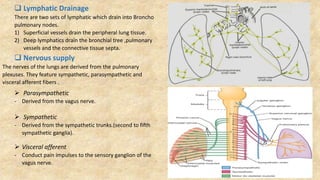
 Nervous supply
The nerves of the lungs are derived from the pulmonary
plexuses. They feature sympathetic, parasympathetic and
visceral afferent fibers .
 Parasympathetic
- Derived from the vagus nerve.
 Sympathetic
- Derived from the sympathetic trunks.(second to fifth
sympathetic ganglia).
 Visceral afferent
- Conduct pain impulses to the sensory ganglion of the
vagus nerve.
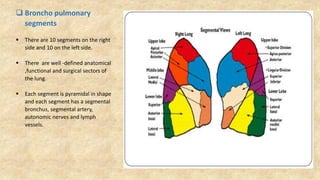
 Broncho pulmonary
segments
 There are 10 segments on the right
side and 10 on the left side.
 There are well -defined anatomical
,functional and surgical sectors of
the lung.
 Each segment is pyramidal in shape
and each segment has a segmental
bronchus, segmental artery,
autonomic nerves and lymph
vessels.
CLINICAL ANATOMY
 Pleuritis or pleurisy
This is the inflammation of the pleura. Acute pleuritis is marked by sharp, stabbing pain, especially on exertion.
 Aspiration of foreign bodies
Since the right bronchus is wider and shorter and runs more vertically than the left bronchus, foreign bodies are
more likely to enter and lodge in it or in one of its branches.
 Bronchoscopy
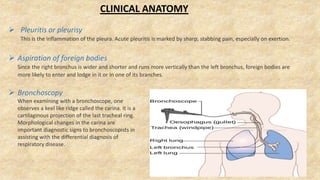
When examining with a bronchoscope, one
observes a keel like ridge called the carina. It is a
cartilaginous projection of the last tracheal ring.
Morphological changes in the carina are
important diagnostic signs to bronchoscopists in
assisting with the differential diagnosis of
respiratory disease.
 Bronchial asthma
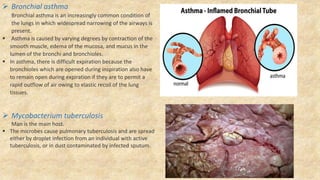
Bronchial asthma is an increasingly common condition of
the lungs in which widespread narrowing of the airways is
present.
 Asthma is caused by varying degrees by contraction of the
smooth muscle, edema of the mucosa, and mucus in the
lumen of the bronchi and bronchioles.
 In asthma, there is difficult expiration because the
bronchioles which are opened during inspiration also have
to remain open during expiration if they are to permit a
rapid outflow of air owing to elastic recoil of the lung
tissues.
 Mycobacterium tuberculosis
Man is the main host.
 The microbes cause pulmonary tuberculosis and are spread
either by droplet infection from an individual with active
tuberculosis, or in dust contaminated by infected sputum.
 Pneumonia
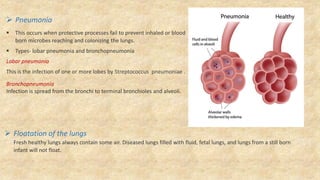
 This occurs when protective processes fail to prevent inhaled or blood
born microbes reaching and colonizing the lungs.
 Types- lobar pneumonia and bronchopneumonia
Lobar pneumonia
This is the infection of one or more lobes by Streptococcus pneumoniae .
Bronchopneumonia
Infection is spread from the bronchi to terminal bronchioles and alveoli.
 Floatation of the lungs
Fresh healthy lungs always contain some air. Diseased lungs filled with fluid, fetal lungs, and lungs from a still born
infant will not float.
 Bronchial carcinoma
Primary bronchial carcinoma is a common form of
malignancy. The tumour usually develops in a main
bronchus, forming a large friable mass that project into the
lumen sometimes causing obstruction.
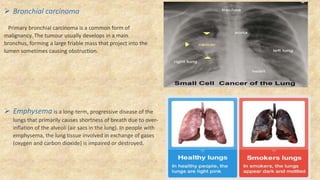
 Emphysema is a long-term, progressive disease of the
lungs that primarily causes shortness of breath due to over-
inflation of the alveoli (air sacs in the lung). In people with
emphysema, the lung tissue involved in exchange of gases
(oxygen and carbon dioxide) is impaired or destroyed.
 Pneumoconiosis
This is a group of lung diseases caused by inhaling organic or inorganic atmospheric pollutants. Some of them are-
 Coal workers pneumoconiosis- soft bituminous coal
 Silicosis- dust containing silicon compounds
 Asbestosis- asbestos
 Pleural mesothelioma- asbestos
 Byssinosis- cotton fibres
 Extrinsic allergic alveolitis
This is a group of conditions caused by inhaling materials contaminated by moulds and fungi.
 Farmers lung- mouldy hay
 Bagassosis- mouldy sugar waste
 Bird handler’s lung- mould in bird droppings
 Malt worker’s lung- mouldy barley
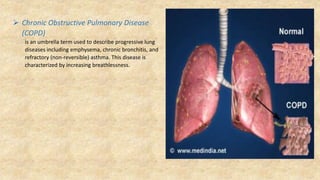
 Chronic Obstructive Pulmonary Disease
(COPD)
is an umbrella term used to describe progressive lung
diseases including emphysema, chronic bronchitis, and
refractory (non-reversible) asthma. This disease is
characterized by increasing breathlessness.
Respiratory system and lungs.pptx

Respiratory system and lungs.pptx

  • 1.
    RESPIRATORY TRACT Mucous membranepresent which act as filter Intersection between oesophagus and lungs Epiglottis present which allows air to pass through Trachea branches to form left and right bronchi. Each bronchi branch into secondary bronchi that branch into tertiary and further into smaller airways called bronchioles that eventually connects with alveoli that function in gas exchange .
  • 2.
  • 3.
    DEVELOPMENT OF RESPIRATORYSYSTEM DEVELOPMENT
  • 4.
    PLEURAE  Pleura isa serous membrane which is lined by mesothelium (flattened epithelium).  There are two pleural sacs, one on either side of mediastinum.  Each pleural sac is invaginated from its medial side by the lung, so that it has an outer layer, the parietal pleura, and an inner layer, the visceral or pulmonary pleura.
  • 5.
    RECESS OF PLEURA Thereare two recesses of parietal pleura, which act as “reserve spaces ” for the lung to expand during deep inspiration.  Costomediastinal recess Lies anteriorly, behind the sternum and Costal cartilages, between the Costal and mediastinal pleurae, particularly in relation to the cardiac notch of the left lung.  Costodiaphragmatic / Costovertebral recess Lies inferiorly between the Costal and diaphragmatic pleurae. Vertically, it measures about 5 cm, and extends from the eighth to tenth ribs along the midaxillary line.
  • 6.
  • 7.
    Features of Lungs Shape - Conical Texture- Spongy Color - In young ones – Brown or Grey In Adults – Mottled Black Weight – Right Lung – 445 grams Left Lung – 395 grams Position – On either side of mediastinum within thoracic cavity
  • 8.
  • 9.
     Apex  Bluntsuperior end of the lung.  Projects upwards ,above the level of the first rib.  Reaches nearly 2.5 cm above the medial one-third of the clavicle, just medial to the supraclavicular fossa.  Covered by cervical pleura, the Supraplueral membrane.  Base  Semilunar and concave.  On inferior surface of lung and rests on the diaphragm..  Separates the right lung from right lobe of liver, and left lung from the left lobe of liver ,the fundus of stomach, and the spleen.
  • 10.
     Three borders Anteriorborder  Shorter.  Formed by convergence of mediastinal and Costal surfaces.  On the left lung , it is marked by a deep notch created by the apex of the heart. It is known as Cardiac notch. Posterior border  Thick and ill defined, Smooth and rounded.  formed by Costal and medial surfaces meeting posteriorly. Inferior border  Separates the base from the Costal and medial surface.  Three surfaces Costal surface  Large ,convex ,smooth.  It is related to the Costal pleura ,which separates it from ribs and intercostal muscles. Medial surface  It is divided into Posterior/Vertebral part and an Anterior Mediastinal part.  The vertebral part is related to the vertebral bodies, intervertebral discs, the posterior intercostal vessels and splanchnic nerves .  The mediastinal part is related to the mediastinal septum, and shows a cardiac impression, the hilum and a number of other impressions which differ on the two sides. Diaphragmatic surface  It lies on the top of diaphragm.
  • 11.
     Fissures andlobes of the lungs –  The right lung is divided into 3 lobes (upper, middle, lower) by two fissures (oblique and horizontal).  The left lung is divided into two lobes by the oblique fissure.  The presence of oblique fissure of each lung allows a more uniform expansion of the whole lung.  Root of the lung It is short, broad pedicle which connects the medial surface of the lung to the mediastinum.It is formed by structures which either enter or come out of the lung at the hilum. Contents 1. Principal bronchus on the left side, and eparterial and hypaterial bronchi on the right side. 2. One pulmonary artery. 3. Two pulmonary veins, superior and inferior. 4. Bronchial arteries, one on the right side and two on the left side. 5. Bronchial veins. 6. Anterior and posterior pulmonary plexuses of nerves. 7. Lymphatic of the lung. 8. Brochopulmonary lymph nodes. 9. Areolar tissue .
  • 14.
     Blood supply The lungs have a dual blood supply provided by a bronchial and a pulmonary circulation.  The bronchial arteries supply nutrition to the bronchial and to the pulmonary tissue. On the right side One bronchial artery (From the third right posterior intercostal artery). On the left side Two bronchial arteries (From the descending thoracic aorta, the upper opposite fifth thoracic vertebra and the lower just below the left bronchus).  The pulmonary circulation includes two pulmonary arteries and four pulmonary veins.  Venous Drainage  The two bronchial veins on each side carries the venous blood from first and second divisions of bronchi.  The right bronchial veins drain into azygous vein.  The left bronchial veins drain into hemiazygous vein.  The greater Part of venous blood from the lungs is drained by the pulmonary veins.
  • 15.
     Lymphatic Drainage Thereare two sets of lymphatic which drain into Broncho pulmonary nodes. 1) Superficial vessels drain the peripheral lung tissue. 2) Deep lymphatics drain the bronchial tree ,pulmonary vessels and the connective tissue septa.  Nervous supply The nerves of the lungs are derived from the pulmonary plexuses. They feature sympathetic, parasympathetic and visceral afferent fibers .  Parasympathetic - Derived from the vagus nerve.  Sympathetic - Derived from the sympathetic trunks.(second to fifth sympathetic ganglia).  Visceral afferent - Conduct pain impulses to the sensory ganglion of the vagus nerve.
  • 16.
     Broncho pulmonary segments There are 10 segments on the right side and 10 on the left side.  There are well -defined anatomical ,functional and surgical sectors of the lung.  Each segment is pyramidal in shape and each segment has a segmental bronchus, segmental artery, autonomic nerves and lymph vessels.
  • 17.
    CLINICAL ANATOMY  Pleuritisor pleurisy This is the inflammation of the pleura. Acute pleuritis is marked by sharp, stabbing pain, especially on exertion.  Aspiration of foreign bodies Since the right bronchus is wider and shorter and runs more vertically than the left bronchus, foreign bodies are more likely to enter and lodge in it or in one of its branches.  Bronchoscopy When examining with a bronchoscope, one observes a keel like ridge called the carina. It is a cartilaginous projection of the last tracheal ring. Morphological changes in the carina are important diagnostic signs to bronchoscopists in assisting with the differential diagnosis of respiratory disease.
  • 18.
     Bronchial asthma Bronchialasthma is an increasingly common condition of the lungs in which widespread narrowing of the airways is present.  Asthma is caused by varying degrees by contraction of the smooth muscle, edema of the mucosa, and mucus in the lumen of the bronchi and bronchioles.  In asthma, there is difficult expiration because the bronchioles which are opened during inspiration also have to remain open during expiration if they are to permit a rapid outflow of air owing to elastic recoil of the lung tissues.  Mycobacterium tuberculosis Man is the main host.  The microbes cause pulmonary tuberculosis and are spread either by droplet infection from an individual with active tuberculosis, or in dust contaminated by infected sputum.
  • 19.
     Pneumonia  Thisoccurs when protective processes fail to prevent inhaled or blood born microbes reaching and colonizing the lungs.  Types- lobar pneumonia and bronchopneumonia Lobar pneumonia This is the infection of one or more lobes by Streptococcus pneumoniae . Bronchopneumonia Infection is spread from the bronchi to terminal bronchioles and alveoli.  Floatation of the lungs Fresh healthy lungs always contain some air. Diseased lungs filled with fluid, fetal lungs, and lungs from a still born infant will not float.
  • 20.
     Bronchial carcinoma Primarybronchial carcinoma is a common form of malignancy. The tumour usually develops in a main bronchus, forming a large friable mass that project into the lumen sometimes causing obstruction.  Emphysema is a long-term, progressive disease of the lungs that primarily causes shortness of breath due to over- inflation of the alveoli (air sacs in the lung). In people with emphysema, the lung tissue involved in exchange of gases (oxygen and carbon dioxide) is impaired or destroyed.
  • 21.
     Pneumoconiosis This isa group of lung diseases caused by inhaling organic or inorganic atmospheric pollutants. Some of them are-  Coal workers pneumoconiosis- soft bituminous coal  Silicosis- dust containing silicon compounds  Asbestosis- asbestos  Pleural mesothelioma- asbestos  Byssinosis- cotton fibres  Extrinsic allergic alveolitis This is a group of conditions caused by inhaling materials contaminated by moulds and fungi.  Farmers lung- mouldy hay  Bagassosis- mouldy sugar waste  Bird handler’s lung- mould in bird droppings  Malt worker’s lung- mouldy barley
  • 22.
     Chronic ObstructivePulmonary Disease (COPD) is an umbrella term used to describe progressive lung diseases including emphysema, chronic bronchitis, and refractory (non-reversible) asthma. This disease is characterized by increasing breathlessness.