Types of infection
• Primary
• Reinfection Secondary
• Focal infection
• Nosocomial infection
• Iatrogenic infection
• Endogenous
• Exogenous
• Inapparent/subclinical
• Atypical
• Latent
• Local
• Systemic
--=
• Primary infection
• Exposure of pathogen for the first time
• Reinfection
• Exposure of the same pathogen for second or many
times.
• Secondary
• Infected by a pathogen, immunity lowered and cause
invasion by other pathogen
• Focal infection
• Localised infection
Nosocomial infection
• A person make a hospital visit, immunity is low, and get
infected by hospital micro1
bes.
• Eg: wou nd sepsis
• Iatrogenic infection
• Drug induced infection during course of treatment
• Eg: muscle sepsis caused by unsterilized equipmen t used.
• Endogenous infectiom
• When a commensal enter places it should not be.
• Eg: entrance of E. coli to urinary tract cause infection.
• Exogenous infection
• When a pathogen comes from other source
• Eg: soil
• Inapparent /subclinical
• Asymptomatic
• Atypical infection
• Symptoms are atypical
• Latent infection
• Parasites remains in tissues in latent or hidden form,
proliferating and producing clinical disease when the host
resistance is lowered.
• Eg: herpes infection
• Systemic infection
• Spread throughout the body
• Eg: streptococcus infection
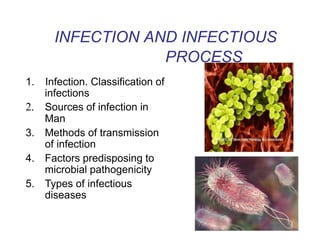
INFECTION AND INFECTIOUS
PROCESS
1. Infection. Classification of
infections
2. Sources of infection in
Man
3. Methods of transmission
of infection
4. Factors predisposing to
microbial pathogenicity
5. Types of infectious
diseases
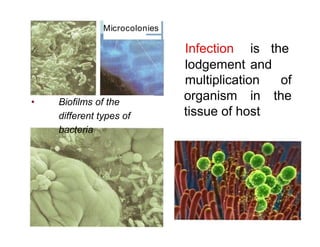
Microcolonies
• Biofilms of the
different types of
bacteria
Infection is the
lodgement and
multiplication of
organism in the
tissue of host
Classification of infections
1. Primary infection: Initial infection
organism in host.
with
2. Reinfection: Subsequent infection by
same organism in a host (after recovery).
3. Superinfection:Infection by
same organism in a host before recovery.
organism may set up in infection.
4. Secondary infection: When in a host
whose resistance is lowered by
preexisting infectious disease, a new
Classification of infections
5. Focal infection: It is a condition where due to
infection at localized sites like appendix and
tonsil , general effects are produced.
6. Cross infection: When a patient suffering
from a disease and new infection it set up
from another host or external source.
7. Nosocomial infection: Cross infection
occurring in hospital.
8. Subclinical infection: It is one where
clinical affects are not apparent.
Causative agents of infections
• Saprophy tes: They are free living organisms
which fail to multiply on living tissue and so
are not important in infectious disease.
• Parasites: They are organisms that can
establish themselves and multiply in hosts.
They may be pathogens or commensal.
Pathogens are those which are capable of
producing disease in a host. On the contrary
commensal microbes can live in a host
without causing any disease.
Sources of infection in Man
Man: Man is himself a common source of
infection from a patient or carrier.
Healthy carrier is a person harboring
pathogenic organism without causing
any disease to him. A convalescent
carrier is one who has recovered from
disease but continues to
pathogen in his body.
Anthroponosis
harbor the
Sources of infection in Man
Animals: Infectious diseases transmitted
from animals to man are called zoonosis.
Zoonosis may be bacterial, (e.g. Plague
from rat), rickettsial, (e.g. Murine typhus
from rodent), viral, (e.g. Rabies from dog),
protozoa!, (e.g. Leishmaniasis from dogs),
helminthic, (e.g. Hydatid cyst from dogs)
and fungal (zoophilic dermatophytes from
cats and dogs).
Sources of infection in Man
Insects: The diseases caused by insects
are called arthropod borne disease.
Insects like mosquitoes, fleas, lice that
transmit infection are called vector.
Transmission may be mechanical
(transmission of Dysentery or typhoid
bacilli
called
called
by housefly) and these are
mechanical vector. They are
biological vector if pathogen
multiplies in the body of vector,
Anopheles mosquito in Malaria.
e.g.
Sources of infection in Man
Some vectors may acts as reservoir
host, (e.g. ticks in Relapsing fever
and Spotted fever) .
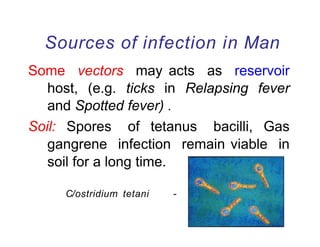
Soil: Spores of tetanus bacilli, Gas
gangrene infection remain viable in
soil for a long time.
C/ostridium tetani -
Sources of infection in Man
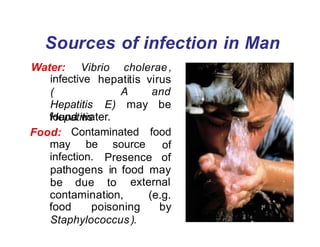
Water: Vibrio cholerae,
infective
(
Hepatitis
Hepatitis
hepatitis virus
A and
E) may be
found water.
Food: Contaminated food
of
may be source
infection. Presence of
pathogens in food may
be due to external
(e.g.
contamination,
food poisoning by
Staphylococcus ).
Methods of transmission of
infection
• Contact (sexual
intercourse): syphilis,
gonorrhea.
• Inhalation: influenza,
tuberculosis,
smallpox,
measles,
mumps, etc.
Methods of transmission of
infection
• Ingestion:
(water), food
(food) and
(hand borne).
• Inoculation:
cholera
poisoning
dysentery
tetanus
(infection), rabies (dog),
arbovirus (insect) and
serum hepatitis, i.e.
Hepatitis B (infection).
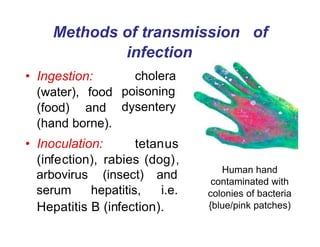
Human hand
contaminated with
colonies of bacteria
{blue/pink patches)

types of Infection.ppt

  • 1.
    Types of infection •Primary • Reinfection Secondary • Focal infection • Nosocomial infection • Iatrogenic infection • Endogenous • Exogenous • Inapparent/subclinical • Atypical • Latent • Local • Systemic
  • 2.
    --= • Primary infection •Exposure of pathogen for the first time • Reinfection • Exposure of the same pathogen for second or many times. • Secondary • Infected by a pathogen, immunity lowered and cause invasion by other pathogen
  • 3.
    • Focal infection •Localised infection Nosocomial infection • A person make a hospital visit, immunity is low, and get infected by hospital micro1 bes. • Eg: wou nd sepsis
  • 4.
    • Iatrogenic infection •Drug induced infection during course of treatment • Eg: muscle sepsis caused by unsterilized equipmen t used. • Endogenous infectiom • When a commensal enter places it should not be. • Eg: entrance of E. coli to urinary tract cause infection. • Exogenous infection • When a pathogen comes from other source • Eg: soil
  • 5.
    • Inapparent /subclinical •Asymptomatic • Atypical infection • Symptoms are atypical • Latent infection • Parasites remains in tissues in latent or hidden form, proliferating and producing clinical disease when the host resistance is lowered. • Eg: herpes infection
  • 6.
    • Systemic infection •Spread throughout the body • Eg: streptococcus infection
  • 7.
    INFECTION AND INFECTIOUS PROCESS 1.Infection. Classification of infections 2. Sources of infection in Man 3. Methods of transmission of infection 4. Factors predisposing to microbial pathogenicity 5. Types of infectious diseases
  • 8.
    Microcolonies • Biofilms ofthe different types of bacteria Infection is the lodgement and multiplication of organism in the tissue of host
  • 9.
    Classification of infections 1.Primary infection: Initial infection organism in host. with 2. Reinfection: Subsequent infection by same organism in a host (after recovery). 3. Superinfection:Infection by same organism in a host before recovery. organism may set up in infection. 4. Secondary infection: When in a host whose resistance is lowered by preexisting infectious disease, a new
  • 10.
    Classification of infections 5.Focal infection: It is a condition where due to infection at localized sites like appendix and tonsil , general effects are produced. 6. Cross infection: When a patient suffering from a disease and new infection it set up from another host or external source. 7. Nosocomial infection: Cross infection occurring in hospital. 8. Subclinical infection: It is one where clinical affects are not apparent.
  • 11.
    Causative agents ofinfections • Saprophy tes: They are free living organisms which fail to multiply on living tissue and so are not important in infectious disease. • Parasites: They are organisms that can establish themselves and multiply in hosts. They may be pathogens or commensal. Pathogens are those which are capable of producing disease in a host. On the contrary commensal microbes can live in a host without causing any disease.
  • 12.
    Sources of infectionin Man Man: Man is himself a common source of infection from a patient or carrier. Healthy carrier is a person harboring pathogenic organism without causing any disease to him. A convalescent carrier is one who has recovered from disease but continues to pathogen in his body. Anthroponosis harbor the
  • 13.
    Sources of infectionin Man Animals: Infectious diseases transmitted from animals to man are called zoonosis. Zoonosis may be bacterial, (e.g. Plague from rat), rickettsial, (e.g. Murine typhus from rodent), viral, (e.g. Rabies from dog), protozoa!, (e.g. Leishmaniasis from dogs), helminthic, (e.g. Hydatid cyst from dogs) and fungal (zoophilic dermatophytes from cats and dogs).
  • 14.
    Sources of infectionin Man Insects: The diseases caused by insects are called arthropod borne disease. Insects like mosquitoes, fleas, lice that transmit infection are called vector. Transmission may be mechanical (transmission of Dysentery or typhoid bacilli called called by housefly) and these are mechanical vector. They are biological vector if pathogen multiplies in the body of vector, Anopheles mosquito in Malaria. e.g.
  • 15.
    Sources of infectionin Man Some vectors may acts as reservoir host, (e.g. ticks in Relapsing fever and Spotted fever) . Soil: Spores of tetanus bacilli, Gas gangrene infection remain viable in soil for a long time. C/ostridium tetani -
  • 16.
    Sources of infectionin Man Water: Vibrio cholerae, infective ( Hepatitis Hepatitis hepatitis virus A and E) may be found water. Food: Contaminated food of may be source infection. Presence of pathogens in food may be due to external (e.g. contamination, food poisoning by Staphylococcus ).
  • 17.
    Methods of transmissionof infection • Contact (sexual intercourse): syphilis, gonorrhea. • Inhalation: influenza, tuberculosis, smallpox, measles, mumps, etc.
  • 18.
    Methods of transmissionof infection • Ingestion: (water), food (food) and (hand borne). • Inoculation: cholera poisoning dysentery tetanus (infection), rabies (dog), arbovirus (insect) and serum hepatitis, i.e. Hepatitis B (infection). Human hand contaminated with colonies of bacteria {blue/pink patches)