Root
morphology
Root
The plant organ that is devoid of
a) Chlorophyll
b) Buds
c) Leaves
• It shows positive gravitropism and moves
away from the light
• Root cap is present at the tip
• Fines, delicate root hairs are present for
the water absorption
Kinds of roots
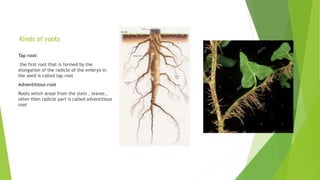
Tap root:
the first root that is formed by the
elongation of the radicle of the embryo in
the seed is called tap root
Adventitious root
Roots which arose from the stem , leaves ,
other then radicle part is called adventitious
root
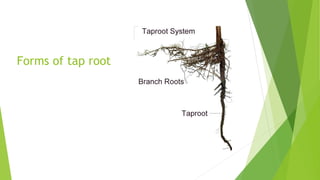
Forms of tap root
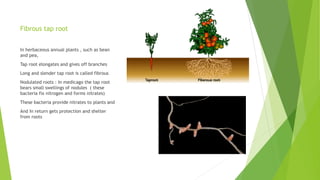
Fibrous tap root
In herbaceous annual plants , such as bean
and pea,
Tap root elongates and gives off branches
Long and slender tap root is called fibrous
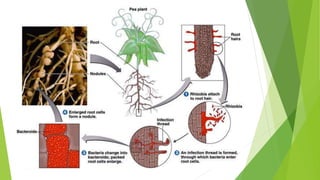
Nodulated roots : In medicago the tap root
bears small swellings of nodules ( these
bacteria fix nitrogen and forms nitrates)
These bacteria provide nitrates to plants and
And In return gets protection and shelter
from roots
Tuberous tap root
When the tap roots are thick
and store reserve food , they
are called as tuberous roots.
Occurs in biennial plants
examples: carrot, radish ,
turnip and beet, oak , dandelion
Biennial plants
These plants live for two seasons
 In the first season they produce leaves
only and store up the surplus food in the
tap root
 In the nest season, they use that stored
food for flower production , after they
die.
• Conical tap root: it is swollen form the
top and tapering from the ends e.g.
English radish and English carrot.
• Napiform tap root : this type of root is
very much swollen form the tap and
abruptly tapers from the lower side. E.g.
turnip and beet
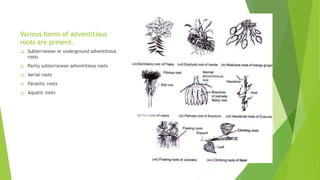
Adventitious roots
Various forms of adventitious
roots are present.
 Subterranean or underground adventitious
roots
 Partly subterranean adventitious roots
 Aerial roots
 Parasitic roots
 Aquatic roots
1: Subterranean or
underground Adventitious roots
They arose from the part of stem , which is in
contact with soil . They may be of fibrous or
adventitious type
1: fibrous adventitious root:
They are long and slender commonly
creeping on underground stem. E.g. grasses ,
ginger
2: tuberous adventitious root:
They are swollen and fleshy, containing
stored food. They are present in Dahlia,
sweet potato and many orchids .
In dahlia and sweet potato some roots remain
fibrous, while others enlarge greatly to form
tubers
2: partly subterranean
adventitious roots
They are present partly above or partly
below the ground . They may be classified
into
• Stilt roots
• Prop roots
• Aerating roots
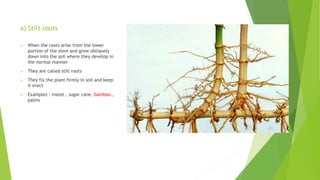
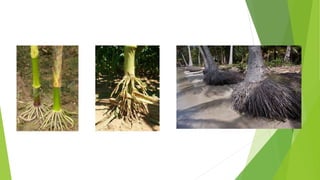
a) Stilt roots
 When the roots arise from the lower
portion of the stem and grow obliquely
down into the soil where they develop in
the normal manner
 They are called stilt roots
 They fix the plant firmly in soil and keep
it erect
 Examples : maize , sugar cane, bamboo ,
palms
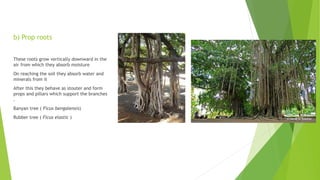
b) Prop roots
These roots grow vertically downward in the
air from which they absorb moisture
On reaching the soil they absorb water and
minerals from it
After this they behave as stouter and form
props and pillars which support the branches
.
Banyan tree ( Ficus bengalensis)
Rubber tree ( Ficus elastic )
c) Pneumatophore roots/
aerating roots
Such roots are found in plant growing in
mangroves or swamps near the sea-shore.
Pneumatophores arise vertically upwards
and come out of soil and water. They bear
small pores called pneumatophores or
lenticels for exchange of gases, e.g.
Heritiera.
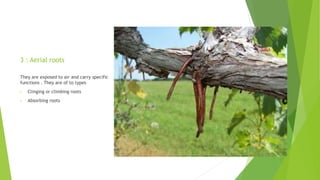
3 : Aerial roots
They are exposed to air and carry specific
functions . They are of to types
• Clinging or climbing roots
• Absorbing roots
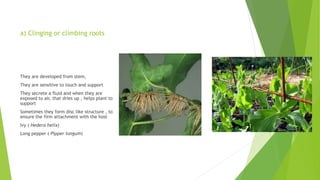
a) Clinging or climbing roots
They are developed from stem,
They are sensitive to touch and support
They secrete a fluid and when they are
exposed to air, that dries up , helps plant to
support
Sometimes they form disc like structure , to
ensure the firm attachment with the host
Ivy ( Hedera helix)
Long pepper ( Pipper longum)
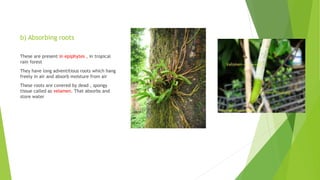
b) Absorbing roots
These are present in epiphytes , in tropical
rain forest
They have long adventitious roots which hang
freely in air and absorb moisture from air
These roots are covered by dead , spongy
tissue called as velamen. That absorbs and
store water
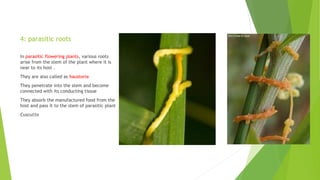
4: parasitic roots
In parasitic flowering plants, various roots
arise from the stem of the plant where it is
near to its host .
They are also called as haustoria
They penetrate into the stem and become
connected with its conducting tissue
They absorb the manufactured food from the
host and pass it to the stem of parasitic plant
Cuscutta
5: aquatic roots
In many water plants , clusters of fibrous
adventitious roots arise from the stem and
dangle ( swing) in water .
They are usually without root hairs
Functions of roots
 Anchoring
 Absorbing
 Storage
 Clinging , propping and absorption
as haustoria
 Involved in vegetative
reproduction ( Dahlia plant , it
stores excess food and serves as
source in next season)
 Develop buds and grow into new
plants

Root morphology

  • 1.
  • 2.
    Root The plant organthat is devoid of a) Chlorophyll b) Buds c) Leaves • It shows positive gravitropism and moves away from the light • Root cap is present at the tip • Fines, delicate root hairs are present for the water absorption
  • 3.
    Kinds of roots Taproot: the first root that is formed by the elongation of the radicle of the embryo in the seed is called tap root Adventitious root Roots which arose from the stem , leaves , other then radicle part is called adventitious root
  • 4.
  • 5.
    Fibrous tap root Inherbaceous annual plants , such as bean and pea, Tap root elongates and gives off branches Long and slender tap root is called fibrous Nodulated roots : In medicago the tap root bears small swellings of nodules ( these bacteria fix nitrogen and forms nitrates) These bacteria provide nitrates to plants and And In return gets protection and shelter from roots
  • 7.
    Tuberous tap root Whenthe tap roots are thick and store reserve food , they are called as tuberous roots. Occurs in biennial plants examples: carrot, radish , turnip and beet, oak , dandelion
  • 8.
    Biennial plants These plantslive for two seasons  In the first season they produce leaves only and store up the surplus food in the tap root  In the nest season, they use that stored food for flower production , after they die. • Conical tap root: it is swollen form the top and tapering from the ends e.g. English radish and English carrot. • Napiform tap root : this type of root is very much swollen form the tap and abruptly tapers from the lower side. E.g. turnip and beet
  • 9.
  • 10.
    Various forms ofadventitious roots are present.  Subterranean or underground adventitious roots  Partly subterranean adventitious roots  Aerial roots  Parasitic roots  Aquatic roots
  • 11.
    1: Subterranean or undergroundAdventitious roots They arose from the part of stem , which is in contact with soil . They may be of fibrous or adventitious type 1: fibrous adventitious root: They are long and slender commonly creeping on underground stem. E.g. grasses , ginger 2: tuberous adventitious root: They are swollen and fleshy, containing stored food. They are present in Dahlia, sweet potato and many orchids . In dahlia and sweet potato some roots remain fibrous, while others enlarge greatly to form tubers
  • 12.
    2: partly subterranean adventitiousroots They are present partly above or partly below the ground . They may be classified into • Stilt roots • Prop roots • Aerating roots
  • 13.
    a) Stilt roots When the roots arise from the lower portion of the stem and grow obliquely down into the soil where they develop in the normal manner  They are called stilt roots  They fix the plant firmly in soil and keep it erect  Examples : maize , sugar cane, bamboo , palms
  • 15.
    b) Prop roots Theseroots grow vertically downward in the air from which they absorb moisture On reaching the soil they absorb water and minerals from it After this they behave as stouter and form props and pillars which support the branches . Banyan tree ( Ficus bengalensis) Rubber tree ( Ficus elastic )
  • 16.
    c) Pneumatophore roots/ aeratingroots Such roots are found in plant growing in mangroves or swamps near the sea-shore. Pneumatophores arise vertically upwards and come out of soil and water. They bear small pores called pneumatophores or lenticels for exchange of gases, e.g. Heritiera.
  • 17.
    3 : Aerialroots They are exposed to air and carry specific functions . They are of to types • Clinging or climbing roots • Absorbing roots
  • 18.
    a) Clinging orclimbing roots They are developed from stem, They are sensitive to touch and support They secrete a fluid and when they are exposed to air, that dries up , helps plant to support Sometimes they form disc like structure , to ensure the firm attachment with the host Ivy ( Hedera helix) Long pepper ( Pipper longum)
  • 19.
    b) Absorbing roots Theseare present in epiphytes , in tropical rain forest They have long adventitious roots which hang freely in air and absorb moisture from air These roots are covered by dead , spongy tissue called as velamen. That absorbs and store water
  • 20.
    4: parasitic roots Inparasitic flowering plants, various roots arise from the stem of the plant where it is near to its host . They are also called as haustoria They penetrate into the stem and become connected with its conducting tissue They absorb the manufactured food from the host and pass it to the stem of parasitic plant Cuscutta
  • 21.
    5: aquatic roots Inmany water plants , clusters of fibrous adventitious roots arise from the stem and dangle ( swing) in water . They are usually without root hairs
  • 22.
    Functions of roots Anchoring  Absorbing  Storage  Clinging , propping and absorption as haustoria  Involved in vegetative reproduction ( Dahlia plant , it stores excess food and serves as source in next season)  Develop buds and grow into new plants