Anabaena
cyanobacteria
Taxonomic position
 Kingdom : Bacteria
 Phylum : Cyanobacteria
 Class : Cyanophyceae
 Order : Nostocales
 Family : Nostocaceae
 Genus : Anabaena
Occurrence
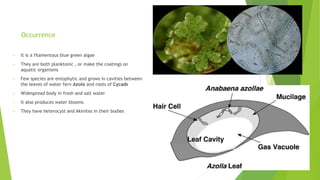
• It is a filamentous blue green algae
• They are both planktonic , or make the coatings on
aquatic organisms
• Few species are entophytic and grows in cavities between
the leaves of water fern Azola and roots of Cycads
• Widespread body in fresh and salt water
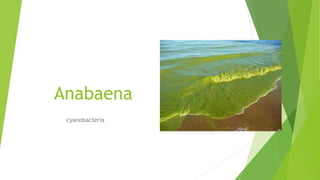
• It also produces water blooms
• They have heterocyst and Akinites in their bodies
Plant body
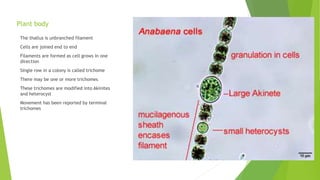
The thallus is unbranched filament
Cells are joined end to end
Filaments are formed as cell grows in one
direction
Single row in a colony is called trichome
There may be one or more trichomes
These trichomes are modified into Akinites
and heterocyst
Movement has been reported by terminal
trichomes
Cell structure
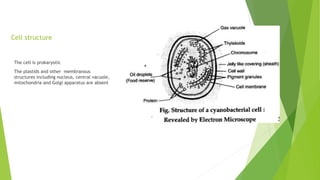
The cell is prokaryotic
The plastids and other membranous
structures including nucleus, central vacuole,
mitochondria and Golgi apparatus are absent
Cell wall
The protoplast is surrounded by cell wall
made up of amino acids peptides
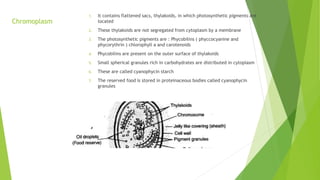
Chromoplasm
1. It contains flattened sacs, thylakoids, in which photosynthetic pigments are
located
2. These thylakoids are not segregated from cytoplasm by a membrane
3. The photosynthetic pigments are : Phycobilins ( phyccocyanine and
phycorythrin ) chlorophyll a and carotenoids
4. Phycobilins are present on the outer surface of thylakoids
5. Small spherical granules rich in carbohydrates are distributed in cytoplasm
6. These are called cyanophycin starch
7. The reserved food is stored in proteinaceous bodies called cyanophycin
granules
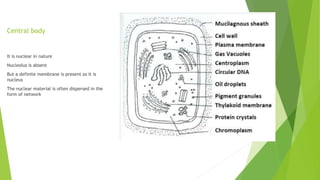
Central body
It is nuclear in nature
Nucleolus is absent
But a definite membrane is present so it is
nucleus
The nuclear material is often dispersed in the
form of network
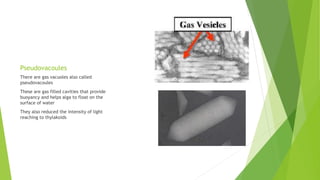
Pseudovacoules
There are gas vacuoles also called
pseudovacoules
These are gas filled cavities that provide
buoyancy and helps alga to float on the
surface of water
They also reduced the intensity of light
reaching to thylakoids
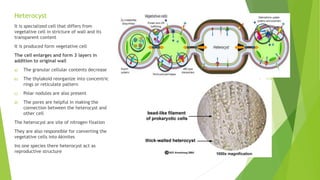
Heterocyst
It is specialized cell that differs from
vegetative cell in stricture of wall and its
transparent content
It is produced form vegetative cell
The cell enlarges and form 3 layers in
addition to original wall
a) The granular cellular contents decrease
b) The thylakoid reorganize into concentric
rings or reticulate pattern
c) Polar nodules are also present
d) The pores are helpful in making the
connection between the heterocyst and
other cell
The heterocyst are site of nitrogen fixation
They are also responsible for converting the
vegetative cells into Akinites
Ins one species there heterocyst act as
reproductive structure
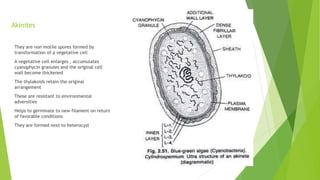
Akinites
They are non motile spores formed by
transformation of a vegetative cell
A vegetative cell enlarges , accumulates
cyanophycin granules and the original cell
wall become thickened
The thylakoids retain the original
arrangement
These are resistant to environmental
adversities
Helps to germinate to new filament on return
of favorable conditions
They are formed next to heterocyst
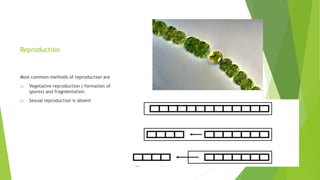
Reproduction
Most common methods of reproduction are
a) Vegetative reproduction ( formation of
spores) and fragmentation
b) Sexual reproduction is absent
Fragmentation or formation of
hormogonia
• It is a type of vegetative reproduction
• In this process the chain of cells break
into multicellular fragments
• It is due to death of cell of one or more
cell in trichomes
• The breaking takes place at heterocyst
point
• The hormogonia are motile and capable
of forming new trichomes
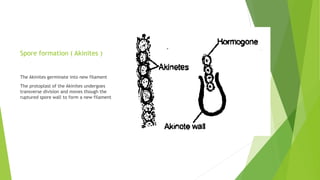
Spore formation ( Akinites )
The Akinites germinate into new filament
The protoplast of the Akinites undergoes
transverse division and moves though the
ruptured spore wall to form a new filament
Endospore formation
In some species Anabaena cicadae ,
The heterocyst contents divide to form small
spores called endospores, these give rose to
new filament upon germination
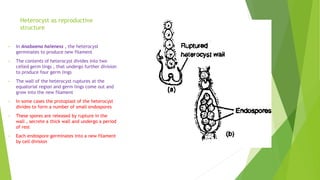
Heterocyst as reproductive
structure
• In Anabaena haleness , the heterocyst
germinates to produce new filament
• The contents of heterocyst divides into two
celled germ lings , that undergo further division
to produce four germ lings
• The wall of the heterocyst ruptures at the
equatorial region and germ lings come out and
grow into the new filament
• In some cases the protoplast of the heterocyst
divides to form a number of small endospores
• These spores are released by rupture in the
wall , secrete a thick wall and undergo a period
of rest
• Each endospore germinates into a new filament
by cell division
Economic importance
• Nitrogen fixation
• Increase in fertility of soil and crop yield
• Symbiotic association
• Reclamation of saline soil
• Water blooms
• Death to animal
Nitrogen fixation
Anabaena actively participates in nitrogen
fixation, therefore increases the fertility of
the soil
Increase in fertility of soil and
crop yield
Anabaena spp are grown in rice fields to
increase the fertility of the soil and promotes
yield of rice crops
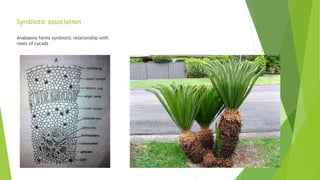
Symbiotic association
Anabaena forms symbiotic relationship with
roots of cycads
Reclamation of saline soil
Anabaena is grown in saline soils where they
form thick mass on the soil surface and help
in reducing the pH of the soil and increases
the water holding capacity of the soil
Water blooms
Anabaena forms water blooms in storage
water and impart unpleasant smell as a result
of water becomes unfit for the humans
consumption due to presence of suspended
organic matter in it
Death to animal
Anabaena spp produce toxins causing deaths
of animals like horses , cattle , sheep etc.

Anabaena

  • 1.
  • 2.
    Taxonomic position  Kingdom: Bacteria  Phylum : Cyanobacteria  Class : Cyanophyceae  Order : Nostocales  Family : Nostocaceae  Genus : Anabaena
  • 3.
    Occurrence • It isa filamentous blue green algae • They are both planktonic , or make the coatings on aquatic organisms • Few species are entophytic and grows in cavities between the leaves of water fern Azola and roots of Cycads • Widespread body in fresh and salt water • It also produces water blooms • They have heterocyst and Akinites in their bodies
  • 4.
    Plant body The thallusis unbranched filament Cells are joined end to end Filaments are formed as cell grows in one direction Single row in a colony is called trichome There may be one or more trichomes These trichomes are modified into Akinites and heterocyst Movement has been reported by terminal trichomes
  • 5.
    Cell structure The cellis prokaryotic The plastids and other membranous structures including nucleus, central vacuole, mitochondria and Golgi apparatus are absent
  • 6.
    Cell wall The protoplastis surrounded by cell wall made up of amino acids peptides
  • 7.
    Chromoplasm 1. It containsflattened sacs, thylakoids, in which photosynthetic pigments are located 2. These thylakoids are not segregated from cytoplasm by a membrane 3. The photosynthetic pigments are : Phycobilins ( phyccocyanine and phycorythrin ) chlorophyll a and carotenoids 4. Phycobilins are present on the outer surface of thylakoids 5. Small spherical granules rich in carbohydrates are distributed in cytoplasm 6. These are called cyanophycin starch 7. The reserved food is stored in proteinaceous bodies called cyanophycin granules
  • 8.
    Central body It isnuclear in nature Nucleolus is absent But a definite membrane is present so it is nucleus The nuclear material is often dispersed in the form of network
  • 9.
    Pseudovacoules There are gasvacuoles also called pseudovacoules These are gas filled cavities that provide buoyancy and helps alga to float on the surface of water They also reduced the intensity of light reaching to thylakoids
  • 10.
    Heterocyst It is specializedcell that differs from vegetative cell in stricture of wall and its transparent content It is produced form vegetative cell The cell enlarges and form 3 layers in addition to original wall a) The granular cellular contents decrease b) The thylakoid reorganize into concentric rings or reticulate pattern c) Polar nodules are also present d) The pores are helpful in making the connection between the heterocyst and other cell The heterocyst are site of nitrogen fixation They are also responsible for converting the vegetative cells into Akinites Ins one species there heterocyst act as reproductive structure
  • 11.
    Akinites They are nonmotile spores formed by transformation of a vegetative cell A vegetative cell enlarges , accumulates cyanophycin granules and the original cell wall become thickened The thylakoids retain the original arrangement These are resistant to environmental adversities Helps to germinate to new filament on return of favorable conditions They are formed next to heterocyst
  • 12.
    Reproduction Most common methodsof reproduction are a) Vegetative reproduction ( formation of spores) and fragmentation b) Sexual reproduction is absent
  • 13.
    Fragmentation or formationof hormogonia • It is a type of vegetative reproduction • In this process the chain of cells break into multicellular fragments • It is due to death of cell of one or more cell in trichomes • The breaking takes place at heterocyst point • The hormogonia are motile and capable of forming new trichomes
  • 14.
    Spore formation (Akinites ) The Akinites germinate into new filament The protoplast of the Akinites undergoes transverse division and moves though the ruptured spore wall to form a new filament
  • 15.
    Endospore formation In somespecies Anabaena cicadae , The heterocyst contents divide to form small spores called endospores, these give rose to new filament upon germination
  • 16.
    Heterocyst as reproductive structure •In Anabaena haleness , the heterocyst germinates to produce new filament • The contents of heterocyst divides into two celled germ lings , that undergo further division to produce four germ lings • The wall of the heterocyst ruptures at the equatorial region and germ lings come out and grow into the new filament • In some cases the protoplast of the heterocyst divides to form a number of small endospores • These spores are released by rupture in the wall , secrete a thick wall and undergo a period of rest • Each endospore germinates into a new filament by cell division
  • 17.
    Economic importance • Nitrogenfixation • Increase in fertility of soil and crop yield • Symbiotic association • Reclamation of saline soil • Water blooms • Death to animal
  • 18.
    Nitrogen fixation Anabaena activelyparticipates in nitrogen fixation, therefore increases the fertility of the soil
  • 19.
    Increase in fertilityof soil and crop yield Anabaena spp are grown in rice fields to increase the fertility of the soil and promotes yield of rice crops
  • 20.
    Symbiotic association Anabaena formssymbiotic relationship with roots of cycads
  • 21.
    Reclamation of salinesoil Anabaena is grown in saline soils where they form thick mass on the soil surface and help in reducing the pH of the soil and increases the water holding capacity of the soil
  • 22.
    Water blooms Anabaena formswater blooms in storage water and impart unpleasant smell as a result of water becomes unfit for the humans consumption due to presence of suspended organic matter in it
  • 23.
    Death to animal Anabaenaspp produce toxins causing deaths of animals like horses , cattle , sheep etc.