BASIDIOMYCETES
Dr Aditee Pandya
 The Basidiomycetes comprise the highest group
of fungi which are often noticed conspicuously
occurring in fields and forest areas. Most of them
possess highly deve­
loped fructifications, known
as basidiocarps which may be fleshy or woody.
 The fungi commonly known as mushrooms,
toadstools, puff-balls, and bracket fungi are the
Basidiomycetes. To this group also belong the
rusts and smuts, responsible for diseases of
plants of economic importance. There are both
parasitic and saprophytic fungi in this group.
 The fungi of this group are characterized by the
production of spores known as basidiospores
resulting from karyogamy and meiosis, and are
borne externally on slender protuberances, the
sterigmata (sing, sterigma). The sterigmata are
developed from a more or less club-like
structure, called a basidium (pl. basidia) for
which the Basidiomycetes have been frequently
named as club fungi.
Mycelium of Basidiomycetes:
 The well developed, filamentous mycelium
consists of a mass of branched, septate hyphae
generally spreading in a fan-shaped manner. The
cell wall is chitinous in nature. Within the cell
wall is the plasma membrane.
 The cytoplast contains a complement of usual cell
organelles except the chloroplasts. The septum, as
in the Ascomycetes, originates as an annular
outgrowth on the inside of the tubular wall.
 The first stage is represented by the primary
mycelium or homokaryon which is formed by
the germination of a basidiospore. The latter,
finding conditions of temperature, food supply
and moisture congenial for growth, germinates
to form a hypha consisting of uninucleate cells.
 Most of the Basidiomycetes are heterothallic. It
means the primary or homokaryotic mycelium
in them is of two distinct strains which are
called + and – strain.
 The first step in the formation of the secondary
mycelium involves the interaction between two
compatible primary mycelia.
 Two compatible hyphae (+ and – strain) from
the neighbouring mycelia meet.
 The intervening walls between the two adjacent
cells at the point of contact dissolve. The
protoplasts of the uninucleate cells intermingle
in the fusion cell (plasmogamy). The two nuclei
in the fusion cell do not fuse.
 They lie side by side constituting a dikaryon.
One of these is of + strain and the other of –
strain. The binucleate cell thus established is
known as the dikaryotised cell. Both the
uninucleate and binucleate cells may be found in
the same mycelium.
 Clamp Connections :
 When the dikaryotic cell is ready to divide a pouch-like
outgrowth arises from its wall , it arises midway between the
two nuclei of the dikaryon. The two closely associated nuclei of
the cell now divide simultaneously. This is called conjugate
division.
 One of the four daughter nuclei, generally the lower one of the
upper pair, passes into the pouch . A septum appears at the base
of the pouch . As a result the pouch is cut off from the main cell.
It may now be called a clamp cell.
 The clamp cell grows into hook like structure. Its tip bends over
and finally fuses with the lateral wall of the parent cell. The
clamp cell now forms a bridge. It is called the clamp connection.
 Another septum is laid down vertically under the bridge usually at about
the level of the upper end of the clamp connection . It divides the parent
cell into two daughter cells. The terminal daughter cell has two nuclei.
 Each of these is a sister nucleus of the parent dikaryon. The lower or basal
daughter cell possesses one nucleus. The fourth nucleus lies in the clamp
connection. The nucleus of the clamp connection now migrates into the
basal daughter cell. The latter also becomes binucleate .
 The clamp connection thus simply functions as a bypass. It ensures that
the sister nuclei formed by the conjugate division of the dikaryon
separate into two newly formed daughter cells. The clamp connections
are usually formed on the terminal cells of the hyphae of the secondary
mycelium.
 They generally persist on the old dikaryotic hyphae. The presence of hook
like clamp connections is a safe criterion for distinguishing a secondary or
dikaryotic mycelium from the primary or monokaryotic mycelium.
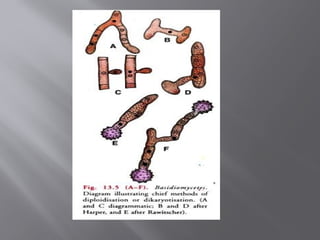
 Diploidisation or Dikaryotisatton
 The process by which the primary mycelium is
converted into secondary or dikaryotic
tnycelium is called diploidisation or
dikaryotisation. The first step in diploidisation is
the establishment of a dikaryon in the fusion cell.
 The dikaryotised ceil through repeated divisions
by clamp connections gives rise to a secondary
mycelium in which ‘ each cell possesses a
dikaryon (two neclei).
 Reproduction in Basidiomycetes:
 Asexual Reproduction
 It takes place by the following methods:
 (i) By Conidia :
 The production of conidia is not of so common occurrence
in the Basidiomycetes. They are produced in the rusts,
smuts and some other Basidiomycetes. In the smuts, they
are budded off from the basidiospores and the mycelium.
 The uredospores of rusts are also of conidial nature and
function. The conidia in the Basidiomycetes are produced
by the dikaryotic mycelium . They serve to propagate the
dikaryophase in the life cycle.
 (ii) By Oidia
 These are small, hyaline thin-walled unicellular sections or
fragments of the mycelium. They may be uninucleate or binucleate
accordingly as they are produced by the breaking up of the primary
or secondary mycelium.
 They usually do not round up or secrete thick walls to become
spore-like. They germinate by means of germ tubes. The latter grow
into new mycelia. In some species the oidia are segmented from
special, short lateral hyphal branches called the oidiophores .
 They are segmented from the tip of the oidiophore in succession
towards the base (basigenous succession). The oidia serve a double
function. They may either germinate to form primary mycelia or
bring about diploidisation.
 In the latter case the germinating oidium acts as a spermatium and
fuses with the hyphal cell of an opposite strain.
 (iii) Budding and fragmentation:
 constitute the unimportant vegetative means of
asexual reproduction in Basi-diomycetes.
 In the higher Basidiomycetes (class
Homobasidiomycetidae) the secondary mycelium
develops fruiting bodies called basidiocarps. The
basidiocarps are usually massive aerial sporophores
which bear basidia.
 They are of various sizes, types, textures and forms. In
texture they may be thin, crust-like, gelatinous, papery,
thick and fleshy, leathery, corky, woody and spongy.
 In size they range from small microscopic objects to
macroscopic bodies 3 feet or more in diameter. In form
they may be umbrella-shaped, fan-shaped, round and
the like.
 The portion of the secondary mycelium which forms
the fructifications (basidiocarps) is, sometimes, called
the tertiary or generative mycelium. It is dikaryotic.
Basidia:
 The basidia which are characteristic reproductive
structures of this class are of two types in general, the
holobasidia and the phragmobasidia. The former are
aseptate and thus unicellular and the latter are septate
structures.
 The holobasidia are characteristic of most of the
Basidiomycetes particularly the gilled or fleshy fungi.
They are developed in a palisade- like layer on the
basidiocarp. This fertile layer is called the hymenium.
 Interspersed among the basidia are the sterile hyphae
known as the paraphysis. The hymenial layer may be
exposed from the beginning or exposed towards maturity
or remains closed throughout.
Formation of Basidiospores:
 The club-shaped holobasidium pushes out four slender projections
at its top {d). These are the sterigmata. The tip of each sterigma
swells to form a sac-like swelling, the basidiospore initial.
 Into each basidiospore initial migrates a haploid nucleus from the
basidium. During its passage through the narrow neck of the
basidiospore initial the haploid nucleus in the mushrooms is said
to assume vermiform shape .
 It again becomes spherical in the spore. Subsequently each
basidiospore initial is separated from its respective sterigma by a
wall.
 The protoplast of the spore secretes a new wall around it within
and in initimate contact with the original wall of the basidiospore
initial. The basidiospore wall thus appears two-layered.
 The outer layer which represents the parent wall
of the spore initial is known as perispore. The
inner layer is called the epispore. It is the tine
spore wall secreted by the spore protoplast.
Usually the perispore and epispore are fused.
 Typically the basidia are four spored structures.
The basidiospores are borne externally. Each
basidiospore has a small lateral outgrowth near
the juncture with the sterigma. It is called the
hilum. Of the four basidiospores two are of plus
strain and two of minus strain
(c) Discharge of Basidiospores
 The basidiospores which are exposed on hymenium are
usually perched in an oblique manner (asymmetrically) on
the tips of sterigmata. As a rule they are discharged forcibly
and in quick succession by the “water drop mechanism”.
 As the basidiospore matures, the turgid basidium forces out
of the sterigma tip a liquid which begins to collect in the
form of a droplet at the base of the basidiospore.
 The droplet gradually grows bigger till it attains a certain
size and suddenly pushes off the basidiospore forcibly into
the air to a short distance . The surface tension is said to
provide the necessary force.
 The long distance dispersal is, however, dependent on air
currents. The basidiospore carries the water drop with it.
Germination of Basidiospores
 On falling on a suitable substratum the
basidiospore germinates. It puts out a germ
tube . The latter develops into a primary
mycelium.
 In a few species the basidiospores bud off into
secondary basidiospores or conidia.
Sexual Reproduction
 The development of sex organs, antheridia and ascogonia, is
universally absent throughout the class. Majority of the species are
heterothallic. Morphologically the mycelia are alike but they are
different in their sexual behaviour.
 This rudimentary difference in sex, shown at the time of sexual
fusion, is designated by plus and minus signs. These signs are called
the sexual strains. Either of these mycelia, if cultured artificially,
remains sterile.
 They form no fructifications. Fructifications are formed only if two
mycelia of opposite strains come into contact. The sexual process is
thus extremely simplified.
 It consists of three fundamental processes characteristic of sexual
reproduction, namely, sexual fusion or plasmogamy, karyogamy and
meiosis.
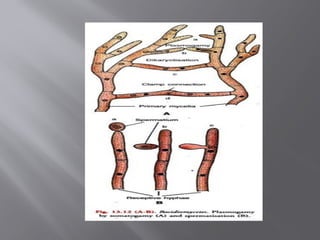
. Plasmogamy
 It means the union of two protoplasts whereby the sexual
nuclei of opposite strains come close together in a pair
within the same cell. In Basidiomycetes plasmogamy is
accomplished either by somatogamy
 (a) Somatogamy :
 Two somatic hyphae of the primary mycelia of opposite
strains come in contact (b). The walls between the adjacent
cells at the point of contact dissolve (c).
 The two nuclei come to lie side by side in the fusion cell
which thus becomes binucleate (c). This sexual union or
plasmogamy by fusion of somatic cells is called
somatogamy.
(b) Spermatisation
 It is another method whereby plasmogamy occurs.
Plasmogamy by spermatisation exclusively takes place in
the rusts. The rusts produce numerous, tiny, uninucleate,
non-motile, spore-like bodies called the spermatia.
 They are formed in flask- shaped organs, the
spermagonia developed on the upper surface of the leaf
of the second host. The spermatia are carried by the
various agencies.
 Generally, they are carried by the insects to the special
receptive hyphae of opposite strain produced in another
spermagonium. The spermatia adhere to these hyphae at
the tips (a) or laterally (b).
 At the point of contact the wall dissolve and a pore
is formed . The contents of the spermatium, which
function as a male gamete, migrate through the pore
into the receptive hypha and make it binucleate.
 The receptive hypha thus functions as a female
organ. Plasmogamy by the union of a spermatium
with a receptive hypha is known as spermatisation.
 Some mycologists use this term in a wider sense to
refer to the contact of detached non-motile cells such
as spermatia, microconidia, conidia and oidia with
trichogyne or a receptive hypha.
Karyogamy:
 The terminal binucleate or dikaryotic cells of
the hyphae of the secondary mycelium develop
into basidia (Fig. 13.8). The two nuclei in the
dikaryotic cell fuse. This fusion of the two
nuclei is called karyogamy (Fig. 13.8 b).
 The resultant diploid fusion nucleus is called a
synkaryon. The young basidium containing the
synkaryon is called the probasidium. It
represents the transitory diplophase.
3. Meiosis:
 The synkaryon in the probasidium soon
undergoes two nuclear divisions.
 These divisions constitute meiosis. Meiosis
restores the haploid condition in the life cycle.
 Karyogamy and meiosis take place in the
basidium at different stages of development.
The basidium is thus homologous to the ascus
of Ascomycetes.
Basidiomycetes.pptx                                    m

Basidiomycetes.pptx m

  • 1.
  • 2.
     The Basidiomycetescomprise the highest group of fungi which are often noticed conspicuously occurring in fields and forest areas. Most of them possess highly deve­ loped fructifications, known as basidiocarps which may be fleshy or woody.  The fungi commonly known as mushrooms, toadstools, puff-balls, and bracket fungi are the Basidiomycetes. To this group also belong the rusts and smuts, responsible for diseases of plants of economic importance. There are both parasitic and saprophytic fungi in this group.
  • 3.
     The fungiof this group are characterized by the production of spores known as basidiospores resulting from karyogamy and meiosis, and are borne externally on slender protuberances, the sterigmata (sing, sterigma). The sterigmata are developed from a more or less club-like structure, called a basidium (pl. basidia) for which the Basidiomycetes have been frequently named as club fungi.
  • 4.
    Mycelium of Basidiomycetes: The well developed, filamentous mycelium consists of a mass of branched, septate hyphae generally spreading in a fan-shaped manner. The cell wall is chitinous in nature. Within the cell wall is the plasma membrane.  The cytoplast contains a complement of usual cell organelles except the chloroplasts. The septum, as in the Ascomycetes, originates as an annular outgrowth on the inside of the tubular wall.
  • 5.
     The firststage is represented by the primary mycelium or homokaryon which is formed by the germination of a basidiospore. The latter, finding conditions of temperature, food supply and moisture congenial for growth, germinates to form a hypha consisting of uninucleate cells.
  • 8.
     Most ofthe Basidiomycetes are heterothallic. It means the primary or homokaryotic mycelium in them is of two distinct strains which are called + and – strain.  The first step in the formation of the secondary mycelium involves the interaction between two compatible primary mycelia.  Two compatible hyphae (+ and – strain) from the neighbouring mycelia meet.
  • 9.
     The interveningwalls between the two adjacent cells at the point of contact dissolve. The protoplasts of the uninucleate cells intermingle in the fusion cell (plasmogamy). The two nuclei in the fusion cell do not fuse.  They lie side by side constituting a dikaryon. One of these is of + strain and the other of – strain. The binucleate cell thus established is known as the dikaryotised cell. Both the uninucleate and binucleate cells may be found in the same mycelium.
  • 10.
     Clamp Connections:  When the dikaryotic cell is ready to divide a pouch-like outgrowth arises from its wall , it arises midway between the two nuclei of the dikaryon. The two closely associated nuclei of the cell now divide simultaneously. This is called conjugate division.  One of the four daughter nuclei, generally the lower one of the upper pair, passes into the pouch . A septum appears at the base of the pouch . As a result the pouch is cut off from the main cell. It may now be called a clamp cell.  The clamp cell grows into hook like structure. Its tip bends over and finally fuses with the lateral wall of the parent cell. The clamp cell now forms a bridge. It is called the clamp connection.
  • 11.
     Another septumis laid down vertically under the bridge usually at about the level of the upper end of the clamp connection . It divides the parent cell into two daughter cells. The terminal daughter cell has two nuclei.  Each of these is a sister nucleus of the parent dikaryon. The lower or basal daughter cell possesses one nucleus. The fourth nucleus lies in the clamp connection. The nucleus of the clamp connection now migrates into the basal daughter cell. The latter also becomes binucleate .  The clamp connection thus simply functions as a bypass. It ensures that the sister nuclei formed by the conjugate division of the dikaryon separate into two newly formed daughter cells. The clamp connections are usually formed on the terminal cells of the hyphae of the secondary mycelium.  They generally persist on the old dikaryotic hyphae. The presence of hook like clamp connections is a safe criterion for distinguishing a secondary or dikaryotic mycelium from the primary or monokaryotic mycelium.
  • 13.
     Diploidisation orDikaryotisatton  The process by which the primary mycelium is converted into secondary or dikaryotic tnycelium is called diploidisation or dikaryotisation. The first step in diploidisation is the establishment of a dikaryon in the fusion cell.  The dikaryotised ceil through repeated divisions by clamp connections gives rise to a secondary mycelium in which ‘ each cell possesses a dikaryon (two neclei).
  • 15.
     Reproduction inBasidiomycetes:  Asexual Reproduction  It takes place by the following methods:  (i) By Conidia :  The production of conidia is not of so common occurrence in the Basidiomycetes. They are produced in the rusts, smuts and some other Basidiomycetes. In the smuts, they are budded off from the basidiospores and the mycelium.  The uredospores of rusts are also of conidial nature and function. The conidia in the Basidiomycetes are produced by the dikaryotic mycelium . They serve to propagate the dikaryophase in the life cycle.
  • 16.
     (ii) ByOidia  These are small, hyaline thin-walled unicellular sections or fragments of the mycelium. They may be uninucleate or binucleate accordingly as they are produced by the breaking up of the primary or secondary mycelium.  They usually do not round up or secrete thick walls to become spore-like. They germinate by means of germ tubes. The latter grow into new mycelia. In some species the oidia are segmented from special, short lateral hyphal branches called the oidiophores .  They are segmented from the tip of the oidiophore in succession towards the base (basigenous succession). The oidia serve a double function. They may either germinate to form primary mycelia or bring about diploidisation.  In the latter case the germinating oidium acts as a spermatium and fuses with the hyphal cell of an opposite strain.
  • 17.
     (iii) Buddingand fragmentation:  constitute the unimportant vegetative means of asexual reproduction in Basi-diomycetes.
  • 18.
     In thehigher Basidiomycetes (class Homobasidiomycetidae) the secondary mycelium develops fruiting bodies called basidiocarps. The basidiocarps are usually massive aerial sporophores which bear basidia.  They are of various sizes, types, textures and forms. In texture they may be thin, crust-like, gelatinous, papery, thick and fleshy, leathery, corky, woody and spongy.  In size they range from small microscopic objects to macroscopic bodies 3 feet or more in diameter. In form they may be umbrella-shaped, fan-shaped, round and the like.  The portion of the secondary mycelium which forms the fructifications (basidiocarps) is, sometimes, called the tertiary or generative mycelium. It is dikaryotic.
  • 19.
    Basidia:  The basidiawhich are characteristic reproductive structures of this class are of two types in general, the holobasidia and the phragmobasidia. The former are aseptate and thus unicellular and the latter are septate structures.  The holobasidia are characteristic of most of the Basidiomycetes particularly the gilled or fleshy fungi. They are developed in a palisade- like layer on the basidiocarp. This fertile layer is called the hymenium.  Interspersed among the basidia are the sterile hyphae known as the paraphysis. The hymenial layer may be exposed from the beginning or exposed towards maturity or remains closed throughout.
  • 21.
    Formation of Basidiospores: The club-shaped holobasidium pushes out four slender projections at its top {d). These are the sterigmata. The tip of each sterigma swells to form a sac-like swelling, the basidiospore initial.  Into each basidiospore initial migrates a haploid nucleus from the basidium. During its passage through the narrow neck of the basidiospore initial the haploid nucleus in the mushrooms is said to assume vermiform shape .  It again becomes spherical in the spore. Subsequently each basidiospore initial is separated from its respective sterigma by a wall.  The protoplast of the spore secretes a new wall around it within and in initimate contact with the original wall of the basidiospore initial. The basidiospore wall thus appears two-layered.
  • 22.
     The outerlayer which represents the parent wall of the spore initial is known as perispore. The inner layer is called the epispore. It is the tine spore wall secreted by the spore protoplast. Usually the perispore and epispore are fused.  Typically the basidia are four spored structures. The basidiospores are borne externally. Each basidiospore has a small lateral outgrowth near the juncture with the sterigma. It is called the hilum. Of the four basidiospores two are of plus strain and two of minus strain
  • 23.
    (c) Discharge ofBasidiospores  The basidiospores which are exposed on hymenium are usually perched in an oblique manner (asymmetrically) on the tips of sterigmata. As a rule they are discharged forcibly and in quick succession by the “water drop mechanism”.  As the basidiospore matures, the turgid basidium forces out of the sterigma tip a liquid which begins to collect in the form of a droplet at the base of the basidiospore.  The droplet gradually grows bigger till it attains a certain size and suddenly pushes off the basidiospore forcibly into the air to a short distance . The surface tension is said to provide the necessary force.  The long distance dispersal is, however, dependent on air currents. The basidiospore carries the water drop with it.
  • 24.
    Germination of Basidiospores On falling on a suitable substratum the basidiospore germinates. It puts out a germ tube . The latter develops into a primary mycelium.  In a few species the basidiospores bud off into secondary basidiospores or conidia.
  • 25.
    Sexual Reproduction  Thedevelopment of sex organs, antheridia and ascogonia, is universally absent throughout the class. Majority of the species are heterothallic. Morphologically the mycelia are alike but they are different in their sexual behaviour.  This rudimentary difference in sex, shown at the time of sexual fusion, is designated by plus and minus signs. These signs are called the sexual strains. Either of these mycelia, if cultured artificially, remains sterile.  They form no fructifications. Fructifications are formed only if two mycelia of opposite strains come into contact. The sexual process is thus extremely simplified.  It consists of three fundamental processes characteristic of sexual reproduction, namely, sexual fusion or plasmogamy, karyogamy and meiosis.
  • 27.
    . Plasmogamy  Itmeans the union of two protoplasts whereby the sexual nuclei of opposite strains come close together in a pair within the same cell. In Basidiomycetes plasmogamy is accomplished either by somatogamy  (a) Somatogamy :  Two somatic hyphae of the primary mycelia of opposite strains come in contact (b). The walls between the adjacent cells at the point of contact dissolve (c).  The two nuclei come to lie side by side in the fusion cell which thus becomes binucleate (c). This sexual union or plasmogamy by fusion of somatic cells is called somatogamy.
  • 28.
    (b) Spermatisation  Itis another method whereby plasmogamy occurs. Plasmogamy by spermatisation exclusively takes place in the rusts. The rusts produce numerous, tiny, uninucleate, non-motile, spore-like bodies called the spermatia.  They are formed in flask- shaped organs, the spermagonia developed on the upper surface of the leaf of the second host. The spermatia are carried by the various agencies.  Generally, they are carried by the insects to the special receptive hyphae of opposite strain produced in another spermagonium. The spermatia adhere to these hyphae at the tips (a) or laterally (b).
  • 29.
     At thepoint of contact the wall dissolve and a pore is formed . The contents of the spermatium, which function as a male gamete, migrate through the pore into the receptive hypha and make it binucleate.  The receptive hypha thus functions as a female organ. Plasmogamy by the union of a spermatium with a receptive hypha is known as spermatisation.  Some mycologists use this term in a wider sense to refer to the contact of detached non-motile cells such as spermatia, microconidia, conidia and oidia with trichogyne or a receptive hypha.
  • 30.
    Karyogamy:  The terminalbinucleate or dikaryotic cells of the hyphae of the secondary mycelium develop into basidia (Fig. 13.8). The two nuclei in the dikaryotic cell fuse. This fusion of the two nuclei is called karyogamy (Fig. 13.8 b).  The resultant diploid fusion nucleus is called a synkaryon. The young basidium containing the synkaryon is called the probasidium. It represents the transitory diplophase.
  • 31.
    3. Meiosis:  Thesynkaryon in the probasidium soon undergoes two nuclear divisions.  These divisions constitute meiosis. Meiosis restores the haploid condition in the life cycle.  Karyogamy and meiosis take place in the basidium at different stages of development. The basidium is thus homologous to the ascus of Ascomycetes.